The best active noise cancellation headphones aren't the ones with the biggest decibel claim. They're the ones that make a plane's engine vanish without making your music feel like it's playing inside a sealed jar.
I'm Marque Hersh, founder of Supermarket Sound, and I've never trusted a leaderboard that treats silence like a single number. ANC has become a serious mass-market category, with one forecast valuing the global noise-cancelling headphones market at USD 16,079 million in 2024 and projecting USD 41,933 million by 2032, while another forecasts the broader active noise cancellation headphones market at USD 20.38 billion in 2025 and USD 44.76 billion by 2031. Those projections matter because buyers now have real choice, not because a larger market figure tells you which pair belongs on your head. The market forecast data describes scale. Your ears still decide quality.
Table of Contents
- Stop Measuring Silence. Start Listening to It
- How Active Noise Cancellation Actually Behaves
- What Matters When You Judge ANC
- The 2026 ANC Headphones Worth Your Money
- Matching the Headphones to the Job
- The Hidden Cost of Owning ANC
- The Verdict and the Questions Nobody Else Answers
Stop Measuring Silence. Start Listening to It
Raw attenuation and good cancellation aren't the same thing. A pair can suppress a low engine drone impressively, then leave voices, brake squeal, keyboard clatter, and air-conditioning hiss floating around the edges. Another can create a calmer, more natural hush with less of the pressure sensation that makes some ANC headphones feel like they're squeezing the room around your skull.
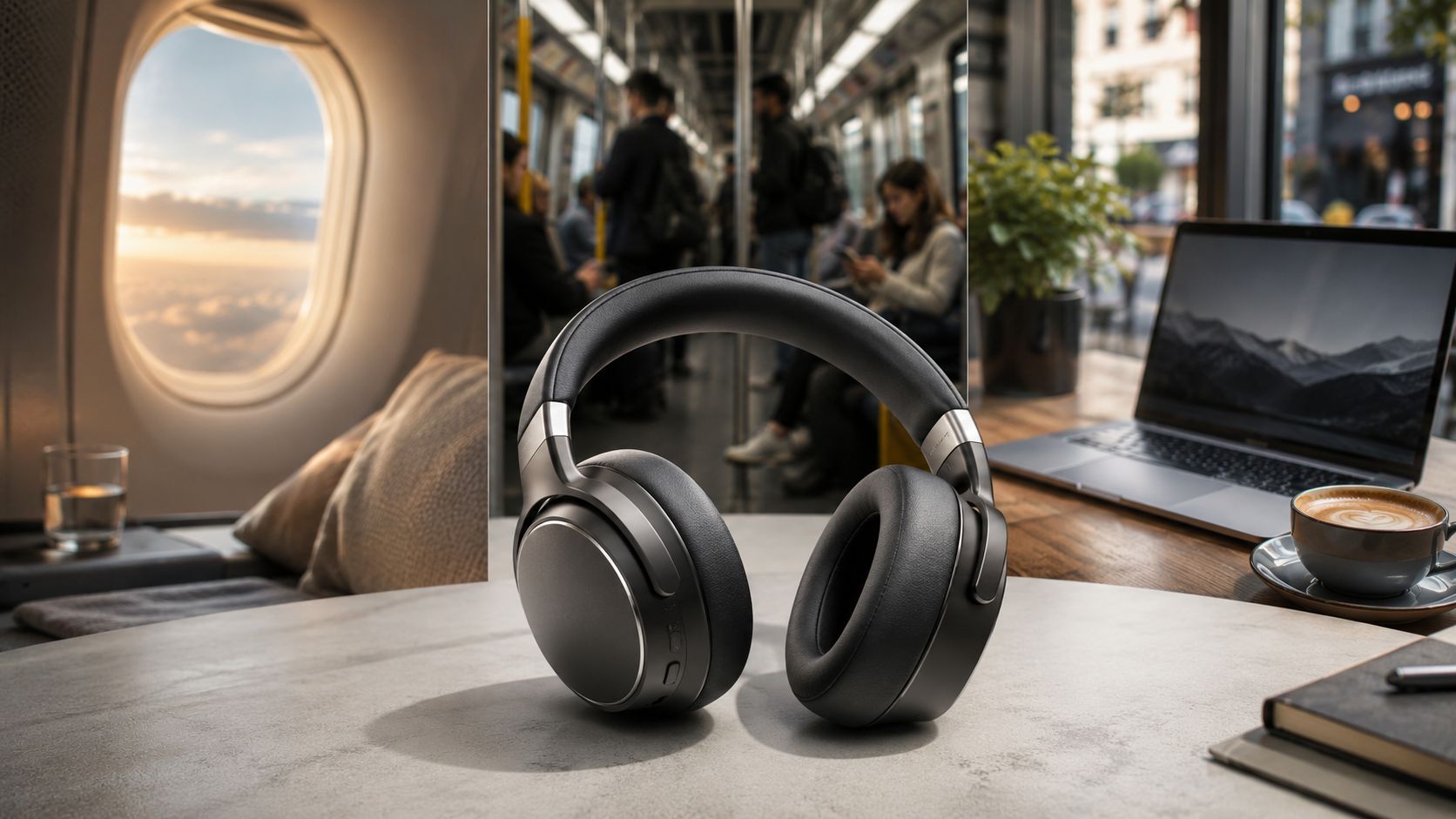
That difference becomes obvious in actual places. On a 737 at cruising altitude, the winning headphone lowers the deep mechanical rumble until your music can occupy the foreground at a sensible level. On a rush-hour train, the problem changes. The rolling noise may disappear, but a nearby conversation can still arrive as a ghostly midrange shape. Under a window AC unit, the best pair turns the steady mechanical note into background texture rather than leaving you with a thin electronic hiss.
The useful question: Does the headphone remove distraction, or does it merely replace one kind of noise with another?
ANC works through destructive interference, but the listener experiences the result as a texture. Some headphones produce a soft shelf of quiet. Others create a pressure-y hush, especially when the cancellation pushes hard against low-frequency sound. A few make the room feel quieter while starving the music of body, particularly in the bass and lower midrange.
That's why the best ANC isn't automatically the most aggressive ANC. The cancellation has to sit underneath the music, not lean on it. A kick drum should still feel round. A cello shouldn't lose its wooden bloom. Voices should retain their chest instead of arriving as clean but weightless outlines.
The technology itself has a long history. Paul Lueg patented a theoretical sound-cancellation system in 1936, Bose applied noise-cancellation technology to pilot headsets in 1986, and Bose launched the first QuietComfort consumer ANC headphones in 2000. Later checkpoints in 2003, 2006, 2009, 2013, and 2014 marked steady gains in fit, electronics, and noise reduction, as documented in the history of noise-cancelling headphones.
ANC didn't arrive as one miracle. It accumulated.
How Active Noise Cancellation Actually Behaves
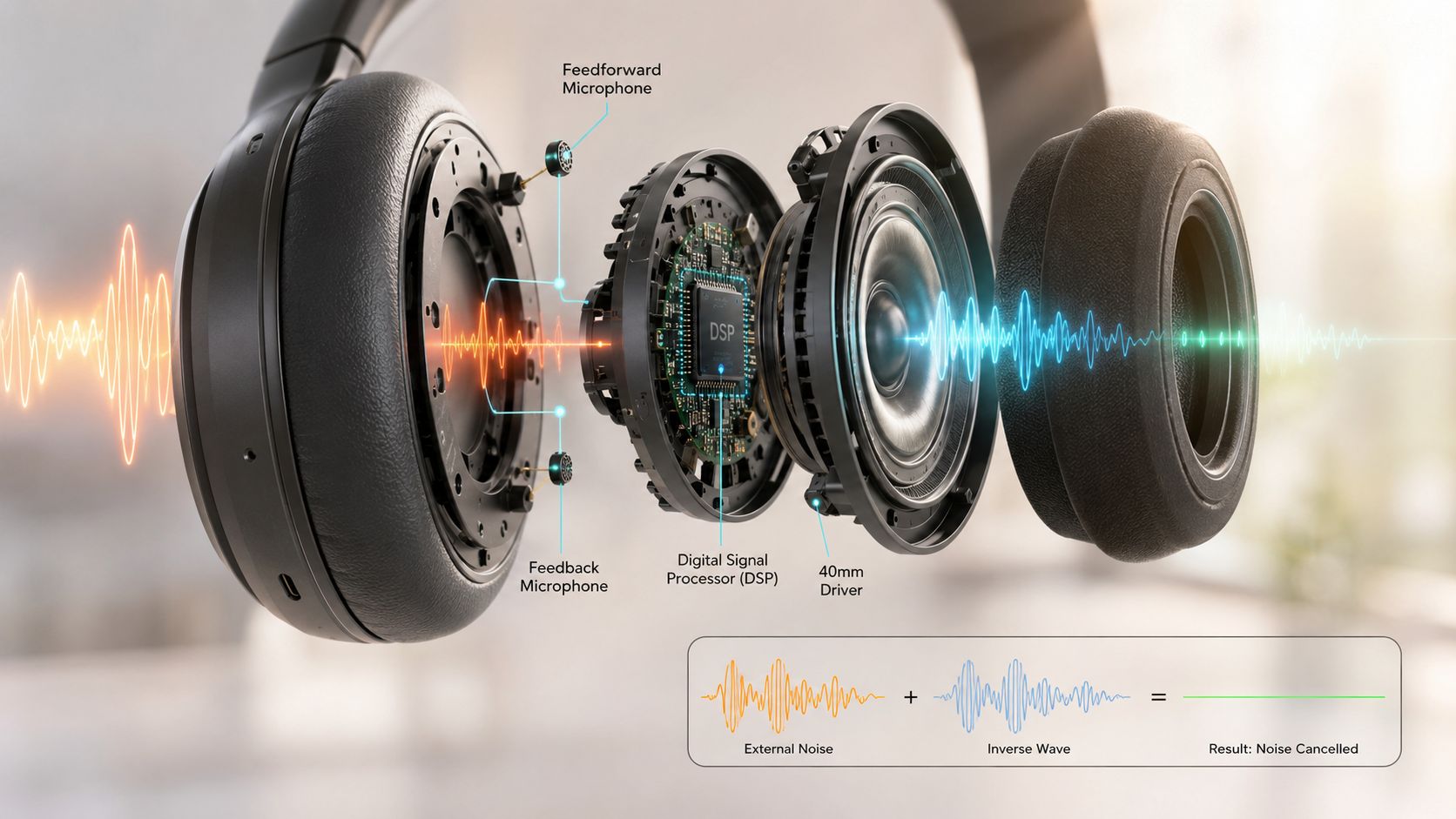
Active noise cancellation starts with microphones. They listen to the sound around the earcup, a digital signal processor analyzes that incoming noise, and the headphone drivers produce a counter-signal with the opposite phase. The original sound and the counter-signal meet, interfere destructively, and reduce what reaches your ear.
That explanation sounds tidy because the basic idea is tidy. The result depends on timing, microphone placement, seal quality, processing, and the character of the noise itself.
The sound decides what gets cancelled
Steady, repetitive low-frequency noise gives the processor a predictable target. Plane engines, train movement, HVAC systems, and bus rumble tend to occupy that category, which is why ANC feels most impressive during travel or beneath constant office machinery. This plain-language explanation of ANC covers the microphone, inverse-signal, and destructive-interference process without pretending the headphones erase every sound.
Speech behaves differently. Human voices change quickly, contain substantial midrange energy, and arrive from shifting positions. The headphones can reduce parts of a conversation, but they usually won't make a colleague disappear. Sudden claps, dropped objects, dishes, and sharp high-frequency noises challenge the processor even more.
A snug fit matters because leaks give outside sound another path to the ear. If the earcups don't seal properly, the cancellation system can't rescue the design. Glasses, hair, shallow pads, and an awkward headband position can all turn impressive hardware into a compromised listening experience, as this explanation of ANC behavior across frequencies makes clear.
Microphone architecture changes the feel
Feed-forward systems use microphones outside the earcup to detect incoming sound before it reaches the ear. That arrangement can respond early, but wind and environmental interference can confuse the outside microphone. Feedback systems place microphones inside the cup, where they monitor what reaches the ear, which can improve low-frequency control but leaves less time to react to abrupt events.
Hybrid systems combine both approaches. That tends to produce the most consistent experience because the headphone gets an outside view of the environment and an inside check on the result. Adaptive processing then adjusts cancellation as the environment changes, rather than applying one fixed response everywhere.
You'll still hear the limits. ANC reduces noise. It doesn't delete reality.
For a useful companion explanation of how earcup design affects isolation before electronics even begin, see open-back versus closed-back headphones. Passive fit remains load-bearing.
What Matters When You Judge ANC
Judge ANC headphones by the conditions where you will wear them, not by the order manufacturers use on a specification sheet. Silence comes first, but fit, sound, calls, battery behavior, and long-term reliability decide whether that silence remains useful after an hour, a flight, or a year.
Start with real-world attenuation across different frequency ranges. Low-frequency engine noise shows whether the system can control a plane or train's steady rumble. Midrange chatter reveals how much office conversation still reaches your attention. High-frequency hiss tests both the seal and the limits of the processing. A strong result in one range does not guarantee a calm listening experience everywhere.
Comfort comes next. A headphone that sounds superb but presses against your jaw or traps heat around your ears becomes expensive furniture. Travel and work expose poor ergonomics quickly, especially when the earcups, pads, or headband create pressure that a short store demo hides.
Sound quality needs separate checks with ANC on and off. Some headphones keep their tonal balance stable. Others shift the bass, flatten the stage, or push vocals backward when cancellation engages. That behavior matters more than a laboratory trophy because the feature will be active through most flights, commutes, and office sessions.
Call quality deserves its own test. Traffic, wind, and public spaces expose microphone processing that a quiet-room demo hides. Multipoint reliability matters for the same reason. A headphone that drops the laptop connection when your phone rings has failed at the job, whatever its driver specification says.
Battery life belongs in the practical column, especially with ANC always on. One source reports that enabling noise cancellation draws at least a third more energy than playback without ANC, using an example where 6 hours per charge without ANC falls to 4 hours with ANC. The battery trade-off is explained here. Treat runtime as a lived condition, not a box number. In 2026, that also means asking how long the battery, replacement pads, firmware support, and multipoint behavior will remain dependable.
ANC Headphone Judging Criteria at a Glance
| Criterion | What It Means in Practice |
|---|---|
| Real-world attenuation | How well the headphone handles low rumble, midrange voices, and high-frequency hiss |
| Comfort | Whether you can wear it through a workday or long flight without pressure, heat, or fatigue |
| Sound with ANC on and off | Whether the tonal balance and musical weight survive the processing |
| Call quality | How clearly your voice reaches others in wind, traffic, and shared spaces |
| Battery with ANC on | Whether the claimed runtime survives the mode you'll use |
| Long-term ownership | Firmware stability, replacement pads, battery service, and dependable multipoint behavior |
Separate recommendations by use instead of pretending one flagship suits every head and commute. A travel specialist, an office workhorse, a budget pair, a studio-leaning over-ear model, and an in-ear commuter option solve different problems.
The table is a filter, not a throne.
The 2026 ANC Headphones Worth Your Money
The flagship choice is the Sony WH-1000XM6. Independent lab coverage from RTINGS calls it the best noise-cancelling headphone it has tested, with outstanding isolation against both low airplane rumble and high-pitched air-conditioning whine. Its measured battery life runs over 31 hours, which gives it the rare combination of deep cancellation and practical endurance. The lab-backed case for the WH-1000XM6 appears in this headphone coverage.
To my ears, the XM6's strength is composure. The low end doesn't merely become quieter. It steps backward, leaving the music with room to breathe. On a plane, the cabin drone loses its physical insistence. On a train, the rumble recedes while the headphone preserves enough musical density that you don't need to turn the volume into a weapon.
Its sound has more authority than clinical politeness. Bass carries weight, vocals stay present, and dense arrangements don't collapse into a grey strip when ANC engages. It's the safest default for someone who wants maximum isolation without accepting a battery-life penalty that undermines travel.
2026 ANC Headphones Compared
| Headphone | Price Tier | Best For | Silence Quality | Comfort | Sound Signature | Battery (ANC On) |
|---|---|---|---|---|---|---|
| Sony WH-1000XM6 | Flagship | Flights, trains, open offices | Deep and broad, including low rumble and AC whine | Strong for long sessions | Full, controlled, slightly warm | Over 31 hours measured |
| Bose QuietComfort Ultra | Flagship | Focus work and travel comfort | Strong low-frequency hush | Especially easy to wear for long stretches | Spacious and smooth | Check current manufacturer claim |
| Apple AirPods Max 2 | Flagship specialist | Maximum measured over-ear suppression | About 89.4% perceived loudness reduction | Heavier presentation | Spacious, polished, weighty | 21 hours measured in ANC use |
| Premium mid-tier over-ear | Mid-tier | Offices and cafés | Consistent everyday reduction | Usually lighter than flagships | Balanced and accessible | Varies by model |
| Budget ANC over-ear | Budget | First ANC purchase | Impressive on steady rumble, less complete on voices | Depends heavily on pad design | Often bass-forward | Varies by model |
| Premium ANC earbuds | Mid-tier to flagship | Commuters who dislike headbands | Strong seal-dependent isolation | Small and portable | Direct, intimate, often energetic | Varies by model |
The Bose QuietComfort Ultra is my alternative for focus work. It doesn't win because it makes every noise disappear. It wins because the wearing experience stays relaxed over long sessions, with a spacious presentation that avoids the cramped sensation some aggressive ANC designs create. If your primary problem is fatigue rather than maximum engine suppression, this is the calmer tool.
The Apple AirPods Max 2 is the specialist pick for pure measured suppression. SoundGuys and related lab-summarizing coverage place it at about 89.4% perceived loudness reduction, while coverage reports a 385.6 g weight and a measured 21-hour battery figure in ANC use. The measured comparison and trade-offs are covered here. That combination tells the story. It can silence aggressively, but the mass and endurance make it harder to recommend as the universal choice.
For the mid-tier slot, choose a well-tuned over-ear model with dependable multipoint, comfortable pads, and an honest ANC mode rather than a dramatic one. Office use rewards stable voices and tolerable pressure more than it rewards the deepest possible bass cancellation. The best value lives in balance.
Budget buyers should avoid models that sound anaemic with ANC disabled. A cheap pair can produce a convincing hush under steady mechanical noise, then reveal thin vocals and brittle treble the moment you listen critically. Spend less, but don't accept a headphone that makes every record feel underfed. I keep a broader set of value recommendations in the guide to headphones under 300 dollars.
For studio-leaning listeners, pick the over-ear model whose passive tuning works when the electronics are off. ANC should be an extra layer, not the only reason the headphone has a pulse. Commuters who hate headbands should choose premium ANC earbuds, provided the seal fits their ears. In-ear cancellation can feel more immediate, but the result depends heavily on tip fit and the shape of your ear canal.
Skip anything that creates fatigue within an hour. A specification can't wear the headphone for you.
Matching the Headphones to the Job
A daily subway commuter should choose the Sony WH-1000XM6 if isolation leads the brief, with a lighter mid-tier over-ear model as the honest alternative. Subway noise contains plenty of low mechanical energy, but the midrange chatter and platform announcements still matter. The XM6 handles the foundation while keeping music substantial enough for a long ride.
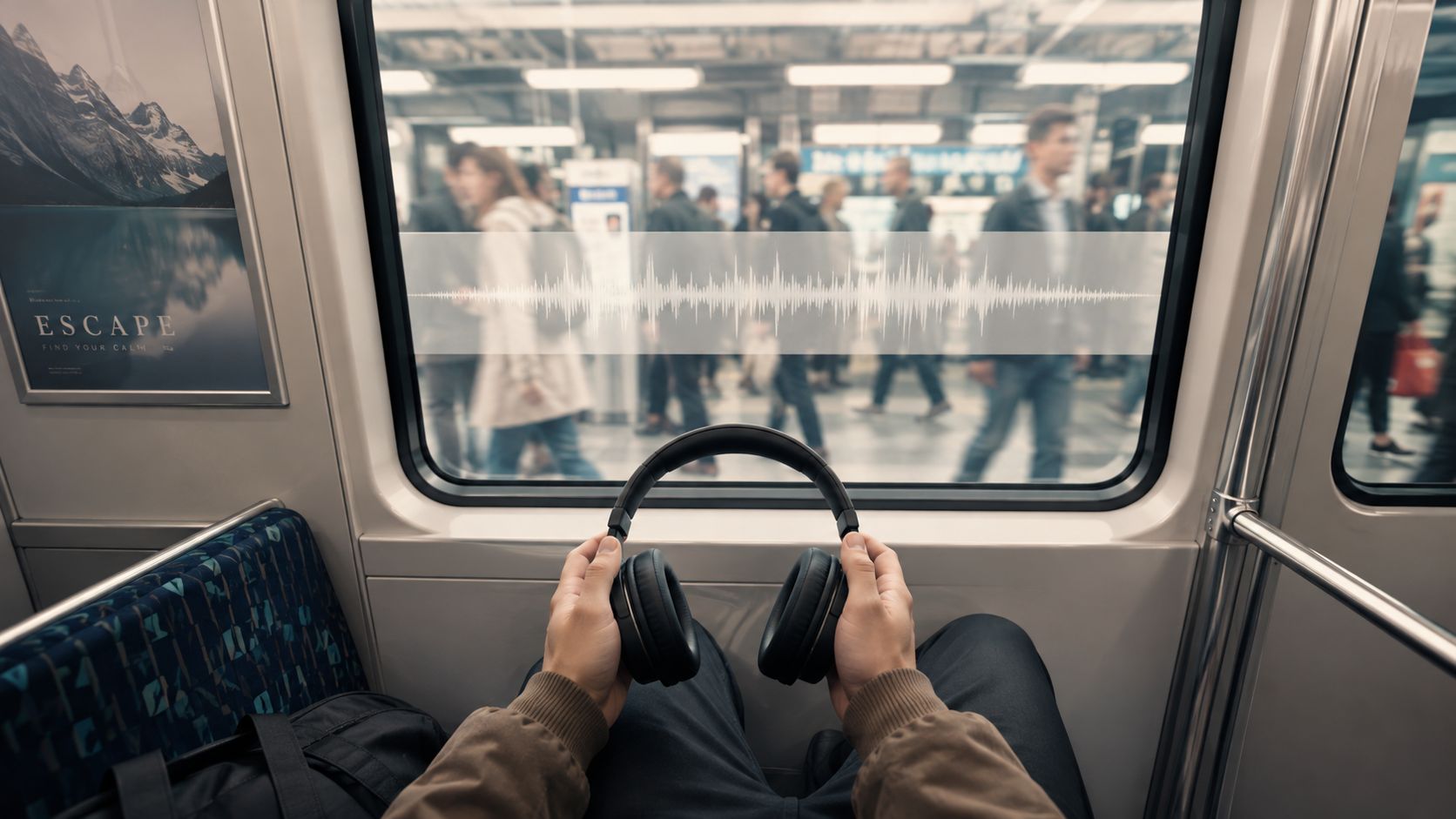
Long-haul flyers should also take the XM6, unless comfort pressure decides the vote. Its deep low-frequency reduction and over 31 hours of measured battery life make it the travel default, while the QuietComfort Ultra offers the better alternative for listeners who notice head pressure or clamp before they notice the final layer of engine rumble.
Open-office workers should choose the Bose QuietComfort Ultra when all-day comfort and a relaxed sound matter most. A balanced mid-tier workhorse makes more sense for frequent calls or tighter budgets. A flagship with weak microphone behavior loses to a cheaper model that lets colleagues hear every word clearly.
For deep-focus work, comfort becomes the floor. The headphone needs to disappear physically while it disappears sonically. I'd take the QuietComfort Ultra for long concentration sessions, with the XM6 as the alternative when outside noise is extremely severe.
The wrong headphone in the right scenario is still the wrong headphone.
Casual home listeners should prioritize sound quality with ANC switched off, then treat cancellation as a useful bonus. The studio-leaning over-ear option makes more sense here than a travel-first flagship, particularly if your room is already quiet. For guitar-heavy records, dense mixes, and forward drums, use this guide to headphones for rock music as a useful listening framework rather than chasing a cancellation leaderboard.
The in-ear route suits commuters who dislike headbands, people who need pocketable gear, and listeners who want a direct seal around the ear canal. The trade-off is less forgiveness. A poor fit starves the bass and weakens the cancellation.
Use the headphones where they earn their keep.
The Hidden Cost of Owning ANC
Most 2026 buying guides stop at the first purchase. They discuss isolation, comfort, sound, and battery life, then send you toward checkout as if the headphone will remain frozen in its launch condition. That misses the expensive part.
ANC headphones live hard lives. Travel exposes them to bags, pressure, sweat, temperature changes, and constant handling. Daily commuting wears the pads. Frequent charging ages the battery. After 18 to 24 months, the ownership question changes from “How quiet is it?” to “What can I replace without replacing everything?”
The parts determine the lifespan
Ear pads should count as consumable components. They compress, split, collect oils, and lose their seal. Once that happens, passive isolation suffers and ANC has less stable acoustic material to work with. A headphone with accessible replacement pads can keep its sound and fit intact. A sealed design turns ordinary wear into a reason to buy another product.
Battery service matters even more. ANC depends on active electronics, so a dead battery doesn't merely remove a convenience feature. It can turn the entire product into a poor passive headphone, especially when the tuning assumes digital processing.
Firmware creates another ownership variable. Updates can improve connection behavior and adaptive cancellation, but they can also change the way a headphone sounds or manages its modes. Keep your settings, app support, and multipoint behavior in mind before treating launch-day performance as permanent.
Repairability should influence the purchase
The category still gives buyers uneven information about parts programs, battery service, and long-term support. Independent 2026 coverage frequently crowns the Sony WH-1000XM6 or Bose QuietComfort Ultra for immediate performance, but that leaves the more important ownership question underdeveloped. This coverage of the long-term ANC gap captures the problem: peak cancellation today doesn't tell you whether the headphone will remain a sensible object after its pads wear and battery fades.
I favor products with replaceable pads, clear service routes, stable apps, and hardware that doesn't feel disposable. I'm less interested in a tiny launch advantage if the downstream ownership experience forces a full replacement.
Ask the retailer or manufacturer about pads and battery service before buying. If the answer is vague, assume the cost will land on you later.
Quiet shouldn't become e-waste.
The Verdict and the Questions Nobody Else Answers
For travel, buy the Sony WH-1000XM6. For focus work, choose the Bose QuietComfort Ultra. For the daily commute, take the XM6 over-ear or a properly fitting premium ANC earbud if you hate headbands. For casual home listening, choose the best-sounding over-ear model with ANC as a secondary feature. For budget buyers, buy the most comfortable well-tuned pair you can find, not the one shouting the largest cancellation figure.
Can ANC damage hearing?
ANC itself doesn't damage hearing because it cancels environmental sound. The danger comes from excessive playback volume, especially when users raise music to overpower sounds that the headphone hasn't cancelled. Use the quiet as an opportunity to listen lower, not as permission to turn the music up.
How long does a pair last?
The electronics, pads, battery, hinge, and software age at different rates. Daily use exposes weak parts sooner, and battery service becomes more important after sustained charging over the ownership period. Buy for repair and replacement options, not just launch performance.
Do over-ear headphones cancel better than earbuds?
Over-ear headphones usually provide a larger, more stable platform for passive isolation and microphones, but a well-fitting earbud can outperform a badly fitting over-ear model for a particular listener. Fit decides more than category loyalty.
Is transparency mode more important than ANC?
For many people, yes. Transparency determines whether you can hear an announcement, speak to a colleague, cross a street, or order coffee without removing the headphones. The best ANC headphone manages both silence and awareness gracefully.
The right pair doesn't erase the world. It puts the world in its place.
If you're buying today, choose the Sony WH-1000XM6 for travel and serious commuting, the Bose QuietComfort Ultra for long focus sessions, or a well-fitting ANC earbud when portability matters more than headband comfort. Before you order, check replacement-pad availability, battery service, microphone behavior, and how the headphone sounds with ANC switched off. Then put on a record you know by heart and buy the pair that leaves the music standing.

