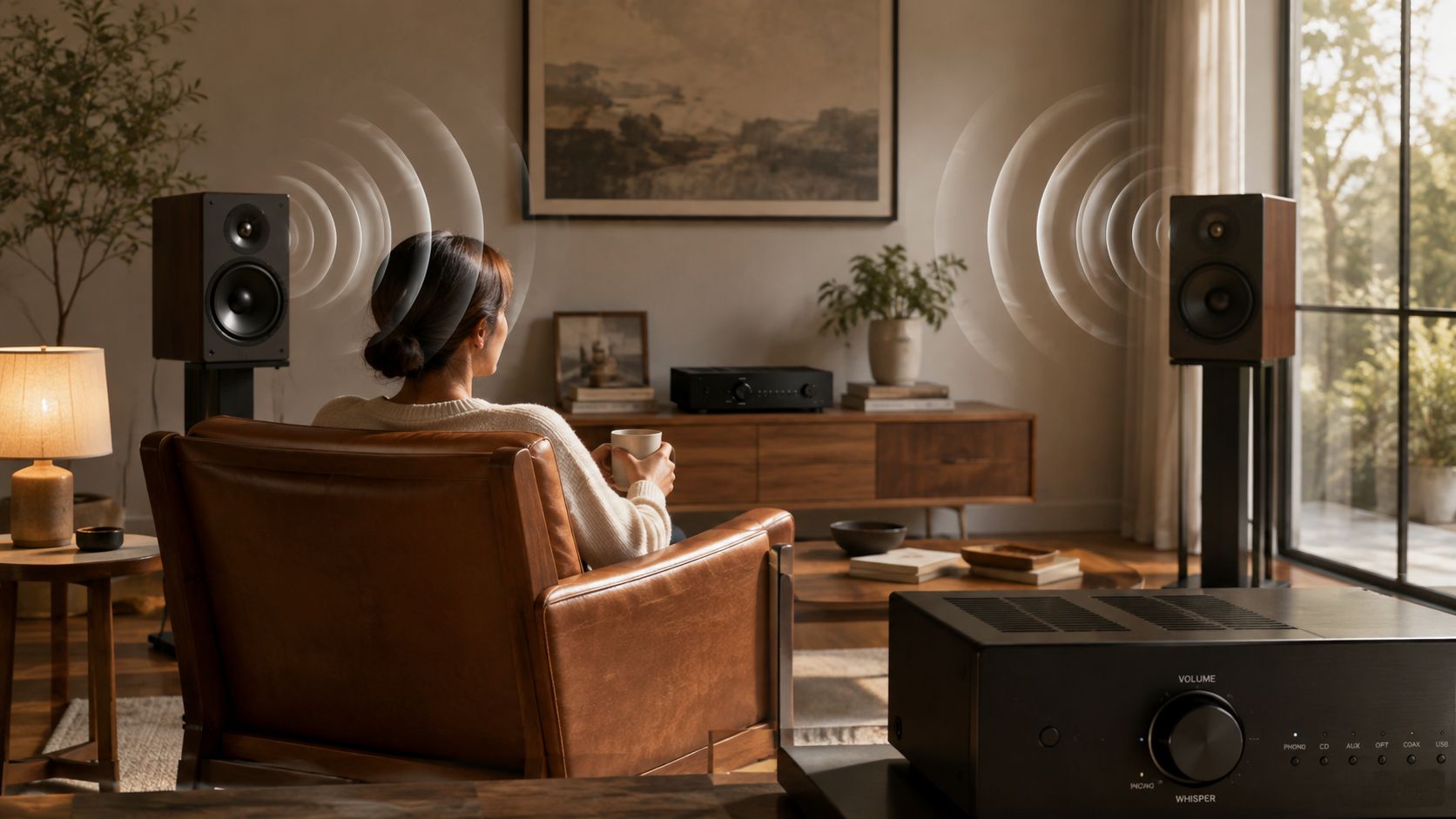
Sensitivity is usually the wrong number to chase if you want speakers that sound good at low volume. A speaker can produce plenty of level and still turn thin, papery, and strangely mid-forward when the room gets quiet. At eleven o'clock, the problem isn't usually a lack of horsepower. It's that the ear, speaker, amplifier, cabinet, and room stop agreeing with one another.
I'm Marque Hersh, founder of Supermarket Sound. I care about specs because they tell me where a design might fail, not because a specification can tell me how a vocal sits in the room after midnight. The useful question isn't “How loud can this speaker get?” It's “What survives when the volume knob barely moves?”
Table of Contents
- Why Low-Volume Listening Breaks Most Speakers
- The Ear Is the First Component in the Chain
- Sensitivity, Amplifier Power, and the Chair You Actually Sit In
- Driver Design, Dispersion, and Cabinet Behavior at Whisper Levels
- Your Room Is the Hidden Loudspeaker
- Speaker Archetypes That Hold Up When the Volume Drops
- Choosing What to Buy and How to Set It Up
Why Low-Volume Listening Breaks Most Speakers
Chasing a higher sensitivity rating is the wrong frame for quiet listening. Most domestic speakers can already reach conversational levels at a chair across an ordinary room. What collapses first is tonal shape, not maximum output.
A speaker may advertise an impressive sensitivity figure and still sound lifeless at modest playback. The driver may need a certain amount of movement before its bass feels substantial. The port may behave less convincingly at low drive. Electrical damping, cabinet resonances, crossover behavior, and distortion can all change the character of the sound before the amplifier comes close to running out of power.
That's why a speaker rated at 90 dB at 1 watt and 1 meter can still sound anaemic at the listening seat. The number describes a test condition. It doesn't describe whether the bass retains weight, whether the vocal remains fleshy, or whether cymbals turn into a brittle little spray.
The number measures output, not liveliness
Sensitivity still matters. A more efficient design generally asks less from the amplifier, and a high-sensitivity speaker can preserve dynamics when the system has limited headroom. But sensitivity doesn't tell you how smoothly the speaker radiates into the room, how its impedance behaves, or how its tonal balance holds together when the signal gets small.
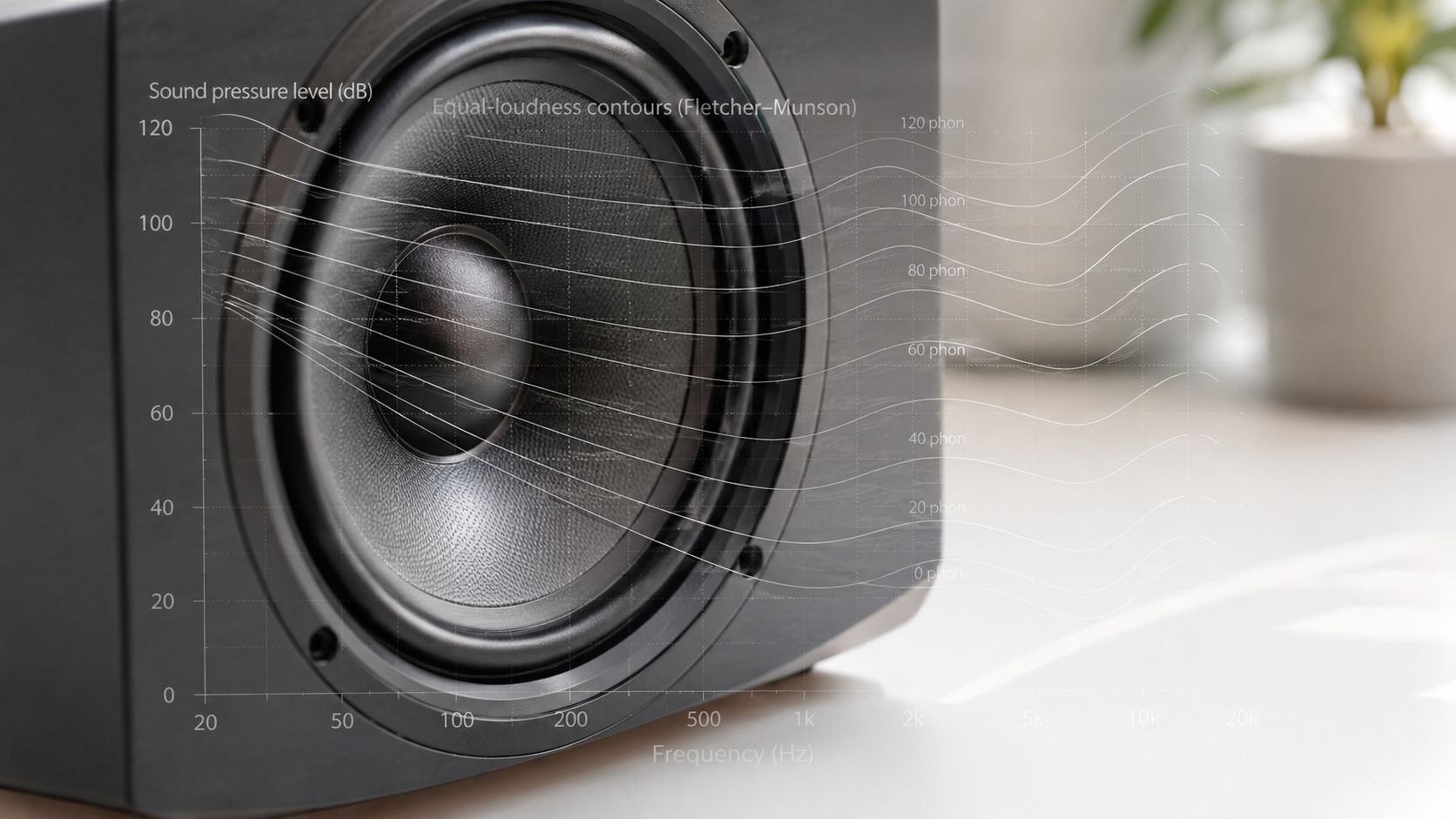
The foundational issue sits upstream in human hearing. Loudness compensation developed because the ear becomes less sensitive to low-level bass and treble. Fletcher and Munson's 1933 equal-loudness curves mapped perceived loudness across roughly 0 to 120 dB SPL, and later work by Robinson and Dadson produced a similar loudspeaker-based set of contours in 1956. Commercial radios were already using tapped volume controls by 1935 to restore bass at quieter listening levels. The old loudness knob wasn't decoration. It compensated for biology. The historical loudness-compensation reference lays out that lineage.
A speaker that feels balanced at 80 dB can collapse into papery midrange at 60 dB unless its voicing, directivity, and room interaction begin from a sensible place. Low-volume fidelity is a system problem.
The sensitivity obsession starts in the wrong room. The ear comes first.
The Ear Is the First Component in the Chain
Human hearing doesn't treat every frequency equally, and the difference becomes more obvious as playback gets quieter. Midrange information remains relatively easy to hear while bass and extreme treble lose apparent weight. The speaker hasn't necessarily stopped producing those frequencies. Your hearing has stopped giving them equal priority.
Fletcher and Munson's original 1933 work turned that behavior into equal-loudness contours. These curves map the sound pressure required at different frequencies for tones to seem equally loud. Robinson and Dadson published a similar loudspeaker-based set in 1956, while ISO 226:2003 provides the modern reference framework, with contours plotted in phons and 1 kHz used as the reference tone. The equal-loudness contour overview explains the basic mechanism, and this ISO 226 discussion places the older curves in their modern context.
At 60 phons, the ear is roughly 20 dB less sensitive at 100 Hz than at 1 kHz, so the kick drum can disappear long before the vocal loses intelligibility. MIT's perception course transcript describes the same broad perceptual imbalance, with low frequencies requiring substantially more level to sound equally loud.
What the quiet version of a song reveals
Take a familiar singer-songwriter recording. At a comfortable level, the kick has a rounded front edge, the bass guitar gives the vocal a floor, and the cymbals sit above the arrangement without taking over. Turn the dial down and the vocal remains readable because its energy lives in the midrange. The kick loses its thump, the bass becomes a suggestion, and the cymbals can feel oddly prominent even though the tweeter hasn't become louder.
That's the sound people describe as thin, but “thin” is only the symptom. The ear has changed its weighting, and the playback chain hasn't compensated.
Individual hearing varies. Noise-induced hearing loss can make a person's own contours steeper or less even, particularly at higher frequencies. A loudness circuit can help, but it can't guess every listener's hearing profile or repair poor placement.
Practical rule: Judge quiet performance with music, not pink noise alone. Voices reveal tonal collapse quickly, while bass instruments reveal whether the system still has a floor.
The loudness control is part of the design brief. Ignore the ear, and every downstream choice inherits the mistake.
Sensitivity, Amplifier Power, and the Chair You Actually Sit In
Sensitivity ratings become useful only after you move them from the brochure to the listening chair. A rating measured at 1 meter doesn't tell you what reaches a listener several meters away, and room losses can reduce the result further. The provided room guidance gives a practical example: a typical home setup can lose roughly 7 dB by the seat compared with the one-meter sensitivity figure. This sensitivity and room-size guide explains why the chair matters more than the headline.
Using that rough room allowance, the comparison looks like this:
| Sensitivity (2.83V/1m) | SPL at 2m | SPL at 3m | SPL at 4m |
|---|---|---|---|
| 86 dB | 79 dB | 79 dB | 79 dB |
| 88 dB | 81 dB | 81 dB | 81 dB |
| 90 dB | 83 dB | 83 dB | 83 dB |
| 92 dB | 85 dB | 85 dB | 85 dB |
That table is deliberately conservative and simplified. Distance loss, boundary reinforcement, room absorption, program material, and whether the measurement uses a true 2.83-volt input can all change the outcome. Treat it as a warning against reading sensitivity in isolation, not as a promise of exact chair-level SPL.
Power is less magical than amplifier brochures suggest
Doubling amplifier power gives you only a 3 dB increase. Doubling driver sensitivity gives the same 3 dB change for the same amplifier-power comparison. That difference matters more when you're trying to create headroom, but neither solves a tonal balance that collapses at low drive.
Impedance complicates the pairing. A nominal 8-ohm speaker that dips to 3.5 ohms at 80 Hz asks more from a modest amplifier exactly where the ear already undervalues bass at quiet levels. A low-wattage amplifier may not sound obviously broken. It can lose grip, making bass softer and less articulate.
Amplifier damping factor matters here too. A high output impedance can reduce bass control, especially with speakers whose impedance changes substantially through the low frequencies. For a fuller explanation of choosing an amplifier around a bookshelf speaker, see this amplifier guide for bookshelf speakers.
Start with the listening distance, estimate the loss, then inspect the speaker's impedance curve and the amplifier's ability to drive it. Specs become useful when they describe the whole chain.
Driver Design, Dispersion, and Cabinet Behavior at Whisper Levels
At low volume, dispersion becomes a tonal control, not a party trick. Direct sound gets quieter, so the balance between the speaker's forward output and the room's reflected sound carries more weight. A speaker with a smooth off-axis response tends to keep its character as you move around the room. One with uneven radiation can sound balanced in one chair and nasal or glassy two steps away.
Wide-dispersion two-way designs with gentle crossover behavior often preserve harmonic continuity at quiet levels. Their presentation can feel connected, with the vocal, guitar body, and room ambience occupying one piece of space. Multi-driver floorstanders can produce impressive scale, but some designs narrow their useful listening window and leave the midrange carrying too much of the burden when only a few watts reach the drivers.
That isn't a verdict against floorstanders. It's a demand for honest matching.
Cabinets still speak when the music whispers
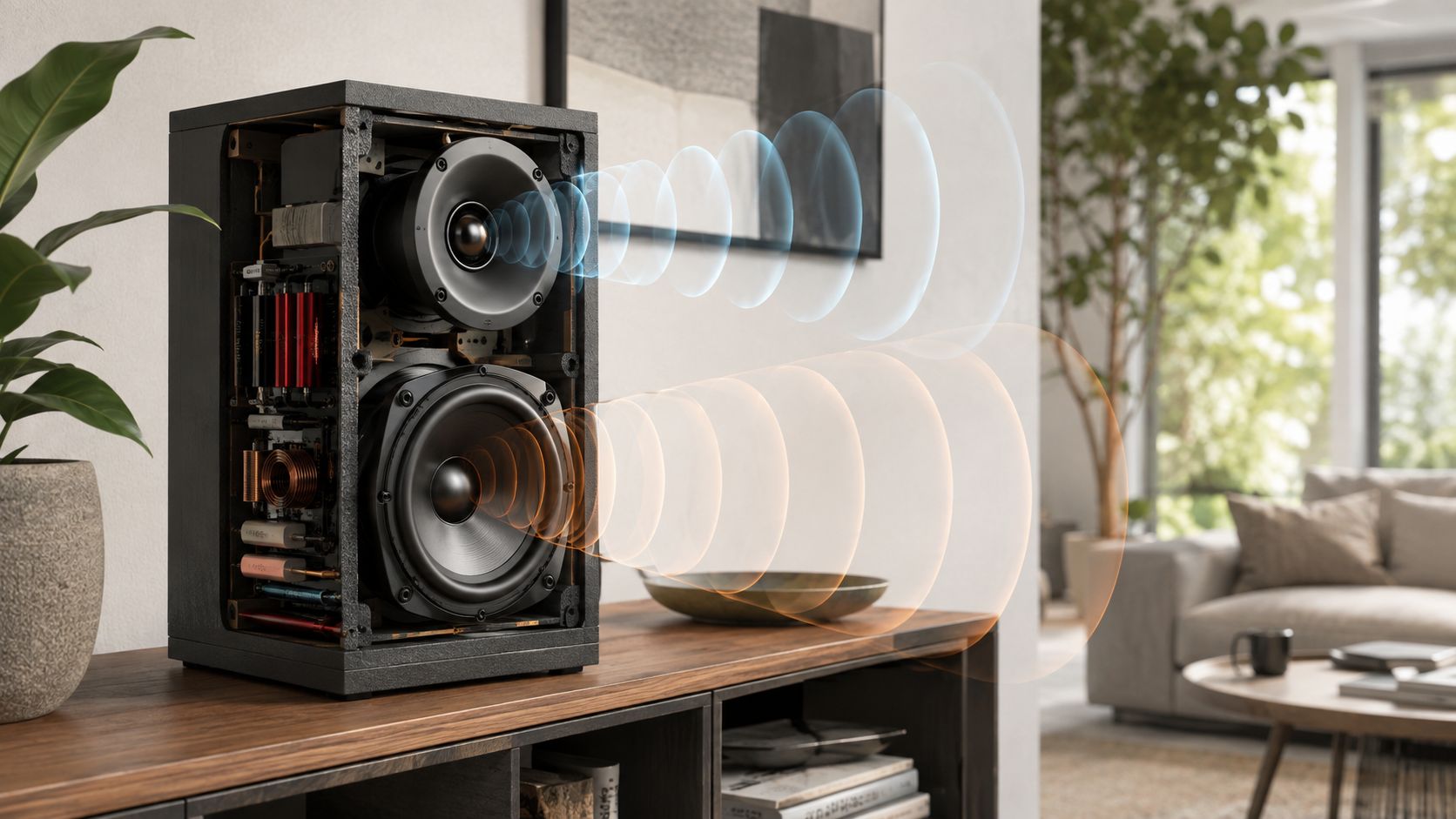
Baffle geometry and edge diffraction shape the transition from direct sound to reflected sound. Cabinet stiffness and internal bracing suppress secondary resonances that can add a faint papery glaze to quiet details. At high volume, those artifacts may hide beneath the broad energy of the music. At night, they can sit exposed around a vocal or acoustic guitar.
A plain-language guide to speaker frequency response helps separate the measured curve from the way that curve behaves in a room. The trace matters, but so does the speaker's radiation pattern around it.
Sealed and ported alignments also make different compromises. A sealed cabinet usually gives up some deep bass extension gradually, while a ported cabinet can provide more apparent low-end weight. At low SPL, port turbulence and compression can disturb micro-dynamics, particularly when the design relies heavily on the port to create its sense of bass authority. The issue isn't that every ported speaker misbehaves. It's that the port remains part of the sound, even when the volume is barely cracked.
Midnight makes design choices obvious
Put on a sparse singer-songwriter track at midnight. A controlled baffle-step transition keeps the voice anchored instead of letting the upper midrange shout. Smooth directivity keeps the room from adding a strange halo around the consonants. A quiet cabinet lets the guitar's decay fade into black rather than leaving a cardboard aftertaste.
You don't need a giant box. You need a speaker that keeps its shape.
Your Room Is the Hidden Loudspeaker
A noisy room can defeat a well-designed speaker before the driver gets a fair hearing. HVAC systems, refrigerators, traffic, computer fans, and building noise raise the noise floor, masking low-level detail and forcing you to turn up the volume just to hear the spaces between notes. The room then becomes louder, bass excites boundaries, and late-night listening loses its purpose.
At modest playback levels, room noise and reflections occupy more of the signal you perceive. This discussion of low-level speaker listening is useful because it treats the cabinet as only one part of the problem. Low-volume performance depends on psychoacoustics, tonal balance, dispersion, and the room's own noise floor, not sensitivity alone.
Placement does more than another upgrade
Start with the speakers away from the front wall, then adjust by ear for the smoothest bass rather than the deepest bass. A position that creates a cancellation can remove the notes that loudness compensation needs to restore. EQ can reduce a broad excess, but it cannot fully erase a null created by room interference.
Toe-in should follow the speaker's directivity. Controlled designs often benefit from modest toe-in, while broader-radiating speakers may sound more open with less angle. Keep the listening chair away from the back wall when the room allows it. A chair pressed against that boundary can exaggerate low-frequency pressure and blur the image.
Nearfield placement on a desk or small table often beats a grand stereo triangle in a difficult room. Shorter paths increase the proportion of direct sound, so the room contributes less coloration at the same modest playback level. That can matter more than a higher sensitivity rating.
Room rule: Move the speaker before you move the equalizer. Placement changes the cause. EQ usually treats the symptom.
Soft surfaces help without turning the room into a recording studio. A rug reduces hard floor reflections. Curtains can calm a bright window wall. A bookcase or irregular shelving breaks up a bare reflective surface. These changes reduce apparent glare and help vocals retain texture when the system plays at a low volume. For more detail on practical treatment choices, see this small-room acoustic treatment guide for near-field listening.
The room's response can preserve low-volume fidelity or undermine it. The speaker often gets blamed because it is easier to point at than the walls, boundaries, and background noise surrounding it.
Speaker Archetypes That Hold Up When the Volume Drops
Different speaker families fail in different ways. A sealed two-way monitor often sounds composed at modest levels because its bass rolls away gently and its midrange stays honest. A high-sensitivity floorstander can create an immediate sense of presence with very little amplifier effort, yet its forward voicing or strong bass alignment may become too obvious in a small room. An active DSP-corrected design can use equalization, room correction, and protection circuits to keep the response coherent without demanding large amplifier reserves.
Those are tendencies, not laws. Implementation decides whether the design earns its category.
| Archetype | Tonal Balance at Low SPL | Micro-Dynamics | Placement Forgiveness |
|---|---|---|---|
| Sealed two-way monitor | Even and controlled, with a gentle bass perspective | Natural, clean, and easy to follow | Moderate, especially on rigid stands |
| High-sensitivity floorstander | Lively, sometimes forward or bass-heavy in a small room | Immediate, though voicing can dominate | Low to moderate |
| DSP-corrected active speaker | Tunable and consistent when correction suits the room | Preserved well if processing stays transparent | Highest, provided correction and placement work together |
Match the archetype to the room
For a late-night apartment, the sealed two-way monitor usually makes the most sense when you value vocal texture over subterranean bass. It won't make the building quieter, but it can avoid adding a large, overripe low end to an already compromised environment.
A high-sensitivity floorstander suits a shared family room where listeners sit farther away and occasionally need more headroom. It still needs careful boundary placement. Efficiency doesn't grant immunity from room modes or a bright tonal balance.
In a home office, an active DSP-corrected speaker can absorb imperfect placement better than a passive design, especially when desk reflections and uneven wall distances dominate. DSP won't make poor acoustics disappear, but it can apply a controlled correction where a passive setup has fewer tools.
The quiet winner isn't the loudest box. It's the one that keeps the music proportionate.
Choosing What to Buy and How to Set It Up
Begin with the room, not the catalogue. Use a phone SPL app as a rough guide to the background level, then listen from the chair you use. The purpose isn't laboratory accuracy. It's discovering whether the room itself stays intrusive when the music drops.
Next, identify your quiet-listening target. Don't confuse the amplifier's maximum output with the level you normally enjoy. A speaker with sensible sensitivity and an easy impedance load may sound more relaxed than a nominally efficient design that asks the amplifier to negotiate ugly electrical dips.
A practical buying filter
Measure the environment. Check the room at the time you normally listen. A quiet afternoon can tell you very little about a late-night apartment or a room with active appliances.
Test from the seat. Place the speakers where they can produce a stable direct soundstage. Keep them on rigid, mass-loaded stands when they're designed for stands, and don't let a wobbly surface turn bass notes into furniture noise.
Adjust the front-wall distance. Move the speakers in small increments until the bass sounds even rather than merely large. Boundary cancellations can make a speaker seem weak, while reinforcement can make it seem impressive for the wrong reason.
Set toe-in by texture. With controlled directivity, increase toe-in until the vocal locks in, then back off if the treble becomes too concentrated. The correct angle should improve focus without making the room feel narrow.
Audition below your comfort level. Use a familiar recording and turn down to roughly 30 dB below your reference level, then check vocal weight, midrange texture, bass articulation, and the decay around instruments. This tests whether a speaker keeps its composure or exposes spec-sheet theatre.
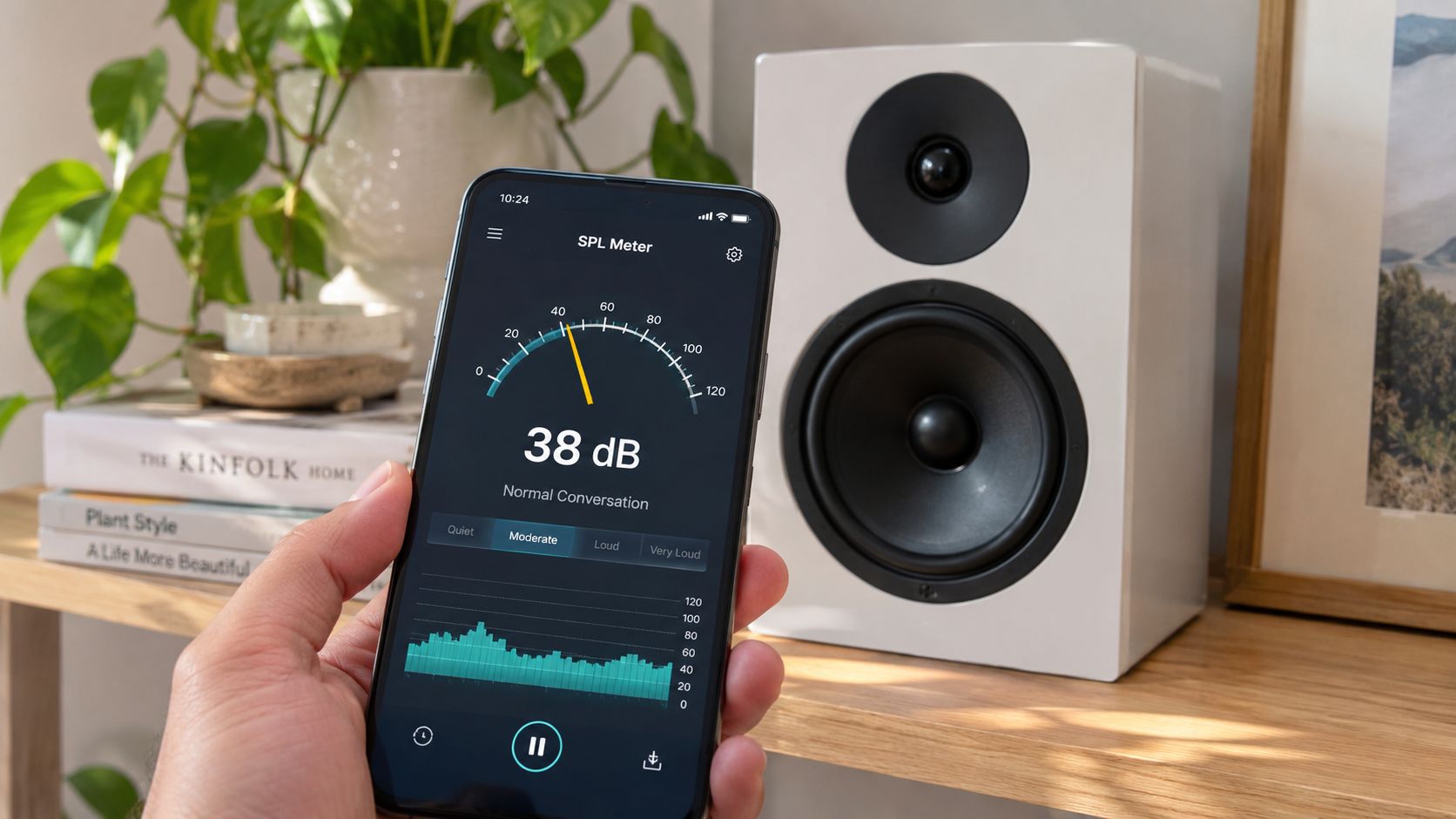
Supermarket Sound also publishes practical guidance on amplifier matching and speaker setup, but the buying decision should remain grounded in your room, your chair, and your listening hours. A flagship specification won't make a noisy room disappear.
Choose the speaker that keeps the vocal human, the bass present, and the treble civil when the neighbours are asleep. Then place it properly. Let it live with you. That's the test.
If your current speakers sound papery after dark, measure the room noise, move the speakers before changing electronics, and audition replacements at the quiet level you use. Start with tonal balance and dispersion, then confirm sensitivity and amplifier compatibility. Buy for the hour you'll live with, not the volume you'll brag about.

