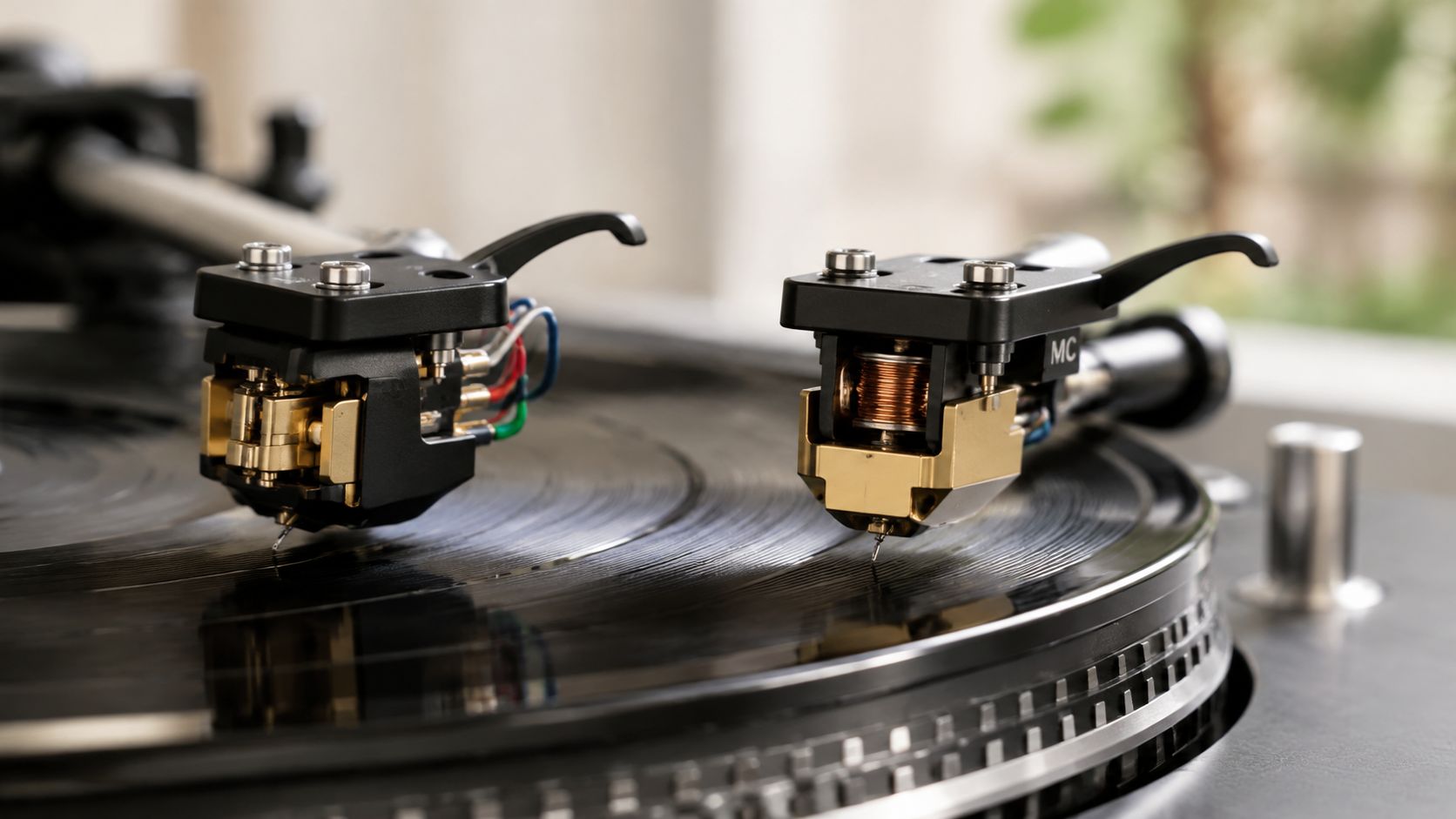
Moving coil isn't automatically better. It's often just more expensive, more demanding, and more revealing of the mistake you made before breakfast.
Moving magnet vs moving coil decision is a system-matching problem. The cartridge that wins is the one your tonearm, phono stage, loading, gain structure, and records can support properly. I've swapped cartridges at 2 AM, chased hum through cables, and heard expensive MC designs sound embarrassed beside a well-matched MM. The motor assembly didn't save them. Correct setup would have.
Forum status games make this worse. Someone runs a costly low-output MC into a cheap phono stage with no gain to spare, then blames the cartridge when the music comes out thin and grey. The downstream chain inherits every shortcut.
Table of Contents
- The Cartridge Debate Nobody Wins by Specs Alone
- How Moving Magnet and Moving Coil Work
- Output and Loading Compared Side by Side
- What Your Phono Stage Demands from Each Type
- How MM and MC Cartridges Sound on Real Records
- Which Cartridge Type Fits Your Budget and System
- Setup Mistakes That Ruin Either Cartridge Type
The Cartridge Debate Nobody Wins by Specs Alone
The advice to start with moving coil for serious sound belongs beside bent alignment protractors and “universal” cartridge recommendations. Moving magnet vs moving coil is a system-matching problem, not a specs contest. The right cartridge is the one your tonearm, phono stage, gain structure, loading, and records can support properly.
Moving coil has a real technical advantage. Its moving assembly can reduce moving mass, helping the stylus respond to fine groove changes. That benefit depends on the rest of the system. A phono stage with insufficient gain can starve the signal, while a poor tonearm relationship can compromise tracking. The cartridge cannot repair either mistake.
Moving magnet designs deserve more respect than audiophile hierarchy usually grants them. They generally provide higher output, simpler loading, replaceable stylus assemblies, and wider phono-stage compatibility. That makes MM a sensible choice for many turntables, not a consolation prize.
The expensive mistake happens downstream
A low-output MC can require a dedicated MC input, a step-up transformer, impedance adjustments, and careful gain matching. Each part can work beautifully. Each can also add noise, hum, poor loading, or another chance to make the signal miserable.
Practical rule: Buy the phono stage before the low-output cartridge, or price both as one system.
Moving magnet cartridges became practical hi-fi products after postwar advances in permanent magnets made the same mass substantially stronger. The technology matured by the mid-1960s. Samarium-cobalt rare-earth magnets were perfected in the late 1970s, followed by neodymium magnets in the 1980s. That progression reduced moving mass and narrowed much of the old performance gap with moving-iron designs, as documented in Korfaudio's cartridge history and technical explanation.
Moving coil has the deeper documented precision-audio lineage. Ortofon's first moving-coil cutting head appeared in 1945, its AB moving-coil magnetic cartridge launched in 1948, and later patent records show continued MC development, including a Japanese moving-coil pickup cartridge filed in 1971 and granted in 1972, as shown in the associated patent record.
I'm not crowning a winner. I'm telling you how to stop buying the wrong cartridge for the right reasons.
How Moving Magnet and Moving Coil Work
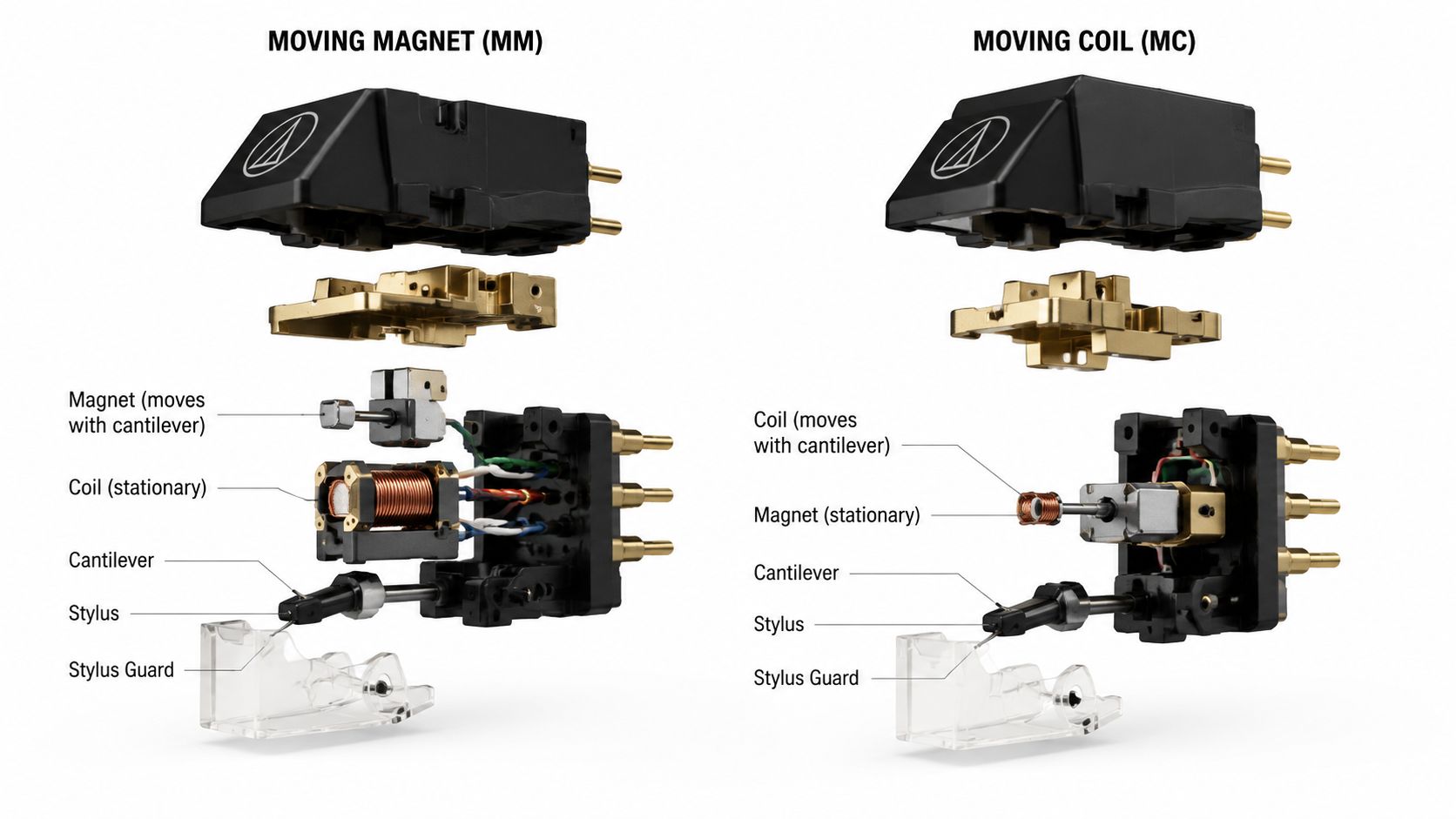
The MM versus MC choice is a mechanical decision before it becomes a sound-quality argument. Both cartridge types convert stylus movement into an electrical signal, but they move different parts inside the generator. That difference determines output, loading, and how demanding the cartridge will be on the rest of the system.
In a moving magnet cartridge, a small magnet is attached to the cantilever. The coils stay fixed inside the cartridge body. As the stylus traces the groove, the magnet moves past the stationary coils, inducing a signal. The heavier electrical components remain in the body, while the cantilever carries the magnet.
A moving coil cartridge reverses that arrangement. The coils attach to the cantilever and move within a fixed magnetic field. The magnet stays anchored in the cartridge body, while the stylus assembly carries the smaller coil structure.
The electrical tradeoff shapes the setup
MM cartridges can use more turns of wire because their coils do not move with the cantilever. That produces a stronger output. Typical MM output sits around 3–6 mV, with internal impedance around 500–2,000 ohms, a standard 47 kΩ load, and roughly 35–45 dB of gain, according to this cartridge loading guide. An MM therefore usually works with an integrated amplifier or receiver's built-in phono input.
MC cartridges use much smaller coils on the moving assembly. Typical low-output MC designs deliver about 0.2–0.6 mV, compared with roughly 3–6 mV for MM designs, as documented in Ortofon's documented cartridge history and patent material. That lower signal demands more phono-stage gain and commonly comes with lower impedance and lower compliance.
MM's higher inductance creates a different compromise. Typical MM inductance sits around 100–500 mH, while published MM examples show values around 460–720 mH, with recommended loading centered on 47 kΩ, as shown in the Shure M55 technical library entry. Cable and phono-stage capacitance interact with that inductance. A poor match can shift the phase response or reduce treble extension.
MC's lower moving mass can improve transient response and high-frequency extension in theory. You may hear cleaner leading edges, finer texture separation, and more precise groove tracking. The generator cannot rescue a badly matched system. An under-gained MC stays under-gained, regardless of its construction.
The motor matters. Your phono stage decides whether it can perform.
Output and Loading Compared Side by Side
The MM versus MC argument becomes useful only after you check the electrical match. Output voltage sets the gain burden, while impedance and inductance determine whether the cartridge and phono stage work comfortably together. Prestige does not fix a poor interface.
| Specification | Moving Magnet (MM) | Low-Output MC | High-Output MC |
|---|---|---|---|
| Output voltage | 3–6 mV | 0.2–0.6 mV | About 1.0–2.0 mV, depending on winding |
| Typical load | 47 kΩ | Low-impedance MC loading | Often MM-style loading |
| Gain requirement | 35–45 dB | Substantially more gain | Closer to MM requirements |
| Moving assembly | Magnet on cantilever | Coil on cantilever | Coil on cantilever |
| General character | Full, forgiving, adaptable | Detailed, airy, demanding | MC construction with easier integration |
The MM output and loading relationship is covered in the cartridge loading guide at AudioChain HiFi. The broader output contrast between MM and MC follows the design history described in the Ortofon and patent reference material. High-output MC figures depend on the winding, so treat the range as a practical guide rather than a universal specification.
Output voltage decides the first move
An MM's 3–6 mV output gives the phono stage a healthy signal. That generally means less gain, lower noise exposure, and fewer compatibility problems. Connect it to a standard 47 kΩ input, set the tracking force correctly, and the basic electrical match is already in place.
A low-output MC, around 0.2–0.6 mV, demands substantially more amplification. The phono stage must offer suitable MC gain and loading, or you need a step-up transformer feeding an MM input. That transformer route can sound excellent, but it adds another matching decision and another device to the signal path.
Tracking and tone follow the design
MC's lighter moving assembly can respond more cleanly to difficult groove modulations. Percussion may start and stop with greater snap, while fine reverberation remains separate from the main image instead of smearing across it. The advantage depends on the entire setup, including the tonearm, alignment, tracking force, and phono stage.
MM often sounds fuller and more forgiving. That does not mean dull. A properly loaded MM can produce a broad midrange, firm musical momentum, and open treble that makes some moving-coil claims sound overstated.
High-output MC occupies the practical middle ground. It retains the moving-coil generator while producing enough voltage for easier integration with equipment designed around MM. Extra coil windings can, however, reduce some of the very low moving-mass advantage that makes low-output MC attractive.
The figures tell you what the cartridge needs. Your system decides whether it delivers.
What Your Phono Stage Demands from Each Type
The phono stage comes before the cartridge in the decision process. Choose the cartridge first and you may end up paying for a generator your system cannot drive properly. The expensive stylus will not rescue a mismatched input.
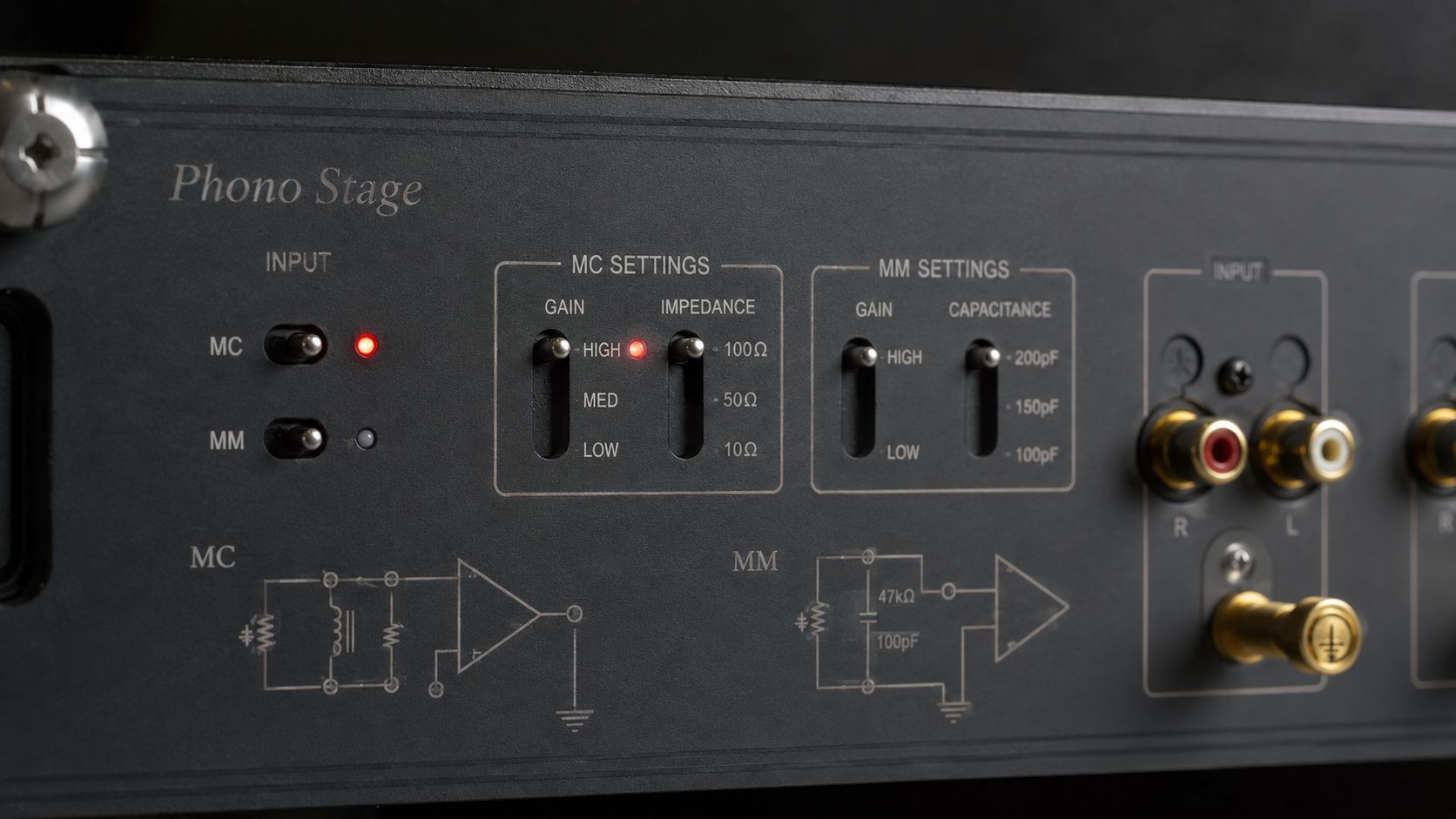
MM cartridges normally expect a 47 kΩ load and roughly 35–45 dB of gain. That electrical match explains their practical appeal. Many integrated amplifiers, receivers, and standalone phono preamps already provide the required input, so an MM often works without another box or complicated adjustment.
MC requires a different environment. Low-output MC cartridges produce far less voltage, which means the phono stage needs substantially more gain and suitable low-impedance loading. Get either requirement wrong and the cartridge can sound small, noisy, and anaemic.
Gain is not a volume knob
Turning up the amplifier does not replace missing phono gain. A tiny cartridge signal needs proper amplification before it reaches the line stage. Otherwise, the system raises noise along with the music. You may get plenty of volume while losing body, contrast, and quiet backgrounds.
A dedicated MC input handles the required gain and loading. A step-up transformer raises the signal before it reaches an MM input, but the transformer and cartridge impedance still need to match. That is another front-end decision, not a harmless accessory.
The cost extends beyond the cartridge. Include the phono stage, possible transformer, cables, loading options, and setup time before calling MC the cheaper upgrade. The system total can change quickly.
Do the system arithmetic first
A good MM connected to a competent MM stage will usually beat a low-output MC connected to an unsuitable input. The issue is system matching, not allegiance to one cartridge design.
Before shopping, use Supermarket Sound's phono preamp vinyl guide to review the compatibility questions. Check cartridge output, available gain, input impedance, and adjustable loading. If the specifications do not explain those points, choose another stage or choose an MM.
The cartridge is the first component in a chain. Make sure the rest of the chain can feed it properly.
How MM and MC Cartridges Sound on Real Records
Specifications can tell you why a cartridge behaves a certain way. They can't tell you whether a brushed cymbal feels like metal or like a strip of sandpaper.
On acoustic jazz, a well-matched MM often gives the piano enough weight to anchor the session. The double bass has roundness. The ride cymbal stays present without demanding attention. Surface noise and imperfect pressings sit farther back in the experience, which matters when the record itself isn't immaculate.
MC tends to open the room. You may hear more of the piano's decay after the hammer strike, more wood around the bass note, and more air between the cymbal and the recording space. That extra information can sound thrilling, but it also exposes groove damage and setup errors with ruthless efficiency.
Dense mixes reveal different strengths
Rock benefits from MM's sense of mass. Guitars can arrive as a thick wall rather than a collection of sharply outlined wires. Bass drums feel planted, and the presentation stays enjoyable when the pressing carries a little grit.
MC can separate the layers more clearly. A crowded mix may reveal backing vocals, guitar texture, or studio ambience that previously blended into the main event. The danger is a system that confuses exposure with resolution. If the phono stage adds noise or the loading is wrong, MC turns “more information” into fatigue.
Electronic records show the contrast in another way. MM can make synthesizer lines feel dense and physical, with a satisfying push through the midbass. MC often tightens the edges of sequenced percussion and gives reverberant effects more room to trail into silence.
Classical music rewards a quiet, properly aligned chain. MC can place sections more precisely and expose low-level hall information. MM can make the orchestral body feel generous and continuous, which is sometimes more convincing than surgical separation.
Listening rule: Choose the cartridge that makes your late-night records easier to play, not the one that gives you more equipment to discuss.
Neither design owns the word “musical.” That word belongs to the setup.
Which Cartridge Type Fits Your Budget and System
Start with the phono stage, not the cartridge badge. Under $300, buy MM. An established moving-magnet design is the sensible choice before an entry-level MC, provided your tonearm and phono input support it.
Between $300 and $800, MM remains my first recommendation. A strong MM with a better stylus can outperform an MC that forces you into a mediocre phono stage. Spend on the complete signal path. The cartridge alone cannot rescue poor gain, unsuitable loading, or a mismatched tonearm.
From $800 to $1,500, MC makes sense when the system already has the required gain, loading, tonearm compatibility, and setup discipline. Above $1,500, MC becomes the natural high-end direction only when the turntable and phono stage justify it. These tiers are buying guidance, not laboratory guarantees.
| Budget Tier | Recommended Type | Example Cartridges | System Requirements | Total System Cost Reality |
|---|---|---|---|---|
| Under $300 | MM | Ortofon 2M series, Audio-Technica VM95ML | Standard MM phono input, correct alignment | Cartridge cost can remain the main upgrade |
| $300–$800 | MM first, MC selectively | Higher MM stylus options, carefully matched MC | Strong MM stage or capable MC support | A cheaper MC may require a larger supporting spend |
| $800–$1,500 | MC if the chain is ready | Hana SL, Denon DL-103 | Dedicated MC gain or suitable transformer, compatible tonearm | Cartridge and phono-stage budget must be considered together |
| Above $1,500 | MC for a fully developed system | High-end MC designs | Serious gain, loading control, alignment, and tonearm support | The cartridge shouldn't outrun the rest of the front end |
The example models reflect editorial recommendations, not claims about measured superiority. Check the cartridge's actual electrical requirements before buying. A cartridge that your phono stage cannot drive properly is an expensive mismatch, regardless of its reputation.
My blunt buying order
Use the phono stage you already own as the starting point. If it supports MM only, choose MM unless you are budgeting for the complete MC chain. If you want moving-coil construction without rebuilding the front end, consider high-output MC designs, then verify their output and loading instead of trusting the label.
A replaceable MM stylus also changes ownership. Many designs let you upgrade the stylus assembly without replacing the cartridge body. Low-output MC ownership demands more planning when the stylus wears, since retipping or cartridge replacement becomes part of the long-term cost.
For broader cartridge selection criteria, see the Supermarket Sound turntable cartridge guide. I run a hi-fi site that has to rank to survive, so search engines prefer tidy categories. Your records do not care about categories. They care whether the stylus reaches the groove cleanly.
Buy the system, not the fantasy.
Setup Mistakes That Ruin Either Cartridge Type
Most “bad cartridge” complaints begin with a setup error. The cartridge gets blamed because it's the newest object in the room.
Loading comes first. MM designs can react strongly to the relationship between their higher inductance and the capacitance in the tonearm cable and phono input. The standard 47 kΩ load works broadly, but a cartridge's specified capacitance range matters. Ignore it, and the treble can become sharp, inflated, or tiring.
Geometry comes next. A cartridge that sits crooked in the headshell won't track the groove properly, even if the generator itself is excellent. MC designs often reveal that mistake faster because their lower moving mass and more explicit top-end character leave less blur to hide behind.
Three failures I see repeatedly
Gain starvation is the classic MC disaster. A low-output MC into a standard MM-only input produces a weak, noisy signal. Raising the amplifier volume doesn't restore the missing signal-to-noise performance.
Tracking-force errors affect both types. Too little force encourages mistracking, especially toward inner grooves. Too much force can flatten the presentation and accelerate stylus wear. Use the manufacturer's specified range and measure with a digital scale.
VTA and alignment errors shift tonal balance and tracking behaviour. The cartridge needs correct overhang, offset angle, azimuth, and vertical geometry. A precise cartridge mounted carelessly remains a careless setup.
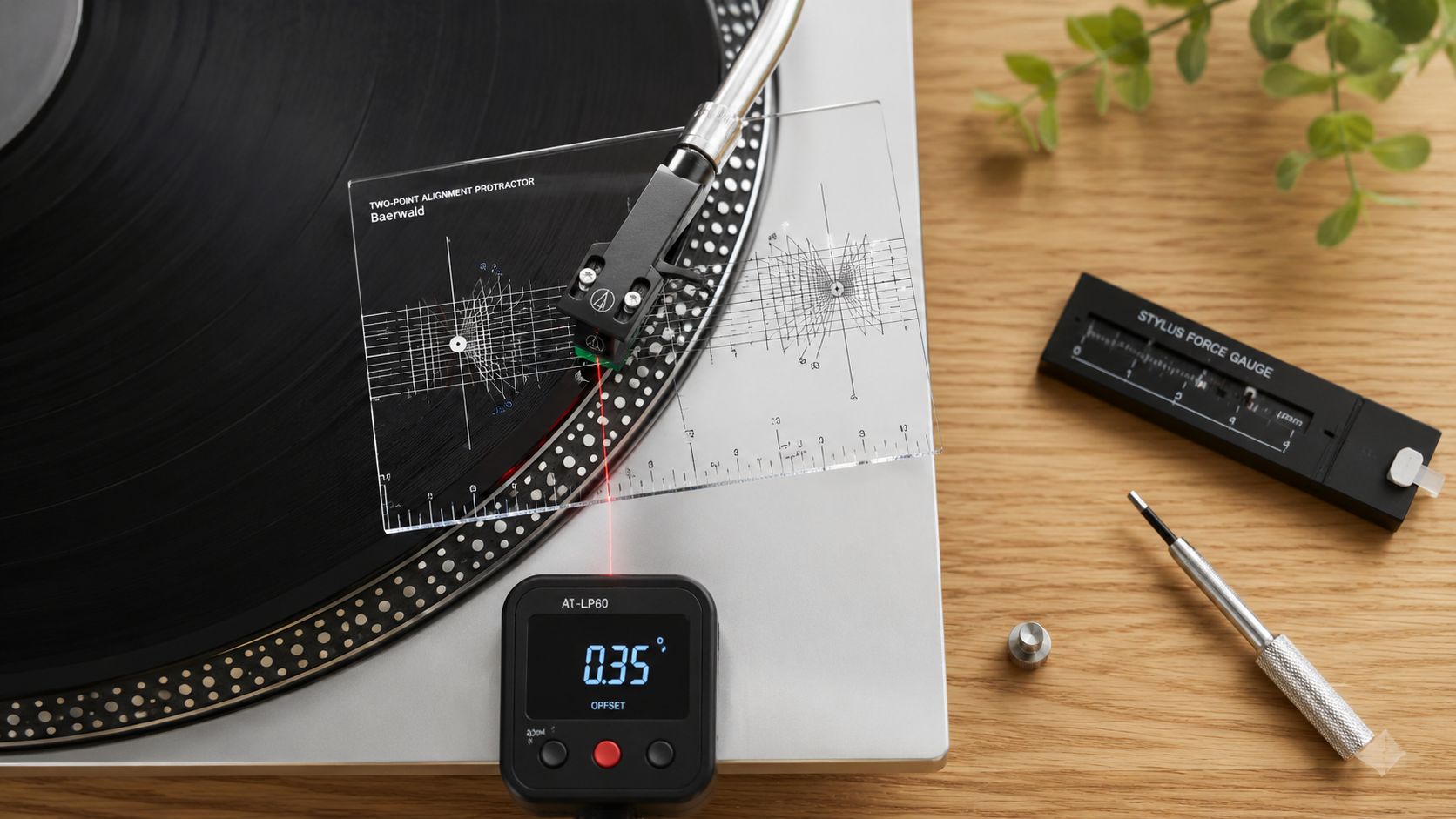
Use this turntable cartridge alignment guide when the cartridge is mounted but the sound still feels wrong. Don't tune by ear until the geometry is correct.
A short diagnostic order
- Verify load impedance. Confirm the phono input suits the cartridge.
- Confirm gain staging. Make sure low-output MC receives proper amplification.
- Measure tracking force. Use a digital scale, not a guess.
- Align the cartridge. Set overhang and offset with a proper protractor.
- Inspect the record and stylus. Dirt can impersonate distortion.
Fix the setup before replacing the cartridge.
The right cartridge is the one your system can drive properly. For most listeners, that means starting with MM, learning the system, and moving to MC only when the entire chain is ready. If you're choosing now, send Supermarket Sound your turntable model, tonearm, phono stage, current cartridge, and the records you play most. I'll help you build the complete match before you spend money on a cartridge that your system can't feed.

