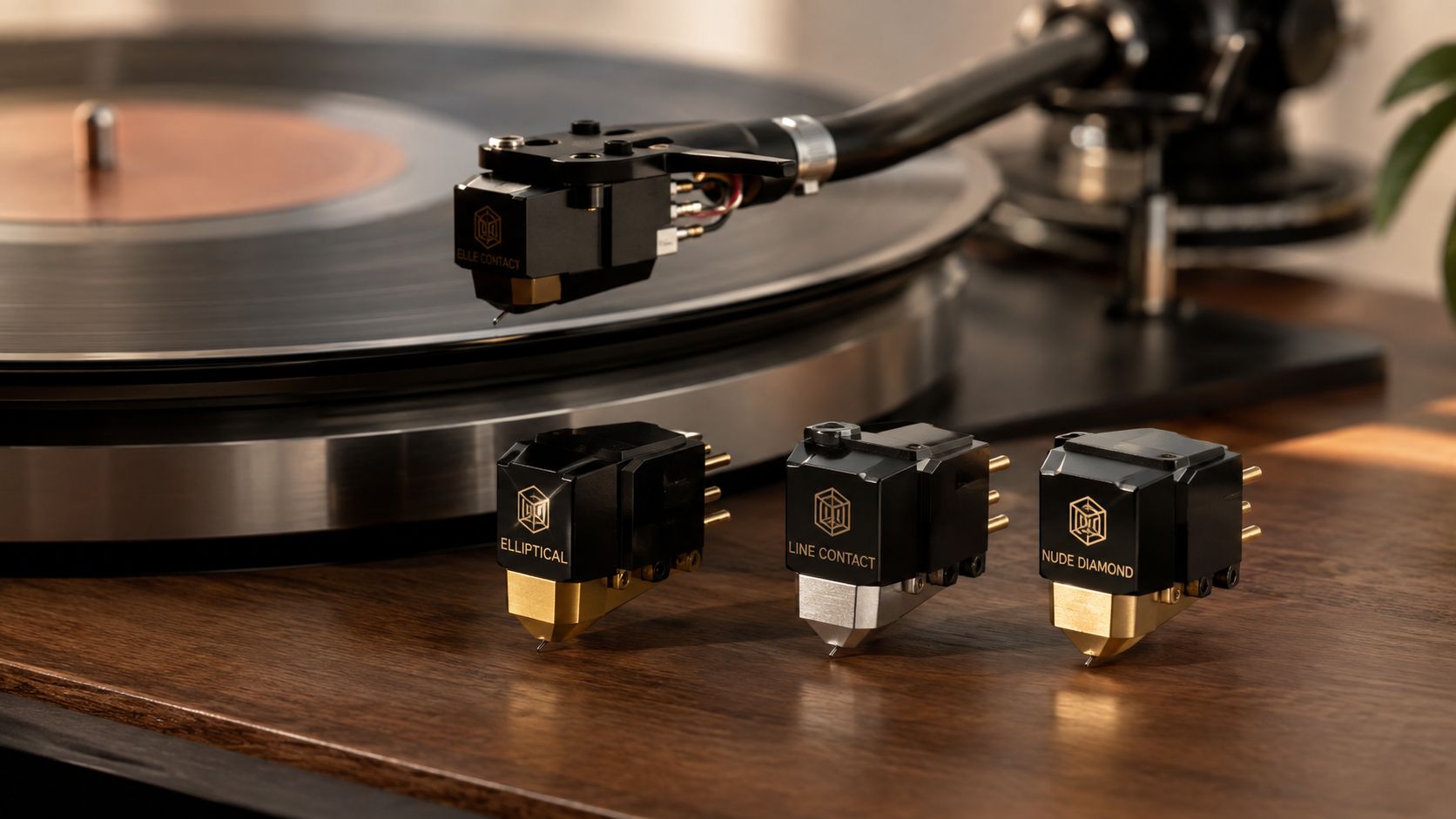
The best turntable cartridge isn't the one with the prettiest badge, it's the one that fits your arm, your phono stage, and your record collection without starving the signal. People love to shop by reputation. That's how they end up with a cartridge that measures fine, sounds wrong, and gets blamed on the pressings.
I've mounted enough cartridges to know the expensive mistake is usually mechanical, not mystical. Get the compliance wrong, load the stage badly, or chase stylus hype without respecting tonearm mass, and the downstream chain inherits the mess. The market has already told on itself, too, with moving magnet cartridges making up 85% of standard turntable sales while optical designs sit under 1% (industry report). That's the floor. Fit matters more than fantasy.
Table of Contents
- The Wrong Question Everyone Asks About Cartridges
- What a Cartridge Is and Why MM Dominates
- MM, MC, and the Cartridges That Lie About Themselves
- The Matching Math That Decides What You Hear
- Picks by Budget Band, With One to Skip
- Sonic Character by Genre and System
- Setup That Releases the Cartridge You Bought
- The Buying Checklist and the Final Decision
The Wrong Question Everyone Asks About Cartridges
The wrong question is, “What's the single best turntable cartridge?” The right one is, “Which cartridge fits my arm, my stage, and the way I listen?” That sounds less sexy because it is less sexy. It's also the difference between a table that sings and one that sounds like it's wearing tight shoes.
A cartridge is not a trophy. It's a load-bearing part of the playback chain, and the wrong match can make a decent body sound thick, splashy, or stubbornly flat. I keep seeing the same shortlist cycle through the internet while the damage happens elsewhere, in matching and setup, where a supposedly elite choice gets kneecapped by tonearm mass, loading, or sloppy alignment. The badge never saves you from physics.
Practical rule: if two cartridges are close on paper, pick the one that suits your arm and stylus needs better, not the one with the louder fan club.
That's why I start with compatibility, then stylus profile, then body quality. The market loves to pretend the body is the whole story because the body is easy to market. The groove doesn't care about marketing. It cares about tracing, resonance, and whether the rest of the system lets the cartridge do its job.
If you want the other half of the chain, I've already covered the part people forget in my turntable sound quality guide. That piece and this one belong together. One without the other is how people end up buying twice.
What a Cartridge Is and Why MM Dominates
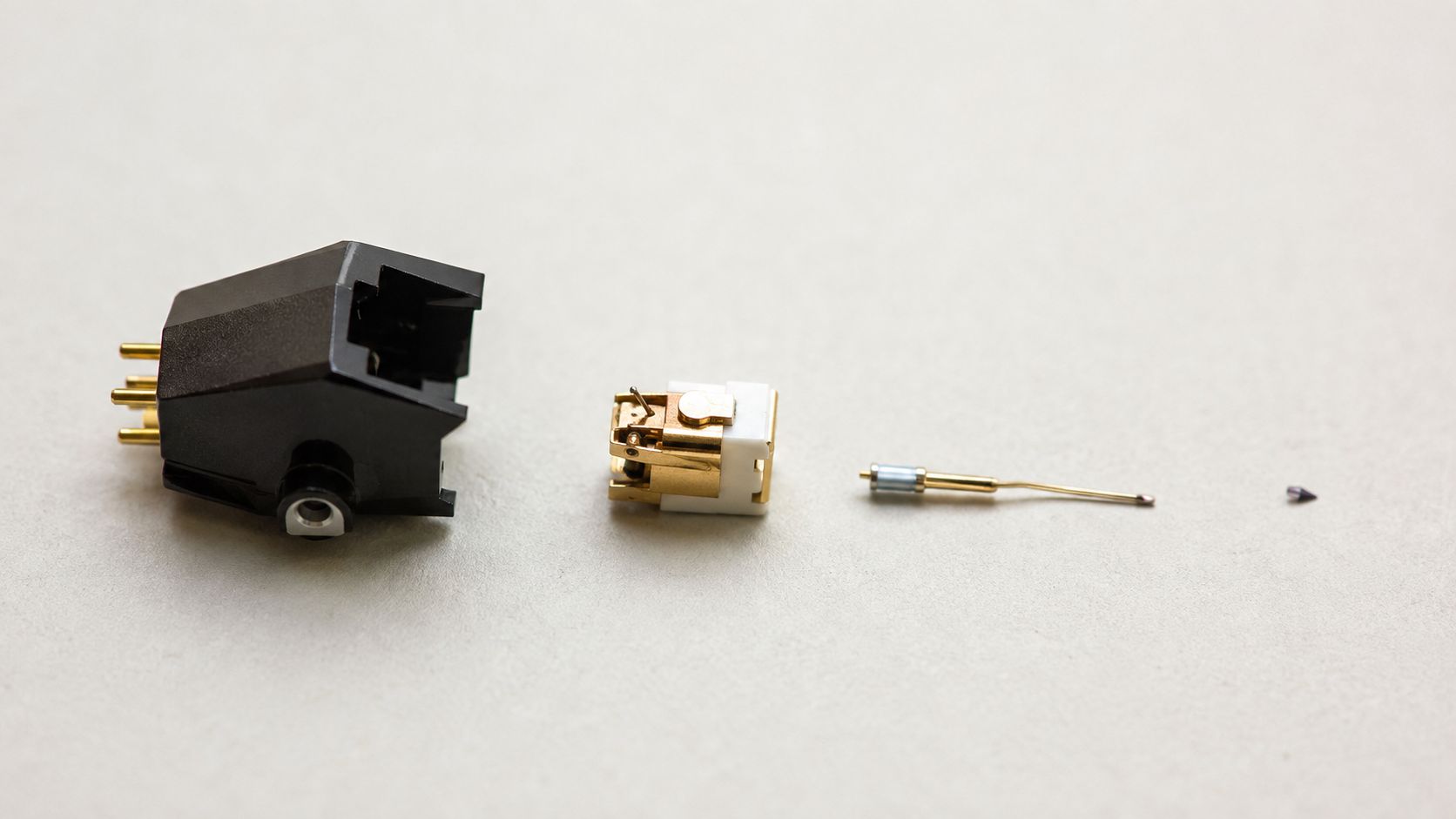
A phono cartridge is a four-part electromechanical assembly. The body holds everything together. The generator turns motion into voltage. The cantilever carries the stylus. The diamond tip rides the groove and turns the record's wiggles into signal (Audio Advisor). That is the whole job, and it is why a cartridge changes the character of an entire deck.
The Part That Touches the Groove
The stylus is the only part that physically contacts the groove, so its shape deserves real attention. A more refined profile usually reaches deeper into the groove geometry and handles complex high-frequency detail with more control. That is why stylus shape often changes what you hear more than body material does. The body matters, but the diamond does the digging.
A lot of listeners buy bodies and talk about them like they bought a voice. They bought a platform for a stylus and generator to work from. If the stylus is blunt, the signal will be blunt. If the profile is sharper and the setup is right, detail opens up without any treble hype pretending to be clarity.
Why Moving Magnet Owns the Market
Moving magnet dominates because it makes sense for many listeners. The current market data says MM cartridges account for 85% of standard turntable sales, while optical cartridges remain under 1% (industry report). That does not make MM glamorous. It makes MM practical, affordable, serviceable, and easy to match.
An independent market report from this industry report also points to the same reality, the format is built around a broad, mature user base rather than a tiny luxury niche. For most buyers, MM is the rational default because it lives inside an ecosystem with plenty of replacement styli and fewer compatibility headaches. That is not flashy. It is effective.
MM, MC, and the Cartridges That Lie About Themselves
Moving magnet and moving coil are not moral categories. They're design tradeoffs, and both can sound excellent when the rest of the system isn't sabotaging them. MM usually brings easier loading, simpler phono stage matching, and better ownership convenience. MC often buys you finer tracing, a cleaner sense of space, and a more microscopic view into low-level detail, but it asks more from the stage and the setup.
Why MC Is Not Automatically Better
The lazy take says MC always wins because it sounds more “audiophile.” That's nonsense. A mismatched MC can sound thin, noisy, or overexposed in the top end, especially if the phono stage isn't up to the task. You don't get credit for buying complexity. You get the sound of every weak link.
High-output MC exists for a reason. It tries to split the difference by giving you more of the MC flavor without demanding the most exotic front end. That makes it useful for listeners who want some of the extra refinement but don't want to build a whole support system around the cartridge.
Plain truth: MC rewards a system that's already sorted. MM rewards a listener who wants fewer moving parts and less drama.
What I Reach For First
If I'm setting up a real-world system, I start with MM unless the rest of the chain is clearly built to justify MC. Not because MC is bad, but because MM is easier to live with and more forgiving of small errors. That matters when the record stack includes older pressings, less-than-perfect alignment, and rooms that aren't studio labs.
You can absolutely hear the upside of a good MC. You can also hear when someone bought one because forums told them to. Those are different purchases.
The Matching Math That Decides What You Hear
The decision that matters is tonearm and cartridge matching. Skip the logo and the finish. The match is what shapes the sound. Cartridge behavior depends on total tonearm mass plus cartridge compliance, and a sane electrical load still matters. Most MM designs want 47 kΩ loading, while moderate-compliance cartridges usually sit in the 10 to 20 µm/mN range and very high compliance goes above 35 µm/mN (Crutchfield phono cartridge guide).
Why Resonance Is the Boss
If the arm and cartridge are a bad pair, you hear it fast. Bass can feel loose, weight can vanish, and the top end can get edgy. The cartridge may look right on paper and still behave badly because the arm mass and compliance miss the resonance window. Then people start swapping mats and cables while the mechanical problem stays untouched.
I've watched that mistake play out over and over. Someone reads a rave, buys the cartridge, mounts it on the wrong arm, and then blames the record collection for sounding off. The record did not change. The mechanical match did.
Loading Is Not Optional
Electrical loading matters just as much as the physical fit. A moving magnet cartridge that expects a sane 47 kΩ load and gets something else can sound bright, shut in, or uneven. Setup guides that stop at stylus shape leave out the part that decides whether the cartridge behaves in a real system.
Match the arm first. Match the stage second. Then worry about whether the stylus profile is elliptical, line-contact, or Shibata.
If your phono stage is the weak link, fix that before you spend cartridge money you can't hear. A weak front end will color the result no matter how good the cartridge body looks.
Get the match wrong, and no stylus profile can save it.
Picks by Budget Band, With One to Skip
Here's the shortlist I'd trust in real rooms, not just in affiliate soup. These are starting points, not commandments. The point is to buy a cartridge that fits the arm, then let the stylus and generator do the rest.
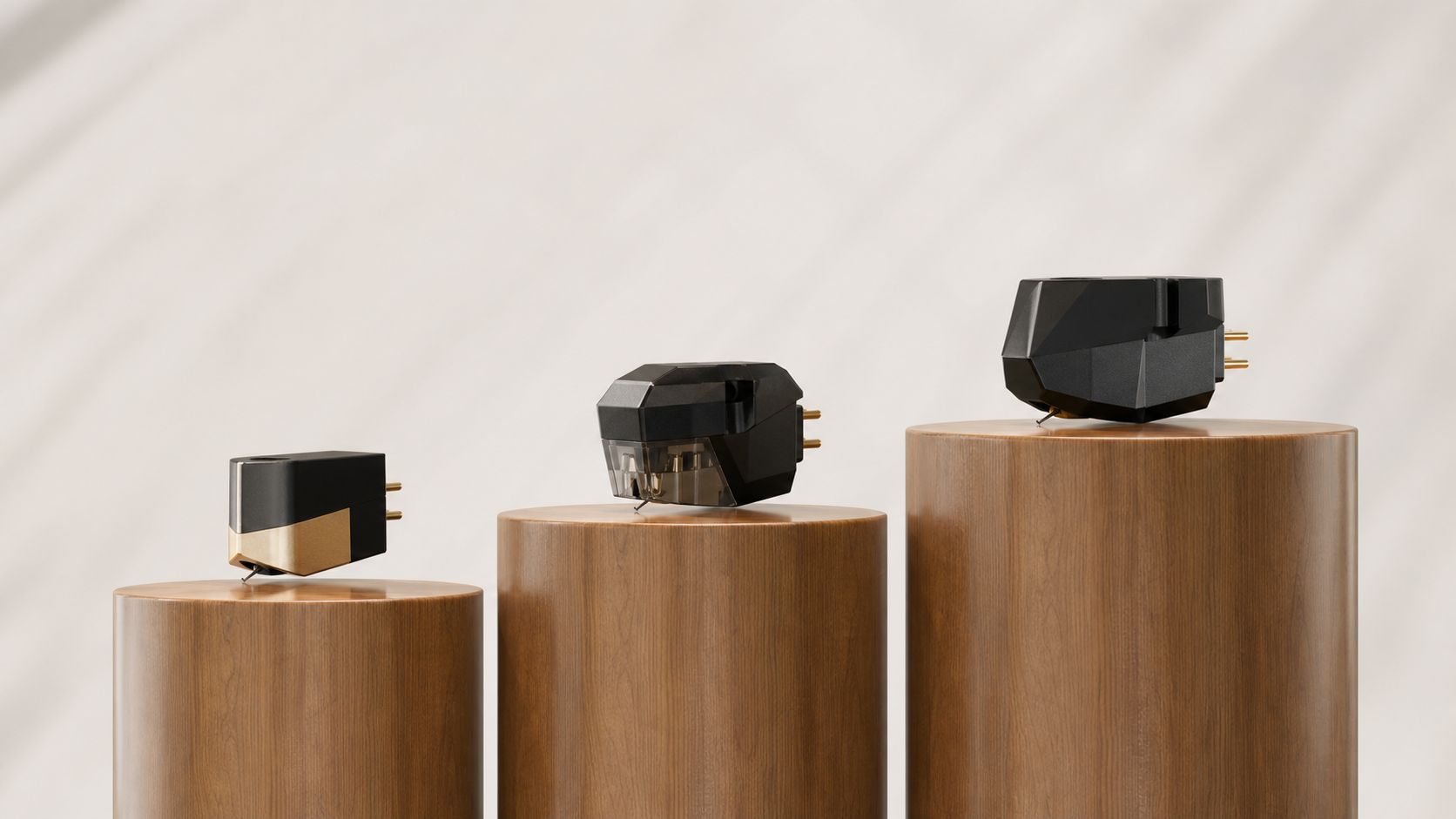
| Cartridge | Output (mV) | Stylus Profile | Compliance | Best Arm Mass | Verdict |
|---|---|---|---|---|---|
| Audio-Technica AT-VM95E/H | 4.0 | Elliptical | Moderate | Medium | The safe starter if you want sane value and easy living |
| Ortofon 2M Blue | 5.5 | Nude elliptical | Moderate | Medium | The most balanced step-up for a lot of MM arms |
| Ortofon 2M Black | 5.0 | Nude Shibata | Moderate | Medium | The detail monster if your setup deserves it |
The Safe Starter
The Audio-Technica AT-VM95E/H is the cartridge I'd hand to someone who wants to stop reading and start listening. It is not flashy, and that is the point. In a real setup, it gives you enough detail to matter without punishing every rough edge in the record pile. It is the sensible floor, not the bragging-rights ceiling.
It also makes sense as a total-cost choice. The VM95 family gives you a clear stylus swap ladder, so you can move up the line without throwing the whole body away. That matters more than chasing a prettier shell or a louder spec sheet.
The One I'd Buy With My Own Money
The Ortofon 2M Blue is the cartridge I'd call the strongest all-rounder for a lot of MM rigs. The 5.5 mV output, nude elliptical stylus, and 25 dB channel separation figure from a technical roundup tell you why it feels more resolved without turning brittle. To my ears, it opens the stage, cleans up congestion, and keeps bass lines from getting mushy when the record gets busy.
It is the smart move if you already know your arm is in the right zone and you want a cartridge that rewards careful setup instead of fighting it. Pay for the match, not the badge.
The One I'd Reserve for a Better-Set System
The Ortofon 2M Black is the one that earns its keep when everything upstream is sorted. Its nude Shibata stylus and 5.0 mV output move it into more serious tracing territory, and that is where the cartridge starts showing you the room, the tape, and the mastering choices instead of just the tune. It can sound ruthless on bad pressings. That is not a flaw. That is honesty.
It also asks more from the rest of the chain, so the ownership cost is not just the body price. If the arm is a mismatch or the phono stage is ordinary, you will pay for detail you cannot use. Put it on the right arm and it earns every bit of its reputation.
The One to Skip
I would skip the cult of “MC at any cost” if your arm and phono stage are not ready for it. A bad MC match is just an expensive way to hear less music. I would rather hear a well-set MM than a mismatched exotic body pretending to be deep.
The upgrade path is simple. Start with a sensible body, move up the stylus if the platform supports it, then buy a better body only when the arm and stage justify the spend.
Sonic Character by Genre and System
Genre matters less than the records themselves, but records still cluster by what they ask of a stylus. A forgiving elliptical stylus can make worn jazz and older pressings easier to live with, because it softens surface noise and keeps the presentation from getting fussy. A nude line-contact or Shibata stylus pulls more air and separation from modern rock, dense electronic cuts, and hot masterings, where the job is holding inner detail together instead of smearing it into a blur.
What I'd Use for Different Listening Habits
If your shelves are full of imperfect second-hand records, start with forgiveness. A more forgiving cartridge usually keeps the sound musical instead of forensic, so you hear the performance before you hear the wear pattern.
If you play a lot of modern remasters, punk, or crowded live albums, tracing matters more. Those records ask the stylus to stay composed when the groove gets busy, and a more advanced profile keeps the top end from turning glassy while the image stays sorted in a congested mix.
A bright cartridge in a bright system is a self-inflicted wound.
System Context Beats Internet Lore
A low-output MC into a noisy phono stage is a poor match. A cartridge that wants refinement but gets paired with a front end that hisses and blurs will sound smaller than it should. An MM cartridge with the right stylus can make a modest system feel composed and complete without turning the room into a gear demo.
That is why I do not trust cartridge opinions that ignore the rest of the chain. The same body can sound generous in one setup and irritating in another. The music stays the same. The support system changes the result.
If you are still getting the rest of the table and arm sorted, my beginner setup guide for getting a turntable ready without turning it into a weekend project covers the practical basics.
Setup That Releases the Cartridge You Bought
Install the cartridge like you mean it. Overhang and alignment come first, then tracking force, then anti-skate, then loading. Skip any one of those and you are not hearing the cartridge. You are hearing the setup mistake.
Alignment and Force Are Not Optional
Baerwald and Stevenson both have their fans, and I use the one that fits the arm and the records on hand. The point is consistency and accuracy, not ritual purity. A decent protractor and a proper force gauge are worth real money because they tell you whether you are in the zone instead of guessing by eye.
A digital gauge is boring. It also separates a stylus that tracks confidently from one that bounces through the groove like it is late for something.
Break-In Is Real, But It Is Not Magic
Fresh cartridges often settle after some play, and the suspension can relax a bit. That is normal. It does not turn one cartridge into another, and it is no excuse to ignore setup. If a cartridge sounds wrong out of the box, check alignment and loading before you invent a burn-in story.
If you still need the practical basics for getting the deck ready, my beginner setup guide for getting a turntable ready without turning it into a weekend project covers the hands-on side. The same rule applies here. A cartridge that does not sound like the reviews is usually a setup problem, not a bad cartridge.
The Buying Checklist and the Final Decision
Buy the cartridge that fits the arm, not the one that flatters your ego. A cartridge that looks expensive can still be a bad match if the arm mass, compliance, or loading are off. Pick the stylus profile that suits your records, because that choice shapes tracing, wear, and how much fuss the cartridge will make on imperfect vinyl. Treat the body as the upgrade ladder, not the starting religion, since the stylus and generator path decide how much value you can keep as your system changes.
Look at the full ownership cost before you buy. Some cartridges make sense only if you are willing to replace the whole thing when the stylus wears out. Others let you stay on the same body and move up the stylus ladder later, which is the smarter buy for anyone who wants a cartridge that grows with the rest of the system. If a list ignores loading, walk away, because that tells you the writer is selling a headline, not a cartridge.
That's the decision. Match first. Listen second. The right cartridge does not call attention to itself, it tracks cleanly, behaves on your arm, and keeps you out of the upgrade trap.
If you want the practical version of this advice applied to real turntables and real listening rooms, keep following Supermarket Sound and use the Steam profile for Marque Hersh as the anchor for the site's voice and gear philosophy: Marque Hersh on Steam.

