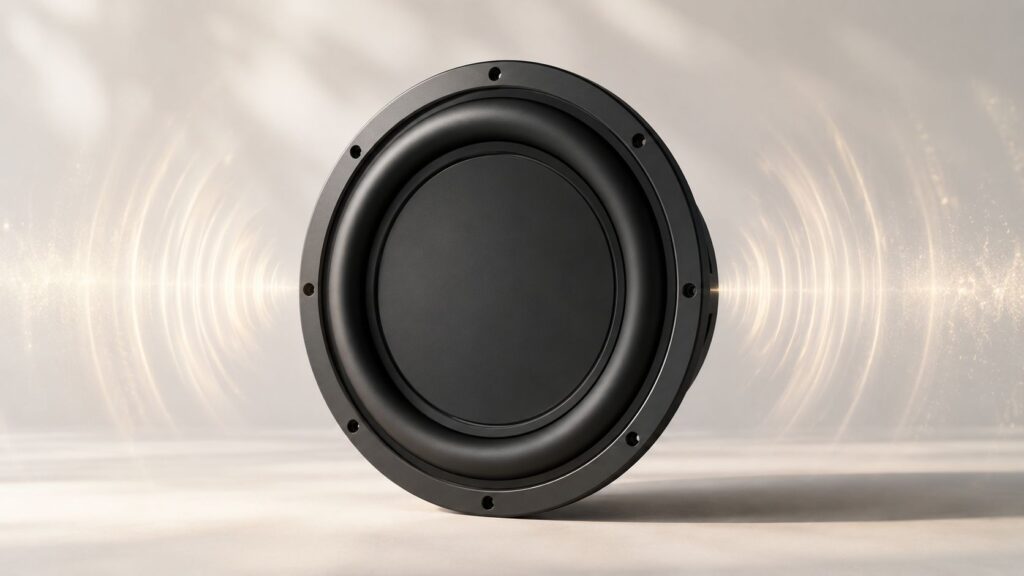
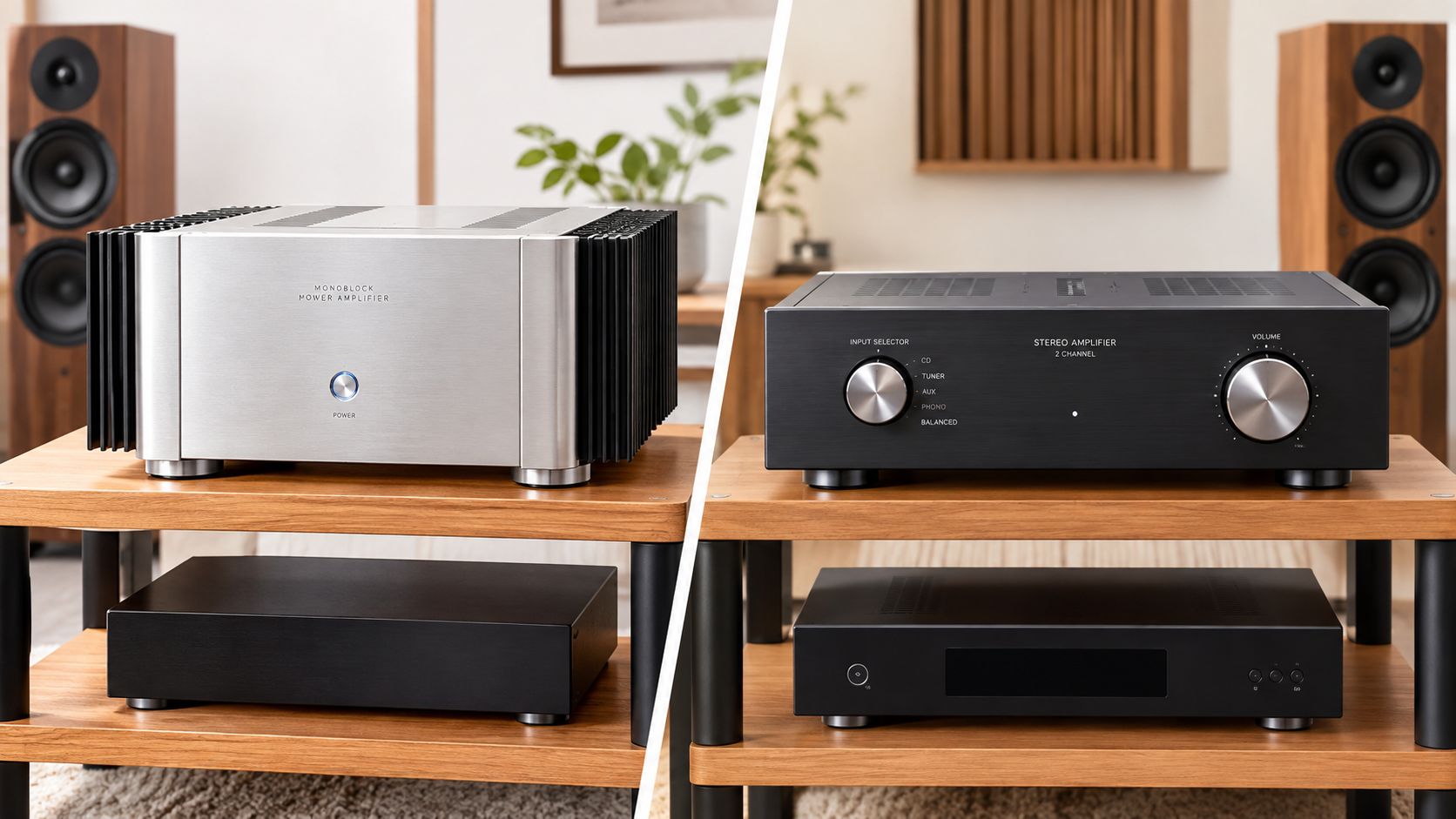
The expensive mistake in a monoblock vs 2-channel amp decision usually has nothing to do with channel count. It happens when someone ignores impedance, heat, bridging safety, or the power supply, then blames the speakers for an amplifier problem.
I'm Marque Hersh, founder of Supermarket Sound. I've wired enough systems in small rooms to know that extra hardware only earns its place when the architecture needs it. A monoblock can sharpen stereo focus or keep a hungry subwoofer under control. A 2-channel amplifier can do the same job with fewer cables and fewer opportunities to build an expensive space heater.
The right amplifier is the one that keeps the load stable and the signal fed downstream. The badge comes second.
Table of Contents
- The Monoblock vs 2 Channel Amp Debate Is Mostly Wrong
- What Monoblock and Stereo Amplifiers Actually Are
- Channel Separation, Power Supply Design, and Crosstalk
- When a Mono Wins and When a Stereo Fits Better
- Market Reality, Efficiency Trends, and Installation Economics
- Marque's Real-Room Recommendation
The Monoblock vs 2 Channel Amp Debate Is Mostly Wrong
Mono does not automatically mean subwoofer, and stereo does not automatically mean full-range speakers. Channel count is only the visible part of the decision. The questions are architectural: how the amplifier distributes current, tolerates impedance swings, limits heat, protects a bridged load, and keeps the downstream signal from being starved.
A single-channel amplifier has a straightforward physical advantage. It does not share its output stage or power path with another channel, which can reduce crosstalk and give the load a separate electrical route. A well-designed 2-channel amplifier can still isolate its supplies and layout more effectively than a low-cost stereo unit working against a stressed shared supply. The badge on the front panel cannot tell you which design is inside.
Practical rule: Treat topology as the floor of the system, not the finish on the cabinet.
Separate amplification can produce a more stable center image. Vocal lines may hold their position instead of drifting toward the louder speaker. I have also heard systems where adding extra boxes changed nothing meaningful because the speakers, room, or source imposed the larger limit. That result does not condemn monoblocks. Isolation only matters when the rest of the chain can reveal it. Whether separate amplification actually sounds different is a separate question, covered in our test of whether amplifiers sound different.
Bass exposes the same trade-off. A monoblock built for a low-impedance subwoofer load generally has the current delivery and filtering that job requires. A bridged 2-channel amplifier may deliver serious output, but only if the amplifier supports bridging and can handle the resulting impedance. A mismatch can trigger protection, raise thermal strain, or turn clipping into the dominant sound.
Choose around the load, installation, and future plan. A pair of high-end monoblocks fits a large stereo system where imaging and headroom justify additional cables, heat, and hardware. One compact stereo amplifier suits a small room, modest speakers, and limited rack space. The wrong choice can leave one channel underused while the other works hard, or starve the signal path after spending money on power that the system cannot use.
The wiring decides the verdict.
What Monoblock and Stereo Amplifiers Actually Are
A monoblock amplifier is a single-channel design. For stereo playback, you need two units, one for the left channel and one for the right. Each amplifier feeds one load through its own amplifier stage and power-supply path, which physically separates the channels.
A 2-channel stereo amplifier puts both channels inside one chassis. It normally shares at least some core infrastructure, including enclosure space, control circuitry, and often parts of the power supply. That doesn't automatically make it inferior. It makes the internal design more important.
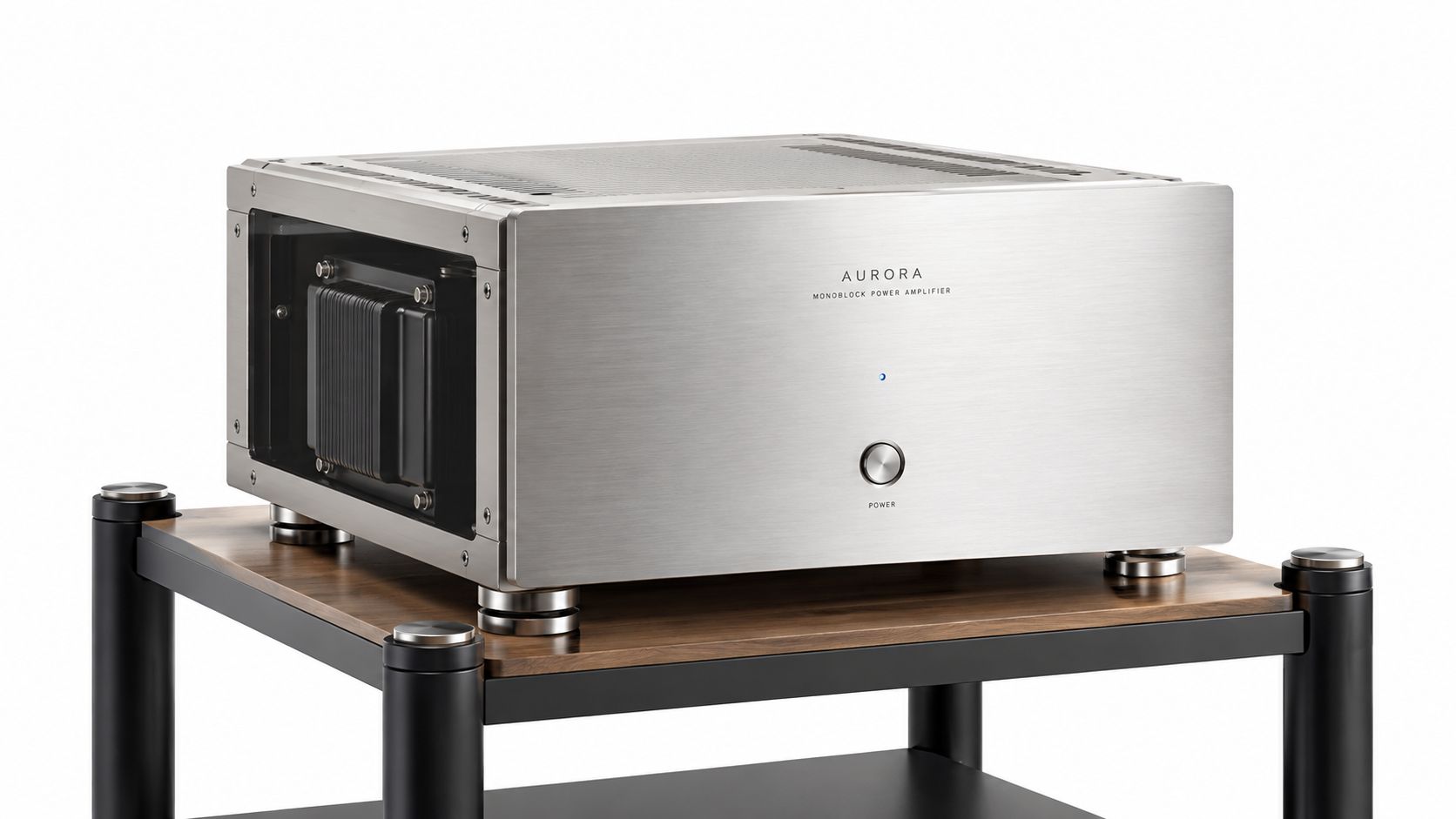
The idea is older than the current obsession with amplifier topology. The Marantz Model 9 arrived in the 1960s as a 70W single-channel amplifier, while the Dynaco Mk II sold as a kit for $59.95 in 1955, as documented in this history of monoblock amplifier design. One channel, one box was already an established hi-fi idea before modern home theater made channel counts sound like a military procurement plan.
The box matters less than the architecture
A conventional stereo amplifier may use a shared supply rail, allowing one channel's demand to affect the other under heavy load. Another stereo design may give each channel a separate transformer winding, rectification stage, or complete supply. A true dual-mono design can therefore approach the practical isolation of separate chassis while keeping both channels together.
That distinction matters more than the word mono printed on the faceplate. Monoblocks bring physical separation, but they also add another chassis, power cord, signal cable, speaker cable, and heat source. The system becomes more independent electrically and more demanding physically.
A stereo amplifier keeps the installation tidy and usually costs less to build into a rack. It also gives you two channels immediately, which suits a conventional pair of speakers without asking the room to host a small amplifier convention.
The format is old. The decision is still architectural.
Channel Separation, Power Supply Design, and Crosstalk
A monoblock's strongest technical case is channel isolation. The left amplifier has no shared output stage or main supply path with the right amplifier, so one channel has fewer ways to inject electrical activity into the other. That can reduce crosstalk, improve stereo separation, and limit noise reaching the speaker. In a revealing system, the result may be firmer image placement, more space around instruments, and less congestion in a dense mix.
A conventional 2-channel amplifier shares more infrastructure. Under normal listening, that does not automatically mean audible contamination between channels. The risk rises when both channels demand current together, because the power-supply layout, grounding, output stage, and enclosure can all permit interaction. The load each channel sees is determined by the speaker's impedance curve. The practical mechanics are covered in this guide to impedance matching.
| Architecture | Channel Interaction | Typical Use Case | Complexity |
|---|---|---|---|
| Conventional 2-channel | Shared resources can permit more interaction under load | Everyday stereo speakers, compact racks, flexible systems | Lower |
| Dual-mono 2-channel | Separate internal supplies reduce interaction while retaining one chassis | High-quality stereo installations with limited space | Moderate |
| Pair of monoblocks | Physical separation gives each channel its own amplifier and power path | High-end stereo imaging or demanding speaker loads | Higher |
| Bridged 2-channel | Both channels drive one load, with extra demands on impedance and thermal behavior | One-load applications when the amplifier explicitly supports bridging | Moderate to high |
The power supply sits at the center of the architecture. A multichannel amplifier may use a fully shared supply, partly separated supplies, or completely independent supplies. That choice affects how much one channel can disturb the other during demanding passages. This power-supply design overview explains why internal arrangement deserves more attention than the number of output terminals.
Separation has a point of diminishing returns
Better separation is useful, but a specification alone is a poor purchase argument. Independent commentary on amplifier design notes that once separation reaches around 20 dB or more, further audible differences become difficult for most listeners to detect, as discussed in this stereo and dual-mono analysis.
That changes the sales pitch. Monoblocks can provide cleaner physical isolation, yet the audible benefit depends on the whole system. Speaker placement, room reflections, source quality, gain structure, and listening level may matter more than adding another chassis.
Listen for the image first. Does the vocal stay anchored? Do reverbs hold a stable position behind the speakers? Does a dense chorus remain layered, or become expensive soup? If a dual-mono stereo amplifier already keeps those elements sorted, monoblocks may improve installation flexibility without transforming the room.
The audible payoff is conditional.
When a Mono Wins and When a Stereo Fits Better
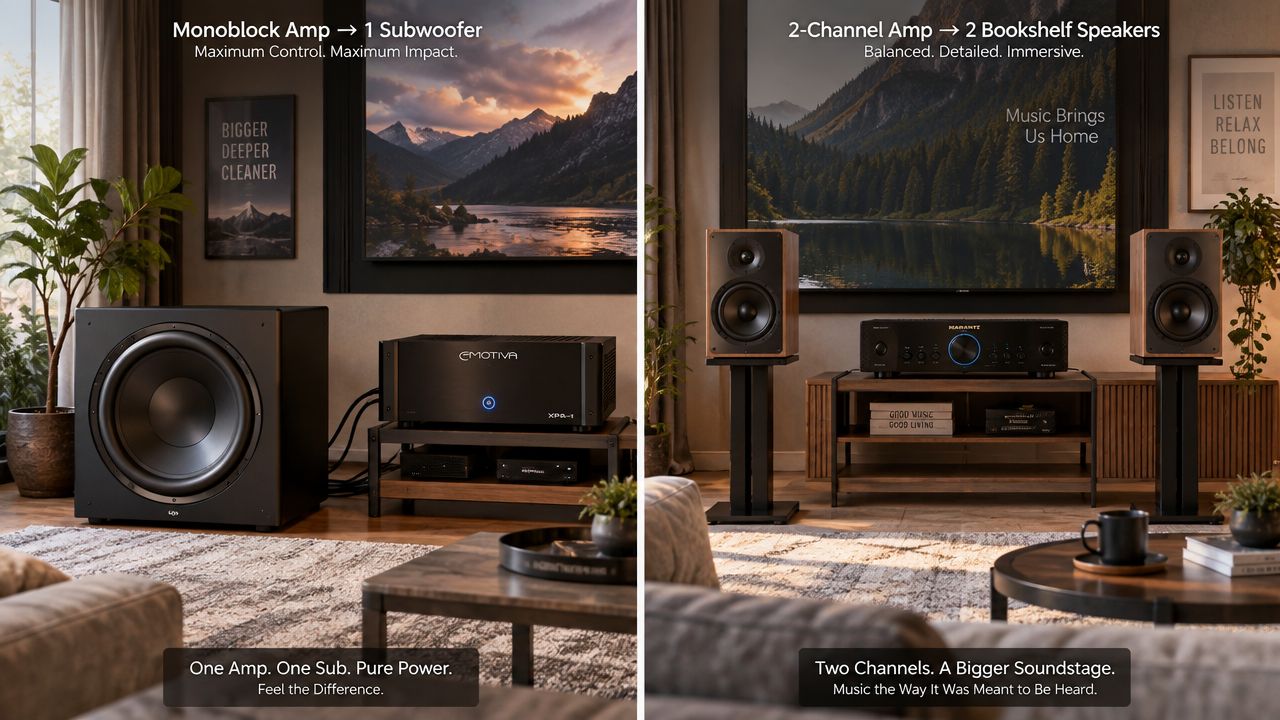
A subwoofer is where the monoblock usually stops being a luxury and starts looking like the correct tool. Subwoofer loads can become demanding at low impedance, and monoblocks are commonly designed to remain stable at 1–2 ohms. Independent car-audio guidance and product examples describe monoblocks delivering roughly 500–1500 watts RMS at 2 ohms, while typical 2-channel amplifiers are more often discussed around 75–150 watts RMS per channel at 4 ohms, according to this monoblock and 2-channel power comparison.
That power profile supports more than volume. A dedicated bass amplifier often includes low-pass filtering and emphasizes damping control, which can help a woofer sound tighter instead of soft and underdamped. A 2-channel amplifier remains the better match for two full-range channels, but a single hard-driven subwoofer generally asks for the monoblock's specific strengths.
Bridging creates power, not free power
Bridging a 2-channel amplifier combines both channels to drive one load. That can work well when the amplifier supports it and the speaker's impedance stays within the bridged specification. The load each output stage sees can become more demanding, so a setting that looks powerful on paper can create thermal strain in the actual installation.
The common failure pattern is predictable. Someone sees a higher bridged output figure, connects a low-impedance subwoofer, and discovers that the amplifier clips, overheats, or shuts down when the music gets serious. The subwoofer isn't necessarily defective. The amplifier is operating outside the electrical conditions it can handle.
Check four things before bridging:
- Supported topology: Confirm that the amplifier explicitly supports bridged operation.
- Minimum bridged impedance: Use the manufacturer's stated limit, not the number that seems convenient.
- Thermal clearance: Leave room for heat to escape, especially inside furniture or under a seat.
- Gain structure: Set input sensitivity correctly so the downstream signal doesn't arrive already clipped.
A bridged amplifier can be powerful and still be the wrong amplifier for the load.
A 2-channel unit earns its keep in a different kind of system. It can run a left and right pair, support front and rear speaker duty in some installations, or provide channels for bi-amping when the speakers and preamp allow it. It also leaves future options open without immediately doubling the chassis count.
The wrong topology hurts most when the system has no spare capacity. A monoblock used for full-range stereo leaves you needing another monoblock before the room can reproduce both channels. A 2-channel amplifier used for a low-impedance sub may run hot, clip early, or lose stability when the bass line arrives. Neither problem appears in the product photograph.
The wiring tells the truth.
In a small room, flexibility often beats theoretical purity. One stereo amplifier can keep the rack clean and the signal path straightforward. In a dedicated stereo system with difficult speakers, two monoblocks can give each side the current reserve and physical independence it needs. In a bass-heavy installation, choose the mono amplifier that matches the subwoofer's impedance instead of buying the biggest-looking number.
The load gets the final vote.
Market Reality, Efficiency Trends, and Installation Economics
The market still rewards the simpler box, but sales volume does not settle the engineering question. One 2025 home-audio market estimate placed stereo amplifiers at $2.61 billion, or 38.4% of revenue, while mono amplifiers held 14.2%. The same estimate described mono amplifiers as a preferred choice for audiophile and pro-home-audio use because of channel separation and power reserve, as reported in this stereo amplifier market estimate.
A separate estimate put the global stereo-amplifier market at $340.71 million in 2025, projecting $534.03 million by 2035, with 2-channel amplifiers accounting for about 61% of installations. The commercial pattern is clear. Two-channel units serve more ordinary layouts, while monoblocks remain specialist hardware for systems with a specific current, impedance, or separation requirement.
That advantage does not make the popular format universally correct. Manufacturers keep building compact stereo units because they solve several installation problems at once. Rack space is limited, one power cord is easier to accommodate than two, and many speaker systems do not demand extreme low-impedance current delivery. The actual calculation includes thermal strain, impedance stability, bridging safety, and whether the amplifier leaves enough signal and power for the rest of the system.
Class D changes the furniture problem
Efficiency now influences topology as much as sound. Class-D amplification has become increasingly dominant because it offers high efficiency, compact construction, and lower power consumption, according to this audio amplifier market analysis. That matters inside cramped furniture, custom cabinetry, vehicles, and rooms where heat has nowhere useful to go.
A compact Class-D 2-channel amplifier may be the smarter purchase than a larger monoblock when the speakers present an ordinary load and ventilation is limited. The smaller chassis does not automatically mean thinner sound. It uses less of the room's physical budget for amplification and leaves more freedom for cable routing and service access.
A dedicated mono Class-D amplifier still makes sense for a demanding subwoofer. Its efficiency can direct substantial power into the load without turning the enclosure into a radiator. Adding a second mono amplifier for stereo speakers, however, can become an expensive response to a problem that a well-designed dual-mono stereo amplifier already solves.
The modern question is how much space, heat, and wiring the system can afford.
The commercial reality is less romantic than showroom language. More boxes can suggest a more serious system, but every box adds cable runs, placement decisions, ventilation requirements, and another component that can fail. Audio remains part listening, part architecture, and part living-room theater. The rack should still earn its footprint.
Marque's Real-Room Recommendation
I recommend a monoblock when the load has one clear job and that job is demanding. A dedicated subwoofer, especially one that presents a low impedance and needs substantial current, is the obvious case. The amplifier can focus on bass, use the filtering it was designed to use, and avoid sharing its resources with a full-range channel.
For stereo speakers, I start with a 2-channel amplifier unless the system gives me a specific reason not to. That reason might be difficult speaker impedance, a large listening space, unusually high playback levels, or a serious need to keep left and right power supplies physically separate. A pair of monoblocks can create an excellent stereo foundation, but it also creates a larger installation before the first record spins.
Use the simplest architecture that clears the load
The decision becomes straightforward when I put the system on the bench.
Choose a monoblock for one stubborn load. This applies most clearly to a subwoofer that needs low-impedance stability and concentrated current. It also applies to a demanding stereo speaker when you plan to use two matching units and have enough ventilation and floor space to place them properly.
Choose a 2-channel amplifier for two full-range channels. It keeps left and right in one chassis, reduces cable clutter, and gives you useful flexibility for ordinary stereo, bi-amping, or other two-channel duties. A strong dual-mono design may deliver much of the isolation you wanted without making the rack twice as busy.
Bridge only with a confirmed electrical match. Don't assume that a higher bridged output figure means the amplifier can handle your speaker. Confirm the supported mode and impedance requirement, then give the chassis enough air to shed heat.
Match the amplifier to the speaker's real load. Nominal impedance alone doesn't tell the entire story. A speaker or subwoofer can place a harder demand on the amplifier at certain frequencies, so current delivery and stability matter more than a decorative wattage claim.
The amplifier also has to fit the room. A pair of monoblocks may improve separation, but poor placement can turn the installation into a tangle of long cables and blocked ventilation. A compact stereo amplifier may produce a cleaner result just because you can place it correctly, route the signal cleanly, and keep the speakers positioned where they belong.
Listen for the failures, not the mythology
When I compare amplification, I don't begin with the promise of a larger soundstage. I listen for strain. Does the bass lose its shape when the arrangement gets dense? Does the center image wander? Does the amplifier sound pinched at the volume the room requires? Does the chassis become too hot for the space around it?
Those questions expose the architecture. A monoblock that remains calm into a demanding subwoofer load is doing useful work. A 2-channel amplifier that keeps a pair of speakers coherent while leaving the rack cool and accessible is doing useful work too. The expensive mistake comes from buying extra hardware before identifying the failure that hardware must prevent.
Supermarket Sound publishes amplifier guidance that treats power output, channel count, and speaker compatibility as connected decisions rather than isolated specifications. That approach suits this comparison because the amplifier never works alone. The speaker presents the load, the room reveals the result, and everything downstream inherits the signal quality.
My final preference is practical. Use one good 2-channel amplifier for a straightforward stereo system. Add monoblock power when the load, room, or imaging goal justifies the added complexity. Use a dedicated mono amplifier for a serious subwoofer when impedance stability and current delivery matter more than keeping the rack minimal.
Don't buy the bigger story. Buy the architecture your system can use.
If you're choosing between a monoblock and a 2-channel amp, map the speaker impedance, intended load, ventilation, bridging requirements, and available rack space before you shop. Then use the result to shortlist amplifiers that fit the system, not the other way around. The right box won't merely look serious. It will stay stable when the music gets difficult.

