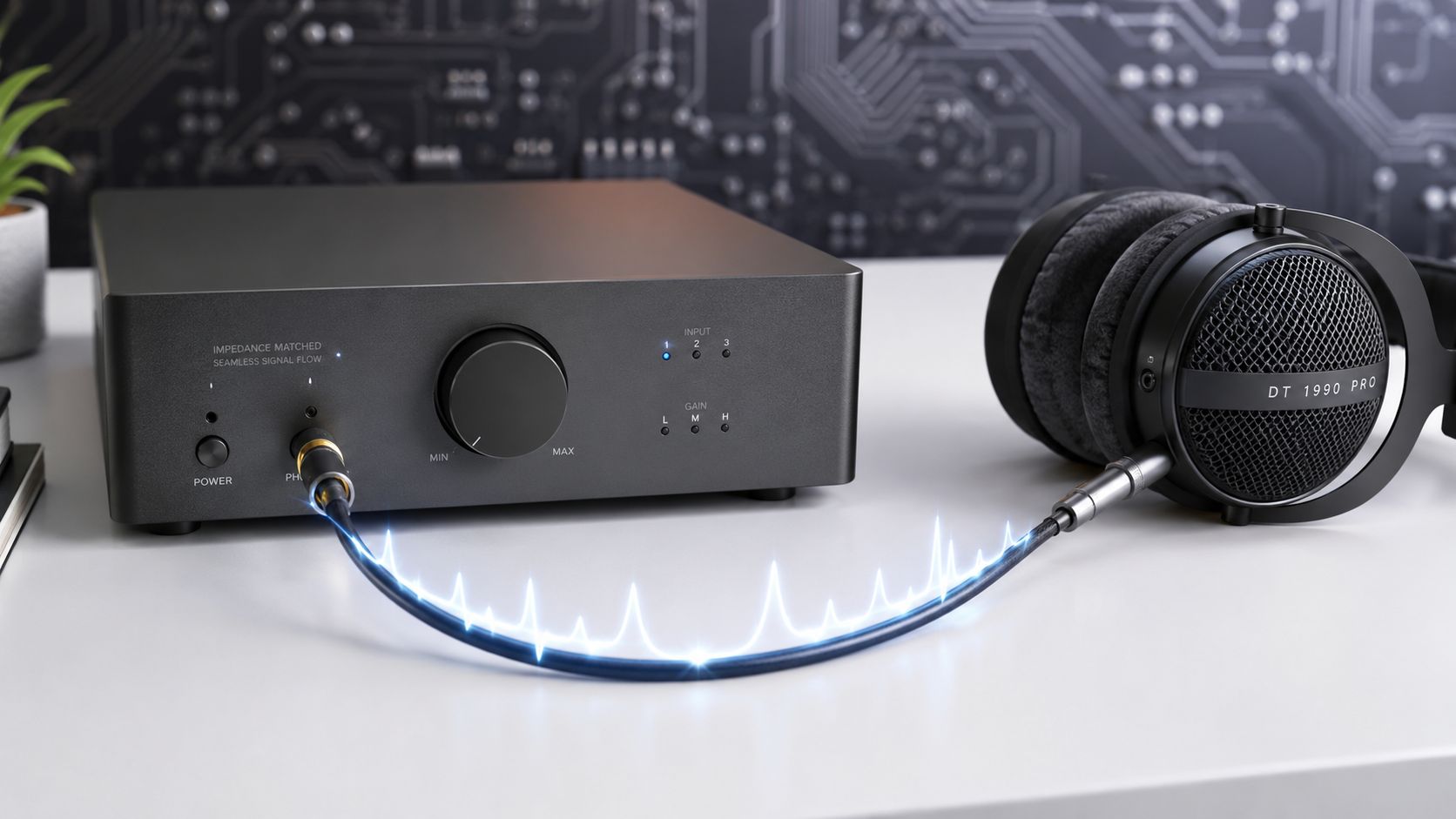
What Is Impedance Matching? It's the practice of aligning a source's output impedance with a load's input impedance so power transfer and signal reflections behave the way you want. In most modern audio gear, though, you're not chasing maximum power transfer, you're bridging voltage, and that's a very different animal.
The old advice gets repeated like it's sacred. In reality, impedance matching is a context tool, not a universal rule, and if you apply it blindly to a solid-state headphone amp, you can end up worrying about a problem that isn't there.
Table of Contents
- Impedance Matching Is Not the Universal Rule You Were Told
- The Electrical Theory Without the Textbook Pain
- Maximum Power Transfer Versus Voltage Bridging
- How Impedance Shows Up in Real Audio Gear
- Audiophile Myths About Impedance That Need to Die
- Practical Diagnostic Checks and Real-World Fixes
- From the Smith Chart to Adaptive Matching Systems
Impedance Matching Is Not the Universal Rule You Were Told
Impedance matching sounds like one of those audio commandments people toss around to sound serious. In practice, it only matters when the system's physics demand it. Radio-frequency lines, transmission paths, and some older amplifier topologies care a lot. Your modern solid-state headphone amp usually doesn't.
The phrase means less than the folklore says
At the simplest level, impedance matching means making the source and load play nicely so power transfer and reflections are controlled. That became a formal engineering problem in the late 1930s, when Philip H. Smith's chart turned a nasty complex-number problem into a usable design tool, right as radio and radar were exploding in importance History of Broadband Impedance Matching. The same era also gave engineers Darlington's theorem, which mattered for how real reactive networks could be represented and solved History of Broadband Impedance Matching.
But the hi-fi internet often smears that RF logic across every audio connection. That's the mistake. In most consumer audio, the source should have a low output impedance and the load should have a high input impedance, so voltage passes cleanly without you trying to wring maximum power from the interface.
Practical rule: If the connection is short, line-level, and solid-state on both ends, matching is usually the wrong mental model. Bridging is the right one.
Where matching still earns its keep
Matching still matters when the cable behaves like a transmission line, when reflections become audible or destructive, or when the amplifier topology itself wants a specific load. That's why the old language survives in RF, in tube output stages, and in certain long-run or high-frequency situations. It also explains why so much audio advice sounds half right and fully misapplied.
A lot of SEO content wants a clean universal answer because Google likes tidy answers. Real gear doesn't care about our neat little boxes. It cares about what the circuit downstream inherits.
The Electrical Theory Without the Textbook Pain
Think of impedance as the load-bearing floor under the signal path. Voltage sits on that floor, current moves across it, and the load decides how easily the source can push energy through. If the floor sags, the whole structure changes.
Resistance isn't the whole story
Resistance is the simple part. Reactance is the part that shifts with frequency, which is why impedance isn't just a fixed number you can tattoo on the back of a rack unit and forget. Audio signals aren't clean laboratory tones, they're messy, frequency-rich shapes, so the load changes as the music changes.
That's where people get tripped up. A speaker or headphone can look polite at one frequency and stubborn at another. The amp doesn't see one flat wall, it sees a moving target.
The classic maximum power transfer idea is straightforward enough. When source and load impedances are equal, maximum power reaches the load. The catch is ugly and important, because the matched case is only 50% efficient. Half the power is burned in the source, half makes it to the load Origin of Impedance Matching in RF Design.
Why that 50% matters
That number is the whole reason audio people stopped treating matching as a moral absolute in many systems. If you're trying to preserve voltage integrity for a line-level connection, maximizing transfer in the RF sense is the wrong prize. You don't want to waste half the available power just to satisfy an old rule.

The better question is not “Is it matched?” It's “What does this connection need to do, and what does the load demand?”
Maximum Power Transfer Versus Voltage Bridging
The useful split is simple. Maximum power transfer belongs to systems where reflections, line integrity, or specific output stages make the load part of the design problem. Voltage bridging belongs to modern audio chains where the source hands off signal voltage and the load barely leans on it.
Two approaches, two jobs
Here's the cleanest way I know to separate them:
| Criterion | Maximum Power Transfer | Voltage Bridging |
|---|---|---|
| Goal | Push the most power into the load | Pass voltage cleanly into a light load |
| Typical fit | RF lines, some transformer-coupled stages, long or sensitive transmission paths | Modern solid-state audio, line outputs, many headphone chains |
| Efficiency profile | Equal impedances; ideal efficiency is 50% | Source stays low, load stays high, power loss stays low |
| What goes wrong | Reflections, loss, or stage stress | Frequency response shifts only if the load gets too close or too weird |
| Listener's experience | Broken integrity, unstable behavior, or weak delivery | Usually nothing, until the downstream load starts pulling the floor around |
That is why a clean solid-state interface output does not need to “match” your monitor in the old sense. It needs to stay comfortably below the load, so the load does not drag the source around.
A lot of confusion comes from treating every connection like a transmission-line problem. In audio, that is often the wrong model. The amplifier should act like a steady source, not a participant in a tug-of-war.
A practical listener's shortcut
If the system is designed to bridge, the source should look boring and the load should do the work. If the system is designed to match, the interface itself is part of the sound path and the rules get stricter.
Short version: Matching chases transfer. Bridging protects voltage.
That difference matters in headphone work, especially with higher-impedance loads that make amplifier behavior easier to hear. My practical notes on that are here: my headphone amp guide for high-impedance loads.
How Impedance Shows Up in Real Audio Gear
The theory stops being decorative when we look at practical devices. Loudspeakers, headphones, interfaces, and cartridges all expose impedance in different ways, and the bad advice starts when people pretend those differences don't exist.
Speakers and headphone amps do not behave the same
With speakers, impedance interacts with the amplifier's control over the driver, especially as the speaker's impedance curve rises and dips. When the match goes sideways, you can hear it as looser bass, shifted balance, or an amp that sounds less composed when the music gets dense. With headphones, output impedance matters most when it collides with the headphone's own impedance curve, and that can tilt the tonal balance enough to matter.
If you want the headphone-specific version of that, this internal guide helps: what impedance means in headphones.
Pro audio line-level gear is simpler. Line outputs usually want to see a high input impedance on the other end, so the source doesn't get loaded down. When that works, the result is clean, stable, and boring in the best possible way.
Where the mismatch becomes audible
Turntable cartridge loading is the oddball in the room. The impedance relationship there can affect tonal shape and perceived openness more directly than most casual listeners expect. Get it wrong, and the top end can feel closed in or a little wiry.
The practical lesson is that mismatch isn't automatically a disaster. Some mismatches are benign, some are audible, and some are the reason a setup sounds flat or edgy even when every box is expensive.
Here's the listening cue I use: if the sound loses texture, the bass stops gripping, or the highs feel pinched and not just “different,” impedance deserves a look. If everything still images cleanly and the tonal balance stays stable, you're probably fine.
When the gear is set up right, you don't hear impedance. You hear music.
For a visual check on the connection between amplifier and speaker, this is the right frame of reference.
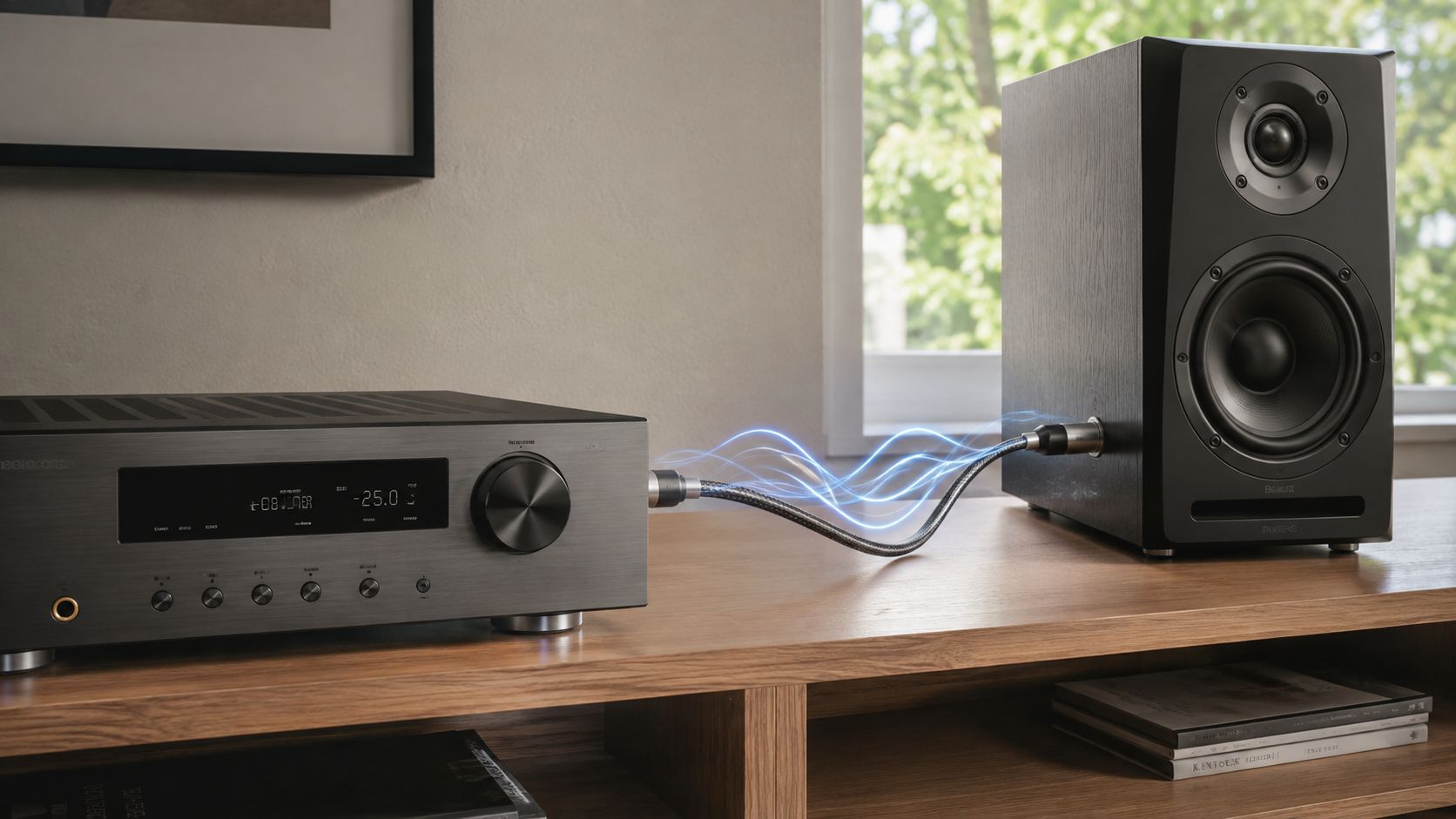
If you prefer watching the idea mapped onto real gear, this embedded video does the job without the usual audiophile fog.
Audiophile Myths About Impedance That Need to Die
The first myth is that you always need to match impedance. You don't. That rule belongs to contexts where reflections or power transfer dominate, not to every headphone jack and every line output in the room.
The folklore sounds confident, then falls apart
The second myth is that higher impedance headphones are automatically better. That's nonsense dressed up as wisdom. Impedance tells you how a load behaves electrically, not whether it will sound cleaner, more resolving, or more musical.
The third myth is that low output impedance specs are meaningless if they're “low enough.” That's sloppy thinking. Output impedance still matters when it starts interacting with the load's impedance curve, because the downstream device inherits that relationship and the tonal balance can move with it.
The fourth myth is that cable impedance matters in short analog audio runs like it's some hidden gremlin. In ordinary short runs, that's usually superstition, not a load-bearing problem. The cable is not the main character.
If a claim sounds universal, treat it like a sales pitch until the circuit proves it.
What actually matters instead
The key question is whether the source can maintain control of the load. If it can, the system performs as expected. If it can't, the frequency response can tilt, damping can soften, and the sound can lose grip.
That's why I trust the relationship between source and load more than I trust the badge on the headphone shell. A 32-ohm headphone is not inferior by default, and a 300-ohm headphone is not holy by default. The only honest answer is how the amp and load behave together.
A lot of audiophile folklore survives because it feels like certainty. Real audio is more annoying than that. It's conditional.
Practical Diagnostic Checks and Real-World Fixes
Start with the output impedance spec of the amp or interface. If the manufacturer publishes it, use it. If they don't, that silence is a clue, not a green light.
What to check before you buy
- Find the output impedance: Look for the number in the manual or spec sheet, because that's the source side of the relationship.
- Check the load curve: For headphones and speakers, the impedance curve tells you where the load gets tricky, not just where the nominal number sits.
- Listen for tonal shifts: Rolled-off highs, looser bass, or a pinched upper midrange often tell you more than a badge does.
- Stop if the system already behaves: If the amp drives the load cleanly and the sound stays stable, don't create a problem out of habit.
For speaker matching in a practical purchase context, this internal guide stays useful: best amp for bookshelf speakers.
What to do when the match is genuinely wrong
If the mismatch is audible, choose gear with a more appropriate output impedance for the load. In specific RF or transformer-coupled cases, an impedance-matching transformer or network may be the right fix. In most consumer audio chains, though, the simpler move is to stop forcing the wrong interface and pick the right one instead.
If you want a practical editorial option for a site that covers this stuff, Supermarket Sound also publishes plain-language guides that help readers sort usable advice from folklore. That matters because the internet sells certainty, and the gear rewards fit.
Use this decision rule and you'll save yourself a lot of bad chasing:
If the source is low-impedance, the load is high-impedance, and the sound stays balanced, leave it alone.
If the sound changes with the load, the circuit is telling you something.
From the Smith Chart to Adaptive Matching Systems
Impedance matching started as a hard engineering problem, not an audiophile vibe. Smith's chart in 1939 turned complex math into a graphical tool during the radar boom of World War II, and that wartime pressure pushed matching into mainstream engineering practice History of Broadband Impedance Matching.
The future looks less static. A 2024 acoustic study describes load variation and increased transducer temperature changing impedance characteristics in ways that can reduce stability and machining efficiency dynamic impedance matching method for acoustic systems. That's the modern turn, matching that adapts instead of pretending the load stays still.
The old chart still matters. The new trick is knowing when the load moves under you.
If you're shopping gear today, stop asking whether impedance matching is always required. Ask whether your connection needs maximum power transfer or voltage bridging, then pick the circuit that actually fits the load.

