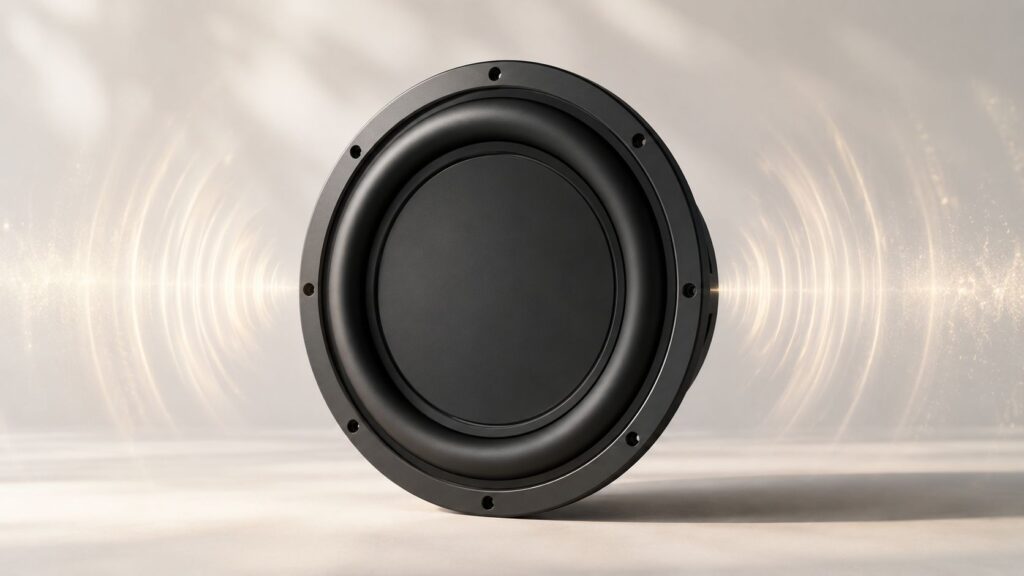
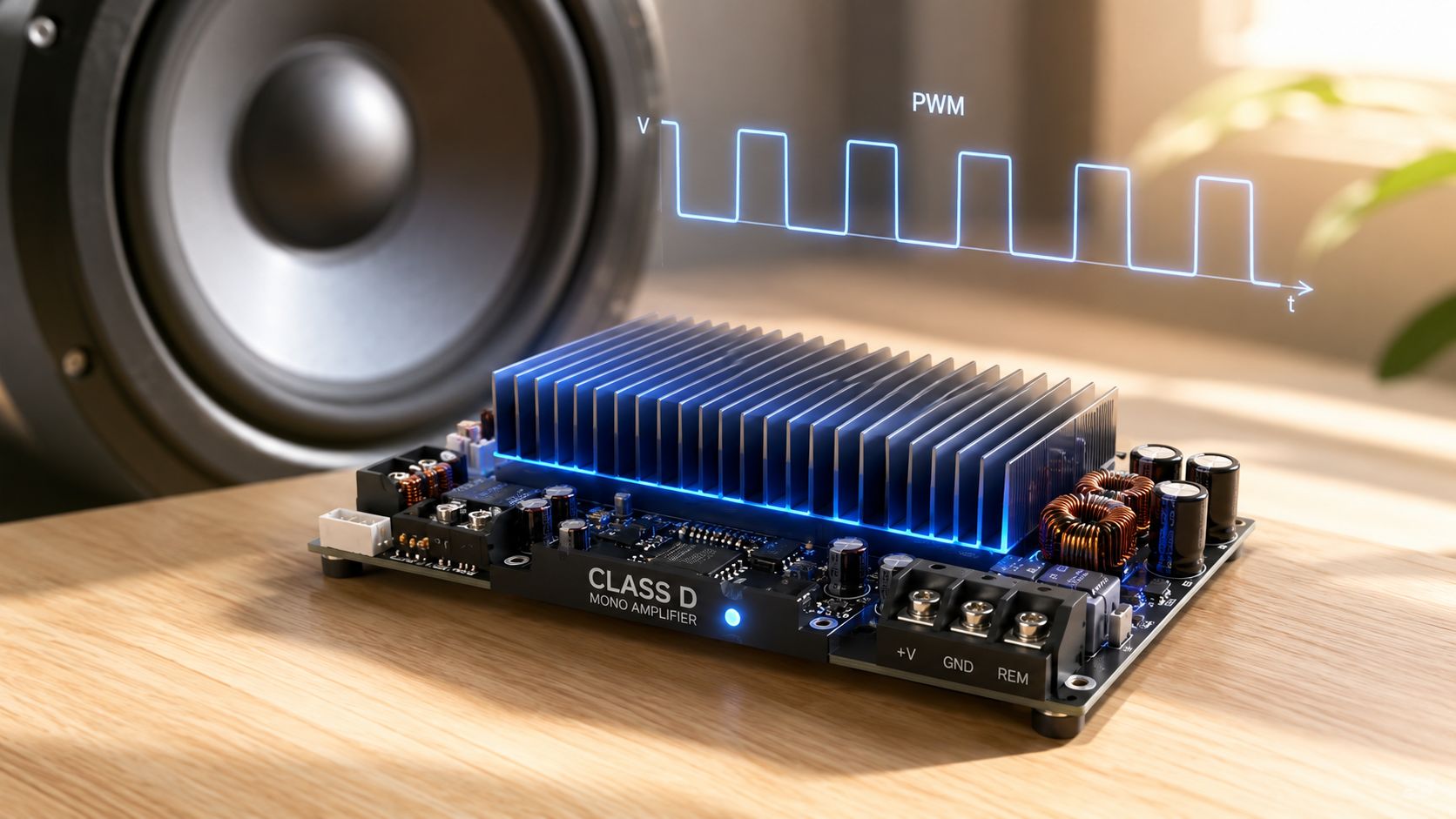
The worst advice around a mono Class D amplifier is still the oldest one, the idea that it's “digital” and therefore somehow less real. That myth survives because people hear the letter D and start inventing a signal path that isn't there. This is simpler and more useful. Class D is a switching amplifier, and in the mono form it's a load-bearing answer to heat, size, and current delivery, not a polite compromise for people who ran out of rack space.
I've unboxed enough of these little brick-shaped bastards to know why the prejudice lingers. They look too tidy to be serious, then they run cool while older linear stages sit there cooking the shelf. If you care about subwoofers, that matters more than the romance of a glowing chassis. The same thing happens to the sound, because the room doesn't reward mythology, it rewards control.
Table of Contents
- The Letter D Does Not Mean Digital
- Switching Topology Versus Linear Heat
- Why Mono Is the Right Architecture for Bass
- Bench Measurements Versus the Listening Seat
- Matching Impedance and Managing the Power Envelope
- What to Expect When You Press Play
- Buying Guidance Framed by Taste and System Fit
The Letter D Does Not Mean Digital
The letter D does not mean digital. It's just the next amplifier class label after A, B, and C, and the whole “digital amp” myth has wasted a ridiculous amount of time in audio forums. A mono Class D amplifier can take an analog input and still use a pulse-width-modulated output stage. That's not a CD in a hoodie. It's a switching output stage doing what switching output stages do.
That distinction matters because it changes how you judge the part. You are not buying a tiny computer hidden inside a speaker box. You're buying an amplifier that moves the ugly work of power conversion downstream, where it belongs, instead of dumping it into the room as heat. That's why the category deserved serious respect years ago, and why it still does.
If you want a longer argument about the sound question itself, I've already written that up here.
The label is the mistake, not the topology
When people call Class D “digital,” they usually mean “modern” or “small” or “efficient,” and then they smuggle in suspicion with the praise. That's lazy. The topology is doing a very old engineering job, turning supply power into motion with less waste, and it does that job with ruthless practicality.
The useful way to think about it is not digital versus analog, but switching versus linear. Linear amps burn excess as heat. Switching amps don't need to. That's the floor, and everything else hangs from it.
The room tells on the myth
A subwoofer doesn't care about forum language. It cares whether the amp can stay composed when the driver asks for current and the cabinet fights back. That's where mono Class D earns its keep. In the hand, these amps feel almost suspiciously light for the output they promise. In the room, the lack of heat is not cosmetic. It changes where you can place the amp, how long you can run it, and how hard it can work before thermal baggage gets in the way.
Practical rule: if a piece of gear makes you uncomfortable because it looks too efficient, you're probably reacting to old habits, not engineering.
Class D is not magic. It's discipline.
Switching Topology Versus Linear Heat
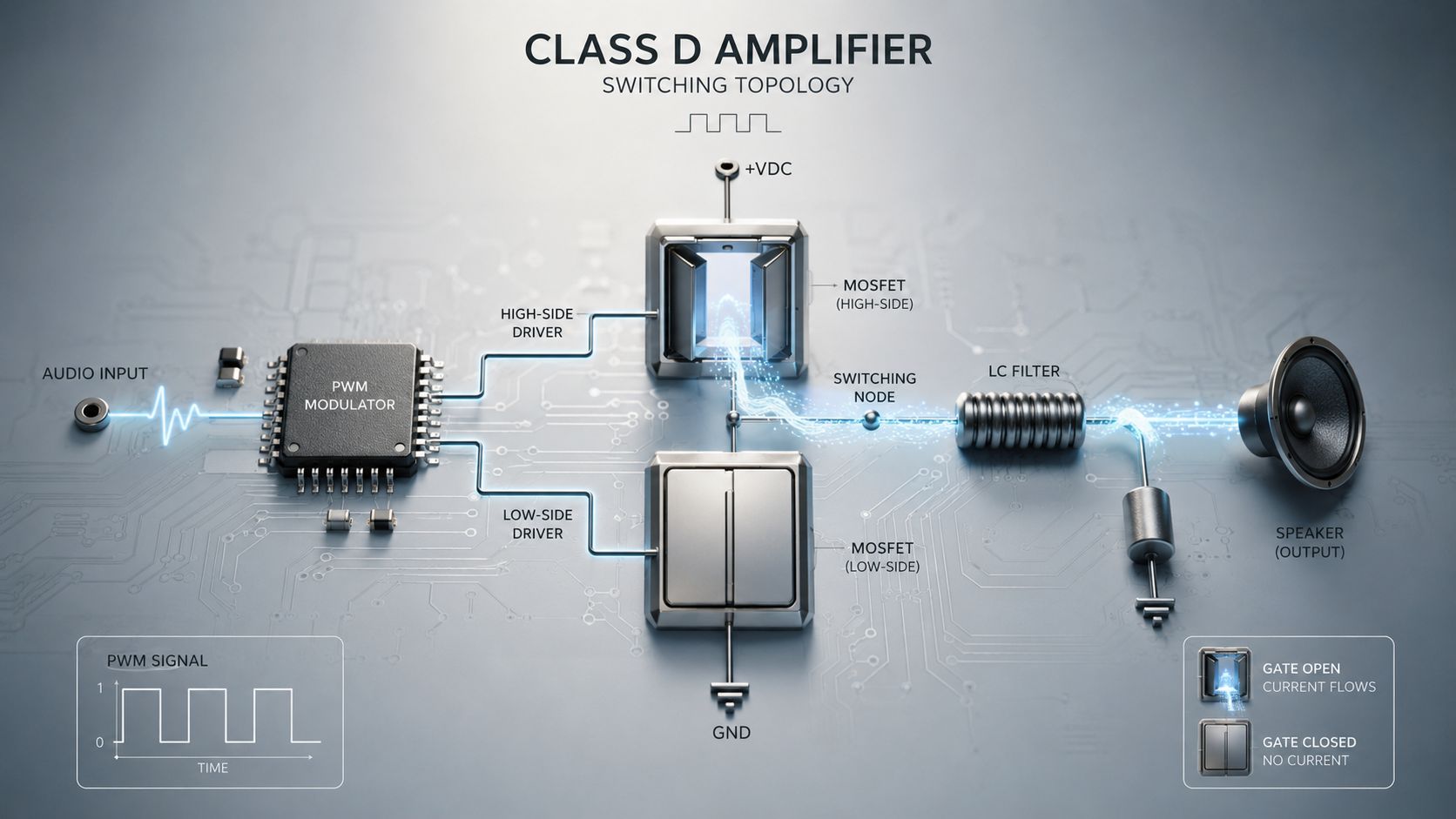
A switching amplifier behaves like a light switch rather than a dimmer knob. The output devices spend their time fully on or fully off, which is why practical designs can get so close to the theoretical ceiling. Analog Devices notes that practical Class D designs can reach about 90% efficiency at clipping, while a Class A stage sits around 25% and Class B around 78.5% in the same comparison, and that gap is the whole story, not a side note. On a realistic 10 W amplifier with an average 1 W load, ADI says the Class D output stage dissipates only 282 mW, versus 2.53 W for Class B and 30.2 W for Class A, with Class D still at 78% efficiency at that low-power point. Analog Devices Class D amplifier overview
That is why the category displaced so much heavy iron. You get serious output without turning the chassis into a radiator. The switching complexity still exists, but it lives downstream in the output filter and control scheme, not as room heat and wasted wall power. The ear does not care about the inconvenience. It cares about whether the amp survives the job.
The penalty moves, it doesn't vanish
That is the part spec-sheet worship misses. The losses do not disappear. They move. A linear amp spends them as heat in the output devices. A switching amp pushes the mess into filtering, timing, and load interaction. The result is still load-bearing efficiency, but you do not get it for free. You get it because the design accepts complexity where it does the least harm.
I have seen enough cheap implementations to know that not every Class D amp earns that bargain. When the output stage is sloppy, the sound can lose texture and feel pinned to the plane of the speaker. When it is done right, the bass stays composed and the cabinet feels like it has been told the rules. That difference is why some people hear Class D as “dry.” It is not dry by nature. It is unforgiving when the designer cuts corners.
For a straight comparison of how Class A, Class B, and Class C behave on the heat side of the trade-off, this breakdown of amplifier classes is the cleaner reference point.
The numbers explain the shelf space
The modern mono Class D amplifier became a serious power platform because it scaled. NXP's TDA8954 data sheet shows 1 × 420 W into 8 Ω in mono bridge-tied-load mode, and the same part is rated around 93% efficiency into a 4 Ω load in stereo operation. Texas Instruments' TPA2001D1 went the other direction, as a 1 W filterless mono Class D amplifier with 75–85% efficiency into 8 Ω. The category stretched from tiny portable parts to absurdly muscular mono BTL designs, and that tells you why it won.
A good Class D amp does not cheat heat. It removes the reason heat mattered in the first place.
That is the story. The floor moved.
Why Mono Is the Right Architecture for Bass
Bass doesn't need stereo theater. It needs current, grip, and enough headroom to stay composed when the impedance curve gets rude. That's why a mono Class D amplifier is not just a stereo amp with one channel abandoned in a drawer. It's the correct architecture for a subwoofer because the job is to move air, not paint left-right illusions that vanish below the crossover point.
The best mono blocks also make more sense in bridged-tied-load form, because bridge operation lets the amp turn supply voltage into usable output more effectively. ST's TDA7498MV is a clean example of where this architecture lands when current delivery matters, with 100 W into 6 Ω at 36 V, 80 W into 8 Ω at 34 V, 90% efficiency, and selectable gains from 25.6 dB to 37.6 dB. ST TDA7498MV data sheet That kind of scaling is why mono Class D became normal in bass duties instead of remaining a clever laboratory trick.
A subwoofer is not a polite load
A subwoofer cabinet is often the least polite thing in the system. Port tuning, impedance dips, and room gain all conspire to make the amp work harder than a brochure suggests. That's where mono matters. You want one power stage thinking about one ugly load, not a stereo chassis pretending the second channel isn't along for the ride.
I've matched mono blocks to ported subs that dipped hard around tuning, and the difference between enough current and almost enough current is not subtle. Enough current gives you bass that starts cleanly and stops on command. Not enough current gives you that smeared, wheezy, slightly embarrassed low end people blame on the room because they don't want to blame the amp.
Mono is about allocation, not austerity
A lot of buyers treat mono as a downgrade because they assume stereo equals premium. That's nonsense for bass. The sub doesn't need a stage image. It needs a dedicated budget for power delivery, thermal management, and control. When you allocate the whole amp to one job, you stop wasting design headroom on features the driver can't use.
Practical rule: if the job is a subwoofer, spend your engineering budget on current delivery before you spend it on cosmetics.
That's where mono earns the rack space. It's not smaller because it's weaker. It's smaller because it's not wasting effort on the wrong problem.
Bench Measurements Versus the Listening Seat
A mono Class D amplifier can look immaculate on a bench and still behave differently on a real subwoofer. That's not a contradiction. It's the difference between a resistive dummy load and a reactive speaker load. The bench wants certainty. The cabinet offers motion, back-EMF, and impedance that shifts with frequency. Downstream inherits that mess.
The output filter is where this becomes audible. A well-designed filter and feedback scheme keeps the amp's behavior stable as the load changes. A poorer one can make bass feel flatter, less textured, or weirdly detached from the room. That's why “excellent THD+N” doesn't end the conversation. It's only one measurement in a system that lives in the world.
The ear hears behavior, not graphs
I care about bass that has weight, not just amplitude. A good Class D amp gives a driver a tight hand on the reins. Kick drum starts with shape. Synth bass carries texture instead of sludge. The room fills, but it doesn't blur. That's the sound people call fast, and I use the word because it points at something real, even if audio snobs pretend they're above it.
Cheaper implementations can go gray. They don't always distort in an obvious way, which is why they fool people on first listen. The bass is there, but it doesn't breathe. The attack lands, then the note seems to lose its outline before it decays. You don't need golden ears to hear that. You need a few albums and a system you know.
The hard part is robustness
The under-discussed issue is not headline distortion, it's how the amp behaves when the woofer pushes back. That's where load impedance and damping meet the output filter. If the design is solid, the amp stays calm and the sub stays obedient. If it isn't, the listening seat gets the punishment even though the spec sheet still looks clean.
That's why I distrust bench worship when the conversation is bass. Measurements matter. They just don't get to be the whole religion. A speaker is a living load, not a spreadsheet cell.
The amp you want is the one that stays boring when the sub gets difficult.
Boring is good. Boring means control.
Matching Impedance and Managing the Power Envelope
The load and the supply set the ceiling. The class only tells you how efficiently you reach it. That's the practical rule that keeps people from buying the wrong mono Class D amplifier for the wrong cabinet and then blaming the topology. Analog Devices' MAX98300 runs from 2.6 V to 5.5 V, draws only 1.1 to 2.0 mA quiescent current at 5.0 V, and reaches 2.6 W output, which is exactly what you expect from a low-idle, compact design with limited headroom. At the high end, ST's TDA7498MV shows the opposite reality, a 100 W mono BTL part at 36 V into 6 Ω with 90% efficiency. Same class. Totally different power envelope.
Read the data sheet for the boring numbers
If you're choosing one of these amps, do not start with the biggest wattage line in the marketing copy. Start with supply voltage, load impedance, and quiescent draw. Those are the numbers that tell you whether the amp fits the build. A battery-powered setup and a fixed home theater sub are not asking for the same thing, even if the class label is identical.
A few practical checks keep the whole thing honest:
- Match the supply to the ceiling. Low voltage keeps things compact, but it also limits headroom.
- Respect the load impedance. A sub that sags hard is not the place for wishful thinking.
- Watch quiescent current. In always-on or portable installs, idle drain matters as much as output.
- Leave wiring sane. Short, twisted speaker runs help keep the amp from spraying noise where it does not belong.
The wiring is part of the sound
That last point gets ignored because it does not sound sexy. Too bad. Bass systems punish sloppy wiring. Long speaker leads and weak power delivery starve the signal when current demand jumps. Bass then sounds softer than it should, and people start inventing mystical explanations. The cause is usually more mundane. The amp wanted clean power, and the install got cute.
I keep the leads short and the power supply honest. That is not audiophile theater. That is common sense. The amp can only deliver what the supply can stand to give.
What to Expect When You Press Play
A good mono Class D amplifier doesn't sound like a trick. It sounds like the low end has been told to sit up straight. Bass notes arrive with a crisp edge, then settle into the room with less smear than many people expect from a small box doing hard work. The sensation is not “digital,” whatever that word is supposed to mean in a barroom argument. It's composed.
The main impression I get, when the implementation is right, is grip. The woofer doesn't wag around after the note should be over. Kick drums feel punctual. Synth lines have contour. The space around the bass opens because the amp isn't smearing the floor under the rest of the mix.
The bad versions fail in a very specific way
When a Class D amp is mediocre, it often sounds clean on first listen and hollow on second. The bass is tight but not alive. It has edges, but not body. That's the “dry” complaint in plain English. I've heard enough of those units to know the problem isn't the class. It's the design around the class, usually the output filter behavior or the way the load is being handled.
If the amp is well matched to the sub, the low end stops feeling like a separate object in the room. It blends. The system gets calmer. You stop hearing the amplifier and start hearing the recording's actual bass shape.
Trust the seat, not the slogan
Listening for hours matters more than staring at plots. Specs can tell you whether an amp is likely to be competent. They can't tell you whether the bass will bloom naturally in your room or stop too abruptly and leave the system sounding lean. Those are ear-level questions, not marketing questions.
If you're auditioning one, listen for three things. Does the bass have weight? Does it keep its outline when the arrangement gets busy? Does the amp disappear, or does it leave a fingerprint? The right answer is the boring one. Disappear.
Buying Guidance Framed by Taste and System Fit
There's no universal “best” mono Class D amplifier, and anybody selling that idea is usually selling something else too. The right choice depends on the subwoofer, the room, the power source, and how much thermal breathing room you have. A compact portable chip and a high-power mono BTL module live in the same family, but they do not belong in the same conversation unless the system is tiny.
Taste still matters. Some listeners prefer the softness and warmth they associate with Class AB, even when the cleaner, cooler, more controlled presentation of Class D is technically the better fit for the job. That preference is real. I'm not interested in arguing someone out of their own ears.
Buy for the room you own
A living room with one demanding sub does not need the same amplifier as a portable rig or a rack that runs all day. If the amp sits where heat becomes a problem, efficiency stops being a spec and becomes a design requirement. If the sub is difficult to drive, current delivery comes first. If the system is simple and the load is modest, smaller Class D parts make a lot of sense because they stay cool and stay out of the way.
I'd rather see someone buy the right power envelope with sane headroom than chase a wattage number that only makes sense on a box. Bigger isn't better if the amp never gets to use the power cleanly.
Let the system decide
The useful question is not “How much power can this class make?” It's “What does this room and load ask for?” That answer changes with cabinet design, crossover point, supply voltage, and how hard you listen. The class label tells you the efficiency strategy. It doesn't choose the rest of the system for you.
And that's fine. Real hi-fi is always a series of compromises that only sound like compromises if you picked the wrong ones.
If you're narrowing down a mono Class D amplifier for a subwoofer system, spend the next hour on the boring stuff, supply voltage, load impedance, and thermal fit, then trust your ears in the room. If you want more of this kind of blunt, listener-first gear talk, keep an eye on Supermarket Sound and the next round of hands-on notes from Marque Hersh.

