Most turntable buying advice starts in the wrong place. It asks whether you want belt drive or direct drive, then marches you toward a price tier as if the deck lives alone in a glass case. It doesn't. A turntable is the first load-bearing part of a chain, and the rest of that chain, plus the room beneath it, decides whether your records sound open and alive or thin, nervous, and vaguely metallic.
I'm Marque Hersh, founder of Supermarket Sound. I care about the ritual, but I care more about the result. The right turntable makes a piano note hang in the air like warm brass, keeps a bass line rooted instead of woolly, and lets a vocal occupy a human-sized space. The wrong one turns every downstream component into cleanup duty.
Table of Contents
- The Real Question Behind How to Choose a Turntable
- Start With Your Use Case, Not the Spec Sheet
- Tonearm, Cartridge, Speed, and Drive Type Explained
- The Signal Chain That Actually Makes It Sing
- Bluetooth, USB, and Built-In Phono Stages as Trade-Offs
- Setup Precision as Part of the Purchase
- Audition, Room Reality, and the Final Checklist
The Real Question Behind How to Choose a Turntable
The question isn't “which turntable is best?” It's what does the rest of your system need from the turntable?
That distinction matters because this is a live hardware category, not a museum shelf. One independent estimate places the global turntable market at about USD 1.41 billion in 2025, with a projection of USD 2.72 billion by 2032 at a 9.6% CAGR. A separate forecast for the related hi-fi vinyl turntable market puts it at USD 1,314 million in 2024, USD 1,448 million in 2025, and USD 2,654 million by 2032, with a 10.8% CAGR. Those projections come from independent turntable market estimates and a separate vinyl turntable market forecast.
That scale creates real choice, and real choice creates real trade-offs. Buyers should judge a deck by build quality, drive system, speed control, cartridge support, and isolation, not by fetishizing one shiny specification. A turntable is load-bearing hardware. If its speed wanders, its tonearm mistracks, or its phono stage starves the signal, better speakers only make the problem easier to hear.
Spec sheets are only one room in the house
The cartridge shapes the contact between stylus and groove. The phono stage raises that tiny signal and corrects its tonal balance. The amplifier supplies current, the speakers turn voltage into air movement, and the room decides whether that air movement arrives as music or as a soup of reflections.
Change one variable and everything downstream inherits it. A mid-range deck with a bright, underpowered phono stage can make a familiar vocal sound like it's been scrubbed with glass. The same deck, properly loaded and isolated, may give you a denser center image, rounder cymbals, and bass that feels poured rather than pushed.
That's why “best turntable” lists often function as marketing theater. They rank the chassis while ignoring the floor, the furniture, the input sensitivity, and the speakers already in your room. I know the commercial reality here. Search engines like clean winners, and readers like simple answers. But a simple answer can be an expensive wrong turn.
Practical rule: Buy the system the deck will join, not the product photograph you happen to like.
The category is healthy. Your shortlist still needs discipline.
Start With Your Use Case, Not the Spec Sheet
Before you compare a single model, make three decisions. Do them in this order, because each one removes bad options before marketing gets a chance to seduce you.
Decide what kind of records you'll actually play
If your collection centers on 12-inch LPs for seated listening, prioritize stable speed, a competent tonearm, replaceable cartridge support, and serious isolation. That combination helps a sustained piano chord remain steady, keeps a singer's vibrato natural, and prevents quiet passages from filling with mechanical haze.
Seven-inch singles create a different priority. You'll care more about reliable speed selection, easy cueing, and a platter or spindle arrangement that makes frequent record changes painless. If you're working with 78s, standard modern playback assumptions stop applying. You need a deck and stylus arrangement designed for that format rather than a machine that merely spins at a different setting.
Digitizing a library changes the brief again. USB output may matter, but only if you'll connect the deck to a computer and manage the files. A turntable that promises every feature can still be a poor choice if its core playback is noisy or its cartridge can't be replaced.
Shape the budget around the chain
Never spend the whole budget on the deck. Reserve room for the cartridge, phono stage if needed, isolation, a stylus gauge, alignment tools, and sensible cables. The exact balance depends on what you already own, but the principle doesn't move.
A deck with a strong arm and replaceable cartridge can grow with you. A sealed all-in-one player may feel cheap at checkout and expensive later, because you eventually replace the whole thing instead of upgrading the part that limits it.
Budget for the first setup, then budget for the next sensible upgrade. That usually means choosing a sturdy platform and a cartridge path before paying extra for decorative finishes or wireless controls.
Place the deck inside your existing system
Look at the amplifier, speakers, and room before you look at the turntable. If you use powered speakers, the deck must provide a usable line-level signal through a built-in phono stage or an external one. If your receiver already has a phono input, that feature may be redundant.
Your room matters just as much. A suspended wooden floor, thin walls, or a walkway near the rack can turn footfall into a low-frequency thump. A rigid floor and heavy furniture give you more freedom, but they don't excuse placing the deck directly beside a speaker cabinet.
A beautiful turntable in the wrong system is still the wrong turntable.
Tonearm, Cartridge, Speed, and Drive Type Explained
The mechanical core decides whether the stylus can follow the groove without turning music into friction. Belt drive and direct drive aren't moral categories. They're engineering choices with different strengths.
A belt-drive design places the motor away from the platter and uses a belt to transfer motion. A direct-drive design places the platter directly on the motor. Some direct-drive tables use quartz-lock systems that compare platter speed against a quartz crystal clock and correct it in real time, as explained in this overview of direct-drive and belt-drive mechanisms.
Drive type changes behavior before it changes flavor
Belt drive can reduce the motor's physical connection to the platter, which may lower the sense of mechanical grain in a quiet room. When it works well, the presentation feels relaxed and spacious, with a blacker gap around instruments. When the belt slips, stretches, or receives poor tension, the music can acquire a faintly seasick pitch movement.
Direct drive usually gives you immediate start-up and firm speed control. That precision can make bass notes feel planted and rhythms snap into focus. Poorly executed designs can transmit motor vibration into the platter, though, and that vibration may harden the midrange or blur low-level detail.
Don't choose based on folklore. Choose based on the motor implementation, platter bearing, speed control, intended use, and support for the cartridge you want.
Speed stability is audible
Published wow-and-flutter figures vary between models. One example belt-drive specification lists 0.25% at 33⅓ rpm and 0.23% at 45 rpm, while another direct-drive-oriented model lists under 0.20% weighted wow and flutter at 3 kHz. These figures appear in the published turntable specifications. Lower is generally the cleaner choice when you care about piano sustain, held strings, and vocal steadiness.
Pitch accuracy and wow and flutter overlap, but they aren't the same listening experience. A deck can hit the nominal speed while still producing small cyclic variations that make long notes shimmer at the edges. Listen for the piano, not the marketing adjective.
The tonearm is the cartridge's working environment
Tonearm geometry, effective mass, bearing quality, and adjustment range determine how safely a cartridge operates. A cartridge with high compliance may prefer a lower-mass arm, while a stiffer cartridge may behave better with more effective mass. Compatibility isn't just a matter of mounting holes.
Tracking force controls how firmly the stylus sits in the groove. Too little force can cause mistracking, where loud passages spit, crackle, or flatten into a brittle smear. Too much force can increase stylus and record wear. Start within the manufacturer's recommended range, generally around its middle when you need a sensible baseline, then verify the result rather than trusting a printed dial.
Anti-skate counters the inward pull that acts on the arm during playback. A common starting point sets anti-skate to the same numeric value as tracking force, a recommendation repeated in Audio-Technica's setup guidance. Refine it with a test record or a suitable blank groove, then listen for balanced channel behavior.
VTA and cartridge alignment matter too. A cartridge that sits at the wrong angle can make cymbals splash, vocals lose focus, and inner-groove passages sound pinched. For a deeper cartridge-specific guide, use Supermarket Sound's turntable cartridge guide.
The cartridge doesn't float above the arm. It lives or dies by it.
The Signal Chain That Actually Makes It Sing
The stylus reads the groove, the cartridge converts movement into an electrical signal, the phono stage raises that signal to line level and applies inverse RIAA equalization, the amplifier adds power, and the speakers move air. Miss one link and the record may still play, but it won't communicate cleanly.
A phono stage matters because the cartridge's output is tiny and the record's tonal balance needs correction. A deck with a built-in phono preamp can feed a line input. A deck without one needs a receiver with a phono input or a separate phono preamp, as described in this turntable connection guide.
Match the cartridge to the phono input
Moving-magnet cartridges usually offer a straightforward starting point. Moving-coil cartridges can demand different gain, loading, and noise performance, so an MM-only input won't automatically serve them properly. MC-capable phono stages and step-up transformers form separate paths, not magic switches.
| Cartridge Type | Output (mV) | Needs | Added System Cost |
|---|---|---|---|
| Moving magnet | Moderate | MM phono input or suitable phono stage | Often contained in the initial setup |
| High-output moving coil | Higher than low-output MC | MM-compatible stage in many systems, subject to cartridge requirements | May require a cartridge-specific upgrade |
| Low-output moving coil | Low | MC-capable phono stage or step-up transformer with an appropriate phono stage | Can add roughly $300-$800 to system cost, as noted in this turntable buying guidance |
The table's exact electrical match depends on the cartridge manufacturer's requirements. The practical point is simple. Don't buy a low-output MC because its name sounds serious, then feed it into an input that can't give it enough gain or the right load.
Hidden cost lives after checkout
A $400 deck paired with a $250 phono preamp and $150 in cables totals $800. That example is arithmetic, not a market average. It shows why the deck price alone lies by omission.
The phono stage often becomes the most impactful upgrade after the cartridge. A poor one can add hiss, flatten spatial depth, or make the upper midrange feel like a fluorescent light. A coherent one lets the cartridge breathe, so bass gains texture and the image stops collapsing toward the speakers.
If you're building around an amplifier, Supermarket Sound's turntable amplifier guide can help you map the deck into the rest of the system.
Grounding prevents the soundtrack of electrical regret
Connect the turntable's ground wire to the phono preamp or receiver grounding post. Hookup guidance warns that failing to make this connection can create obvious hum, as discussed in this grounding reference.
Keep signal cables away from power supplies where possible, and don't assume a hum problem means the cartridge is defective. A loose ground, a badly routed cable, or an incompatible input can turn a quiet record into a refrigerator audition.
The phono stage isn't plumbing. It's part of the voice.
Bluetooth, USB, and Built-In Phono Stages as Trade-Offs
Convenience features aren't free. You pay once in the purchase price, then again in the compromises they introduce.
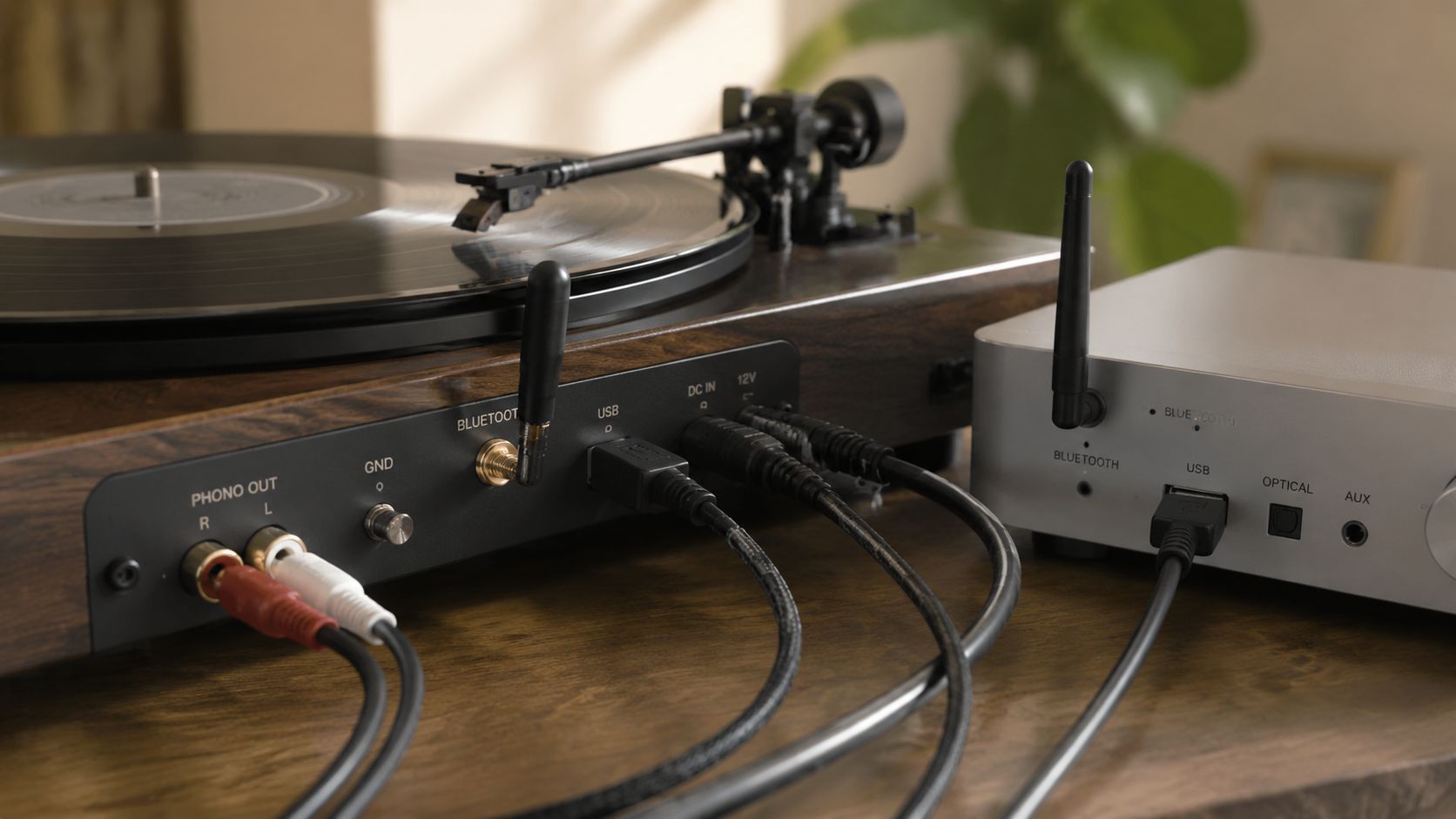
Bluetooth solves a real problem when the speakers sit across the room or you need casual playback without a cable run. It also adds wireless transmission, codec behavior, and another conversion stage. If you bought vinyl for physical, direct playback, Bluetooth can put a pane of glass between the groove and your ears.
USB makes sense when digitizing is the point. It gives the cartridge's analog signal a path into a computer, but that path also brings computer-ground noise and the quality limits of the deck's analog-to-digital conversion. Don't buy USB because the port looks modern. Buy it because you'll archive records.
Convenience earns its place only when you use it
A built-in phono stage keeps the box count down and lets a deck feed a line input. That's useful for powered speakers and receivers without phono. The trade-off is that you're committed to the built-in circuit's gain, noise floor, and tonal character, and you lose one of the easiest future upgrade points.
Automatic operation saves handling and can protect a stylus from an awkward cueing mistake. It also adds mechanisms that may drift or require service. Manual operation asks more from you, but the signal path stays simpler and the cueing ritual becomes part of the listening rather than a task delegated to a small machine.
My filter: If a feature solves a problem you actually have, keep it. If it merely fills a checkbox, leave it out.
A basic, upgradeable deck with a replaceable cartridge and sensible phono arrangement usually ages better than an all-in-one player stuffed with features you stop using after the novelty fades. Choose convenience deliberately.
Setup Precision as Part of the Purchase
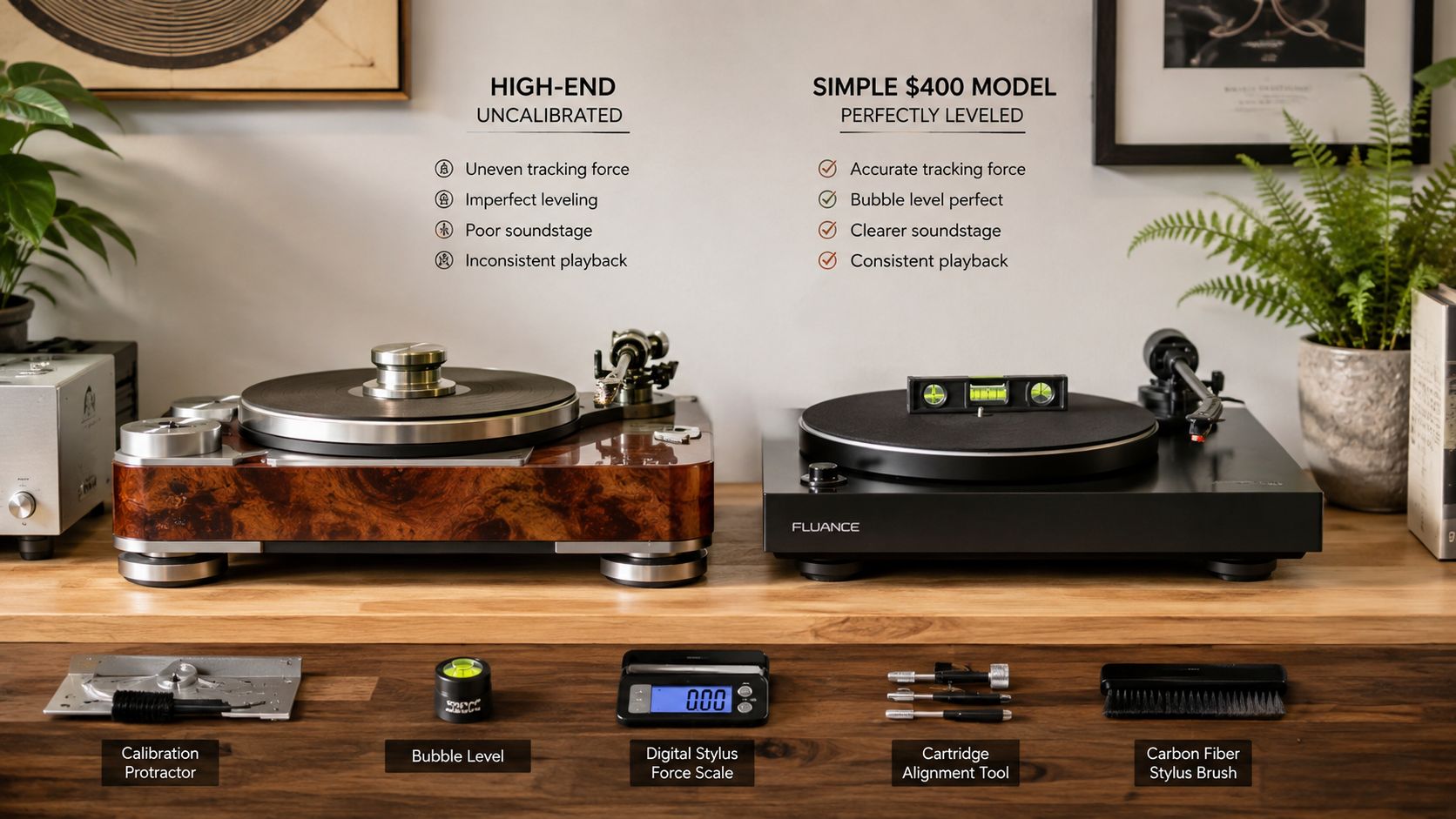
A perfectly adjusted modest deck can sound more convincing than an expensive deck installed carelessly. Setup isn't an accessory to the purchase. It's part of the purchase.
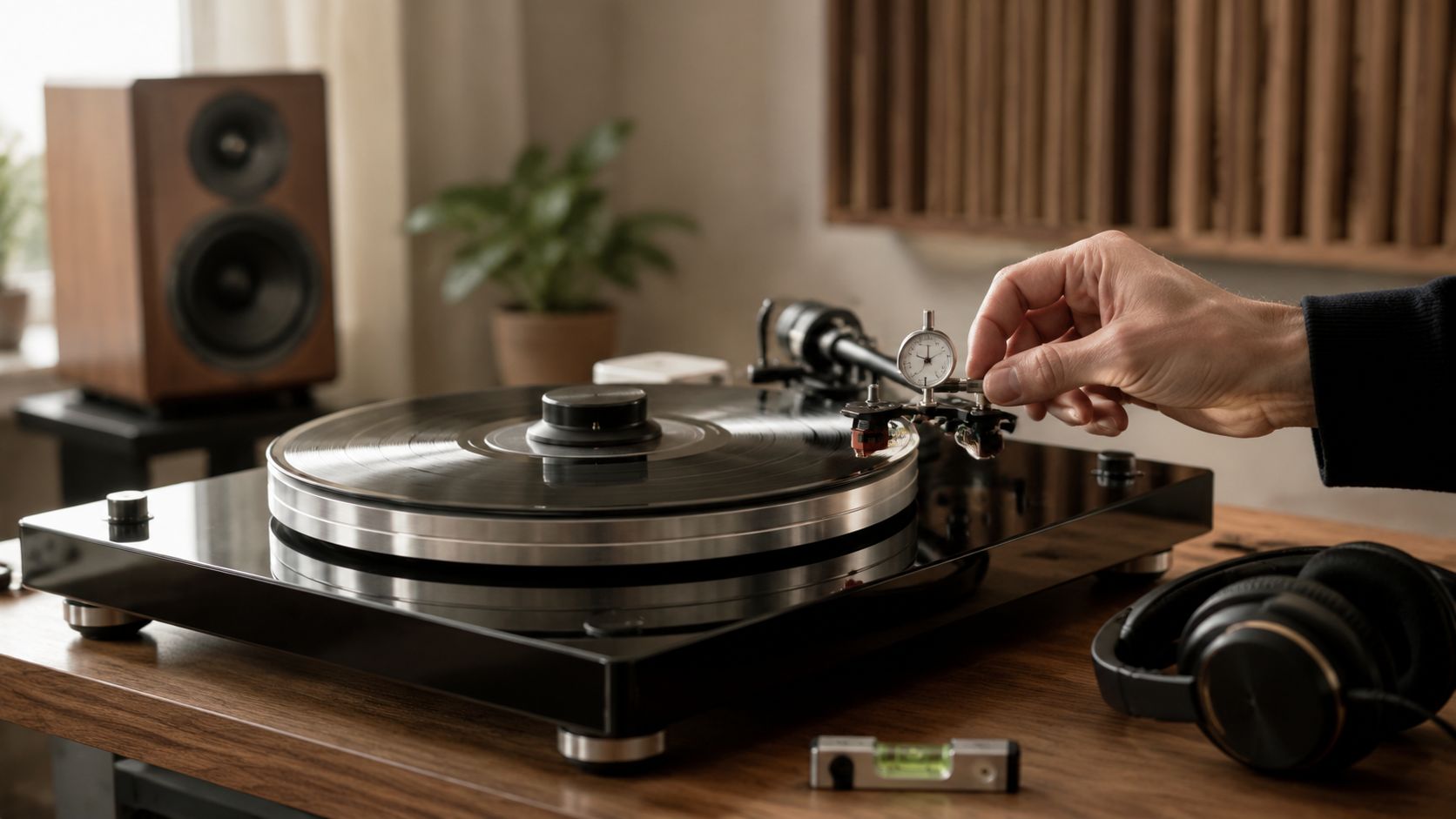
Start by leveling the plinth with a real bubble level. Do it before balancing the arm or aligning the cartridge. A tilted deck changes how the tonearm sits over the groove, which can disturb tracking behavior and channel balance.
Calibrate the arm in the right order
Balance the tonearm according to the manufacturer's procedure, set the counterweight to the cartridge's recommended vertical tracking force, and verify the result with a digital stylus gauge. Expert setup guidance recommends using the middle of the manufacturer's range when uncertain because insufficient force increases mistracking while excessive force can accelerate stylus and record wear.
Set anti-skate to the same numeric value as tracking force as a starting point. Then refine it with a blank groove or test record, listening for equal, clean behavior between channels. The adjustment should prevent the arm from leaning into one channel without making the other sound thin or strained.
For the final geometry, use a reliable cartridge alignment protractor and follow the tonearm's intended geometry. This cartridge alignment guide covers the practical relationship between alignment and tracking.
A short visual walkthrough can help you check the physical sequence before you drop the stylus onto a valuable record.
Isolation is where the furniture gets judged
Place the deck on a rigid, mass-loaded platform or a wall shelf that can resist footfall and speaker energy. Never put it directly on a speaker. If the furniture flexes, the stylus hears that movement as low-frequency feedback, and the bass becomes a slow, muddy shadow around every kick drum.
VTA and azimuth come after the fundamentals. They can sharpen image focus and improve tonal coherence, but they can't rescue a crooked plinth, bad tracking force, or a shelf that shakes when someone walks past.
Calibration turns hardware into playback.
Audition, Room Reality, and the Final Checklist
Take a familiar record to an audition. Not a record you bought because its pressing has become a forum talisman. Use music you know well enough to recognize a wandering piano note, a vocal that has moved too far forward, or bass that has swollen into the room.
Listen for three things first: speed stability, tracking cleanliness, and bass integration. A good deck keeps sustained notes calm, lets a vocal occupy a stable center, and gives the kick drum a defined edge. It shouldn't make detail feel like extra treble.

Let the room expose the weak link
Keep the plinth away from the immediate acoustic pressure of the speakers. Rigid floors and heavy furniture usually give the system a quieter foundation, while thin walls, flexible floors, and active walkways demand more careful isolation. Distance to walls changes warmth and bass weight, so judge the turntable where you'll use it, not only in a treated showroom.
Before buying, check:
- Tonearm geometry: Confirm that the cartridge sits correctly and that the arm offers the adjustments you'll need.
- Tracking force: Set the cartridge within its recommended range and verify it with a stylus gauge.
- Anti-skate: Start at the tracking-force value, then refine through careful listening.
- Phono gain: Match the cartridge type and output to the phono input or external stage.
- Grounding: Connect the ground wire and listen for hum before blaming the deck.
- Cable dressing: Keep signal cables tidy and away from power supplies.
- Support: Use rigid, stable furniture that doesn't transmit footfall or speaker vibration.
Trust the familiar record over a reviewer's ranking. Trust the room over the showroom. Trust the chain over the chassis.
Choose your turntable by mapping the whole system before you spend money. Write down your records, amplifier, speakers, room constraints, cartridge plan, phono-stage needs, and isolation solution, then shortlist only decks that fit that reality. Buy the machine that lets the music arrive intact, not the one with the loudest spec sheet.

