Most headphone amplifiers aren't bought because the listener needs more volume. They're bought because the existing output sounds strained, soft, or oddly colored, then the owner blames the headphones or the recording. The popular advice, “You only need an amp if your headphones aren't loud enough,” is tidy, memorable, and incomplete.
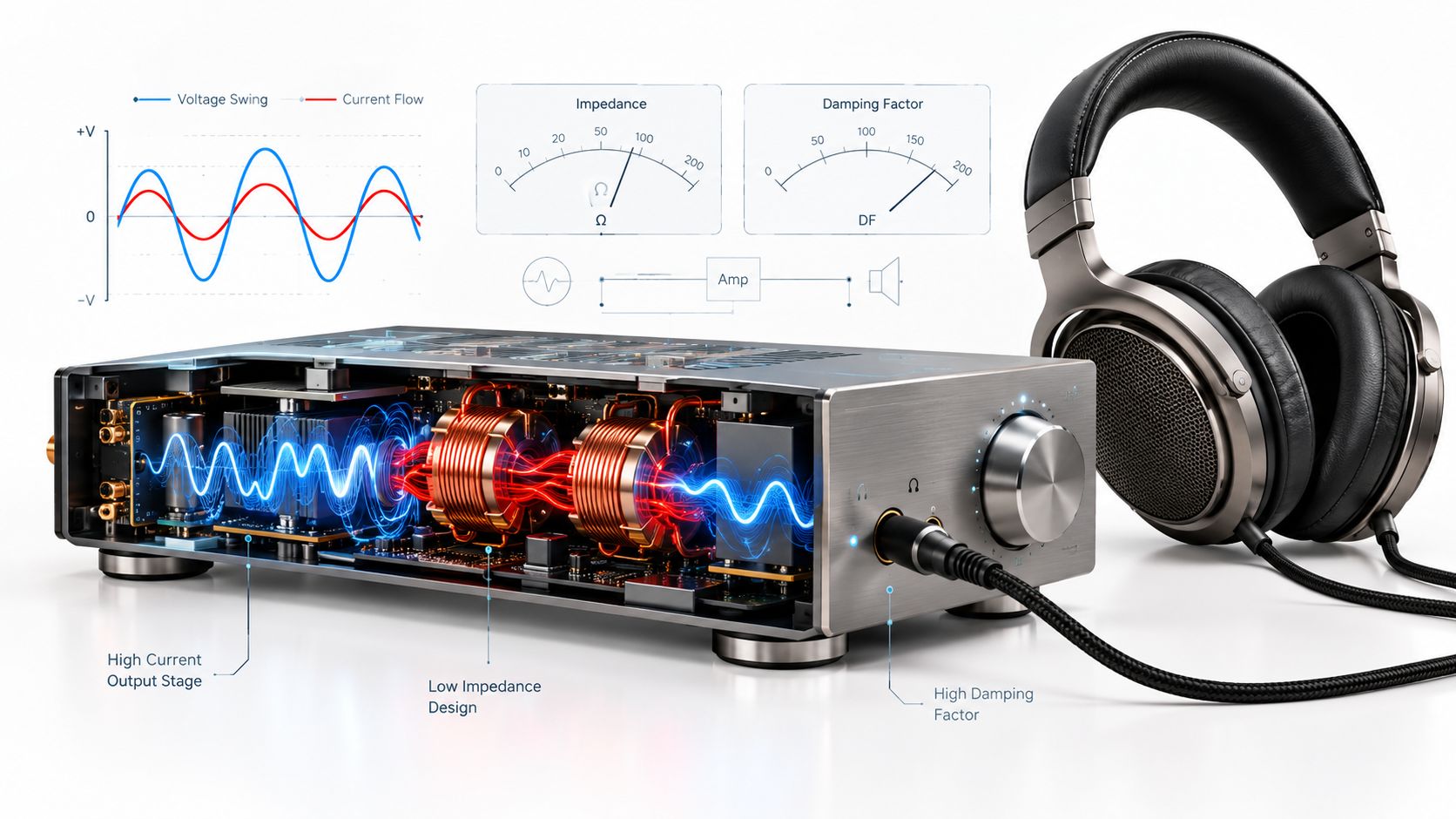
A headphone amplifier is a load-matching tool. Its real work involves voltage swing, current delivery, and output impedance. Gain only tells you how much the input signal gets multiplied. It doesn't guarantee that the amplifier can control the driver once the music becomes demanding. I've owned enough expensive black boxes to know that a heavier chassis and a heroic product description don't automatically produce better sound. The circuit has to do the electrical job first.
Table of Contents
- The Myth of the Magic Volume Knob
- Voltage, Current, Gain, The Plumbing Behind the Plug
- Why Low and High Impedance Headphones Need Different Amps
- Output Impedance and Damping Factor Explained Without Tears
- What a Weak Amp Actually Sounds Like
- Portable, Desktop, and DAC-Amp Hybrids Compared
- Bench Numbers vs Listening Ears
- Matching Your Amp to Your Headphones Without the Guesswork
The Myth of the Magic Volume Knob
Most phones can drive many headphones to a reasonable listening level. That sentence has probably sold more bad advice than bad amplifiers have sold units. Reasonable volume and reasonable control aren't the same thing.
A phone jack may make one pair of headphones sound perfectly lively while another sounds anaemic, compressed, or strangely loose. The difference comes from the load. A headphone amplifier must supply the voltage and current that the headphone demands, rather than merely turning up a small signal until the knob looks busy. This practical explanation of headphone amplifiers describes the split clearly: low-impedance headphones often sit around 8–32 ohms, while high-impedance models commonly sit around 300–600 ohms. The former can need under 1 Vrms but as much as about 100 mA, while the latter may need roughly 4–5 Vrms and only a few milliamps for similar loudness.
That's the first reason the phrase “it gets loud enough” fails. A source can reach the target level while running out of headroom on peaks. The music doesn't necessarily become quiet. It becomes flatter, harder, and less convincing.
Three numbers carry the load
Voltage is the electrical floor. High-impedance headphones need more of it.
Current is the plumbing. Low-impedance headphones can demand a lot of flow even when the required voltage looks modest.
Damping factor describes how firmly the amplifier controls the driver through its output impedance. A source with a high output impedance can alter the headphone's tonal balance instead of merely feeding it a stronger signal.
The useful rule is blunt: lower impedance asks for more current, higher impedance asks for more voltage. That doesn't mean every low-impedance headphone needs a desktop amplifier, or every high-impedance headphone needs a tube shrine glowing beside it. It means the amplifier must suit the electrical load.
Historically, dedicated headphone amplifiers emerged as headphone use expanded beyond simple radios and studio monitoring. One account identifies 1992 as the year of the first commercially available portable headphone amplifier, a useful marker for the point when pocketable driving power became a product category rather than a workaround. The history of headphone amplification also reflects the broader problem. As headphone designs diversified, amplifiers had to become load-matching devices.
Not magic. Control.
Voltage, Current, Gain, The Plumbing Behind the Plug
Think of the amplifier as a water system, but don't take the metaphor too far or an engineer will appear behind your sofa.
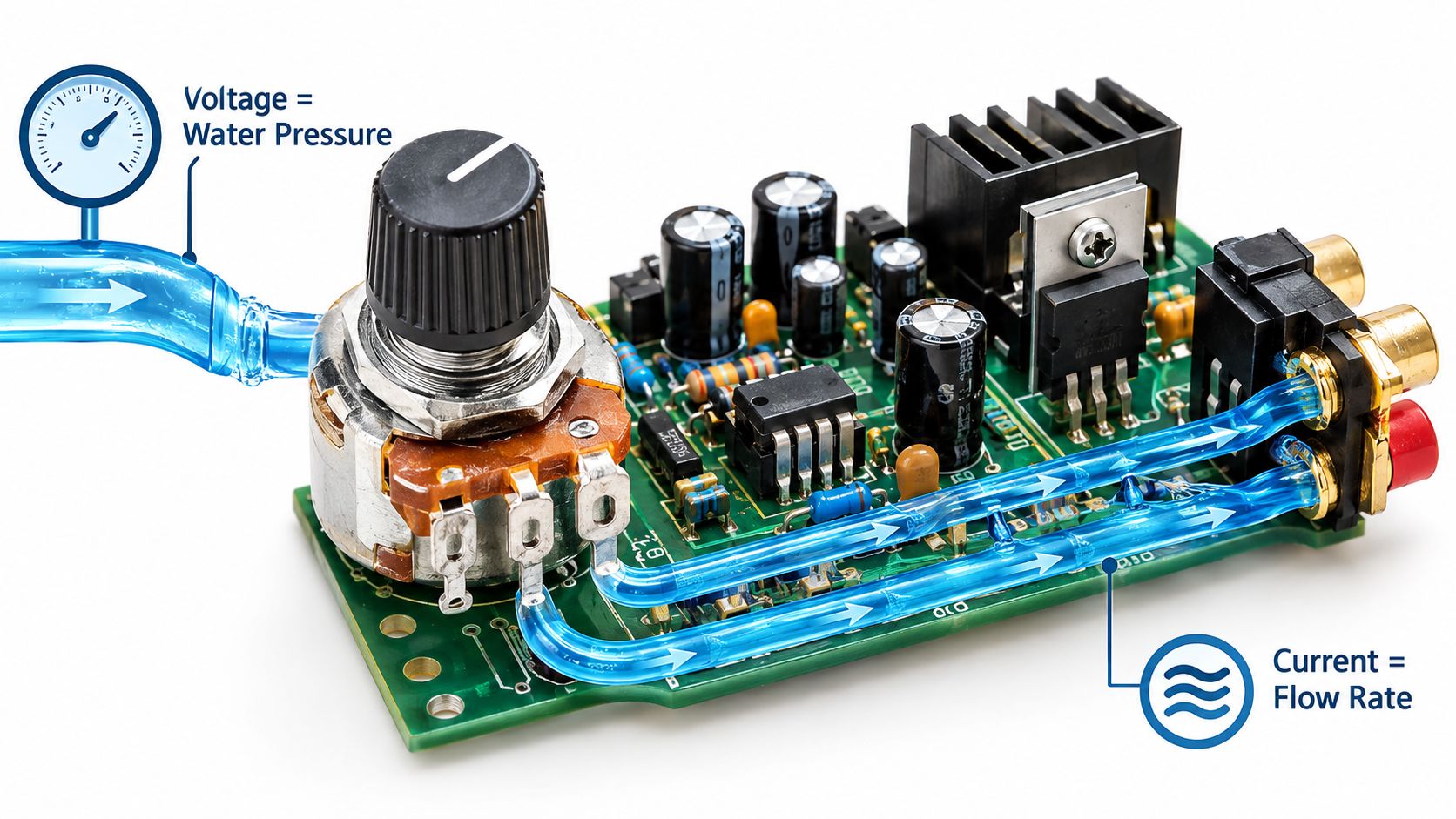
Voltage is pressure. It's the force available to push the signal through the headphone. Current is flow rate. It's how much electrical movement the amplifier can provide when the load asks for it. Gain is the valve multiplier. It increases the input signal, but it doesn't magically create unlimited supply capacity.
The basic relationships are enough to make the point:
- Vout = Vin × Gain
- I = V/R
If the source provides an input signal and the amplifier applies gain, the output voltage rises. Once that voltage meets the headphone, the current depends on the headphone's impedance. The same 2 V output therefore demands more current from a 32-ohm load than from a 300-ohm load. The lower resistance leaves the amplifier pushing harder.
Gain isn't the same as reserve
Gain can make a difficult headphone louder, but excessive gain can create a different nuisance. The volume control becomes twitchy, sensitive headphones expose noise, and the useful range of the knob shrinks. A sensible amplifier offers enough gain for the source and load without treating every headphone like a distant concert speaker.
The output stage carries the load-bearing responsibility. It must deliver voltage without clipping and current without sagging. Clipping occurs when either limit gets exceeded, turning loud peaks into distortion rather than more level, as explained in this guide to headphone amplifier output power.
Sensitivity complicates the easy version of the story. Manufacturers commonly express it in dB/mW, which means the listener must consider power as well as impedance. A headphone can have a modest impedance but still demand serious current, or a high impedance that needs substantial voltage despite drawing only a small current.
A good amplifier keeps the signal from starving downstream. It doesn't perform a séance.
At the same loudness, two amplifiers can behave differently because one has more reserve and a lower output impedance. One sounds relaxed and solid on a bass hit. The other sounds like it's holding its breath.
Why Low and High Impedance Headphones Need Different Amps
Headphone impedance commonly spans roughly 15 Ω to 600 Ω, and that spread creates two different amplifier problems. The relationship between sensitivity, impedance, and amplifier power explains the broad division: higher impedance generally needs more voltage for the same loudness, while lower impedance demands more current.
A low-impedance planar magnetic headphone can behave like a stubborn tap with a narrow pipe. It may not need huge voltage, but it can ask the output stage to supply current repeatedly, especially during dense bass passages. A high-impedance dynamic headphone reverses the demand. It may draw only a few milliamps, but the amplifier needs enough voltage swing to preserve peaks instead of flattening them.
The numbers supplied in the common examples make the distinction clear. A 32-ohm planar may need 500 mW to reach 110 dB, while a 300-ohm Sennheiser may need only about 10 mW but demand much higher voltage swing. Those figures describe different stress points, not a ranking of headphone quality. They tell you which resource the amplifier must carry.
| Impedance | Voltage Needed | Current Needed | Typical Use Case |
|---|---|---|---|
| 32 Ω | Lower voltage demand | Higher current demand | Low-impedance planar or efficient portable headphone |
| 300 Ω | Higher voltage demand | Lower current demand | High-impedance dynamic headphone |
| 600 Ω | Very high voltage demand | Low current demand | Particularly demanding high-impedance dynamic headphone |
A phone can sometimes make a high-impedance headphone loud enough, but its small output stage may run out of voltage headroom when a recording produces a sharp transient. With a current-hungry planar, the same phone may struggle in the opposite direction. The level might seem acceptable, yet bass impact loses its grip and the whole presentation feels compressed.
Practical rule: match the amplifier to the harder quantity, voltage or current, that your specific headphone stresses.
Impedance isn't an abstract badge. This explanation of headphone impedance helps frame it as part of the electrical load rather than a simple quality rating. Read the sensitivity specification beside it. Then look at the amplifier's output capability.
The headphone decides the exam.
Output Impedance and Damping Factor Explained Without Tears
Output impedance, usually written as Zout, is the amplifier's own resistance in series with the signal path. The amplifier and headphone form a voltage divider. If Zout rises, the headphone receives a voltage that changes according to its own impedance curve.
That matters because a headphone driver isn't a fixed resistor across every frequency. Its impedance can rise around resonance or shift through the audible range. A high-output-impedance amplifier therefore allows the headphone's electrical behavior to reshape the tonal balance. Bass may lift. Frequency response may ripple. Transient control may soften.
The damping factor gives the same problem a more intuitive ratio:
Damping factor = headphone impedance ÷ amplifier output impedance
A common engineering target keeps output impedance at or below one-eighth of the headphone's nominal impedance, preserving a damping factor of 8 or higher. This technical guide to output impedance explains why the ratio matters. At a damping factor around 40, the source becomes close to electrically invisible, with deviations below roughly 0.2 dB.
The divider changes the sound
Consider a 32-ohm headphone connected to a 4-ohm output. The source resistance takes a meaningful slice of the voltage, and the response can swing by over 1 dB across the bass band in the example described. Put the same headphone on a 0.5-ohm amplifier and the output becomes far stiffer, keeping the response ruler-flat by comparison.
That's why low-impedance multi-driver IEMs can expose output impedance immediately. Their impedance curves can be complicated, and the amplifier's resistance becomes part of the tuning whether you intended it or not. This overview of impedance matching puts the practical issue in plain terms. The amp's electrical character can become audible through the headphone's frequency response.
A high-output-impedance tube amplifier may pair happily with a high-impedance headphone. That pairing isn't universally superior, but the ratio can be less troublesome, and the resulting tonal change may suit the listener. With a low-impedance headphone, the same amplifier can turn a carefully voiced design into something thick around the bass and less settled above it.
Output impedance is not a decorative specification.
It's the steering wheel.
What a Weak Amp Actually Sounds Like
A weak amplifier rarely announces itself by refusing to make noise. More often, it plays music while removing the reasons you bought the headphones.
Take a 600-ohm Beyerdynamic DT 880 from a phone jack. The volume control crawls past 80%, and the presentation loses its easy rise and fall. Cymbals flatten into pale metal, kick drums lose chest impact, and the listener starts blaming the mastering. The mechanism is simple: the phone lacks voltage headroom, so peaks arrive with less shape.
A current-starved planar behaves differently. A 6-ohm planar magnetic headphone on a first-generation dongle may produce treble that sounds nervous and over-alert while the bass sags underneath it. The volume can look adequate, but the output stage runs short of current reserve. Transients compress, and the music loses its physical shove.
Three failures, three signatures
An easy-to-drive 32-ohm dynamic headphone can expose a third problem. Connect it to an amplifier with 10-ohm output impedance and the frequency response may tilt with the headphone's impedance curve. The result can sound bloated rather than weak, with a bass shelf that wasn't part of the designer's intention.
Those three examples separate the causes:
- Voltage headroom: High-impedance headphones flatten peaks when the amplifier can't swing far enough.
- Current reserve: Low-impedance planars lose grip when the output stage can't supply the demanded flow.
- Output impedance: A poor electrical interface changes tonal balance through voltage-divider behavior.
The listening impressions aren't mystical. A phone driving a difficult dynamic can sound grey and two-dimensional. A struggling planar can lose the clean edge of a bass note. A high-output-impedance source can make an otherwise tidy headphone sound swollen around the lower registers.
“Sounds weak” rarely means “not loud.” It usually means the amplifier and headphone speak different electrical dialects.
Portable, Desktop, and DAC-Amp Hybrids Compared
Form factor tells you what problem the manufacturer expects you to have.
A portable amplifier or dongle works within the limits of a USB-powered rail. It aims to provide enough voltage and current for IEMs, efficient headphones, and portable planars without turning a pocket into a battery funeral. The best portable designs keep output impedance low and noise controlled. The worst ones advertise gain while leaving the actual load capacity vague.
A desktop amplifier assumes access to a wall outlet. That gives the designer more room for voltage swing, current delivery, heat management, and multiple gain stages. Balanced outputs can provide a different connection arrangement and, depending on the circuit, more available drive. They don't automatically make the music wider or more truthful.
A DAC-amp hybrid combines digital conversion and amplification in one chassis. That usually simplifies the signal path and can make impedance matching more predictable, but it gives you less freedom to replace one half independently. This guide to DAC and headphone amplifier combinations is useful when the question is system simplicity rather than component collecting.
Choose the problem, not the mythology
| Category | Typical Power (mW @ 32Ω) | Best For | 2025 Trend |
|---|---|---|---|
| Portable amplifier or dongle | Depends on the design and load | IEMs, efficient headphones, mobile listening | Basic dongles continue to dominate the entry tier |
| Desktop amplifier | Depends on the design and load | Harder headphones and sustained listening | Planar adoption is pushing interest toward desktop and balanced-port designs |
| Integrated DAC-amp | Depends on the design and load | Compact systems and matched conversion with amplification | Integrated units remain a significant global category |
A 2025 global estimate places portable units at 38.5% share, desktop units at 27.2%, and integrated DAC amplifiers at 22.4%, as reported in this coverage of headphone amplifier operation and market categories. Treat those figures as a market snapshot, not an argument for one box over another.
Portable solves mobility. Desktop solves reserve. Hybrid solves clutter.
Bench Numbers vs Listening Ears
A proper measurement rig catches sins my ears can't reliably isolate. An APx555 or QA403 can expose channel imbalance below 0.1 dB, distortion at -120 dBFS, and noise behavior that determines whether a sensitive IEM hisses during a quiet track. Those measurements establish the floor.
They don't tell me whether a single-ended 300B amplifier makes a pair of headphones sound like Sunday morning or a wet napkin. That judgment belongs to listening, provided the listener controls the variables and stops treating adjectives as laboratory instruments.
Measurements remove excuses
Bench data can reveal clipping, frequency-response deviation, output impedance, channel mismatch, and noise. It can also expose the classic trick of selling more gain as more performance. An amplifier that measures badly may still charm someone with a particular headphone, but the buyer should know what the circuit is doing rather than confuse coloration with competence.
Listening catches different information. A familiar vocal can reveal a shifted midrange. A dense orchestral passage can show whether the presentation hardens under pressure. A repeated bass transient can tell you whether the driver feels controlled or merely loud.
Measurements are the floor. Listening decides whether you want to live in the room.
Pick an amplifier that measures cleanly first. Then audition it with the headphones you own and music you know cold. Don't let a dealer's spectacular demo recording make an unfamiliar tonal balance seem like truth.
The tribes can keep fighting over graphs and vibes. I'll use both.
Matching Your Amp to Your Headphones Without the Guesswork
Start with the headphone's impedance and sensitivity specifications. Sensitivity alone is a trap because it doesn't tell you which resource the amplifier will struggle to provide. A low-impedance headphone may need current, while a high-impedance model may need voltage.
Then check the amplifier's output capability at the load you use. Rough guidance places around 1 Vrms as enough for many orthodynamic headphones, while headphones above 200 ohms can want 5–10 Vrms for comfortable headroom, but the manufacturer's sensitivity and impedance figures still decide the requirement.
Use this checklist:
- Read both specifications. Don't buy from impedance alone.
- Calculate voltage demand. Use your target listening level and leave room for musical peaks.
- Check output impedance. Keep it at or below one-eighth of the headphone's rated impedance, which supports a damping factor above 8. This headphone power calculator guide explains why output impedance can alter response rather than only reduce volume.
- Prioritize current for difficult low-impedance loads. Planars and sub-50-ohm dynamics need current delivery and headroom, not inflated gain numbers.
- Listen with known music. Use tracks you've heard repeatedly, not the dealer's immaculate FLAC files designed to make everything sound expensive.
A portable amp makes sense when the headphones are mobile and the source lacks reserve. A desktop unit earns its space when voltage, current, or sustained headroom becomes the limiting factor. A hybrid earns consideration when you value a compact, matched signal path over separate upgrade options.
Supermarket Sound publishes practical guidance on headphone amplifiers, impedance, and source matching for readers who want the electrical basics beside the listening judgment.
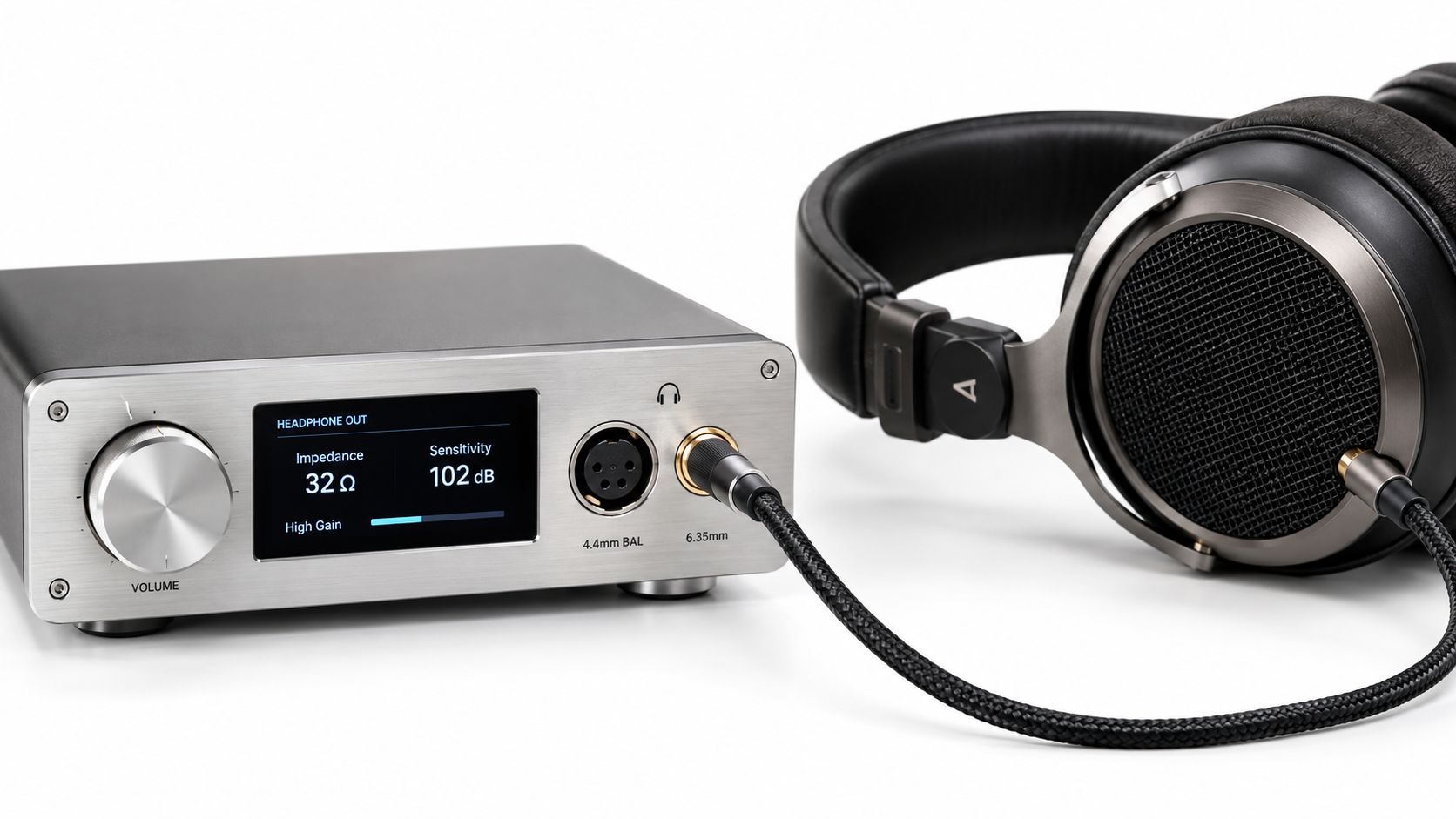
The amp's job is clean voltage. Clean current. Low impedance. Quiet enough to disappear. Do that, and the rest is knob dressing.
If your headphones sound compressed, bloated, or strangely nervous, check the electrical match before buying another cable or chasing a more fashionable DAC. Use the impedance, sensitivity, voltage, current, and output-impedance checks above, then compare your findings with the practical guides at Supermarket Sound before choosing your next amplifier.

