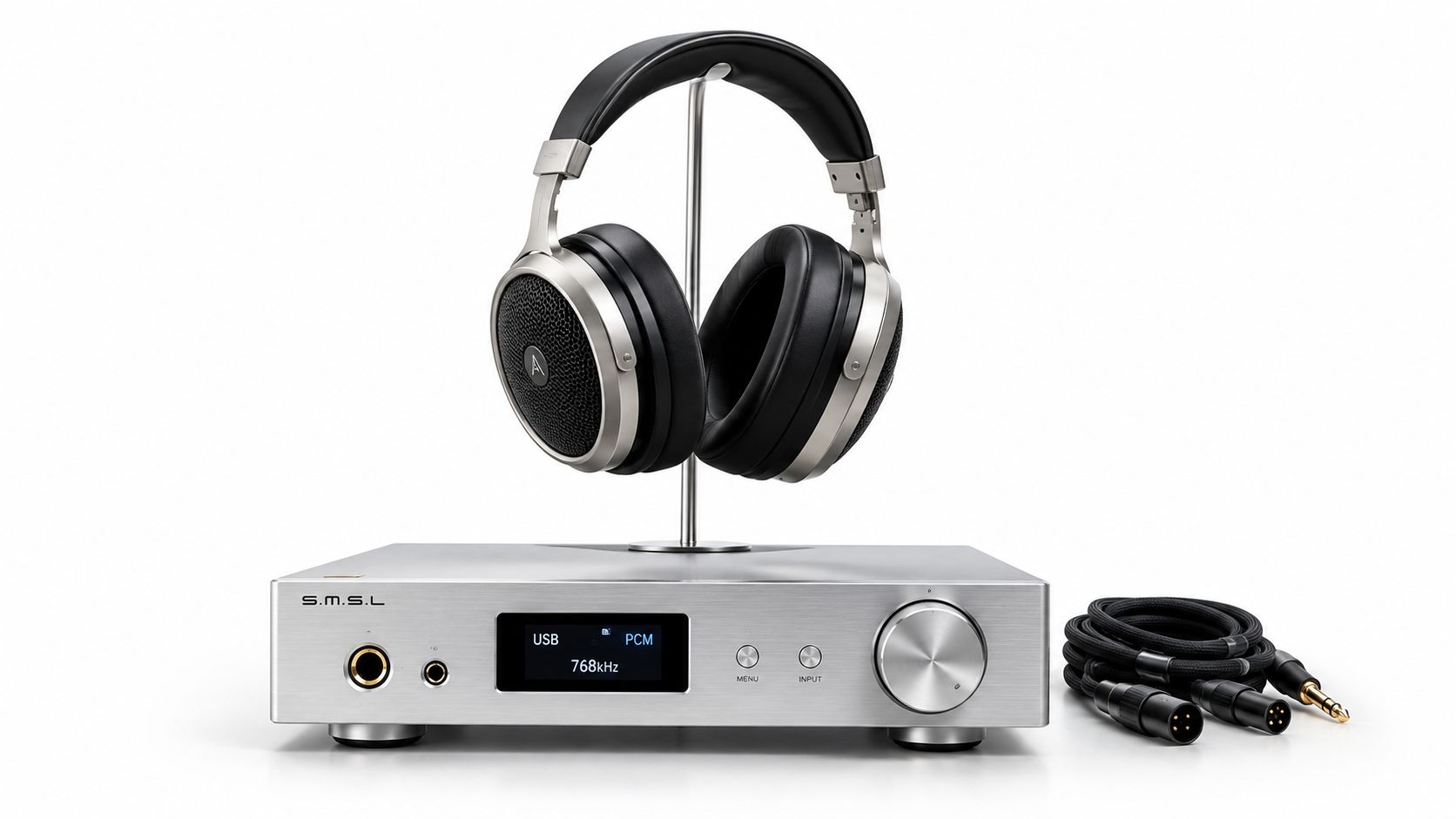
The most popular advice about a headphone amp DAC combo is also the laziest: buy balanced because balanced is better. That slogan sells connectors, not decisions. A superior system is built on quieter ground, lower output impedance, and an amplifier that can deliver current into the headphones you own.
I'm Marque Hersh, founder of Supermarket Sound. I know the SEO reality here. “Balanced” gets clicks. “Read the output impedance and noise floor” gets fewer. But the second instruction keeps your music from sounding thin, hissy, or strangely retuned by the box sitting between your computer and your ears.
Table of Contents
- The Load-Bearing Floor of Desktop Audio
- Output Impedance and the Noise Floor
- The Balanced Output Illusion
- Matching the Amp to the Transducer
- Routing the Digital Handshake
- Listening-Driven Buying Reasoning
- Building a Signal Chain That Stays
The Load-Bearing Floor of Desktop Audio
A headphone amp DAC combo is not a consolation prize for listeners who could not afford separate boxes. It is the electrical floor of a desktop system. Current designs commonly place a DAC, preamp, and headphone amplifier in one chassis, with USB audio, digital processing, Bluetooth, and balanced outputs now familiar features across accessible equipment, as documented in this 2026 DAC and headphone amplifier buying guide.
That layout solves a real problem. A desktop rig needs a digital entrance, a volume-control stage, and an output stage with enough current and voltage to drive the chosen headphones cleanly. One enclosure can reduce clutter while preserving performance, provided its internal stages are properly designed. Separate components offer more flexibility, but extra boxes do not automatically create better sound.
Combos now dominate the convenience conversation, which makes careless designs worth scrutinizing.
Convenience Isn't the Point
Desk space is a minor benefit. The useful question is whether the box establishes a clean, stable electrical foundation for everything downstream.
A weak output stage can leave a planar headphone sounding flat and underfed, especially when music demands sudden weight. Excessive output impedance can interact with a multi-driver IEM's impedance curve and shift its tonal balance. A noisy amplifier can lay a faint static veil over quiet passages. Cable changes will not correct those faults, and a more expensive headphone cannot reliably compensate for them.
The balanced socket is not a quality certificate. If the single-ended output already supplies sufficient current, maintains low noise, and preserves the headphone's intended response, a second wiring scheme adds little. The meaningful questions concern output impedance, current delivery, and how the circuit behaves under load.
Practical rule: Treat the combo as infrastructure, not decoration.
That standard does not make every all-in-one unit a sensible purchase. It means the category deserves the scrutiny normally given to a separate stack. A good combo should recede from attention until the music asks for headroom. Then it should respond with control, texture, and space instead of glare, hiss, or softened impact.
The box is the floor.
Output Impedance and the Noise Floor
Two specifications tell me more than a front panel full of logos: output impedance and residual noise. Manufacturers may lead with processing modes, wireless formats, and connector counts, but those features don't explain why one headphone sounds balanced and another sounds bass-light through the same amplifier.
Output impedance acts like a mechanical filter. A headphone doesn't present one perfectly stable resistance across the frequency range. Its impedance changes with frequency, and the source resistance interacts with that curve. If the amplifier's output impedance rises too far, the headphone's intended response can tilt. Bass may gain weight, treble may soften, or a multi-driver IEM may depart noticeably from the tuning its designer intended.
That's why headphone impedance isn't an abstract number to glance at before checkout. It's part of the electrical relationship between the amplifier and the transducer.
Low Resistance Keeps the Tuning Intact
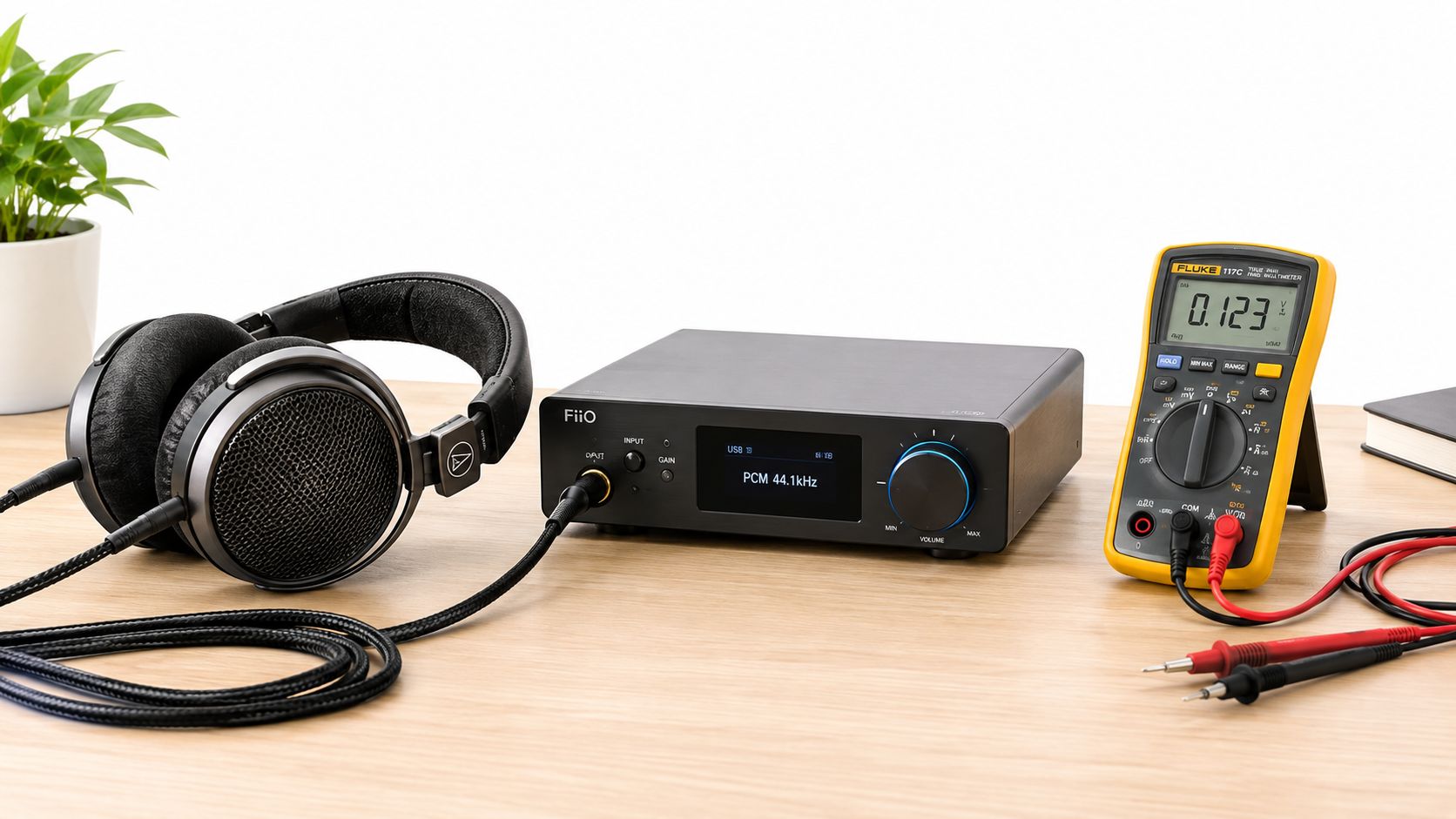
Independent measurements of the JDS Element IV report a headphone output impedance of 0.22Ω and residual noise of 1.8µVrms across the 20Hz to 20kHz band. The same measurements report up to 3W into 32Ω and 10Vrms into loads of 32Ω or higher, as shown in the JDS Element IV measurement discussion.
Those figures matter because the Element IV isn't merely loud. Its low output impedance reduces the chance that the amplifier will become an unwanted tone control. With sensitive IEMs and low-impedance dynamic headphones, that restraint preserves the shape of the signal instead of letting source resistance redraw it.
The noise figure matters just as much. 1.8µVrms is a microvolt-level residual signal, and that's the territory where sensitive earphones either remain quiet or expose the amplifier as a constant electronic hiss. A combo can have abundant wattage and still fail the IEM test if its noise floor sits too high.
Power Without Silence Is a Bad Trade
I've heard systems that can play loudly but never sound calm. The background carries a faint grain, cymbals acquire a brittle edge, and low-level ambience loses its blackness. That isn't a lack of volume. It's the floor showing through.
Read noise and output impedance before you read the feature list. A low noise floor helps sensitive earphones stay silent between notes. Low output impedance helps headphones retain their intended frequency response. Power only becomes useful after those conditions are under control.
A good combo stays electrically invisible until you ask for current.
The Balanced Output Illusion
Balanced headphone output is not a quality certificate. It changes the wiring arrangement, and depending on the circuit, it can change voltage swing, output impedance, noise floor, and connector topology. Those changes may help. They may also introduce extra noise or distortion when the design uses two amplifiers per channel.
The popular shortcut says balanced equals more power. That's only half the story, and half-truths are dangerous in audio because they sound tidy. A balanced jack can be a serious performance upgrade when the amplifier's balanced stage has stronger voltage or current capability. It can also be a decorative socket attached to a circuit that doesn't deliver a meaningful advantage.
Sensitive IEMs expose the problem quickly. Their high sensitivity makes amplifier hiss easier to hear, and a more complicated balanced stage can make that background less quiet. Independent measurement-based discussion has also shown that balanced outputs can be less useful with low-impedance loads and can become the wrong choice for sensitive earphones, as outlined in this measurement discussion of balanced headphone amplifier trade-offs.
More Pins Don't Guarantee More Grip
The connector is only the doorway. The circuit behind it does the work.
Published specifications for the Topping DX7 Pro+ cite 1,900mW ×2 into 32Ω and 320mW ×2 into 300Ω. The same specifications give the 4-pin XLR and 6.35mm headphone outputs the same power rating, which is exactly the kind of detail that gets erased when a product page says “balanced output” in oversized type. The DX7 Pro+ specifications show why the output label alone doesn't tell you what changes under load.
Balanced can provide more voltage swing in some architectures. It can also use more active devices in the signal path. If those devices add hiss or distortion, the connection has gained pins and lost silence.
Balanced is a topology, not a flavor of magic.
When Single-Ended Wins
For sensitive IEMs, I'd start with the quietest output that has suitably low output impedance. If the single-ended output remains silent and delivers enough level, there's no technical prize for abandoning it.
A balanced output makes more sense when the headphones need the extra voltage or current headroom and the balanced circuit maintains clean behavior into that load. It can also make sense when a long, properly implemented connection benefits from the topology. But the cable must match the circuit, and the amplifier must provide the promised electrical advantage.
Don't buy a balanced cable to solve a power problem before checking the measurements. Don't choose the jack with more metal because the label feels premium.
More pins. Not always more performance.
Matching the Amp to the Transducer
A headphone amp DAC combo earns its place by controlling the headphone's electrical load, not by carrying an impressive power number. “Powerful” without an impedance is a stage whisper wearing a leather jacket. Voltage and current limits expose different weaknesses, so a combo that looks formidable at one load may lose composure at another.
Low-impedance headphones and planar magnetics often demand current. High-impedance dynamic headphones place greater emphasis on voltage swing. Sensitive IEMs usually need little power but reveal amplifier noise immediately. Start with the transducer, then judge the combo.
Read the Load, Then Read the Wattage
The Texas Instruments high-power headphone amplifier reference design reports 0.000210% THD+N at 1kHz while driving 16Ω at 100mW, and 0.000148% THD+N at 1kHz while driving 32Ω at 100mW, according to the Texas Instruments reference design data.
The engineering point is more useful than the decimal places. Distortion does not automatically explode when a low-impedance load demands more current. A properly designed amplifier can remain clean, provided its current headroom and gain structure stay stable.
Read a specification sheet in this order:
- Find the impedance. Look for power into 16Ω, 32Ω, 300Ω, or the impedance your headphones present.
- Separate voltage from current. High-voltage capability helps demanding high-impedance dynamics. Current delivery matters more for low-impedance planars and dynamics.
- Check the noise floor. Sensitive IEMs do not need heroic wattage. They need silence and low output impedance.
- Watch for missing loads. A large watt figure without an impedance attached tells you almost nothing useful.
The matching problem becomes clearer in a matrix.
Transducer Matching Matrix
| Transducer Type | Critical Spec Priority | Common Pitfall |
|---|---|---|
| Sensitive IEMs | Low residual noise and low output impedance | Choosing maximum wattage and hearing hiss |
| Low-impedance dynamics | Current headroom and stable output behavior | Assuming loudness proves control |
| Planar magnetics | Real power into low impedance, with current reserve | Trusting a headline rating measured at an easier load |
| High-impedance dynamics | Voltage swing and clean gain structure | Reading only the 32Ω specification |
The phrase impedance matching sounds more mysterious than it is. You are checking whether the amplifier can preserve the headphone's intended response and dynamics under the load it presents. Output impedance matters because it can interact with a headphone's changing impedance, shifting frequency balance. Current delivery matters because a struggling amplifier turns bass weight into softness and transients into compression.
A combo that folds during current demand sounds flat, compressed, and small, even when the volume knob has plenty of travel. That is the electrical floor of the system. Get it wrong, and every later component is working above a compromised foundation.
Routing the Digital Handshake
A strong electrical floor still needs a reliable route from computer to converter. USB audio is straightforward in principle, yet an expensive combo can remain silent when the operating system, driver, or cable path disagrees.
Start with the operating system's native audio support. Many USB audio devices use standard class-compliant drivers, which keeps setup simple. Dedicated drivers can provide device-specific control or professional routing, but they also add another point for conflicts. Install one only when the device or application requires it.
Keep the Computer From Rewriting the Signal
Windows audio may pass through the system mixer. Applications then share a format, and the operating system may resample material to match it. That is not automatically harmful, but direct exclusive or professional routing avoids needless processing when the playback software supports it.
Use a stable chain:
- Select the physical combo directly. Do not leave the operating system assigned to motherboard audio or a monitor output.
- Choose one control point. Avoid stacking application volume, system volume, and amplifier gain at arbitrary positions.
- Test native support first. If the device plays correctly without a dedicated driver, the simpler route is easier to maintain.
- Use exclusive routing when appropriate. It can stop other applications from taking control of the stream or forcing a shared format.
- Treat dropouts as troubleshooting clues. Try another USB port, remove unnecessary hubs, and check whether a driver or background application interrupts playback.
The digital side of whether a DAC is worth it depends on the entire route. A converter cannot improve a connection that keeps dropping, switching outputs, or feeding the wrong device.
Balanced Cables Need Balanced Wiring
A balanced headphone connection requires the correct cable topology. A balanced 4.4mm or XLR path carries separate hot, cold, and ground connections for each channel. A standard single-ended cable connected through an adapter does not activate a balanced circuit or provide its associated noise-rejection behavior.
An adapter changes the plug shape, not the electrical path. That distinction matters because balanced output is not a sonic upgrade by itself. Its practical value depends on the amplifier's circuit, available current and voltage, connection quality, and the headphone load. A correctly wired balanced output can provide a different power envelope, while a single-ended source may already deliver clean, sufficient control.
For ground-loop hum, disconnect other analog devices one at a time and identify which connection introduces the noise. For USB dropouts, simplify the path before blaming the DAC. For driver conflicts, remove redundant software and restart with the operating system's native route.
The music arrives only when the handshake holds.
Listening-Driven Buying Reasoning
Measurements tell me whether a combo has a stable floor. Listening tells me whether I want to live in the room it creates.
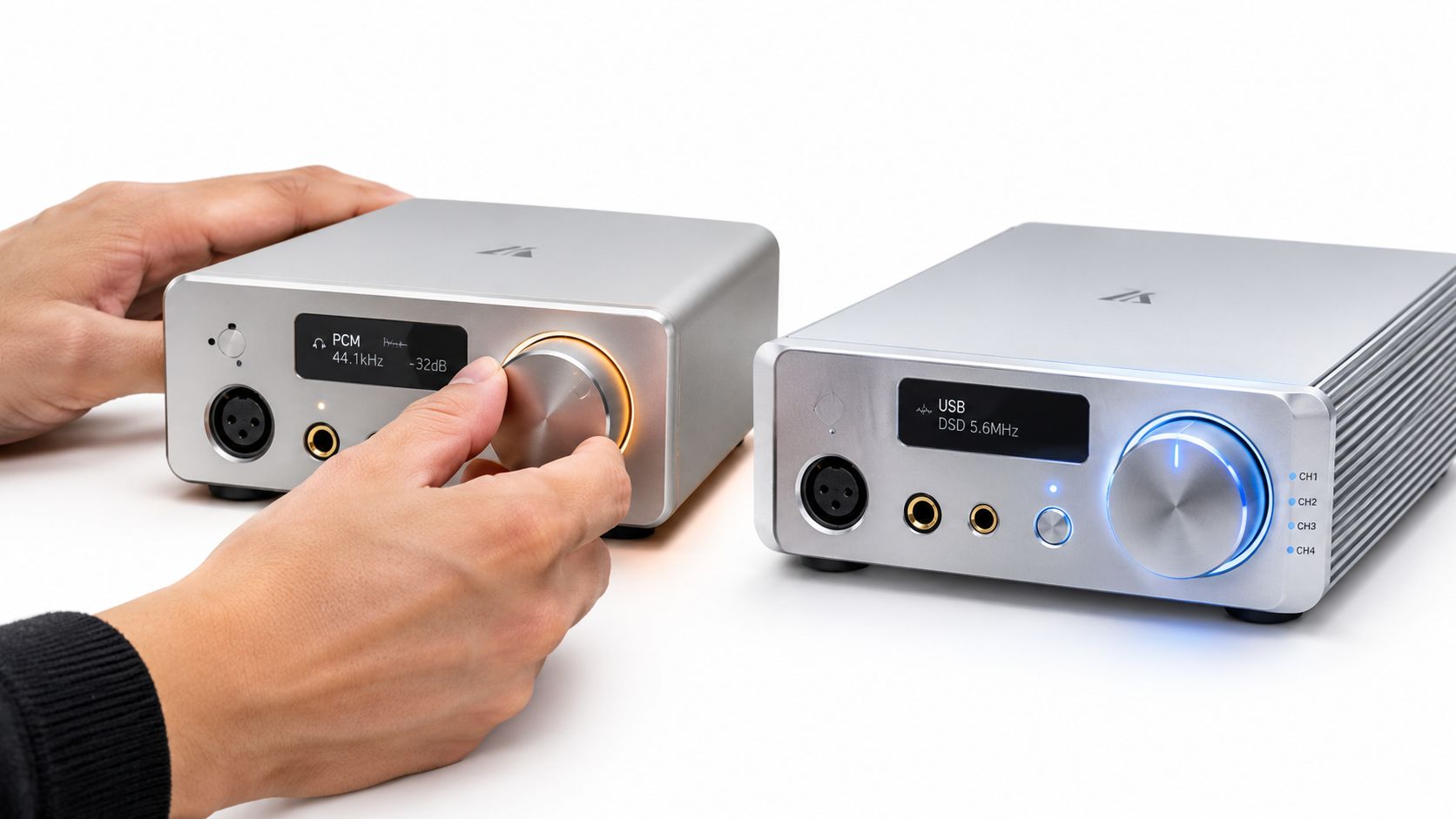
I don't mean that every DAC chip has a mystical personality. The chip matters less than the implementation around it, including filtering, analog output design, power regulation, amplifier topology, gain structure, and the headphone attached at the other end. A clean converter paired with a restrained amplifier can sound spacious and unforced. A warmer analog stage may put more body behind vocals and kick drums. Neither description replaces verification, but both describe the way a system occupies space.
Listen for Weight, Not Just Detail
A bright headphone can make a technically incisive combo feel impressive for ten minutes and exhausting by midnight. A lean planar may benefit from an amplifier with more density through the lower midrange, while a dark dynamic headphone may welcome a cleaner, more open presentation.
Those are system judgments, not excuses to ignore specifications. I want the noise floor low enough that quiet passages stay quiet. I want output impedance low enough that the headphone's tuning doesn't drift. Once those conditions are met, tonal preference becomes legitimate.
Listening test: Use familiar voices, bass lines, and room ambience. Ask whether the combo adds texture and control, or merely adds glare.
A unit with slightly higher output impedance might pair beautifully with a particular dynamic-driver headphone if the resulting interaction complements its tuning. That doesn't make high output impedance universally desirable. It makes the pairing specific. The same electrical behavior can enrich one headphone and wreck another.
I'd rather own a technically disciplined combo that gives me useful tone controls than a supposedly perfect box that forces every headphone into the same emotional temperature. Digital processing, equalization, and spatial controls can correct a transducer more effectively than swapping converters in search of a mythical veil.
Here's the uncomfortable SEO truth. Readers want a single winner because a ranked list is easy to click. Audio doesn't cooperate. The right combo depends on the headphone's load, sensitivity, tonal balance, listening level, and the kind of control you'll use. Supermarket Sound covers DACs and headphone amplifiers as part of that decision process, alongside broader hi-fi equipment.
The best purchase is the one whose trade-offs you understand before the box arrives.
Listen for the kick drum's weight. Listen to the decay around a vocal. Listen for whether the background remains black when the arrangement thins out.
Spec sheets set the boundary. Your ears choose the address.
Building a Signal Chain That Stays
Stop asking which box has the most impressive connector panel. Ask which one gives your headphones a quiet, stable electrical floor and enough authority to stay composed when the music gets difficult.
Start with output impedance and noise. Then read power at the actual headphone impedance. After that, consider balanced topology, digital routing, EQ, preamp functions, and the tonal character you can tolerate for hours. This order prevents the familiar upgrade spiral, where a cable or new headphone gets blamed for a source problem.
A separate stack can make sense when you need modularity, multiple analog inputs, or a particular amplifier architecture. A combo can make more sense when one carefully built enclosure gives you the same control with fewer connection points. Neither format wins by default.
The point isn't to make the system more expensive. It's to stop building on a swamp.
Choose the floor first. Downstream inherits it.
If your current setup sounds hissy, thin, or strangely colored, check the headphone amp DAC combo before buying another cable or headphone. Measure output impedance, inspect noise performance, confirm power at your headphone's actual load, and make sure the digital and balanced connections use the correct topology. Then spend your money where the signal is weakest, not where the marketing is loudest.

