Most advice about phono preamps is stuck on the wrong question. “Do I need a phono preamp?” sounds like a yes-or-no problem, but your system doesn't care about the wording. It cares which component is already applying RIAA equalization and cartridge gain, and whether another component is about to do the same job twice.
I've seen plenty of perfectly good turntables sound thin, shrill, or strangely bloated because someone plugged a line-level output into a PHONO input, or raw cartridge output into AUX. The fix usually isn't a new cartridge or a more expensive amplifier. It's finding the active phono stage in the chain.
Table of Contents
- Stop Asking Whether You Need a Phono Preamp
- What the Phono Preamp Actually Does
- Cartridge Output And Why It Changes The Answer
- Mapping Your Signal Chain End To End
- The Double Preamp Trap Most Setups Fall Into
- Cheap Built-Ins, Real Outboards, And The Upgrade Path
- What To Plug In Tonight
Stop Asking Whether You Need a Phono Preamp
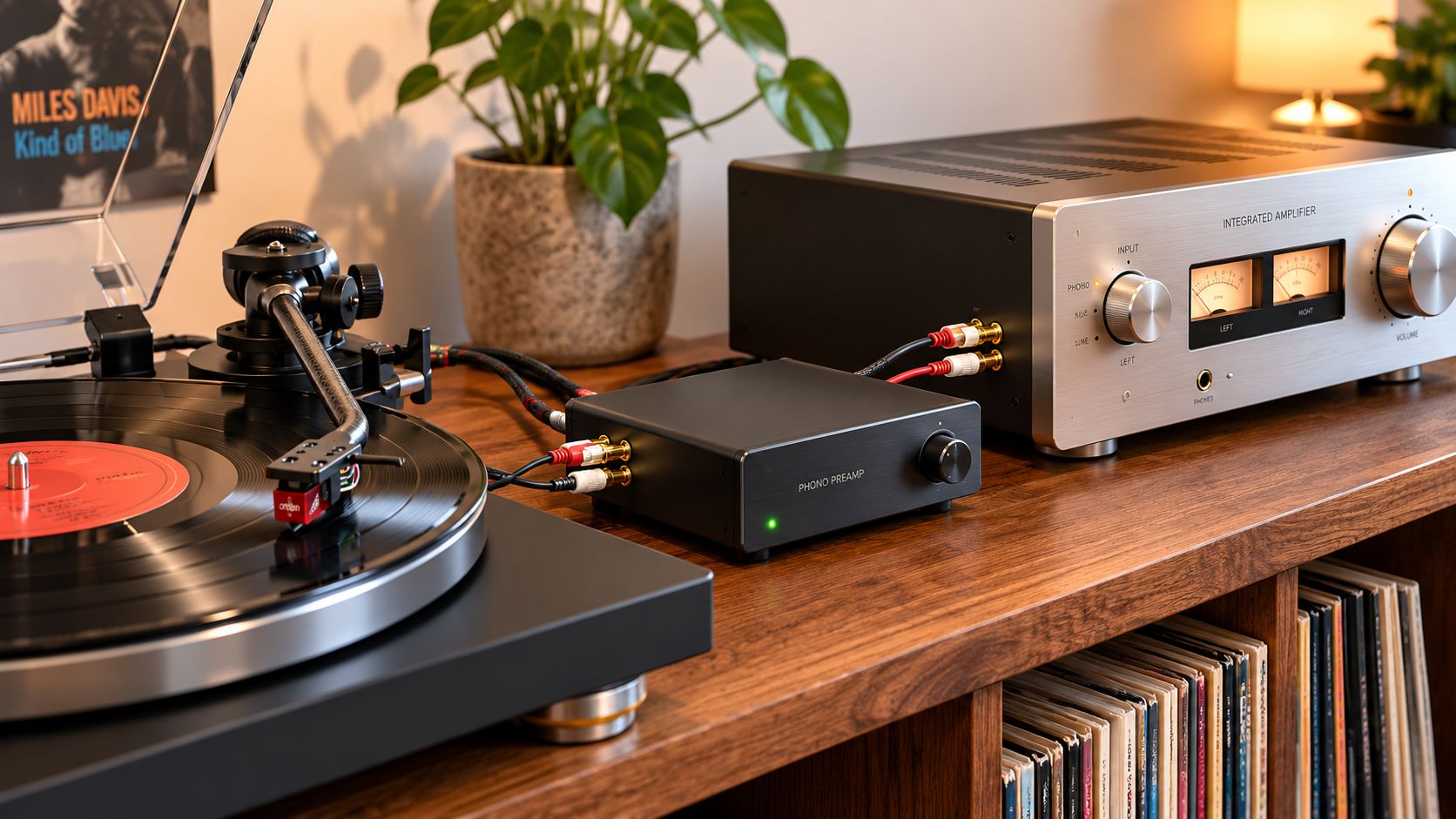
A phono preamp, also called a phono stage, can live in three places: inside the turntable, inside a receiver or amplifier with a PHONO input, or in a separate external box. Those are different physical locations for the same load-bearing jobs, RIAA equalization and gain.
Your first task is simple:
- Find out whether the turntable has a PHONO/LINE switch.
- Check whether the amplifier has a dedicated PHONO input.
- Identify whether an external phono stage sits between them.
- Make sure only one device handles the phono signal.
The popular shortcut says, “If the amplifier doesn't have PHONO, buy a preamp.” That advice works often enough to survive, but it skips the hybrid setups that cause the worst confusion. A turntable with a built-in stage can feed a normal AUX, CD, or TAPE input when set to LINE. The same turntable, with its internal stage bypassed, needs either a receiver's PHONO input or an external phono stage.
Practical rule: Map the signal path before you buy anything. The cartridge comes first, the speakers come last, and somewhere between them one stage must perform the RIAA correction.
The danger isn't just silence. A missing stage produces a quiet, bass-starved signal that sounds skeletal. Two stages in series can produce an unnatural tonal balance, with vocals pushed back and the top end becoming hard or papery. The downstream system inherits whatever mistake happens upstream.
That's why the useful version of the question is: which stage in your chain is already doing that job, and are you doing it twice?
Start there.
What the Phono Preamp Actually Does
A phono stage isn't merely a volume knob with a fancy name. It performs two separate operations that vinyl playback can't avoid.
It reverses the record's stored EQ
Records are cut with bass reduced and treble boosted. That approach helps keep low-frequency groove movement manageable while allowing more musical information to fit into the available groove space. Playback needs the mirror image, bass restored and treble reduced.
The industry standardized the RIAA playback target after years of competing record EQ curves. The Recording Industry Association of America formally approved the standard on January 29, 1954, with the document circulating in June 1954, after more than a decade of incompatible approaches among record makers. The history of the RIAA standard and earlier phono EQ curves explains why the phono stage became a technical necessity rather than an accessory.
The curve uses three time constants:
- 75 µs
- 318 µs
- 3,180 µs
Those values define the correction points built into a proper RIAA phono stage. The curve is not gentle. At the extremes, playback correction can involve roughly a 20 dB bass boost at 20 Hz and a 20 dB treble cut at 20 kHz. This explanation of the RIAA curve shows the scale of the inverse correction.
A phono stage that gets this wrong doesn't sound subtly different. It sounds tonally broken.
It raises a tiny signal to line level
A moving-magnet cartridge commonly produces about 3 to 6 mV, while a line input expects roughly 0.316 V RMS. That forces the phono stage to provide approximately 35 to 45 dB of gain, alongside the inverse RIAA curve. The technical explanation of phono-stage gain and equalization lays out why a cartridge can't feed a standard line input directly.
The cartridge also needs an electrical load. MM stages commonly use a 47 kΩ input load, while moving-coil cartridges often need different gain and loading. Those choices affect noise, tonal balance, bass control, and the way the stylus behaves electrically.
So the phono preamp is two circuits in one box. One restores the frequency balance. The other lifts the voltage.
Neither job is decorative.
Cartridge Output And Why It Changes The Answer
Cartridge type determines whether a phono input is suitable. An MM-only stage may work beautifully with a moving-magnet cartridge and fail badly with a low-output moving coil, even when the cartridge itself is excellent.
Moving-magnet designs commonly sit around 3 to 6 mV, while low-output moving-coil designs can produce only 0.2 to 0.5 mV. That MC signal is roughly 20 dB lower than the MM path, so the stage needs additional gain and a quieter input circuit. This overview of moving-magnet and moving-coil cartridge output puts the raw-output problem in plain terms.
Check the cartridge specification before trusting a PHONO label. A label tells you that a stage exists. It doesn't guarantee that the stage matches your cartridge.
| Cartridge Type | Typical Output (mV) | Gain Needed | Compatible Phono Stage |
|---|---|---|---|
| Moving magnet | 3 to 6 mV | About 35 to 45 dB | MM input with suitable loading |
| Low-output moving coil | 0.2 to 0.5 mV | Additional MC gain, often around 20 to 26 dB beyond the MM path | Dedicated MC input or suitable step-up arrangement |
| Higher-output moving coil | Above about 2 mV | Often similar to MM requirements | MM-compatible input when its loading and gain suit the cartridge |
A low-output MC connected to an MM-only stage often sounds hazy, hissy, and undernourished. The problem isn't a lack of musicality in the cartridge. The circuit hasn't supplied enough gain, so the noise floor gets invited into the room.
High-output MC designs can sometimes use an MM input, but don't assume compatibility from the words “moving coil” alone. Output voltage, recommended load, and the phono stage's available gain all matter.
For a deeper cartridge-level comparison, my guide to moving-magnet versus moving-coil cartridges covers the design differences that affect the rest of the system.
The spec sheet decides the starting point. Your ears judge the finish.
Mapping Your Signal Chain End To End
Trace the signal from the groove to the speaker. Don't start at the amplifier's input selector. Start at the cartridge, then identify the first component that performs phono gain and RIAA correction.
Path A uses the turntable's built-in stage
A turntable with a built-in preamp set to LINE sends a line-level signal through its RCA cables. Connect it to AUX, CD, TAPE, or another standard line input on the receiver or powered speakers.
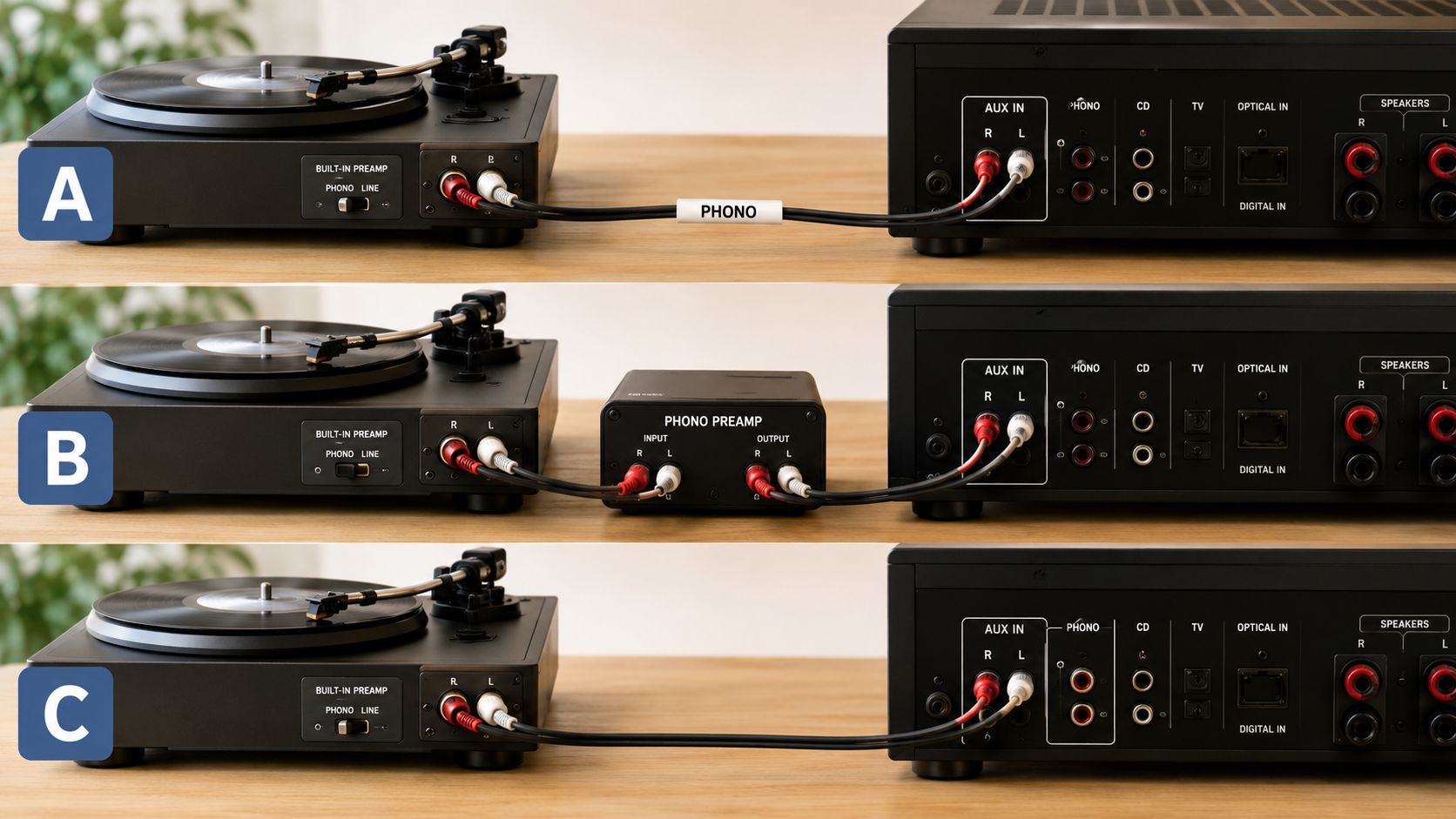
This route keeps the phono work inside the deck. It's convenient, though the built-in circuit may become the weakest link when the rest of the system improves.
Path B uses the receiver's PHONO input
Set the turntable to PHONO, or bypass its internal stage if it doesn't have a switch. Connect the RCA cables to the receiver's PHONO inputs, then attach the turntable's ground wire to the receiver's ground post if one exists.
Look for RCA sockets labeled PHONO rather than CD or AUX. A ground screw beside the PHONO input is another strong clue that the receiver contains a phono stage. The receiver handles both the gain and RIAA correction.
If the receiver offers MM and MC settings, choose the one that matches the cartridge. An MM-only receiver isn't a universal phono solution.
For a fuller physical setup walkthrough, use this turntable setup guide for beginners while checking each connection.
Path C uses an external stage
Set the turntable to PHONO output, connect it to the external phono stage, then run the stage's output into AUX, CD, or another line input. The external box performs the correction and gain, while the receiver passes the result as ordinary line-level audio.
Watch this practical demonstration before moving cables around:
The wiring is logical once you identify the active stage. Most setup trouble comes from skipping that inspection.
The Double Preamp Trap Most Setups Fall Into
Two phono stages in series don't make the signal twice as correct. They make the frequency correction wrong.
The classic mistake runs a turntable with its built-in preamp switched to LINE into a receiver's PHONO input. The turntable has already boosted the signal and applied RIAA equalization. The receiver then applies phono gain and correction again, reshaping an already-corrected signal.
To my ears, that sound is easy to recognize. Vocals retreat from the center image. Bass loses its foundation. Cymbals turn brittle, and the entire presentation feels oddly bright despite the extra electronics. The mix sounds carved out rather than open.
If the vocals sound distant and the bass feels hollow, check for two active phono stages before blaming the cartridge.
The reverse mistake is just as common. A turntable sends raw cartridge output into AUX, CD, or another line input. The input expects a much stronger, already-corrected signal, so the result stays quiet and tonally wrong. You may hear exaggerated low-frequency imbalance, smeared imaging, weak detail, and more audible rumble or hiss than a proper stage should allow.
The inspection takes less time than changing a stylus:
- Check the turntable switch. LINE means the internal stage is active. PHONO means the cartridge signal remains uncorrected.
- Check the receiver input. PHONO means the receiver expects raw cartridge output. AUX, CD, and TAPE expect line level.
- Check the cable destination. A LINE output must not enter PHONO. A PHONO output must not enter a normal line input without an external stage.
- Check the cartridge mode. MM and MC settings aren't interchangeable decoration.
Most of these errors need one switch or one cable swap. Don't buy gear to solve a routing mistake.
Cheap Built-Ins, Real Outboards, And The Upgrade Path
A basic built-in phono stage can get the fundamentals right. It can apply the curve, provide enough gain, and make music come out of the speakers. That doesn't make every built-in stage equally satisfying.
Inexpensive internal circuits often flatten dynamic contrasts, thicken the middle, and push sibilance toward the listener. The sound may remain perfectly enjoyable, but quiet details lose their separation and dense passages turn congested. That's the point where an external stage can sound less like an upgrade in “resolution” and more like removing a blanket from the groove.
Three useful levels
| Tier | Price Range | Sound Character | Best Paired With |
|---|---|---|---|
| Basic built-in stage | Under $50 | Correct enough, sometimes compressed or thick through the midrange | Entry-level turntables and straightforward MM systems |
| Entry external stage | $100 to $200 | More breathing room, cleaner dynamic shading, stronger image depth | Capable MM cartridges and systems ready for refinement |
| Higher-end external stage | Above $300 | Lower perceived noise, more careful cartridge matching, subtler control | Low-output MC designs and revealing systems |
Those price bands are editorial guideposts, not guarantees. A well-designed inexpensive stage can outperform a poorly implemented expensive one. I care about how the record opens up, whether a snare has a dry edge or a gray smear, and whether bass notes stop cleanly instead of hanging around the room.
The middle tier usually makes the most sense when the cartridge already deserves attention. It can improve space and texture without turning the music soft or over-polished. Higher-end stages matter more when the cartridge demands specialized MC gain and loading, or when the rest of the system exposes low-level noise.
Buy the phono stage for the cartridge you own, not for the imaginary system you might build later.
Spending more on the phono stage than the cartridge is a common misstep. Pairing a serious low-output MC cartridge with the cheapest built-in MM stage creates the opposite problem, leaving performance stranded before the signal reaches the amplifier.
For the wider system context, my guide on how to choose a turntable keeps the cartridge, tonearm, and phono requirements in the same conversation.
What To Plug In Tonight
Use the equipment already in front of you. The right connection usually becomes obvious once you identify the active stage.
If the receiver or amplifier has PHONO inputs and a ground screw, connect the turntable there. Set the cartridge selector to MM or MC as appropriate. You don't need an external phono preamp because the receiver already contains one.
If the turntable has a built-in stage and a PHONO/LINE switch, set it to LINE and connect the RCA cables to AUX, CD, TAPE, or another standard line input. Don't send LINE into PHONO. That creates the double-preamp problem described above.
If neither component has a phono stage, add an external unit between the turntable and the receiver. A modest $100 to $150 outboard can provide proper RIAA equalization and, depending on the design, adjustable loading for moving-coil cartridges. The Supermarket Sound phono preamp guide covers the buying criteria without pretending every cartridge wants the same circuit.
Play a record you know well and listen for the shape of the mistake:
- Thin, quiet, and bass-shy: the signal may lack phono gain and RIAA correction.
- Bloated bass with smeared mids: two stages may be running in series.
- Hiss with a low-output MC: the stage may not offer enough gain or the right noise performance.
- Good level but aggressive treble: check the cartridge loading and the active EQ path.
The answer to “do I need a phono preamp?” is usually sitting on the back panel. Find it before you shop.
Look at the labels tonight, identify the one active phono stage, and connect the turntable accordingly. If your cartridge output and phono input don't match, choose a compatible external stage before changing anything else. Your records already contain the music. Stop starving the signal.

