Everyone wants a single best sounding headphone for music because that makes the purchase feel clean. It's a bad fantasy. The moment you pick one “winner,” you start ignoring the recording, the source, and your own taste, which is how people end up with expensive headphones that still leave them cold when the track starts.
I'd rather have the honest answer. The best-sounding headphone is the one that fits the music you own, the gear feeding it, and the way your ears respond to tuning. The market keeps pretending purity is the prize, but the win is a headphone that makes your library feel alive.
Table of Contents
- There Is No Best Sounding Headphone
- What Best Sounding Actually Means
- Open-Back Dynamics, Planar Magnetics, and Closed-Back Choices
- Why Your Source, Amp, and DAC Change Everything
- The Headphone Is Only Half the Equation
- Tasting Notes for Headphones Worth Knowing
- How to Audition a Headphone and Trust Your Own Ears
- Match the Tuning to the Music You Actually Own
There Is No Best Sounding Headphone
The internet loves a crown. Audio doesn't work that way. A major Harman headphone paper found that listeners preferred a response close to the Harman target, with controlled bass, smooth mids, and a modest treble rise, not a raw flat line, and Sonarworks' global headphone research showed the market's popular models clustering around a boosted bass and treble shape, a smiley curve that still wins buyers over and over. That's the whole trick. People don't just buy accuracy, they buy a mood.

The trophy is the wrong metaphor
A trophy assumes a universal finish line. Headphones are more like lenses. One pair makes vocals feel closer, another opens the room around the snare, another forgives a harsh master just enough that you keep listening. That's not indecision, that's the nature of playback.
The obsession with a single champion also hides the ugly truth that a headphone can measure well and still feel wrong on your records. If your library leans bright, compressed, or badly mixed, a revealing headphone can turn every play session into a forensic exam. That's useful for work. It's miserable for pleasure.
Practical rule: if a headphone makes every track sound technically impressive but emotionally thin, you're hearing the wrong kind of “good.”
The better question is not “what's the best headphone?” It's “what does my music need from the chain?” That question is harder to market, which is exactly why it's the right one.
The rest of this guide follows that line, not the lazy crown. Good sound is contextual.
What Best Sounding Actually Means
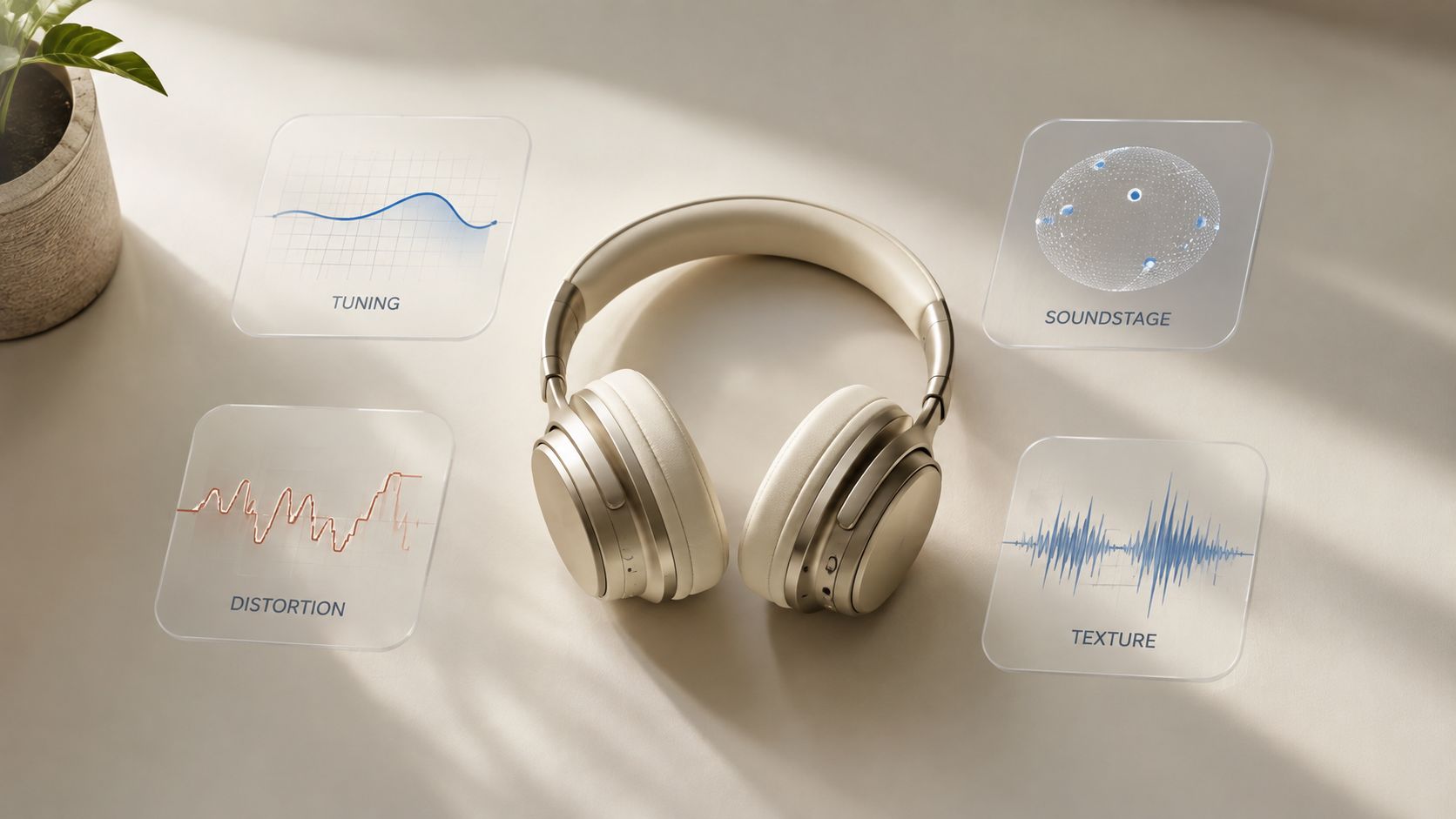
“Best sounding” sounds mystical until you break it into things your ears can identify. I hear four of them first, every time: tuning, soundstage, distortion, and texture. If one of those is off, the whole headphone starts lying to you in a different accent.
Tuning is the load-bearing decision
Tuning is the shape of the frequency response, the part that decides whether bass is pushed forward, mids sit naturally, or treble gets a shiny little halo. The Harman paper linked earlier is useful because it shows listeners don't chase a dead-flat line, they tend to prefer a controlled bass shelf and a gentle treble lift. Sonarworks' market data backs up the commercial side of that preference, because popular headphones keep landing in a boosted bass-and-treble shape.
That doesn't make one tuning universally right. It means tuning is taste made measurable. For a deeper, more technical unpacking of that idea, I've laid it out in my own headphone frequency response guide.
Texture and space are where the lie gets exposed
Soundstage is the sense of width and depth, the way the music occupies the space around your head. Texture is the difference between a voice that feels like flesh and breath versus a voice that feels flattened into a speaker cone. Distortion is the grit that creeps in when a driver is pushed too hard or fed badly.
You notice texture most on vocals, piano, and cymbals. You notice distortion when dense mixes start smearing together instead of separating cleanly. You notice soundstage when live recordings stop sounding pasted to your skull.
The point isn't to memorize jargon. It's to hear what changed. Once you can do that, the spec sheet loses some of its theater.
Open-Back Dynamics, Planar Magnetics, and Closed-Back Choices
Audio gets treated like a morality play. I don't buy it. Open-back dynamics, planar magnetics, and closed-backs each solve a different problem, and the right answer depends on the recordings you own, the source you use, and the kind of presentation you like. Start there, and the buying decision gets simpler fast.
Open-back dynamics sound human
Open-back dynamics, especially the Sennheiser HD 600 and 660S2 class, deserve their reputation because they handle midrange timbre in a way that feels believable. Vocals sit forward without barking. Cymbals decay instead of snapping off. The space around the music stays open, and that matters more than spectacle if you live on singer-songwriter records, acoustic jazz, or anything where the middle of the mix carries the song.
If you want a clearer breakdown of open-back vs closed-back headphones, that distinction matters before you start chasing brand names. Open-backs leak sound, let in room noise, and usually give you a more natural sense of air. That tradeoff is the point.
They also tend to show up around 300 Ω in reference form, which is part of the story. High impedance can leave them sounding lean or restrained from a weak output. Feed them properly and they come alive with better body and control.
Planars hit dense music harder
Planar magnetics, like the HIFIMAN Sundara and HE400SE territory, usually trade a little intimacy for speed. Transients feel faster. Busy passages sort themselves out better. Electronic music and layered productions often benefit because the headphone keeps its shape when the mix gets crowded.
Their nominal resistance often sits much lower, around 35–37 Ω, but that does not make them easy in practical use. Low impedance does not mean low demand. They still want current, and a capable source keeps them from sounding soft around the edges.
Closed-backs are about tradeoffs, not apology
Closed-backs matter when isolation or bass impact is part of the brief. They keep more sound in, block more of the room, and can deliver a more physical low end. That is a design choice with a cost, and it is the right one for commuting, shared spaces, or any setup where leakage matters.
Closed-back headphones do not need your permission. They need a use case.
Pick the job first. Then buy the tool. If you want openness and natural timbre, choose open-backs. If you want speed and separation, choose planars. If you need isolation and punch, go closed-back and stop apologizing for it.
Why Your Source, Amp, and DAC Change Everything
A headphone only sounds as good as the signal feeding it. That sounds obvious until you plug a serious pair into a weak output and wonder why the bass got skinny and the dynamics shrank. The upstream chain is load-bearing, and no driver technology can cook a meal from an empty fridge.
Weak output starves the signal
High-impedance dynamics need voltage headroom. If your source can't give it to them, they can sound lean, compressed, and a little emotionally flattened. Low-impedance planars can look friendly on paper and still ask for real current, which is why a “easy to drive” label often lies by omission.
A phone dongle can be fine for efficient headphones. A dedicated DAC/amp gives you more clean output and better control. A desktop amp adds real headroom, which matters when peaks hit hard and you don't want the sound to collapse on contact.
Clean drive beats fancy driver talk
People chase driver materials and forget the boring part that changes what they hear. Underpowering doesn't just make things quieter. It changes the shape of the listening experience, and the downstream headphone inherits the problem.
If you want the best sounding headphones for music, start by making sure the source can drive the headphone cleanly. That's why I keep pushing match quality over raw spec bragging rights. A big frequency range printed on the box doesn't rescue a starved signal.
For a more practical look at the gear between phone and headphone, my portable DAC and amp guide covers the part people usually skip.
The Headphone Is Only Half the Equation
A revealing headphone is not automatically a better headphone for music. It's just more honest, and honesty is not always kind to your library. Listeners don't sit around listening to pristine audiophile masters all day. They own compressed pop, bright indie, old jazz transfers, live bootlegs, and the odd track that should probably be deleted from history.
Bad masters need mercy
A smoother, slightly warm headphone can rescue a rough recording. It rounds off glare, gives thin mixes some body, and keeps you from wincing every time the chorus opens up. That's why a lot of people swear by a headphone that measures less “perfect” but sounds better on real playlists.
Bright mastering gets tamed by a warmer tuning. Thin mobile mixes gain weight from a bass-present design. Old live recordings need a headphone that doesn't turn audience hiss into a foreground event.
A neutral reference still has a place. For well-recorded jazz, acoustic work, and clean studio material, a balanced headphone lets the recording breathe without editorializing. That's the sweet spot when the source itself is already good.
The right headphone flatters the right library
The common mistake is buying for the test bench instead of the records you play. A headphone that exposes every flaw can be thrilling for ten minutes and exhausting for two hours. A smoother one can feel less dramatic and still be the better music tool.
That's why I resist the one-winner game. Music isn't a spec sheet. It's a library with scars.
Tasting Notes for Headphones Worth Knowing
I'm not going to pretend every buyer needs the same flavor. Here's the short list I'd trust if you forced me to talk in practical terms instead of tribal ones. The value matters, the midrange workhorse matters more than people admit, and a serious reference earns its spot only if it gives you more music, not more marketing.
| Tier | Tonal Character | Best For | Source Requirement |
|---|---|---|---|
| Budget | Slightly forgiving, competent bass, no nonsense midrange | Pop, playlists, casual all-round listening | Friendly to modest sources, but still benefits from clean output |
| Mid-tier open-back | Balanced, spacious, honest without being cruel | Almost everything, especially vocals and acoustic music | Likes proper amplification more than a phone jack |
| High-end reference | Controlled, resolved, and more revealing | Critical listening, better masters, serious genre exploration | Wants a clean, capable source chain |
Budget sound that doesn't embarrass itself
The SuperLux HD 668B is the kind of cheap headphone that reminds people good sound isn't a luxury law. It has no business sounding as competent as it does at the low end of the market. In practice, it gives you enough shape and clarity to enjoy music without pretending to be a halo product.
I'd put it on pop and casual streaming first. It won't seduce you with plushness, but it won't mock your wallet either. That matters.
The mid-tier workhorse most people should stop ignoring
The Sennheiser HD 600 and 660S2 family is still the safe answer for a reason. Vocals land naturally. Snare drums have body without cardboard. Cymbals keep their shimmer without turning into white noise. This is the headphone I'd hand to someone who listens across genres and wants one pair to stop the shopping.
For acoustic records, singer-songwriters, and well-mastered rock, it's hard to beat the way it handles tone. It doesn't dramatize. It just gets out of the way and lets the mix speak.
A high-end reference that earns the seat
If you want more resolution and more room to hear into the mix, the top reference tier makes sense only when the rest of the chain can support it. That's where the listening turns from “nice” to “specific.” You hear the space around the snare, the little scrape of a pick, the decay trail behind a piano chord.
That's the point of paying up. Not louder bass. Not shinier treble. More truth.
How to Audition a Headphone and Trust Your Own Ears
Don't audition a headphone by staring at it for thirty seconds and judging the first impression. The first thirty seconds are often a lie because your brain is calibrating to the new shape of the sound. The second track is usually where the truth shows up, and the third is where fatigue starts talking.
Bring the right three tracks
Use one track you know is well recorded, one average track, and one rough one. That mix tells you more than a polished demo file ever will. You're not testing the headphone in a vacuum. You're testing how it behaves across the mess you live with.
Listen for five things in order.
- Vocal texture: does the voice sound like a person, or like a filtered recording?
- Bass control: does the low end stay shaped, or does it smear?
- Treble smoothness: do cymbals decay naturally, or do they spit?
- Soundstage width: does the music open up, or stay trapped between your ears?
- Transient behavior: does a loud hit land cleanly, or does the headphone flinch?
Fit is part of sound quality
A loose seal doesn't just feel bad, it changes the bass. If the headphone moves around, the low end thins out and the whole tuning shifts. Comfort matters, but fit is also acoustics.
If the seal is wrong, the review is wrong.
That's why I care about wearability only after the sound lands. Specs can lie, measurements can mislead, but your ear on a record you love is the only verdict that matters.
Match the Tuning to the Music You Actually Own
Stop shopping for a universal winner. Buy the tuning that suits your records, your source, and your patience. If your library is bright and rough, choose a smoother headphone. If your source is weak, don't pretend a demanding model will magically forgive it. If your music is well recorded and you want truth, pick a balanced reference and feed it properly.
That's the checklist. Know your genres. Know your masters. Know whether your source can drive the load. Then audition with music you trust, not marketing language.
The best headphone is the one that makes your library sound right. Not louder. Right.
If you want a sharper, no-nonsense shortlist built around your own music, stay with Supermarket Sound and use this guide as the filter, not the finish line.

