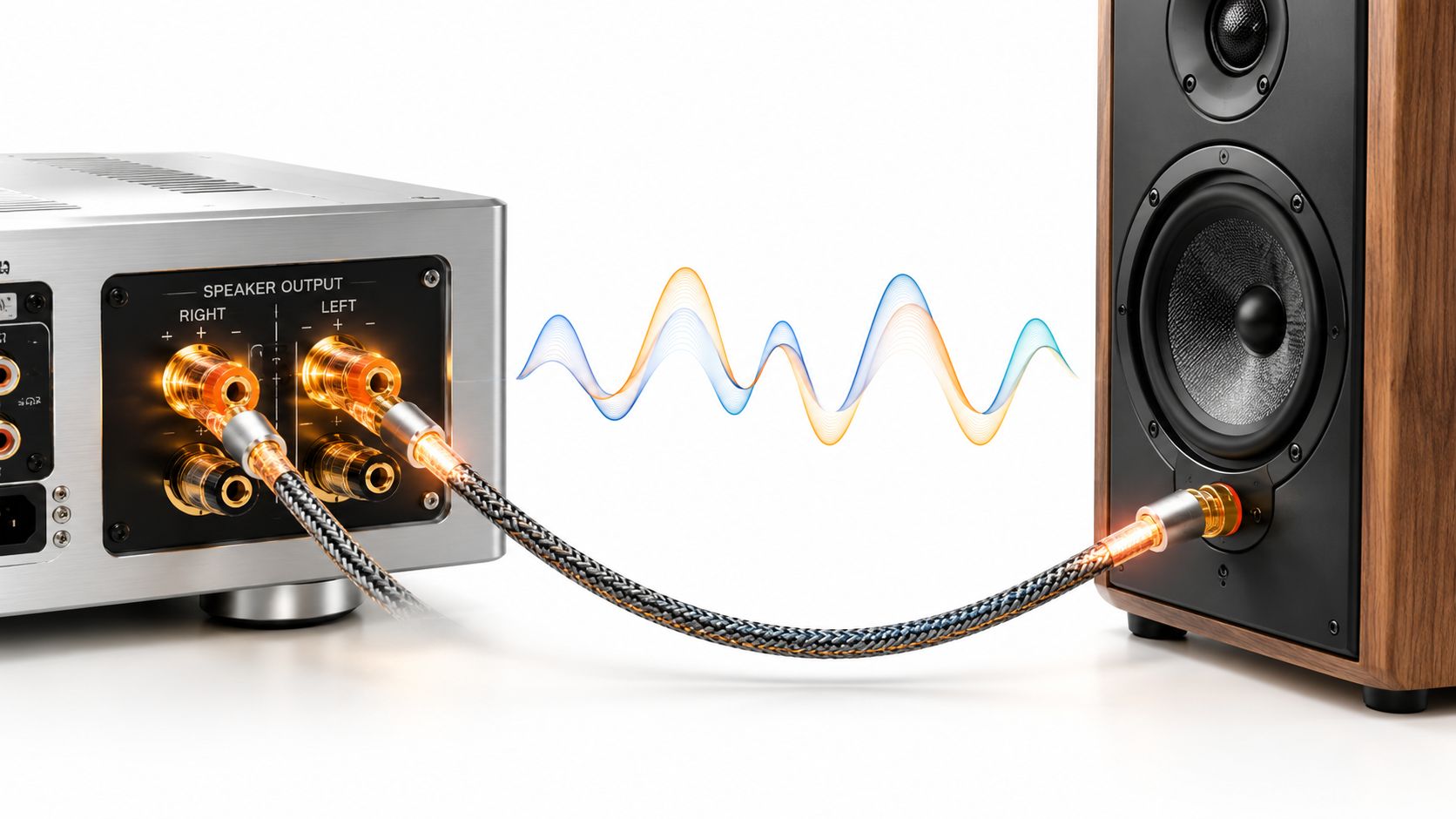
Most advice about 6 ohm speakers on an 8 ohm amp starts with the wrong picture. It treats those labels as fixed resistors, as if the amplifier sees a clean 6 or 8 ohms from the first kick drum to the final cymbal decay. It doesn't. A loudspeaker presents a moving electrical load, and the amplifier's real job is to survive the valleys in that curve.
So yes, a normal solid-state amplifier will often run a nominal 6-ohm speaker safely at sensible levels. The catch is that current delivery, cooling, and headroom matter more than the badge on the rear panel. The printed rating gives you a useful starting point, not a permission slip for unlimited volume.
I write about hi-fi because ears still beat spreadsheets, though SEO pays the rent and occasionally makes me explain Ohm's law before breakfast. The practical answer is straightforward: check the amplifier's minimum-rated load, keep the chassis ventilated, and treat protection shutdown or audible compression as a warning, not a challenge.
Table of Contents
- The Number on the Back Is a Story, Not a Fact
- How Impedance Actually Swings with Frequency
- What Ohm's Law Does to Your Amp's Current Draw
- What Strain Sounds and Feels Like in a Real Room
- Matching Rules, Tube Amps, and the Real Minimum Load
- A Practical Checklist Before You Press Play Loud
- Why the Mismatch Myth Outlives the Math
The Number on the Back Is a Story, Not a Fact
A speaker marked 6 ohms doesn't behave like a 6-ohm resistor. An 8-ohm label doesn't mean the amplifier sees 8 ohms at every frequency, either. Loudspeaker ratings are nominal shorthand, while the impedance changes as the drivers, crossover, cabinet, and voice coils respond to the music.
A real loudspeaker is an electromechanical system. The amplifier drives a voice coil through a magnetic gap, the coil moves the cone, the cabinet and port shape the air load, and the crossover routes different frequencies through different components. Every part affects the load seen by the output stage.
That load rises and falls with frequency. It can become easier in one part of the spectrum and much harder in another. The number printed beside the binding post can't tell that whole story.
Nominal does not mean constant
Industry references commonly use nominal ratings such as 4, 8, 15, or 16 ohms, but the actual impedance swings across the frequency range, as explained in this loudspeaker impedance overview. The same reference describes the IEC convention that keeps minimum impedance within a defined relationship to the nominal rating.
That distinction matters more than the argument over whether 6 or 8 is the “correct” number. An 8-ohm design may legally dip to 6.4 ohms, while a 6-ohm design may dip to 4.8 ohms, based on the 80% minimum relationship described by the standard and summarized in the reference above.
Those aren't exotic exceptions. They're reminders that the label is rounded language for a curve.
Practical rule: Read the nominal rating as a map legend. The dangerous terrain sits in the low points.
The valleys carry the risk
The amplifier doesn't struggle because the speaker has chosen an unfashionable number. It struggles when the impedance valley demands more current than the power supply, output devices, and heat sinking can comfortably deliver.
That changes the question. Don't ask only, “Can an 8-ohm amp run 6-ohm speakers?” Ask what the amplifier's minimum load rating says, how loudly you plan to listen, whether you have one pair or several speakers connected, and how much ventilation surrounds the chassis.
The labels are useful. They aren't literal.
How Impedance Actually Swings with Frequency
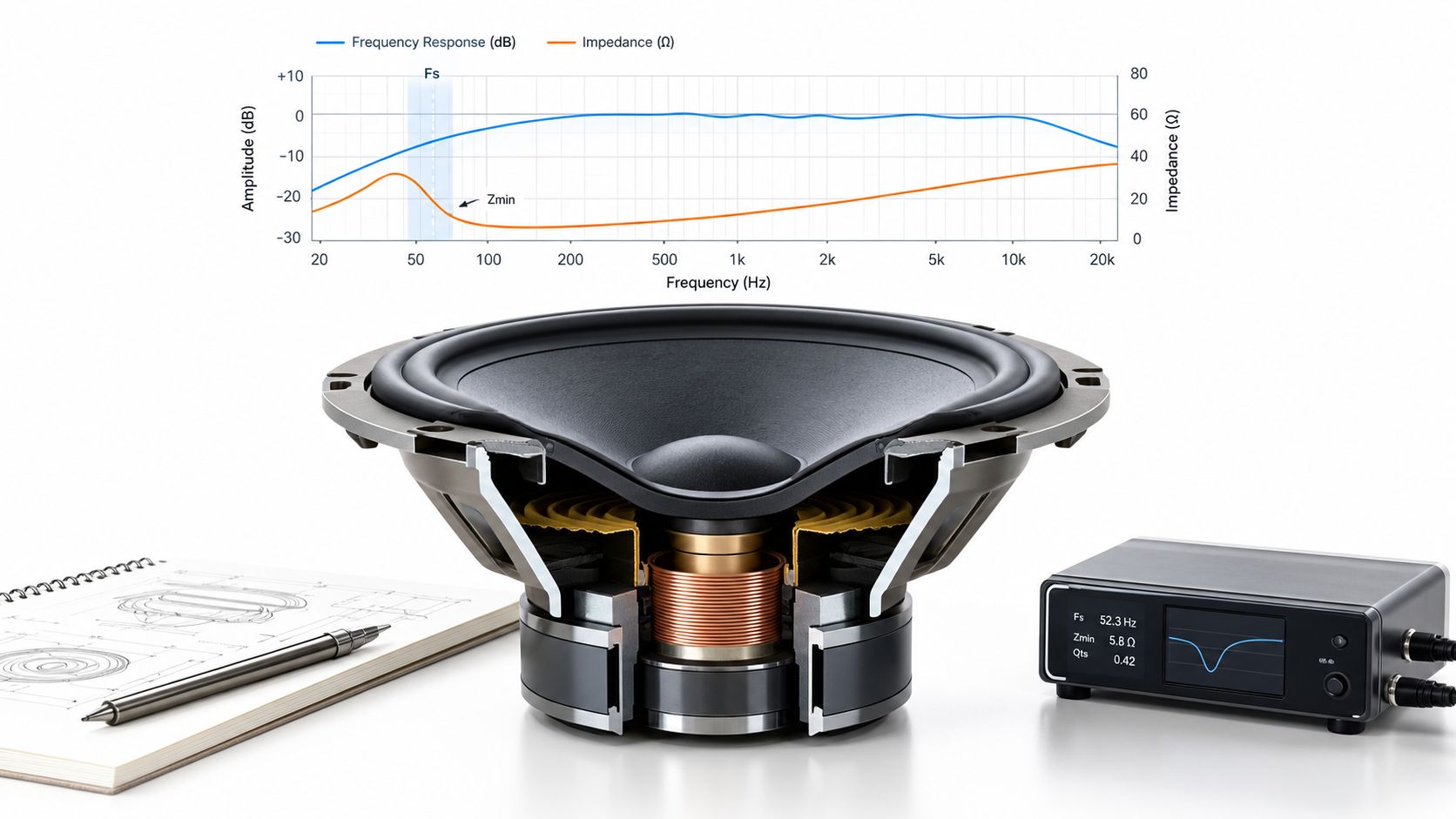
An impedance curve usually tells a more honest story than the rear-panel badge. At low frequencies, the driver often creates a pronounced peak around its mechanical resonance. A ported cabinet adds another shape around its tuning region, where the curve can fall into a demanding valley before rising again.
Through the midrange, the impedance may settle into a broader plateau. At the top end, voice-coil inductance can lift the curve once more. The amplifier therefore sees a pattern of peaks and dips, not a straight road.
For a plain-language refresher on how frequency relates to loudspeaker behavior, Supermarket Sound's guide to frequency response in speakers covers the listening side of the same problem.
The 80% convention
The IEC 60268-5 nominal-impedance method uses an 80% minimum relationship. In practical terms, an 8-ohm loudspeaker can reach 6.4 ohms at its minimum, while a 4-ohm loudspeaker can reach 3.2 ohms, as summarized in this nominal impedance discussion.
A 6-ohm nominal speaker can therefore reach about 4.8 ohms under that same convention. That minimum is where the amplifier has to push hardest, especially when the music contains sustained bass rather than a brief transient.
The important phrase is minimum impedance, not nominal impedance. The former describes a difficult moment in operation. The latter gives buyers a manageable category.
Why the curve matters in practice
A 6-ohm speaker with a gentle curve may behave more easily than a nominal 8-ohm design with an ugly dip. Conversely, a 6-ohm model whose lowest point lands in the bass can ask an 8-ohm-rated amplifier to deliver serious current exactly where the room and the music demand weight.
That's why a multimeter reading won't settle the question. A static resistance check can tell you something about the voice coil, but music presents frequency-dependent impedance. The amplifier responds to the curve.
Look for the valley. That's where the floor gives way.
What Ohm's Law Does to Your Amp's Current Draw
Ohm's law supplies the part of this subject that doesn't care about audiophile mythology. At the same voltage, lower impedance draws more current. Moving from 8 ohms to 6 ohms means the current demand rises by about 33%, because the amplifier is pushing the same voltage into a smaller load, as explained in this speaker impedance analysis.
The idealized example makes the trade-off clear. An amplifier delivering 50 watts into 8 ohms would deliver about 67 watts into 6 ohms if its power supply could maintain the same voltage and source the extra current. Real amplifiers rarely behave that generously at the edge of their operating envelope.
| Voltage Swing | Current into 8Ω | Current into 6Ω | Power into 8Ω | Power into 6Ω |
|---|---|---|---|---|
| Same output voltage | Baseline | About 33% higher | 50 W example | About 67 W ideal example |
The power supply sets the ceiling
Lower impedance can increase output power, but only until the amplifier reaches its current limit. The power transformer, reservoir capacitors, output transistors, and protection circuitry all inherit the extra demand.
Output devices dissipate more heat. The heat sink needs more thermal margin. The transformer works harder, and the power supply may reduce voltage under sustained load. Once that happens, the attractive ideal calculation stops describing the room.
More current can buy more output. It can also buy more heat than the amplifier knows what to do with.
This is why lower impedance doesn't automatically mean dramatically more usable power. A solid design may deliver more clean authority into 6 ohms. A lightly built receiver may clip sooner, protect itself, or flatten the bass when the supply runs short.
The amplifier's rating is the useful boundary
An 8-ohm specification usually describes a reference load, not the amplifier's own internal resistance, as discussed in this solid-state amplifier loading thread. The meaningful question is how the design handles its minimum permitted load.
A normal solid-state amplifier often copes with a nominal 6-ohm speaker at moderate volume. That doesn't promise clean output in a large room, with difficult bass, poor airflow, or multiple speakers wired together. The system may sound fine for an hour, then lose its grip when the music stays loud.
Current is the load-bearing part of the specification.
What Strain Sounds and Feels Like in a Real Room
An amplifier rarely announces impedance stress with a dramatic puff of smoke. More often, the sound loses its composure first.
Bass may arrive with convincing weight, then become flatter during sustained passages. Kick drums lose the sense of a firm floor beneath them. Organ pedals stop expanding into the room and start sounding pressed against a ceiling. The change can be subtle at first, which is why people often blame the recording or the speaker.
Listen for compression, not just distortion
Current limiting in a solid-state amplifier can sound like a hard restriction on dynamics. The system doesn't necessarily become obviously fuzzy. Instead, loud transients stop getting louder, bass impact compresses, and the stereo image loses some of its ease.
The midrange may remain relatively stable because many loudspeaker impedance curves rise through parts of the upper register. The demanding valley often sits lower, so the failure begins underneath the vocal or guitar rather than in the vocal itself.
That distinction matters. If the singer still sounds clean while the kick drum turns papery, suspect current delivery before you accuse the tweeter.
Heat leaves clues
Put your hand near the chassis after sustained listening, without blocking ventilation. A warm enclosure isn't automatically a problem. A chassis that becomes too hot to touch, repeatedly engages protection, or grows hotter as the session continues is telling you the amplifier has little thermal headroom left.
Tube amplifiers reveal stress differently. The output transformer warms, the presentation can narrow, and abnormal tube behavior deserves immediate attention. A solid-state amplifier may become less dynamic, then shut down to protect its output stage.
None of these symptoms proves that a 6-ohm speaker caused the problem. They do show that the pairing is operating closer to its ceiling than the nominal labels suggest.
The sound tells you before the protection circuit does.
Matching Rules, Tube Amps, and the Real Minimum Load
The safest general rule is simple: the speaker's impedance should match or exceed the amplifier's stated minimum impedance. If an amplifier specifies a minimum of 6 ohms, both 6-ohm and 8-ohm speakers fit that operating window, while a 4-ohm speaker falls outside it, as outlined in this speaker resistance matching guide.
That rule isn't superstition. It describes the range the amplifier's power supply, output stage, protection circuit, and cooling system were built to handle.
Solid-state and tube designs don't play the same game
Solid-state amplifiers generally tolerate lower impedance more comfortably because their output stages can deliver substantial current and their protection systems can respond quickly. That doesn't make every solid-state amplifier invincible. A modest receiver with limited ventilation can still run out of road.
Tube amplifiers reverse some of the usual assumptions. Their output transformers and impedance taps expect a particular relationship between amplifier and speaker. A 6-ohm speaker connected to an 8-ohm tap operates away from the tap's intended design point, which can reduce damping and increase transformer stress.
| Load Condition | Solid-State Amp Response | Tube Amp Response |
|---|---|---|
| Speaker meets the stated minimum | Usually the intended operating window | Usually the intended tap and load relationship |
| Speaker drops below the minimum | Current demand rises, with possible clipping or protection shutdown | Transformer and output-stage stress can increase |
| Speaker sits between common tap values | Often workable if the amplifier has headroom | Tap selection and manufacturer guidance matter more |
| Multiple speakers share one channel | Total load can become substantially harder | The transformer sees the combined load through the selected tap |
A tube amplifier with selectable taps deserves closer attention than a typical integrated solid-state design. Check the manufacturer's guidance rather than assuming that a nominal number tells you which tap to use. The wrong connection may sound softer, less controlled, or oddly compressed before it causes a clear fault.
For a deeper look at the underlying concept, Supermarket Sound's guide to impedance matching keeps the electrical relationship in plain language.
The minimum rating is the floor. Don't build below it casually.
A Practical Checklist Before You Press Play Loud
Before you run 6-ohm speakers from an 8-ohm amplifier at serious levels, check the system as a physical object, not just a pair of numbers.
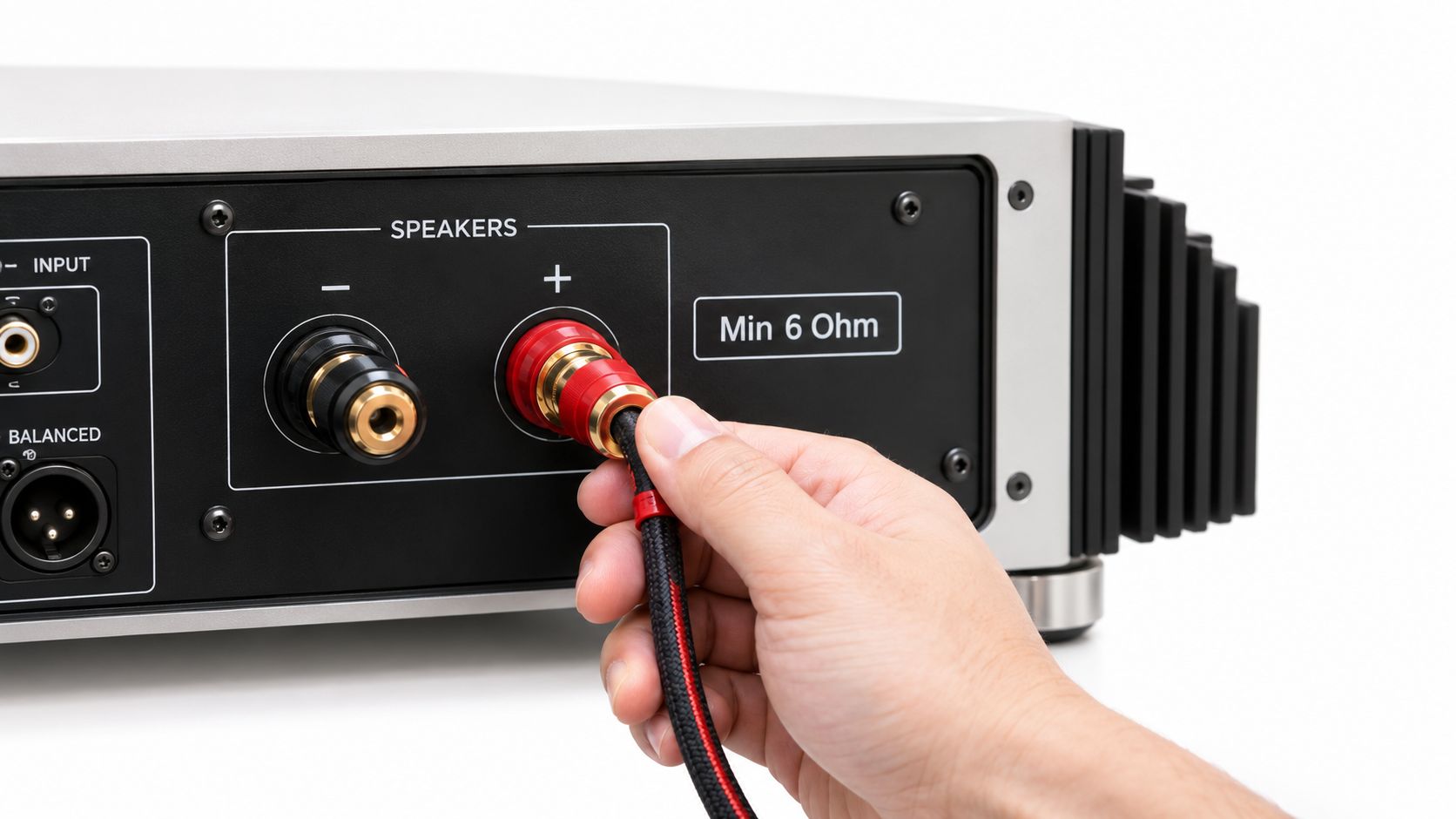
Start with the rear panel and manual. Find the amplifier's minimum impedance rating. That specification matters more than whether the speaker box says 6 or 8 ohms, because it tells you the load the output stage is designed to tolerate.
Make the setup boring
- Check the terminals: Confirm that the speakers connect to the intended output, with no loose strands touching adjacent terminals.
- Protect airflow: Keep the top and sides clear. A closed cabinet turns a manageable load into a heat problem.
- Inspect the cable run: For runs over 20 feet, 16 AWG or heavier cable provides a sensible floor for ordinary home connections.
- Start with dynamic music: A full-range orchestral recording can expose bass strain more clearly than heavily compressed material.
- Use your hand as a warning instrument: After 10 minutes, warm is normal. Too-hot-to-touch means you should reduce the load or level.
- Watch protection behavior: Any current-limiting indicator, relay click, mute event, or shutdown deserves attention.
You don't need to begin with test equipment. Start gently, raise the level gradually, and listen for flattened bass or a sudden loss of dynamics. If the sound becomes harder instead of bigger, stop turning the knob.
This amplifier setup video shows the kind of connection work that should happen before you make a listening judgment.
Don't make a marginal pairing carry the whole room
If the amplifier runs hot or protects itself, lower the listening level first. Don't add another speaker in parallel as a casual fix. Parallel wiring reduces the combined impedance, which can make the amplifier's job harder rather than easier.
A second speaker can share acoustic coverage in some systems, but the electrical calculation changes with the wiring. Confirm the resulting load before you connect anything, especially on one amplifier channel.
If the match remains marginal, use an amplifier with a lower minimum-load rating or choose speakers that present an easier curve. The cheapest repair is the one you avoid.
Why the Mismatch Myth Outlives the Math
The warning that 6-ohm and 8-ohm equipment must never coexist survives because it's easy to teach. “Match the numbers” fits on a sales counter card. “Inspect the impedance curve, understand current demand, and evaluate thermal headroom” requires a conversation, a manual, and sometimes a graph nobody brought to the shop.
Older, lightly built receivers also gave the caution a durable reputation. Some really struggled with low loads, especially when users connected multiple speakers or enclosed the amplifier in furniture. Manuals responded with conservative guidance, and the shorthand became folklore.
The labels hide overlap
An 8-ohm speaker can dip toward the same difficult region that makes a nominal 6-ohm speaker look suspicious. The difference between the badges may therefore be much smaller than buyers assume at the bass frequencies that demand the most current.
That doesn't make every pairing safe. It means the label alone cannot tell you how the system behaves. Two nominally similar speakers can place their impedance valleys in different parts of the spectrum, and one may prove far easier for the amplifier than the other.
The amplifier sees the curve. The manual gives you the boundary. Your room supplies the punishment.
What works and what doesn't
A sensible solid-state amplifier, a single pair of 6-ohm speakers, clear ventilation, and moderate listening levels usually form a workable combination. A small amplifier rated only around 8 ohms, a difficult speaker curve, high sustained volume, and multiple speakers on one channel form a poor one.
The same logic applies to an 8-ohm speaker. Its nominal label doesn't guarantee an easy load, and a 6-ohm speaker isn't automatically a threat. The practical distinction comes from the minimum load, current capability, protection behavior, and heat.
Print numbers are a convenience. They aren't a contract.
If you're setting up 6-ohm speakers on an 8-ohm amp, check the amplifier's minimum rating first, leave the chassis open to airflow, and test with demanding music before committing to high sustained levels. If the bass compresses, the chassis becomes dangerously hot, or protection engages, stop treating the pairing as a numbers question and change the operating conditions. For more amplifier and speaker setup guidance, visit Supermarket Sound and make the load, not the label, the foundation of the system.

