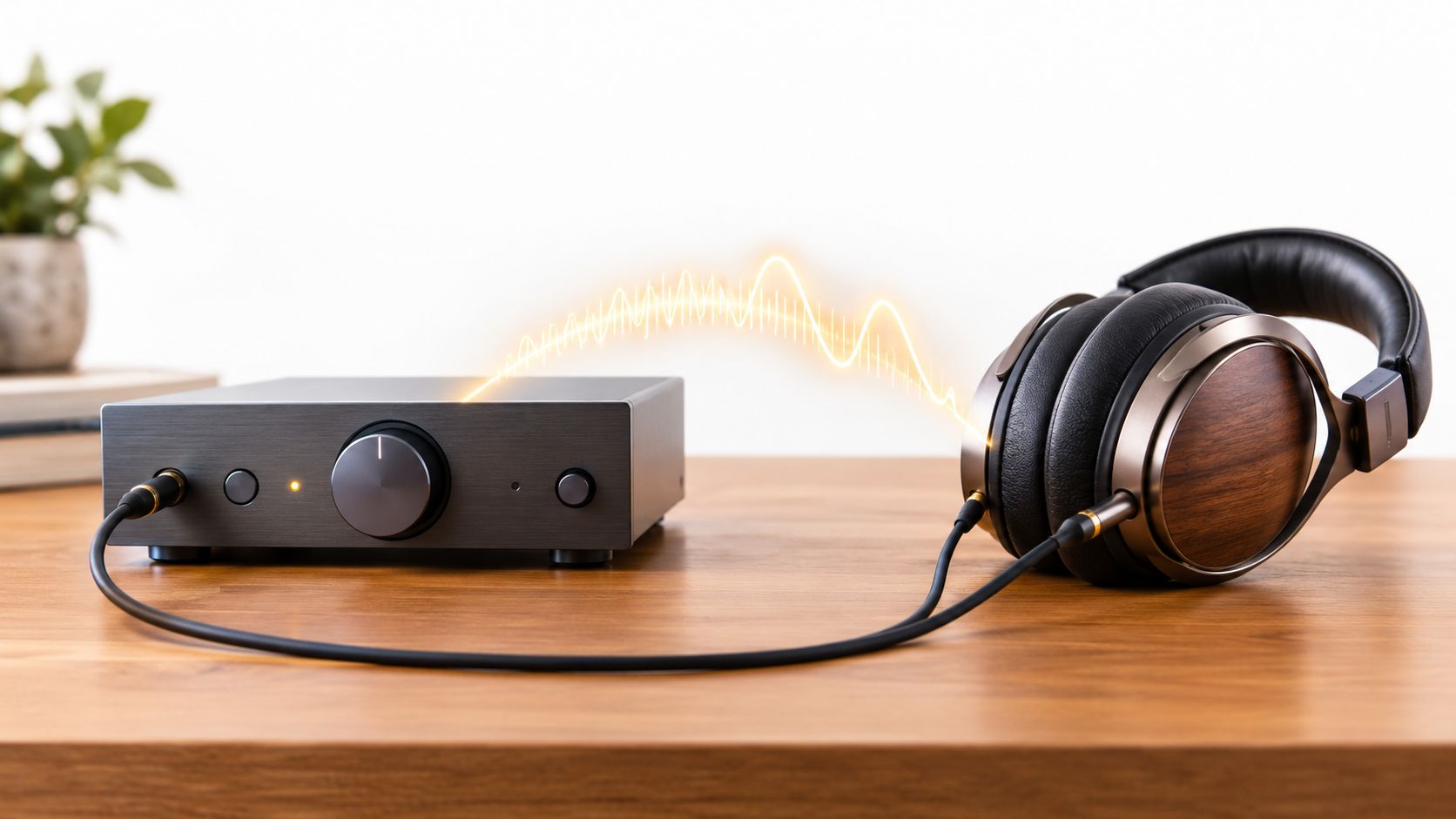
The most popular advice about an amplifier for headphones is usually wrong: you don't buy one because your headphones need to become louder. You buy one because the source may be running out of voltage, current, control, or clean headroom before your music reaches the driver.
That distinction matters. A weak match can make bass feel loose, dynamics flatten, and sensitive in-ear monitors hiss. A good match may sound like no sound at all, just a quieter background, firmer low end, and more space around the recording. I'm Marque Hersh, founder of Supermarket Sound, and yes, this site has to rank to survive. I'd still rather give you a reason not to buy another box than sell you a decorative upgrade.
An amp is the floor.
Table of Contents
- Introduction Why Most People Buy an Amp for the Wrong Reason
- What an Amplifier for Headphones Actually Does to Your Signal
- Do You Actually Need a Dedicated Headphone Amp
- Types of Headphone Amplifiers and How They Sound Different
- Matching Power Impedance and Sensitivity Without the Myths
- How a Good and Bad Match Actually Sounds in Real Listening
- Buying Guidance That Prioritizes Fit Over Hype
Introduction Why Most People Buy an Amp for the Wrong Reason
People often ask whether a headphone amplifier will make their headphones sound “better.” That question skips the load. The useful question is whether the existing source can supply what the headphone demands without strain.
A phone or laptop can handle an easy headphone load beautifully. If the headphones are sensitive and the source has a low output impedance, adding a separate amplifier may change nothing meaningful except the furniture on your desk. The new box can become an expensive volume knob with a glowing logo.
The failure appears when the source runs out of headroom. A high-impedance dynamic headphone may need more voltage swing than a small output stage can provide. A low-impedance planar may ask for more current than that same stage can deliver. Sensitive IEMs create the opposite problem, because a powerful or poorly matched amplifier can expose its noise floor.
The practical test: Don't ask whether an amp has more watts. Ask whether your source is starving the signal.
That's why amplifier specifications can mislead. Power quoted into a low-resistance load doesn't automatically tell you how an amplifier behaves with a high-resistance headphone. Output impedance can alter tonal balance even when the volume seems more than adequate. Gain can make a quiet headphone easy to drive, or make a sensitive IEM unbearable to use.
I'll build this from the signal outward, then bring it back to listening. No product roundup. No badge worship. Just the electrical match between source and headphone, and what that match does to the music.
The load decides.
What an Amplifier for Headphones Actually Does to Your Signal
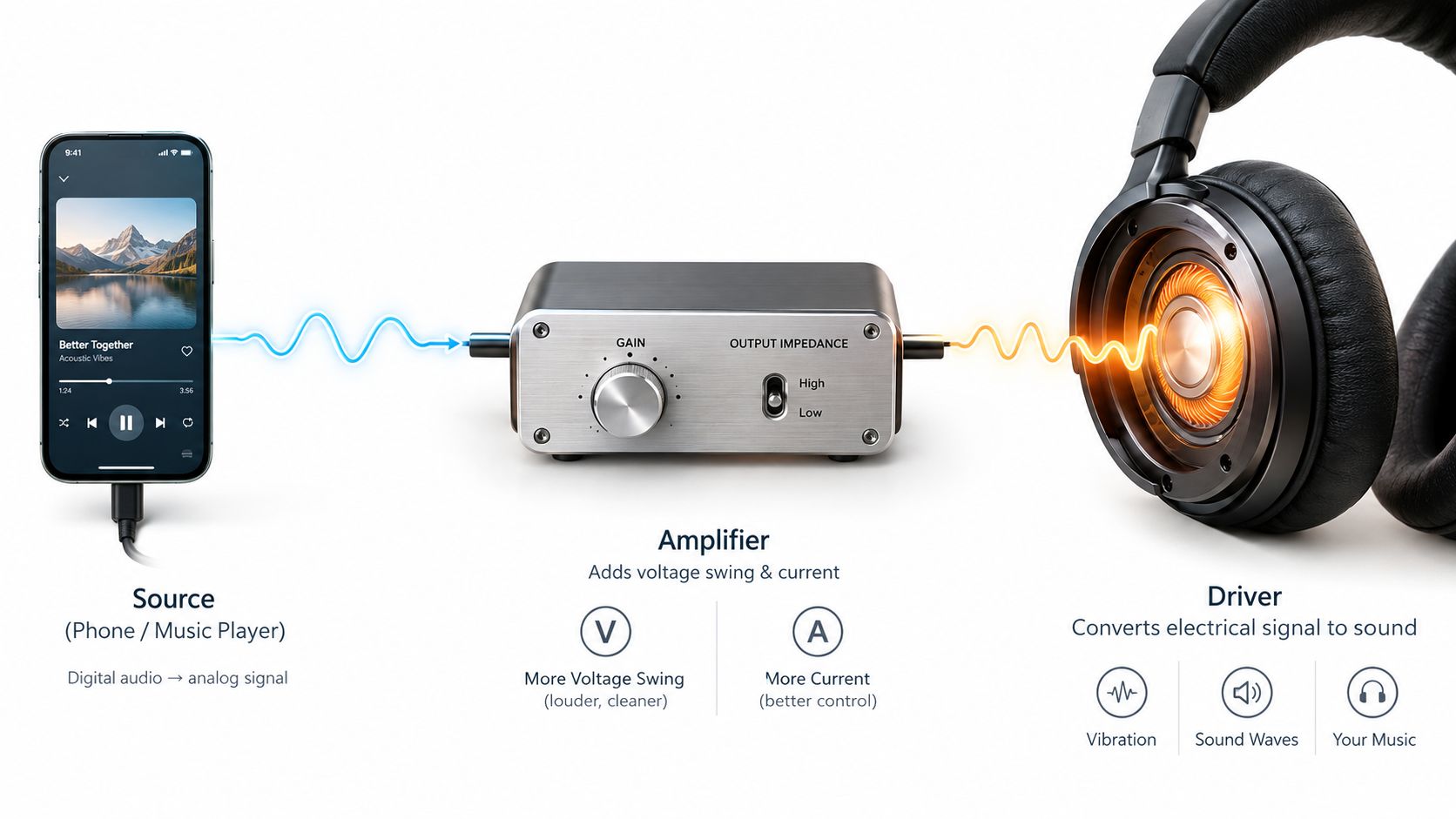
Think of the signal chain as a building. The source provides the plan, the amplifier provides the floor, and the headphone driver carries the load. If the floor flexes, everything downstream inherits the compromise.
An amplifier handles four jobs that matter in practice:
- Voltage swing, which gives the headphone enough electrical pressure to reach demanding peaks.
- Current delivery, which keeps low-impedance loads from draining the output stage.
- Gain, which raises the signal to a usable listening level.
- Output impedance, which determines how firmly the amplifier controls the driver and whether the headphone's frequency response shifts.
A phone may contain a perfectly competent DAC and still struggle as an output stage. The digital conversion can be clean, but the tiny analog section may have limited voltage rails or current capacity. You hear that limitation as compressed dynamics, a thin upper bass, or a presentation that loses its shape when the music becomes dense.
A dedicated amp doesn't rebuild the recording. It gives the existing signal a stronger electrical foundation. The driver then receives the voltage and current it needs instead of whatever the small source can manage at the edge of its limits.
Gain is not the same as authority
Gain changes signal level. It doesn't automatically create unlimited current or voltage capability. A high-gain setting can make headphones louder while reducing usable volume control and increasing hiss, especially with sensitive IEMs.
Output impedance works differently. A high source impedance reduces electrical damping and can reshape the headphone's frequency response. The headphone impedance guidance from Lewitt explains why a source under 2 ohms is commonly recommended for broad compatibility, particularly when the headphone's impedance changes across the frequency range.
The old receiver era helps explain why this became confusing. Before dedicated headphone amplifiers became common, listeners often drove headphones from stereo receivers through resistor networks. Commentary on that history notes that 120 ohms was once treated as a standard headphone-amp output impedance, and that the most common listening setup in the 1960s and 1970s was effectively a tap from speaker equipment rather than a purpose-built headphone amplifier. You can read that background in this history of headphone amplifier output stages.
The modern norm is different. The source should act like a firm floor, not a springy bridge.
For the difference between conversion and amplification, my plain-language guide to headphone amp versus DAC keeps the two jobs separate. That separation prevents a lot of expensive confusion.
Do You Actually Need a Dedicated Headphone Amp
You need to answer three questions before spending money:
- Can the source reach your preferred listening level?
- Can it do that without audible strain?
- Does its output impedance suit the headphones?
Volume alone doesn't settle the matter. Sensitivity and impedance work together. A 300-ohm headphone with high sensitivity can be easier to drive than a low-impedance model with low sensitivity. Impedance tells you how much the load resists current, but sensitivity tells you how efficiently it turns electrical input into sound.
That's why “high impedance always needs an amp” is lazy advice. The better approach is to listen for symptoms. If your headphones already play loud enough with clean peaks, don't assume a separate amplifier will create a new level of detail. If crescendos flatten, bass loses authority, or you need to run the source near its limit, the source may be running out of room.
The source you already own may be enough
Modern interfaces, desktop DAC/amp units, and compact integrated devices have narrowed the gap. Many already provide low output impedance, sensible gain, and enough power for the headphones their owners use. In that case, a separate amplifier becomes a feature or workflow purchase, not an automatic sound-quality requirement.
For IEMs, noise matters more than brute force. A powerful desktop unit can be electrically excellent and still be a poor partner if you hear hiss between tracks. Low gain, a quiet output stage, and very low output impedance matter more than a headline wattage figure.
Portable listening brings another compromise. A small device may offer enough power for efficient headphones while giving up some battery life, connection flexibility, or control compared with a desktop unit. That doesn't make it inferior. It makes the use case different.
A quick decision filter
If your source sounds clean, reaches your normal level, and stays quiet with your headphones, keep using it. That's a successful match.
If the source reaches the volume you want but the tonal balance changes between outputs, investigate output impedance before chasing more power. A mismatch can create the problem that an amplifier appears to solve.
If your headphones sound constricted only on loud, complex passages, look for voltage or current limits. If they hiss at low listening levels, look for gain and noise problems instead.
My buying rule: An amplifier should solve a named electrical problem. “More expensive” isn't a problem.
The dedicated purchase makes sense when it gives you clean headroom, a better output stage, quieter operation, useful gain control, or a practical connection setup. It doesn't make sense when it merely repeats what your current source already does.
Need is narrower than enthusiasm.
Types of Headphone Amplifiers and How They Sound Different
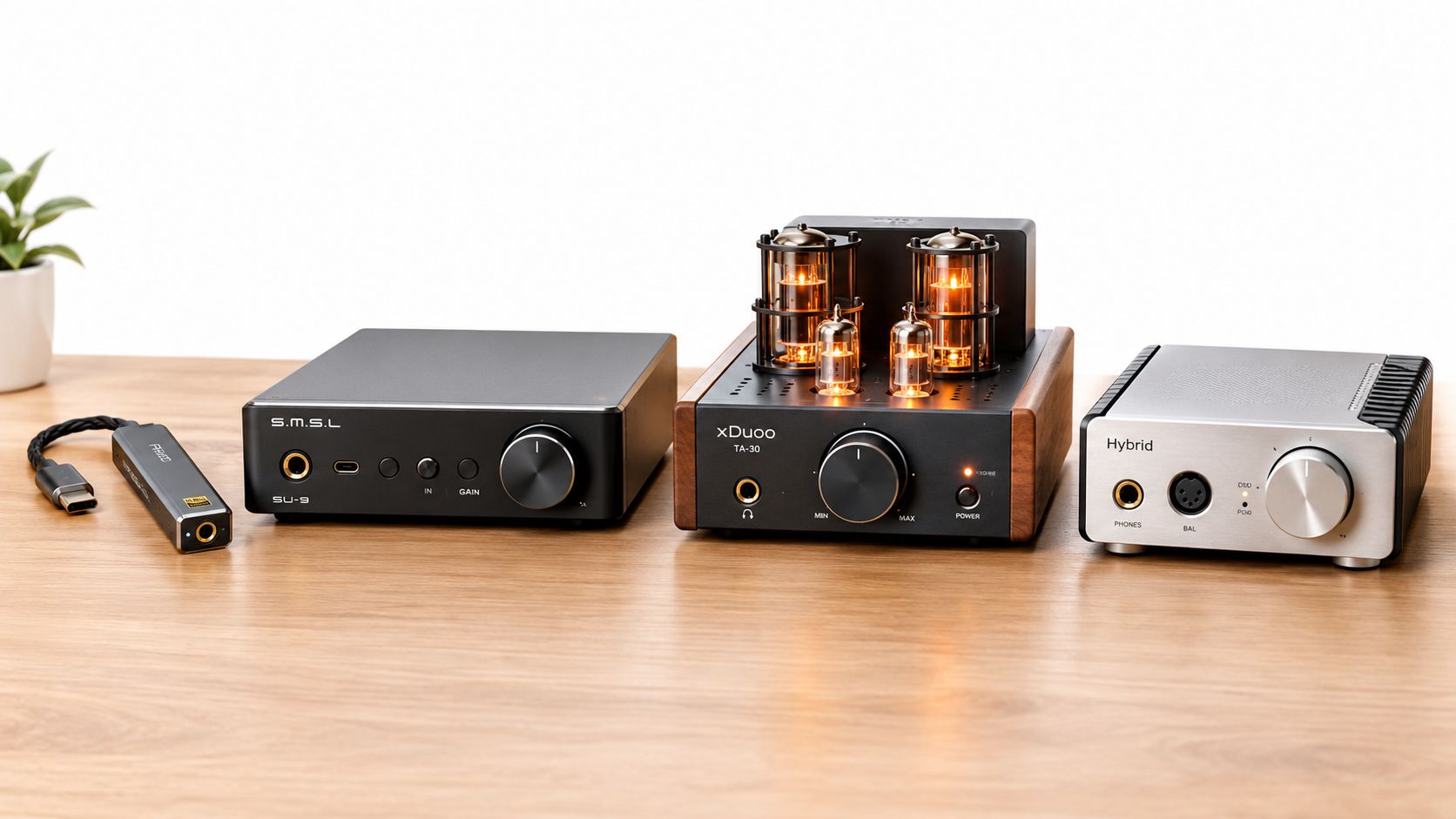
The category splits by job first, circuit style second. A portable amp has to fit into a bag and share power with a battery. A desktop amp can use a larger power supply and more substantial output stage. A DAC/amp combo joins conversion and amplification in one enclosure, which can simplify the chain without making the electrical design automatically better.
Portable and desktop designs
Portable amplifiers prioritize size, battery use, and sensible output. They can sound remarkably composed with efficient headphones and many IEMs. Their presentation often feels quick and direct, with less physical weight than a generous desktop supply can provide on demanding planars.
Desktop amplifiers offer more room for voltage swing, current delivery, gain options, and thermal management. To my ears, a good desktop match gives difficult headphones a steadier center image and firmer bass texture. It doesn't necessarily sound louder. It sounds less hurried.
DAC/amp combos make sense when you want fewer boxes and fewer cables. They also reduce the chance of feeding a noisy or poorly matched analog chain. A separate DAC and amplifier make more sense when you need multiple sources, different outputs, or the freedom to change one part without replacing the other.
Solid-state designs usually aim for low noise, low output impedance, and predictable behavior across loads. That makes them the safe default for mixed headphone collections. The sound can come across as controlled and clean, with tight transients and a stable image.
Tubes, hybrids, and deliberate color
Tube amplifiers are not magic. They often introduce a different output stage behavior, and some designs use a higher output impedance that can interact with the headphone. With a compatible headphone, that interaction may add bloom to the midrange, soften leading edges, or give vocals a warmer, more rounded body.
That can be lovely. It can also turn a loose bass line into soup.
Hybrid designs split the character between a tube input stage and a solid-state output stage. They can give music a little more glow while retaining stronger control than a purely tube-based output. The result depends on the circuit and the headphone, not the word “hybrid” printed on the front panel.
Match the character, not the mythology
A neutral solid-state amplifier suits listeners who want the headphone's own tuning to remain intact. A tube or hybrid design suits someone who wants to shape texture, warmth, or intimacy as part of the system. Neither choice excuses poor impedance matching.
Noise floor, output impedance, gain range, and usable power still carry the load. Circuit fashion comes after compatibility.
Matching Power Impedance and Sensitivity Without the Myths
An amplifier's power rating only means something alongside the load it drives. A figure quoted into 32 ohms describes that load, not every headphone. One published engineering example shows an amplifier delivering about 2.2 watts into 32 ohms, but only 238 milliwatts into 300 ohms in direct drive. With a 120-ohm series feed, those figures fall to roughly 99 milliwatts and 121 milliwatts. The engineering example and test discussion shows why the headphone changes the result.
Low-impedance planars generally demand current. High-impedance dynamic headphones generally demand voltage swing. Sensitivity describes how efficiently a headphone turns that electrical supply into sound. Power, impedance, and sensitivity belong in the same calculation.
The one-eighth rule is a starting floor
A widely used rule says amplifier output impedance should be no more than one-eighth of the headphone's nominal impedance, as explained in this guide to what impedance in headphones means. That keeps mismatch-related error under about 1 dB, while 2 ohms or less is a practical target for broad compatibility, according to this guide to headphone amplifier output impedance.
For a 16-ohm headphone, the rule points to roughly 2 ohms or less at the amplifier output. A sensitive IEM benefits from an output closer to 0.1 ohm, which reduces response changes caused by the electrical interaction. The rule is a filter, not a law.
The headphone amplifier matching guidance connects output impedance with damping factor. A higher value can loosen bass control and create tonal shifts when a multi-driver earphone's impedance varies across its frequency range.
Read the specification as a load map
| Headphone Load | What It Demands | Amp Requirement | Risk If Mismatched |
|---|---|---|---|
| Low impedance, high sensitivity | Current control and low noise | Very low output impedance, low gain, clean current delivery | Hiss, abrupt gain, tonal shifts |
| Low impedance, lower sensitivity planar | Sustained current and headroom | Strong current capability at the stated load | Flat bass impact, compressed dynamics |
| High impedance dynamic | Voltage swing and usable gain | Verified power into the higher-resistance load | Thin peaks, low headroom, strained sound |
| Variable multi-driver IEM | Stable electrical control | Output impedance comfortably below the load variation | Frequency-response coloration |
Gain needs the same practical treatment. Normal headphone amplifier gain is commonly placed around 10 to 20 dB, or roughly a 3x to 10x voltage increase. Example targets include about 12 dB for 32-ohm, 18 dB for 120-ohm, and 22 dB for 300-ohm headphones, as discussed in this technical discussion of headphone amplifier gain.
Choose the lowest gain that provides useful volume range and clean peaks. More gain does not create better headroom. It can make the volume control touchy and expose noise sooner.
How a Good and Bad Match Actually Sounds in Real Listening
A sensitive IEM on a noisy high-gain amplifier announces the mismatch before the music starts. You hear a faint hiss in the black space between tracks, sometimes a soft electronic texture under quiet vocal passages. Lower gain and a quieter output stage remove that layer, leaving the opening silence intact.
To my ears, that change feels less like an upgrade than a window being cleaned. The recording hasn't gained detail. The amplifier has stopped adding its own small distraction.
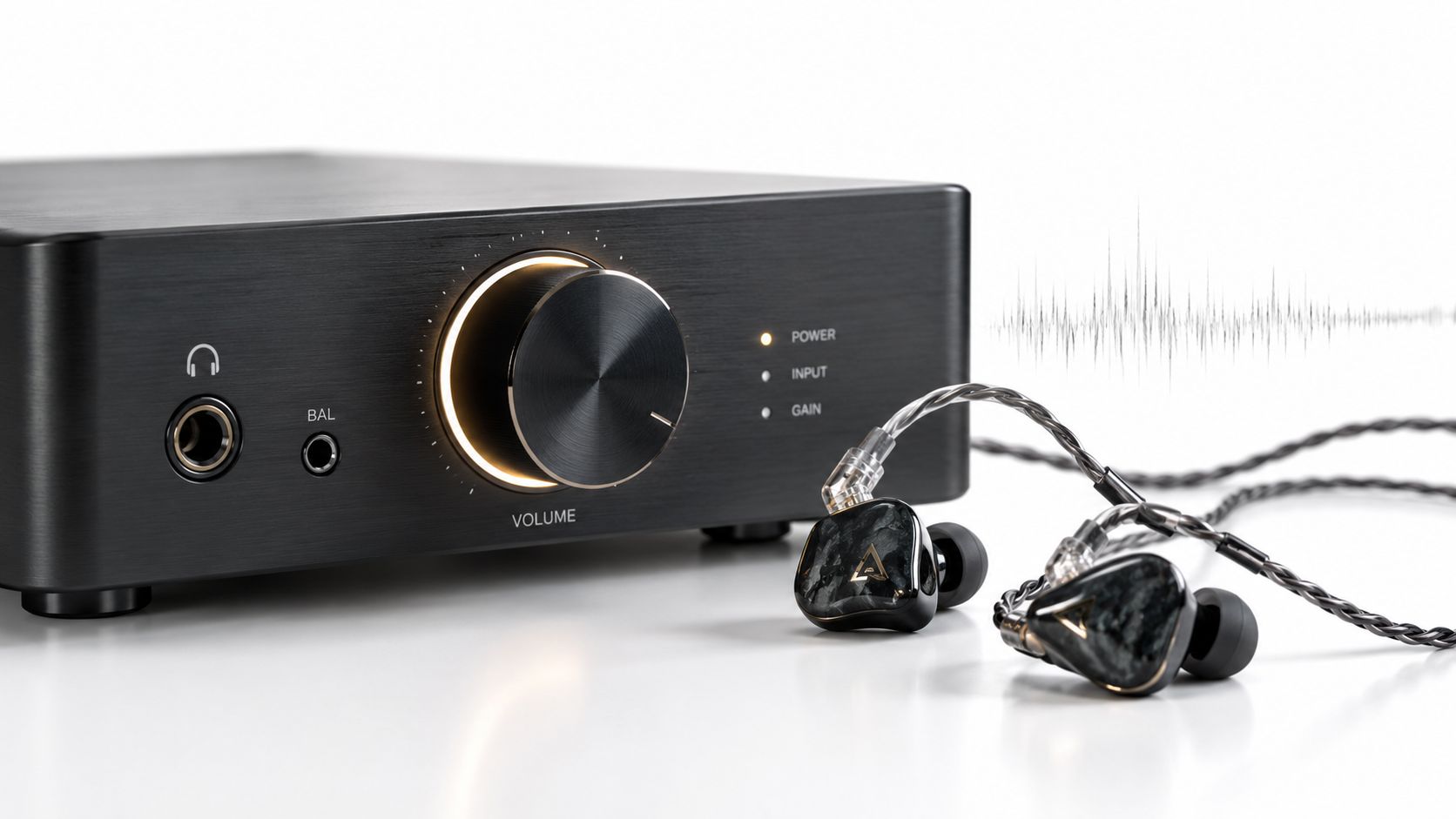
A 300-ohm dynamic headphone with too little voltage headroom presents a different problem. The chorus may reach a reasonable loudness, but the sound turns pale when the arrangement thickens. Kick drums lose their authority, vocals sit farther back, and the whole image feels like it has been folded at the edges.
That isn't always a lack of volume. It's a lack of room.
Current limits have a different fingerprint
A current-limited planar can sound polite when it should sound physical. Bass arrives, but the initial shove disappears. Electronic music loses its push, orchestral low strings lose their wood and tension, and transients feel rounded before they have finished speaking.
A strong match restores grip, though I use that word carefully. I mean the bass starts and stops with more confidence, not that the amplifier has painted extra low end over the recording.
Output impedance creates a subtler clue. If a headphone's tonal balance changes between sources, especially around bass or lower midrange, suspect the electrical relationship before blaming the headphone's tuning. A high source impedance can interact with a variable load and alter the response.
Avoid adding a second weak floor
Double-amping can introduce unnecessary gain, noise, and distortion. It happens when a headphone output feeds another amplifier input instead of using a proper line-level output. The second box then inherits a signal that has already passed through an output stage designed to drive headphones.
Use a line output where possible. Set gain conservatively. Listen for hiss, hardness, bass looseness, and compression before you inspect the logo.
The ears usually find the fault first.
Buying Guidance That Prioritizes Fit Over Hype
Start with the headphones, not the amplifier shelf. Write down their impedance, sensitivity, and the type of driver they use, then check the amplifier's output impedance and power at that actual load. A 32-ohm power claim doesn't prove useful performance into a 300-ohm headphone, as the published load comparison above demonstrates.
Choose gain for control rather than bragging rights. Make sure the lowest setting remains quiet with IEMs, and confirm that the higher setting gives demanding headphones enough voltage without forcing the volume control into an awkward range. Add features only when you'll use them, such as balanced connectivity, multiple inputs, preamp functionality, or tone adjustment.
The market has moved beyond boutique obscurity. One market report estimates the global headphone-amplifier market at about $3.8 billion in 2025, with a projection of roughly $7.1 billion by 2034 and a 7.2% CAGR from 2026 through 2034, as reported in this headphone amplifier market forecast. Another estimate places the market at $3.78 billion in 2025, rising to $4.03 billion in 2026 and $5.58 billion by 2031, with a 6.7% CAGR, showing growth while disagreeing on the exact scale. The category is real. That doesn't make every purchase necessary.
For a simpler route, a headphone amp and DAC combo can provide the whole signal path in one device. For a second opinion on matching, Supermarket Sound publishes practical guidance alongside its broader hi-fi coverage.
Check the match. Keep the money if the floor is already solid.
If your headphones sound strained, hissy, thin, or loose, identify the symptom before shopping. Compare your source's output impedance, gain range, and power at the headphone's real load. Buy the amplifier that fixes that electrical weakness, or keep your current setup when it already does the job. The right amp doesn't shout louder. It stands firm.

