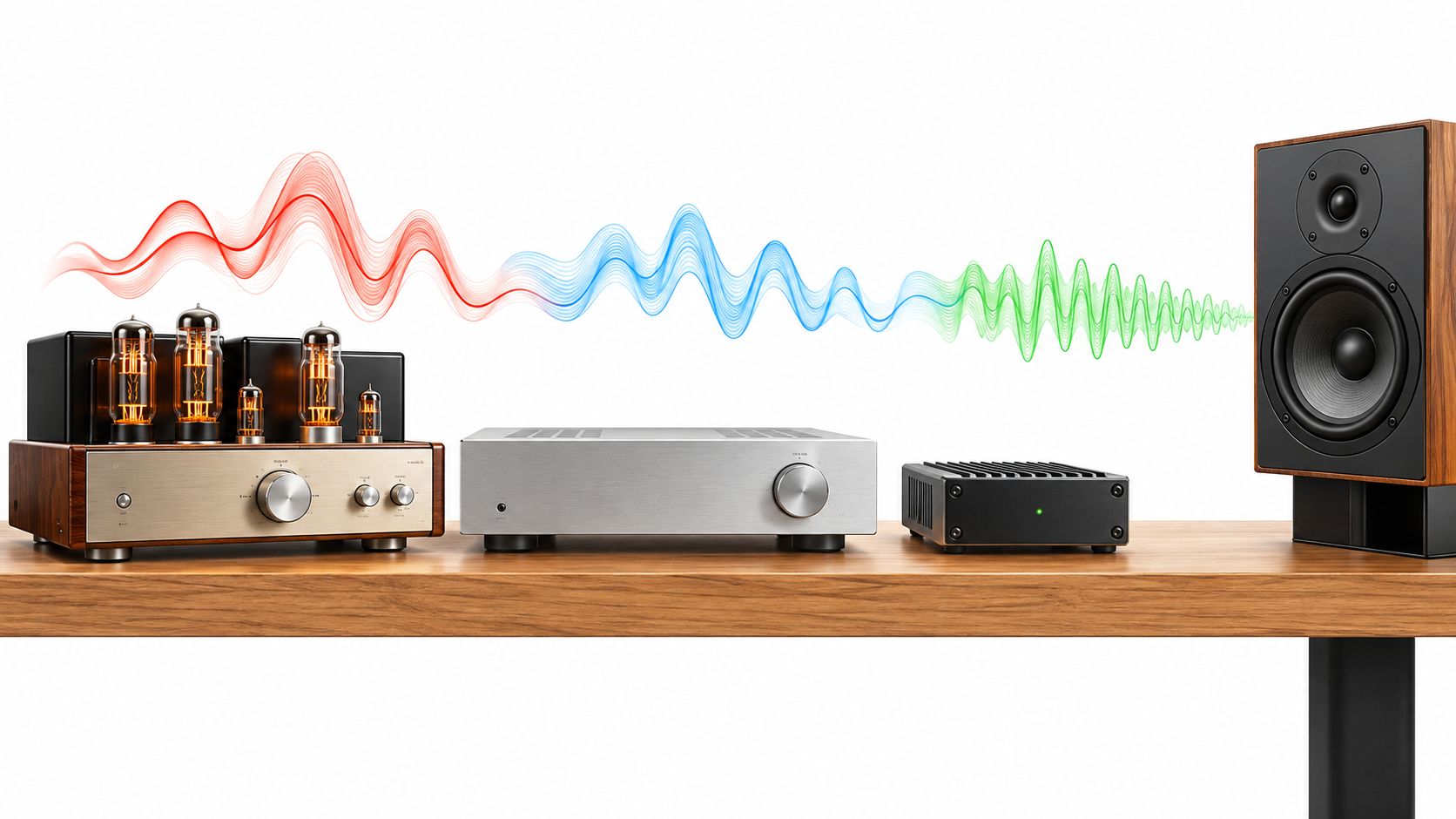
Most amplifiers don't sound different. The ones that do usually aren't expressing some mystical house character. They're changing frequency response, interacting with the speaker load, clipping, or adding noise.
That answer annoys both camps, which is usually a sign that it's useful. I've lived with tubes, Class A/B solid-state, and Class D, and I currently run a tube integrated because I like what it does in my room, not because a glowing bottle possesses musical truth. The honest question isn't “do amplifiers sound different?” It's which differences survive level-matched blind listening.
Table of Contents
- The Question Everyone Asks Wrong
- What Blind Tests Settled
- Tube, Solid-State, and Class D on the Bench of Your Ears
- The Four Variables That Survive a Blind Test
- How to Run Your Own Honest Amp Comparison
- Matching the Amp to the Speaker and the Room
- Which Amp to Buy and Why
The Question Everyone Asks Wrong
Audiophiles often frame the argument as tube versus solid-state, warm versus neutral, musical versus clinical. That framing turns an engineering problem into tribal theater. A better comparison starts with the variables that can alter the signal at the speaker terminals.
Four variables carry most of the load:
- Frequency-response mismatch, including changes that appear only when the amplifier drives a real speaker.
- Clipping behavior, especially when a transient asks for more voltage or current than the amplifier can provide.
- Noise floor, relative to the speaker's sensitivity and your listening distance.
- Load interaction, where the amplifier's output stage responds differently to a speaker's impedance and phase curve.
If those variables remain controlled, exotic descriptions such as “liquid,” “grainy,” or “three-dimensional current” become difficult to defend. A listener may still prefer one amplifier, but preference isn't proof of an audible amplifier signature. Sighted listening adds expectation, volume differences, switching delays, and visual associations that the ear happily converts into certainty.
The practical engineering picture is straightforward. An amplifier that stays flat, quiet, and linear under load gives the speaker nearly the same electrical instruction as another amplifier with the same behavior. The established measurement set for amplifier evaluation includes frequency response, phase response, noise, THD+N across frequency and power, SINAD, crosstalk, residual noise, and maximum unclipped output. Those measurements don't tell you everything about enjoyment, but they tell you where audible differences have somewhere to hide.
Practical rule: If you can't identify the changed variable, you're describing an impression, not diagnosing a sound.
That doesn't make all amplifiers interchangeable. A low-powered design can clip on peaks. A high-output-impedance design can reshape a speaker's tonal balance. A poorly behaved output filter can interact with a difficult load. A noisy amplifier can erase low-level information in a sensitive system.
The floor matters. Everything downstream inherits it.
What Blind Tests Settled
The useful history begins in 1977, when the Stereo Club of Southern California ran an early ABX-style series of double-blind amplifier comparisons. The results did not support the slogan that “all amplifiers sound the same.” They showed a narrower point: some amplifier matchups produce audible differences under controlled conditions, while others do not.
In one matchup, listeners identified the amplifier correctly 63 times out of 80, or 79%, with p < 0.0005. Another produced 78 correct identifications out of 126, or 62%, with p < 0.005. A third reached 41 out of 84, or 49%, which is effectively chance performance. The archived ABX data from the Stereo Club comparisons supports that distinction. Blind testing can expose a real difference, but it can also show that a suspected difference disappears.
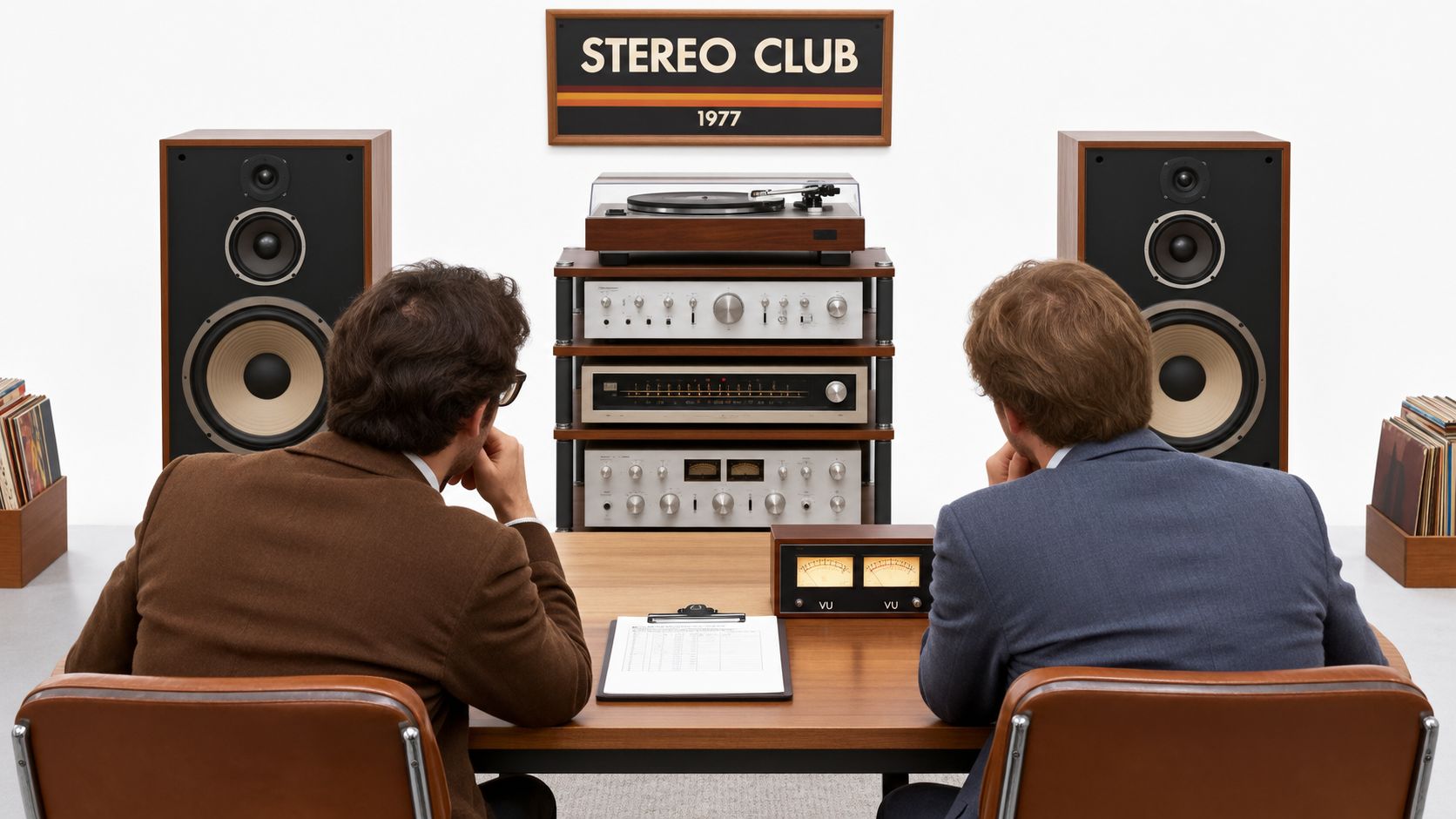
The method matters. Level matching removes one of audio's oldest traps: the louder amplifier usually sounds more exciting, open, and dynamic, even when the change is only volume. Double-blind switching removes visual cues and knowledge of which amplifier is playing. That leaves the ear to judge the signal rather than the story around it.
What the tests did and didn't prove
The trials support a practical conclusion. Listeners generally struggle to distinguish carefully level-matched solid-state amplifiers with similar topology and sufficient power when neither amplifier approaches clipping.
They do not establish that every tube and solid-state amplifier sounds identical. An underpowered amplifier, low-sensitivity speaker, high playback level, or difficult load can expose differences in clipping behavior, output interaction, or noise. Those are the conditions worth testing, rather than treating topology alone as a sonic fingerprint.
Sighted listening answers a different question. Seeing the amplifier, knowing its price, or expecting a particular flavor can shape preference. That preference may be genuine, but it does not show that the difference survives concealment.
The broader technical conclusion remains narrow. After roughly 40 years of amplifier testing, no published evidence has shown audible differences among good-to-excellent amplifiers operating well below clipping when frequency responses are matched within 0.25 dB, according to the technical review of amplifier sound differences. The same discussion notes that a few tenths of a decibel among three power-amplifier samples produced audible changes until response mismatch was equalized.
Blind tests do not end the argument. They identify the conditions under which an amplifier difference has a credible chance of being heard.
Tube, Solid-State, and Class D on the Bench of Your Ears
Topology predicts behavior, not destiny. The circuit tells you how an amplifier may fail, how it handles a speaker, and what kind of distortion appears when you push it. It doesn't hand the amplifier a guaranteed personality.
| Topology | Output Impedance | THD Profile | Clipping Behavior | Load Interaction |
|---|---|---|---|---|
| Tube | Often higher | Typically higher, often dominated by lower-order harmonics | Usually softer | Can reshape response with speaker impedance |
| Solid-state Class A/B | Usually low | Very low at normal levels | Often harder | Usually stable across reactive loads when properly designed |
| Class D | Design-dependent and often low | Can be exceptionally low in modern implementations | Protection and supply limits matter | Output filter can respond to speaker impedance |
Tube amplifiers often produce a softer overload transition. Their distortion can contain a stronger second-harmonic component, which many listeners hear as density around vocals, a rounded leading edge, or a little extra body on strings. That description isn't a magic property of glass. It follows from the circuit, transformer, output impedance, and operating point.
The high output impedance of some tube designs can also reshape the speaker's frequency response. A speaker with a large impedance swing may sound fuller in one region and leaner in another when driven by an amplifier with less electrical control. That can be flattering. It can also be exactly wrong for the room.
Class A/B solid-state designs usually present a low output impedance and high damping factor. They tend to hold bass drivers firmly, preserve a flatter response into reactive loads, and maintain clean output through ordinary listening levels. Push one past its voltage or current limits and the transition can become abrupt. The sound goes from composed to pinched, then hard.
Class D amplifiers switch the output stage rather than continuously tracking the waveform like a linear design. They generate little idle heat and can deliver excellent efficiency, but the output filter and feedback arrangement remain part of the system's behavior. A modern, well-engineered Class D design can measure extraordinarily cleanly. The relevant question is how its protection circuits, power supply, and filter respond to your speakers.
For a useful explanation of what listeners often mean by Class D sound quality, see this Class D amplifier overview. The label tells you where to start investigating.
Not where to stop.
The Four Variables That Survive a Blind Test
The measurement sheet becomes useful when it points toward a listening event. THD+N, damping factor, frequency response, and noise floor aren't trophies. They're clues about where the amplifier may change the music.
| Variable | Audibility Threshold | Typical Range | Sonic Signature |
|---|---|---|---|
| THD+N | Depends on spectrum, level, and content | Around 0.005% to 0.05% in the cited practical range | Tonal thickening, roughness, or altered texture when high enough |
| Damping factor | Depends on speaker impedance and alignment | Roughly 20 for some tube designs to 1000 for some solid-state designs | Bass looseness, altered attack, or response reshaping |
| Frequency response | Small deviations can matter when broad or load-dependent | Flat designs may remain close to neutral, mismatched designs can shift audibly | Vocal color, brightness, bass emphasis, recessed presence |
| Noise floor | Depends on speaker sensitivity and listening distance | Around –110 dBV and below in very quiet designs | Hiss, reduced low-level contrast, masked ambience |
The useful threshold depends on the content and the listener. A summary of amplifier audibility places lenient transparency targets around 0.05% THD/IMD and –85 dB noise, while a stricter target drives distortion, noise, crosstalk, and linearity toward roughly –120 dBFS. The discussion of audibility thresholds for amplifier and DAC measurements makes the larger point: once unwanted output sits below the ear's practical resolving ability, further improvements stop producing a reliable listening difference.
Frequency response is the quiet assassin
A broad response shift can change a vocal's chest, sibilance, or air before you've formed a technical explanation. Load-dependent response is especially important because an amplifier can look flat into a resistor while behaving differently into a real loudspeaker.
Clipping is where “character” gets expensive
A clipped snare loses its snap. A vocal peak hardens. A bass line stops expanding and starts pressing against a ceiling. Soft clipping may sound less offensive, but it still changes the waveform. The correct amplifier is often the one that never reaches that argument in the first place.
Noise lives between the notes
High-sensitivity speakers expose hiss more readily. Quiet passages, decays, and room ambience suffer when the electronics raise the floor. You may not hear “noise” as a separate event. You hear less blackness around the performance.
Damping only matters through the load
Damping factor becomes audible through the speaker's electrical behavior, not as a free-floating virtue. A higher figure can help a woofer stay controlled, while a lower figure may alter bass response in a way that sounds generous or woolly. The number alone doesn't tell you the result.
Specs matter when they cross audibility thresholds. Otherwise, they're decoration.
How to Run Your Own Honest Amp Comparison
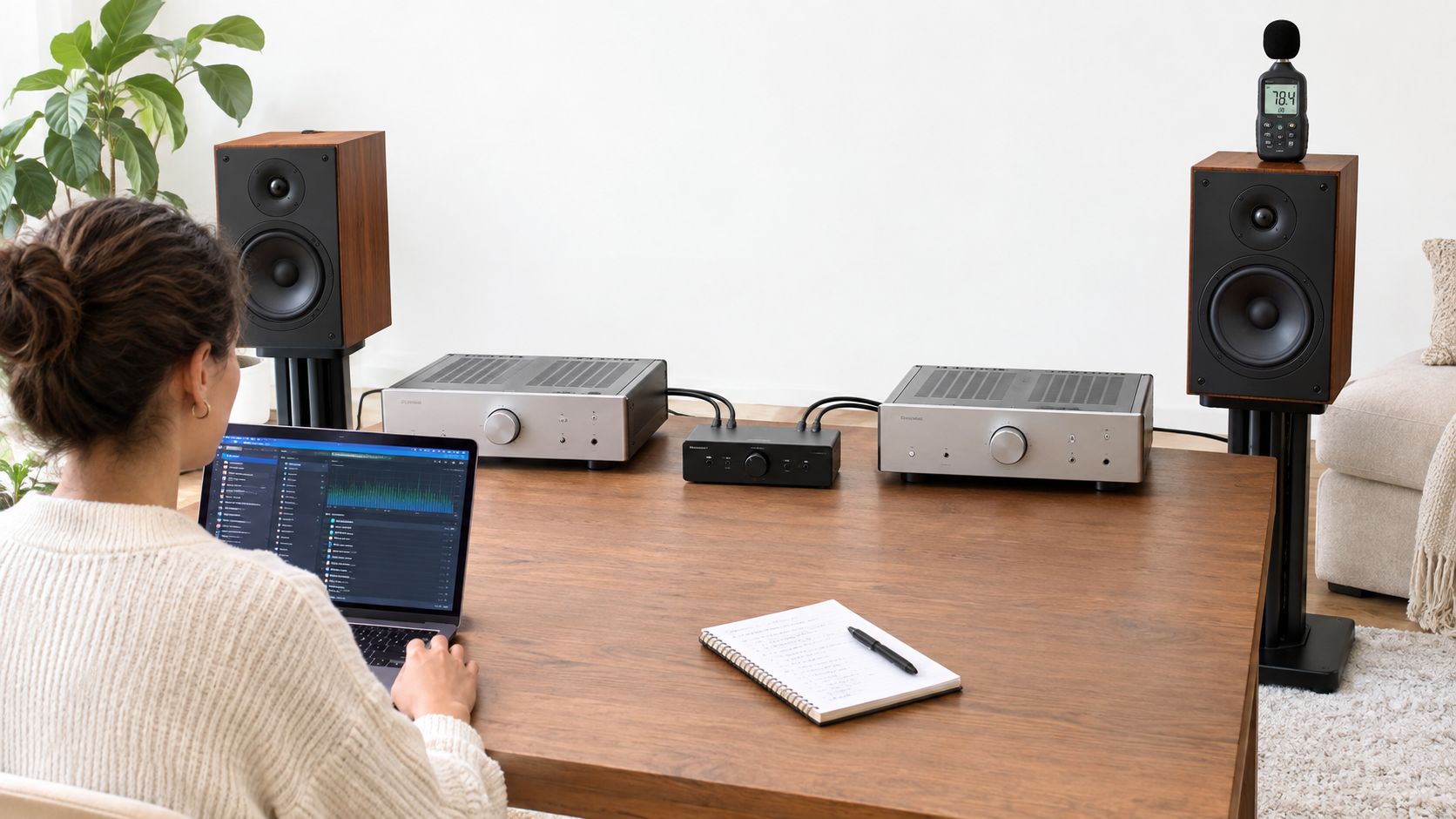
A home comparison can answer more than another week of forum arguments, but only if you remove the easy cheats. Use your own speakers, your own room, and familiar music. The test should make it difficult for your preference to write the result before your ears do.
Set the electrical conditions first
Use pink noise and a multimeter to match the amplifier outputs within 0.1 dB. Measure at the speaker terminals or at a consistent test point, and recheck after every change. Don't assume the volume control position means anything across two amplifiers.
Keep the source and preamp gain structure identical. Confirm that the source can provide enough output voltage to drive both amplifiers cleanly. Give tubes at least 30 minutes to settle thermally, and allow solid-state and Class D designs at least 15 minutes before judging them. Those warm-up times are practical test conditions, not proof that one technology needs mystical seasoning.
The comparison fails before the first song if the levels don't match.
Use a helper to switch inputs, conceal the amplifier identities, and record which unit plays. A suitable relay box can work if it preserves the same wiring and doesn't introduce its own problem. If no helper exists, switch between matched recordings and accept that the test has become less rigorous.
Use music that exposes different faults
Choose short excerpts rather than entire albums. I use one female vocal for midrange texture and sibilance, solo upright bass for pitch and decay, dense orchestral music for congestion and headroom, and electronic music with heavy sub-bass for current delivery and protection behavior.
Listen for a specific change:
- Does the vocal move forward or change color?
- Does the bass note remain tuneful as it decays?
- Do dense passages flatten when the level rises?
- Does the sub-bass stay elastic, or does the amplifier protect itself?
Take a break before fatigue turns every difference into irritation. Run 8 to 12 blind trials per amplifier, log your guesses before revealing the identity, and accept the result you get. If you can't distinguish them reliably, that's a valid result.
A short video can help illustrate the kind of controlled switching and logging that makes a comparison less theatrical.
Most listeners won't hear a repeatable difference on most material when the amplifiers stay within their linear range. That isn't a disappointing conclusion. It tells you to spend money on the actual bottleneck.
Matching the Amp to the Speaker and the Room
The amplifier should fit the speaker's demands before it fits your preferred vocabulary. Start with sensitivity, impedance behavior, phase angle, listening distance, and playback level. Then consider whether the room rewards control or welcomes a little tonal generosity.
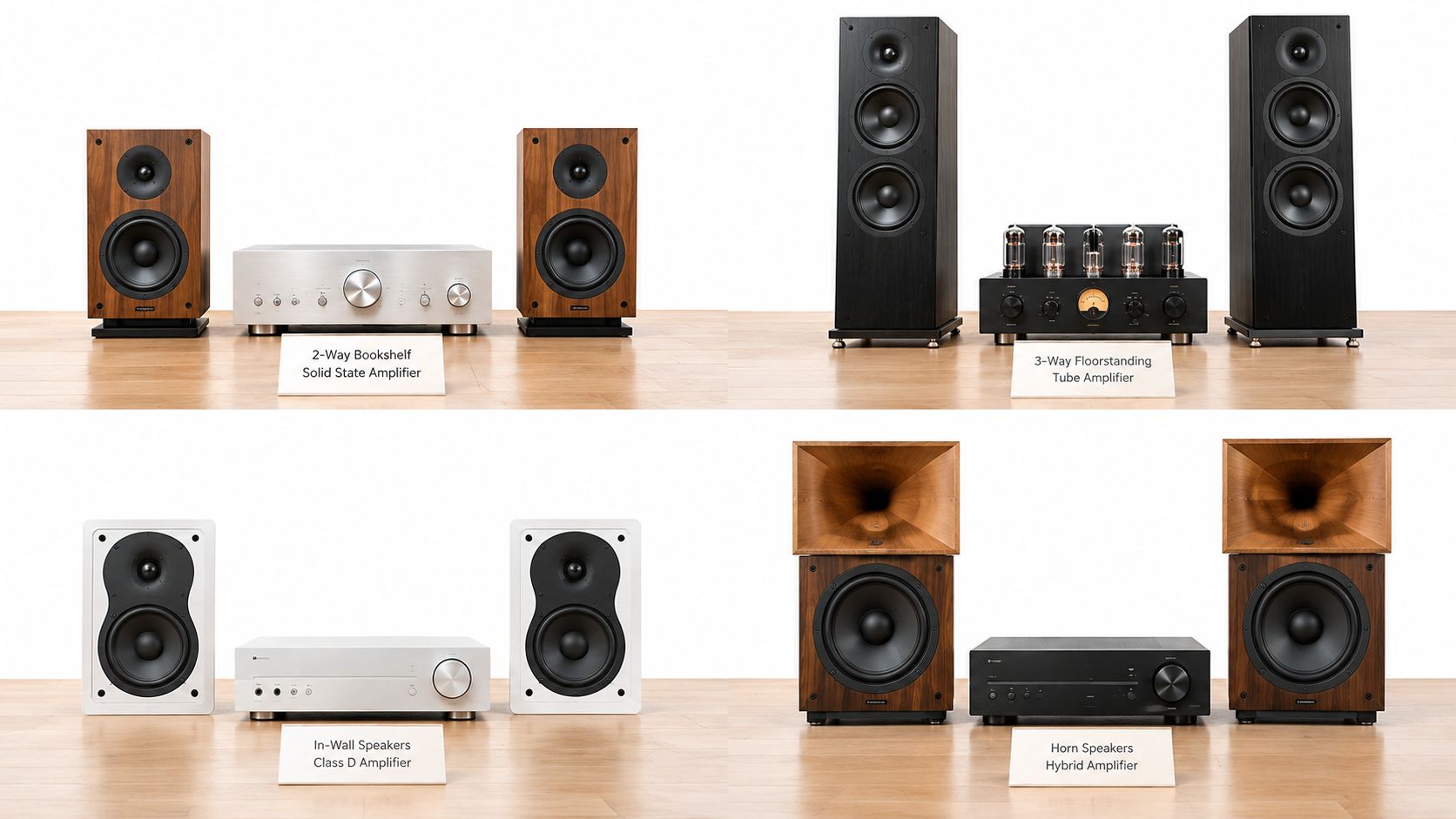
A low-sensitivity panel or electrostatic design can demand serious voltage swing and current delivery. A high-current solid-state amplifier makes the safer starting point, while a suitable output-transformerless tube design may work when its power and load requirements match the speaker. Don't buy by topology badge alone.
High-sensitivity horns and single-driver speakers create the opposite situation. They can reveal amplifier hiss and make a few watts go a long way. A small directly heated triode design may bring a tactile midrange and illuminated vocal texture that a very low-distortion amplifier presents more matter-of-factly. That's not necessarily greater accuracy. It's a deliberate trade.
Planar magnetic speakers typically reward current capability. They may respond beautifully to a solid-state amplifier's grip, though a tube amplifier's harmonic profile can still appeal if it maintains composure. Subwoofer loads favor efficient designs with strong damping and sensible protection behavior, which makes Class D a practical choice in many systems.
Let the room veto your fantasy
A small untreated room can exaggerate bass resonance and make loose control obvious. Higher damping may give the system a cleaner foundation. A large treated room gives an amplifier more breathing space, and a tube design may sound open rather than merely soft when it has enough headroom.
Speaker placement remains part of the amplifier decision. Reflections and room modes can overwhelm the subtle differences between competent amplifiers, so don't use electronics to repair a speaker position that creates a bass peak or a bright early reflection.
For the electrical basics, this guide to impedance matching is a useful reference point. Identify the speaker's sensitivity and impedance curve first. Choose the topology that supplies the required current and damping. Audition the remaining texture.
That order saves money.
Which Amp to Buy and Why
My recommendations change with the system, not the marketing story. A tube amplifier can be the right choice in one room and a costly bass-control problem in another. Class D can be wonderfully clean and completely wrong for a speaker whose protection behavior you can trigger during ordinary listening.
| Scenario | Recommended Topology | Representative Model | Why It Wins |
|---|---|---|---|
| Low-sensitivity floorstanders in a carpeted 3 m room | Tube integrated around 30 W per channel | A 30 W push-pull tube integrated | Midrange bloom can suit acoustic jazz and small-ensemble vocals when the speaker doesn't demand extreme current |
| Full-range dynamic speakers at a nearfield desk | High-current Class A/B | A high-current Class A/B integrated amplifier | Bass grip and dynamic headroom matter more than added harmonic warmth |
| Subwoofer amplification or desktop monitors under 50 W | Well-implemented Class D | A Purifi- or Hypex-based Class D module | Low heat, compact size, efficiency, and strong control suit the installation |
For low-sensitivity floorstanders in a carpeted 3 m room, I'd choose the tube integrated if the speaker's impedance curve supports it. Around 30 W per channel gives the system a sensible starting point for moderate listening, while the tube circuit can add a little body to bowed strings and vocal harmonics. The representative model is any well-designed push-pull integrated in that power class, not a particular badge.
At a nearfield desk, the priorities change. A high-current Class A/B amplifier gives full-range dynamic speakers a firm low end and enough headroom for sudden transients. You're close to the drivers, so bass texture and compression reveal themselves quickly. Warmth is less important than keeping the presentation from folding inward when the arrangement gets dense.
For subwoofers, compact desktop monitors under 50 W, or installations where heat and space matter, a modern Class D module makes the most sense. Purifi- and Hypex-based designs belong in that category because their measured behavior can be exceptionally clean, but the test remains the speaker load and protection behavior.
Supermarket Sound also publishes guidance on choosing an amplifier for bookshelf speakers, with the same practical emphasis on speaker demands and listening conditions.
My current rig is a 35 W tube integrated driving 88 dB-sensitive bookshelves in a 4 m treated room. I chose it for midrange honesty over measured neutrality. I'd make the same choice again.
Buy for the load. Keep the receipt.
Run the weekend comparison before you replace an amplifier that may not be the problem. Match levels, hide the identities, log the trials, and spend your money on the variable your room and speakers expose. I'm Marque Hersh, founder of Supermarket Sound.

