

Most turntable mat upgrades disappoint because buyers shop by material name instead of system behavior. Felt, cork, rubber, leather, acrylic, and layered mats get treated like wine labels. Pick the fashionable one, place it under the record, wait for the revelation. Usually, the platter acquires a new resonance.
I'm Marque Hersh, founder of Supermarket Sound, and I've learned to treat a mat as a mechanical interface, not a decorative accessory. The right turntable mat upgrade controls the dominant vibration problem without wrecking clearance, tracking geometry, or the deck's natural balance. The wrong one shifts the noise somewhere else.
Table of Contents
- Why Most Mat Upgrades Disappoint
- What Each Mat Material Actually Does
- Matching Thickness and Platter Type to Your Deck
- The Swap, Done Without Fuss
- A Real A/B Test You Can Run Tonight
- Buy It, Skip It, or Fix Something Else First
Why Most Mat Upgrades Disappoint
A new mat rarely fixes a deck by itself. Buyers compare felt, cork, rubber, or acrylic as if the material has a fixed sound. In practice, the platter, bearing, drive system, tonearm, suspension, and shelf form one mechanical system, and the mat changes how that system handles energy.
The mat controls the contact between record and platter. It affects how vibration leaves the vinyl, how much mass sits beneath the groove, and how the tonearm tracks that altered interface. A resonant metal platter may need damping, while a low-mass deck can lose speed, snap, or openness under a thick or heavy mat. Choose by system behavior, not by the label on the package.
Practical rule: Match the mat to the dominant vibration problem, not to the material name printed on the packaging.
That rule explains why expensive swaps disappoint. One mat can thicken bass and blur drum attacks. Another can clean up treble while hollowing the midrange. A third can sound quieter only because it has softened the leading edges that give music its life. If the mat shifts the deck's resonance instead of damping it, the upgrade is wrong.
The platter always gets a vote
Independent comparison work from Pspatial Audio's turntable-mat table shows that geometry can matter as much as material. Its record and mat combinations produce sharply different damping results, including configurations reading 100% in a baseline case and others dropping to 11%, 1%, or 12%. Center-chamber designs reach 89% or 81% in several pairings.
Those figures do not identify a universal winner. They show how strongly contact area, chambering, and the record-to-platter stack affect results. A mat that looks superior on paper can change coupling and move the system's resonance rather than control it.
I start with a phone spectral analyzer and pink noise. I identify the prominent vibration band, tap the shelf to find its natural resonance, then shortlist mats with suitable damping behavior and thickness. The sequence is simple: diagnose, test, load, verify.
Don't mistake a symptom for a cure
Check the rest of the mechanical chain before spending money. A warped record, poor shelf isolation, motor hum, footfall, or incorrect cartridge alignment will remain a problem under any mat.
The guidance on turntable dust-cover behavior also deserves attention. A cover can introduce vibration or handling problems, leaving the mat wrongly blamed for the result.
Soft mats need a load check. Leave the record and normal clamp arrangement in place for 72 hours, then inspect the mat for permanent deformation. Treat compression above 10% as a reject condition. Uneven compression changes the record plane and undermines tracking geometry. Use this mat-selection workflow as a practical reference for that check, not as proof that one material suits every deck.
Buy for the deck, not the shelf.
What Each Mat Material Actually Does
Material still matters. It just matters as a behavior, not a badge. Felt, cork, rubber, and acrylic each solve different mechanical problems, and every solution carries a cost.
Felt is soft, familiar, and often too static-prone
Felt remains the factory default on many turntables. It offers light contact, easy handling, and modest damping, which can take the edge off motor or airborne hash. It can also blur fine detail on a bright cartridge, especially when the system already lacks attack and separation.
Independent audio coverage notes that felt mats can build and hold charge, attract dust, and shed fibers. Factory felt mats are usually around 1 to 2 mm thick, while factory rubber mats are often 3 to 5 mm thick, as described by this comparison of common factory mat types.
Felt makes sense when you need a forgiving interface or a slip surface. It isn't my first choice for a serious hi-fi damping job.
Cork offers grip without turning the deck into a bunker
Cork has a firmer feel and tends to preserve a clean mid-band. It provides light damping, useful grip, and a less obviously softened presentation than many felt mats. On a mid-mass platter, cork is often the safest first experiment because it changes the interface without adding an imposing mechanical personality.
Technical writing from Simply Analog's explanation of cork and rubber damping separates the jobs clearly. Cork works especially well against shear-wave resonances in metal platters, while rubber handles longitudinal waves more effectively. That split explains why cork can improve static behavior and control without producing the heavier, more muted character associated with soft rubber.
Rubber controls ringing, but too much control can starve dynamics
Rubber compounds bring stronger damping and can suppress platter ringing effectively. They suit decks where resonance is the obvious problem, particularly when the platter itself sounds metallic or mechanically exposed.
The danger is softness combined with excess thickness. A rubber mat that sinks, drags, or over-damps can make bass feel thick instead of tuneful. The kick drum gains weight, then loses its first hit. That isn't control. That's a blanket.
Acrylic and hard composites expose the truth
Hard mats and hard platter interfaces add little damping. Their appeal comes from direct coupling, mass behavior, and a sense of tighter bass and sharper transients. They can open the image and make rhythm feel more immediate.
They also reveal problems that felt had been hiding. Motor noise, tonearm resonance, and a rough shelf can become more apparent. Choose this path only when the rest of the deck has a stable foundation.
| Material | Damping | Mass | Resonance Shift | Best For |
|---|---|---|---|---|
| Felt | Light, soft | Low | Can soften detail | Slip use, forgiving systems |
| Cork | Light to moderate | Low to moderate | Usually controlled | Mid-mass metal platters |
| Rubber | Strong | Moderate to high | Can over-damp | Ringing or mechanically lively platters |
| Acrylic or hard composite | Minimal | Moderate to high | More likely to expose system behavior | Stable decks with controlled noise |
Hybrid mats accept compromise by design. Cork-rubber blends seek grip plus heavier damping. Leather-felt constructions seek surface contact with a softer interface. They can work, but “layered” isn't a magic word. Each layer adds another mechanical decision.
The best mat is the one that leaves the music intact.
Matching Thickness and Platter Type to Your Deck
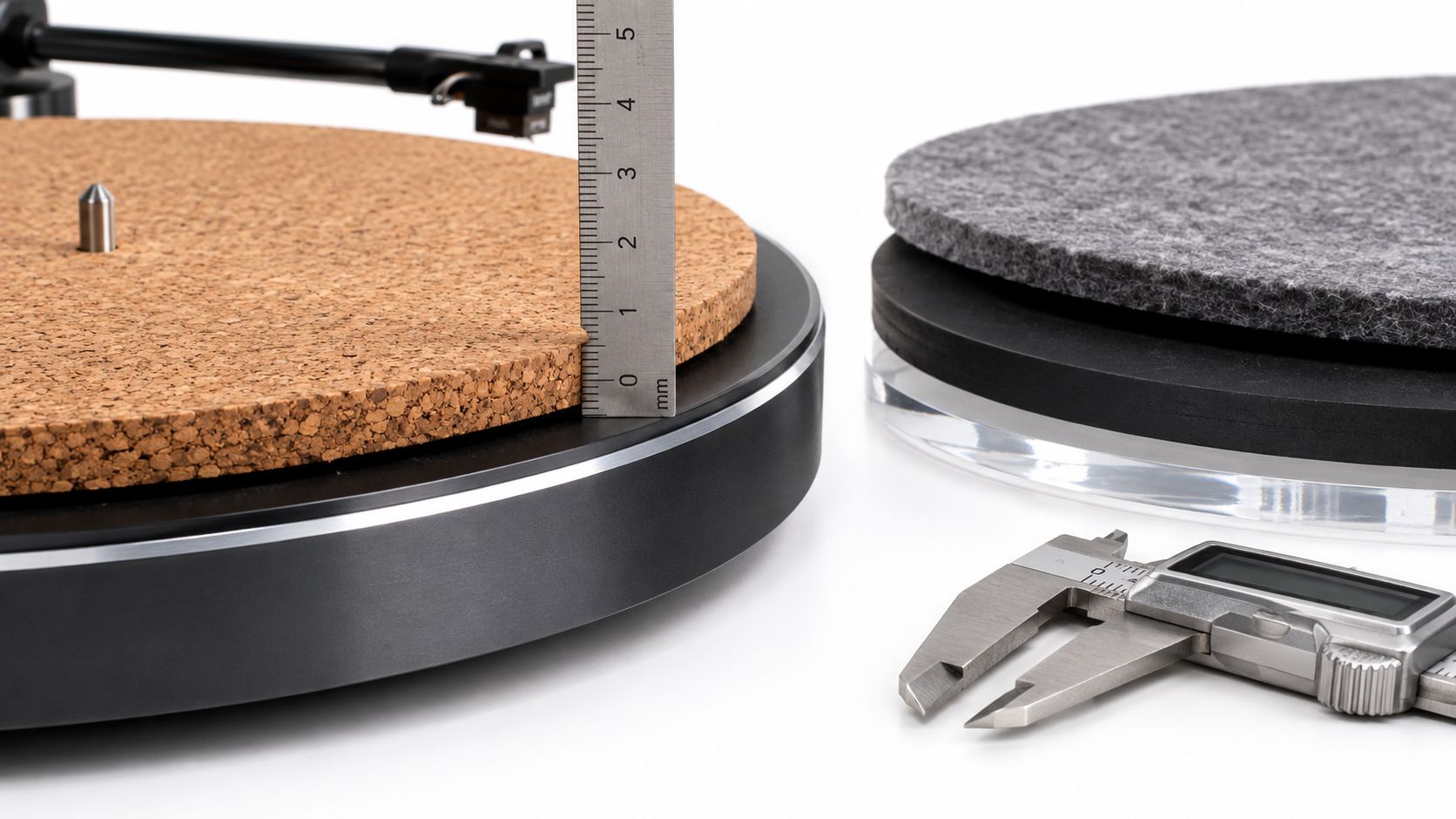
A mat upgrade can damage the sound if it changes the deck's resonance instead of controlling it. Thickness matters because it raises the record and changes the tonearm's vertical tracking angle, or VTA. Treat mat choice as system matching, not a material shopping exercise.
Each added millimeter raises the record by roughly the same amount and may require an arm-height adjustment. A thicker mat is not automatically better. If the tonearm has no VTA adjustment, the cartridge may sit at the wrong angle, producing lean treble, excessive brightness, or a recessed presentation.
Start with the platter, not the product page
Lightweight belt-drive decks with stamped aluminum platters usually suit damping mats around 2 to 3 mm. Mid-mass die-cast aluminum platters can work well with 3 to 5 mm. Heavy glass or acrylic platters generally call for thinner mats around 1.5 to 3 mm, allowing the platter's own resonance behavior to remain controlled rather than covered.
Use those ranges as starting points. The deck decides the final choice. A suspension tuned for a particular load can respond poorly to a thick, heavy replacement, while a low-mass platter may lose its agility under dense rubber. If the new mat shifts the balance toward slower bass or dulled attacks, it is the wrong upgrade, regardless of its material or price.
The record, mat, and platter form one mechanical stack. Measure that stack, then listen to the result on your actual deck instead of trusting a product description.
Fit and function beat visual symmetry
Measure the platter before ordering. An undersized mat can leave the record edge unsupported, letting a dished record wobble. An oversized mat can rub the plinth, adding friction and noise.
Keep a slip mat separate from a damping mat. DJ-style felt slipmats are made for easy record movement and cueing. They are not replacements for a hi-fi mat intended to maintain stable contact during playback.
Before buying, check three things:
- Platter diameter: Support the record without touching the plinth.
- Current thickness: Measure the existing mat instead of trusting a listing.
- VTA range: Confirm that the arm accommodates the new record height.
A one-millimeter change can outperform a dramatic thick mat. Geometry carries the upgrade.
The Swap, Done Without Fuss
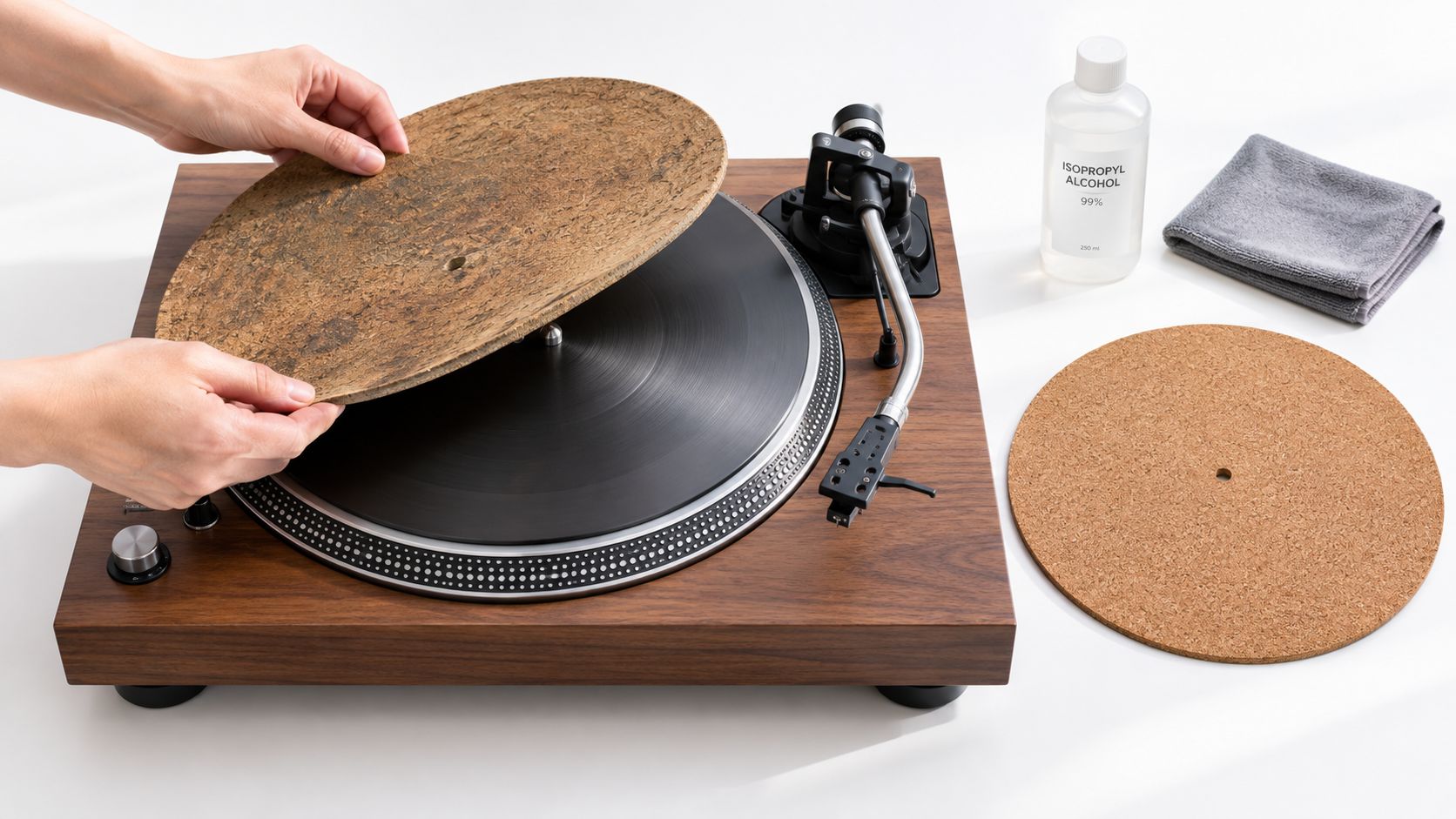
A mat swap should take an afternoon, not become a restoration project. Gather clean microfiber cloths, 70% or higher isopropyl alcohol, a small platter lift or suction cup, a stylus-force gauge or fresh alignment protractor, and a soft towel if the deck must be placed on its side. The right mat is a system match, so keep the process controlled enough to hear whether it damps resonance or shifts it elsewhere.
Remove the record and secure the tonearm first. Belt-drive decks require care around the belt and subplatter, while direct-drive decks often let you lift the platter more directly. Do not pull blindly. Identify the spindle, belt, and platter interface before applying force.
Clean contact surfaces first
Lift off the old mat and inspect the platter. Dust, adhesive residue, and loose fibers can stop the new mat from sitting flat, producing a misleading result. Remove dry debris with a microfiber cloth, then apply alcohol to the cloth instead of flooding the deck.
Cork and rubber reveal fingerprints quickly, and skin oils can make contact inconsistent. Hold the new mat by its edges. Center it with the spindle hole, then rotate it slowly and confirm that the perimeter clears the plinth.
Check the fit with a record in place. A slightly dished platter or record may contact only at the center, leaving the edge rocking. A mat that grips too aggressively can make the record drag during playback. Drag is a setup fault, not a performance benefit.
If the new mat changes record height, check cartridge geometry with this turntable cartridge alignment guide. Recheck stylus force instead of assuming the previous setting still applies. A smooth installation proves nothing about the sound.
The supplied video shows the handling sequence:
Let the interface settle
I do not judge a mat on the first exciting listen. Install it, log the date, and play a familiar record each evening. Use a 72-hour load test to watch for uneven compression, tonal drift, or a presentation that becomes tiring after the novelty fades.
The protocol exposes mats that sound impressive for one night, then harden the upper midrange or slow the bass. Keep the old mat nearby. A reversible upgrade deserves a reversible decision.
A Real A/B Test You Can Run Tonight
A mat that sounds better at first listen may be louder. Remove that bias with a controlled comparison, because the right upgrade should damp your deck's resonance, not shift it into a new, less stable character.
Choose one familiar track with strong dynamics and a clear tonal spread. A vocal with acoustic guitar works well. The voice exposes midrange changes, the strings reveal transient behavior, and the space around the performers makes image stability easier to hear.
Cue both mats to the same lead-in groove. Match playback level by ear or with an SPL meter as closely as you can. A louder presentation nearly always feels more energetic, so do not mistake volume for improvement.
Use the same four questions every time
Run three passes per mat:
- A full side for overall balance.
- An inner-groove passage for sibilance and tracking stress.
- A quiet passage for rumble and surface-noise differences.
After changing mats, wait five minutes before judging. Record the result immediately using the same four checkpoints: bass weight, midrange presence, treble air, and image stability.
| Checkpoint | Old Mat Score (1-5) | New Mat Score (1-5) | Notes |
|---|---|---|---|
| Bass weight | |||
| Midrange presence | |||
| Treble air | |||
| Image stability |
Do not reward a mat for sounding merely different. Bass should stay tuneful rather than inflated. Midrange should preserve vocal texture. Treble air should add space without sharpening consonants. The image should remain locked when the music becomes busy.
Make the test harder to fool
Have someone else switch the mats while you listen without seeing the change. Blind switching removes expectation from the decision and makes differences easier to judge.
Different records and mat pairings can behave very differently, so one record cannot deliver a universal verdict. Repeat the test with another familiar pressing if the first result is close or confusing. A mat that only wins by sounding louder, brighter, or heavier has not earned its place under the platter.
Keep the old mat nearby until the notes show a consistent gain. Hear the change, then trust the notes.
Buy It, Skip It, or Fix Something Else First
Buy a mat for a real defect or a clear system mismatch. Replace it when the current mat is worn, compressed, staticky, shedding fibers, or sitting poorly on the platter. A well-matched mat can restore stable contact and control resonance without forcing a cartridge or amplifier change.
Skip the mat when the deck is mechanically balanced and the cartridge is still entry level. A mat cannot extract detail the pickup does not resolve, and it will not solve a room dominated by strong first reflections. Material shopping is the wrong approach. Match damping, mass, thickness, and contact behavior to the deck, because a mat that shifts resonance instead of damping it is a downgrade.
Fix the symptom at its source
Sibilance sends me to stylus alignment, overhang, azimuth, and tracking force before the mat. Weak bass points toward tracking force or a tonearm and cartridge mass mismatch. Smeared imaging makes me inspect cable dressing, shelf isolation, and speaker placement. Use this turntable sound system checklist before touching the mat.
A mat can redistribute energy, but it cannot correct an upstream setup fault. Every downstream component reproduces what the deck leaves unresolved.
Dealer's rule: Upgrade the weakest link, not the shiniest accessory.
Use this order:
- Cartridge alignment: Set the geometry before judging tonal balance.
- Tracking force: Confirm the stylus sits securely in the groove.
- Mat selection: Match damping, mass, thickness, and contact behavior to the platter and deck.
- Cable and platform tweaks: Address hum, vibration, and placement after the core setup is honest.

A mat upgrade earns its place by solving a named problem. Cork is my first sensible trial for many mid-mass metal platters. Rubber makes sense when ringing dominates. A hard interface suits a stable deck with noise already under control. Felt remains useful for slip and light-duty contact, but it is not automatically the audiophile answer.
Measure the platter, note the current mat thickness, and run the structured A/B test before spending. Keep the old mat until the replacement delivers a repeatable improvement. Then bring your findings to Supermarket Sound for system-first hi-fi guidance from Marque Hersh.

