Most lists confuse bass-heavy with deep-bass capable. They reward the headphone that thumps hardest around the kick drum, then call it a day. I'd rather hear a controlled note descend into the floor, keep the singer's mouth intact, and survive a little EQ without turning the whole mix into wet cardboard.
That's the problem with searching for the best headphones for deep bass. The phrase attracts clicks, brands sell excitement, and I still have to rank the gear truthfully because Supermarket Sound has bills. My rule is simple: separate sub-bass rumble below 60 Hz from mid-bass punch, then judge the seal, texture, vocal clarity, and control. The winner isn't the headphone with the biggest bass slider. It's the one with the most usable low end.
Table of Contents
- Bass Is Not Loudness It Is Control
- What Deep Bass Actually Means for Headphones
- How We Rank Bass Without Falling for Hype
- Headphones That Deliver Punchy Controlled Low End
- Matching Bass to How You Actually Listen
- Getting More Bass Without Wrecking the Mix
- What I Would Buy for Deep Bass Right Now
Bass Is Not Loudness It Is Control
Deep bass is not a volume contest. It is controlled extension, where a synth drop creates pressure, the note stops cleanly, and vocals remain present. A headphone can sound aggressive while missing the lowest material because it concentrates energy in the mid-bass, where kick drums and bass-guitar impact feel immediate. That delivers thump and warmth, but not necessarily the physical descent that gives electronic music and film scores their scale.
Separate sub-bass extension from mid-bass punch before judging either. Sub-bass supplies depth and rumble. Mid-bass supplies impact. A bass-tuned headphone is the direct choice when you want that emphasis without adjustment, while a neutral model can reach the same balance with EQ if its driver extends low enough. EQ cannot create missing extension, and it cannot repair a poor seal.
My load-bearing rule: If bass makes the vocal smaller, it is interfering, not showing power.
Fit controls the result in actual rooms. A leaking over-ear pad, loose IEM tip, or weak clamp can drain low frequencies before the driver has a fair chance. Seal can shift perceived bass by 10 dB or more, according to this summary of headphone fit and equal-loudness behavior. ANC can also make bass feel steadier by reducing outside noise, but its processing and the fit still shape the result.
I reject any “deep bass” claim that does not connect to extension, response shape, and a reliable seal. Buy the most low end you can still use, not the loudest bass on the product page.
What Deep Bass Actually Means for Headphones
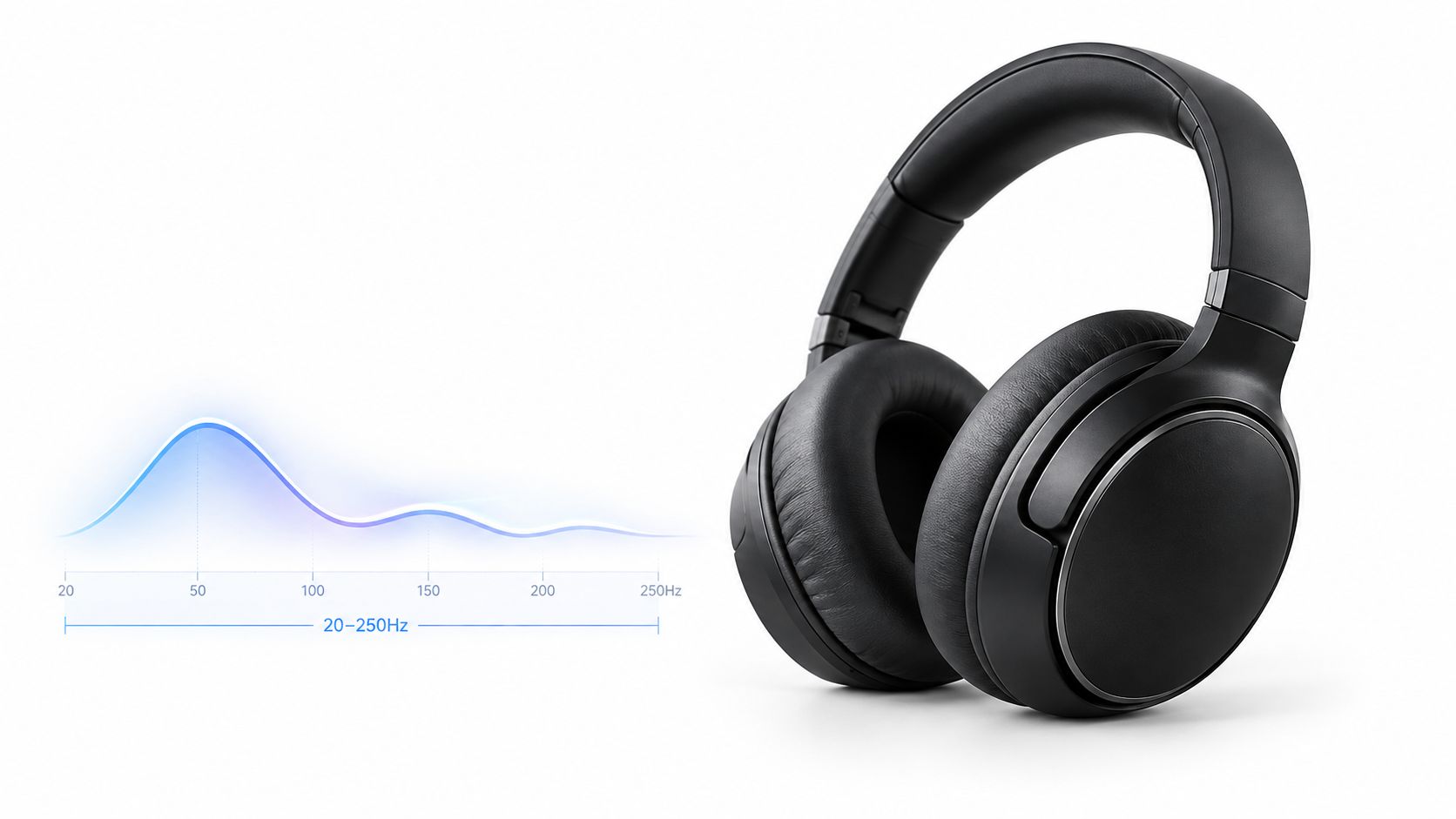
Deep bass is a descent, not a volume trick. The useful headphone bass region is commonly treated as 20 Hz to 250 Hz, with true sub-bass below about 60 Hz. Extension asks how far down the headphone reaches. Mid-bass punch describes the impact around kicks and bass guitar. Control determines whether those notes stay distinct from the mids.
A headphone that remains usable down to 20 Hz can reproduce rumble, low synthesizer fundamentals, and cinematic pressure more convincingly than one that peaks around 80 to 120 Hz. That does not mean every recording contains meaningful information at the very bottom. It means the driver and tuning have not abandoned that range before the music gets there.
Why Your Ears Ask for More Low End
Human hearing does not perceive every frequency with equal loudness. Fletcher-Munson equal-loudness research, later formalized in ISO 226:2003, shows that bass becomes harder to hear at lower listening levels. Headphone designers often compensate with a lift below 100 Hz, as explained in this industry overview of equal-loudness curves and headphone bass tuning.
That compensation explains why a flat headphone can sound thin during ordinary listening, while a modestly warm tuning feels complete. It also makes “neutral” a poor automatic target for bass listeners. A tidy measurement can still feel underfed at a sensible volume, especially during a commute or in a room with competing noise.
The Spec Sheet Does Not Create the Seal
A printed 20 Hz lower limit says little by itself. It does not show whether the response stays strong there, collapses before reaching it, or distorts when you demand more. Raw frequency response testing across 20 Hz to 20 kHz reveals the actual shape more clearly, following RTINGS' raw frequency response testing guidance.
Pads, tips, and clamp establish the acoustic baseline. Over-ear pads must close around the ear, while IEM tips must seal the canal without causing pain. A leaking fit can erase sub-bass even when the driver is capable of producing it. ANC may make low frequencies feel steadier by reducing outside noise, but its processing and the physical fit still affect the result. Read this plain-language guide to headphone frequency response before treating any frequency number as a verdict.
The seal sets the floor. The driver works above it.
How We Rank Bass Without Falling for Hype
I rank bass in four passes: sub-bass extension, mid-bass punch, control under EQ, and vocal tradeoff. That order matters. A headphone that rumbles hard but smears the lower mids doesn't belong at the top. A neutral headphone that takes a clean sub-bass lift may serve a serious listener better than a factory-tuned bass cannon.
The market breaks into three useful philosophies.
Three Ways Headphones Make Bass Feel Bigger
Haptic or boosted bass adds physical sensation or an unusually strong low-end lift. This is the fun-first route. It suits films, games, and bass-heavy playlists where physical impact matters more than tonal accuracy. The tradeoff arrives quickly when vocals, guitars, or snare texture lose their outline.
Tuned and EQ-managed bass starts with a deliberate bass-forward signature, then gives you enough adjustment to bring the low end back into line. This is my favorite wireless compromise because the headphone arrives with weight but doesn't trap you there.
Neutral plus EQ puts the burden on the listener. The factory tuning usually preserves vocal clarity and midrange space, while EQ adds the desired weight. This route wins when control matters more than instant drama, but it depends on a good seal, a clean source, and restraint.
| Philosophy | Sub-Bass Extension | Mid-Bass Punch | Control Under EQ | Vocal Tradeoff |
|---|---|---|---|---|
| Haptic or boosted | Physical and obvious, sometimes exaggerated | Very strong | Can become messy when pushed | Highest risk |
| Tuned and EQ-managed | Usually satisfying | Strong without always dominating | Strong if the adjustment is sensible | Moderate |
| Neutral plus EQ | Depends on the headphone's low-end reach | Moderate by default | Best when the driver stays composed | Lowest before tuning |
The useful question isn't “Which headphone has the most bass?” It's “Which headphone lets me add bass without shrinking the rest of the song?”
That distinction gets ignored because product rankings are easier to click than a conversation about decay, seal, and vocal masking. Still, it decides the purchase. Most adjustable bass with intact vocals beats maximum bass with a permanently swollen lower midrange.
What Gets a Pass
I want to hear the bass line's pitch, not just its presence. I want a kick drum to land with a firm edge, then disappear instead of hanging around like a guest who missed the last train. I also want the headphone to tolerate a sub-bass lift without rattling, buzzing, or turning high-volume playback into sludge.
The headphones that follow aren't arranged around one universal flavor. They're ranked by how convincingly they handle the job they claim to do.
Headphones That Deliver Punchy Controlled Low End
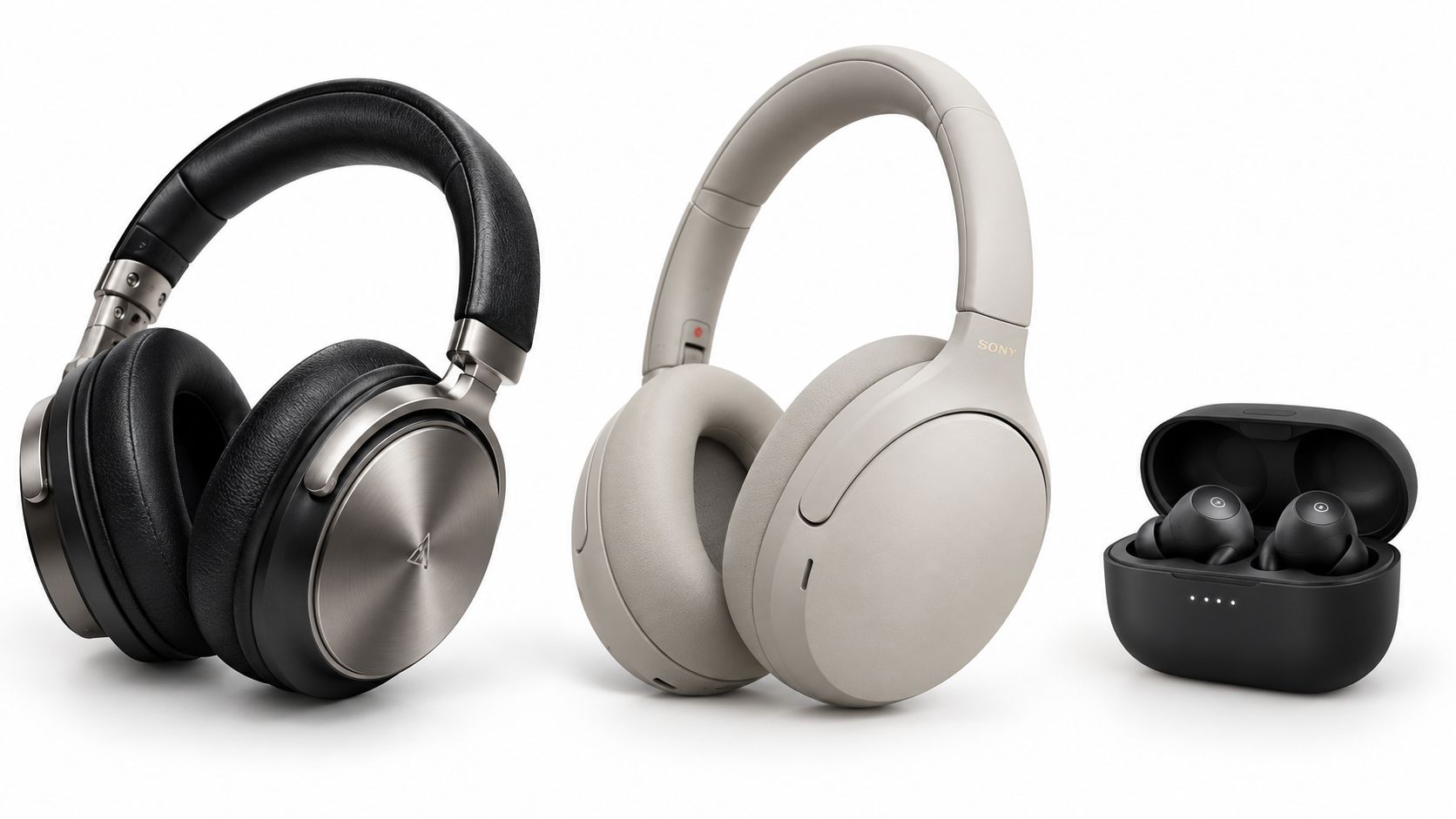
Closed-back over-ears are the strongest starting point for weight, isolation, and a consistent seal. They give bass notes physical body, keep outside noise from masking quiet rumble, and preserve space for vocals and instruments. Choose a bass-tuned model when you want that character immediately. Choose a neutral headphone with EQ when you want to decide how much low end the mix receives.
My First Choice Is A Tunable Closed-Back Over-Ear
For most listeners, I'd choose a closed-back over-ear with adjustable bass before a specialist basshead design. It provides the seal sub-bass needs, protects the midrange where vocals live, and adapts to more music without forcing one permanent sound.
The right tuning separates sub-bass extension from mid-bass punch. Sub-bass should descend with pressure and remain audible beneath a kick. Mid-bass should give the kick a firm front edge without thickening every bass guitar, vocal, and snare body. A low kick should feel round at the front, dense in the center, then stop cleanly at the tail.
On busy electronic tracks, separate bass layers must remain legible. If they merge into one padded wall, the headphone is adding weight without control. A neutral model with a sensible EQ lift can be the better purchase, provided its driver reaches low enough and stays composed under the adjustment.
Raw response still matters. RTINGS evaluates bass accuracy across 20 Hz to 250 Hz, rather than treating “powerful bass” as a complete description. Its bass accuracy testing method is a more useful filter than a product-page slogan.
ANC Over-Ears Earn Their Place On Trains
ANC can change bass, not merely remove outside noise. An AES conference measurement found that enabling ANC on a poorly sealed headphone produced almost a 20 dB low-frequency boost and reduced left/right bass imbalance from about 6 dB to only a couple of decibels below 100 Hz, as shown in the AES measurement document on ANC headphone distortion.
Test the headphone in the mode you will use. On a train, ANC can make the low end feel denser and more stable by reducing the noise that competes with bass. At home, the same processing can sound overripe if the passive seal already works. Fit changes the result in real rooms, so judge bass with the pads seated normally, not pressed against your head.
Haptic designs bring another option. They make explosions and movie scores thrilling, but they do not reproduce bass like a carefully tuned driver. You feel more low end. You do not automatically hear more pitch, texture, or detail inside it.
Sealed IEMs And TWS Can Hit Harder Than Their Size Suggests
A properly fitted IEM can deliver startling sub-bass because its ear-canal seal prevents air leakage. The bass feels immediate and stays less exposed to room noise. Fit consistency decides whether that advantage survives use. One tip that barely seals can leave one side thin while the other retains its weight.
True wireless earbuds continue to attract buyers who want compact designs and strong bass. Global TWS shipments rose 18% year over year to 78.3 million units in Q1 2025, the fastest annual growth since 2021, according to Canalys and Omdia shipment reporting. Compact drivers, sealed fits, and DSP-heavy tuning now help these products suggest a larger low end.
My practical ranking: A sealed IEM with the right tip can beat a leaky over-ear. Fit wins before driver size enters the argument.
Distortion remains the warning sign. Bass boosts at high playback levels can turn weight into mush. One review summary of a studio-style headphone reports audible distortion after bass boosting and describes behavior at 104 dBSPL as “off the charts,” with severe results at 20 Hz, while other approaches found low distortion at sensible levels in the DT 880 distortion discussion.
For the driver-versus-armature question, this comparison of dynamic drivers and balanced armatures provides useful background. I listen for behavior, not ideology.
The best low end stays articulate.
Matching Bass to How You Actually Listen
Your music and surroundings decide which kind of bass matters. A studio apartment, a rattling train carriage, and a dark room with a film on the television don't ask the headphone to do the same job.

EDM And Hip-Hop Need Extension First
If your library leans on sub-heavy electronic production, choose a headphone that stays composed at the bottom rather than one that only gives you kick-drum slap. Synth bass should descend smoothly, with a felt pressure behind the tone. The best match is a sealed over-ear or IEM with adjustable bass, because you can add weight without automatically swelling the 100 to 250 Hz region.
Hip-hop adds a second demand. Bass lines need pitch and texture, not just impact. A tuned wireless headphone usually works better than a haptic model if you care about the shape of the sample, the rasp of the voice, and the gap between kick and bass.
Movies And Games Reward Physical Weight
For cinematic effects, I'm more forgiving. A haptic or heavily boosted design can make an explosion feel immediate and turn a game's low-frequency effects into something you notice in your body. That experience isn't neutral, and it doesn't need to be.
Choose the physical-impact option if immersion outranks accuracy. Choose a controlled closed-back if you want to hear dialogue clearly while the soundtrack fills the room around it. The latter is the more flexible purchase.
Commuting Makes ANC And Fit Load-Bearing
On a train or bus, outside noise masks low frequencies and makes listeners raise the volume. Isolation therefore matters as much as the tuning. A sealed fit lets the headphone preserve quieter bass detail, while ANC can stabilize low-frequency behavior in a less-than-perfect fit.
Battery behavior matters here too. A bass-forward ANC model that sounds excellent only in a particular mode becomes frustrating if that mode drains the battery or changes the balance you rely on. Test ANC on, ANC off, and transparency before deciding which sound you prefer.
For the larger isolation decision, use this closed-back versus open-back headphone guide. Open space can sound beautiful at home. It won't save you on a crowded platform.
Gym And Desk Listening Need Different Kinds Of Slam
At the gym, secure fit and immediate punch usually beat delicate texture. A sealed IEM or stable TWS pair makes more sense than a loose open design because movement and ambient noise attack the seal.
At a desk, you can afford to choose the cleaner option. A neutral headphone with careful EQ gives you a broader range of music, especially if you listen for hours. The bass should support the room, not occupy it.
Pick for the environment, not the fantasy setup.
Getting More Bass Without Wrecking the Mix
Buy the right headphone first, then tune the rest of the chain. EQ can reveal useful low-end weight, but it can't repair a broken seal or rescue a driver that rattles.
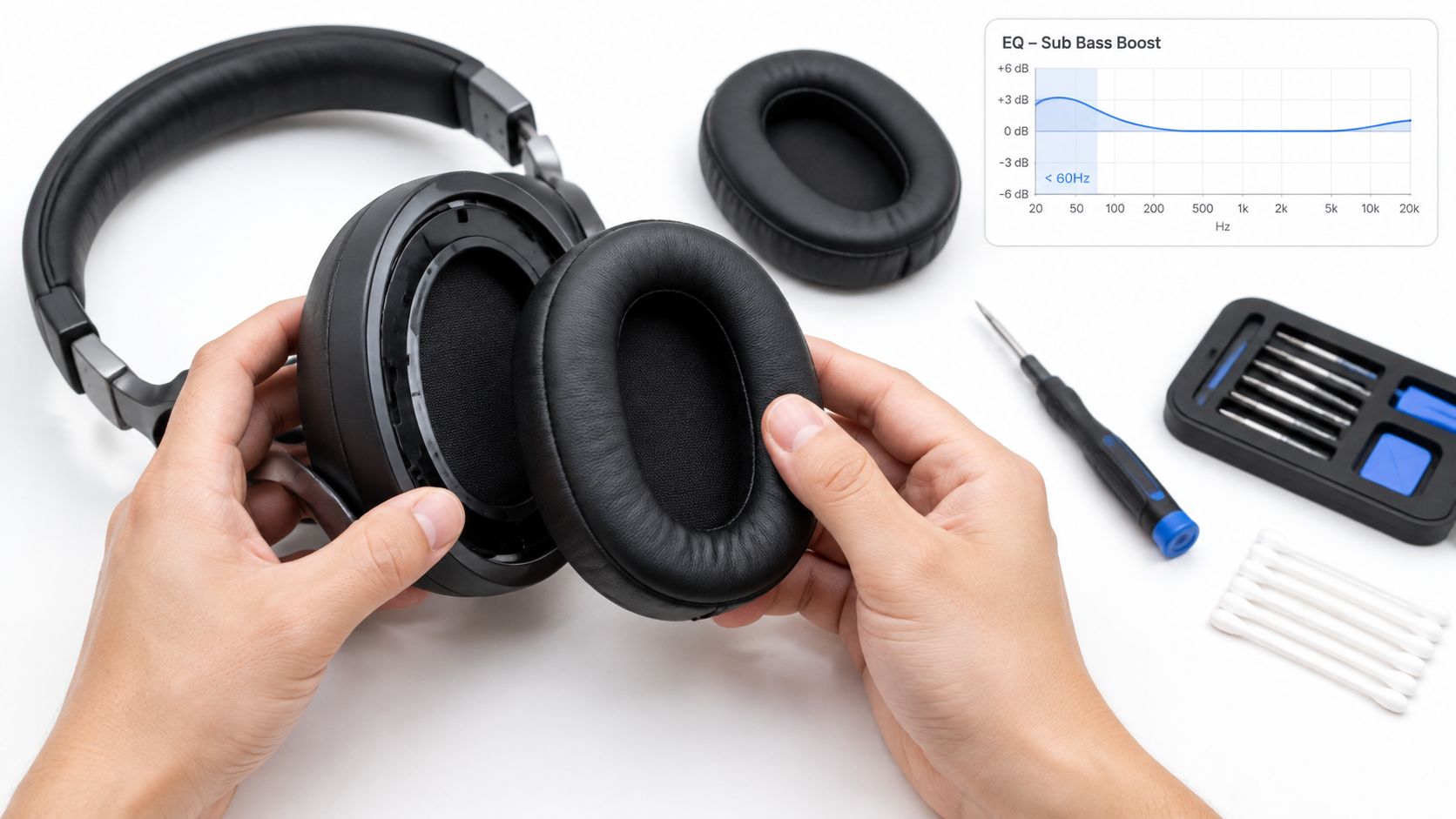
Start With The Seal
- Check the pads: Make sure both cushions close around the ears without gaps. Glasses, hair, and uneven clamp can create a leak.
- Try different tips: With IEMs, change tip size and material until the bass becomes even in both ears. Comfort matters because a tip you remove after ten minutes has no practical value.
- Run a bass sweep: Listen for rattling, buzzing, channel imbalance, or a sudden hole in the low end. The headphone sweep and seal tests from AudioCheck give you a useful way to find mechanical and fit problems.
EQ The Basement, Not The Whole House
If the headphone already has decent extension, lift the sub-bass gently and leave the upper bass alone. Raising the entire low end bloats the area where bass guitar, lower vocals, and room warmth gather. That's how a rumble becomes mud.
Use a small preamp reduction when you boost. Otherwise, the signal can clip before the headphone even receives it. Source power and output impedance also matter for some wired designs. If the amp starves the signal or changes the load behavior, downstream tuning inherits the problem.
Test at the level you actually use. A bass adjustment that works quietly may collapse when you turn the music up.
ANC deserves its own check. Switch it on and off with the same passage, then listen for changes in weight, balance, and vocal size. The measured ANC behavior described earlier shows why the mode can alter bass substantially, but your fit still decides whether that change helps or merely exaggerates a leak.
Don't chase bass after the driver starts complaining. The distortion has already won.
What I Would Buy for Deep Bass Right Now
For the best overall controlled rumble, I'd buy a sealed over-ear with effective ANC and adjustable EQ. ANC can preserve sub-bass in a noisy commute, while EQ lets home listeners reduce excess warmth. Fit still decides the result: a weak seal drains extension, no matter how bass-heavy the tuning looks.
For basshead slam, choose a haptic design only when you want physical impact. It suits movies and games, but it blurs the judgment of a delicate mix. Buy it for sensation, not accuracy.
For TWS bass, prioritize a reliable seal and adjustable tuning over a dramatic factory curve. Compact wireless bass is now a mainstream listening format, as noted in the Canalys and Omdia TWS shipment coverage. DSP and sealed fits can add weight, but a poor fit still turns sub-bass into a thin, uneven outline.
For a value sealed pick, I'd choose a modest closed-back or IEM that keeps vocals clear under EQ. If your neutral headphone already reaches low, tune it before replacing it. Add a small sub-bass lift, protect headroom with preamp reduction, and leave the mid-bass mostly alone.
Buy for the room, then the bass.
Stop shopping by the biggest bass claim. Match the headphone to your use, verify the seal, run a low-frequency sweep, and keep voices intelligible. For more guidance from Marque Hersh, visit Supermarket Sound.

