
A four-figure DAC won't rescue a headphone with the wrong tuning, and a graph won't tell you whether its treble will make you quit a late-night session. The useful headphone review starts downstream, with your ears, your chain, and the room you use.
That's the position I take at Supermarket Sound. The headphone market has enough scale to keep producing endless variations, with one estimate placing the global audiophile headphone market at USD 3.46 billion in 2024, rising to USD 3.6 billion in 2025 and projected to reach USD 5.5 billion by 2035 at a 4.3% CAGR. Another estimate projects USD 3.67 billion in 2026 and USD 6.47 billion by 2035 at 6.5% CAGR. The exact forecast varies, but the pressure is obvious. More inventory means more reviews, and more reviews mean more opportunities for spec-sheet theater. (Market estimate and projections)
I'm Marque Hersh, founder of Supermarket Sound. I'm not here to crown a trophy. I'm here to tell you which headphones will make your system sing, which ones will expose its weak spots, and which ones will punish you for buying on status.
Table of Contents
- What an Audiophile Headphone Review Should Actually Tell You
- The Three Specs That Matter and the Five That Don't
- Four Tuning Signatures and Who They Were Built For
- The Tiered Shortlist From Budget to Summit
- Why the Amp and DAC Change Everything Downstream
- Pick by Scenario, Not by Price Tag
- The Gut Check Before You Spend the Money
What an Audiophile Headphone Review Should Actually Tell You
“Audiophile” doesn't describe one listener, one sound, or one correct buying decision. It describes a person who cares enough about playback to notice when a vocal loses its grain, a kick drum turns soft, or a room collapses into a flat wall behind the singer.
Most reviews still treat the headphone as a standalone object. They describe the finish, quote the impedance, show a graph, then declare the product “detailed” and “musical” as if those words explain anything. They don't. A headphone is the final load-bearing part of a chain, and the listener inherits every upstream weakness.
A headphone earns its place in a system
A credible review should answer four direct questions:
- Who suits it? A bass-heavy planar may delight an electronic listener and exhaust someone mixing vocals.
- What does it punish? Bright headphones can expose bad masters, noisy amplifiers, and tired ears.
- What reveals its character? Some designs change little across sources. Others open up when the amplifier supplies cleaner control.
- Where does it belong? An open-back headphone may create a wide, breathable image at a desk, then fail completely on public transport.
The tuning philosophy matters more than the price tag. So does pad geometry, fit, source quality, and the music you play most often. A premium headphone with a signature you dislike remains an expensive mistake.
The historical move toward preference-based measurement helped reviewers escape pure adjective soup. Harman researchers presented work in 2017 asking whether headphones could follow a preferred target response. A later published summary stated that the target pleased 64% of listeners across broad age groups, genders, and listening experience levels. Reported variations in perceived headphone response ranged from 2.5 dB to 13 dB, which explains why a small-looking response change can sound enormous to one listener and minor to another. (AES report on headphone sound-quality research)
Practical rule: Buy a listening experience, not a piece of furniture for your equipment rack.
That's the floor. Everything else comes after it.
The Three Specs That Matter and the Five That Don't
Spec sheets become useful when they answer a listening question. They become theater when they exist only to make a product look technical.
Start with frequency response, but demand context
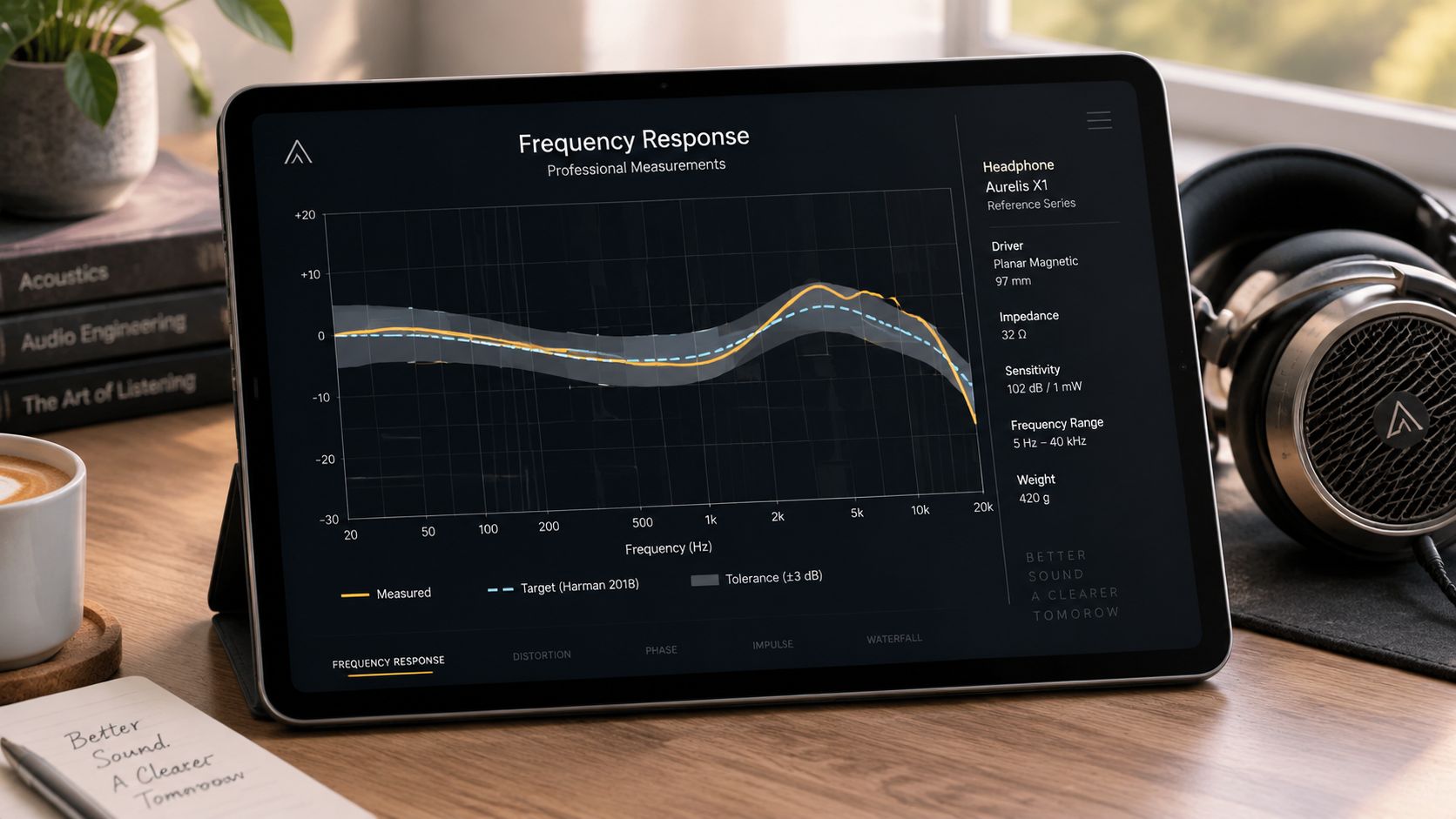
Frequency response tells you how loudly the headphone reproduces different parts of the audible range. It can show a bass lift, a recessed vocal region, or a treble peak that may add edge and apparent detail. The raw range alone means little. A claim such as 15 to 28,000 Hz becomes more meaningful when the manufacturer states a tolerance such as minus 3 dB, as explained in this headphone frequency-response buying guide.
The graph also needs a reference target and a consistent measurement method. RTINGS uses a Brüel & Kjær Type 5128-B head and torso simulator, then re-seats and re-measures each headphone multiple times before averaging the final plot. That process makes comparisons more useful than a single cherry-picked trace. (RTINGS sound-quality test methodology)
If you want a plain-language primer, I've also covered how to read headphone frequency response.
Treat distortion as a question of audibility
Distortion matters, but its headline value often exceeds its listening value. RTINGS found that headphone distortion was largely inaudible at normal levels, with detection thresholds appearing around 104 to 112 dBA SPL. Those levels are already uncomfortable or potentially harmful over long sessions. (RTINGS distortion audibility research)
That doesn't make distortion irrelevant. It means the reviewer should explain whether the figure predicts a problem at sane playback levels. A dramatic THD number at one frequency won't tell you as much as a listening test that connects the measurement to what people hear.
Compare the curve with a useful target
Target deviation gives the graph a map. The approximate Harman target for over-ear and on-ear headphones includes a bass boost of 5 dB at 20 Hz and 3 dB at 100 Hz relative to 400 Hz, plus a 10 dB rise centered at 3.2 kHz across a roughly 1.5-octave span. Earphones use the same bass shape with an additional 4 dB. (B&K 5128 graph guide)
The five commonly over-quoted specs are impedance by itself, THD at one frequency, sensitivity without current context, driver material, and cable conductivity. None tells the whole story.
Buying filter: If a spec doesn't change when you swap the amplifier or pads, it shouldn't drive the purchase.
Specs are clues. Your chain is the interrogation.
Four Tuning Signatures and Who They Were Built For
A tuning signature is a set of priorities. It decides whether a headphone pushes vocals forward, adds body to bass, smooths rough recordings, or shines a light into every corner of a mix.
| Signature | Signature Character | Best For | Avoid If |
|---|---|---|---|
| Harman-neutral | Balanced foundation, modest bass lift, lively upper presence | Analytical listeners who still want musical weight | You prefer a soft, relaxed presentation |
| Bass-forward | Stronger low-end impact, dense physical foundation | Hip-hop, electronic music, cinematic scores | You need strict midrange neutrality |
| Diffuse-field warm | Smooth, vocal-centered, forgiving | Long classical, jazz, and vocal sessions | You chase sharp attack and treble sparkle |
| Bright-analytical | Emphasized edge, separation, immediate detail | Tracking, mixing, detail hunting | You listen late or dislike treble pressure |
Harman-neutral keeps the microscope musical
A Harman-neutral headphone gives you a relatively balanced starting point with enough low-end lift to avoid sounding starved. It suits the listener who wants to inspect a recording without turning every album into a forensic report. Cymbals retain air, vocals stay intelligible, and bass notes carry enough weight to keep the presentation from becoming sterile.
It punishes poor recordings and indifferent fit. A seal change can shift the low end, while a treble-sensitive listener may hear the upper range as too forward.
Bass-forward tuning puts weight under the floor
Bass-forward designs suit hip-hop, electronic music, and cinematic material because they make sub-bass physical. The tradeoff is space. Extra low-end energy can blur the boundary between kick and bass guitar, and it can make a vocal-centered mix feel less exposed.
That's not a flaw if the signature matches your routine. It's a flaw when you buy it because the price looks serious and then spend every evening reaching for equalization.
Diffuse-field warmth favors voices and endurance
Warm, diffuse-field-influenced tuning works when you value tone over spectacle. A singer's chest, a cello's wood, and the body of a jazz ensemble become the center of gravity. The presentation feels less like a spotlight and more like a room with the lights lowered.
It gives up some treble drama. Detail remains present, but it doesn't arrive wearing a reflective vest.
Bright-analytical sound is a workbench
Bright-analytical headphones suit tracking, mixing, and listeners who want every edit, breath, and pick scrape exposed. The attack feels quick. Layers separate cleanly. A familiar recording can reveal decisions you'd never noticed before.
The punishment is fatigue. If your routine involves long sessions, low-quality masters, or late-night listening, that extra edge can turn into pressure behind the eyes.
Don't force your taste onto a tuning built for another person's room.
The Tiered Shortlist From Budget to Summit
Price tiers help organize the field, but they don't establish musical hierarchy. I'd rather recommend a cheaper headphone that fits the listener than a costly model that creates a permanent urge to “upgrade” away from its sound.
| Tier | Headphone | Driver / Tuning | Strengths | Weakness | Min. Amp |
|---|---|---|---|---|---|
| Budget | Sennheiser HD 560S | Dynamic, Harman-tilted open-back | Honest mids, spacious balance | Can sound lean and unforgiving | Clean basic headphone output |
| Mid | HiFiMAN Sundara | Planar magnetic, airy and controlled | Transient speed, treble openness | Wants current for full authority | Capable dedicated amp |
| Summit | Focal Utopia | Beryllium dynamic driver, resolving reference tuning | Low-level detail, depth, immediacy | Expensive and revealing | High-quality dedicated amp |
Budget pick, Sennheiser HD 560S
The HD 560S is the corrective to the belief that neutrality requires a luxury budget. Its open-back presentation gives the midrange room to breathe, and its balance makes it a strong tool for late-night mixing, acoustic music, and anyone who wants to hear the structure of a recording without adding a velvet curtain.
Buy this if you want one honest open-back headphone that won't make you mortgage your listening habits.
It rewards a clean source and punishes harsh masters. A weak or noisy output can make it feel flatter than it should, but it doesn't demand an exotic chain before becoming useful.
Mid pick, HiFiMAN Sundara
The Sundara brings planar speed and treble air into a more serious listening tier. Transients arrive with a crisp snap, bass notes start and stop cleanly, and dense arrangements gain separation without turning every instrument into a detached object.
Buy this if you listen to electronic music, acoustic recordings, or complex arrangements and want faster low-end behavior than a conventional dynamic design usually provides.
It needs current to show its full composure. Driven poorly, it can sound technically capable but emotionally underfed.
Summit pick, Focal Utopia
The Focal Utopia earns its place through resolution and stage depth, not exaggerated bass. Its beryllium driver gives small details a sharp outline, while the presentation puts voices and instruments into a convincing front-to-back arrangement.
Buy this if you already own a clean, capable chain and want the headphone to expose low-level texture rather than add weight.
The honest con is simple. It tells you exactly what the recording and electronics are doing, including the parts you'd rather ignore. At this level, you're paying for vanishing detail and control, not a bigger bass button.
The right tier is the one that matches your tolerance for revelation.
Why the Amp and DAC Change Everything Downstream
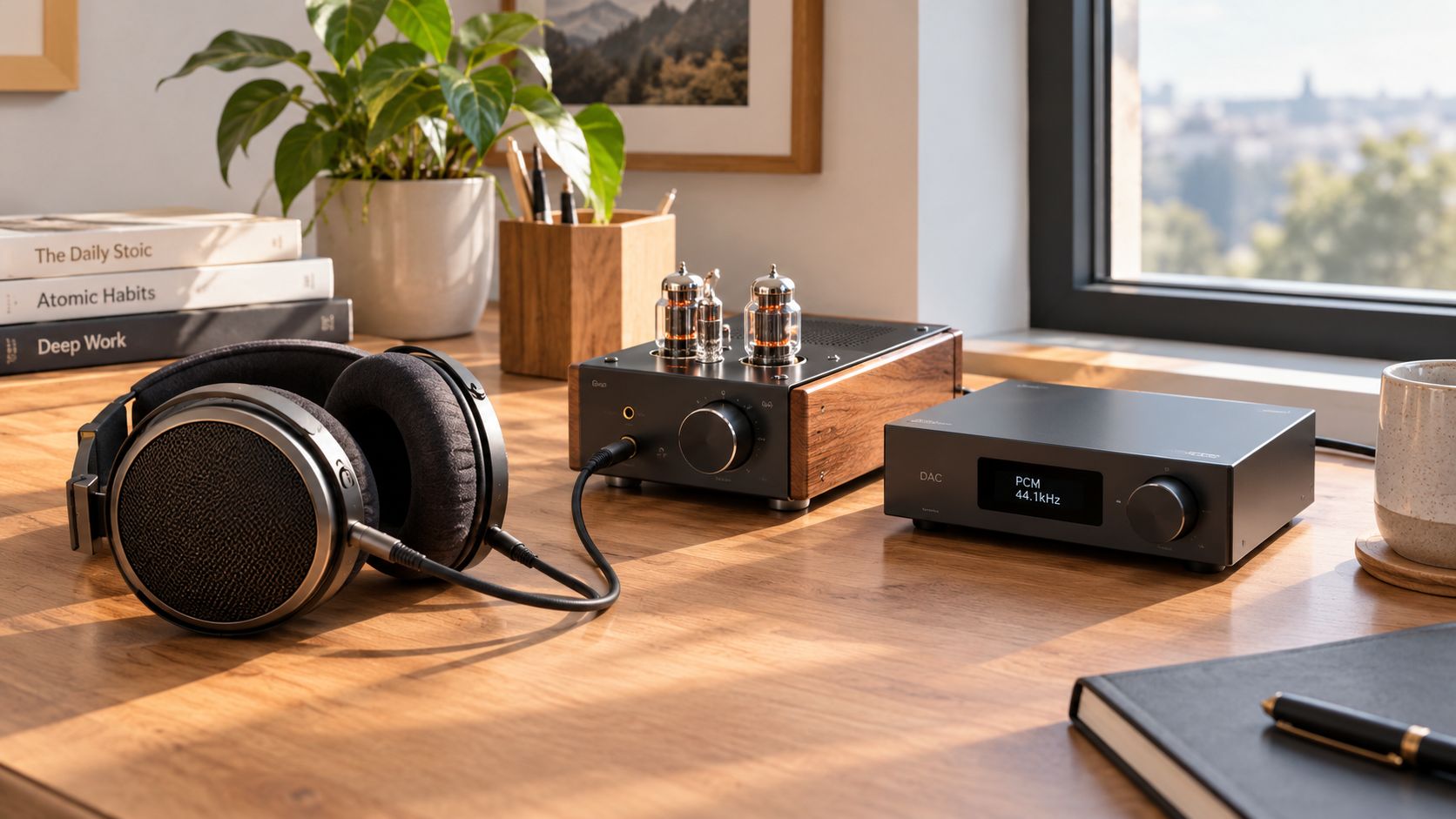
An amplifier isn't jewelry for the rack. It controls the electrical conditions under which the headphone works, and the headphone's character can change when those conditions change.
I divide headphones into three practical groups. Chain-tolerant designs perform well from ordinary outputs, though a clean amp can still improve headroom and control. Chain-demanding designs need more voltage or current before they stop sounding compressed. Chain-revealing designs expose noise, poor gain structure, and upstream brightness with no mercy.
Match the electrical problem to the headphone
Impedance is a starting point, not a verdict. High-impedance dynamic headphones need sufficient voltage swing. Low-impedance planars may demand current even when their rating looks friendly. Sensitive designs can expose amplifier noise that a harder-to-drive headphone hides.
My plain-language guide to what impedance means in headphones covers the principle without pretending one number predicts the entire experience.
A louder headphone isn't automatically a better-driven headphone. Volume only proves that the signal got loud. It doesn't prove that the amp maintained control, low noise, or composure during demanding passages.
Spend where the bottleneck lives
A competent entry-level dedicated amplifier can be enough for a chain-tolerant headphone. The HD 560S doesn't need a shrine. The Sundara benefits more from a current-capable amplifier, especially when the music becomes dense or the volume rises. The Utopia needs a clean, quiet chain because its resolving character makes upstream problems audible.
A high-end DAC can improve a system when it delivers clean conversion and sensible output integration. It won't repaint a headphone's tuning. If the headphone sounds too bright, a more expensive DAC won't necessarily turn it warm. If the amplifier clips or adds noise, the DAC can't repair the damage downstream.
The video below gives a useful visual counterpoint to the usual “just buy more power” advice.
If the headphone changes character when you swap amplifiers, the amplifier was part of the review all along.
Don't over-drive the chain. Feed it cleanly, give it the voltage or current it needs, then stop shopping.
Pick by Scenario, Not by Price Tag
The same headphone can be a brilliant choice in one room and an absurd choice in another. Price doesn't change that. Your routine does.
Late-night mixing
Choose the Sennheiser HD 560S for honest mids and an open presentation that keeps instruments from piling into one congested block. It gives you enough separation to check vocal placement and tonal balance without forcing a sharp treble spotlight into every decision.
If you need isolation, move to a closed-back design, but give up some of that airy space. Mixing late at night also makes fatigue a serious concern, so don't buy a bright-analytical headphone merely because its first impression sounds “detailed.”

Vinyl-side listening
The HiFiMAN Sundara is the pick when you want transient snap and an open window onto acoustic recordings. Plucked strings gain a clean start, percussion feels nimble, and the presentation keeps busy arrangements from turning syrupy.
You give up some warmth compared with a softer dynamic tuning. That's the trade. If your records already lean bright, choose a smoother signature instead of asking the amplifier to perform tonal surgery.
Gaming positional cues
For locked imaging without the smear that bass-heavy tuning can introduce, choose the Audeze MM-100. A closed-back alternative such as the Audeze LCD-XC makes more sense when you need isolation, but the enclosed presentation changes the sense of room around effects.
You give up some natural openness with the closed option. In return, external noise stops competing with positional information.
Portable commuting
No summit open-back survives a train, café, or crowded platform as a serious daily tool. Choose the Sennheiser IE 600 for a compact listening setup, or consider a well-driven Moondrop Venus when your portable chain can support it.
You give up the scale of a home rig. That's acceptable. A headphone that stays in the bag because it's impractical has already lost.
The best headphone belongs to the room where you sit.
The Gut Check Before You Spend the Money
Before you buy, answer three questions without looking at another ranking.
What do you listen to most?
Name the genres, but also consider recording quality and format. Vocal-heavy music exposes midrange choices. Electronic music reveals bass control. Classical and live jazz expose stage depth, decay, and treble behavior.
If you mostly play polished modern masters, a brutally bright headphone may add analysis without adding pleasure. If you listen to rougher recordings, warmth can keep the session alive.
Where do you listen?
A treated room, desk, bedroom, café, and commute demand different physical designs. Open-back headphones leak sound and let outside noise in. Closed-back models isolate better but can create a more enclosed acoustic picture.
Read the practical guide to open-back versus closed-back headphones before you let a price tier make the decision for you.
What drives the headphone right now?
A phone dongle, integrated amplifier, and separate DAC-and-amp stack don't provide the same conditions. Match the headphone's electrical demands to the source you already own, then decide whether an amplifier upgrade fixes a real bottleneck.
Don't buy the cable before you own the proper amp. Don't buy bright analytical cans for late-night fatigue. Don't buy low-impedance planars for an underpowered source. Don't confuse planar speed with detail retrieval.

Trust your ears over the graph when they disagree. The graph describes a measurement system and a broad preference target. Your ears belong to you.
Take your current source, your most-played records, and the room where you listen, then choose the headphone that solves that real problem. If you're still stuck between two signatures, bring the decision to Supermarket Sound and start with the tuning, not the price tag.

