The loudest portable headphone amplifier usually makes the worst buying advice. I'd rather have an amp that stays quiet with sensitive IEMs, keeps its output impedance under control, and survives a week of commuting than a pocket brick whose headline power only works under one friendly test condition.
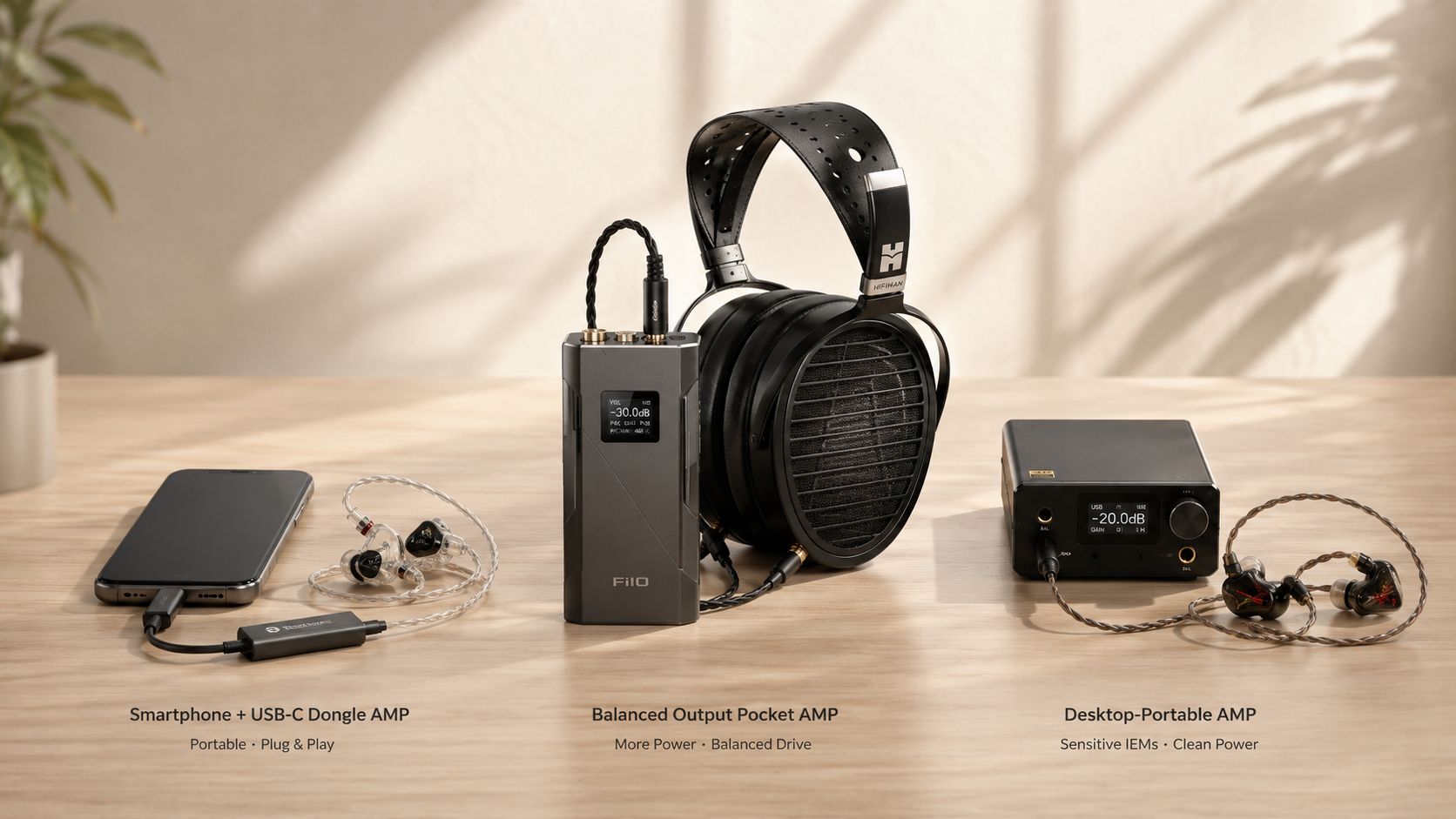
The best portable headphone amplifier is a workflow tool. A phone-first listener, a planar owner, and someone moving between a desk and the sofa need different architectures. I'm routing this guide by those routines, not by a leaderboard built around inflated wattage.
Portable amplification has a real family tree. Older community accounts trace dedicated headphone amplification back to the 1960 Stax SRA-4S for electrostatics, while HeadRoom is cited in later discussions as making “the first portable” headphone amp, with modern portable designs following that early template. The historical discussion on Head-Fi makes the useful point: portable amps came from a genuine need to drive headphones properly before phones became the default source.
| Listening situation | Architecture I'd choose | What matters most | What I'd avoid |
|---|---|---|---|
| Noisy commute with IEMs | USB-C dongle DAC/amp | Low noise, low gain, phone power | A second battery to charge |
| Desk and sofa with sensitive IEMs | Self-powered hybrid amp | Very low output impedance, gain control, line out | A fixed high-gain stage |
| Planars or demanding over-ears | Balanced self-powered amp | Voltage swing, clean current, thermal behavior | Tiny power claims at one easy load |
| Wireless phone-first listening | Bluetooth DAC/amp | Codec behavior, battery under load, controls | Runtime claims measured under gentle conditions |
Table of Contents
- Why Most Portable Amp Rankings Miss the Point
- The Specs That Decide the Fight
- Three Portable Architectures at a Glance
- The Commute Pick, Small, Honest, Phone-First
- The Planar Pick, Balanced Power for Hard-to-Drive Cans
- The IEM and Desktop-Portable Pick, Low Noise, Low Impedance
- Battery, Real Numbers, and the Buyer's Checklist
Why Most Portable Amp Rankings Miss the Point
Portable amp rankings usually reward the loudest number. That is the wrong test. Buy for the way you listen, because a phone-first commuter, a planar owner, and a desk-to-sofa listener need different hardware.
A power figure into 32 ohms helps, but it does not settle the choice. The same output can act very differently with a 300-ohm dynamic headphone, a low-impedance planar, or a sensitive multi-driver IEM. A product page may show impressive power while the amplifier struggles when the load needs voltage rather than easy current.
I refuse to arrange portable amps on a flat wattage ladder. The failures show up in daily use. Sensitive IEMs reveal hiss, an aggressive gain stage makes the volume control jump too quickly, and poor impedance behavior can alter a headphone's tonal balance, especially with multi-driver designs.
The brochure doesn't take the train
Battery claims are another easy way to buy the wrong box. Published runtime often reflects favorable conditions, while commuting adds Bluetooth processing, balanced output, display activity, and higher gain. Independent coverage warns that real-world runtime can fall by 30% to 40%, with LDAC playback around 6 hours compared with 18+ hours on lighter codecs. Independent portable amp coverage captures the practical issue: the feature you paid for may be the one draining the battery.
I also separate a real upgrade from a louder one. If a phone already drives an efficient headphone cleanly, another box adds bulk without solving a problem. Buy amplification to remove a specific bottleneck, such as hiss, insufficient voltage, awkward gain, or a messy daily connection.
For the source-side distinction, this headphone amp versus DAC guide keeps the terminology clear. A DAC converts the signal. An amplifier supplies electrical drive. Your headphones receive the result of both choices.
My rule: Buy the amp that disappears into your routine, not the one that dominates its specification sheet.
The Specs That Decide the Fight
Portable amps succeed or fail on details that change with the headphones. Maximum wattage matters, but battery behavior, output impedance, gain range, and noise determine whether the device fits your routine.
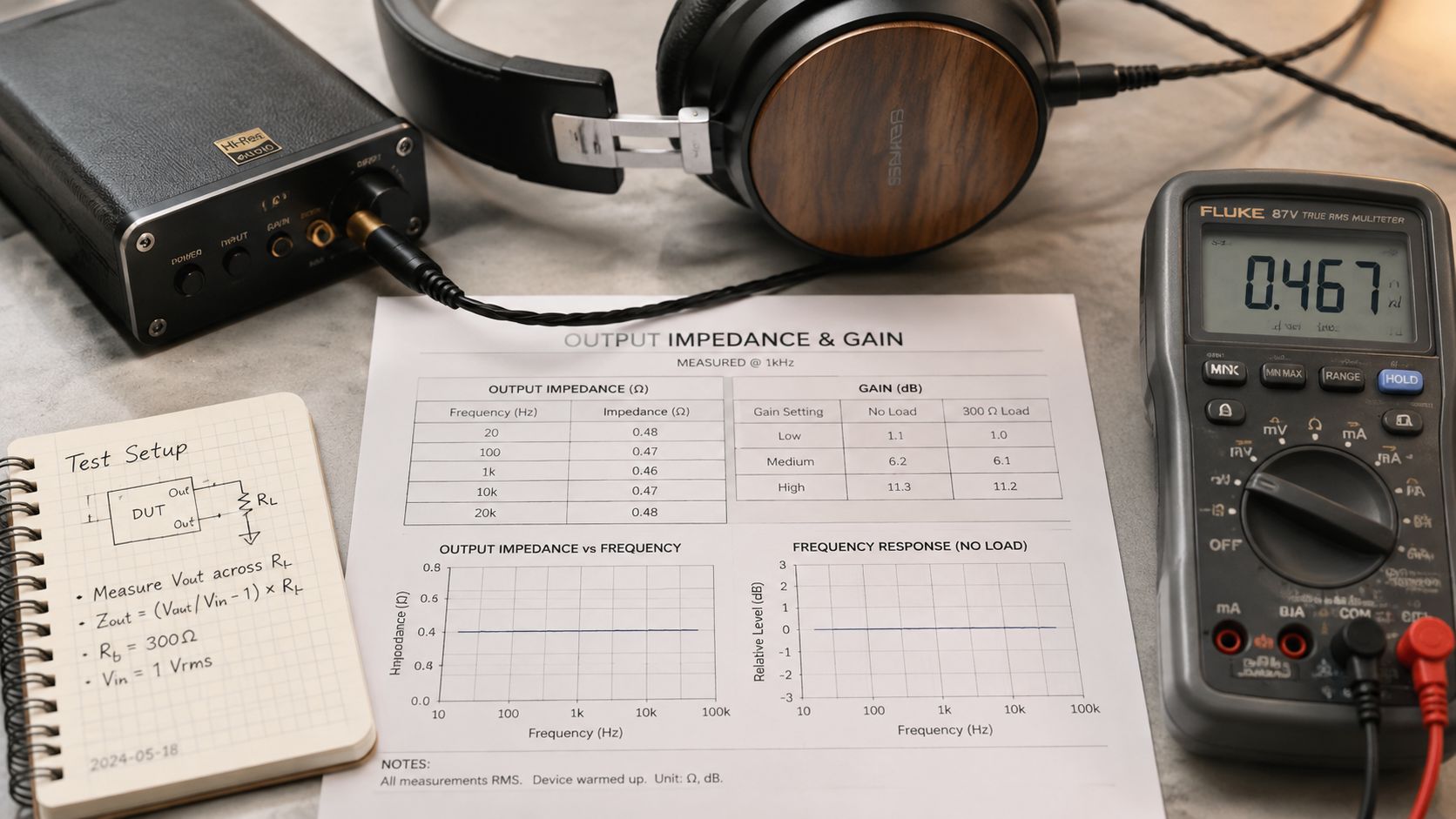
Output impedance keeps the headphone honest
Output impedance sits between the amplifier and the headphone. A lower value generally preserves the headphone's intended frequency response and damping. One portable balanced amplifier lists 1 ohm, another measures under 1 ohm, and a third advertises under 0.5 ohm for headphones from 10 ohms to 600 ohms. The CEntrance Ampersand specifications show why this figure deserves more attention than decorative chassis language.
A portable balanced design may provide 1.1 ohms from its 3.5 mm jack and 1.3 ohms from balanced 4.4 mm, a sensible target for impedance-sensitive IEMs. The physical trade-off can be substantial: 73 × 140 × 23.3 mm and 325 g makes an amplifier bag-friendly rather than invisible. Stereoindex's PA10 coverage captures that compromise clearly.
The familiar 1/8 rule remains a useful sanity check. Keep amplifier output impedance around one eighth of the headphone's nominal impedance or lower when you want the amp to exert less tonal influence. It is not a magic law. It reduces the chance that the amplifier changes the headphone's intended balance.
Gain is the volume control's load-bearing wall
A single high-gain setting makes sensitive IEM listening miserable. The usable range on the volume control becomes tiny, and circuit noise arrives with the music. Stepped low and high gain matters more than a heroic maximum output figure if you use both IEMs and over-ears.
A compact USB DAC/amp publishes low and high gain, recommends headphones from 16 ohms to 300 ohms, and reports more than 10 hours of battery play time. Its product review specifications demonstrate the kind of information buyers can use. The useful question is where the device works, not how loudly its packaging can boast.
Measurements need context too. Published figures for a compact portable amplifier include more than 2.6 V RMS into 150 ohms, more than 1.7 V RMS into 32 ohms, around 2 ohms output impedance, 0.005% THD+N at 1 V RMS into 150 ohms, broadband noise below 10 μV RMS, and channel tracking below ±0.2 dB. The published Glacier measurements matter because they describe voltage swing, noise, distortion, and balance together. Those are listening consequences, not scoreboard confetti.
Three Portable Architectures at a Glance
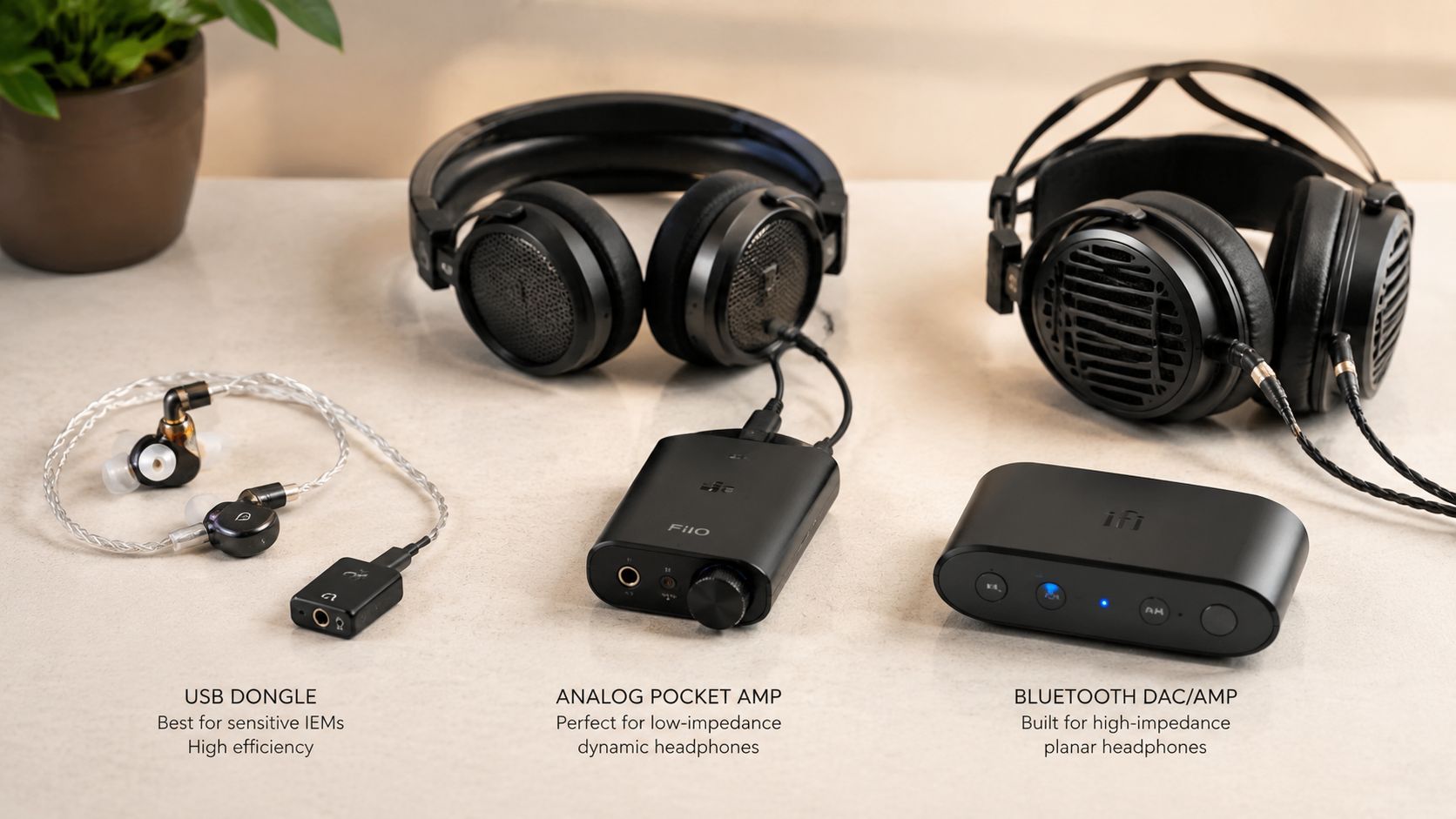
Portable amplification now falls into three useful shapes. Pick the shape first, then worry about the model.
| Architecture | Power Source | Typical Output | Noise Floor | Best For | Trade-off |
|---|---|---|---|---|---|
| USB dongle DAC/amp | Phone or computer | Dongle-level output, often single-ended | Usually quiet with efficient IEMs | Commuting, phone-first listening | Draws source-device power |
| Self-powered analog pocket amp | Internal battery, external DAC | Moderate to high amplifier output | Depends heavily on gain and circuit design | Existing DACs, demanding headphones | Adds a box and charging duty |
| Bluetooth DAC/amp | Internal battery, wireless source | Single-ended or balanced portable output | Codec and circuit dependent | Wireless phone use, mixed routines | Battery falls faster with demanding features |
The USB dongle is the cleanest answer when you want fewer objects. It takes signal and power from the phone, clips near the pocket, and keeps the chain simple. For efficient IEMs, that simplicity often beats a larger stack that spends its life looking impressive beside a charger.
The self-powered analog amp makes sense when your DAC already does the conversion well or when your headphones need a more serious output stage. It separates the amplifier's battery demand from the phone and gives you a sturdier platform for voltage swing. This is the old-school pocket amp approach, and it remains useful when the headphone is the difficult part of the chain.
Bluetooth DAC/amps sit between convenience and capability. They remove the short digital cable, add onboard controls, and may offer app EQ, codec options, and balanced output. Recent portable coverage treats those workflow features as the key differentiators, not merely the maximum power number. The current portable DAC/amp discussion reflects that split between dongles and self-powered designs.
If you're trying to understand how amplifier topology changes the conversation, this primer on mono Class D amplification is a useful detour. For portable buying, though, architecture comes before topology.
The right row is obvious once you stop shopping for a fantasy setup.
The Commute Pick, Small, Honest, Phone-First
For commuting, I'd choose a USB-C dongle DAC/amp under 30 grams. It should pull power from the phone, clip to a jacket pocket, and stop asking for attention once the train doors close.
That sounds modest. It isn't. Pair a clean dongle with efficient IEMs and the chain can stay quiet, keep gain low, and leave enough useful travel on the volume control to make small adjustments without jumping from whisper to nightclub. Add a reasonably easy over-ear headphone and you still get convincing snap on drums and enough separation to keep a dense mix from becoming soup on a noisy platform.
A week in the pocket
The commute test isn't a dramatic first listen. It's Monday morning, a missed connection, a damp coat, and Friday afternoon when you realize you haven't charged an extra box once.
A phone-powered dongle wins there. It doesn't create another battery ritual, and the short cable stays attached to the source rather than dangling from a larger stack. The sound should give the music a stable center, clear consonants, and enough dynamic contrast to survive transit noise. It won't turn a difficult planar into a desktop headphone, and it shouldn't pretend to.
Single-ended output is fine for this job. Balanced output can deliver much more power, but the commute usually favors low weight, low clutter, and efficient headphones. A balanced connector adds little if your IEMs already play cleanly and loudly from the single-ended jack.
Commuter advice: If the device needs a charging schedule, a special case, and careful cable choreography, it has already lost.
The phone-first pick suits listeners who want one less thing to charge and one less cable to forget. It's also the right answer for anyone whose current source already reaches comfortable volume but sounds noisy, thin, or electrically unsettled with IEMs.
Don't buy a pocket brick for a pocket problem.
The Planar Pick, Balanced Power for Hard-to-Drive Cans
Planars expose weak portable amplification faster than almost anything else. The first sign isn't always volume. It's compression when the arrangement gets busy, bass that loses its edge, and a stage that folds inward when the track asks for scale.
For difficult planars and high-impedance over-ears, I'd choose a self-powered amp with a proper balanced output, usually 4.4 mm or 2.5 mm. Balanced output isn't automatically better, but it can provide a genuine power increase when the circuit gives each side its own drive path.
One published portable DAC/amp example rates its 3.5 mm output at 165 mW + 165 mW into 32 ohms, while balanced reaches 650 mW + 650 mW into 32 ohms. That is roughly a fourfold increase in rated power. The FiiO Q11 specifications show why balanced ports matter when the headphone and amplifier can use the extra output.
What clean swing feels like
The change arrives as control rather than fireworks. Kick drums stop sounding rounded at the leading edge. Bass guitar has a firmer floor. In a crowded electronic or orchestral mix, instruments keep more air around them because the amplifier isn't running out of room every time the music surges.
A portable amp can also vary wildly by output type. One unit lists 290 mW + 290 mW at 16 ohms from 3.5 mm, while another reaches 2.3 W into 13 ohms, 4.4 W into 22 ohms, and 6 W into 48 ohms. Audioengine's portable amplifier specifications make the useful point that low-impedance loads can produce dramatically different wattage figures. Don't compare those numbers without matching the load and output.
The cost is physical. Larger batteries, heavier cases, and sustained heat come with serious output. Battery life also takes the hit, especially from balanced operation and higher gain. A self-powered pocket amp beats a dongle here because the phone doesn't have to supply the amplifier's entire appetite.
Use single-ended for casual tracks and balanced when the headphone needs it. Start on low gain, raise it only when the music demands more headroom, and never treat a higher setting as a free improvement.
Planars need grip.
The IEM and Desktop-Portable Pick, Low Noise, Low Impedance
The best hybrid pick serves the listener who spends late evenings with sensitive multi-driver IEMs but doesn't want a separate desk stack. I'd look for three things together: sub-1-ohm output impedance, a genuine gain switch, and a line-out or preamp function that lets the device dock at a desk.
That combination keeps the electrical behavior predictable. Low output impedance helps avoid bass shifts caused by impedance interaction, while low gain gives the volume control useful range. The line-out function matters because a portable amp earns its keep when it can feed the rest of the desk without forcing you to rebuild the chain every time you leave the room.
One stack, two rooms
At lunch, the amp sits beside the computer and feeds powered monitors through its line output. Later, it moves to the sofa with the same source connection and drives IEMs at a quiet level. No second stack waits in a drawer. No cable gets sacrificed to the ritual.
The listening payoff comes at low volume. A quiet circuit leaves the background black enough for reverberation tails to emerge naturally, rather than adding a faint electronic fizz between notes. The gain switch keeps that silence from becoming hiss when you turn the amplifier up to accommodate a harder headphone later.
A low output impedance also protects the IEM's tonal intent. The PA10's 1.1-ohm 3.5 mm and 1.3-ohm balanced figures offer a concrete example of the kind of electrical restraint I want from a portable design. I don't need the amp to add bass, soften treble, or reshape the crossover by accident.
For the basic electrical relationship, this explanation of headphone impedance keeps the language clear. Impedance isn't a quality rating. It tells you how the headphone interacts with the amplifier.
This is the choice for someone tired of owning two stacks. It favors silence, control, and repeatable setup over theatrical output.
The best desk amp may be the one you can carry away.
Battery, Real Numbers, and the Buyer's Checklist
Battery claims describe a test setup, not your pocket. Turn on Bluetooth, choose balanced output, raise the gain, and leave the display lit, and the number on the box stops being useful.
The biggest drains are predictable. LDAC and aptX Adaptive require more processing than lighter codecs. Balanced output makes the amplifier work harder. Active gain stages and bright indicators also consume power. Independent coverage reports that manufacturer runtime can fall by 30% to 40% in real use, while LDAC playback may reach around 6 hours compared with 18+ hours on lighter codecs. The battery-life analysis for portable headphone amps is why I treat runtime as a listening-scenario figure, not a fixed promise.
| Architecture | Advertised Hours | Real-World Hours, Mid Gain, LDAC/HiRes | Biggest Drain Culprit |
|---|---|---|---|
| USB dongle DAC/amp | No independent amp battery | Limited by phone battery | Drawing power from the phone |
| Self-powered analog amp | Model-dependent | Lower than the lightest published condition | Output stage under load |
| Bluetooth DAC/amp | Manufacturer-dependent | Often substantially shorter with demanding codecs | Wireless processing and balanced output |
My six-point check
Start with the routine. Daily commuters should put phone power, size, and weight ahead of balanced output. Planar users should accept the larger battery and chassis required for the job.
Check output impedance. Choose a low figure, especially for multi-driver IEMs. Sub-1-ohm behavior is the safe territory I prefer because it reduces the chance of changing the earphone's intended response.
Inspect the gain structure. Low and high gain should function as useful operating modes. A switch that jumps from barely audible to excessive is poor tuning, not flexibility.
Match output to the headphone. Balanced can provide a genuine power increase when the headphone, cable, and amplifier circuit support it. Treating balanced wiring as decoration wastes money and pocket space.
Read the charging behavior. USB-C charging, pass-through listening, separate data and charging paths, and sensible indicator lights can matter more than another option buried in an app. These details decide whether the amp fits a workday or becomes drawer equipment.
Touch the physical details. Connectors should feel secure, controls should remain reachable inside a pocket, and the cable should bend where the carry setup requires it.
If two amplifiers measure similarly, choose the one that disappears into your routine.
The market has moved beyond novelty. One market estimate projects headphone amplifiers at USD 662.78 million in 2025, rising to USD 1,057.34 million by 2032, with a projected 6.90% CAGR. A separate study uses a much broader scope, estimating USD 18.5 billion in 2024 and USD 24.6 billion by 2033, while another report places portable amplifiers at 38.5% of the market in 2025, or about USD 809.85 million. The market report shows why these figures cannot be combined into one tidy answer. Firms define the category differently, yet portable amplification is now a meaningful market rather than decorative audiophile cosplay.
My routing is simple. Use the phone-first dongle for efficient IEMs, the balanced self-powered unit for planars, and the low-impedance hybrid for a desk-to-sofa routine. That is a workflow map, not a ranking.
Choose the listening situation that matches your week, then compare only devices built for that job. If you are still unsure, bring your headphone impedance, sensitivity, connector type, and daily routine to Supermarket Sound before spending on wattage you will never use.

