The most popular speaker-placement advice fails small rooms at the exact moment you need it most. People obsess over the equilateral triangle, slide the speakers a little farther from the wall, and leave the couch exactly where it was, even though the chair often decides whether the bass sounds full, hollow, or completely absent.
For practical speaker placement in a small room, start with the room, not the boxes. Below roughly 200 Hz, room modes and boundary gain dominate the result, and one acoustics reference places the critical distance in an untreated small room at about 3 to 4 feet from the speakers, beyond which reflected sound and room behavior start to take over. You don't need a perfect room. You need to choose your compromises deliberately.
Table of Contents
- Your Small Room Is the System, Not the Box
- The Triangle, Ear Height, and the 38 Percent Rule
- Boundary Gain Versus Spatial Precision by Speaker Type
- Subwoofer Placement and Integration Without Guessing
- Room Modes Are a Chair Problem, Not a Speaker Problem
- Cheap Acoustic Treatments That Buy Back What Placement Sacrifices
- Calibration and Troubleshooting for Common Small-Room Failures
Your Small Room Is the System, Not the Box
The room usually breaks the textbook setup before the speakers do. In a small space, the walls, floor, ceiling, listening seat, and speaker cabinets form one acoustic system. Furniture cannot always move, doors still need to open, and the couch may be fixed by the room. A useful layout works with those constraints instead of assuming an empty listening room.
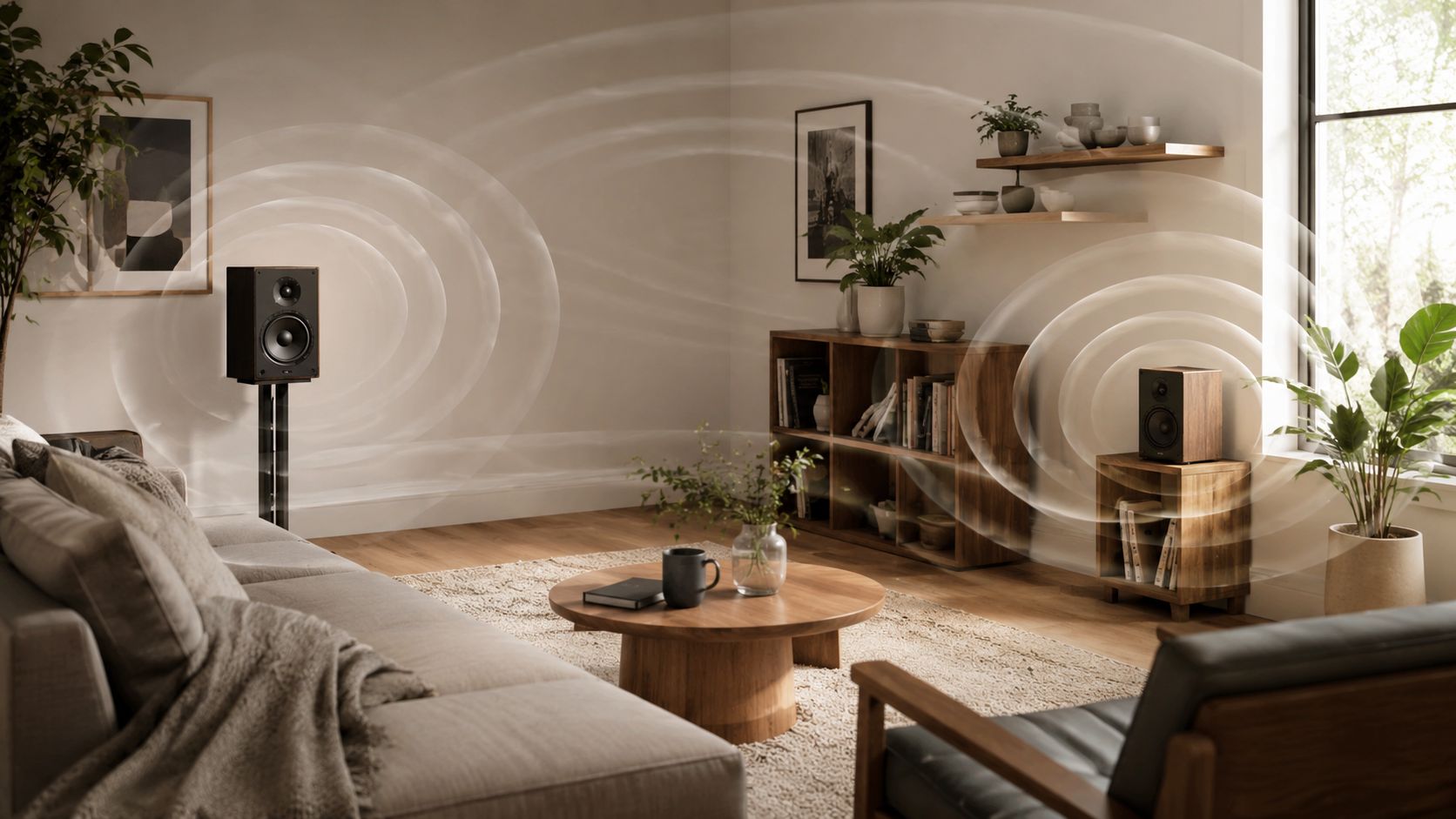
The room changes the speaker's balance almost immediately. Boundaries reinforce some bass notes and cancel others, while early reflections reach the listener before the stereo image has settled. The same capable speaker can sound thick and slow in one seat, then lean and disconnected a short distance away. Treat the room as the dominant component of the system.
Start with the speakers on the short wall, firing down the longer dimension, and establish left-right symmetry before adjusting toe-in or chasing detail. Keep the listening seat away from the exact midpoint when possible. The center of a small room can fall in a low-frequency null, while walls and corners can produce excessive bass pressure. These room-placement principles explain why corner placement may create bass bloom even as another seat loses the same notes.
The chair gets the first move
Set the listening seat where you can live with it, then adjust the speakers around that position. Move the chair before spending an afternoon on tiny toe-in changes. A small shift can alter bass more than a careful change in angle, particularly when the seat is against the rear wall or near the room center. The speakers produce the sound, but the chair selects which part of the room's pressure pattern reaches your ears.
In an acoustically small room, near-field listening limits the apparent scale of the stage, and reduced toe-in can produce a more natural balance than a larger-room setup. The near-field small-room placement approach supports that compromise. Do not treat distance from the wall as a moral rule.
Practical rule: Choose between boundary reinforcement and spatial precision before fine-tuning. Sealed speakers usually tolerate closer wall placement, ported speakers need more care around rear boundaries, and desktop speakers often benefit from accepting near-field precision over a larger stage.
Pick the trade-off that suits the speaker and the room. Then use a repeatable layout, listen from the actual seat, and break the rule that causes the least damage.
The Triangle, Ear Height, and the 38 Percent Rule
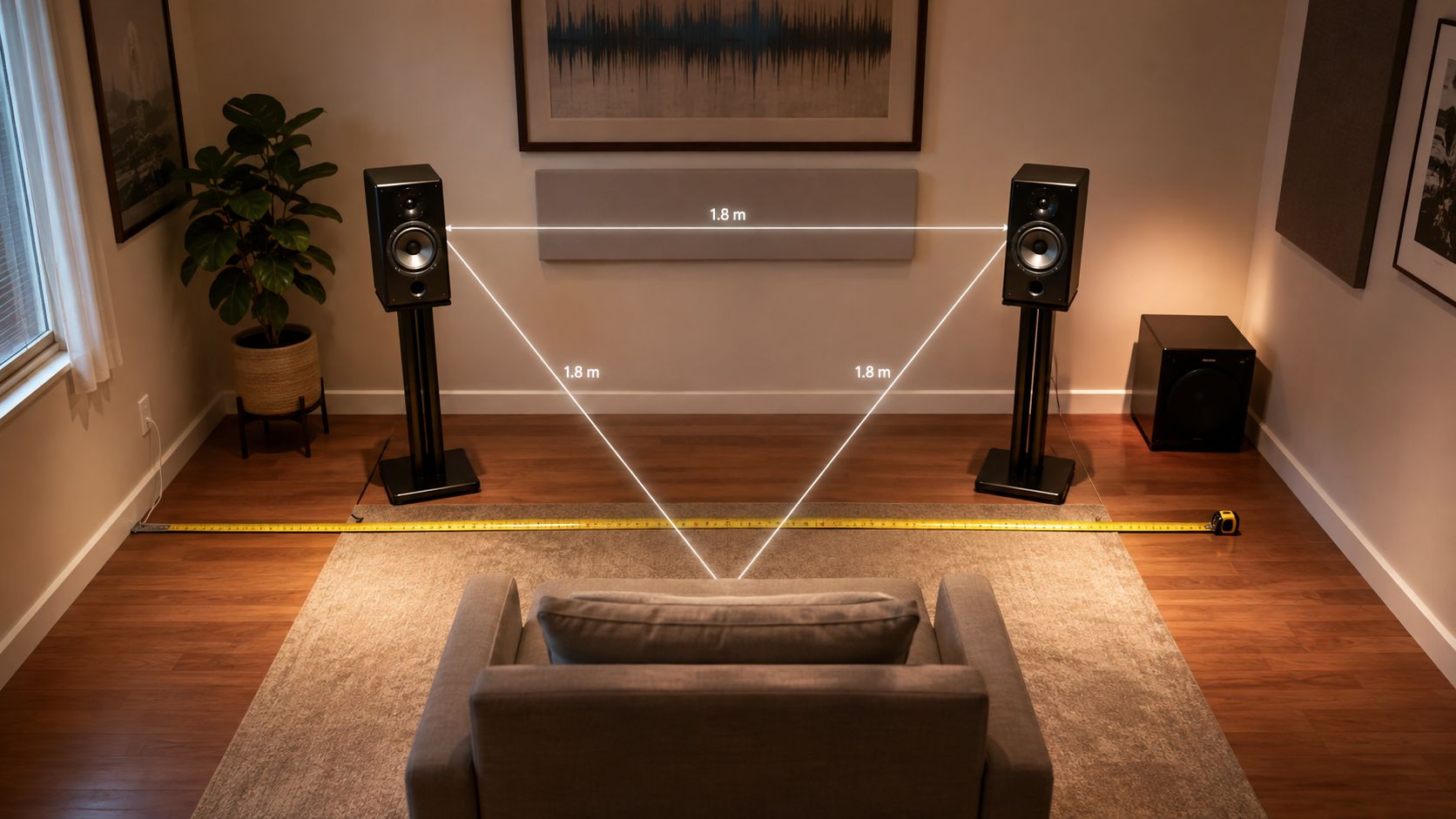
The equilateral triangle remains the right starting point, even in a cramped room. Place the left speaker, right speaker, and listening position so each side measures the same. That creates a 60-degree angle at each point, and it gives the stereo image a stable foundation rather than a vague left-right spread.
Begin with this sequence:
- Use the short wall. Aim the speakers down the room's longer dimension. This usually gives the sound more distance before it reaches the rear wall and leaves more freedom for the listening seat.
- Set the chair off the midpoint. Don't make the room's exact center your default listening position.
- Match the triangle. Measure from each speaker to the chair and match those distances as closely as the room permits.
- Raise the tweeters to ear height. A low couch can put your ears below the tweeter axis, while tall stands can push the drivers above it. Both alter tonal balance and image height.
- Add toe-in gradually. Aim the speakers toward the listener as a starting point. Direct aim corresponds to an inward angle of 30 degrees in the triangle geometry described by DALI, but the final setting depends on the speaker's dispersion and the room.
For room position, use the 38 percent rule as an anchor for the listening seat, measured from the front wall along the room length (listening-triangle reference). It isn't sacred. It keeps you from placing the chair in the most obvious modal traps.
Translating the rule into a real room
Take a 10-by-12-foot room. The 38 percent position along a 12-foot length is about 4.56 feet from the front wall, calculated from the cited rule. The 29 percent placement reference gives about 3.48 feet from the front wall in that same dimension and about 2.9 feet from each side wall in a 10-foot width.
Those positions won't always coexist with a couch, desk, doorway, or radiator. Use them as tape marks, not commandments. If the 38 percent chair position produces hollow bass, move the chair before you move both speakers. If the 29 percent speaker position gives you a sharp center image but too much low-end weight, decide whether treatment or a small retreat from the wall makes the better compromise.
The triangle is load-bearing. The exact wall distance isn't.
Boundary Gain Versus Spatial Precision by Speaker Type
Wall proximity isn't automatically a problem. It depends on what the speaker is designed to do and what the room is stealing from it. A small room often forces a choice between boundary gain, which adds weight and reinforcement, and spatial precision, which gives the image more air and separation.
Sealed speakers favor breathing room
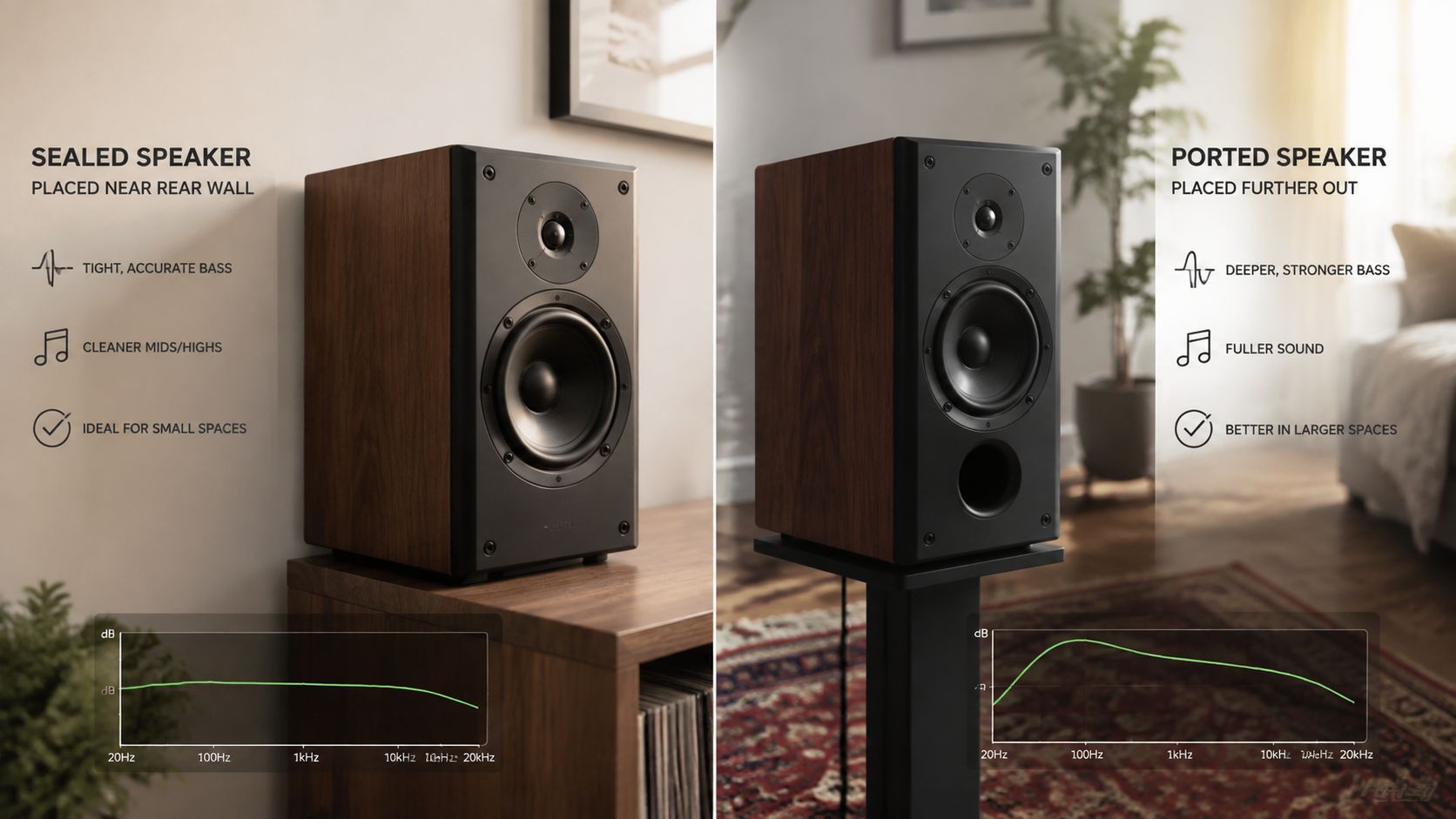
Sealed cabinets usually reward a little distance from the front wall. In my experience, they tend to sound cleaner when you give the midrange room to open up, especially when the room already adds plenty of low-end pressure. Pulling them forward can sharpen image edges, improve depth, and make vocals feel less pinned to the cabinets.
That doesn't mean you should drag them into the middle of the room. In a small living room, the gain in spatial precision can cost too much bass weight or leave the listening triangle too close to the speakers. The practical choice is often a modest move outward, followed by a lower toe-in angle if the sound becomes too narrow.
Ported designs can use the wall
Ported speakers often benefit from some boundary reinforcement. If the room makes them sound thin, bringing them closer to the front wall can fill out the bottom end and give kick drums more body. The danger comes when that added weight turns into a slow, one-note thump.
This is the central tradeoff:
- Near-wall placement adds bass weight but can reduce image specificity and increase muddiness.
- Farther placement improves spatial precision but can starve the lower register.
- Corner placement gives the strongest reinforcement and also the greatest risk of bass bloom.
A recent placement explainer presents the tension clearly, with small rooms sometimes working best when speakers sit close to the front wall, while another approach favors the opposite extreme to avoid boundary interference (geometry-driven placement discussion). The point isn't to pick a universal distance. Pick the side of the tradeoff your speaker needs.
For desktop and near-field monitors, close wall placement often anchors the soundstage and keeps the direct signal dominant. That behavior differs from a larger listening setup, which is why studio monitors and conventional speakers shouldn't receive identical placement advice.
Dipole designs create their own exceptions because they radiate differently into the room. Don't force a conventional bookshelf-speaker formula onto a dipole and then blame the room. The cabinet type decides which rule breaks first.
Subwoofer Placement and Integration Without Guessing
A subwoofer doesn't just add bass to a system. It joins the room's pressure pattern, and you hear the combined result. In a small room, the same sub can sound rich in one chair and almost empty a short distance away.
Start with the subwoofer crawl. Put the subwoofer at the listening seat, play a familiar bass-heavy track, and move around the available wall positions and corners. Listen for the spot where bass sounds fullest without turning into a single-note boom. Place the subwoofer there, then return to the chair.
Integration starts with level
Set the subwoofer's level low rather than impressive. Use a track you know well, and raise the level until the bass fills the mains without announcing itself as a separate box. If the bass sounds like it comes from the corner, you've gone too far or chosen a poor location.
Set the crossover at the lowest point where the main speakers still handle their range cleanly. A higher setting can make the sub easier to hear as a separate source, while a lower setting can leave a hole if the mains roll off too early. The exact control position depends on the speakers, the room, and the system's bass management.
The beginner's guide to subwoofers covers the broader role of the sub. In a small room, placement still comes first.
Phase comes before equalization
If the bass sounds thin around the crossover region, check phase before reaching for room correction. The sub and main speakers may be cancelling each other at the listening seat. Switch the phase control or adjust the phase setting while playing a familiar bass line, then keep the position that produces the strongest, cleanest handoff.
Corner loading isn't a sin. It can give a small sub the weight it needs, but it also excites the room more aggressively. Start near a wall or corner, then control the result with level, phase, and placement. Equalization can't repair a listening seat that sits in a deep null.
Crawl first. Tune second.
Room Modes Are a Chair Problem, Not a Speaker Problem
A room mode does not care how expensive the speaker is. It cares where the listener sits.
I learned that after spending an evening moving both speakers in tiny increments because a familiar record sounded hollow in the bass. The speakers were symmetrical, the tweeters were at the right height, and the center image stayed intact. The chair was the problem. It had landed in a cancellation zone, so every speaker adjustment only shifted the error elsewhere.
Peaks live where pressure builds
Modal pressure peaks form at walls and corners. A speaker or subwoofer placed in a corner can produce impressive bass, but that bass may turn muddy as the level rises. A chair pressed against the rear wall can receive excessive reinforcement. A seat near the room's middle can fall into a null. Boundary gain and spatial precision are competing outcomes, and the listening position often decides which one dominates.
You will not avoid every mode in a small room. Choose the seat that creates the least damage. Start near the previously cited 38 percent position, then move the chair forward or backward in small, repeatable increments while playing the same bass passage. Leave the speakers alone during this test. Change two variables and you lose the evidence.
The room does not need to be perfect. The chair needs to stop sitting in the worst place.
Choose the least-bad seat
If the couch cannot move, shift your head position first. Then test whether the whole seat can move slightly, even if that means accepting a less symmetrical triangle. A small change in distance from the rear wall can restore bass notes that disappeared, while the speaker positions remain unchanged.
The subwoofer crawl can identify a useful source position, but it cannot rescue a chair that sits in a null. The subwoofer and listening seat form one coupled system. More output may only make the surrounding room louder while the missing bass remains missing.
Move the seat before blaming the speakers. That rule breaks first when the furniture is fixed, so work with the smallest position change the room allows.
Cheap Acoustic Treatments That Buy Back What Placement Sacrifices
Placement sets the compromise. Treatment lets you keep more of what you wanted.
Start with the first reflections on the side walls and ceiling. Use a mirror to find the points where you can see each speaker from the listening position, then place broadband panels there. A couple of 2-inch panels at those mirror points can tighten the stereo image and reduce the glare that often appears when speakers sit close to side walls.
Treat the reflection you created
Moving a speaker closer to the wall for bass reinforcement changes the reflection pattern. You gain weight, but the early reflection can smear the image and make vocals lose their body. That's why the placement decision and the treatment decision belong together.
Behind the listening seat, use a thicker absorber or bass trap where possible. The rear wall often returns energy directly into the chair, which can make transients feel soft and bass notes hang around longer than they should. A thin decorative panel won't solve a low-frequency problem because it looks acoustic.
The front wall behind the speakers deserves attention too. Treatment there can reduce the boundary effect that muddies the lower midrange, though you shouldn't strip the wall bare and expect the system to retain the same tonal balance. The room still needs some reinforcement.
Spend treatment where the tradeoff happens
A useful working rule is simple: every foot closer to the wall for bass costs you a reflection that needs control somewhere else. That doesn't mean every speaker must sit far out. It means the wall move isn't free.
Prioritize the surfaces closest to the direct path:
- Side-wall reflections: Use broadband absorption to stabilize the center image.
- Ceiling reflection: Treat it if the speakers fire toward a low ceiling or the sound feels hard and flattened.
- Rear-wall bounce: Use thicker absorption behind the seat when the couch sits close to the wall.
- Front-wall energy: Add treatment when boundary reinforcement clouds the lower midrange.
Treatment isn't decoration. It buys back precision.
Calibration and Troubleshooting for Common Small-Room Failures
Placement gets you close. Calibration tells you which compromise you're hearing.
Level-match the speakers with a meter app, then enter accurate speaker distances into the receiver or processor. Run room correction as a starting point, not as a finishing touch. Correction can shape the remaining response, but it can't move a chair out of a null or repair an asymmetrical triangle.
Use one familiar track while you work. Change one thing at a time, and resist the urge to chase every tonal shift. The useful question isn't “does this sound more impressive?” It's “does the bass line stay intelligible, and does the center image remain fixed?”
| Symptom | Likely Cause | First Move |
|---|---|---|
| Hollow bass at the seat | The chair sits in a null | Move the seat forward or backward |
| Bloated bass that blurs the kick drum | Excessive boundary gain | Pull the speakers out or reduce room reinforcement |
| Smeared center image | Toe-in or triangle asymmetry | Recheck distances, then adjust toe-in |
| Wide but flat soundstage | Too much toe-in | Back off the inward angle |
| Bass that changes dramatically around the room | Seat and subwoofer are exciting different modes | Repeat the crawl and reassess the chair |
Fix the failure upstream
A frequency-response explanation can help you understand what the microphone or meter is showing, but the repair still starts with physical placement. Read what frequency response means in speakers if the graph looks unfamiliar, then use it as evidence rather than a verdict.
If the bass disappears, move the chair first. If the kick drum blooms, reduce boundary reinforcement before adding more equipment. If the image smears, restore symmetry before touching equalization.
Supermarket Sound publishes placement and speaker guidance alongside listening-focused gear coverage, but no page can calculate the one position your furniture, walls, and ears will prefer. You have to test it.
Measure. Listen to one track you trust. Change one thing. Repeat.
Stop moving expensive gear before you've tested the chair. Mark the current positions with tape, try the 38 percent starting point, establish the triangle, and run the subwoofer crawl this week. If you want more room-by-room audio guidance, visit Supermarket Sound and bring the results of your first rearrangement, not another shopping list.

