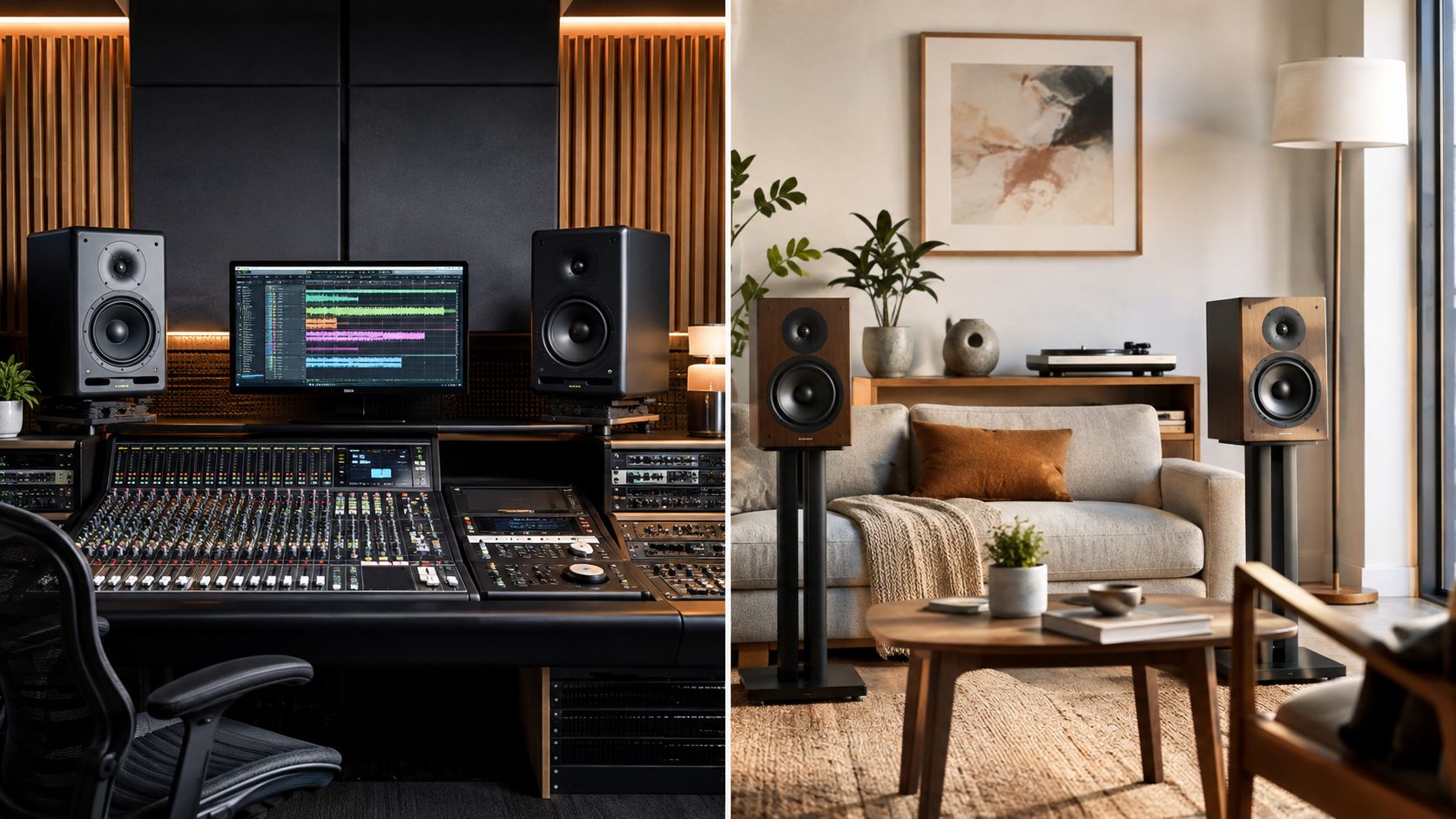
Studio monitors aren't “better speakers,” and anyone selling them that way is dodging the question. The box matters less than the room it sits in and the distance you listen from, because a monitor that's honest in theory can turn into a liar the moment you shove it against a wall and call that a setup.
That's the part most comparisons skip. Studio monitors vs speakers isn't a clean accuracy-versus-fun split, it's a placement problem first, a tone problem second, and a label problem last. Get the room wrong and both categories betray you. Get the room right and each one starts behaving like the tool it was built to be.
| Category | Studio Monitors | Home Speakers |
|---|---|---|
| Core job | Reveal mix flaws and keep playback neutral | Make music sound pleasing in a room |
| Typical listening distance | Nearfield, close to the listener | Broader room listening |
| Built-in amplification | Usually active, with built-in amps | Often passive, needs an external amp |
| Sonic bias | Flat, exposed, diagnostic | Warmer, fuller, more flattering |
| Best fit | Editing, mixing, desktop listening, critical work | Casual listening, room-filling playback, relaxed use |
Table of Contents
- The Studio Monitor vs Speaker Question Is Really a Room Question
- What Studio Monitors and Speakers Are Built to Do
- Sonic Character Side by Side in a Real Room
- Placement, Distance, and Why the Room Runs the Show
- The Backend Gear That Each Box Demands
- Use Cases That Decide The Real Winner
- Budget, Wattage, and a Sharp Decision Checklist
- The Label Matters Less Than You Think
The Studio Monitor vs Speaker Question Is Really a Room Question
The loudest bad advice in audio is that studio monitors are for accuracy and speakers are for enjoyment, as if the label alone decides the outcome. It doesn't. A monitor in the wrong room can sound thinner, harsher, and more confused than a good hi-fi speaker placed with a little care.
That's why I start with distance, not brand language. Nearfield listening usually happens a few feet from the boxes, and that close range changes what the room can do to the sound before your ears ever get the direct signal. A speaker built for relaxed room filling will behave differently, but it may still tell you the truth more cleanly if the room is small and the placement is sensible. The floor isn't the badge on the cabinet. The floor is the room.
Practical rule: if you can't place the speakers properly, the category debate is already half lost.
People get trapped by marketing. They buy “studio monitors” because the name sounds serious, then park them on a crowded desk in a tiny untreated bedroom and wonder why the bass is weird and the imaging won't lock. Or they buy warm hi-fi speakers for a mixing desk and wonder why their balances don't survive the car ride. The room answers first. The label answers last.
For a beginner-friendly starting point on the gear itself, I'd point people toward a practical studio monitor buying guide, but even that only matters after the room question is answered. Accuracy downstream inherits the space you give it.
What Studio Monitors and Speakers Are Built to Do
Studio monitors are built to reveal, not to flatter. They're meant for critical listening, where the point is to hear low-end smear, brittle vocal edge, a snare hiding behind a bass note, and the small balance mistakes that a sweeter speaker would smooth out. A good monitor sounds less like a celebration and more like a diagnostic tool, bright enough to show the stains.
Consumer speakers live on the other side of that fence. They're tuned for pleasure, which usually means more bass weight, a little extra sheen up top, and a presentation that makes recordings feel finished even when they aren't. That can be great for music. It's also exactly why they make a poor ruler for mix decisions.
The Mechanical Difference Behind The Sound
The construction supports the intention. Monitors are commonly active, with built-in amplification and internal crossovers, while home speakers are often passive and depend on an external amplifier. That active design gives monitors tighter control over the drivers and a cleaner signal path for short-range work. It's one reason they became the reference tool in studios, radio rooms, and post-production spaces in the first place.
The sound follows the hardware design. A monitor tends to throw detail at you, sometimes in a way that feels unforgiving until your ear adapts. A home speaker tends to spread sound across the room with more ease, more body, and more mood. One is less interesting than the mix on purpose. The other is often more interesting than the recording on purpose.
Monitors are supposed to be honest enough to annoy you.
If you're new to the category and want the plain-language version of the split, the difference between studio monitors and regular speakers comes down to that design intent. Not prestige. Not mythology. Use.
Sonic Character Side by Side in a Real Room
Take the same track, a dense one with a kick drum, a vocal that leans sibilant, and a bass line that wants to step on the snare. On a nearfield monitor pair, the kick's shape shows up fast, including the part that's muddying the low end. The vocal spits a little more than you wanted. The bass note that looked fine on paper suddenly crowds the snare.
On a decent pair of home speakers, the picture changes. The kick sounds rounder, the vocal softens, and the track feels more assembled, more like something you'd sit with for an hour. That doesn't mean the speaker is lying in a malicious way. It means it's doing what it was built to do, which is make playback pleasant rather than diagnostic.
What The Numbers Mean In Practice
Technical targets reflect that split. Monitors are commonly aimed at a flat, neutral response, with one guide describing a monitor target around 20 Hz–20 kHz ±3 dB. Consumer speakers are more often voiced with a deliberate curve, usually a little bass lift and treble lift, the classic smiley-shape tuning. That's why a monitor sounds like a flashlight, and a speaker sounds like a lens with a bit of polish on it.
Typical monitor playback is also described more broadly, in one guide, as ranging roughly from 20 Hz to 50 kHz depending on the model, while regular speakers are generally framed around the human-audible 20 Hz to 20 kHz span. The practical point isn't bragging rights at the top end. It's that the monitor is built to keep the signal plain enough for decision-making.
| Behavior | Studio Monitors | Home Speakers |
|---|---|---|
| Bass | Exposes masking and buildup | Often adds weight and warmth |
| Vocals | Reveals sibilance and grit | Smooths rough edges |
| Imaging | Pinpoint and conditional on placement | Wider and more forgiving |
| Mix translation | Built to expose problems | Built to make playback enjoyable |
If you want a broad technical comparison of the voicing split, this overview of studio monitors versus speakers lands the same core idea. The monitor tells on the mix. The speaker forgives it.
Placement, Distance, and Why the Room Runs the Show
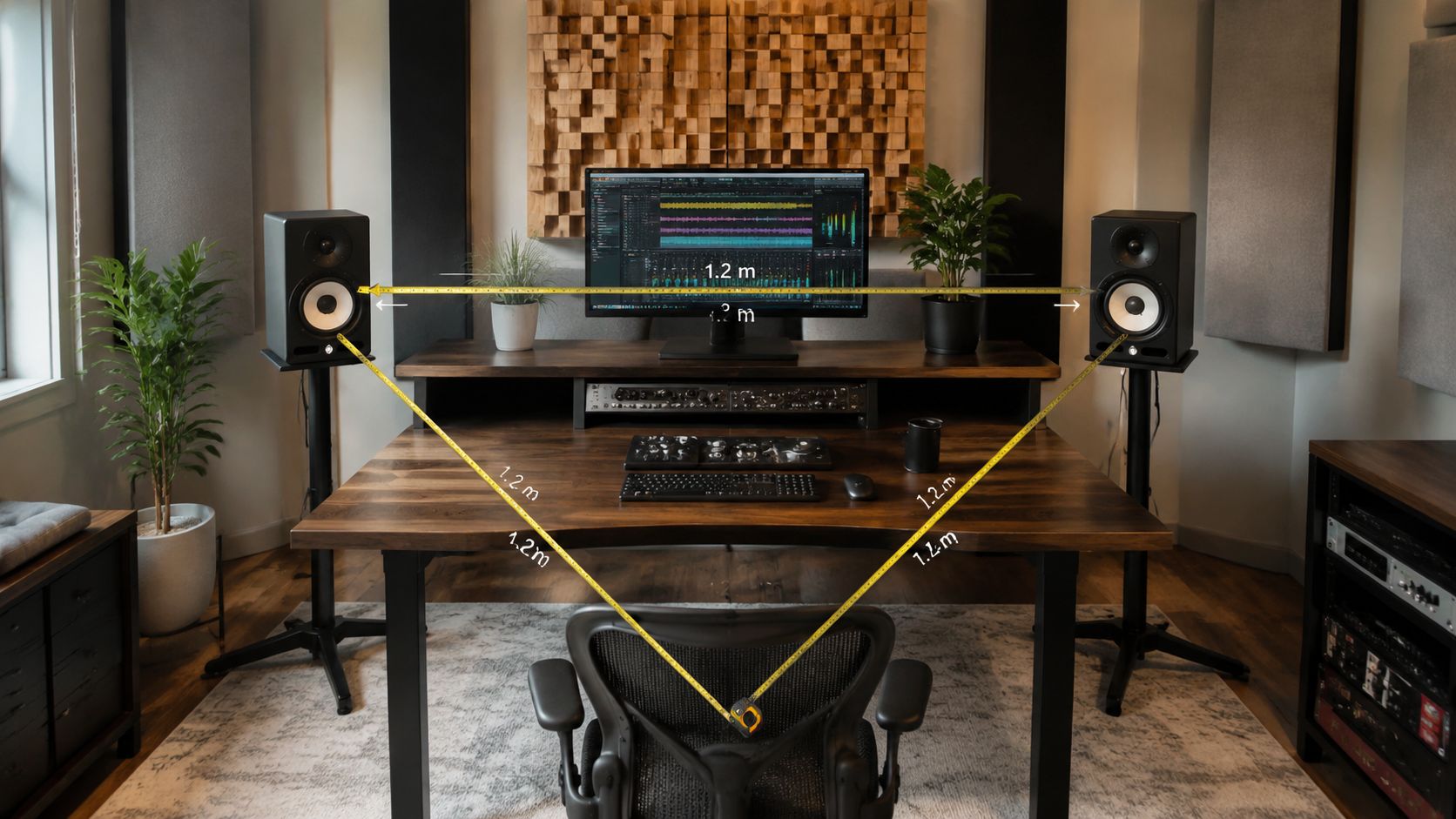
Nearfield listening starts with geometry, not taste. The usual setup puts you roughly 3 to 8 feet from the monitors, with the tweeters at ear height and the speakers and your head forming an equilateral triangle. That keeps the direct sound dominant, and that direct path is the part you can trust most.
Once that triangle falls apart, the room takes over. A desk surface throws reflections back at you, a wall behind the monitors piles up bass, and a corner can make a modest speaker sound bigger and less precise than it really is. Imaging does not just get a little fuzzy, it smears, and when that happens the center image stops holding its shape.
A well-placed consumer speaker in a small untreated room can be less misleading than a technically accurate monitor shoved into a bad position. That is not a case for using a colored speaker to mix on. It is a reminder that placement decides what reaches your ears before the label on the box does.
A few practical rules hold up in real rooms:
- Keep the listening distance short: Monitors are built for close work, so do not force them to cover the room like floorstanders.
- Match left and right placement: Asymmetry makes the stereo picture wobble before the music starts.
- Respect the wall behind the desk: Bass reinforcement there is real, and it is not subtle.
- Get the tweeters near ear height: Off-axis listening changes tone faster than most buyers expect.
If you want a clearer look at the room side of the equation, speaker placement for better bass covers the part that people usually ignore until the low end turns muddy.
There is a reason setup guides keep coming back to walls, desks, and corners. The room is not background scenery. It is part of the system.
The Backend Gear That Each Box Demands
Active monitors simplify the chain. You plug them in, feed them a signal, and the amplification is already inside the cabinet. That changes how the system behaves day to day, because the amp, crossover, and often the protection limiting are designed to work together. In practice, that means the box is built to stay controlled and clean at the listening distance monitors expect.
Passive speakers ask for more gear and more decisions. They need an amplifier, often a DAC, and sometimes a little trial and error before the chain feels right. That can be a good path if you already own an amplifier you trust, because the amp becomes part of the sound. It can also turn into a money sink if you are starting from zero. The passive route looks simple on the shelf and gets complicated at the checkout.
What The Wattage Tells You
A practical starting rule: 50 to 75 watts per channel is enough for a small-to-medium room. That is the right way to read wattage, as room fit and headroom, not as bragging rights. More watts do not automatically mean better sound, especially if the placement is wrong or the speakers are too large for the space.
The powered-monitor side shows how this category is usually built. The Focal Shape 65 with 40 Hz to 35 kHz and 105 W, the JBL 305P MkII with 49 Hz to 20 kHz and 80 W, and the KRK Rokit RP5 G5 with 45 Hz to 36 kHz and 145 W all live in the powered-monitor world, where the amplification is built in and the short-range use case is assumed. Those specs do not make one box morally superior. They show how the category is engineered around desk distance and direct sound.
The passive side has a different kind of burden. Once you add an amplifier, the signal path gets longer, and the quality of that amp matters in a way many buyers underestimate. A solid Class D amplifier can make the passive route easier to live with, especially when you want efficient power without a hot, bulky box, and this Class D amplifier guide gets into why that topology can sound better than its reputation suggests. I have also seen plenty of people overbuild the chain when they do not need to. If your goal is one box and one cable per side, active monitors make sense. If your goal is to keep a beloved amplifier in the loop and fill a room with a more relaxed voicing, passive speakers are the obvious move. If you want a category name for the one-box path, active monitors are the cleaner ownership model. If you want a living-room chain that can be tuned by taste, passive speakers keep more of the system open.
The only rule that survives contact with reality is this. Match the box to the chain you want to own.
Use Cases That Decide The Real Winner
Mixing and mastering belong to monitors. That's not a preference, it's a job description. You need to hear the flaw, the imbalance, the brittle top, the low-end collision, and the monitor's neutrality is what lets those problems stay visible. A flattering speaker starves the signal of the information you're trying to recover.
Desktop Work Needs A Different Kind Of Truth
For competitive gaming, nearfield monitors can be a strong fit because they keep positional detail close and direct. You're not trying to bathe the room in sound. You're trying to hear movement, timing, and separation without room bloom getting in the way.
For casual living-room listening, movies, and background music, home speakers usually make more sense. They're built to sound good from more of the room, not just from one sweet spot. That wider voicing matters when people are moving around, talking, eating, and not sitting in a triangle with their nose pointed at the tweeters.
If the room is social, a monitor can feel too revealing for comfort.
There's a useful middle ground too. A modern home setup can use active monitors as a desk system for music, gaming, and focused listening, especially when the placement is tight and the listener stays close. That's where a boutique option like Supermarket Sound's own monitor-focused guides can be useful for readers who want a less fussy desktop chain. I'm not pretending that makes monitors a universal home-audio answer. It just means the old “studio only” box is looser than people think.
The core difference lies in intent. If the goal is to fix or judge sound, use monitors. If the goal is to enjoy sound across a room, use speakers. Different job. Different truth.
Budget, Wattage, and a Sharp Decision Checklist
The money question is easier than the forum chatter makes it sound. A usable starter monitor budget usually lands around $200 to $400, while professional models often climb past $1,000 per monitor. With passive speakers, the speaker price is only part of the bill, because the amplifier and often the DAC still have to be paid for, and that pushes the cost up fast.
That is why active monitors often look like the cleaner value for a desk or small production room. You are buying a self-contained system with fewer moving parts, fewer unknowns, and less money tied up in extras that do not change the sound in your room. If the room is modest and the listening distance is short, that simplicity matters more than glossy brochure language.
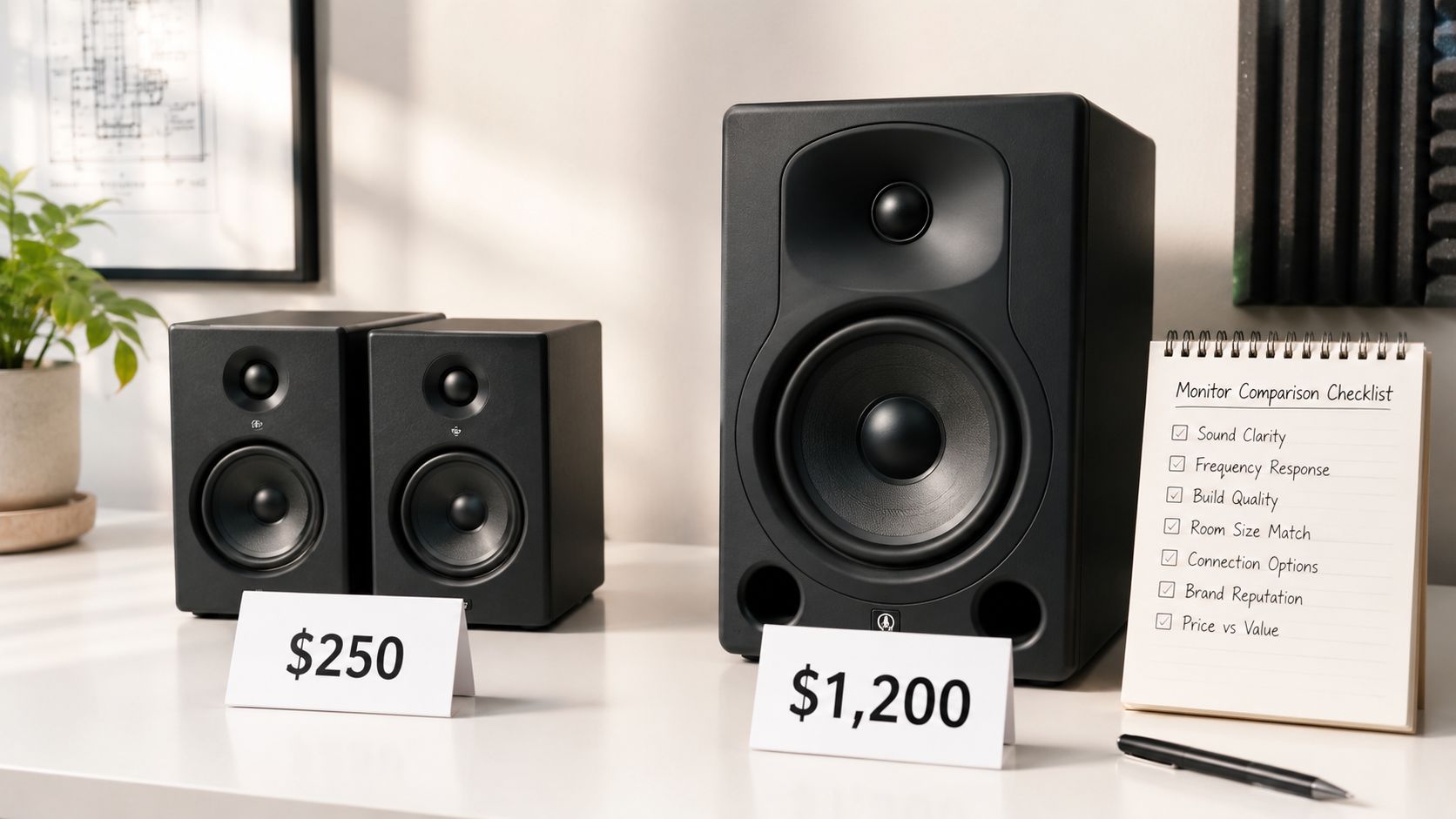
Use this checklist when the choice gets muddy:
- Pick monitors if you mix or edit regularly: Accuracy matters more than warmth when you are making decisions.
- Pick monitors if you sit close: Nearfield use is where they behave most predictably.
- Pick passive hi-fi speakers if you already own a strong amplifier: Do not buy a second chain just to rebuild the same job.
- Pick passive speakers if you listen from across the room: They are built for a broader, more relaxed field.
- Pick active monitors for a simple home setup: Self-contained systems are easier to place, power, and live with.
One more practical threshold helps. A practical starting rule from one industry guide says 50 to 75 watts per channel is enough for a small-to-medium room, so do not let inflated wattage numbers push you toward the wrong box. Wattage only tells part of the story anyway. Sensitivity, room size, listening distance, and how hard you plan to drive the system all matter. The room gets a vote. It always does.
The Label Matters Less Than You Think
The line between studio monitors and home speakers has gotten thinner in practice than the old category war suggests. Modern monitors now come with room-positioning flexibility, boundary EQ options, and practical guidance for wall distance, which makes them far easier to live with outside a studio than they used to be. Plenty of home speakers are also measured and voiced well enough that the tired slogan, one is accurate and one is fun, misses what happens in a room.
That's the trap. People buy the word monitor because it sounds professional, then place the speakers badly and blame the box. Or they buy hi-fi speakers because they want warmth, then try to use them as a truth machine and wonder why mixes do not translate. The mistake is usually not the category. It is the mismatch between category, room, and intent.
Pick By Placement First
If you are sitting at a desk a few feet away, active monitors are often the most sensible answer. If you are listening from the couch, across a room, passive speakers often make more sense. If you already know your amp and want the system to feel like a room-filling object, lean passive. If you want one self-contained pair that can do desktop listening cleanly, lean active.
The split is intent. A pair meant to help you judge edits and balance tracks should behave one way. A pair meant to fill a room with music should behave another. Both can sound excellent, but they do not succeed by the same standard, and they do not forgive the same mistakes.
That is the whole game. The marketing word matters less than the distance, the room, and what you expect the box to do.
The smartest buyers stop asking which label sounds more serious and start asking which box will work where they live. That's the only decision that survives the first playback.

