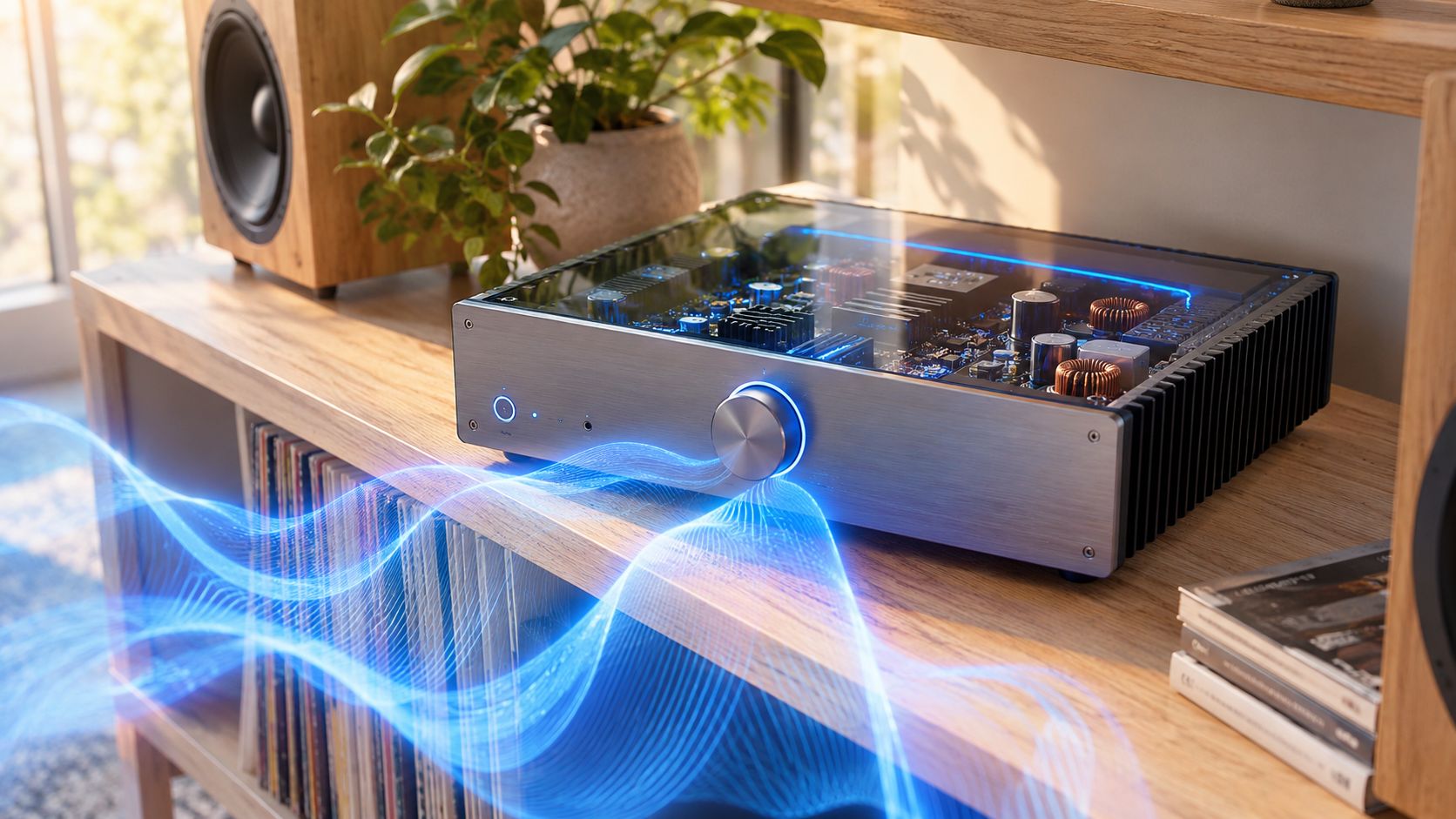
Cold was never the truth about Class D. Cold was the sound of early switching amps getting caught by their own mistakes, and modern designs have mostly fixed those mistakes with cleaner modulation, better filtering, and distortion figures that now sit below 0.001% THD+N in serious implementations, which is exactly why the old stereotype deserves to be retired (modern TMDS and filtering context).
To my ears, the story of Class D amplifier sound quality isn't that it lacks warmth. It's that it stops flattering the chain. If your DAC is brittle, you'll hear brittle. If your speakers are voiced well, you'll hear that too. Not romance, but honesty. For people who listen instead of worshiping old forum folklore, that's the point.
Table of Contents
- Class D Doesn't Sound 'Digital' It Sounds Like Your Signal
- The Ghost in the Machine Why Class D Got a Bad Rap
- Efficiency Isn't a Spec Sheet It's the Sound
- What Separates Good Class D from Great Class D
- How to Listen for Honest Amplification
- The Verdict Your Room and Your Ears Decide
Class D Doesn't Sound 'Digital' It Sounds Like Your Signal
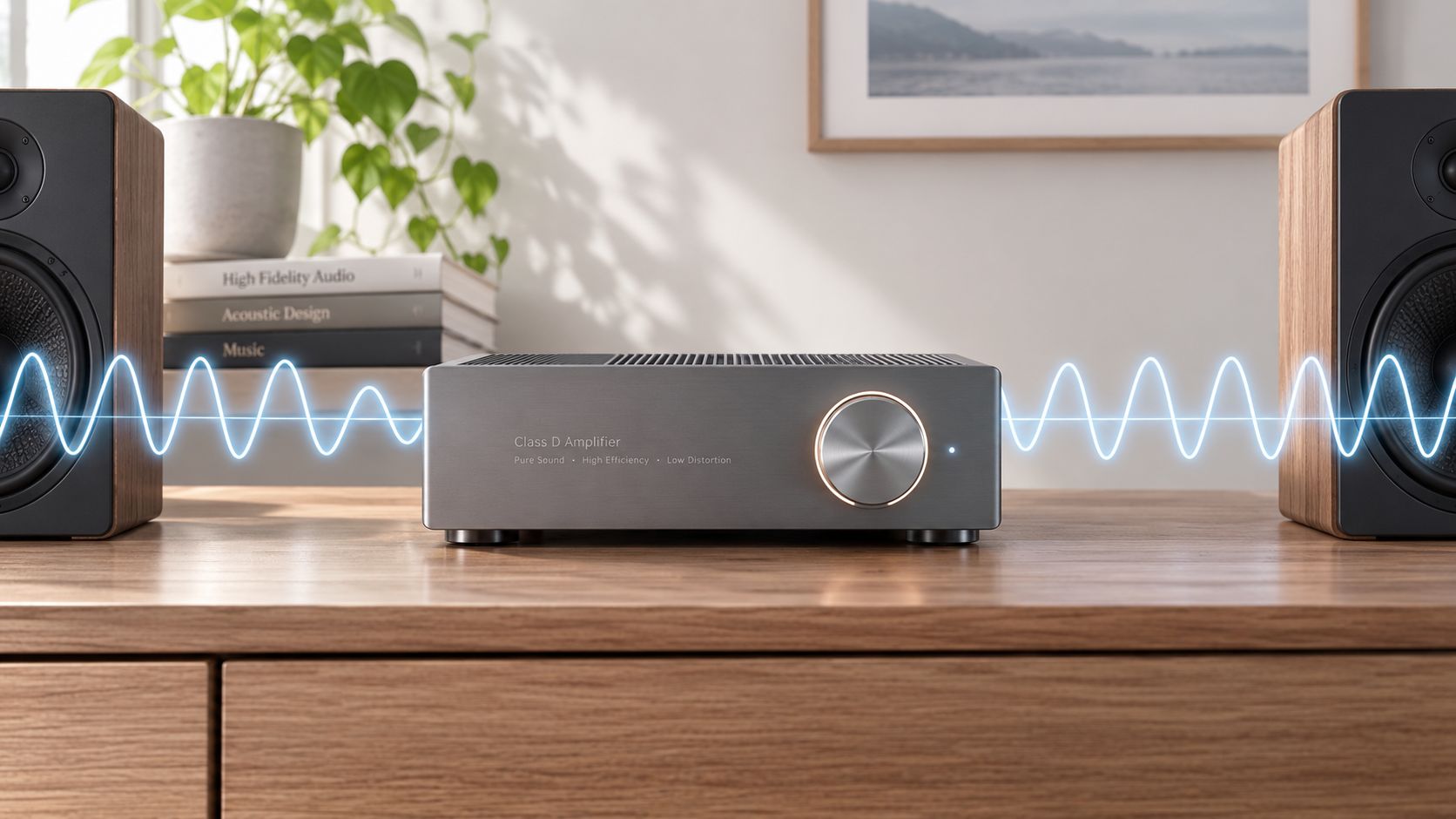
Modern Class D does not sound digital. It sounds honest. That difference matters, because a lot of listeners were trained to mistake added sweetness, softened edges, and a little harmonic blur for musicality.
The Sterile Myth Came From Bad Behavior, Not the Letter D
The term "digital sounding" stuck because a lot of older switching amps had real problems. They sounded etched, flat, and slightly mechanical. Listeners heard those flaws and blamed the whole category. That was bad engineering, not some built-in penalty for the letter D.
Current Class D done right gets out of the way. It does not glaze over the midrange or puff up the bass to seem richer than it is. It passes the signal with less editorializing, which is why people coming from older Class A audio amplifier designs sometimes hear it as less romantic at first. Fine. Romance is not the same as accuracy.
I hear this most clearly in vocals and bass lines.
A strong Class D amp keeps a voice centered and exposed, with breath, chest tone, and microphone texture intact. Bass notes start and stop cleanly instead of smearing into a warm blanket. Cymbals sound like metal in air, not like treble effects added for excitement. That is not sterile sound. That is lower haze.
Practical rule: If an amp sounds clean because detail vanished, something is wrong. If it sounds clean because fuzz and bloom stopped riding on every note, the design is doing its job.
Honesty Can Sound Unforgiving
This is why some people still recoil from good Class D. Honest amplification shifts the pressure onto the recording, the speakers, and the room. A bright tweeter stays bright. A thin source stays thin. A bad mix gets nowhere to hide.
That can be uncomfortable if you are used to an amplifier flattering everything it touches. Plenty of classic Class AB designs did exactly that, and many listeners learned to call that warmth. I call it seasoning. Sometimes pleasant. Rarely truthful.
At its best, Class D amplifier sound quality is about restraint and control. You hear more of the source, more of the recording choices, and more of your system's real character. That is the whole point.
The Ghost in the Machine Why Class D Got a Bad Rap
Class D earned its bad reputation the old-fashioned way. Some of it really did sound rough. Thin center image, papery treble, bass that hit hard but didn't quite bloom into believable body. I remember hearing early units that felt more like electrical demonstrations than music systems.
Early Class D Exposed Its Own Flaws
That history matters because a lot of current arguments are really stale memories dressed up as principles. People heard an early switching amp, didn't like the grain or the flatness, and turned that into a permanent theology. Meanwhile the engineering kept moving.
There's a reason those complaints became clichés. Class-D amplifiers are often described as cool, sterile, analytical, with a shallow soundstage and fast decay, and some listeners still call them "not musical," even while admitting they work well for electronic music and home theater because of their clean sound and punchy bass (audiophile discussion of the stereotype).
If you love older linear designs, I get it. I also understand why some listeners still gravitate toward the bloom and harmonic softening you often get from Class A audio amplifiers. But that preference isn't the same thing as a universal truth about fidelity.
Some Of The Criticism Was Fair
Early Class D often sounded bad for concrete reasons.
- The top end got edgy: Poor control of switching residue made treble feel etched instead of airy.
- The soundstage flattened: Weak output filters and speaker interaction could make space collapse inward.
- The bass cheated: It was punchy, yes, but sometimes one-note punchy, more impact than texture.
The old complaints weren't imaginary. They were just over-generalized.
That's the distinction too many spec-sheet debates miss. The problem wasn't that switching as a concept was doomed. The problem was that immature implementations were brutally revealing of their own weaknesses. Once the supporting design improved, the supposed "Class D sound" started disappearing.
And good riddance.
Efficiency Isn't a Spec Sheet It's the Sound
The dumbest way to talk about Class D is as if efficiency were just about your electric bill. In audio, efficiency is not a side benefit. It's load-bearing. It changes what happens to the signal when the amplifier is asked to work.
Switching Doesn't Mean Digital
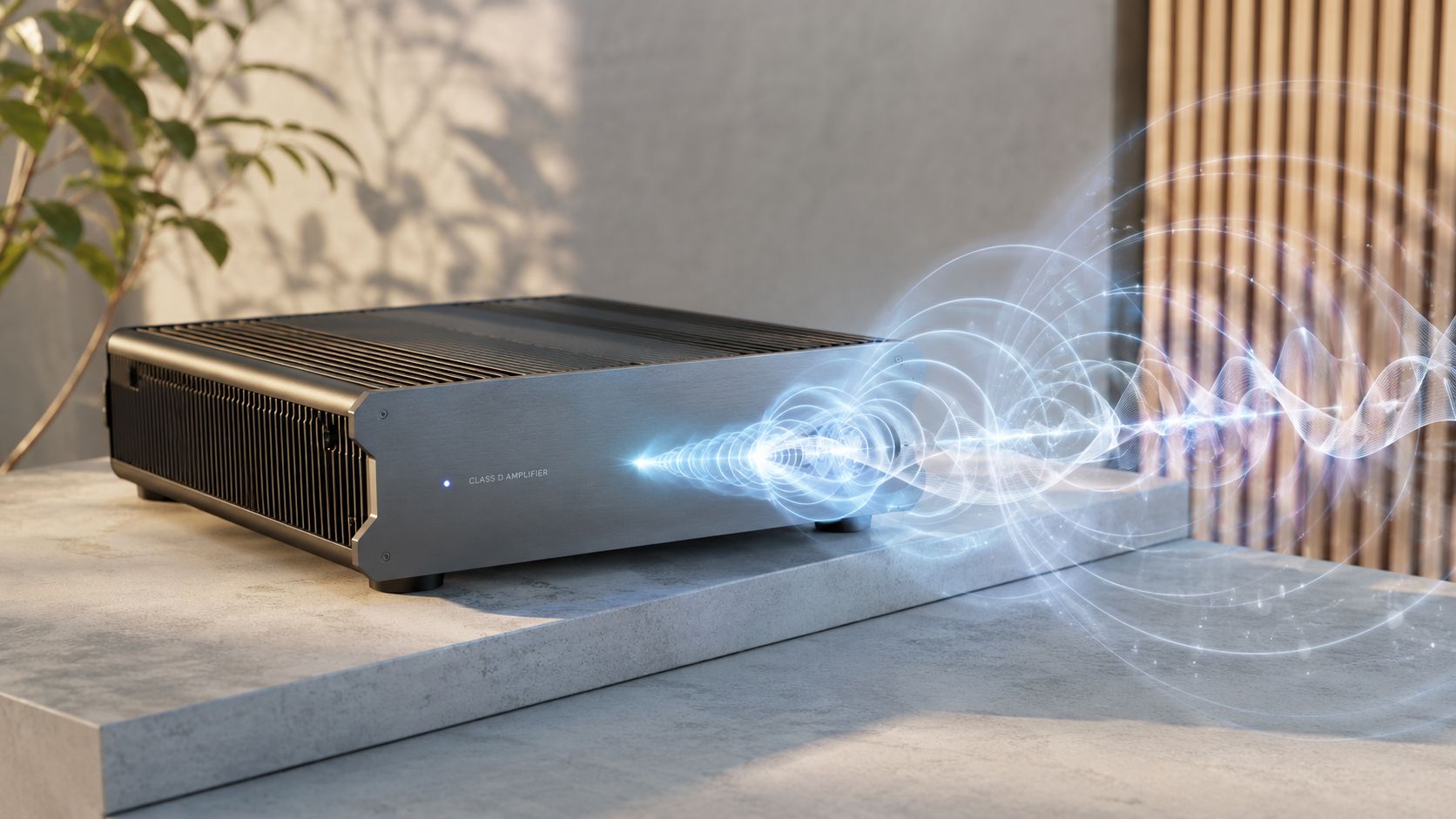
A Class D amplifier operates by switching its output devices on and off rather than asking them to sit in the middle and behave like a space heater with aspirations. That's the whole trick. The signal is represented through pulse-width modulation, then reconstructed after the output stage. Not fake. Not compromised. Just a different way of doing the job.
If you're new to amplifier basics, my beginner's guide to amplifiers covers the broad scope. For this conversation, the key point is simple. A switching output stage avoids the same kind of constant waste that makes traditional linear designs run hot and wander under strain.
Heat Is The Distortion Factory
This is the part old-school romanticism keeps trying to dodge. Class D amplifiers deliver roughly 75% real operating efficiency, while Class AB tops out at a 20% efficiency ceiling in the cited comparison, and that gap matters because less energy dumped as heat means less thermal distortion and better signal integrity under load (real operating efficiency comparison).
That isn't trivia. That's the floor the sound stands on.
When an amplifier runs cooler, its output devices don't drift as hard when the session goes long or the volume goes up. The amp doesn't spend the night cooking itself into a different personality. Downstream, your speakers inherit a steadier signal. Dynamics stay cleaner. Bass stays composed. The top end keeps its shape instead of turning chalky.
| What People Assume | What's Actually Happening |
|---|---|
| Efficiency is about saving power | Efficiency reduces heat that can contaminate performance |
| Warmth means musicality | Warmth is often coloration, sometimes flattering, sometimes not |
| Clean means thin | Clean often means the amplifier stopped adding smear |
Listening shortcut: If the amp gets out of the way during dense passages, that's usually better engineering, not less emotion.
To my ears, Class D amplifier sound quality reveals its persuasive qualities. It doesn't sound "fast" because it's hyped. It sounds composed because the circuit isn't wasting energy in the least useful place possible. Lower heat. Lower distortion. Less self-inflicted damage.
That's not anti-musical. It's anti-nonsense.
What Separates Good Class D from Great Class D
Saying "I like Class D" is like saying you like kitchens. Fine. But who built it, how it's wired, and whether the plumbing leaks matters more than the room name. Topology sets the direction. Implementation decides whether the thing sings or spits.
Layout Is Load Bearing
The most underappreciated truth in this category is brutally unglamorous. The primary cause of poor Class-D sound quality is not the topology itself but the PCB layout, because bad trace routing and weak component placement can inject noise and distortion before the output stage ever gets a chance to behave (PCB layout and distortion in Class D).
That squares perfectly with what I've heard. Cheap or careless builds often have a weird nervousness to them. Not always obvious hiss. More like the image never quite locks, transients have a brittle spray around them, and complex passages feel electrically busy.
If you're shopping higher up the ladder, this is why I keep telling people to read beyond the module badge and spend time with actual engineering discussion around high-end Class D amplifiers. The box around the amplification stage matters.
The Filter And Power Supply Decide Whether It Breathes
The output filter is not decoration. In a Class D design, that filter removes the sharp edges of the switching pulses and reconstructs a smooth audio waveform. If it's handled lazily, the amp can sound either blunt or hashy. If it's done well, the presentation gains shape, body, and ease.
Then there's the power supply. A strong module fed by a weak supply can still sound starved. You'll hear it when the music gets crowded. Kick drums lose authority. Large crescendos flatten instead of opening up. The whole thing feels like it shrank a size.
Here are the three things I care about most when I'm judging whether a Class D amp is merely competent or excellent:
- Board discipline: Quiet layout, sensible grounding, and careful part placement keep the circuit from sabotaging itself.
- Filter quality: The output stage needs a well-executed low-pass filter and feedback scheme so the reconstructed waveform stays believable into real speakers.
- Power reserve: The amp has to stay relaxed when the music asks for current fast.
Great Class D doesn't sound impressive in the showroom sense. It sounds unforced.
That's the tell. Not fireworks. Poise.
How to Listen for Honest Amplification
Many still judge amplifiers with a vocabulary that does them no favors. Warm. Cold. Musical. Clinical. Fine for forum arguments, useless in the chair. If you want to judge Class D amplifier sound quality properly, listen for control, space, and what happens when the mix gets busy.

Listen For Grip, Not Hype
Start with bass. Not quantity. Not showroom slam. Listen for whether the amp grips the woofer and lets individual notes start and stop cleanly. Good Class D often shines here. You get shape inside the bass line, not just pressure. Electric bass sounds fingered, not inflated. A kick drum has a leading edge and a skin behind it.
Modern audiophile-grade designs now reach below 0.001% THD+N across 20Hz to 20kHz and post SINAD above 120dB, which helps explain why the best examples sound transparent instead of merely forceful (measured Class D performance). Measurements aren't the music, but they do confirm that the old "good for subs only" sneer no longer holds much water.
Treble Should Open Up, Not Spray At You
The top end is where bad Class D used to betray itself. A hi-hat could sound like compressed foil. Strings could get silvery in the wrong way. A good modern design doesn't do that. It gives you air without glare.
Use simple cues:
- Cymbals should decay naturally: You want shimmer with shape, not a white-noise halo.
- Vocals should stay intact at volume: Sibilants shouldn't sharpen into little needles.
- Reverb tails should remain visible: Space should extend behind the speaker plane instead of snapping shut.
If treble detail arrives as irritation, you're not hearing resolution. You're hearing a problem.
A useful demo is worth watching before you audition your own system:
Dynamics Tell On The Whole Design
This is the part many quick auditions miss. A proper test isn't a sparse vocal track at polite volume. It's what happens when the arrangement gets dense and the system has to keep multiple lines sorted without sounding stressed.
To my ears, honest amplification sounds effortless on attacks. Snare hits crack without turning hard. Piano has weight at the front of the note and wood behind it. Big horn swells don't smear into a wall.
Try this listening sequence:
- Start quiet: Check whether low-level detail still feels alive.
- Push the level up: Listen for tonal drift. The amp should get louder, not harsher.
- Use dense material: Complex passages reveal whether the stage holds together.
- End with voices: Human voice exposes glare faster than almost anything else.
When Class D is done right, it doesn't wow you by sounding obviously "Class D." It disappears. That's the whole win.
The Verdict Your Room and Your Ears Decide
At this point, buying a Class AB amp for "warmth" often means buying distortion you happen to like. Fine. Enjoy it if you want. Just stop calling it more truthful.
That old argument has survived on nostalgia for gear that flatterered the signal in pleasant ways. Modern Class D cuts through that romance. Done properly, it does not strip the life out of music. It strips the extra seasoning out of the chain, which is a very different thing.
That honesty changes the whole buying decision.
If your speakers are bright, a clean Class D amp will show you. If your room is splashy and reflective, it will show you that too. If your front end is sorted and your speakers are balanced, modern Class D rewards you with exactly what people keep claiming it cannot do: body, tone, scale, punch, and long-term listenability without the syrup.
Efficiency is the reason. Less wasted energy and less heat are not just engineering trivia. They support control, consistency, and composure. The amp stays cleaner when the music gets demanding, and your system sounds more like itself instead of more like the amplifier.
So buy with your ears, in your room, with your speakers. Stop shopping by amplifier class like it predicts the result on its own. A good design beats a comforting stereotype every time.
Use a short reality check before you decide:
- Listen at your normal volume: You live there, not at demo-room extremes.
- Use recordings you know well: Familiar voices and instruments expose added color fast.
- Pay attention to tonal honesty: Richness is welcome. Added haze is not.
- Check control in the bass: Tight, even low end tells you a lot about the whole design.
- Notice what happens over an hour: The right amp keeps you engaged without coating everything in fake sweetness.
My verdict is simple. Choose the amplifier that preserves the signal, keeps its grip when the mix gets busy, and does not ask to be admired for having a personality of its own.
That is honest hi-fi.
Author: Marque Hersh
Publisher: Supermarket Sound
Author profile / sameAs: Marque Hersh on Steam
If you read Supermarket Sound regularly, you already know I care less about romance copy than repeatable listening. That's the whole job.

