Most audiophiles are arguing about the wrong thing. The raw Class D circuit isn't the sound. The implementation is the sound, and the evidence is sitting in plain view: modern top-tier designs deliver vanishingly low noise and distortion, dead-flat response, and load independence that kills the old “cold and clinical” stereotype, which is why the familiar Class A versus Class D cage match now feels like nostalgia masquerading as wisdom, as noted in this discussion of the cold-sound myth and load independence.
I was skeptical for years. Fairly skeptical, too. Early switching amps earned their reputation. But if you're searching for a class d amplifier high end answer now, you're not really asking whether switching can sound good. You're asking whether the best modern examples belong in serious systems. They do. More than that, some of them make the old heat-soaked heavy-metal religion look sentimental.
Table of Contents
- The Best Amps Are Now "Digital" and We Need to Get Over It
- So What Makes an Amplifier "Class D" Anyway
- Why Early Class D Sounded Like a Fax Machine
- The Anatomy of a Truly High-End Class D Amp
- Listening Notes from the Danish, Dutch, and American Schools
- How to Properly Audition a Class D Amplifier
- Your Next Upgrade Is Probably Class D
The Best Amps Are Now "Digital" and We Need to Get Over It
Let me be blunt. “Class D sound” is mostly a lazy phrase people use when they haven't separated cheap execution from great execution.
That matters because a class d amplifier high end design isn't a novelty anymore. It's not a compromise amp for people who care about watts, space, or electric bills. It's a serious listening tool. Not an apology for efficiency, but a better way to keep the signal intact when the speaker starts asking hard questions.
Good Design Beat Topology Tribalism
Audiophiles love categories because categories save us from listening carefully. Class A is pure. Class AB is musical. Class D is cold. Nice story. The problem is that stories aren't load-bearing.
What decides whether an amp sounds expensive is boring to people who shop by myth. The power supply has to stay stiff. The output filter has to behave with real speakers, not just easy loads. The feedback loop has to clean up errors instead of smearing them downstream. Get those right and the result doesn't sound “digital.” It sounds sorted.
The useful debate isn't Class A versus Class D. It's competent engineering versus shortcuts.
I know why people search this topic. SEO isn't a crime, and skepticism is healthy. Most readers arriving here want permission to trust their ears after years of hearing that switching amps are for convenience systems and subwoofers. I'm giving you more than permission. I'm telling you the hierarchy changed.
Real Rooms Favor Stability
A great amplifier doesn't win because it flatters itself on a bench. It wins because it stays composed in a room, with your speakers, at real playback levels. That's where many modern Class D designs pull ahead. They don't romanticize stress. They avoid it.
The old “warmth” argument often confuses coloration with grace. Some listeners love that. Fine. Keep it if that's your religion. But if you want grip, silence, and dynamic ease without a chassis that doubles as a space heater, the best switching amps have already taken the seat at the head of the table.
That's the thesis. Implementation is everything.
So What Makes an Amplifier "Class D" Anyway
People call these amps “digital,” and that shorthand has done more damage than the circuitry ever did. Class D is not digital in the way people mean when they imagine bits, glare, and sterile edges. It's a switching amplifier.
It Is Not Digital in the Way People Mean It
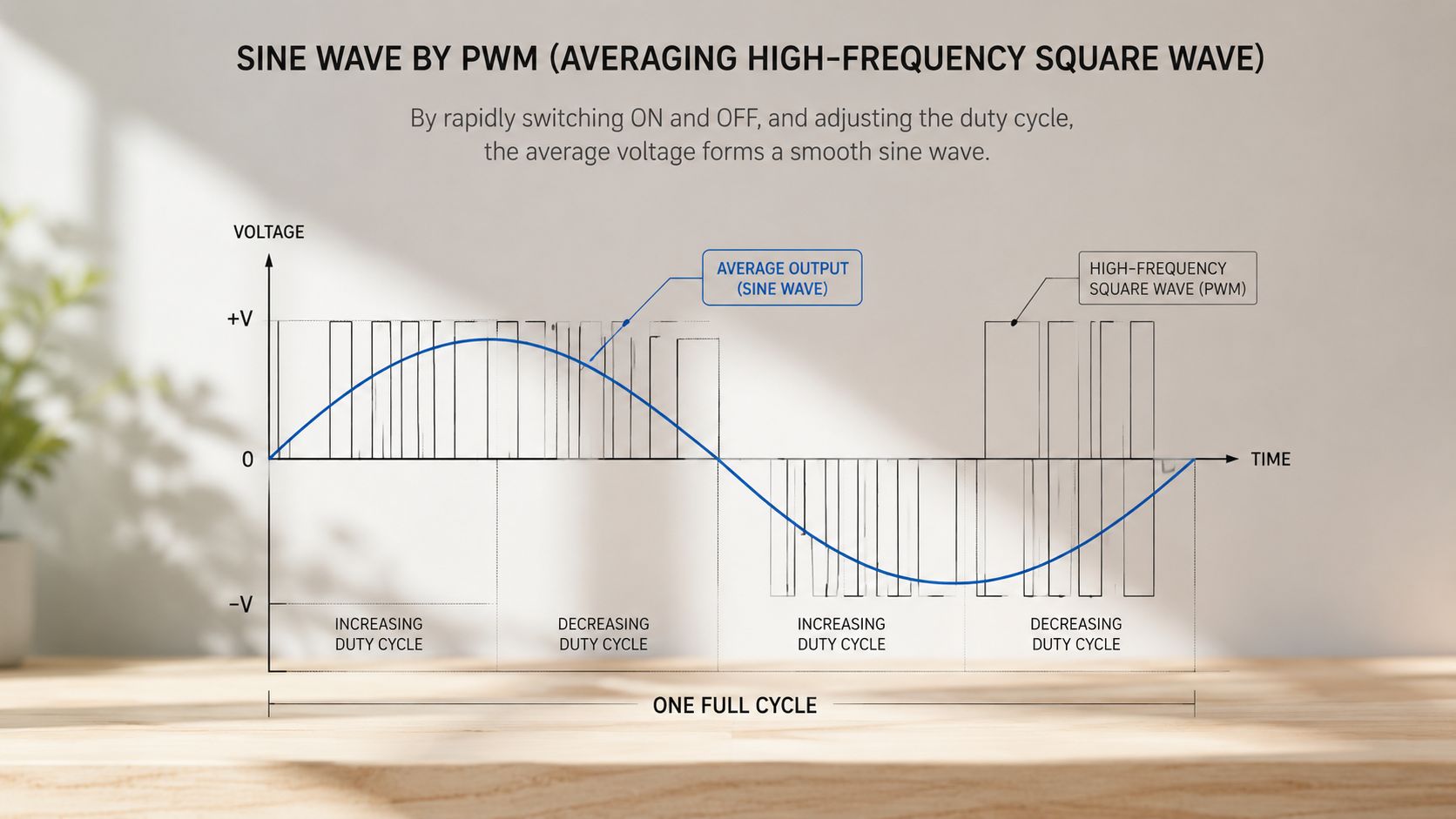
The simple picture goes like this. Instead of holding the output devices in a half-on state the way linear amps do, a Class D stage flips them on and off like a light switch, very fast. That switching pattern, usually through pulse-width modulation, carries the shape of the music. Then an output filter reconstructs the audio waveform your speakers see.
That's why the topology exists. Not because engineers wanted to annoy vinyl people, but because switching wastes far less energy as heat than linear operation. If you want a quick baseline on the old amplifier classes, I've already laid that out in my guide to Class A, B, and C amplifier behavior.
Efficiency Changes the Whole Chassis
The technical point translates into a listening point. According to the summary at Wikipedia's Class-D amplifier reference, Class-D amplifiers achieve efficiency rates of 90% to 95%, versus 20–30% for Class A and 50–60% for Class-AB. The same reference notes that a 100W Class-D amp dissipates only 5–10W as heat, while a 100W Class-AB unit dumps 40–50W.
That's not green-marketing fluff. That changes the entire physical design.
- Less wasted heat: The chassis doesn't spend its life cooking itself.
- More sensible packaging: High output no longer demands a giant metal altar in your rack.
- Better long-session behavior: The amplifier can stay composed without thermal drama becoming part of the sound.
A lot of people still think efficiency is a convenience feature. Wrong. It's performance headroom. If the amp isn't burning itself alive, the rest of the design has a better chance to stay linear and quiet.
Practical rule: In amplification, heat is rarely evidence of virtue. Usually it's evidence of waste.
That's the doorway into high-end Class D. Not magic. Not fake digital pixie dust. Just a smarter way to do the hard part.
Why Early Class D Sounded Like a Fax Machine
The bad reputation didn't come from nowhere. Early Class D often sounded brittle, sketchy, and weirdly synthetic because the design problems were real, audible, and common.
You heard it in the treble first. Cymbals got papery. String tone turned chalky. The air around voices had that gray electronic film that makes everything feel processed even when the midrange looked clean on first listen.
The Filter Fought the Speaker
One core problem was the output filter interacting badly with the loudspeaker load. On paper, a cheap module could look competent. In practice, the speaker's impedance curve would lean on the amp, and the tonal balance would move with it.
That's where the old “accurate but cold” line got traction. It wasn't accuracy. It was instability. The amp wasn't holding the line. It was reacting.
Put a difficult speaker on a mediocre switching amp and you could get splashy highs, uneven upper mids, and bass that looked tight until the music got dense. Then the floor gave way. Downstream inherits every shortcut.
Weak Execution Made the Treble Miserable
The other recurring failure was switching noise and general hash bleeding where it shouldn't. If the implementation was rough, you got audible glare. Not detail. Glare.
Three failure points showed up again and again:
- Cheap output filters: They didn't keep behavior consistent across real speakers.
- Underbuilt power supplies: The amp had theoretical power, but under musical demand it could sound starved and flat.
- Crude control loops: Errors weren't being corrected gracefully, so the presentation hardened under stress.
Early Class D didn't fail because switching is flawed. It failed because too many builders treated the supporting architecture like an afterthought.
That distinction matters because it explains why opinions got stuck in time. Plenty of audiophiles heard bad Class D once, hated it, and never came back. I understand that reaction. I had it myself.
But the part they're still missing is simple. The old sound wasn't the topology revealing its nature. It was poor implementation exposing itself.
The Anatomy of a Truly High-End Class D Amp
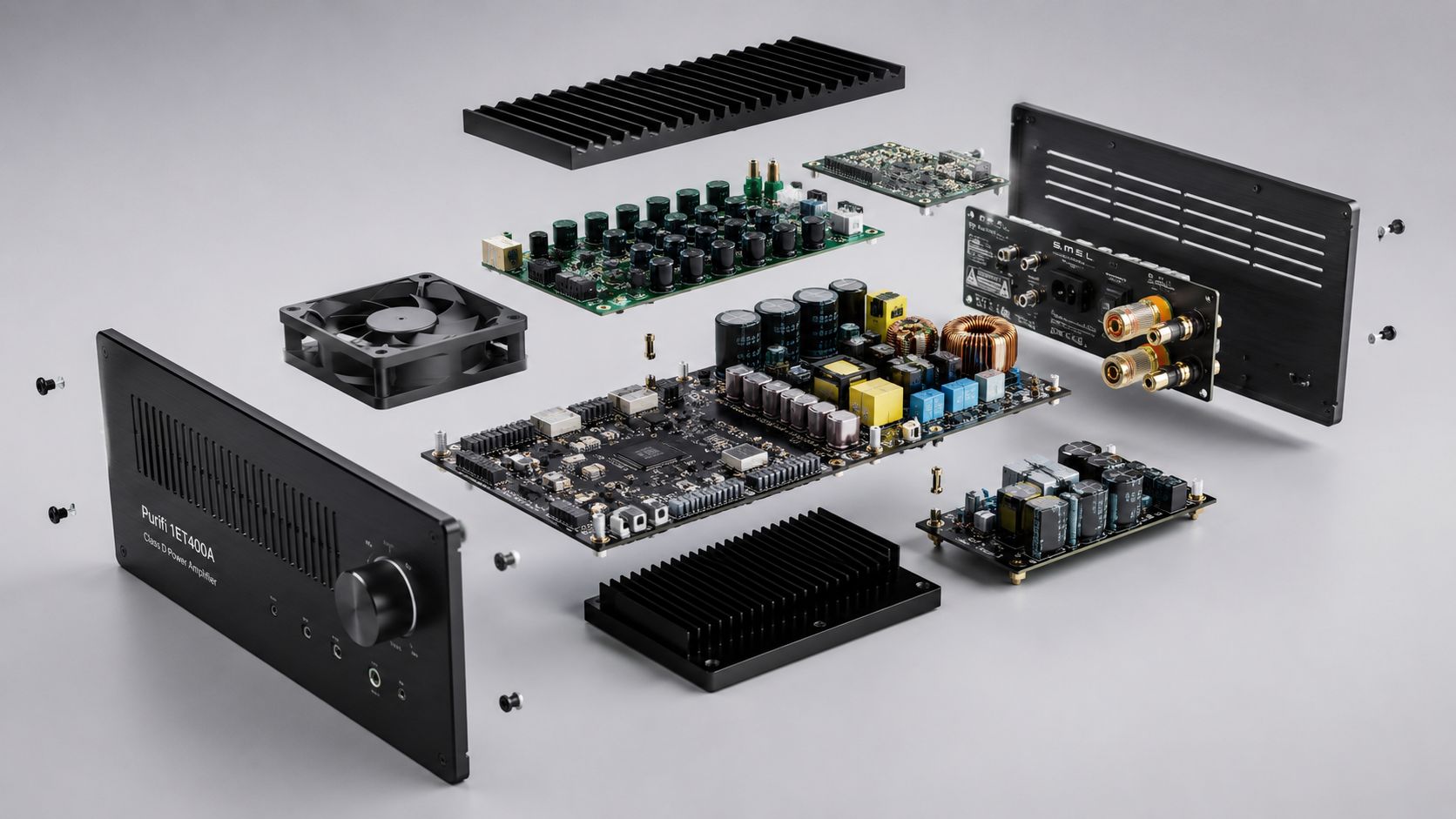
For a more insightful conversation, if you want to know whether a class d amplifier high end model is genuinely high-end or just a dressed-up module in a nice box, stop staring at the word “Class D” and inspect the load-bearing parts around it.
The Power Supply Sets the Floor
An amplifier's power supply is not packaging. It is the floor the whole performance stands on.
If the supply sags, spits noise back into the circuit, or can't recover cleanly from dynamic demand, no amount of elegant marketing language will save the sound. To my ears, this is often where cheap switching amps betray themselves. They have speed, sure, but not substance. Bass arrives fast and leaves no footprint. Large orchestral swings flatten. Images get pinched.
A serious design uses a supply that keeps the stage calm under pressure. Not “good for Class D.” Good, full stop.
The Output Filter Decides Whether the Amp Behaves
The output filter is where high-end Class D separates itself from commodity parts-bin design. This filter has to reconstruct the signal cleanly and stay stable with actual loudspeakers, not just polite resistor loads.
If this part is done right, the amp sounds settled. Tonal balance holds together. Treble extension doesn't turn glassy when the speaker gets awkward. Bass grip doesn't loosen when impedance shifts.
Here's the simple test:
| What you hear | What it often means |
|---|---|
| Treble changes from speaker to speaker in suspicious ways | The filter and load are interacting badly |
| Bass is fast but thin | The supporting architecture isn't giving the output stage enough authority |
| Soundstage collapses when music gets busy | The amp isn't staying composed under complex demand |
Feedback Is the Brain, Not a Footnote
Modern Class D amplifiers evolved from merely interesting to properly serious, a transformation requiring specific technical advancements. According to this Texas A&M engineering reference on Class D design, the technical prerequisite for high-end performance is self-oscillating PWM topologies or high-resolution digital feedback loops that suppress switching distortion and EMI to below 0.001% THD+N, with modern devices switching at 500 kHz–1 MHz.
Translated into normal language, the amplifier is no longer spraying errors and hoping the output filter cleans up the mess. The control system is actively keeping the circuit honest.
That matters audibly. A well-executed feedback system gives you cleaner decays, less grit around transients, and that lovely sensation that the amp isn't pushing the speaker so much as not getting in its way. If you're sorting the rest of your system, my broader guide to high-end audio components that actually matter connects the same principle across the chain.
What to pay for: Better control, not more mythology.
Device Choice Still Matters
The transistor type isn't everything, but it isn't nothing. The same engineering reference notes that modern implementations use gallium-nitride or advanced MOSFETs. That's important because faster, cleaner switching pushes the junk farther away from the audible band and gives the designer more room to make the amp behave like a grown-up.
I don't buy amps for semiconductor romance. I buy them for what I hear. But when a design uses better devices, a cleaner filter, a stronger supply, and a smarter loop, you hear the whole system snap into focus. More black space between notes. More stable images. More ease.
That's what you're paying for. Not the letter D.
Listening Notes from the Danish, Dutch, and American Schools
Specs tell you whether the kitchen is clean. Listening tells you whether the food tastes good.
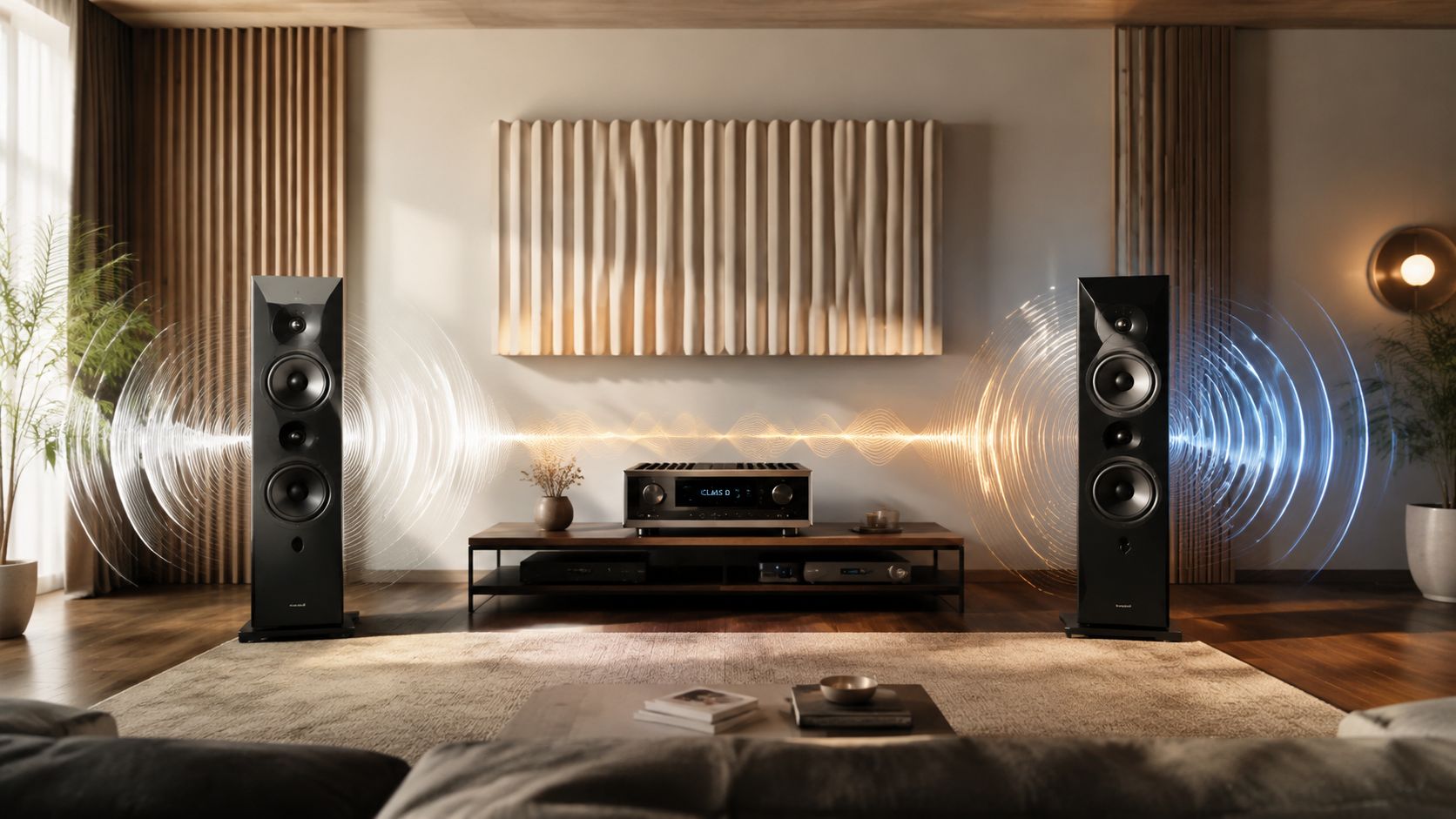
The broad families of modern high-end Class D tend to arrive with distinct personalities, even when they share the same basic logic. That's why I get impatient with anyone claiming all switching amps sound the same. They don't. Not remotely.
The Danish Take
The Danish school tends to sound like self-control in hardware form. Clean edges, strong bass authority, and a sense that the amplifier has endless grip without feeling clenched. Good examples from this camp usually present a deep silence behind the music. Not a sterile silence. More like a black backdrop that lets images appear without fuzz around them.
I hear these as excellent “sort the whole system out” amplifiers. They don't editorialize much. If your source is sloppy or your speakers have issues, they won't hide it. But pair them with a resolving front end and they give you scale, precision, and real dynamic poise.
The Dutch Flavor
The Dutch-flavored designs I've heard tend to push transparency further. Not brighter. Not thinner. Just more revealing in the way micro-detail arrives. Room cues are easier to track. Vocal layering gets spooky. Reverb tails don't smear into a nice wash. They hang there, then disappear on schedule.
That can be intoxicating or a little ruthless, depending on your system. If the chain upstream is already edgy, this style won't save you. If the chain is balanced, it can sound almost invisible.
- On small ensemble jazz: You notice the shape of the venue more clearly.
- On dense rock mixes: Separation improves, but only if the recording gives you something to work with.
- On acoustic records: Harmonic texture comes through without syrup.
A good example helps. Here's a listenable overview that puts real-world Class D performance into context:
The American GaN Mood
The American high-end GaN stuff is where a lot of old prejudices go to die. This is the branch that finally convinced many linear-amp loyalists to stop talking like switching can only do precision and never beauty.
A published review at Future Audiophile's look at the Atma-Sphere GaN Mono amplifiers describes naturally smooth midrange and treble, especially on vocals, trumpet, and violins, along with warm lower mids and bass, plus excellent soundstaging and imaging. That lines up with what the better GaN designs do to my ears. They can sound less mechanical than older modules and more texturally relaxed without giving up control.
Some of the best GaN amps don't sound “impressive.” They sound unforced, which is harder and better.
That's the thing people miss. The top Class D amplifiers don't win by sounding hi-fi in the showroom sense. They win by making strain disappear. Instruments keep body. Space stays intact. Bass has weight without bloat. You stop listening for technology and start listening through it.
That's the whole point.
How to Properly Audition a Class D Amplifier
Don't audition a Class D amp by swapping it in for ten minutes, playing an audiophile vocal track, and congratulating yourself for hearing “detail.” That's how people end up buying treble tricks.
Start with Bass and Silence
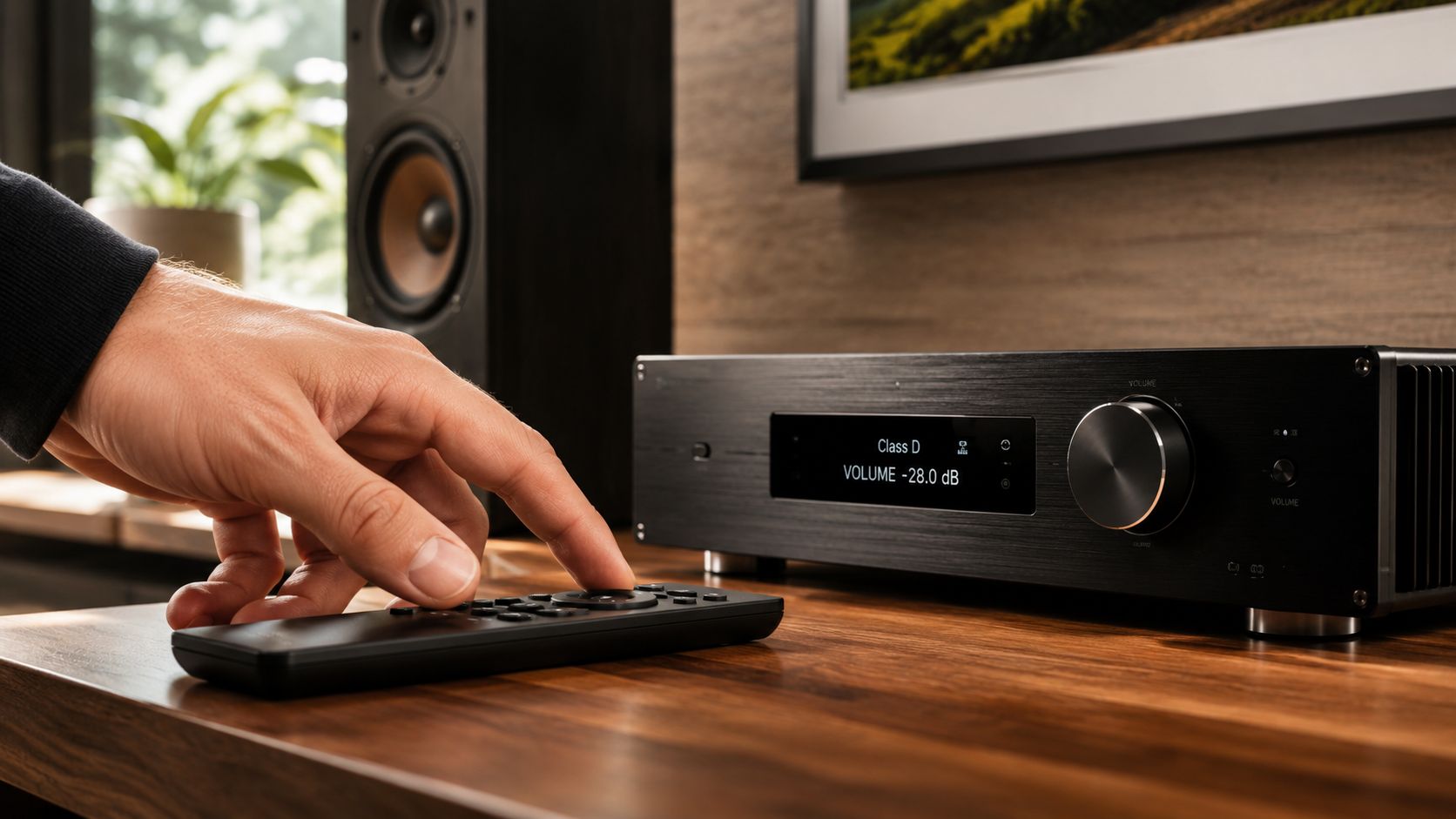
The first thing I listen for is bass control. Not quantity. Control. The amp should start and stop low frequencies with confidence, but still let you hear texture in bass guitar, kick drum skin, and the body of a piano's lower register.
Then listen to the gaps. The silence between notes tells on an amplifier fast. A great one gives you a dark, stable background where low-level details emerge naturally. A mediocre one gives you a faint film of tension. Not hiss, necessarily. Just a kind of nervousness.
Use this quick checklist:
- Bass lines: They should be tight and weighted, not puffy.
- Cymbals and strings: They should extend cleanly, not turn glassy.
- Imaging: Center images should lock in rather than wander when passages get dense.
- Your own speakers: If possible, audition with speakers that present a difficult load. Easy speakers flatter amps.
Bring music with real dynamic swings. Tiny polite recordings flatter almost everything.
Stress It Before You Trust It
Warm it up properly. Then make it work.
A useful torture test comes from this buying guide's thermal check advice for Class D amplifiers: run 30 minutes of pink noise at 75% maximum volume and make sure the amplifier stays stable without thermal compression or distortion. I wouldn't make purchasing decisions from bench ritual alone, but this is a smart sanity check. It tells you whether the efficiency story survives real sustained load.
After that, go back to music immediately. Listen for whether the tonal balance changed, whether the treble got brittle, or whether the bass lost composure. A serious amp should come through that sort of stress sounding like itself.
That's the tell. Not the spec sheet. The recovery.
Your Next Upgrade Is Probably Class D
If your speakers are demanding, your room is honest, and you want more control than romance, your next amplifier should probably be Class D.
Not because it's trendy. Not because it measures well. Because the best examples now solve real listening problems without importing the old penalties. You get grip, scale, low noise, and sane heat. That's not a side-grade. That's progress.
If your whole system is built around bloom, soft edges, and a bit of flattering color, then no, I'm not here to drag you out of your happy place. Keep the amp that gives you that glow. Systems are for pleasure, not ideology.
But if you've been circling the class d amplifier high end question because you suspect the old prejudice has expired, trust that instinct. Start listening seriously. If you're building around vinyl, I'd also think carefully about system matching and gain structure, which I get into in this guide on the best amp for a turntable setup.
The best Class D amps are no longer good for what they are.
They're just good.
Author: Marque Hersh
Publisher: Supermarket Sound
Author profile: Marque Hersh on Steam

