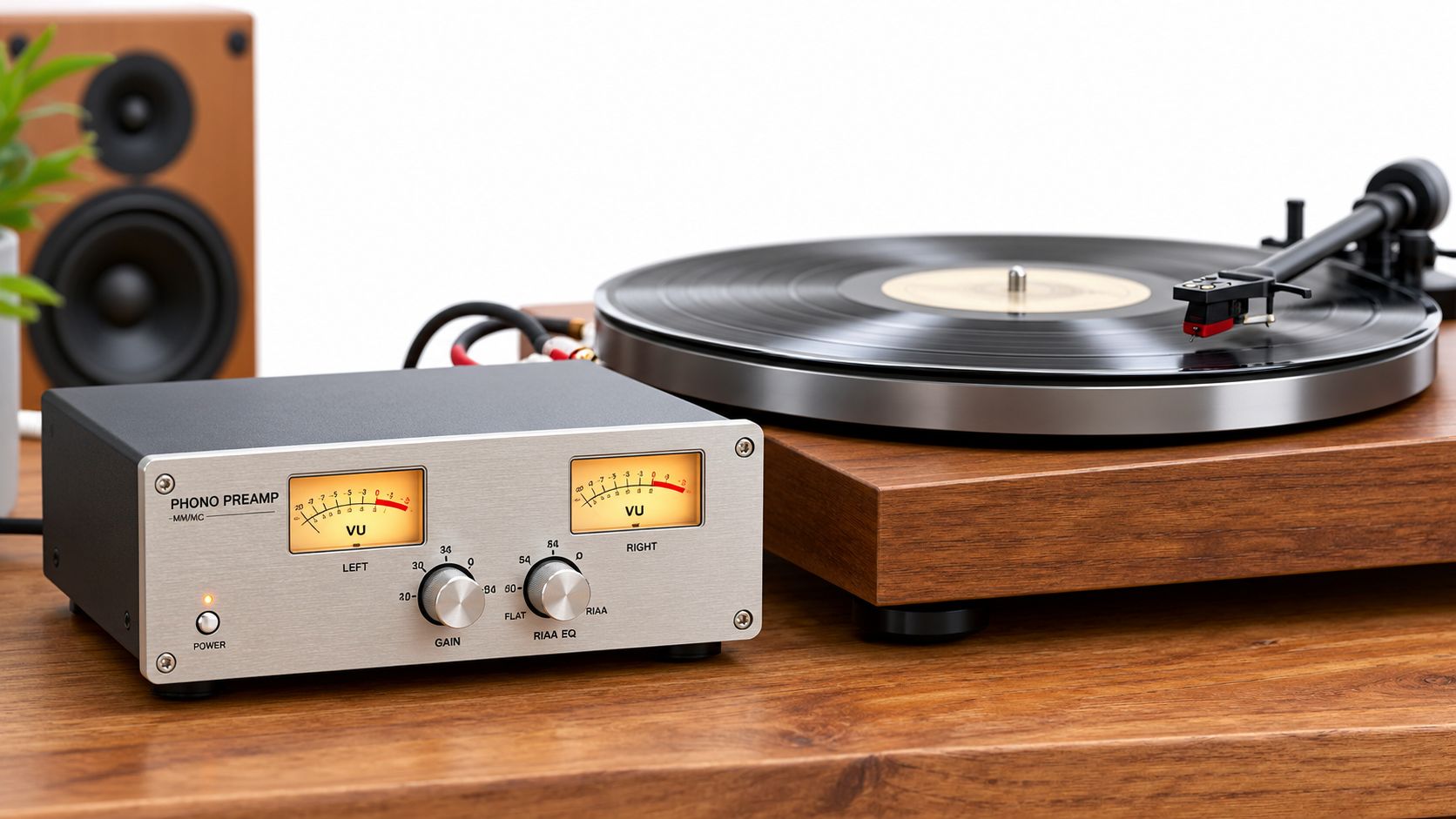
Most advice about phono preamps is too polite. It treats the thing like an accessory, a little helper box you add if your turntable seems shy. That's backwards.
A phono preamp is not garnish. It's the load-bearing floor of a vinyl system. If this stage is wrong, everything after it inherits the mistake. Your amp doesn't fix it. Your speakers don't forgive it. They just play the damaged version louder.
People usually search what is a phono preamp because they want a yes-or-no answer. Fair enough. SEO likes a clean definition. Real systems don't. The useful question is what happens when the phono stage is missing, duplicated, or mismatched. That's where the sound goes thin, glassy, pinched, overcooked, or weirdly flat in a real room.
Two jobs live here, and both matter. First, the phono stage has to take a tiny cartridge signal and make it big enough for the rest of your system to use. Second, it has to undo the EQ baked into the record itself. Get either part wrong and the music arrives bent.
That's the whole game.
Table of Contents
- Your Turntable Is Whispering and Nothing Else Can Hear It
- What a Phono Preamp Actually Does to Your Signal
- Why the RIAA Curve Still Dictates Everything Since 1954
- MM vs MC and Why Gain and Loading Change Everything
- Built In vs External Phono Stages and What You Actually Hear
- Loading Capacitance and Gain Matching That Shapes Tone
- Do You Need One and How to Choose Without Overthinking It
Your Turntable Is Whispering and Nothing Else Can Hear It
A turntable doesn't send out a normal music signal. It sends out a fragile little voltage that most gear barely recognizes. Plug that straight into a regular AUX input and you don't get "audiophile minimalism." You get a weak, wiry version of the record that sounds like the band moved into the next apartment.
The signal starts small, then gets judged by everything downstream
This is the part beginner guides often flatten into one sentence. Your cartridge reads motion in the groove and turns it into an electrical signal, but that signal isn't ready for civilized company. It needs help before a normal amplifier, receiver, or powered speaker can do anything useful with it.
If you're building a vinyl setup and sorting out where the turntable fits in the larger chain, my guide to a turntable sound system maps the handoff points. The phono stage sits right at the pressure point.
A bad phono stage doesn't stay in its lane. It teaches the rest of the system the wrong lesson.
That's why I call it load-bearing. The cartridge hands off a tiny, specialized signal. The phono preamp decides whether that signal lands on solid concrete or rotten floorboards.
The failure is audible, not theoretical
When this stage is missing, the sound usually comes out quiet, thin, and oddly bright. When it's duplicated, the sound can turn bloated, harsh, and overdriven. When it's merely mismatched, the symptoms get sneakier. Vocals lose body. Cymbals get splashy. Bass turns papery instead of weighty.
That last category catches a lot of people. They assume "I have sound, so the setup must be right." Not true. Vinyl systems can be wrong and still play music. They just play it with the tonal balance bent out of shape.
Three common traps show up again and again:
- No phono stage at all. The record plays, but it sounds starved and anaemic.
- Two phono stages in one chain. A turntable with a built-in stage feeds a receiver's phono input, and the result gets hot and ugly fast.
- The wrong stage for the cartridge. The sound works, but it never relaxes into itself.
That's the starting point. Not "do I need a box?" but "is the floor under my signal built correctly?"
What a Phono Preamp Actually Does to Your Signal
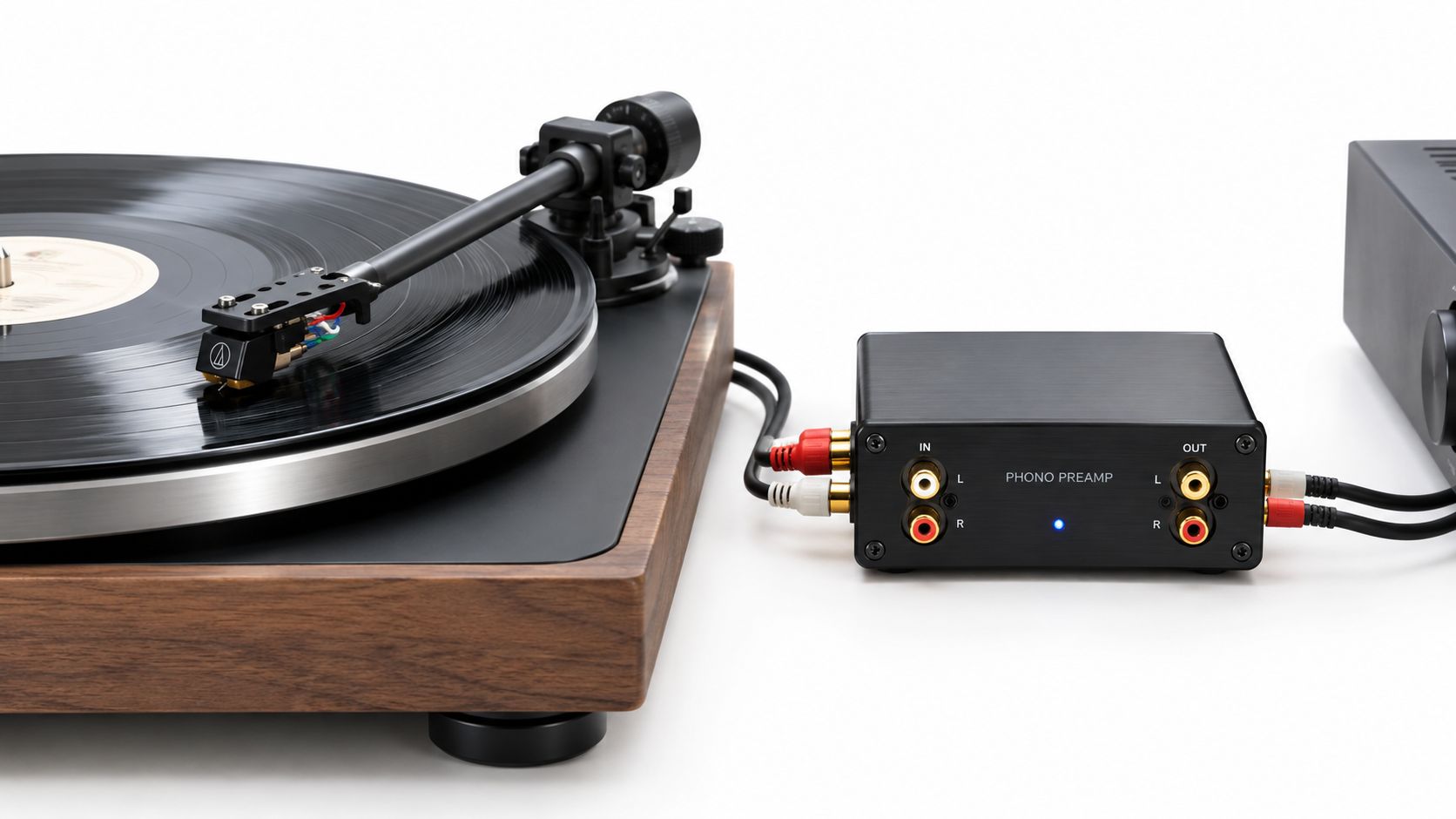
A phono preamp does two inseparable jobs. It adds gain, and it applies the inverse of the RIAA playback curve. Miss either one and vinyl won't sound like itself.
First job, make the signal big enough to survive
A moving magnet cartridge typically puts out around 3 to 6 mV, while a normal consumer line input expects about 0.316 V, which is why phono stages commonly provide about 40 dB of gain for MM and 60 to 70 dB for low-output MC, as laid out in this phono preamp gain explanation.
Another neutral reference puts the picture plainly. A phono stage for vinyl typically provides about 40 dB of gain at 1 kHz, and a nominal 5 mV cartridge input becomes about 500 mV at the output, according to this RIAA phono preamp overview.
Those numbers matter because they describe survival, not luxury. Too little gain and the music stays buried in noise. Too much and headroom collapses, which means loud passages hit a ceiling and harden up.
Second job, undo the EQ baked into the record
Records aren't cut flat. The lows are reduced and the highs are pushed up during cutting, then the phono preamp reverses that on playback. That's why a turntable can't just behave like a CD transport or a streamer.
The easiest way to picture it is this:
- At the cutting stage: bass gets reduced and treble gets boosted
- At the playback stage: the phono preamp restores bass and brings treble back down
- At the listening chair: if the reversal is accurate, tonal balance sounds normal instead of skeletal or abrasive
Without that correction, the sound doesn't just come out quieter. It comes out wrong.
Practical rule: If your record sounds both too quiet and too thin, you're usually hearing a phono problem, not a speaker problem.
Why line inputs can't fake it
A regular line input expects a source that's already been prepared. A turntable with a magnetic cartridge isn't prepared. It's raw.
That distinction confuses people because connectors don't explain themselves. RCA plugs look like RCA plugs. The jacks don't scream, "one of us expects a corrected line signal and the other expects a cartridge." So people connect the wrong things and blame the format.
The audible difference is easy to describe once you've heard it a few times. Correct phono gain and EQ give you bass with actual footing, mids with shape, and treble that extends instead of spits. Wrong phono handling gives you a sketch of the music, not the body.
That's why what is a phono preamp isn't really a vocabulary question. It's a signal-chain question.
Why the RIAA Curve Still Dictates Everything Since 1954
The RIAA curve is old enough to look boring on paper, which is exactly why people underestimate it. In a vinyl system, it is the load-bearing floor. If that floor is off, every choice above it, cartridge, amp, speakers, room, sits on a tilt.
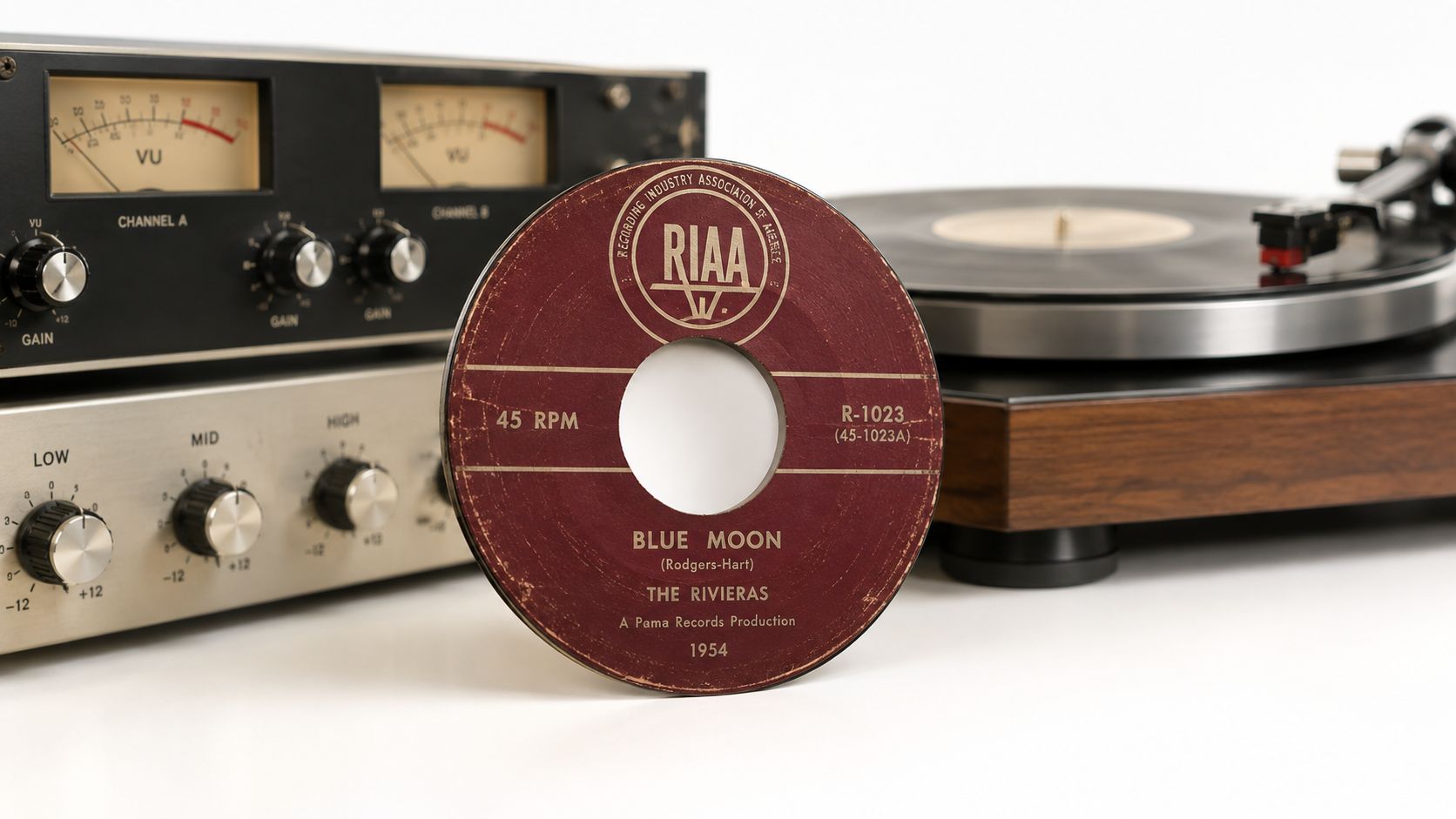
Before the Recording Industry Association of America standardized the RIAA curve in 1954, record labels used different playback EQ targets. By 1955, most major labels, including Columbia, Decca, and EMI, had shifted to the new standard, as described in this history of the RIAA standard and phono stage role.
That change matters for a simple reason. Once records were cut to a common target, phono stages had one job they could no longer dodge. They had to restore the tonal balance accurately, every time, while amplifying one of the smallest signals in your system.
The standard itself is built around three time constants: 3180 µs, 318 µs, and 75 µs. In listening terms, those turnover points shape the relationship between bass weight, midrange body, and upper-frequency bite. Miss the target and the error is not abstract. You hear it as lightweight bass, pinched mids, splashy cymbals, or a room that feels brighter than the recording should.
That is why I keep coming back to structure. The phono stage is not a flavor box sitting off to the side. It sets the floor flat before the rest of the system tries to build a house on top of it.
Standardization did not make all phono stages sound the same. It only gave designers the same map. Some stages track the curve more accurately. Some add noise. Some run out of headroom on hot cuts. Some get the gain and loading close enough that the record stops sounding like hi-fi parts and starts sounding like musicians in a space.
By the early transistor era, engineers were already publishing dedicated RIAA phono circuits as part of serious preamp design work. Current market analysts still track phono preamps as an active hardware category, with continuing demand for both solid-state and tube designs, according to this phono preamp history and market overview.
A quick visual helps if you want to see the playback side framed in plain terms.
What you hear in a real room is pretty consistent once you know the cues. A phono stage that gets the RIAA job right gives bass actual footing, keeps vocals fleshed in, and lets treble extend without turning glassy. A stage that gets it wrong shifts the whole tonal center. The record feels lean, edgy, or strangely distant, even when the cartridge and speakers are perfectly decent.
That is why a standard from 1954 still dictates the sound of vinyl today. The curve did not freeze taste. It froze the target. Whether your system sounds grounded or tipped upward still depends on how well the phono stage hits that target.
MM vs MC and Why Gain and Loading Change Everything
Cartridge type decides the phono stage conversation faster than almost anything else. Not because audiophiles love categories. Because the electrical demands really are different.
Output decides how much help the signal needs
Moving magnet cartridges commonly output roughly 3 to 6 mV, while low-output moving-coil cartridges often sit around 0.2 to 0.5 mV, which is why MC stages need far more gain than MM stages, as summarized in this MM and MC output guide.
That difference isn't cosmetic. It changes whether the signal arrives at your amp with enough muscle or crawls in half-conscious.
If you're sorting out cartridge families first, my take on moving magnet vs moving coil gets into the personality differences without pretending the answer is universal.
MM and MC don't want the same electrical environment
MM cartridges are normally loaded at 47 kΩ, while low-output MC cartridges usually want a much lower impedance, often in the 10 to 100 Ω range, according to this MM versus MC loading reference.
That means the phono stage can't just be "good" in the abstract. It has to be appropriate.
Here is the quick version.
| Cartridge Type | Typical Output | Gain Needed | Standard Load |
|---|---|---|---|
| MM | 3 to 6 mV | about 40 dB | 47 kΩ |
| Low-output MC | 0.2 to 0.5 mV | 60 to 70 dB | 10 to 100 Ω |
What the mismatch sounds like
With MM, the common problem is underestimating how much the input environment shapes the top end. With MC, the trap is using the wrong gain or an arbitrary load and then calling the cartridge "clinical" or "slow" when the stage is steering the behavior.
In a room, wrong gain and loading don't announce themselves with labels. They show up as listening fatigue or lack of grip:
- Too little gain: the sound lacks drive, image density, and confidence
- Too much gain: peaks flatten, transients get hard, the presentation feels jumpy
- Wrong load: the tonal balance shifts, often in the highs, and timing can feel oddly tense or blunted
Matching cartridge to phono stage is less like choosing a flavor and more like setting the foundation under the whole record collection.
I don't treat MM as beginner gear and MC as the grown-up room. That's forum theater. A well-matched MM setup can sound full, grounded, and wonderfully direct. A badly matched MC setup can sound expensive and miserable.
The cartridge tells the phono stage what kind of job it's walking into.
Built In vs External Phono Stages and What You Actually Hear
The built-in versus external argument gets weirdly religious. It shouldn't. This is about implementation, not moral purity.
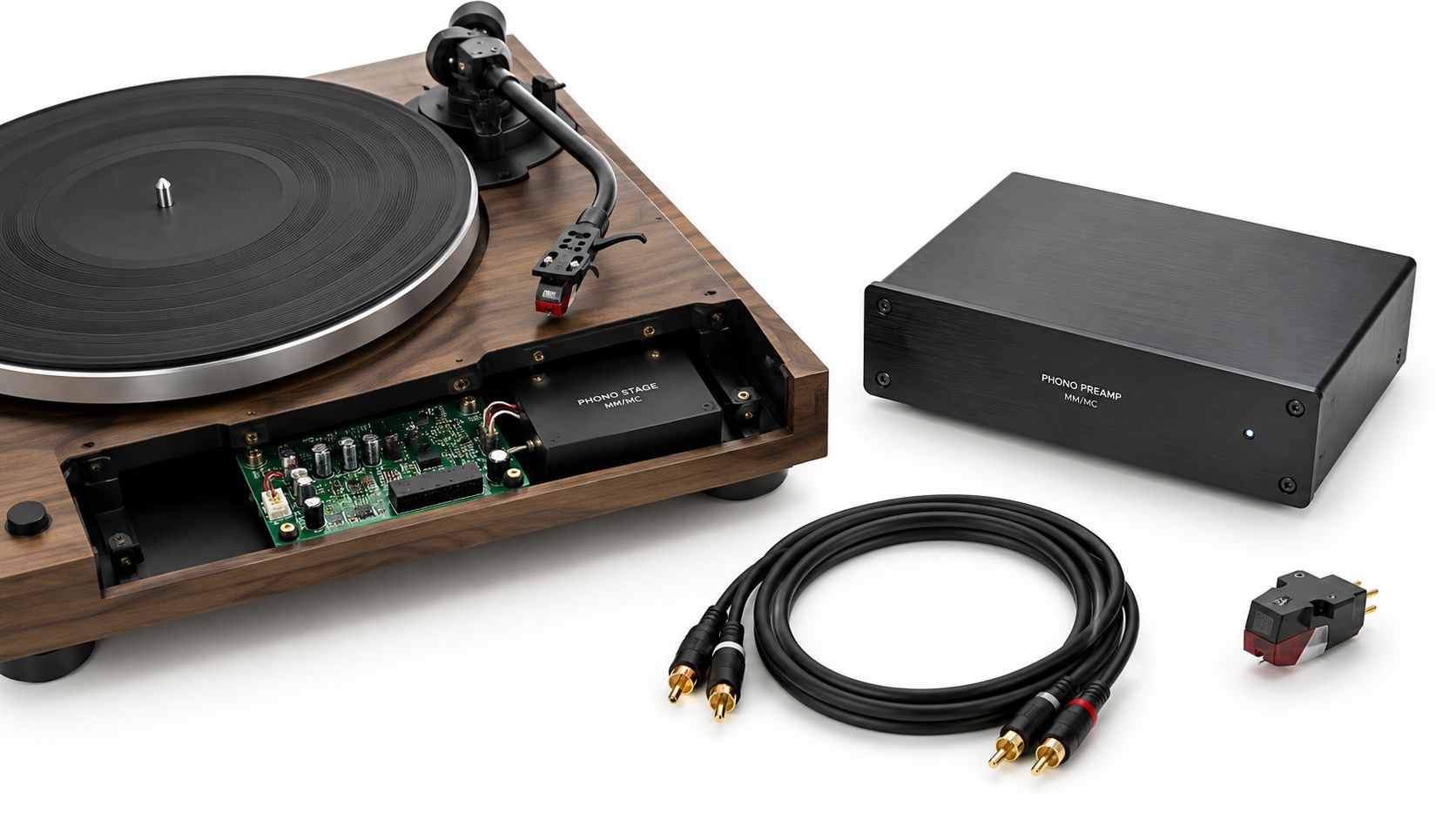
Built-in can be fine, external can be better
A built-in phono stage inside a turntable or receiver often makes sense. It reduces boxes, cables, and setup errors. If the implementation is competent and the cartridge match is sane, you can get enjoyable sound.
But convenience is not the same thing as headroom. Or flexibility. Or future-proofing.
If you're pairing vinyl with a receiver or integrated amp, my guide to the best amp for turntable helps sort where the phono stage should live in the chain.
What changes in the room
When a basic built-in stage runs out of grace, the first thing I hear is texture loss. Bass notes still exist, but they stop blooming naturally and start feeling stapled on. Space narrows. Loud passages crowd together.
A stronger external stage often sounds less "processed" not because it's doing less, but because it's doing the required work with more ease. Images hold shape. Cymbals keep shimmer without turning brittle. Low end gets weight and timing instead of one-note thump.
One independent review measured a phono preamp with 45 dB gain, RIAA accuracy of ±0.1 dB, MM noise of 70 dB unweighted, and input overload points of 100 mV for MM and 6 mV for MC, which is useful because it shows the hard limits a real stage has to manage in practice, in this measured phono preamp review.
Choose architecture by failure risk
If you want the shortest practical buying advice, it looks like this:
- Use the built-in stage when simplicity matters most and your setup already sounds balanced, quiet enough, and dynamically open.
- Use an external stage when the system sounds constrained, when you need cartridge flexibility, or when you want control over gain and loading.
- Avoid stage duplication at all costs. A turntable with its own phono stage should feed a line input, not another phono input.
I don't worship extra boxes. I worship getting out of the signal's way.
That's different.
Loading Capacitance and Gain Matching That Shapes Tone
Tone often gets blamed on the cartridge, the speakers, or the pressing. Fair. But the load-bearing floor under all of it is the phono stage setup. If gain is off, if capacitance is off, if loading is off, the whole presentation tilts before the signal ever reaches the rest of your system.
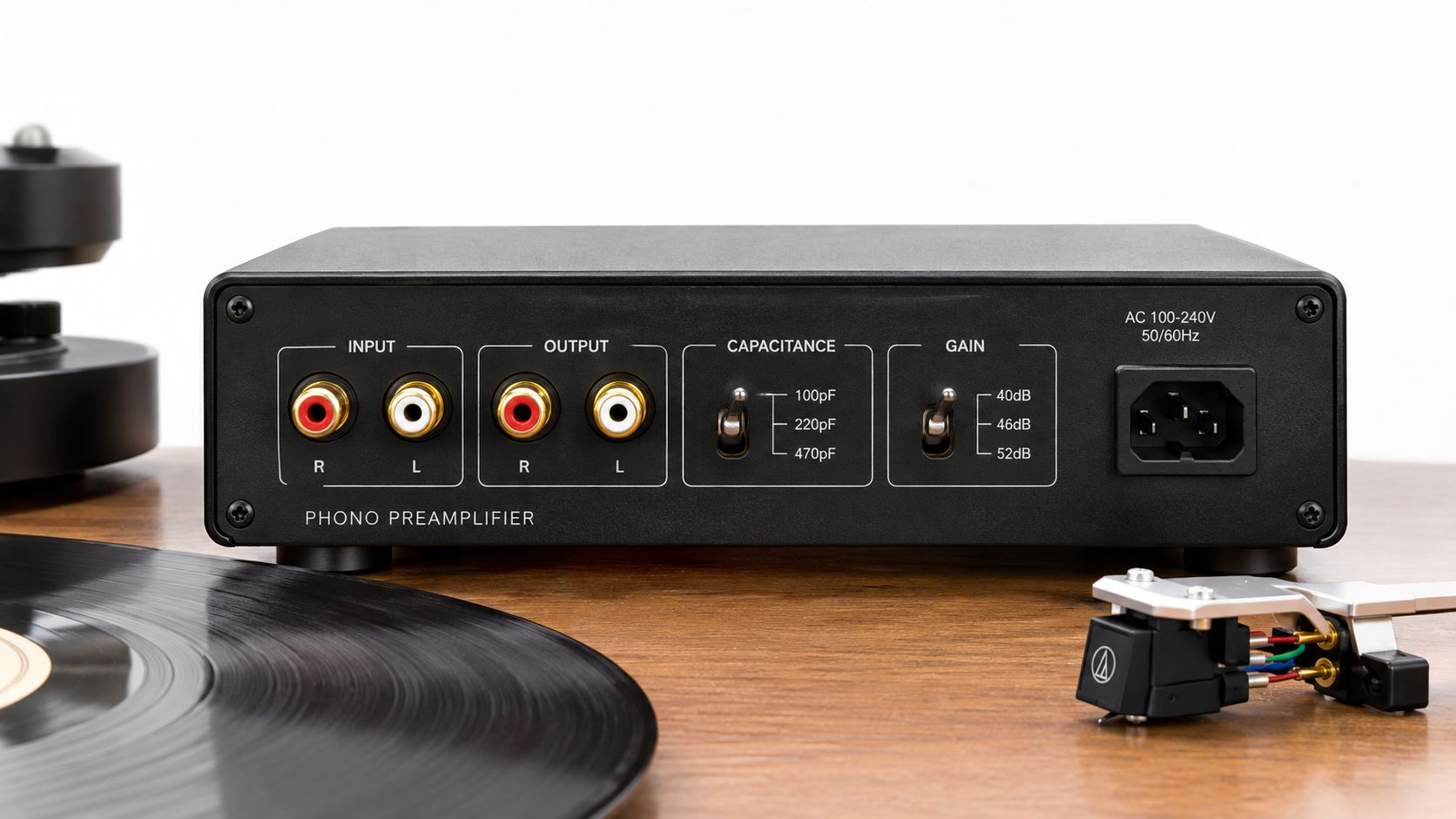
Capacitance quietly shapes MM tone
With moving magnet cartridges, the usual target is 47 kΩ and a specified capacitance window. One manufacturer manual notes that many MM designs want total capacitance in roughly the 100 to 400 pF range because the cartridge inductance and the cable plus input capacitance interact electrically, which can push the top end up or down in audible ways, as described in this loading and capacitance manual.
In plain English, capacitance behaves like a hidden tone shaper. You do not turn a knob and hear "more treble." You hear a system that starts sounding glassy, shut-in, or strangely uneven from record to record.
Too much capacitance often makes the upper range jump forward. Cymbals turn whitish. Sibilants get spotlit. Detail seems sharper at first, then listening gets tiring.
Too little can flatten the life out of the top end. Air drops away. Harmonics lose shine. The room sounds less like a space and more like a sketch of one.
MC loading changes grip, speed, and tonal balance
Moving coil cartridges shift the problem. Capacitance usually matters less than resistive loading, and the wrong setting changes feel as much as frequency balance. Cartridge makers commonly give a recommended load, often somewhere from low hundreds of ohms upward, and a common starting point is to set the phono stage well above the cartridge's internal impedance, then listen and adjust by ear.
That last part matters. I do not treat loading as a superstition contest. I treat it like setup pressure on a suspension. Too far one way and the sound gets nervous. Too far the other and it drags.
Here is what I listen for:
- Too bright or splashy: cymbals turn chalky, vocal edges detach from the body, image outlines get hard
- Too dull or shut in: transients soften, ambient decay shortens, the room feels smaller
- Too loose: bass stops and starts less cleanly, timing gets fuzzy, the image loses grip
The point is not to chase a magic number. The point is to solve an audible problem.
Gain matching affects texture, not just volume
Gain gets treated like a loudness setting. It is more than that. Too little gain leaves the system underdriven, which can make music feel small, pale, and dynamically hesitant even if you can fix the level later with the volume control. Too much gain pushes noise up, trims usable headroom, and can make dense passages feel pinned flat.
This is why the phono preamp is the floor, not a side accessory. It sets the signal's working conditions. Get those conditions right and tone relaxes into place. Get them wrong and you start compensating everywhere else.
Compatibility mistakes still masquerade as "vinyl sound"
A plain-language setup guide from a major retailer does a good job explaining a problem that causes endless confusion: people know a phono preamp boosts signal and applies RIAA equalization, but they often miss what happens when the active stage is missing, duplicated, or mismatched in a system with powered speakers, receivers, or turntables that already include one, in this compatibility-focused phono preamp guide.
Those mistakes have a sound:
- Thin and quiet output usually means the cartridge signal is hitting a line input without proper phono gain and EQ
- Boomy, distorted, or overly hot output usually means two phono stages are active in series
- Normal volume but odd tonal balance often points to gain or loading mismatch
Supermarket Sound has a phono preamp guide that lays out these connection errors in simple terms. That kind of checklist helps because the controls doing the most tonal work are often the ones people never realize are active.
Do You Need One and How to Choose Without Overthinking It
If your turntable already has a built-in phono stage and you're feeding a normal line input, you may not need a separate unit. If your amp, receiver, or speakers already provide the correct phono input for your cartridge, same story.
If neither side handles phono duties, yes, you need one. No romance here. Just signal chain.
The easy diagnostic is audible. Too quiet and too thin usually means no proper phono stage. Too loud, bloated, or distorted usually means you're running through two. If the level seems normal but the sound never settles, look at gain and loading before you blame the record or the speakers.
Keep the buying priorities brutally simple
Don't start with boutique fantasies. Start with fit.
- Match the cartridge type. MM and low-output MC need different gain and loading environments.
- Prioritize clean headroom. A phono stage should stay composed when the record gets busy.
- Treat loading as setup, not trivia. If the stage gives you useful loading options, that can matter more than decorative features.
- Choose convenience. A built-in stage that works properly beats an external box used incorrectly.
I know why so many searches for what is a phono preamp end up buried in jargon. It sounds like a specialty topic, so everyone starts performing expertise. It is simpler. A phono preamp is the stage that makes vinyl intelligible to the rest of your system and tonally correct in the first place.
Not an accessory. The floor.
Build that part right.

