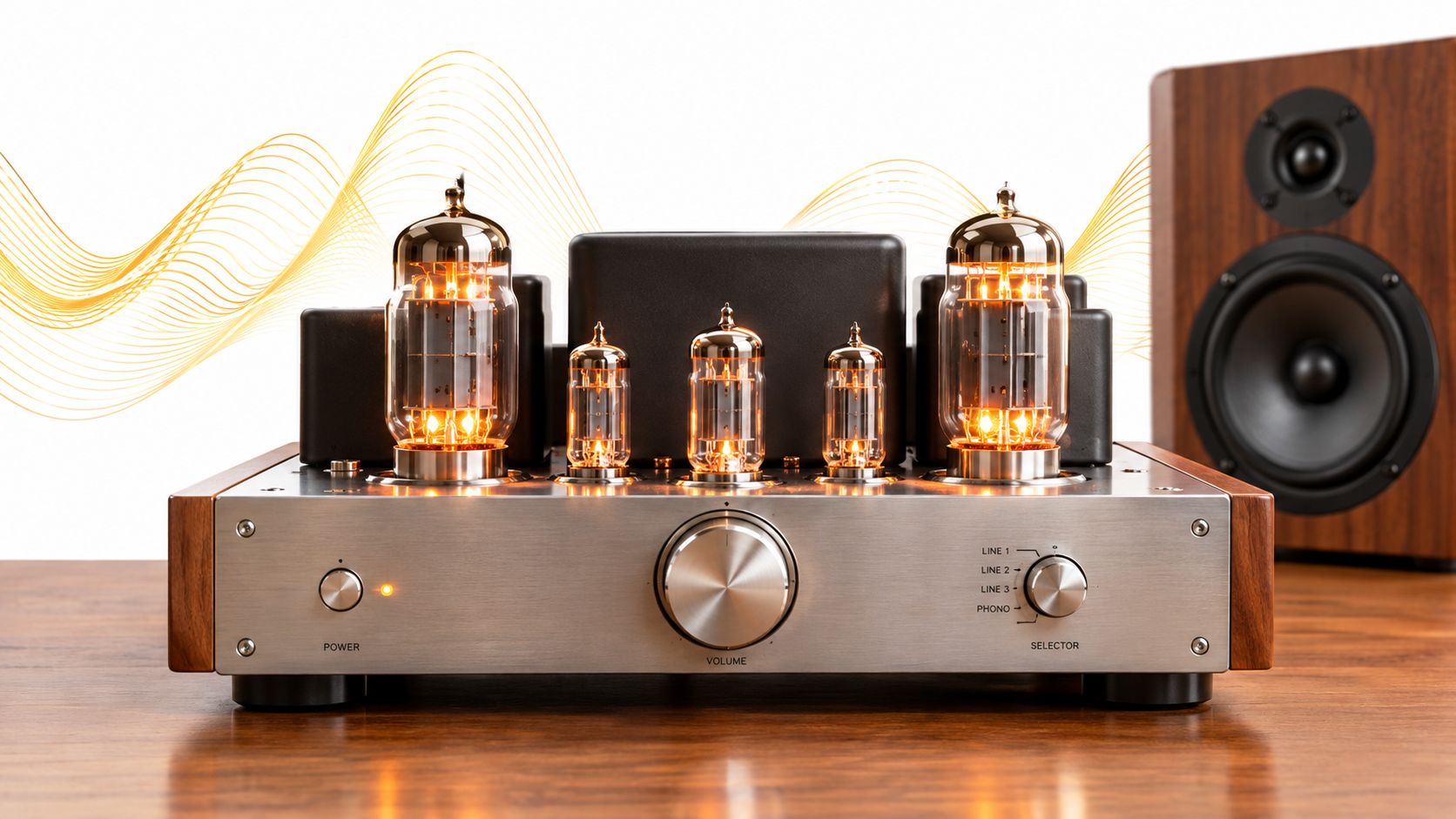
A stereo tube amplifier gives you harmonic softness and dynamic lift as vacuum tubes approach clipping gradually, not a magic “warm” button. The key differentiator is topology and load management, not the glow.
That answer sounds less romantic than the usual sales copy, which is exactly why it matters. I'm Marque Hersh, founder of Supermarket Sound, and I've spent enough time around output tubes, hum, aging components, and suspiciously cheap vintage chassis to know that the pretty part is the least dangerous thing to misunderstand.
A tube amplifier can make a vocal feel physically closer, give a snare more grain, and let a guitar swell into a room instead of hitting it with a hard edge. It can also sound thin, hissy, soft in the wrong places, or unstable with a speaker it should never have been asked to drive. My thesis is simple: topology, speaker matching, and maintenance discipline matter more than nostalgia.
The commercial reality is obvious. “Stereo amplifier tube” is a useful search phrase, and the internet likes to turn every glowing bottle into a lifestyle object. I'd rather tell you what the circuit does, what your ears can actually hear, and where your hands should stop.
Table of Contents
- Why Tube Sound Isn't Just Warm Glow
- How Tube Distortion Actually Shapes Music
- Push-Pull Vs Single-Ended And What Changes
- Matching Speakers, Loads, And Expectations
- Maintenance, Aging, And The Safety Floor
- Marque Listening Notes And Buying Checklist
Why Tube Sound Isn't Just Warm Glow
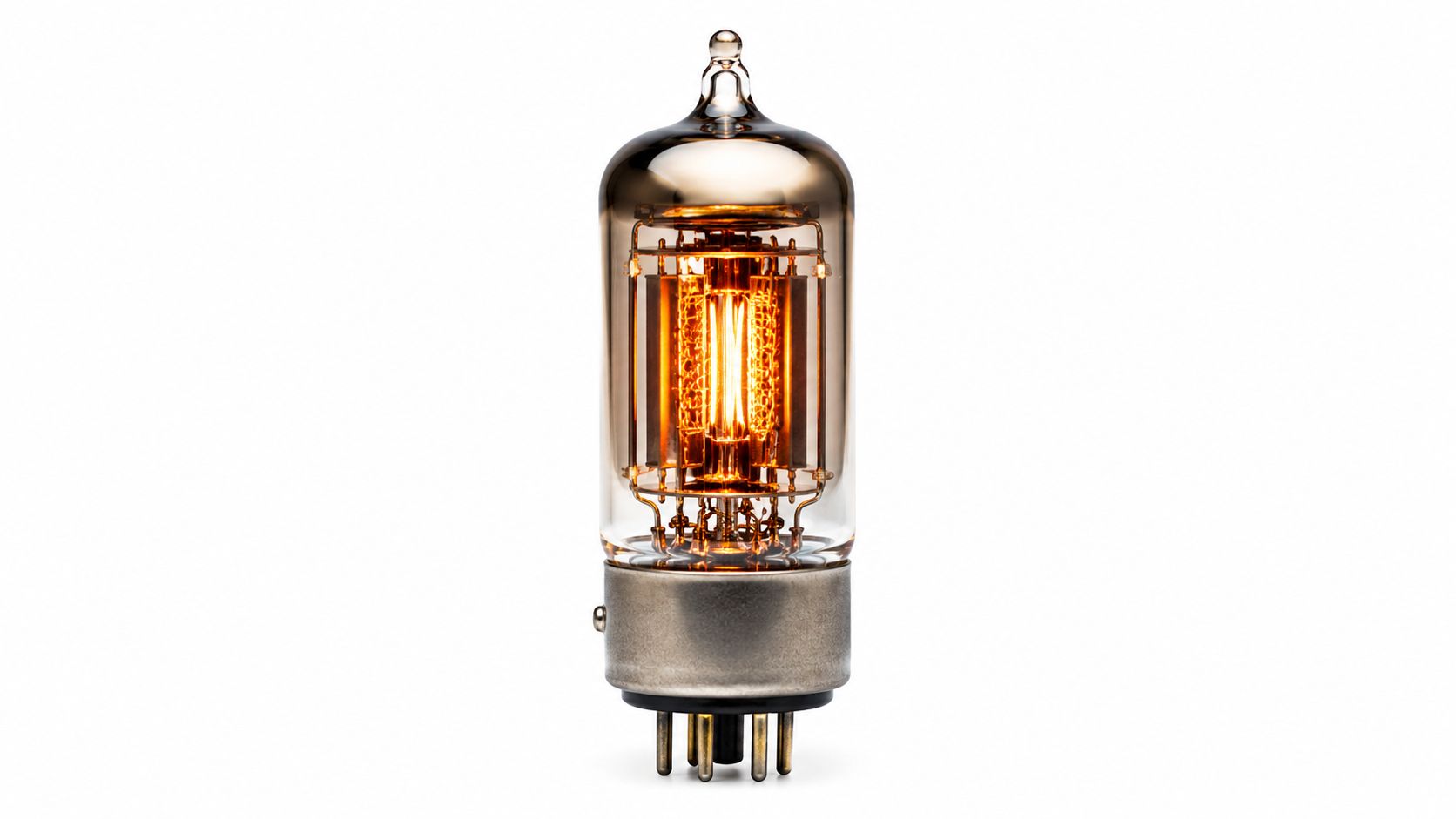
A glowing tube doesn't guarantee musical sound. It guarantees that something is hot.
The tube's contribution comes from how it amplifies, how it approaches its limits, and how the output transformer and loudspeaker respond to that behavior. A well-designed amplifier can sound open, tactile, and generous. A poorly matched or poorly maintained one can sound like the music is wearing a wool coat.
That's why I separate tube character from tube mythology. Character lives in the signal path. Myth lives in the product photograph.
The circuit decides what the bottle can do
The preamp stage, driver stage, output stage, transformers, feedback choices, power supply, and speaker load all shape the result. Downstream inherits what happens upstream. If the input stage adds glare, the power stage doesn't politely remove it. If the power supply sags at the wrong moment, the music loses its floor under pressure.
I've heard tube amplifiers that produce a beautiful sense of body at modest volume, then collapse when a bass line gets ambitious. I've also heard designs that keep the midrange inviting while holding bass notes in place. Both may use the same broad category of output tube. The implementation decides whether the result feels alive or merely soft.
The same principle applies to solid-state. A good transistor amplifier can sound clean, fast, and unforced, while a bad one can sound brittle and flat. The old tube-versus-solid-state argument hides the more useful question: what does this particular circuit do with your speakers and your music?
For a broader look at why amplifier designs can produce audible differences, see this guide to how amplifiers sound different.
Warmth can hide a problem
Warmth often means a pleasing balance of harmonic texture, gentler clipping, and a relaxed presentation. It doesn't mean rolled-off treble, weak bass, or a permanent blanket over the tweeter.
If cymbals lose their edge, voices sound congested, or the bass swells behind the beat, don't call it “analogue magic” until you've checked the load, the tubes, and the service condition. Romance is not a diagnostic method.
Topology is the frame. Load is the floor. Maintenance keeps the picture straight.
How Tube Distortion Actually Shapes Music
Tube distortion doesn't throw dirt over the recording. In the right amount, it changes the way musical peaks arrive.
Vacuum tubes tend to move toward clipping gradually. Instead of chopping a transient off abruptly, the circuit can compress the approach to its limit, allowing the note to retain a sense of continuity. To my ears, that's part of why a pushed tube amplifier can feel less aggressive even when it's working hard.
The effect is easiest to hear on voices, brass, electric guitar, and piano. A singer's consonants remain present without turning into splinters. A trumpet gains a little brass around the note. A guitar sustains with a rounded edge rather than a hard electronic snap.
Harmonics can reinforce the note
Tube circuits are often associated with even-order harmonic content, where added frequencies relate closely to the original musical tone. That relationship can make the coloration feel connected to the pitch instead of detached from it. The result isn't automatically accurate, but it can sound coherent.
This is why “distortion” remains an incomplete description. Some distortion makes the music feel denser and more tactile. Some makes it feel strained. The ear responds to the structure and timing of the added content, not merely to the presence of an error.
A solid-state amplifier often gives me a firmer outline around bass and transients. Kick drums start and stop with more obvious authority. A tube amplifier often gives the same event more connective tissue, the small bloom around the note that makes the presentation feel less diagrammatic.
Neither behavior wins every recording. A dry, close-miked vocal may benefit from tube texture. A dense electronic mix may need the transistor grip so the low end doesn't turn into soup.
Preamp color and power-stage movement aren't the same
People often blame “the tubes” for a tonal effect that actually comes from one stage. A preamp tube can add harmonic color at low listening levels, while the output stage may remain mostly clean. Push the amplifier harder and the power tubes, transformers, and power supply start making their own decisions.
That distinction matters when troubleshooting. If the amplifier sounds colored at every volume, look toward the gain stages and voicing. If it becomes compressed only during peaks, the output section and load deserve attention.
The signal chain behaves like a building. The preamp lays the wiring. The driver carries the load. The output stage supports the roof. If an early floor flexes, everything downstream inherits the movement.
A tube amplifier doesn't sound musical because distortion is good. It sounds musical when the circuit handles imperfection gracefully.
Push-Pull Vs Single-Ended And What Changes
Single-ended and push-pull designs solve different problems. Treating one as the “pure” choice and the other as a compromise is mostly audiophile theater.
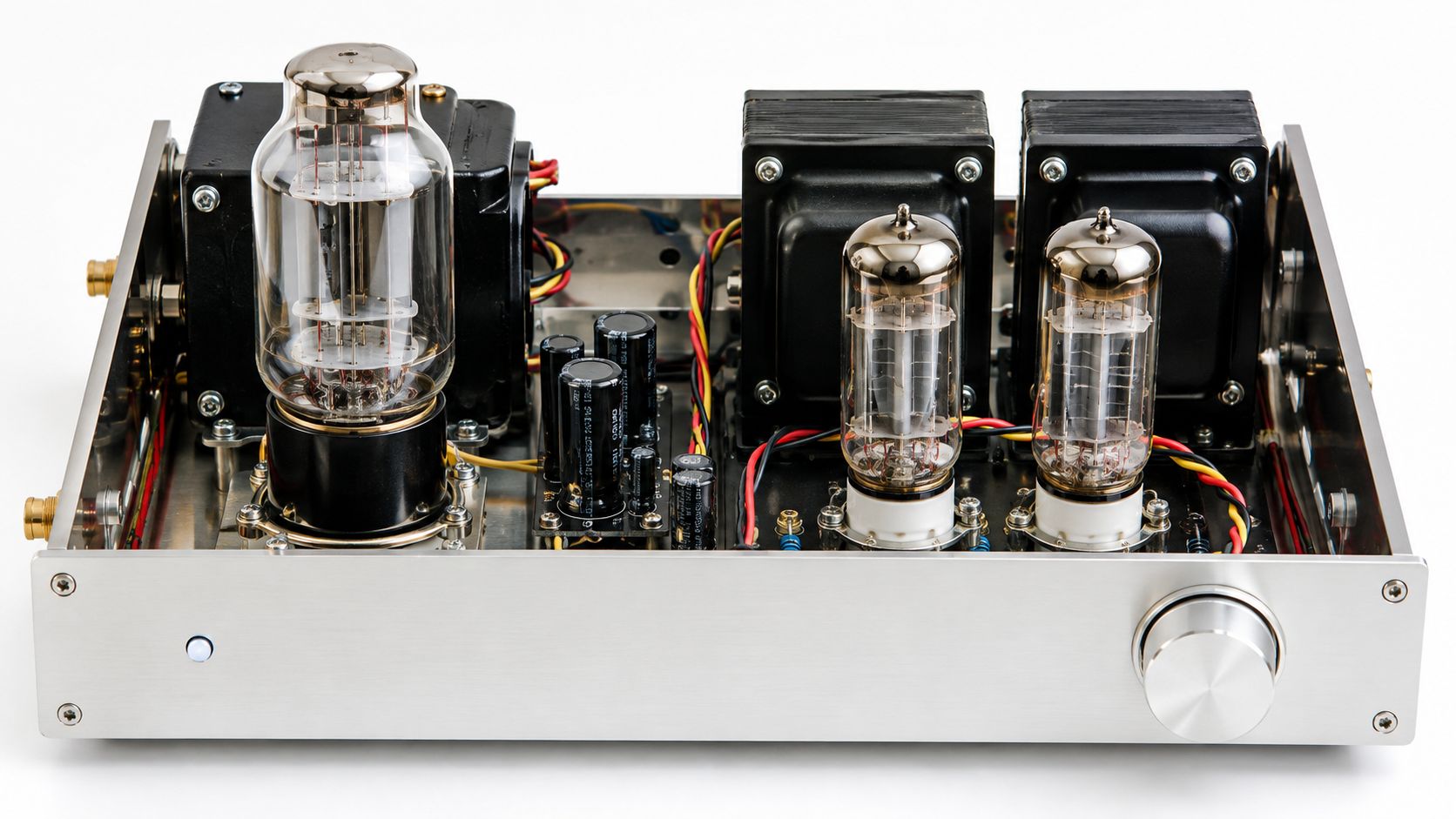
A single-ended amplifier uses its output device continuously through the signal path in a way that often creates a direct, intimate presentation. With suitable speakers and a sympathetic room, it can place a voice in front of you with startling immediacy. The bass may feel less forceful, and the available headroom can make speaker efficiency and room size decisive.
A push-pull amplifier divides the work between output devices. That arrangement can deliver a firmer low end, greater headroom, and more confidence when music becomes crowded or a speaker presents a difficult load. It often suits full-range listening better, especially when you want orchestral peaks or rock drums to retain their shape.
Choose the topology around the room
Here's the practical split I use:
- Single-ended designs suit listeners who value intimacy, texture, and low-level nuance, especially with speakers that don't demand much current.
- Push-pull designs suit listeners who need stronger bass control, broader dynamic confidence, and more flexibility across speaker types.
- Solid-state designs often make the easier partner for demanding loads, particularly when the room and speaker need current more than harmonic bloom.
That isn't a ranking. It's a job description.
The listening distance matters, too. A compact room with nearfield seating can make a low-powered single-ended amplifier feel astonishingly complete. Move the same amplifier into a larger room with insensitive speakers and it may spend the evening gasping.
The distinction between Class A and Class AB adds another layer. A Class A output device conducts for the full 360° of the input cycle at full unclipped output, while Class AB conducts for more than half but less than 360°, as explained in this Class A clarification. Bias method and amplifier class aren't the same thing. A fixed-bias amplifier can operate in Class A, and a cathode-biased amplifier can operate in Class AB.
That detail kills a common shortcut. You can't infer the whole sound from “cathode bias,” “fixed bias,” or a single class label.
Listening rule: Choose the topology that keeps your speakers composed during the music you actually play, not the topology that looks most convincing in a photograph.
A tube amplifier should serve the room. The bottle doesn't get a vote.
For a plain-language explanation of the class labels, this guide to Class A, B, and C amplifier operation is useful background.
Matching Speakers, Loads, And Expectations
Speaker matching is the load-bearing skill in tube audio. Ignore it and the amplifier can sound loose, bright, or oddly compressed even when the circuit itself is sound.
A tube output stage usually works through an output transformer. That transformer presents the speaker with a practical impedance relationship, which means the amplifier expects you to use the correct output connection and respect the speaker's behavior. A nominal impedance label gives you a starting point, not the whole story. Speakers change impedance as frequency changes, and some create far more work for the amplifier than their headline rating suggests.
Listen for the consequences
Poor matching usually announces itself through music rather than a warning light. Bass loses its grip. Sibilants harden as volume rises. The tonal balance shifts between quiet listening and demanding passages. A clean guitar may sound handsome at midnight and strained at dinner-party volume.
Solid-state amplifiers often tolerate difficult speaker loads with more forgiveness. That doesn't make every transistor design invincible, but it does mean tube owners need to pay closer attention before buying.
Use this short decision filter:
- Check the amplifier's output options. Connect the speaker to the intended tap rather than guessing.
- Read the speaker's minimum impedance information. Don't rely only on its nominal figure.
- Listen at realistic volume. A pairing that sounds seductive at low levels may lose control when the rhythm section arrives.
- Watch the bass first. Loose low frequencies often reveal a mismatch before the treble makes a complaint.
- Ask about service and operating conditions. A tired output stage can imitate a bad speaker match.
The central principle is simple. The amplifier and speaker form one electrical system, not two independent purchases. For the basic concept, use this explanation of impedance matching in audio.
Don't chase damping numbers blindly
A higher damping factor can suggest stronger control, but a number alone won't tell you how the combination sounds in your room. Listen for bass integration, not abstract grip. The kick drum should have a defined front edge and a believable decay, not merely a larger silhouette.
I've heard tube systems with less apparent control produce more convincing bass because the speaker and amplifier shared the same pace. I've also heard technically respectable combinations turn warm recordings into a slow, swollen blur.
Match the load before you judge the tone.
Maintenance, Aging, And The Safety Floor
The most important tube amplifier maintenance fact has nothing to do with tube rolling. A chassis can retain lethal high voltage after you unplug it. Independent safety guidance warns that tube amplifiers may hold voltages in ranges such as 500VDC to 700VAC/500VDC, and recommends discharging filter capacitors, verifying with a multimeter, using one-hand probing, removing jewelry, and never working alone without proper training. See the tube amplifier troubleshooting safety guidance.
That's not vintage romance. That's a live electrical hazard.
What belongs at home
Owners can handle a narrow set of tasks carefully:
- Replace tubes with the amplifier off, unplugged, and cool. Use the correct type and avoid forcing pins.
- Clean external contacts and ventilation areas. Keep dust from becoming a heat problem.
- Check cables and speaker connections. Never operate a tube power amplifier without the required speaker load.
- Observe symptoms. Note hum, crackle, loss of treble, red-plating, channel imbalance, or unusual heat before seeking service.
Tube rolling is legitimate when you treat it as component replacement, not casual experimentation. Don't remove a tube from a powered amplifier, don't touch hot glass, and don't assume a visually bright tube is healthy.
What belongs on a technician's bench
Bias adjustment applies to the output tubes, not the preamp tubes. The amplifier should remain under load during the adjustment, because removing that load can damage or destroy the output transformer. The practical formula given in this bias setup guide is maximum plate dissipation divided by plate voltage equals current.
That formula doesn't turn a dangerous chassis into a beginner project. You still need the correct test points, meter technique, service information, and an understanding of where charged capacitors sit. If you haven't been trained to work around high voltage, call a qualified technician.
Bench boundary: If the task requires opening the chassis, measuring live voltage, discharging capacitors, or adjusting bias inside the amplifier, it isn't a casual owner job.
Hum can come from grounding, heater wiring, aging capacitors, poor cable routing, or a failing tube. Loss of highs can point toward tube wear, dirty contacts, or a circuit fault. Compression may reflect tired output tubes, power-supply trouble, or a speaker load the amplifier can't control.
Startup needs patience
Many tube amplifiers use delayed high-voltage startup rather than throwing full voltage at cold components. One guide describes roughly 15 to 30 seconds before full B+ for indirectly heated output stages, while directly heated triodes such as 300B, 2A3, and 45 often need 30 to 60 seconds or more. It also describes a B+ rise over roughly 3 to 10 seconds, with bias current potentially taking another 5 to 10 minutes to stabilize. See the soft-start and delayed B+ power-up explanation.
Let the amplifier warm properly. Don't judge its final balance in the first moments, and don't cycle power repeatedly because you're impatient.
The glow is decoration. The voltage is the floor.
Marque Listening Notes And Buying Checklist
I listen for four things before I care about the chassis, the tube count, or the marketing story.
First, vocals need presence without a cardboard chest. Second, bass should connect to the rhythm rather than float behind it. Third, small dynamic changes should survive at ordinary home volume. Finally, when the music peaks, the amplifier should bend gracefully instead of turning sharp or vague.
That last point separates a convincing tube system from a decorative one. The best presentation isn't always the softest. It's the one that lets you hear texture without starving the signal of impact.
The purchase filter
Before buying a stereo tube amplifier, I want clear answers to these questions:
- Topology: Is single-ended or push-pull appropriate for the room and speakers?
- Load: Do the output connections suit the speaker's behavior, not just its nominal label?
- Service: Is there a credible service history, or are you buying an unknown chassis?
- Tubes: What replacement types does it use, and can you realistically maintain them?
- Home listening: Does it sound coherent at the volume you use?
- Convenience: Do you need streaming or digital connectivity, or will extra circuitry complicate the system?
The category is moving beyond pure vintage worship. One market report values the global tube power amplifier market at $0.6 billion in 2025 and projects $0.9 billion by 2034, with a 5.2% CAGR. It identifies hybrid tube amplifiers as the fastest-growing segment at 6.7% CAGR and names streaming and digital connectivity as key trends. The same report places push-pull amplifiers at 42.5% share and home audio at 48.2% revenue share in 2025, pointing toward practical living-room systems rather than glow-only nostalgia. Read the tube power amplifier market report for that market context.
That direction makes sense to me. Tube character in the gain stage, transistor control in the output stage, and useful connectivity can solve real ownership problems. Pure tube still has its place, but purity won't rescue a bad load or a dead capacitor.
Supermarket Sound publishes listening-led guides for people who want to judge gear in a real room rather than worship a specification sheet. My advice is simpler: audition the amplifier with your speakers, confirm the service path, and keep your hands out of a live chassis unless you're trained.
Buy the amplifier that keeps the music intact after the glow stops impressing you. That's the one worth living with.
If you're choosing a stereo tube amplifier now, start with your speakers and room, then shortlist single-ended, push-pull, or hybrid designs around that load. Contact a qualified technician for any chassis work or bias adjustment, and use the checklist above before you spend money on vintage charm.

