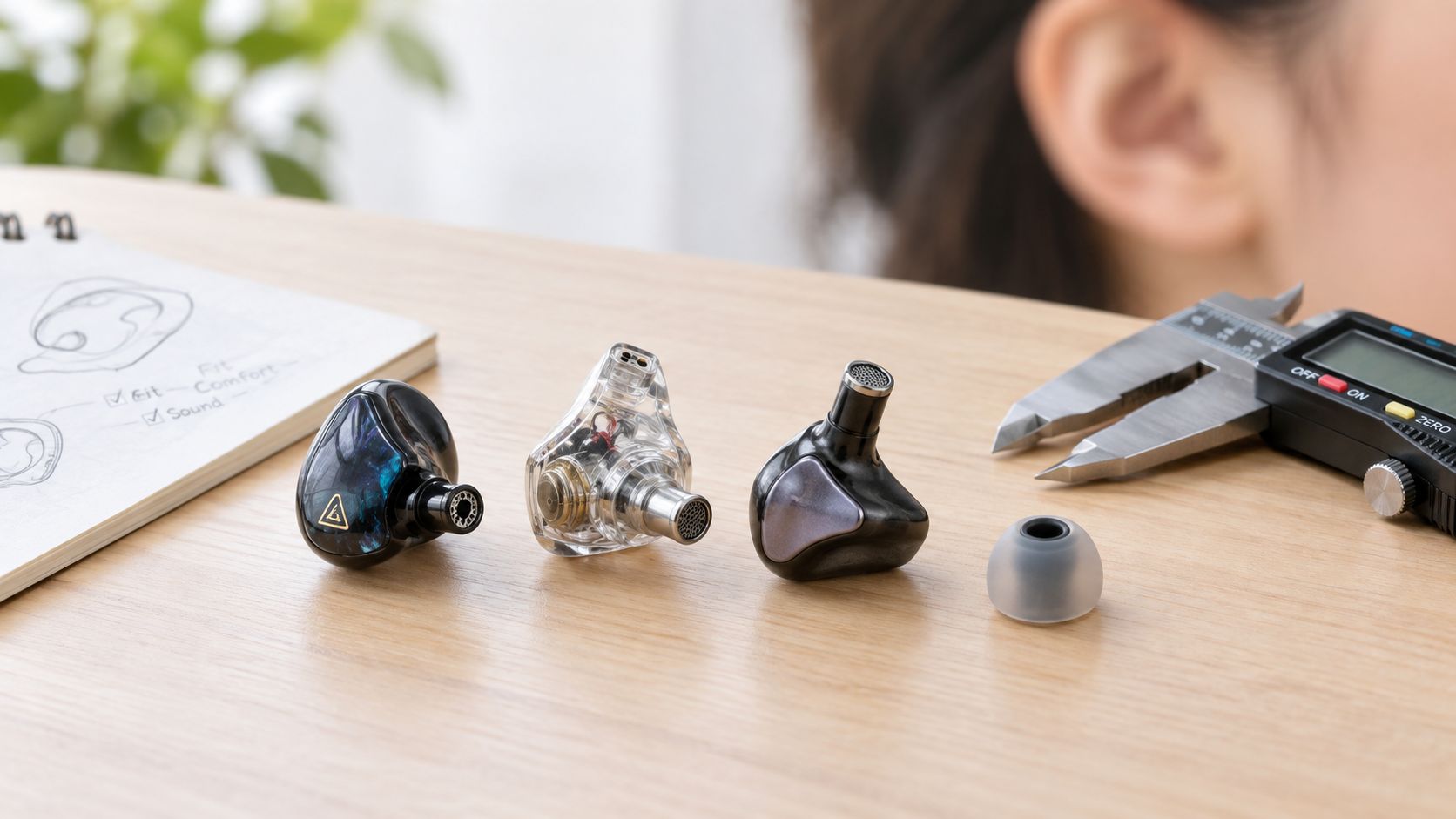
The most comfortable IEM isn't necessarily the smallest, lightest, or most expensive one. Comfort is downstream of geometry, and a beautifully tuned monitor can still become an expensive drawer ornament if its nozzle presses the wrong part of your canal.
I've worn enough in-ear monitors through commutes, long desk sessions, and side-sleeping to distrust spec-sheet theatre. Driver count doesn't tell you whether the shell will jab your antihelix. A prestige logo doesn't reveal whether the nozzle angle will torque the housing outward. Even the same model can feel invisible in one ear and unbearable in another.
The useful question isn't “Which IEM is universally most comfortable?” That model doesn't exist. The useful question is which fit profile matches your ear and your routine. Shallow or deep insertion, flush or protruding housing, straight or angled nozzle, soft or firm tips. Those are the load-bearing decisions.
Table of Contents
- Comfort Is a Geometry Problem, Not a Brand Problem
- The Three Variables That Decide If an IEM Disappears
- Matching Fit Profile to Ear Anatomy
- Comfort Across Real Situations
- Comfort-First IEMs Compared on the Same Criteria
- Tips, Seal, and the Smallest Tip That Actually Works
- What to Buy If Comfort Is the Whole Point
Comfort Is a Geometry Problem, Not a Brand Problem
A costly IEM with an awkward shell remains awkward. I've abandoned hyped monitors after an hour because the housing rubbed a ridge in my outer ear, while compact, inexpensive designs stayed comfortable through an entire work session. The sound can be excellent. The fit still wins.
Balanced armature technology helps explain why many comfortable IEMs can stay compact. Knowles' historical introduction says audio engineers began adapting hearing-aid balanced armature drivers for in-ear monitors in the 1980s because they offered precise reproduction and more passive isolation than moving-coil speakers. The important point isn't nostalgia. Smaller driver architecture gives designers more room to keep the body tucked inside the ear rather than building a brick into the concha.
Practical rule: Treat the shell as furniture for your ear. A chair can be beautifully upholstered and still punish your back.
The fit taxonomy I use is straightforward:
- Shallow insertion: The tip seals near the canal entrance. This often suits listeners who dislike pressure deep inside the ear.
- Deep insertion: The nozzle travels farther into the canal. It can offer a stable seal, but it demands compatible anatomy and tolerance.
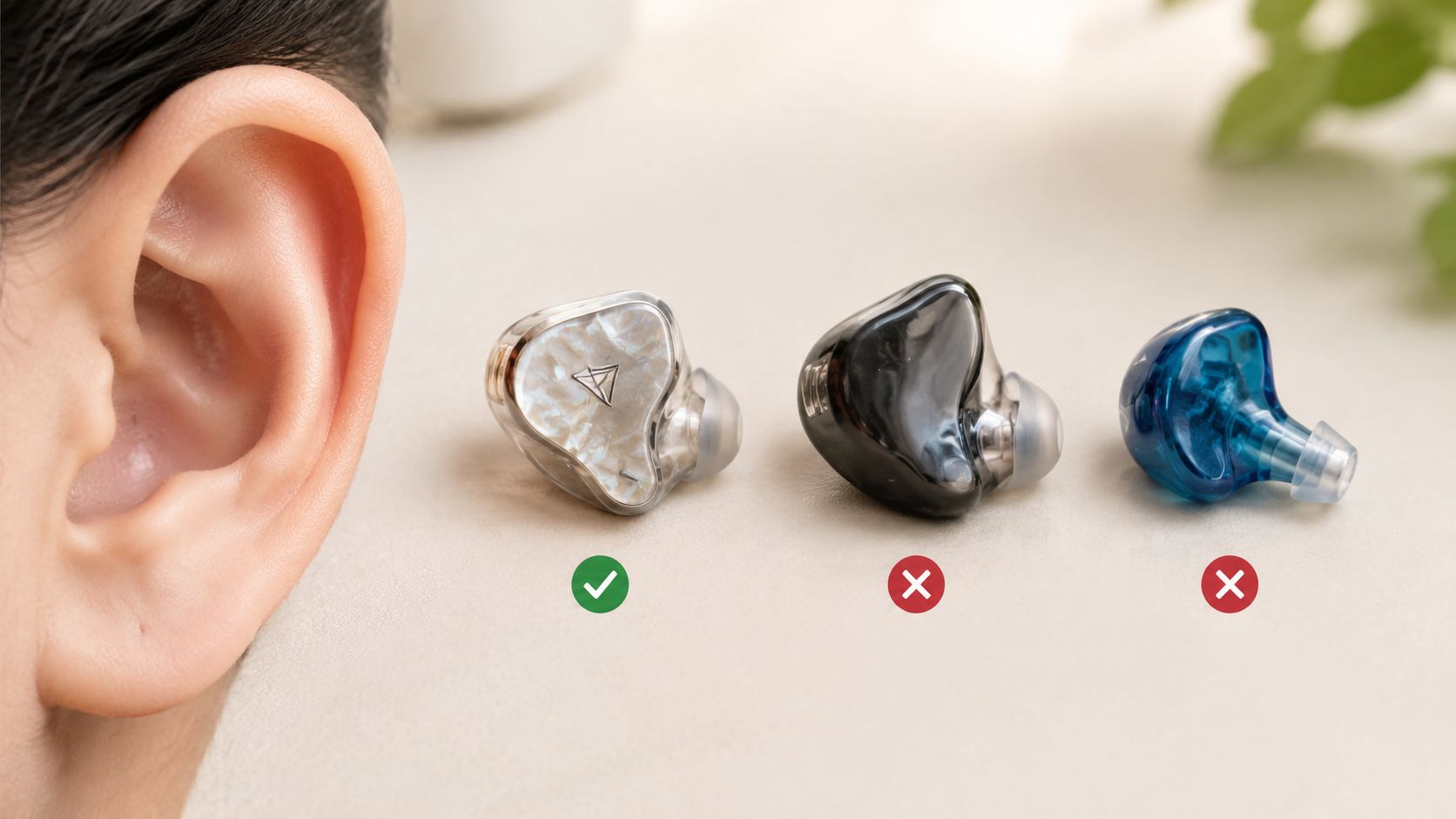
- Flush housing: The body nests inside the outer ear with little protrusion. This is the profile to investigate for sleeping and headwear.
- Protruding housing: The shell extends beyond the concha. It may offer more internal space for hardware, but it creates more contact with pillows, glasses, and hands.
- Straight nozzle: The nozzle exits directly from the shell. Its success depends heavily on the angle of your canal.
- Angled nozzle: The nozzle follows the natural path of the ear canal, reducing the tendency for the housing to lever outward.
A 2026 pilot study gives comfort more substance than forum folklore. Participants rated an in-ear EEG device at a median 8 out of 10, compared with 6.5 out of 10 for conventional scalp EEG, while mean scores were 8.1 ± 0.9 and 6.6 ± 1.8 respectively, as reported by Frontiers in Digital Health. That hardware isn't a music IEM, so I won't pretend it proves a particular earphone fits everyone. It does support the broader point: in-ear comfort can be measured, and considerate geometry matters.
The right IEM disappears for a reason.
The Three Variables That Decide If an IEM Disappears
Three physical variables do most of the work: nozzle diameter, shell volume, and nozzle angle. They interact, but separating them makes an uncomfortable IEM easier to diagnose.
Nozzle diameter is the first suspect when your canal feels compressed. Independent fit guidance places typical IEM nozzle diameters between 4 mm and 6 mm, and describes nozzles at or below roughly 5.0 mm as a useful comfort target, with approximately 4.5 mm particularly friendly to narrow canals, according to this small-ear fit guide. A broad nozzle spreads pressure across a larger structure, but it can also create a hard hotspot where your canal has less room.
Shell volume creates a different problem. A large body can press against the tragus, antitragus, or antihelix, especially when you talk, chew, or turn your head. That pressure doesn't always announce itself immediately. It accumulates through tiny movements until the ear starts making the listening decision for you.
Nozzle angle and length decide whether the shell sits naturally or fights your anatomy. A nozzle that tracks the canal lets the housing settle into place. A straight or poorly aligned nozzle can push the shell outward, increasing contact at the concha and making the cable pull matter more than it should.
| Variable | Low Loading | High Loading |
|---|---|---|
| Nozzle diameter | Narrower contact, less canal-wall pressure, easier shallow seal | Wider contact, more pressure hotspots, greater risk of plug-like fatigue |
| Shell volume | Compact body, fewer outer-ear contact points, easier movement | Bulky body, tragus or antihelix pressure, more interference with pillows and glasses |
| Nozzle angle and length | Canal-aligned entry, stable seating, less outward torque | Misaligned entry, housing leverage, shifting seal and migrating hotspots |
At home, don't begin with music. Insert the IEM, relax your jaw, then talk and slowly rotate your head. If the shell moves when your jaw moves, the fit is relying on friction rather than anatomy. Press the housing gently inward, then release. If comfort improves only under pressure, the nozzle or tip is probably doing too much work.
A comfortable fit should survive movement without needing constant correction.
Matching Fit Profile to Ear Anatomy
Small ears don't automatically require tiny IEMs, but compact shells and modest nozzles give them more margin for error. A low-profile body has fewer chances to collide with the tragus or antihelix, while shallow insertion avoids forcing a long nozzle into a narrow canal.
For small ears, start with a shallow-fit, flush or mildly protruding profile. The Moondrop Aria and Final E500 belong to the general category worth investigating, not because a product name guarantees comfort, but because compact designs reduce the amount of body competing for space. Keep the nozzle below the rough 5.0 mm comfort target described in the earlier fit guidance, and pay attention to nozzle angle rather than shell size alone.
Larger outer ears can accommodate more housing volume, and some listeners with roomier canals prefer deeper insertion. An Etymotic ER2XR-style profile can feel stable and remarkably unobtrusive to the right listener. To another person, that same deep fit can feel invasive. Deep insertion isn't superior. It's a different chair.
A quick anatomy check
Use a mirror and your smartphone camera before you buy. You aren't trying to photograph the inside of your canal. You're classifying the outer ear and the entrance geometry.
- Check the available concha space. If the visible bowl is shallow or crowded by the tragus and antihelix, favour a compact, low-profile shell.
- Look at the canal entrance. A narrow-looking opening suggests starting with smaller tips and a thinner nozzle. A wider opening gives you more freedom, but it doesn't guarantee that deep insertion will feel good.
- Watch the angle. Compare the canal entrance with the direction an IEM nozzle would need to travel. If that path points upward or forward, a straight nozzle may push the shell away from your ear.
- Test jaw movement. With an existing IEM inserted, speak, chew, and smile. Pressure that appears only during movement points to contact mechanics, not a simple tip-size problem.
Your left and right ears may need different tips. That's normal. The generic medium pair supplied in the box is a starting point, not a verdict.
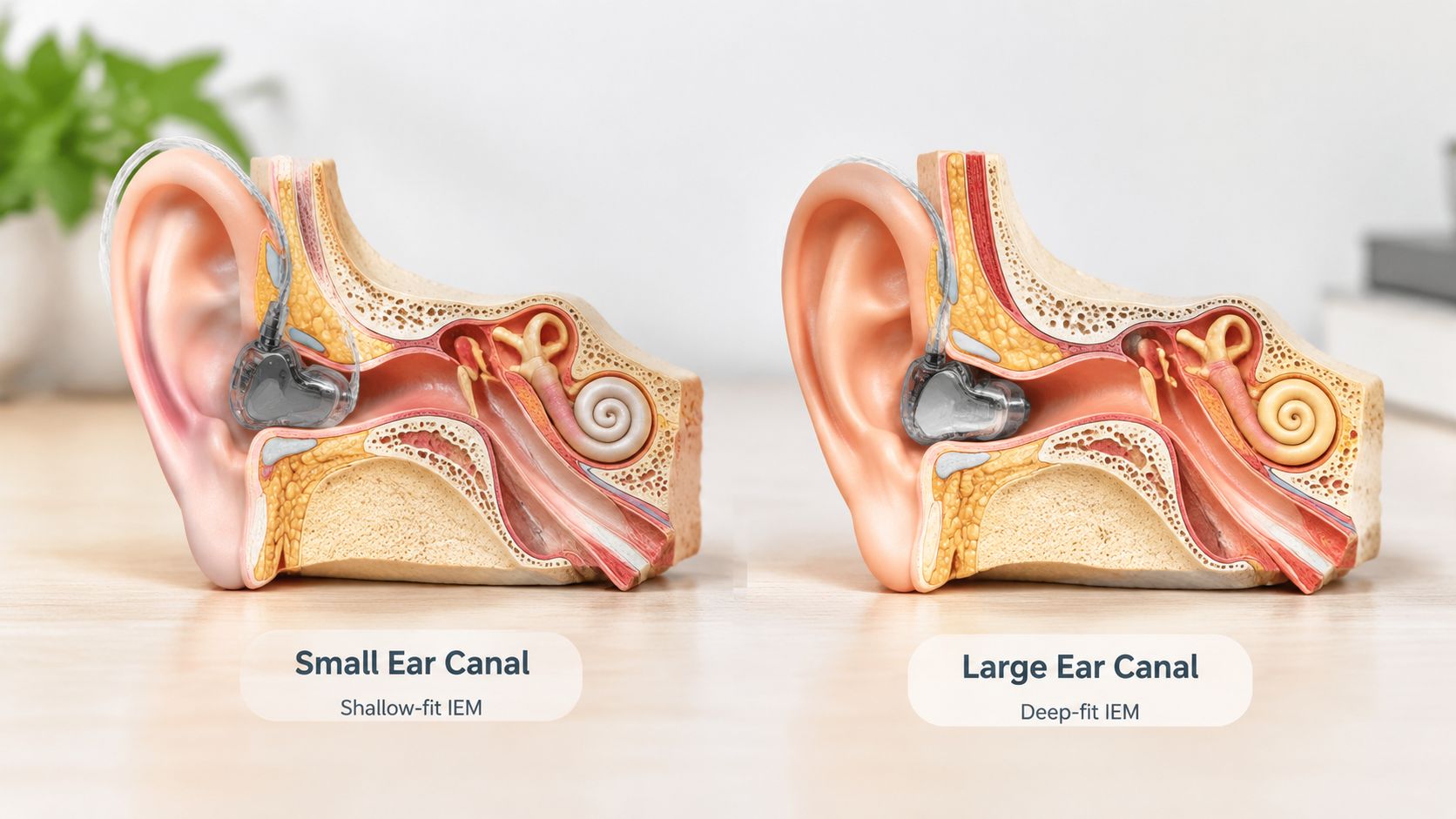
A round canal and an oval canal can react differently to the same tip. So can a canal that narrows sharply after its entrance compared with one that stays open farther in. If your IEM feels fine at first and then develops pressure, your ear may tolerate the entrance but reject the deeper contact.
Classify the ear before classifying the IEM.
Comfort Across Real Situations
Comfort changes with the activity. An IEM that feels perfect at a desk can become a nuisance against a pillow, beneath a hood, or beside the hinge of your glasses. I don't use one universal comfort score because the ear doesn't experience one universal pressure pattern.
| Use Case | Best Fit Profile | Critical Constraint | Failure Mode to Avoid |
|---|---|---|---|
| Side-sleeping | Shallow-flush or sub-flush | No faceplate ridge and minimal outward body | Pillow pressing the shell into the tragus |
| Commuting | Hybrid or controlled deeper fit | Stable seal with a slim external profile | Housing shifting as footsteps and cable movement disturb it |
| Wearing glasses | Shallow-flush or slim hybrid | Clearance around the temple arm and hinge | Wide shell colliding with the glasses frame |
| Long desk sessions | Flush hybrid or shallow-flush | Pressure spread across stable contact points | One small hotspot growing unnoticed over time |
Pillows punish protrusion
Side-sleeping exposes the weakness of large shells immediately. A protruding body turns the pillow into a lever, pressing the housing inward while the nozzle pushes against the canal. The Shure SE846 is a useful benchmark for this category because independent reviewers have described its small ergonomic housing as sitting fully inside the outer-ear cavity, avoiding spillover into the concha and reducing pressure on the antihelix, as documented in this comfort-focused review discussion.
The fit profile to seek is shallow-flush. A low shell matters more than an elaborate faceplate. If the body clears the pillow, the rest of the design has a chance.
Commuting rewards stability, not maximum depth
A commute adds footfall, cable movement, and changing external noise. A slightly deeper or hybrid fit can hold its seal better than a loose shallow fit, but depth shouldn't become a contest. Foam can help a marginal seal, while an angled over-ear cable route keeps the body from swinging.
The right commuter IEM sits firmly without requiring a hard push. If you need to reseat it every time you turn your head, the geometry is wrong.
Glasses and long sessions expose contact points
Glasses wearers should inspect the space around the temple arm and hinge. A wide rectangular shell can collide with that hardware even when the canal seal feels fine. A slim, cavity-shaped body usually behaves better.
For a long desk session, prioritise distributed contact over a single pressure point. Let the shell nest against the ear rather than clamp it. If your jaw movement changes the sensation, stop chasing a tighter seal and revisit the nozzle angle or tip size.
Six hours reveals the truth.
Comfort-First IEMs Compared on the Same Criteria
I'm not ranking these monitors by sound. That would contaminate the question. Think of them as chairs with different seat depths, widths, and backs. The same dimensions matter every time, but different ears prefer different furniture.
The table uses qualitative fit judgements rather than invented measurements. Manufacturers and retailers don't provide a consistent public set of nozzle length, shell footprint, weight per side, and protrusion-depth figures across these models, so pretending otherwise would be spec-sheet cosplay.
| Model | Nozzle Length | Shell Footprint | Weight/Side | 6-Hour Comfort | Side-Sleep Score |
|---|---|---|---|---|---|
| Moondrop Chu II | Short to moderate, anatomy-dependent | Compact metal body | Light to moderate feel | Strong for shallow-fit listeners | Fair, depending on protrusion |
| Truthear Hexa | Moderate insertion | Compact contoured shell | Light to moderate feel | Strong for ears that accept mid-depth seating | Fair to good |
| Sennheiser IE 200 | Short to moderate | Compact rectangular shell | Light feel | Strong for long wear | Good when seated flush |
| Final E5000 | Longer, deeper-insertion profile | Slim bullet-style body | Cable and metal body influence feel | Excellent for listeners who tolerate depth | Good for compatible ears |
| 7Hz Salnotes Zero | Short to moderate | Flat, shallow-oriented shell | Light feel | Strong for low-pressure use | Good if the faceplate clears the pillow |
The Moondrop Chu II makes sense for listeners who want a compact, shallow-oriented option, though its metal body can still create a contact point if your outer ear is crowded. The Truthear Hexa sits in a more middle-depth category. It can suit smaller ears better than its internal hardware might suggest, provided the nozzle and tip combination doesn't force pressure at the canal entrance.
The Sennheiser IE 200 is the safer shape for people who want a compact rectangular body that stays out of the way. It's the kind of IEM I'd put on a glasses wearer's shortlist before looking at driver architecture. The Final E5000 offers a slim bullet-style approach, but its deeper insertion changes the deal. If your canals dislike depth, its minimal external shape won't rescue the experience.
The 7Hz Salnotes Zero appeals to low-profile wearers who value a flat, shallow shell. It can work well for desk use and side-sleeping, but the faceplate and nozzle still need to align with your ear. Flat doesn't mean universally flush.
For a broader explanation of why driver architecture shouldn't dominate the fit decision, see dynamic driver versus balanced armature designs. The driver is upstream of sound. The ear interface remains upstream of comfort.
Choose the seating shape first.
Tips, Seal, and the Smallest Tip That Actually Works
The cheapest comfort upgrade is usually not a new IEM. It's the tip you stop forcing into your ear.
A tip has to seal, but it doesn't need to create a pressure monument. Campfire Audio's ear-tip fit guidance describes nozzle diameters commonly ranging from 4 mm to 6 mm and makes the practical case for a slightly looser fit that still seals. That distinction matters. A tight seal can preserve bass while turning the canal wall into a pressure hotspot.
Independent experimental work makes the physical mechanism clearer. In a study of ear tips with similar foam stiffness, a tip with a larger and more rigid sound bore exerted nearly twice the force on an ear-canal surrogate, while finite-element modelling identified pressure hotspots created by material and geometry differences, as shown in the published ear-tip study. The tip isn't a passive accessory. It is the contact surface.
Silicone, foam, and the seal compromise
Silicone keeps the fit clean, durable, and easy to adjust. It works best when the size matches the canal without excessive compression. Foam conforms more readily and can rescue an irregular seal, but its feel changes as it compresses and wears.
Insertion depth adds another variable. A longer stem can push the sealing section farther in than intended, while a short stem may leave the tip unstable. The tip should sit on the nozzle without bottoming out against the housing or forcing the nozzle deeper than your anatomy wants.
Run the pressure test
Insert the IEM with a gentle twist. Hold it in place for five seconds, then release and listen for pressure equalisation. Move your jaw, speak, and turn your head. If the seal stays intact and you feel no growing pressure, you've found a workable combination.
The goal is not the largest tip. It's the smallest tip that seals.
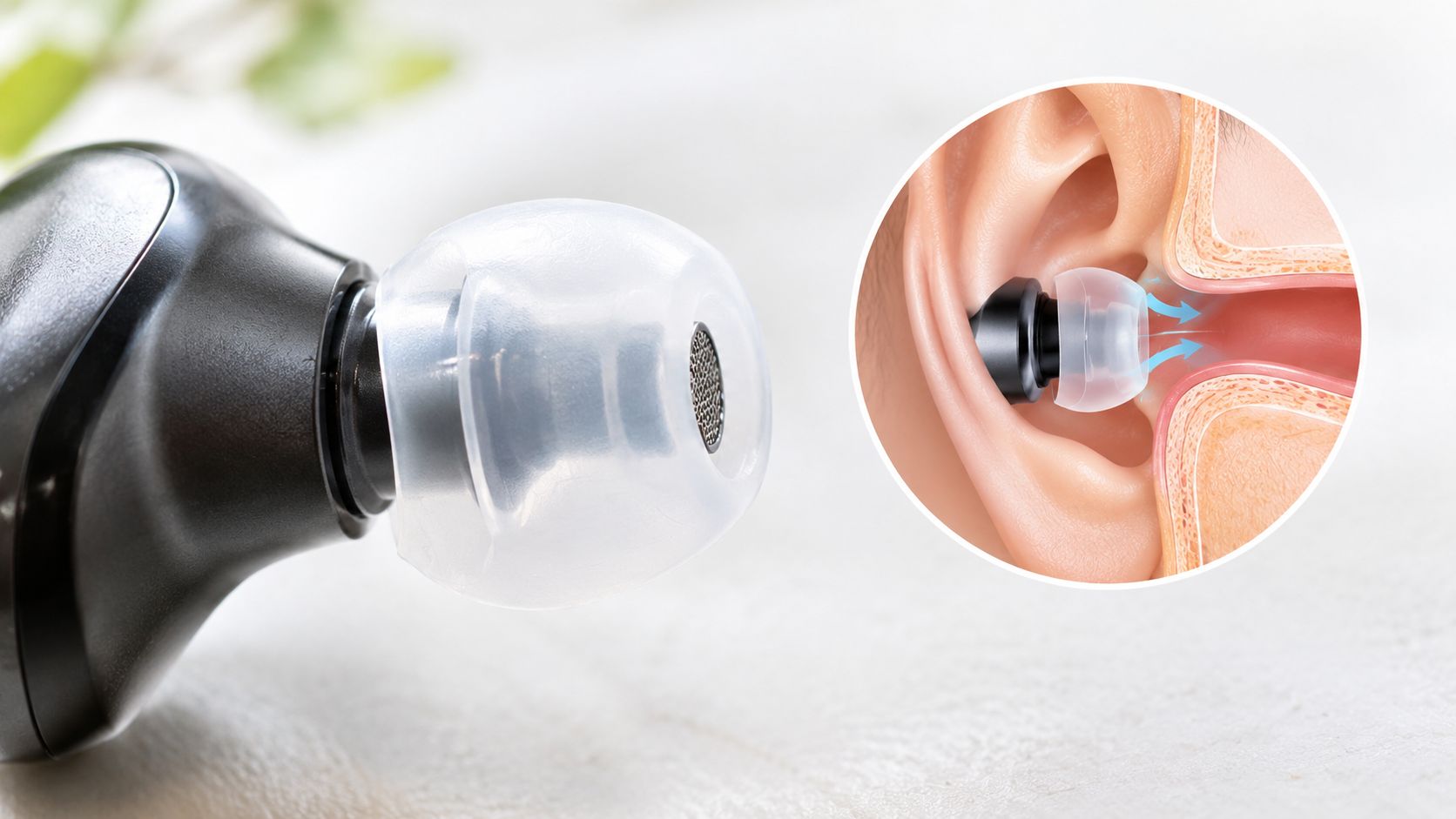
Use different sizes for each ear if necessary. A tip that seals with barely perceptible contact usually beats one that creates a strong vacuum-like sensation. For a more detailed practical fitting routine, use this IEM fit guide.
Seal first. Pressure second.
What to Buy If Comfort Is the Whole Point
Driver count doesn't predict comfort. A monitor can house one driver or several and still fail because the nozzle is too wide, the shell catches on the antihelix, or the faceplate presses into a pillow. Popularity doesn't predict comfort either. Review consensus can't see inside your ears.
For small ears that prefer shallow insertion, I'd start with the 7Hz Salnotes Zero as the primary pick, with the Moondrop Chu II as the fallback. Both belong to the compact, low-pressure conversation, but the final decision depends on whether the shell shape and nozzle align with your canal entrance.
For listeners who want mid-depth seating without a huge body, the Truthear Hexa is the primary choice, with the Sennheiser IE 200 as the fallback when a more compact outer profile suits the ear. The Hexa gives you a more structured, contoured fit. The IE 200 makes more sense when glasses, headwear, or outer-ear space complicate the seating area.
| Fit Profile | Primary Pick | Fallback Pick | Best Use Case |
|---|---|---|---|
| Shallow-fit small ears | 7Hz Salnotes Zero | Moondrop Chu II | Low-pressure desk listening and modest movement |
| Mid-depth compact fit | Truthear Hexa | Sennheiser IE 200 | Long sessions where a stable seal matters |
| Flush external profile | Sennheiser IE 200 | 7Hz Salnotes Zero | Glasses, headwear, and cautious side-sleeping |
| Deep-insertion tolerance | Final E5000 | Truthear Hexa | Listeners who prefer a stable internal anchor |
| Tiny bullet-style preference | Final E5000 | 7Hz Salnotes Zero | Minimal outer-ear contact |
For deep-canal listeners who don't mind insertion, the Final E5000 earns the primary position because its slim bullet-style body can stay clear of the outer ear. The Truthear Hexa is the fallback when you want less reliance on deep seating. For side-sleeping, the Sennheiser IE 200 is the more sensible first look because compact external geometry matters more than driver theatre.
The best answer for “most comfortable IEM” is therefore conditional. Pick the profile before the model, then try the smallest sealing tip before buying anything new. If you're still learning the category, Supermarket Sound's beginner's guide to in-ear monitors covers the wider selection process.
Your ears are the final reviewer.
Before buying another monitor, map your fit profile, test the smallest tip that seals, and reject any shell that creates a hotspot during jaw movement. If you're comparing models now, start with the table above, then choose the geometry that matches your ears and your actual routine. Comfort isn't a luxury feature. It's the floor everything else stands on.

