Two amplifier boxes don't make a system sound better. They make it take up more shelf space.
The choice in integrated amplifier vs power amplifier isn't prestige, future-proofing, or how impressive the rack looks in a photograph. It's whether your speakers and room need more current, more headroom, cleaner separation between circuit jobs, or just a well-designed amplifier that doesn't starve the signal with unnecessary links. I'd choose an honest integrated amplifier over a lazy separates stack every time.
The room gets the final vote. The brochure only gets a speaking part.
Table of Contents
- Stop Confusing Boxes With Sound Quality
- What Each Architecture Actually Does
- Integrated Amplifier vs Power Amplifier Performance
- Matching Amplification To Speakers And Room Load
- Noise Floors, Power Supply Sharing, And Upgrade Paths
- When To Choose Integrated Versus Separate Amplification
- Marque's Plain-Spoken Listening Conclusion
Stop Confusing Boxes With Sound Quality
A second chassis isn't a sonic upgrade by itself. It's just a second chassis.
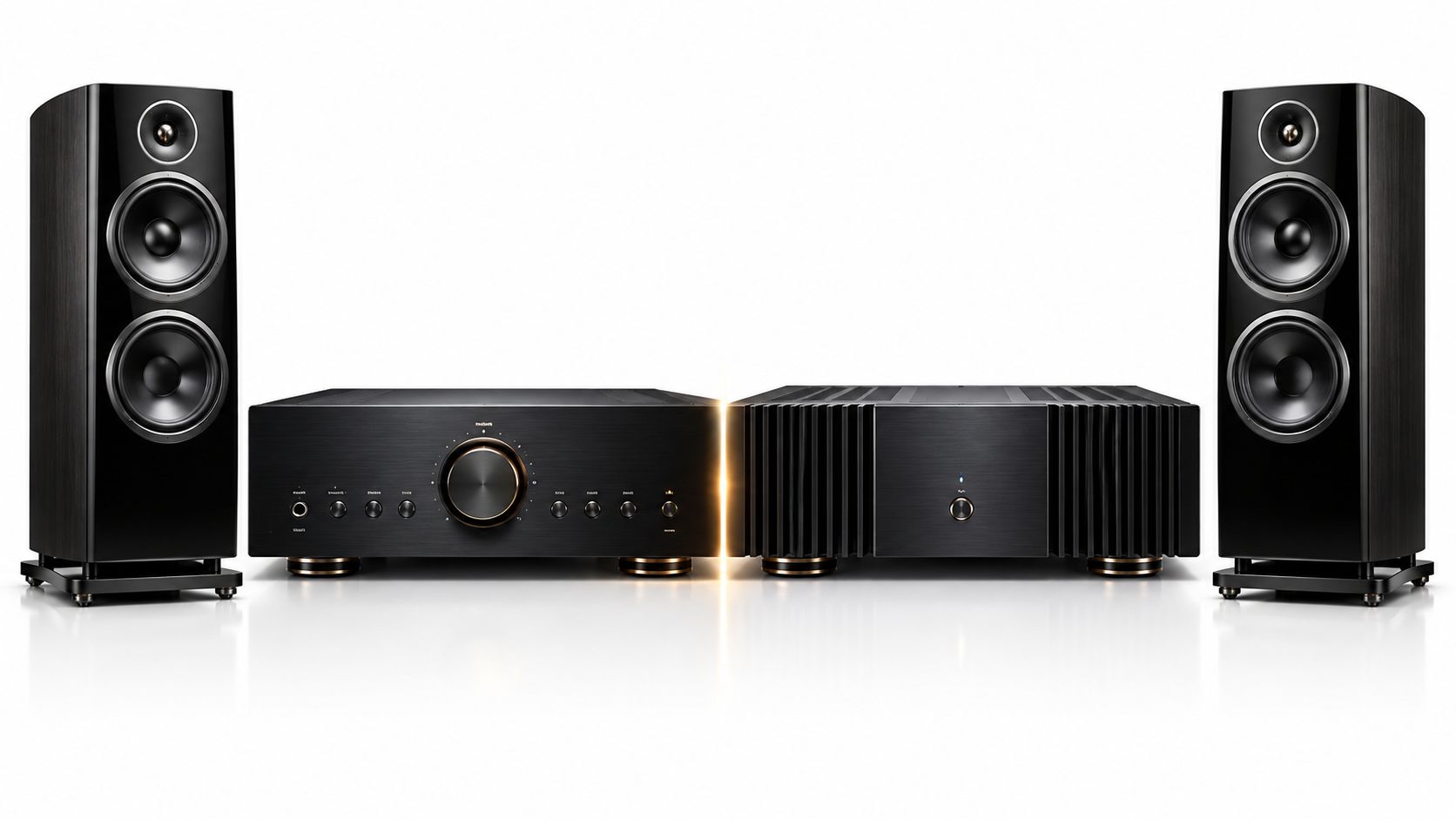
An integrated amplifier combines the preamplifier and power amplifier in one enclosure. The preamp selects sources and controls volume. The power amp takes that managed line-level signal, raises its voltage and current, and drives the speakers. A standalone power amplifier only handles the final speaker-driving stage, so it needs an external preamp for source switching and volume control. Crutchfield's explanation of integrated amplifiers lays out those separate jobs clearly.
That architecture creates a genuine engineering trade-off. A single enclosure has to manage sensitive preamp circuitry and a high-current output stage while keeping power supply noise, grounding, heat, and physical layout under control. Separate components give each stage more physical and electrical room, but they also add interconnects, another power supply, another ground relationship, and another place for a designer to get careless.
The practical rule: separation creates options. It doesn't create performance automatically.
The signal path matters more than the furniture
A good integrated amplifier can keep the signal path short and controlled. Fewer links mean fewer connectors, fewer cables, and fewer opportunities for a poor interface to soften transients or raise noise. That doesn't make every integrated amplifier superior. It means the one-box arrangement has a real technical advantage when the designer uses it properly.
Separation earns its keep when the output stage needs more current, when the speaker presents an ugly impedance curve, or when the owner wants to replace stages independently. It can also help a manufacturer isolate delicate preamp circuitry from the magnetic and electrical demands of the power section. But a weak preamp feeding a powerful amplifier still produces a weak system. Downstream inherits upstream decisions.
The history makes the distinction clearer. Power amplification came first, with the triode vacuum tube breakthrough in 1906 and Bell Labs' first working solid-state amplifier in 1947. In 1957, Cerwin-Vega introduced one of the world's first high-power transistor power amplifiers, rated at 125 W, according to this history of integrated and power amplification. Integrated amplifiers later brought those jobs together for practical stereo systems.
The room still decides.
What Each Architecture Actually Does
Start with the signal, not the shopping category.
A source sends a line-level signal to the preamplifier. The preamp chooses which source you want and sets the listening level. It may also provide tone controls, phono equalisation, digital conversion, Bluetooth, or network inputs, depending on the design. The power amplifier then takes that controlled signal and supplies the energy required to move the speaker drivers.
That's why an integrated amplifier isn't merely a power amp with a volume knob glued on. It contains two load-bearing sections with different demands. The preamp deals in small signals and control. The power stage deals in voltage, current, heat, and speaker impedance.
A plain-language explanation of what an integrated amplifier is helps keep those roles separate in your head. One box doesn't mean one function.
The integrated route
An integrated amplifier connects your sources directly to one central component, then sends the amplified signal to passive speakers. That arrangement reduces setup complexity and often makes daily use much cleaner. You can change sources and volume without adding a dedicated control unit to the rack.
Yamaha identifies the early 1970s as the point when integrated amplifiers became a mainstream high-end home-audio format. In 1972, Yamaha launched its first-generation 700 Series integrated amplifiers, marking an explicit move away from the separate preamp and power-amp stacks that had dominated the 1960s. Yamaha's hi-fi history treats that shift as an architectural milestone, not a fashion cycle.
The appeal remains obvious. One enclosure can provide source management, volume control, amplification, and sometimes digital or phono facilities. That makes an integrated amplifier a compact control centre rather than a compromised substitute.
The separate power route
A dedicated power amplifier sits after a preamp. It doesn't select sources or control listening level. Its job is narrower, and that narrowness can be valuable.
A manufacturer can devote the enclosure, transformer, heatsinking, and output devices to speaker control. You can replace the power amp without replacing the preamp, or change the preamp while keeping the power stage. That flexibility suits listeners who want to build a system in stages or match different circuit personalities over time.
But every added component brings another connection and another electrical relationship. A separates system only improves the music when those additional resources solve a real problem.
Architecture explains the choice. It doesn't settle it.
Integrated Amplifier vs Power Amplifier Performance
Box count does not determine performance. The room, speaker load, and amplifier's control of that load do. A separate power amplifier earns its place only when it delivers more current, headroom, or stability than a capable integrated amplifier can provide.
The figures often used to illustrate high-output integrated performance include 125 W into 8 Ω, 250 W into 4 Ω, a 109 dB signal-to-noise ratio, 0.008% THD+N at 1 W, 0.003% THD+N at full rated power, a 700 damping factor, and frequency response extending to 90 kHz. The supplied MOON 641 product page does not match the named product, so it should not be presented as verification of those MOON specifications. Treat the figures as an example of what a serious integrated design may claim, not as confirmed data from that link.
The useful point is the relationship between the numbers. Output that rises from 8 Ω to 4 Ω suggests greater current capability than an amplifier whose output barely changes with a lower impedance. Low distortion indicates clean operation under the stated test conditions. A high signal-to-noise ratio can support a quieter background, although room noise, speaker sensitivity, and gain structure still decide how much of that advantage you hear.
Damping factor is the load-bearing number
Damping factor describes the amplifier's electrical control over the speaker's motion. It does not predict the entire sound, but it matters when the speaker's impedance changes sharply or the room already reinforces the bass.
A high damping factor can produce firmer bass starts and stops, less overhang, and clearer rhythm. The effect depends on the speaker, its crossover, and the cable resistance between amplifier and driver. A large number is not a guarantee of better sound. It becomes useful when it addresses a real load problem.
A second example lists 303 W into 8 Ω, stability to 2 Ω, a damping factor above 4000, and distortion below 0.005% at 50 W. The supplied H600 performance information also does not match the named product, so those figures should not be attributed to that model without a correct source. The engineering lesson remains valid: an integrated amplifier with strong current delivery and impedance stability can compete with separates on speaker control.
| Metric | What It Controls | Integrated Example Behavior | Separate Power Example Behavior |
|---|---|---|---|
| Output power | Clean volume and transient headroom | 125 W into 8 Ω and 250 W into 4 Ω indicate useful reserve | A dedicated stage may provide more reserve for demanding speakers |
| Signal-to-noise ratio | Background quietness | 109 dB SNR indicates a low-noise operating floor | Physical separation may reduce interaction between preamp circuitry and the power supply |
| Distortion | Accuracy under load | 0.008% THD+N at 1 W and 0.003% at full rated power show low measured distortion | A dedicated design can focus on composure at high output |
| Damping factor | Electrical control of woofer motion | A 700 damping factor supports firm control | Above 4000 indicates exceptionally strong electrical grip |
| Impedance stability | Behaviour with difficult speakers | Operation into 4 Ω suggests current capability | Stability to 2 Ω gives more margin with hostile loads |
The strongest power amplifiers outperform weaker integrated amplifiers in headroom and control. The strongest integrated amplifiers close that gap while retaining source switching and volume control.
Choose separation for a load problem, not for the visual authority of extra boxes.
Matching Amplification To Speakers And Room Load
More amplifier boxes do not fix a speaker that presents the wrong load. Start with the room and speakers, then decide whether separation earns its place.
Impedance describes the electrical load presented to the amplifier, measured in ohms. Lower impedance demands more current from the output stage, while a speaker's impedance curve shows how that demand changes across frequencies. Sensitivity describes how loudly a speaker plays from a 1-watt input measured at 1 metre. High-sensitivity speakers can reach satisfying levels with modest power, while inefficient designs need more current and headroom. This amplifier-matching guide explains why sensitivity and impedance belong in the same decision. For a practical explanation of the relationship, see this guide to impedance matching.
Room size changes the demand. A compact room with efficient speakers rarely needs a huge power amplifier. A larger room, longer listening distance, or low-sensitivity speaker consumes headroom quickly. The same integrated amplifier can sound open in one system, then compressed in another because the load asks more than its output stage can deliver comfortably.
Read the speaker before reading the amplifier
Look beyond the nominal impedance printed on the speaker. A model labelled as an easy load can still dip sharply at particular frequencies. That is where a limited power supply may lose control. Listen for bass that fattens under pressure, vocals that harden as volume rises, or percussion that loses its snap.
Damping factor matters here. It indicates how firmly the amplifier can control the speaker's woofer electrically, but a large figure alone does not guarantee a better result. The amplifier must remain stable as impedance shifts, and its current delivery must suit the speaker's lowest practical load.
Sensitivity works in the opposite direction. Efficient speakers keep the amplifier in a more comfortable operating range. With that kind of speaker, a well-designed integrated amplifier often gives all the control you need without adding a preamp, power amp, and interconnects that solve no actual problem.
Match the amplifier to the speaker's worst behaviour, not its friendliest headline.
Where separates earn their place
Separation earns consideration when the room and speaker load expose an integrated amplifier's limits. A demanding low-impedance speaker may benefit from a dedicated output stage with greater current reserves, higher headroom, and stronger electrical control. A distant listening position can increase that demand.
The second box still needs the right numbers. If its damping factor, power supply, or impedance stability suit the speaker poorly, separation only gives the mismatch more capacity to waste. Marketing noise cannot turn an unsuitable amplifier into a good system match.
Friendly load? Choose integration. Hostile load? Consider separation.
Noise Floors, Power Supply Sharing, And Upgrade Paths
The hidden cost of integration is shared real estate inside the chassis. The preamp wants a quiet electrical environment. The power stage pulls hard on the supply and generates heat. A careful designer separates those domains through layout, grounding, shielding, and power-supply management. A careless one lets the output stage bully the small-signal circuitry.
When the design works, an integrated amplifier can sound remarkably clean. When it doesn't, you may hear a raised noise floor, a flatter background, or less dynamic contrast in quiet passages. Those faults don't come from the concept of integration. They come from poor execution.
Separation buys distance, not guaranteed silence
Separate components let designers distribute the power-supply burden across more than one enclosure. A dedicated power amplifier can focus its transformer, output devices, and cooling on speaker duty, while the preamp gets a quieter environment for source switching and volume control.
That arrangement can produce a darker background and more effortless dynamics. It can also produce a mess. Poor interconnects, bad grounding, mismatched gain, and careless cable routing can introduce hum or noise between the boxes. Two mediocre stages don't become transparent because they arrived in separate cartons.
A separate system gives each circuit more breathing room. It also gives every mistake a second address.
Upgrade freedom has a carrying cost
An integrated amplifier offers a simple early system. You connect sources, connect speakers, and listen. If the unit includes a DAC, phono stage, Bluetooth, or streaming inputs, you may not need extra boxes for a long time. That simplicity reduces cable clutter and limits the number of connections that can fail.
Separates offer independent replacement. You can retain a power amplifier while changing the preamp, or keep the preamp while adding more output capability. That matters if your sources, speakers, or listening priorities will change. It doesn't matter if you have one digital source, a manageable room, and no interest in rebuilding the chain.
The upgrade path should follow an actual future problem. “I might want to upgrade someday” is not a system requirement.
Spend flexibility where the room can use it
A buyer who spends heavily on separation may leave too little for speakers, placement, or room treatment. Those choices can influence the result more directly than another enclosure. A feature-rich integrated amplifier can keep the signal path compact while leaving resources for the parts that interact with the room.
The right question isn't whether separates are more upgradeable. They are. The right question is whether you'll use that flexibility.
When To Choose Integrated Versus Separate Amplification
Choose an integrated amplifier first if your system has a modest source count, a reasonable listening room, and speakers that don't present an abusive load. You'll get source switching and volume control in one chassis, fewer cables, and fewer failure points. That's not settling. It's refusing to pay for architecture you won't use.
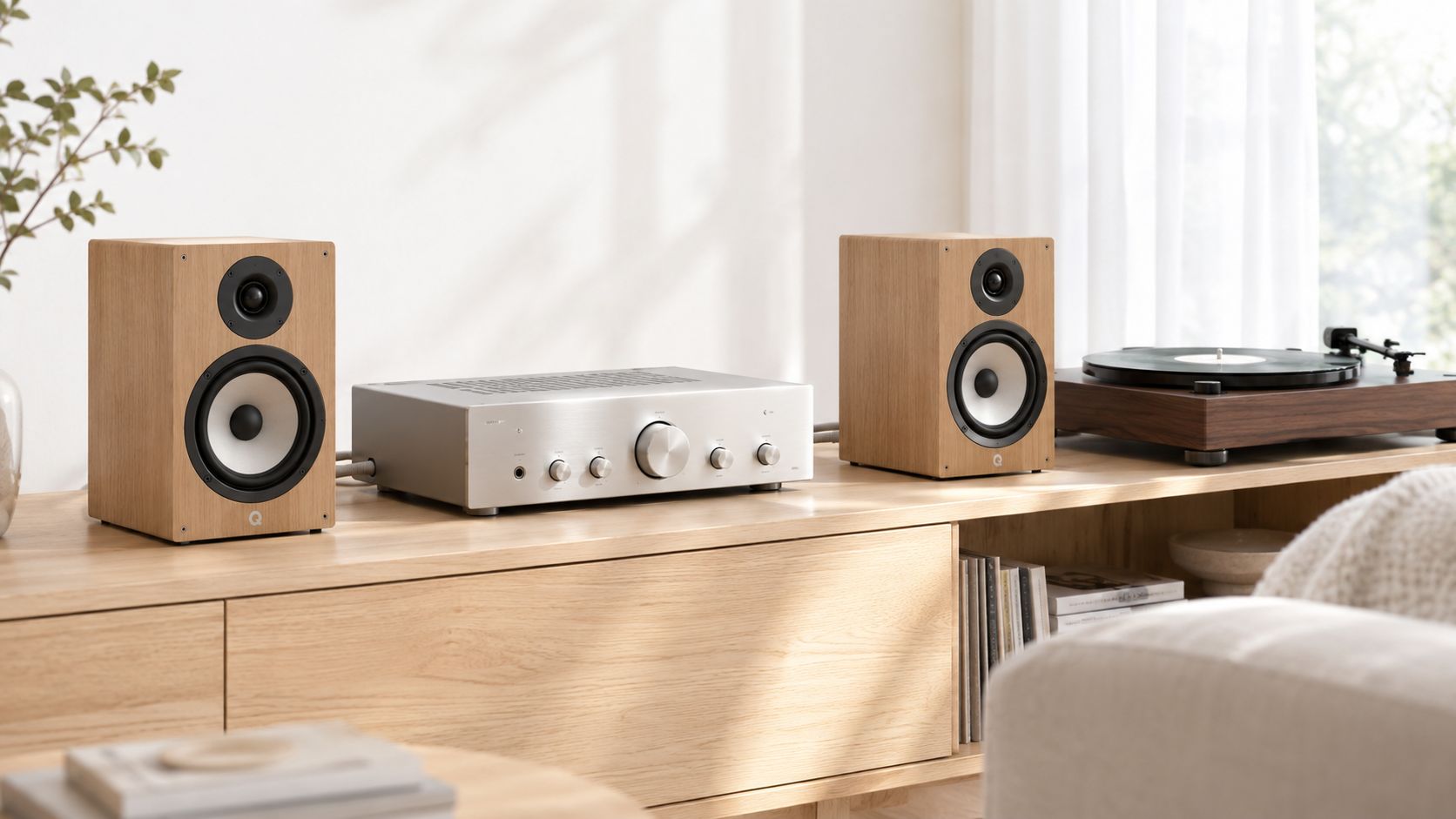
Modern integrated amplifiers increasingly act as compact control centres. They may include phono equalisation, digital inputs, Bluetooth, and streaming-style connections, while a power amplifier remains a stripped-down stage that depends on an external preamp for control. This guide to home-audio preamps and power amplifiers describes that division of labour.
Use the room as the filter
A small or moderate room with efficient speakers rarely benefits from a separates stack because the stack looks serious. A well-engineered integrated amplifier can provide enough control, a quieter physical setup, and a more coherent daily experience. Put the money into speakers and placement before you add a box.
A separate power amplifier earns consideration when low-impedance speakers demand current, when the listening position sits far away, or when louder peaks cause the integrated amplifier to sound strained. The audible symptoms matter: bass loses shape, cymbals turn hard, and the soundstage collapses when the music gets busy.
Video can help you visualise the component roles, but don't let a rack shot make the decision for you.
Choose separation for a reason
Pick separates if you need independent upgrades, a dedicated phono stage, specialised tone control, or a power amplifier built for a difficult speaker load. Pick an integrated amplifier if those needs don't exist. The extra chassis only buys something audible when it solves a load, noise, feature, or upgrade problem.
My own editorial filter is blunt. If you can't name the problem the second box fixes, don't buy the second box.
Marque's Plain-Spoken Listening Conclusion
The integrated amplifier vs power amplifier argument keeps getting framed as convenience versus serious sound. That framing is lazy. A properly designed integrated amplifier can deliver low noise, low distortion, current capability, and firm woofer control while also handling the sources and volume. A badly designed one can sound congested. A badly designed separates system can sound exactly the same, with more cable and a warmer equipment rack.
I've heard systems where the integrated route sounded faster because the signal had fewer obstacles between source and speaker. The leading edge of a snare arrived cleanly, bass notes stopped instead of dragging, and the room felt more open because the system wasn't working so hard to organise itself. I've also heard demanding speakers wake up when a dedicated power stage brought extra current and headroom. The improvement didn't sound like magic detail. It sounded like less strain.
That distinction matters. Power doesn't add a halo around the music. It keeps the amplifier from running out of road.
Specs should answer a listening question
A damping factor matters when the woofer needs firmer electrical control. Impedance stability matters when the speaker's load drops. Output power matters when the room, distance, and sensitivity demand more headroom. Distortion and signal-to-noise figures matter when you're judging how cleanly the amplifier preserves low-level information.
A spec sheet that doesn't connect to your speakers is just typography. The Hegel figures cited earlier show what a heavyweight integrated output stage can achieve. The MOON figures show how a compact integrated design can combine source management with serious measured control. Those examples don't prove every integrated amplifier equals every power amplifier. They prove the category line is too crude to make the decision for you.
For a broader look at whether amplifier differences reach the listening seat, read this explanation of whether amplifiers sound different. Then return to the system, not the argument.
My recommendation is simple
Buy an integrated amplifier when it gives your speakers enough current, your room enough headroom, and your sources enough control. Buy a separate power amplifier when the speaker load, room scale, or upgrade plan demands it. Don't buy separates to perform seriousness for strangers on the internet. The speakers won't be impressed.
The best architecture is the one that keeps the signal clean and the woofers under control. Your ears live in the room. Let the room decide.
If you're choosing between an integrated amplifier and a separate power amplifier, start with your speaker impedance, sensitivity, room size, listening distance, and source requirements. Then choose the simplest architecture that solves those real constraints. For more plain-spoken hi-fi guidance from Marque Hersh at Supermarket Sound, visit Supermarket Sound and build around what you hear, not what looks expensive on the rack.

