Class A isn't automatically better. It's automatically hotter.
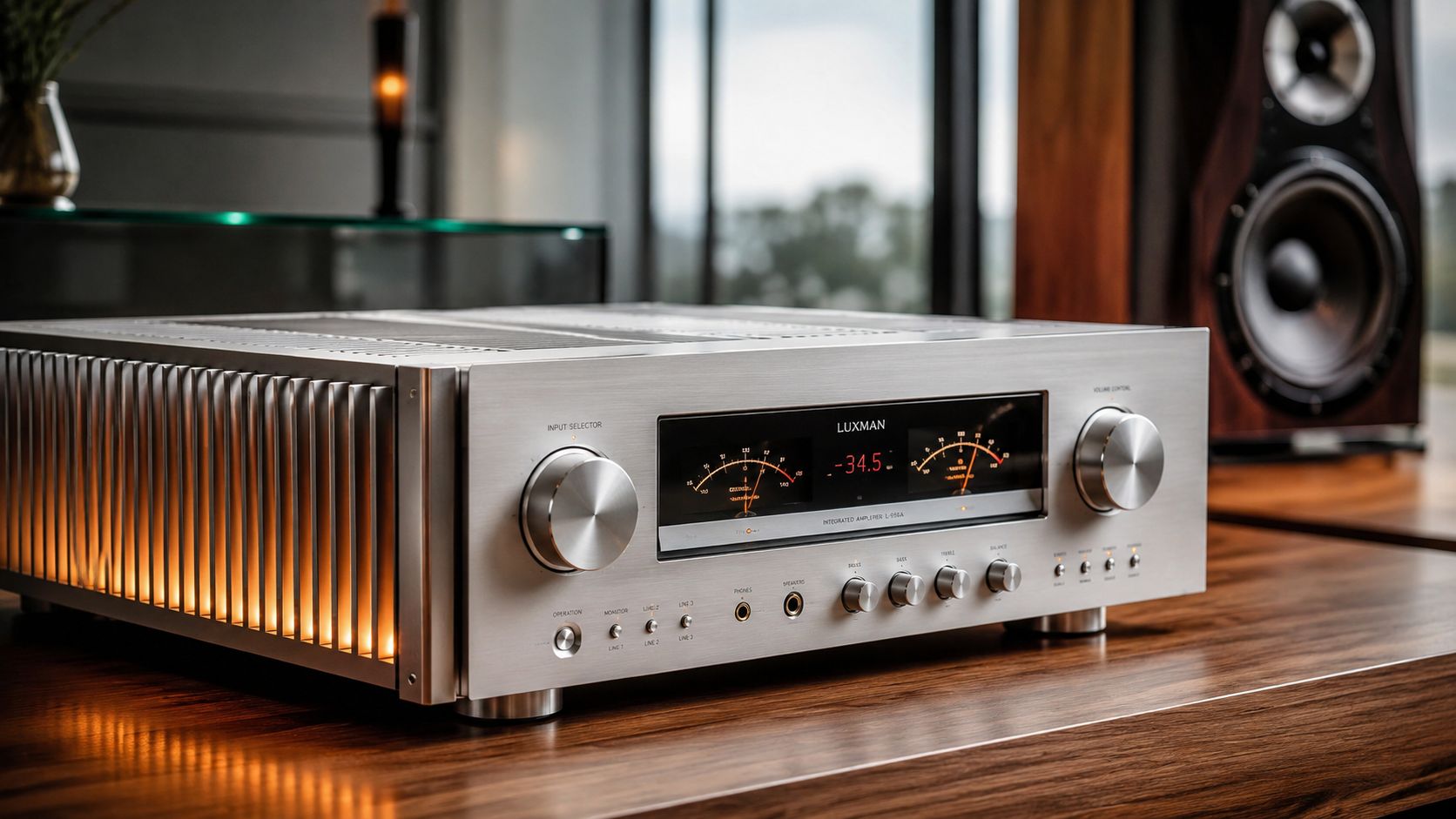
That distinction gets lost in the usual audiophile sales pitch, where the letter A starts behaving like a moral judgment. Put it on the front panel and suddenly the amplifier is supposed to be purer, more musical, more serious. After spending an afternoon with a Luxman and a Musical Fidelity A1 in a small room, I heard something more useful than a miracle. I heard a specific distortion profile, a beautifully controlled low-level presentation, and a lot of heat rising into the room.
The question isn't whether class A integrated amplifiers sound better in the abstract. It's whether their particular advantages justify the thermal, electrical, and speaker-matching costs in your system.
Table of Contents
- Why Class A Is Not Automatically Better
- How Class A Circuits Actually Work
- Class A Versus AB and D and Tubes
- What Running Class A All Day Actually Costs
- Matching Speakers and Rooms to Class A
- What to Listen for When Auditioning Class A
- When Class A Is Worth the Trade-Off
Why Class A Is Not Automatically Better
Class A is an engineering choice, not a quality tier. The output devices conduct through the full waveform, so the circuit avoids the handoff behavior associated with class AB stages. That can produce clean, composed sound at ordinary listening levels, but it doesn't create extra headroom, lower power consumption, or an easier relationship with difficult speakers.
Denon's 1981 L-550 is widely described as the world's first pure Class A integrated amplifier, a milestone that helped move the topology from niche engineering into a commercial statement piece for serious hi-fi buyers. Its appeal wasn't brute force. It was a willingness to spend electricity and chassis space in pursuit of linearity, with the heat treated as part of the design rather than an unfortunate side effect. (Denon's Class A history)
That trade-off still defines the category. Resistively biased Class A has a textbook maximum efficiency of 25%, while practical audio designs commonly land around 10% to 20% in real use. Most of the power entering the amplifier becomes heat. The sound gets the premium treatment. The room gets the bill.
The useful reframe: Class A buys operating linearity. It doesn't buy unlimited power.
A well-designed class AB amplifier can sound open, tonally balanced, and dynamically effortless. A well-designed class D amplifier can offer control and efficiency without turning music into laboratory wallpaper. I've heard ordinary implementations of all three outperform expensive gear built around a more fashionable label.
That's why the more useful comparison is with how class D amplifier sound quality is actually judged, not with a fantasy hierarchy where class A sits permanently at the top. Class A earns its place when the listener wants its specific behavior and has a system that lets it work.
It's a thermal tax. Pay it deliberately.
How Class A Circuits Actually Work
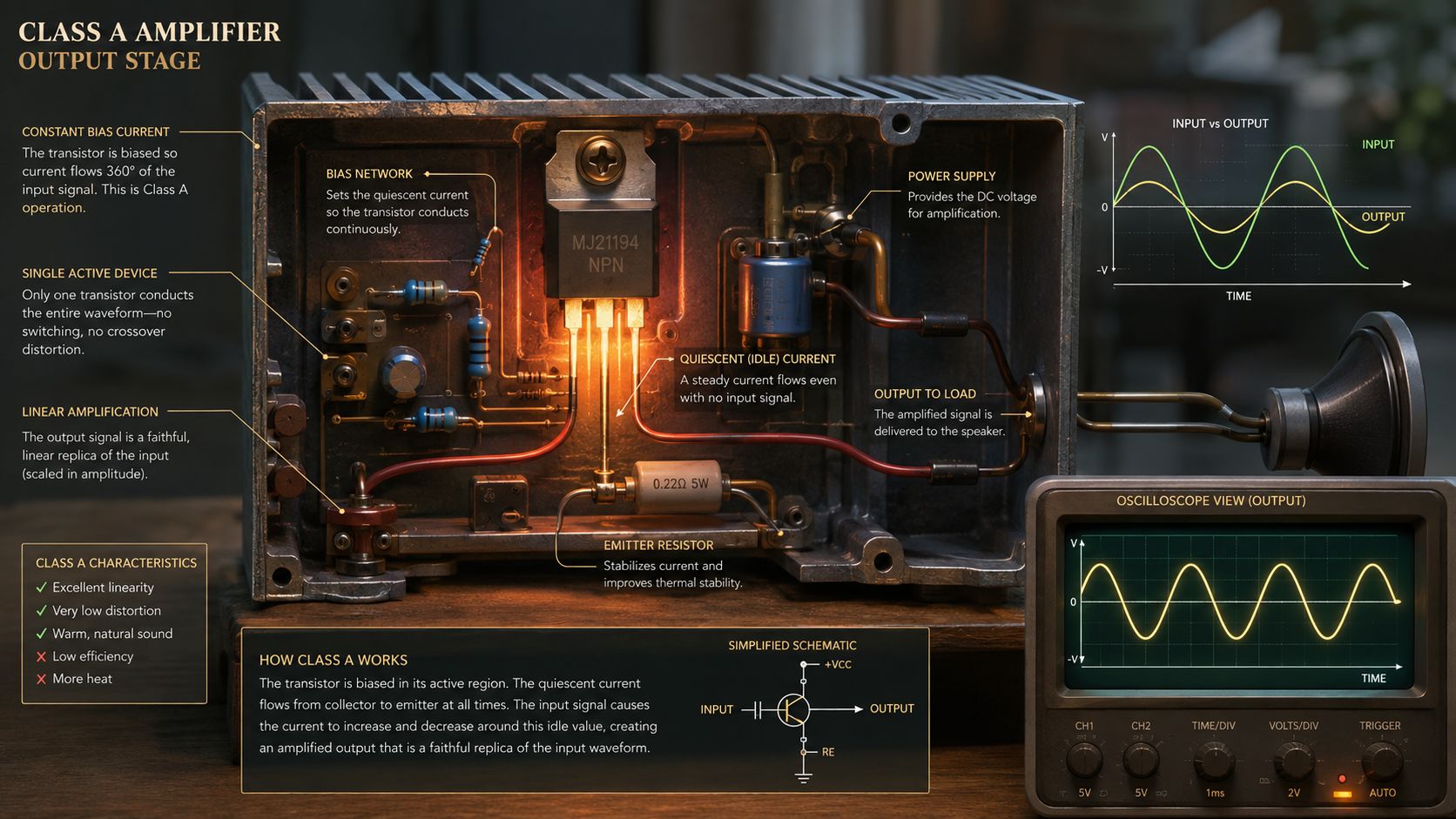
A Class A output stage keeps its devices conducting through the full 360° of the waveform. Current continues flowing during silence, so the output devices remain in their operating region instead of switching on only when music arrives. That constant bias is the circuit's defining choice, and the source of both its smooth behavior and its heat.
The practical hardware follows directly. Designers need substantial heatsinks, ventilation, stable power supplies, and a chassis built to dissipate heat continuously. A modest 25-watt Class A rating describes usable audio output, not the total energy drawn while the amplifier idles. The operating principle is explained in this technical overview of Class A operation.
Heat comes before sound
In a conventional resistively biased circuit, the theoretical efficiency ceiling is about 25%. Specialized transformer-coupled arrangements can reach 50% in theory, but typical integrated-audio designs do not operate in that special case. High-bias amplifiers may run at around 20% or less at the wall, so much of the incoming power becomes heat rather than acoustic output.
The heatsink is load-bearing hardware, not decoration. Some technical accounts estimate roughly 2 to 4 watts of heat for every watt of output, which explains why a compact amplifier can noticeably warm a small room. The technical discussion of Class A thermal behavior gives the operating context.
The audible rationale is straightforward. Keeping the output devices conducting avoids the crossover handoff that can add artifacts when devices switch between halves of a waveform. At normal listening levels, a well-executed circuit can sound smooth and settled, with low-level detail arriving without the grain associated with poorly controlled switching. Class A still has distortion. Its appeal is that the distortion follows a different, often more benign pattern.
The amplifier is always working.
Class A Versus AB and D and Tubes
Class A makes sense only when you compare it with the alternatives you could live with. Class AB usually gives you more headroom and far less idle waste. Class D delivers compact efficiency. Tubes bring a different kind of harmonic behavior, along with maintenance and heat. None of these descriptions predicts the whole listening experience, but they establish the floor.
| Topology | Efficiency | Heat Output | Distortion Profile | Best Speaker Match |
|---|---|---|---|---|
| Class A | Low, with a theoretical resistive ceiling of 25% | High, including at idle | No crossover distortion, often low distortion at normal levels | Sensitive speakers with sane impedance curves |
| Class AB | Higher than Class A in practical use | Moderate, rising with output | Can introduce crossover artifacts if poorly designed | Broad compatibility, including many demanding loads |
| Class D | High by design | Low relative to output | Depends heavily on implementation and filtering | Broad compatibility when properly matched |
| Tube | Low to moderate, depending on circuit | High | Harmonic richness and a forgiving distortion character | Speakers suited to the amplifier's output and impedance behavior |
Class AB remains the sensible default for most integrated systems. It offers a larger safety margin when a recording suddenly demands bass impact or orchestral scale. A good AB amplifier doesn't sound apologetic. It avoids turning every listening session into a conversation about ventilation.
Class D takes the opposite route from Class A. It prioritizes efficiency, compact size, and low waste. Some designs sound clinical or brittle with particular speakers, while others sound direct, controlled, and thoroughly convincing. The topology doesn't decide the result by itself.
Tubes occupy another lane. Their harmonic richness can make voices feel rounder and guitars more tactile, but the same coloration can blur detail or soften bass control in the wrong system. They also generate heat and demand maintenance, so they're not an escape from practical compromises.
Class A's niche is narrower. The constant-current operating point rewards speakers that don't ask for heroic current delivery. Low impedance and difficult phase behavior can turn the amplifier's graceful composure into strain. The comparison with class A, B, and C amplifier behavior is useful because topology describes the operating method, not a guarantee of musical superiority.
Choose the behavior, not the badge.
What Running Class A All Day Actually Costs
The heat is not a side effect you can ignore. A pure Class A amplifier draws nearly the same wall power at idle as it does while playing, so silence does little to reduce its standing load.
A 100-watt Class A design drawing about 200 watts from the wall with no signal shows the scale of the issue. A modern integrated Class A amplifier review measured 91 watts at idle and roughly 100 watts at full 2 x 25-watt output. (Practical Class A power consumption)
That consumption changes where the amplifier belongs. Use an open, ventilated stand, not a sealed cabinet. In a small room, the chassis adds heat to the listening space, particularly during warm weather. A short audition may hide that effect. Several hours of continuous idle dissipation will not.
Do the homeowner math
Your electricity cost depends on the local tariff and the number of hours the amplifier remains powered. Measure wall draw with a meter, or use the manufacturer's consumption figure, rather than treating the audio-output rating as an energy estimate.
A 25-watt output rating does not mean the amplifier consumes 25 watts. That figure describes delivered audio power. The amplifier's idle draw describes the thermal load it imposes even when no music is playing.
Check four practical points:
- Rack placement: Can hot air escape above and around the chassis?
- Room comfort: Will the additional heat become irritating during long summer sessions?
- Listening habits: Do you leave the system powered between sessions?
- Apartment reality: Does the room already run warm or have limited ventilation?
Class A designs commonly remain within a modest power range because heat dissipation rises sharply as output capability increases. Guidance commonly places such amplifiers around 20 to 50 watts per channel, a range shaped as much by thermal limits as by listening requirements. (Class A power and thermal trade-offs)
The electricity bill may be acceptable for the sound you want. The room still has to absorb the heat.
Matching Speakers and Rooms to Class A
Class A matching starts with the speaker, not the amplifier's reputation. A unit can look adequate on paper yet run short of control in your room. Speaker sensitivity, impedance behavior, listening distance, room size, and preferred volume determine whether its limited power feels relaxed or stays close to its ceiling.
Higher-sensitivity speakers are usually the safer partner because they reach a useful level with less power. Read the impedance curve as well as the nominal rating. A speaker that dips low, or combines low impedance with difficult phase behavior, can demand current that a modest Class A integrated amplifier cannot supply cleanly.
Read the system, not just the amplifier
Luxman's L-595ASE shows the category's modest-power reality at 2 x 20 watts into 8 ohms and 2 x 40 watts into 4 ohms. The Musical Fidelity A1 specifies 25 watts per channel into 8 ohms as pure Class A output, as shown in the Musical Fidelity A1 specifications. These figures define practical boundaries rather than shortcomings.
A small or medium room and moderate listening distance give those boundaries more room to breathe. A large room, insensitive speakers, or a preference for cinematic volume changes the calculation quickly. Constant dissipation supports the circuit's operating behavior, but it does not create extra current headroom.
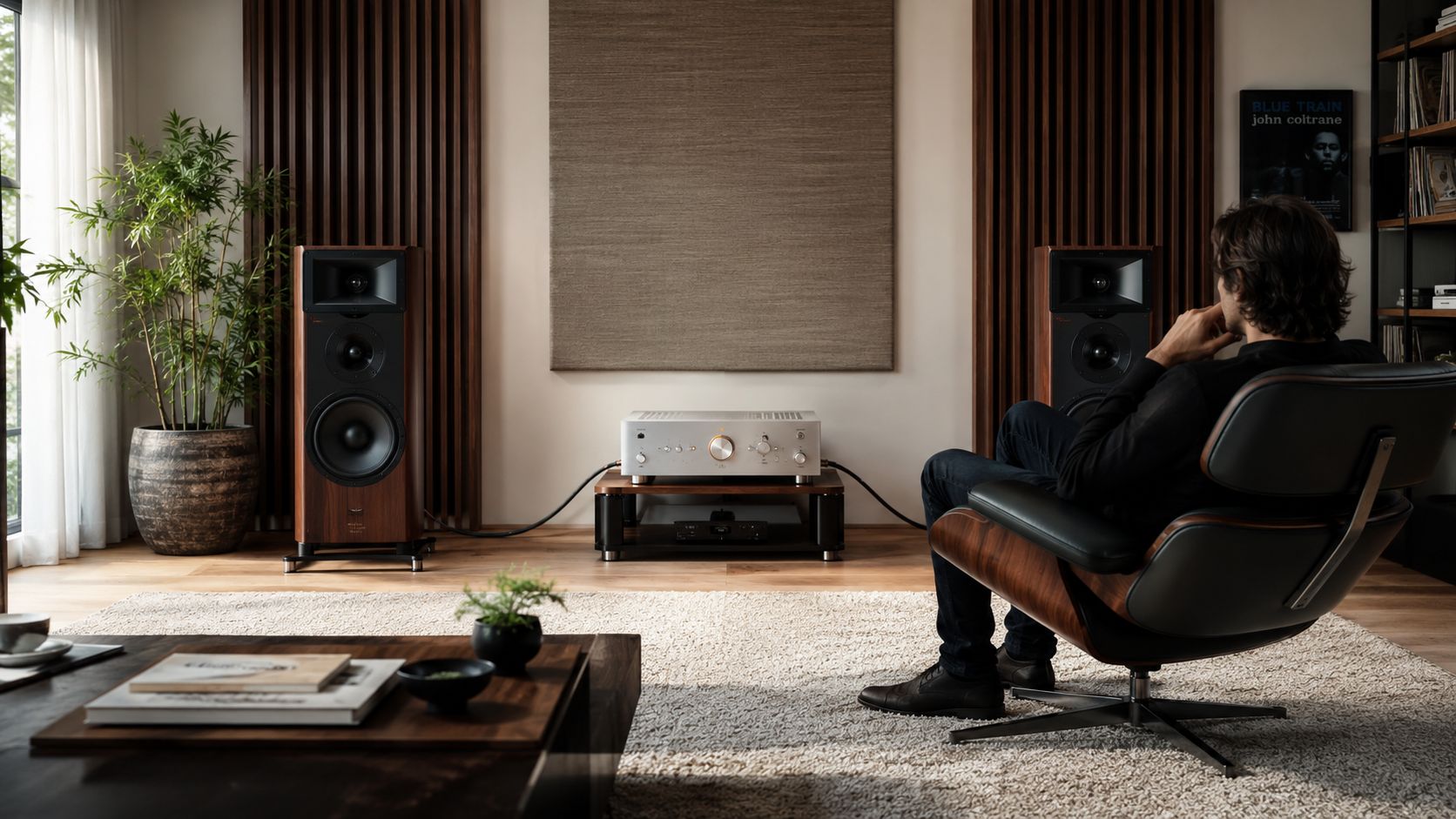
Audition the complete system at your normal listening distance. Listen for strain instead of chasing a wattage figure. Bass should keep its shape when an arrangement becomes dense, vocals should retain composure as volume rises, and the presentation should remain controlled rather than merely loud.
Practical rule: If your speakers are insensitive or present a difficult load, audition the complete system at your actual listening distance.
A high damping factor can improve speaker control, but it cannot remove the amplifier's power ceiling. One Class A design lists a damping factor of 1,000, with THD of 0.03% into 8 to 16 ohms and 0.05% into 2 to 4 ohms. Those specifications show that strong control is possible within the topology. They do not make every speaker an easy match.
Hard-to-drive speakers can turn Class A into a performance trap. The amplifier may sound composed at ordinary levels, then lose scale when the music demands larger swings. Choose the speakers and room first, then decide whether the amplifier's thermal cost and power limits suit the way you listen.
What to Listen for When Auditioning Class A
Don't audition Class A by asking whether it sounds warm. That shortcut causes trouble because Class A isn't automatically warm, soft, or romantic. Its sound depends on the circuit, the power supply, the speakers, and the room.
Start with low-level listening. Use familiar vocals, sparse acoustic recordings, or small ensembles where you know the space around the performers. A good Class A integrated amplifier can make quiet information feel continuous. Room ambience doesn't arrive as a spotlighted detail. It sits inside the performance, like air behind the musicians.
Find the texture before the volume
With a Luxman in a small room, the impression was less about extra color and more about composure. Piano notes had a firm leading edge and a clean decay. Voices carried body without a blanket over the upper midrange. The music felt settled, not sleepy.
The Musical Fidelity A1 brought a different balance. Its modest output made speaker matching more obvious, but with a suitable load it delivered an easy, tactile midrange. Bass had shape rather than brute force. Turn the system up beyond its comfort zone and the thermal tax became a power-delivery problem, not a philosophical one.
Listen for these behaviors:
- Low-level continuity: Can you follow soft phrasing without the image collapsing?
- Midrange texture: Do vocals and strings sound smooth without becoming thick?
- Transient control: Do percussion attacks stay clean, or do they flatten as demand rises?
- Spatial stability: Does the soundstage hold together when the arrangement becomes dense?
- Fatigue: After sustained listening, does the presentation remain inviting?
A frequency-response specification still matters because it tells you how the speaker behaves across its range, but it won't replace listening in your room. The practical groundwork is covered in what frequency response means in speakers.
Class A should sound calm under ordinary demand. Not sleepy. Calm.
When Class A Is Worth the Trade-Off
Class A is not a universal upgrade. It is a thermal tax paid for a particular distortion profile, low-level continuity, and a smooth operating character. The trade makes sense when your speakers are reasonably sensitive, your room is small or medium, listening distances are moderate, and you can provide real ventilation. It makes less sense when you mainly want maximum output, extensive features, or carefree all-day operation.
Room heat deserves a practical check. An amplifier that draws substantial power at idle turns part of that electricity into heat even during low-level playback. In a compact room, that can change comfort well before the amplifier reaches its output limit. If heat is already a problem, a Class A badge will not solve it.
A plain decision framework
Choose Class A when:
- Your speakers are cooperative: They avoid difficult low-impedance behavior and do not demand large current reserves.
- Your room is manageable: You can leave space around the chassis, tolerate its heat, and keep the listening position comfortable.
- Your priorities are specific: You value composure, low-level detail, and this particular distortion profile more than maximum headroom.
- Your habits fit the design: You can ventilate the amplifier properly and shut it down when the system is not in use.
Choose class AB when you need wider speaker compatibility, stronger peak headroom, or less idle heat. Choose class D when efficiency, compact size, and cool operation carry greater weight. Choose tubes when their harmonic character and maintenance demands suit your taste, not because a sales description calls them magical.
The current market reflects that divide. Mainstream integrated-amplifier coverage favors class AB and feature-rich designs with HDMI eARC, streaming, and phono stages, while Class A remains a niche, premium, heat-heavy choice.
That is not a failure. It is a useful admission.
Before buying, check the speaker's impedance behavior, the room's ventilation, and the volume you use. Then arrange a home audition if possible. Leave the amplifier operating long enough to judge both the music and the room temperature.
If the system passes those tests, Class A can deliver a compelling, deliberate compromise. If it fails them, choose the topology that gives your speakers headroom instead of buying a badge that leaves the amplifier struggling.

