Most budget turntable speakers lie by omission. They'll brag about Bluetooth, optical inputs, and tidy cabinets, then fold the second the room asks for real bass control. That's not a speaker problem, it's a shopping problem. If you want records to sound full instead of politely thin, the floor is clean near-field output with enough low-end extension to keep the bottom octave intact.
I'm going to be blunt about it. The best budget turntable speakers aren't the ones with the longest feature list, they're the ones that stay composed when the stylus hits a hot pressing and the room starts adding its own nonsense. A compact powered box can be the right answer for a desk or small apartment, but once the low end rolls off early, your brain starts filling in the missing weight instead of hearing it. That's not hi-fi. That's a compromise wearing a nice finish.
Table of Contents
- Most Budget Speakers Lie to You
- The Technical Floor That Separates Real Hi-Fi From TV Speakers
- The Contenders and How They Actually Sound
- The Room Problem Nobody Talks About
- Powered vs Passive and Where Your Money Actually Goes
- Direct Picks for Every Room and Budget Tier
- Stretching the Budget Without Starving the Signal
Most Budget Speakers Lie to You
Features Are Cheap, Control Isn't
A lot of entry-level speakers are built to look complete on a product page. They give you Bluetooth, extra inputs, and a compact footprint, then ask you to lower your standards. I don't care how many sockets are on the back if the speaker can't keep kick drum impact separate from room bloom. That's not vinyl-friendly, that's convenience-first design.
For turntables, the useful question isn't “what does it support.” It's “does it keep its composure when records get dense.” A budget powered speaker can be perfectly sensible in a small space, but the moment it starts sounding hazy in the low end, the downstream system inherits that weakness. You hear a nice tone. You don't hear real scale.
Practical rule: if the speaker sounds impressive only when you stand close to it, it's not controlling anything. It's surviving.
The Best Budget Option Is Usually Less Flashy
The smarter buy is usually the one with fewer toys and better fundamentals. Active speakers with a built-in amplifier are designed for direct use without a separate amp, which makes them the cleanest budget path when you want fewer boxes and less cable mess. That matters more than people admit, because turntable setups get awkward fast when you bolt on features you won't use.
The SEO world loves a tidy roundup, so it keeps pushing the same compact powered boxes as if they're all interchangeable. They aren't. A cheap speaker that keeps the midrange clean and leaves the bass honest beats a feature-rich box that sounds glossy for twenty seconds and then turns mushy in a real room. Records need floor, not flair.
If you want the short version, here it is. Budget speakers should survive the room, not just the spec sheet.
The Technical Floor That Separates Real Hi-Fi From TV Speakers
Continuous Power Matters Most
Ignore peak watts unless you enjoy marketing theatre. The useful number is continuous output, because that tells you whether the speaker can keep playing without collapsing into strain. One budget roundup lists the Edifier R1280DBs at 42W peak, 6 ohms, with 13mm tweeters, 4-inch bass drivers, and a 75 Hz–18 kHz response, while a larger Rockville APM5C class setup is listed at 90W continuous / 200W peak, 8 ohms, with 1-inch tweeter, 5-inch midrange, and dual 8-inch woofers reaching 35 Hz–20 kHz. That comparison lands hard in practice.
The compact option makes sense on a desk or in a small apartment because it won't overwhelm the room. A speaker that rolls off around 75 Hz leaves kick drum weight and upright bass fundamentals partly inferred rather than fully reproduced. The larger driver package behaves more like a real hi-fi load. It gives you the bottom octave where vinyl sounds expensive. It also needs space.
Frequency Response and Driver Size Set the Floor
A speaker's frequency response isn't a trophy number. It is a clue about where the illusion starts to crack. Buying guides keep using frequency response and continuous power as the filters that separate budget speakers that merely play records from budget speakers that control them. ZDNET lists the Edifier R1280DB at 42W and 55 Hz–20 kHz, while larger systems in the same category climb to 100W–180W with wider extension like 50 Hz–20 kHz or 61–21 kHz ±3 dB. What Hi-Fi's 2026 guide places the R1280DB in the budget tier at $189.99.
That is the floor in plain language. A system with around 20–30W RMS per channel is fine for near-field listening in a small room, but once you want the room to fill without compression, you need more than headline peak watts. You need continuous output, sensible driver size, and low-end extension that doesn't fold early. Tiny speakers can sound neat and still fail the record test. They stay composed until the music asks for weight, then the low end turns thin and the whole presentation shrinks.
| Speaker Class | Continuous Power | Low-End Extension | Driver Size | Best For |
|---|---|---|---|---|
| Compact powered bookshelf | Lower continuous output, often built for near-field use | Rolls off early | Smaller woofer package | Desk, bedroom, small apartment |
| Larger powered bookshelf | Higher continuous output | Deeper extension | Bigger woofer and midrange layout | Living room, fuller vinyl playback |
| Passive bookshelf with amp | Depends on amplifier match | Can go deeper if the speaker is designed for it | Often larger, better-controlled drivers | Long-term system building |
The Contenders and How They Actually Sound
The Usual Compact Boxes
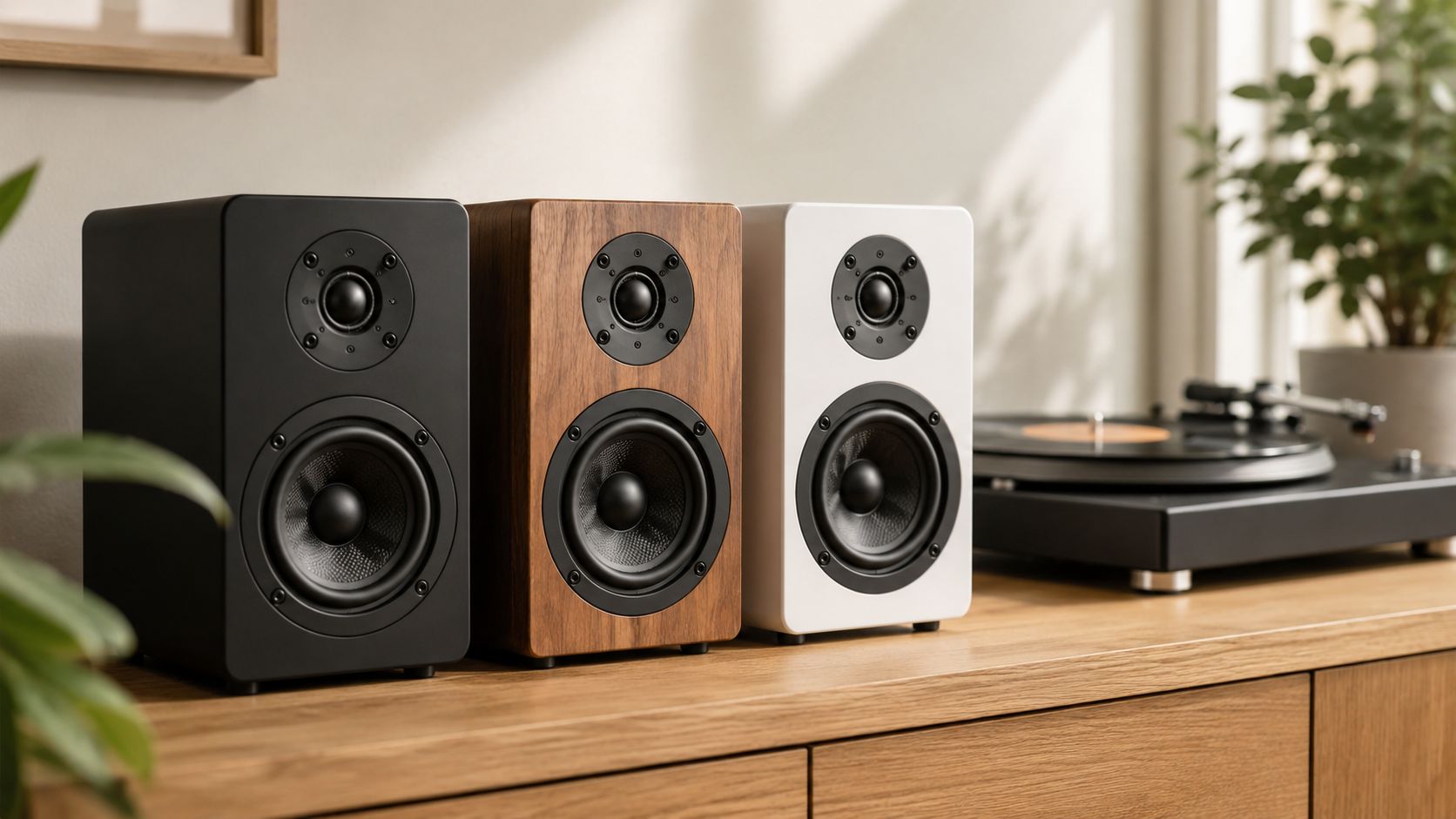
The Edifier R1280T is the safe, sane starter. It's tidy, easy to place, and it does the near-field job without fuss. On records, that usually means clean mids and enough body to avoid sounding like a laptop speaker in a wood suit.
The R1280DB and R1280DBs exist for people who want flexibility first. They're practical, and they can make a small room pleasant, but they don't change the fundamental equation. You still get the compact powered-speaker ceiling, which means the bass is present rather than authoritative. For background listening, fine. For records you sit with, a little too polite.
The MR3 gets attention because it's being positioned around a flatter, more modern voicing rather than the usual warm-story marketing. That's the right direction. I'd still treat it as a desk speaker first and a room-filler second. Flatter doesn't matter much if the cabinet can't move enough air.
The Bigger, More Serious Loads
Once you step up to bigger powered designs, the sound stops feeling like a clever desk solution and starts feeling like a system. That's the difference between “nice at low volume” and “this can fill the room.” The larger class has more weight in the kick, more foundation under acoustic bass, and less of that papery edge that cheap compact boxes get when they're pushed.
I prefer speakers that sound slightly reserved in the first minute and then open up as the record goes on. That usually means they're not exaggerating the top end to seem detailed. They're giving you space, texture, and a sense that the room isn't dragging the presentation off course. Cheap speakers often mistake brightness for clarity. Real playback doesn't.
A speaker doesn't need to shout detail at you. It needs to keep the image together when the groove gets crowded.
Passive Bookshelves Are a Different Sport
Passive bookshelf speakers can outclass cheap powered boxes, but only if you stop pretending the amplifier doesn't matter. They don't win because they're passive. They win because the money can go into better drivers and better cabinet behavior instead of onboard convenience circuitry. That's a real trade, not an ideology.
The catch is obvious. You buy more boxes, you spend more on the amplifier, and the placement math gets less forgiving. But if you're trying to build something that sounds like hi-fi instead of a dressed-up accessory, passive becomes the smarter long-term play. If you're after one clean box and a turntable, active still has the simpler answer.
The Room Problem Nobody Talks About
A Desk and a Living Room Are Not the Same Test
Most budget turntable speaker roundups pretend room size is a side note. It isn't. A compact 4-inch woofer can sound decent at arm's length, then fall apart once a sofa, a side wall, and a coffee table get involved. Bass turns into a smear, and suddenly the room is doing half the playback for you.
That's why the small powered speaker is a desk solution, not a universal solution. In a close setup, the limited bass can help because it keeps the room from being overexcited. In a living room, the same speaker often sounds smaller than the record deserves. Placement decides whether the bargain holds together.
Good placement is the cheapest bass upgrade you can make. Bad placement makes decent speakers sound lazy.
Bigger Cabinets Need Space, But They Pay It Back
The larger powered and passive designs need breathing room, and that's the part most buyers don't budget for. A speaker that reaches lower and moves more air will expose sloppy placement faster, but it also gives back a more convincing foundation. If you have wall distance and some lateral space, the sound stops collapsing into the middle.
That's why the room question should come before the shopping question. If you're in a small apartment, a compact powered box is the sane choice. If you're in a living room and want the system to carry the space, you should stop buying around convenience and start buying around control. Sometimes a subwoofer is the better spend than a different bookshelf model, because the room needs proper low-end support more than it needs another shiny feature.
The honest rule is simple. Buy for the room you have.
Powered vs Passive and Where Your Money Actually Goes
Connectivity Costs More Than People Admit
Modern budget speakers often bundle Bluetooth, optical, and multiple line inputs into models around the $99 to $189 range, and that creates a false sense of value. Those features are useful if you'll use them. They're dead weight if you won't. Vinyl buyers get seduced by convenience, then wonder why the speaker budget got diluted.
That's the trap. You're not just paying for sound, you're paying for input flexibility, wireless hardware, and the marketing story around it. The same money can sometimes buy a simpler passive setup plus a small amp, which shifts more of the budget into parts that shape the sound. That's the part most people should do the math on.
Active Is Cleaner, Passive Is More Flexible
Active speakers with a built-in amplifier are the cleanest budget path when the goal is simplicity and fewer boxes. That's not a moral claim, it's a practical one. You plug in a turntable, keep the chain short, and get to music faster. For a lot of people, that's the right answer.
Passive speakers buy you an upgrade path. You can change the amplifier later, and that matters if you know you're going to keep improving the system. The downside is obvious. More parts, more cables, more chances to make a weak link the star of the show. If you're buying once and staying simple, active is the cleanest move. If you're building, passive makes more sense.
Rule of thumb: don't pay for features you won't use if that money could buy better drivers or a better amp.
Direct Picks for Every Room and Budget Tier
Desk and Near-Field
For a desk, I'd pick a compact active speaker with a sane voicing and enough control to keep cymbals from turning glassy. The Edifier R1280T is the baseline answer if you want easy, tidy stereo without drama. The R1280DB makes sense if you want wireless convenience, but only if you'll use it.
If your turntable setup lives on a desk and you listen close, stop chasing room-filling bass you don't have space for. Put the money into clean mids, stable imaging, and a speaker that doesn't compress when you lean into the volume knob. That's the right call. Clean first. Loud later.
Small Apartment
In a small apartment, the best move is still a compact powered speaker, but one with enough body to avoid sounding anaemic at normal listening levels. The R1280DBs is the practical pick if you want the easiest all-in-one setup and don't need a separate amp. If you want a slightly more modern, flatter direction, the MR3 is the smarter voicing bet.
If you run a warm moving-magnet cartridge, a speaker with a little restraint up top keeps the system from getting sleepy. If your cartridge leans brighter, you want something that doesn't add extra edge. Match the voicing to the cartridge. Don't fight both ends of the chain at once.
Living Room
For a living room, I'd skip the tiny powered stuff and move up. That's where the larger powered classes or a passive bookshelf plus amp start making sense. You need real bass extension, better driver control, and enough continuous output to keep the presentation from flattening when the room opens up.
Active speakers with a built-in amplifier are designed for direct use without a separate amp, which makes them the cleanest budget path for a turntable setup when the goal is simplicity and fewer boxes. But if the room is large enough to expose the limits of compact powered boxes, the passive route earns its place fast. It's not as simple, but it scales better. Simplicity is nice. Sound matters more.
Stretching the Budget Without Starving the Signal
Spend on the Load-Bearing Parts
If you are stretching a turntable budget, do not starve the speakers so the turntable can wear a fancy badge. Speakers carry the system, and the wrong allocation leaves the whole setup thin and brittle in a real room. Output capability and sensitivity shape how much of the music survives once the walls, furniture, and listening distance get involved. Zococity's point about focusing on power and SPL is the right one, even if buyers love to ignore it. The budget has to be balanced.
Used-market shopping can help, especially with passive bookshelves and small amplifiers. Look for honest cabinet condition, intact drivers, and a clean ownership history. Skip anything that looks like a garage-sale rescue project unless you are ready to replace parts. A cheap deal that needs saving is not cheap.
Don't Let the Amp Be an Afterthought
If you are going passive, pair the speakers with a small amp that can drive them properly. I would rather hear a modest speaker with a competent amplifier than a prettier speaker starved by a weak box. The signal chain is only as strong as its least serious part.
My budget amp notes live here, and the same logic applies to a practical guide to the best budget DAC and amp and entry-level amplification more broadly. Buy with the room in mind. Buy with the load in mind. That's the part you should do the math on. Everything downstream inherits the choice.
If you want a straight answer, here it is. For a desk, buy compact active speakers and stop overthinking it. For a small apartment, buy the cleanest powered box that does not choke the low end. For a living room, stop pretending convenience wins and move up to a real speaker and a matching amp. If you want help putting together a budget turntable system that survives your room, start with Supermarket Sound's speaker and amp guides, then build from the floor up.

