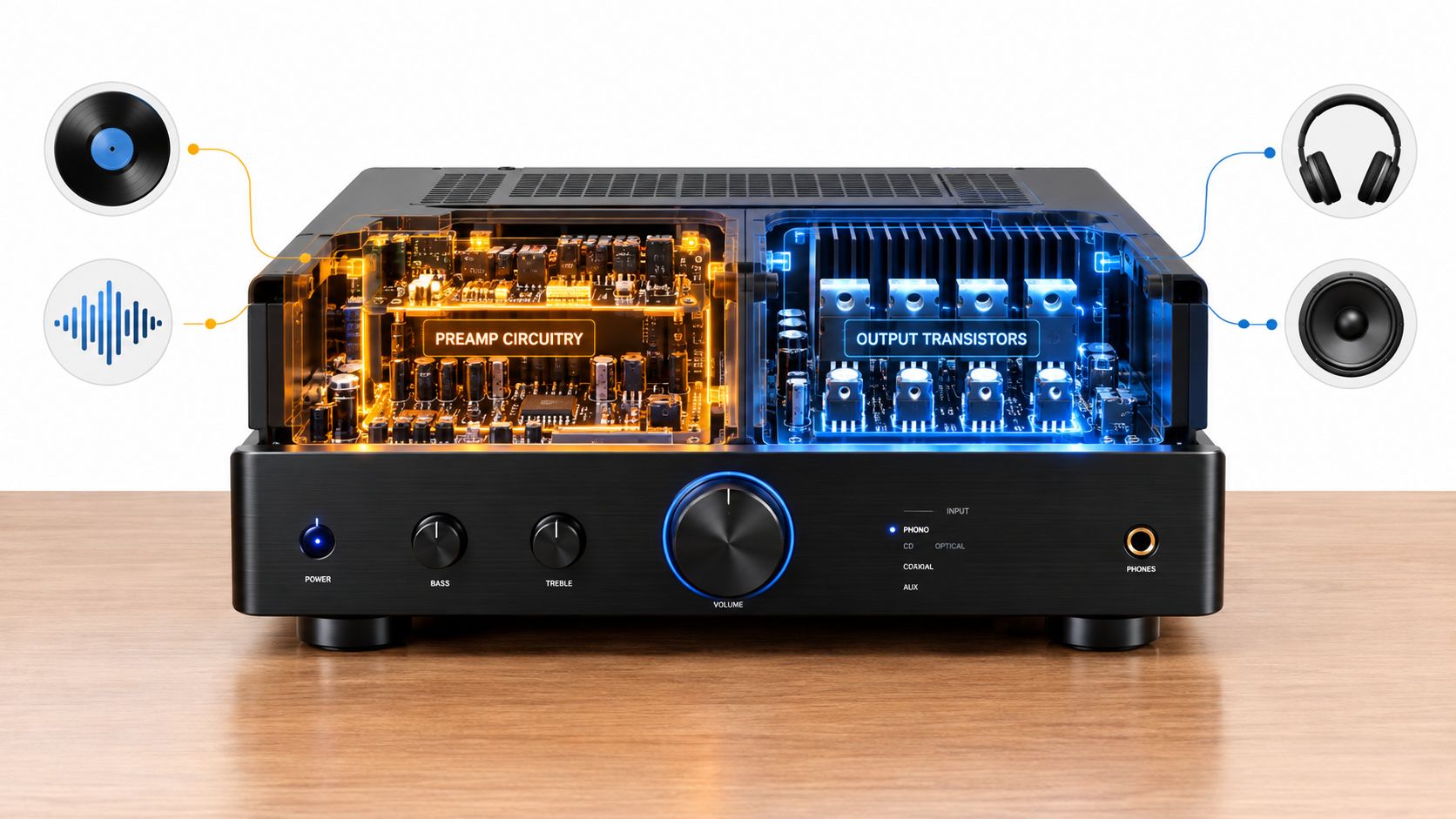
An integrated amplifier combines the preamp and power amp in one chassis, so it handles source switching, volume, gain, and speaker driving in a single box. The trade is simple. You get less clutter and a tighter, unified signal path, but usually fewer upgrade paths than a system built from separate components.
Most bad advice on this subject starts with the wrong assumption. It treats the integrated amp like a compromise box people buy before they're serious. I don't buy that. In a real room, with real speakers, an integrated amplifier is often the load-bearing floor of the whole system. Not a shortcut. Not a consolation prize. The floor.
That's the right way to answer the search term what is integrated amplifier. Not with a dictionary definition and a pile of brochure language, but with the job it does in your room. It decides how your sources come in, how the signal gets shaped, how much noise rides along, and whether your speakers sound planted and confident or a little underfed and vague. Downstream inherits all of it.
I'm also not pretending this topic doesn't attract a lot of SEO fluff. It does. “One box solution” gets repeated until it means nothing. The useful question is whether one box is enough for your system, your speakers, and the way you listen. Sometimes it is. Often, it just works. Sometimes it isn't.
So that's the line I'm taking. An integrated amp trades ultimate modular freedom for shorter signal paths, fewer cables, one shared gain structure, and a control center that makes sense in ordinary homes. If you want to know whether that's smart engineering or tidy compromise, the answer depends on what's inside, what features matter, and how you match it to the room.
Choose the floor first.
Table of Contents
- Introduction That Reframes the One Box Question
- What an Integrated Amplifier Actually Does Inside
- How the Integrated Amplifier Became the Default
- Inputs and Features That Change How You Live With It
- Class and Topology and How They Actually Sound
- How to Choose Power and Matching for Your Speakers and Room
- When One Box Is Enough and When It Is Not
Introduction That Reframes the One Box Question
People love to say separates are automatically better. Cleaner idea. More serious look. More racks, more boxes, more chances to feel like you've built a laboratory. Fine. But most systems don't fail because they lacked one more chassis. They fail because the core amp choice was wrong for the speakers, the room, or the source mix.
An integrated amplifier is not just preamp plus power amp stuffed into a prettier case. It's the central structure that decides how the whole system behaves. It's where source selection happens, where volume and gain get sorted, and where the signal gets handed off to the speaker-driving section. That's why I call it load-bearing. It holds everything up.
The usual advice misses the room
A lot of buying advice treats audio like a bench test fantasy. You'd think everyone has a dedicated room, unlimited shelf space, patient housemates, and a spiritual commitment to cable dressing. Many don't. They have a living room, a desk, or a modest listening corner where one smart box makes more sense than three “aspirational” ones.
Practical rule: If one box does the full job cleanly, adding more boxes isn't automatically an upgrade. Sometimes it's just more furniture.
That doesn't mean integrated amps are always the right answer. It means the default prejudice against them is lazy. In a small room especially, fewer interconnects and one coherent gain structure can sound more direct, more grounded, and less fussy than a pile of gear that never really locks together.
What matters more than the label
The serious questions aren't romantic. They're practical.
- What does it control: Can it handle the sources you use, not the sources you imagine using someday?
- What does it drive: Will it keep hold of your speakers when the music gets dense, bass-heavy, or loud enough to matter?
- What does it leave open: Are you buying a clean endpoint, or are you boxing yourself out of future changes you'll want?
That's the path. Inside architecture first. Then history, because this format didn't appear by magic. Then features, class, topology, and matching. Not to worship the box, but to figure out whether it deserves to be the floor of your system.
It usually does.
What an Integrated Amplifier Actually Does Inside
The textbook definition gets you only halfway there. Yes, an integrated amplifier combines a preamp and a power amp in one chassis. According to Wikipedia's integrated amplifier overview, that means source switching, volume control, and gain happen before the stage that drives the speakers. The part that matters in real use is the handoff. How cleanly does the box take a small signal, shape it, strengthen it, and keep control once a real speaker starts asking for current?
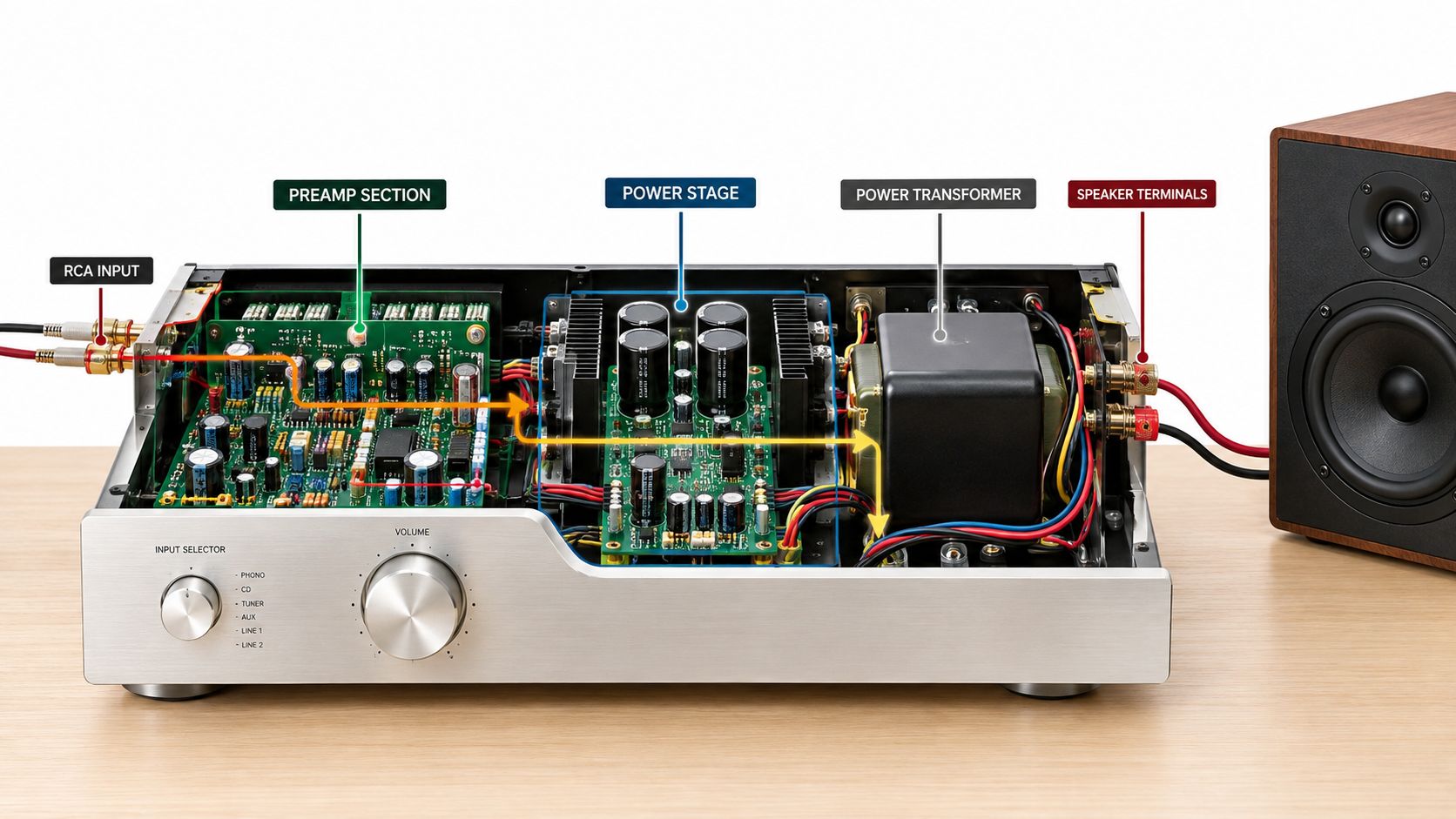
An integrated amp works like the load-bearing floor of a room. Furniture, people, and movement all depend on it. If that floor flexes, everything above it feels unstable. In the same way, the integrated amp sets the conditions for the whole system. Your source feeds it. Your speakers push back against it. Your room exposes whether it has real grip or just pretty specs.
The preamp shapes the signal. The power amp does the heavy lifting.
Start with the preamp section. The amplifier picks the source, sets the volume, and manages gain. It deals with tiny signals, so small problems here get magnified later. A noisy preamp stays noisy after amplification. A flat, gray front end stays flat and gray, no matter how impressive the power rating looks on the carton.
Then the power amp section takes over. Its job is less about choosing and more about control. It has to supply current, keep its composure, and move the speaker drivers without losing the shape of the music. Bass notes, drum hits, and dense passages all test this part.
A kitchen and a delivery truck is a fair comparison, but I'd put it more bluntly. The preamp decides what meal leaves the counter. The power amp has to get it to the table hot and intact. A weak finish ruins a good start. A messy start gives the finish nothing worth saving.
Why the one-box layout can work so well
In a good integrated, those two sections are designed to live together from the start. That matters more than people admit.
Shorter internal signal runs can reduce opportunities for noise pickup. The gain structure is usually worked out as one system instead of as a negotiation between separate boxes. You also avoid one more pair of interconnects, one more grounding variable, and one more chance to mix components that look compatible on paper but never quite settle down together in a room.
That is why a solid integrated can sound more planted than a stack of separates in the same small setup. The center image tends to lock in more firmly. Bass can feel less loose and more timed. Quiet details come through without that faint haze that makes everything seem outlined rather than embodied.
You do not always get more fireworks. You often get more coherence.
A good integrated does not sound compromised by default. It sounds like one design pulling in one direction.
Of course, one box does not excuse bad engineering. Shared chassis design brings its own risks. A noisy power supply can contaminate the front end. Heat from the output stage can make life harder for nearby circuits. A power section that looks strong into easy loads can still lose its grip when a speaker dips low in impedance or asks for current in the bass.
That is the part many buyers miss. They shop the integrated amp as a feature bundle. They should judge it as the structural core of the system.
A short visual explanation helps more than another paragraph of jargon.
Where the confusion starts
Three mix-ups come up over and over.
- “Is it just a power amp with volume?” No. An integrated amp includes the control stage that selects sources and manages the signal before it reaches the output stage.
- “Does one box mean entry-level?” No. It means the designer had to solve signal control, power delivery, noise, heat, and layout inside one chassis.
- “If the sound is thin or cramped, is wattage the whole story?” No. Power matters, but so do current delivery, preamp quality, gain structure, and how the amp behaves with your speakers in your room.
That last point matters most in a small room. You are not trying to fill a hall. You are trying to keep a pair of real speakers sounding composed at normal distances, with believable bass weight, stable imaging, and no strain when the mix gets busy. Judged that way, an integrated amplifier is more than pre plus power in one box. It is the floor the rest of the system stands on.
How the Integrated Amplifier Became the Default
Integrated amplifiers didn't become common because audiophiles got lazy. They became common because separate stacks solved one set of problems while creating another. In the 1960s, the high-end default was still the separate preamp and power-amp arrangement. Great on paper. Less great when normal people had to live with it.
The 1972 pivot that made the format real
The clean milestone is 1972. Yamaha's own hi-fi history says the market shifted sharply toward component stereo systems that year, and Yamaha launched its 700 Series integrated amplifiers, including the CA-700 and CA-500, as its entry into the component-stereo market. That's in Yamaha's history of the integrated amplifier.
That date matters because it gives the category a real commercial hinge point. Not vague “vintage hi-fi days.” Not nostalgia fog. A specific moment when the market moved and brands answered with single-chassis control centers for home listening.
It solved a domestic problem, not just a technical one
The integrated amp stuck because it solved ordinary-room problems in a way separates often didn't.
- Fewer boxes: Less shelf space, less visual clutter, less chance your system looks like a repair bench.
- Fewer cables: Fewer handoffs between components, fewer opportunities to introduce noise or mismatch.
- One control center: Inputs, preamplification, and power delivery in one place.
Yamaha's history leans on practical appeal too. Rich input and output terminals, broad usability, unified chassis. That combination is why the format endured. It made serious playback fit into homes that still needed to function as homes.
The integrated amplifier won because it respected the room.
That's still the appeal now. Different source mix, different feature expectations, same core need. One box that can run a real stereo system without turning the living room into a parts department.
The use case never left.
Inputs and Features That Change How You Live With It
Once you stop treating an integrated amp like a stripped-down “starter” product, the buying question changes fast. It becomes less about the abstract idea of one box and more about which jobs that box should do. That's where people either simplify their system beautifully or trap themselves in a feature pile they don't even use.
Recent guidance from Yamaha on what an integrated amplifier is still frames these units as stereo hubs that often combine preamp, power amp, phono EQ, and tone controls. That's useful, but it skips the messier question. Which features improve daily listening, and which ones just make the front panel look busy?
The extras that earn their keep
A built-in DAC can make perfect sense if your system is streaming-first or if your TV audio is part of the same setup. One less box. One fewer power supply. One remote instead of a coffee table full of remotes pretending to be a lifestyle.
A phono stage is similar. If you run a turntable and want a clean, compact rig, built-in phono EQ can be the difference between “I use this” and “I'll set it up next month.” Tone controls can also be more useful than audiophile purity culture admits, especially in a small room where speaker placement is never ideal.
A headphone stage matters if the integrated will live at a desk or in a shared space. A subwoofer output matters if your main speakers are compact and your room needs low-end help without turning the amp choice into a tower-of-boxes project.
The features that can quietly limit you
Every built-in function is a trade. If the DAC ages badly relative to the rest of the amp, you may wish it were separate. If the phono stage is just “there,” not good, it can keep you from hearing what your cartridge is doing. If you want to experiment with gain staging later, a tightly closed feature set can become the bottleneck.
That's why I like the newer idea of the integrated amp as a hybrid control hub, not merely an amplifier. Build HiFi's glossary entry on integrated amplifiers makes that point well. The core function stays line-level control plus speaker-level power, while the extras broaden what the box can do without changing its identity.
Buy for the life you live with the system, not the fantasy rack you scroll past at midnight.
Feature Tradeoff Matrix for Real Systems
| Feature | Best For | Tradeoff to Consider |
|---|---|---|
| Built-in DAC | Streaming-first setups, TV audio, fewer boxes | Digital section may age faster than the amplifier section |
| Built-in phono stage | Turntable listeners who want simplicity | Limited flexibility if you later want a different phono sound |
| Tone controls | Rooms that need a little correction, varied recordings | Purists may leave them untouched, which makes them dead panel space |
| Headphone output | Shared homes, desk listening, late-night sessions | Some are convenience features, not serious headphone stages |
| Subwoofer output | Small speakers in real rooms | Integration still depends on careful placement and level setting |
| Pre/power separation mode | People who may expand later | More complexity, and not every buyer will ever use it |
There's also a middle path that gets ignored. Some integrated amplifiers can separate their internal sections. One current model description at HiFi Heaven's Audiolab 9000A page describes an integrated mode plus a pre-power mode that lets the unit work as either a standalone preamp or a standalone power amp. That matters because “integrated” doesn't always mean sealed shut forever.
Match features to source reality
If your system is mostly streaming, TV, and maybe one analog source, a modern integrated with digital inputs probably makes more sense than pretending you need a separate stack. If you're weighing that route, this guide to an integrated amplifier with DAC is one practical way to think about the all-in-one side of the category.
If your setup includes a turntable, multiple digital sources, late-night headphone use, and the possibility of future subwoofer integration, then feature quality matters more than feature count. Don't buy a Swiss Army knife if all you needed was a sharp kitchen knife.
Live with the right functions. Skip the fake versatility.
Class and Topology and How They Actually Sound
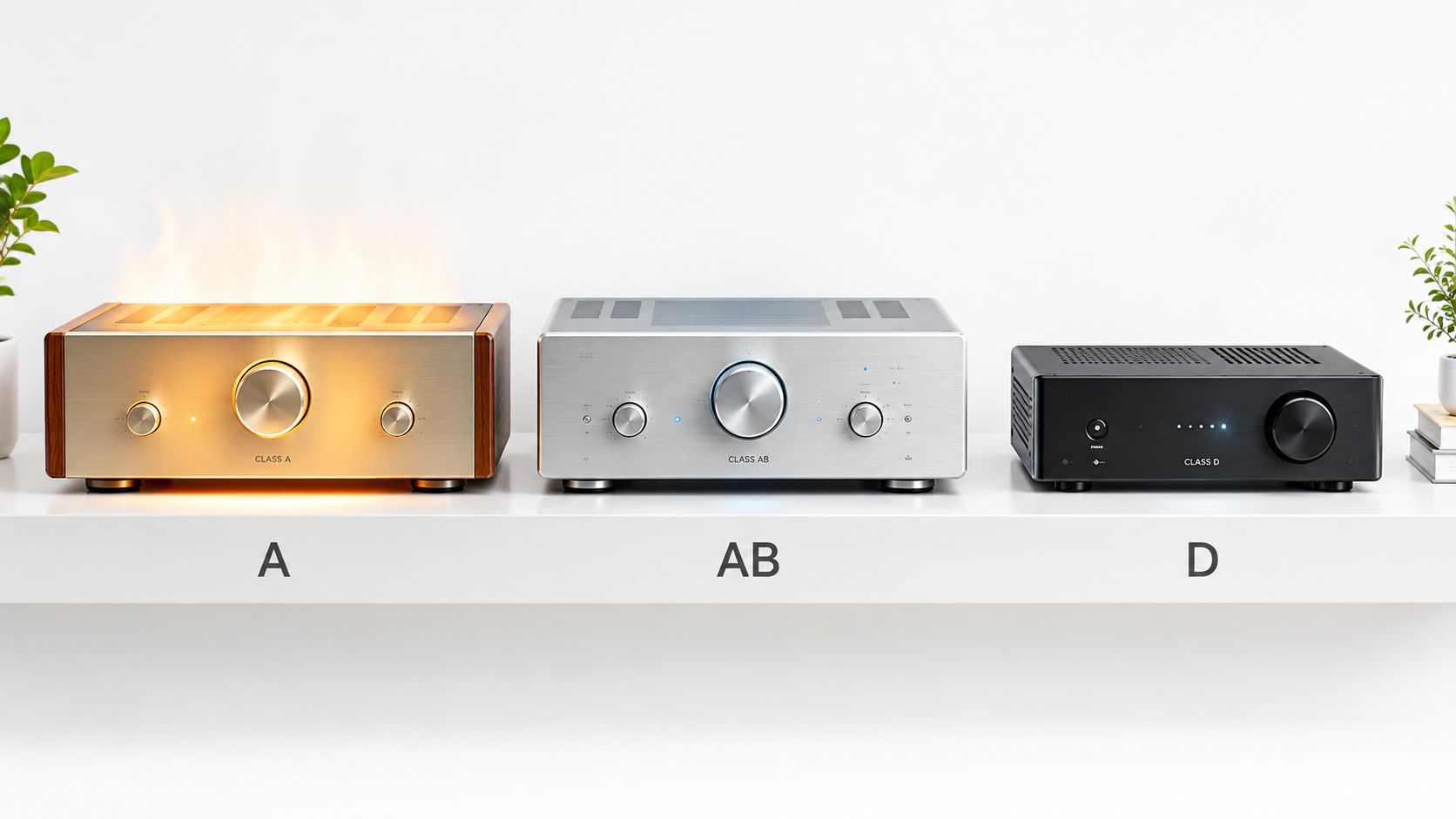
People talk about amplifier class like it's a moral ranking. It isn't. Class A, Class AB, Class D, and hybrid designs are not ladder rungs toward virtue. They're different engineering choices with different sonic tendencies, different heat behavior, and different relationships to speakers.
What the class letter tends to mean in a room
To my ears, Class A often sounds dense, saturated, and continuous. Notes can feel almost poured rather than placed. The trade is obvious. Heat, weight, and inefficiency.
Class AB is the familiar middle ground for a reason. It often gives you a convincing mix of body, control, and practical power. In many small and medium rooms, it's the least ideological and most broadly useful choice.
Class D has matured into something many people still underestimate. Good implementations can sound quick, controlled, and clean, with bass grip that feels firm rather than fluffy. Some listeners still hear them as a touch drier or less texturally generous than the best linear designs. Sometimes that's true. Sometimes people are hearing old prejudice.
Hybrid designs can split the job in interesting ways, often chasing a bit of sweetness or dimensionality up front while keeping speaker-driving authority in the output stage. That doesn't guarantee romance, and it doesn't guarantee accuracy either. Implementation wins.
The specs that actually connect to listening
A few hard numbers matter, not because numbers are the music, but because they tell you where the one-box idea starts collecting rent. The NAD C 316BEE V2 data sheet lists THD below 0.03% across 20 Hz to 20 kHz, output impedance of 68 ohms, and damping factor above 200 referenced to 8 ohms at 1 kHz. The same verified data set also notes measured examples such as a Marantz integrated at 70 W into 8 ohms and 100 W into 4 ohms at 1% THD+N, with damping factor measured at 188, and an Accuphase integrated with 190 mV input sensitivity at rated output on line input and 20 kΩ input impedance.
Those figures matter in human terms.
- Damping factor: Higher generally means tighter speaker control, especially in the bass. Not “more bass.” Better grip.
- Input sensitivity: Tells you how easily a source can drive the amp to full output without strain.
- Input impedance: Helps determine whether your source and amp play nicely together electrically.
- Power into lower impedance: Gives you a clue about how comfortable the amp may be when speakers ask for more current.
If you want a broader argument for why these differences can become audible, I've written about whether amplifiers sound different from the listener's chair rather than from the marketing brochure.
Warmth is not the same thing as weight. Speed is not the same thing as thinness.
Don't turn topology into theology
A Class D integrated can sound more convincing in your room than a poorly matched Class AB unit. A hybrid can charm you and still lose grip on a difficult speaker. A Class A amp can be glorious and still be the wrong answer if your room, speakers, and habits don't fit it.
Choose the behavior, not the badge.
How to Choose Power and Matching for Your Speakers and Room
The fastest way to waste money in hi-fi is to buy wattage as a fantasy identity. Bigger numbers feel safe. They also distract from the thing that matters, which is whether the amplifier can keep control of your speakers in your room at your listening distance.
Recent buyer guidance from ETEI's integrated amplifier guide pushes the right practical point. Speaker compatibility, impedance, and power output matter in real setups more than abstract feature bragging. That's the right frame.
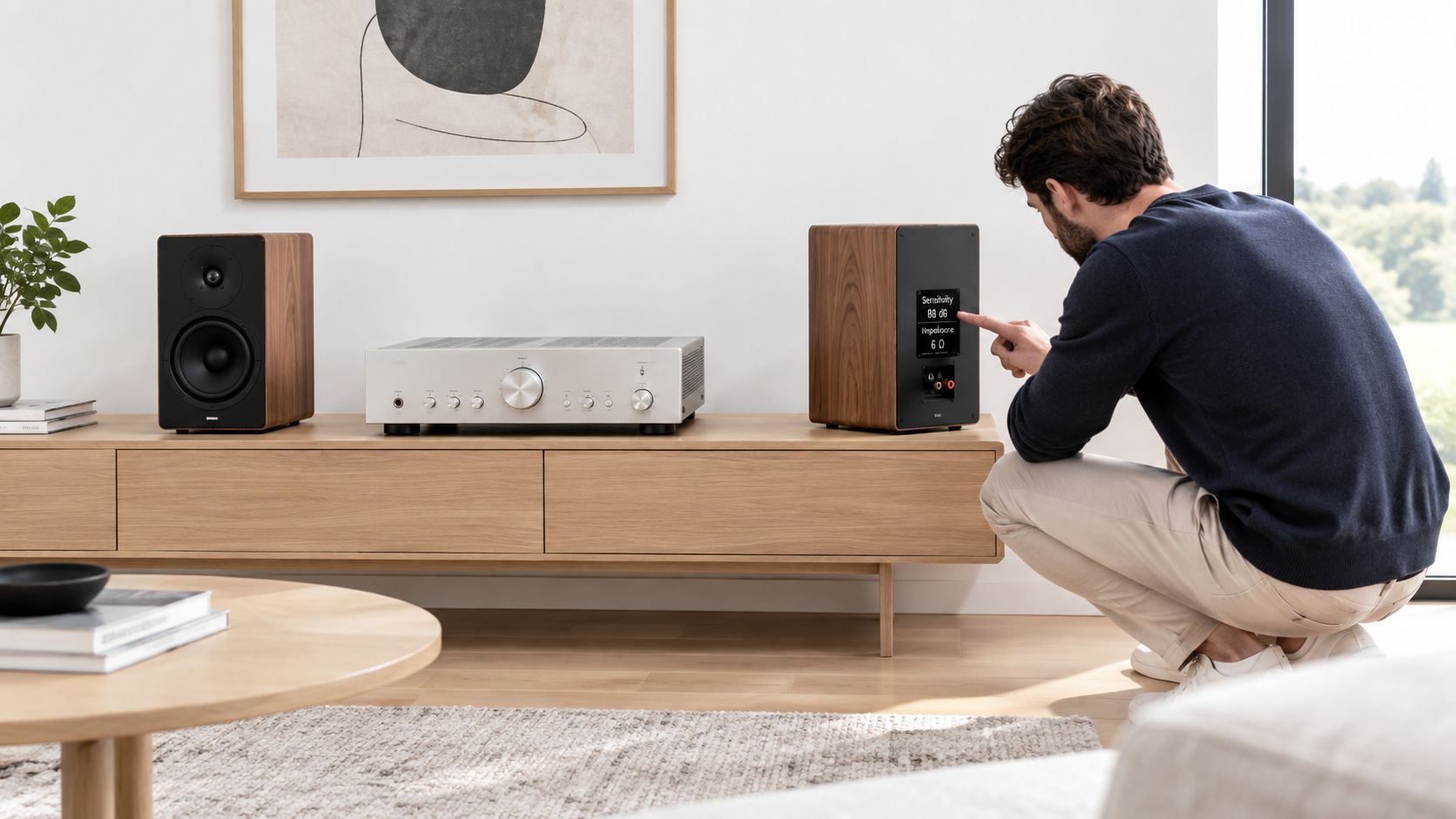
Start with the speaker load, not the amp brochure
Two speaker specs matter immediately. Sensitivity tells you how loud the speaker gets from a given amount of input. Nominal impedance gives you a rough picture of electrical load, but the nastier part is usually where the speaker dips low and asks for current with a bad attitude.
That's why a so-called modest speaker can still make an amp sound tired. Not because the watt number was tiny, but because the speaker wanted control the amp couldn't maintain. The result is easy to hear. Bass softens. Dynamics flatten. The soundstage shrinks toward the speaker boxes.
A simple matching flow that keeps you honest
Don't overcomplicate it. Use a short checklist.
List your actual sources
Streaming only is one system. Streaming plus TV plus turntable is another. Mixed systems often justify a more feature-complete integrated.Check the speaker's behavior
Sensitivity gives you a rough loudness clue. Impedance tells you whether the amp needs some muscle and stability. If you need a plain-language refresher, this piece on what impedance matching means in audio covers the basics.Measure the room and distance
Nearfield desktop listening needs a different kind of authority than a sofa across the room. Small rooms can still punish weak amps if the speakers are demanding.Leave headroom
The amp shouldn't sound like it's working for tips. Clean reserve matters more than chasing a heroic published watt figure.
If your speakers dip low and your room asks for real bass, current delivery matters more than vanity watts.
What this sounds like in practice
A well-matched integrated in a small room sounds anchored. Kick drums have shape, not just thump. Vocals stay centered as the arrangement gets busy. Bass lines don't smear into room boom. You get weight without the wool blanket.
A mismatched one tells on itself quickly. At low levels it may seem fine, even pretty. Then the track gets dense or you turn it up slightly and the system starts to collapse inward. That's not always “bad sound.” More often it's an amp getting bossed around by a speaker it never really had hold of.
When separates still make sense
If you know you'll keep changing DACs, experimenting with phono stages, adding room correction, or bi-amping difficult speakers, separates can still be the smarter route. They give you more permutations and more room to chase your own taste.
But many listeners don't need infinite permutations. They need one coherent system that works every day and doesn't starve the signal before it even reaches the speakers.
That's matching. Not shopping. Matching.
When One Box Is Enough and When It Is Not
The integrated amplifier remains a serious category because the job never disappeared. One market estimate pegs the integrated amplifier market at about 15 million units in 2025, while another values the global integrated stereo amplifier market at about $2.1 billion in 2025, projecting $3.2 billion by 2034 at a 4.8% CAGR. The broader audio amplifier market is larger still, with one estimate at $11.13 billion in 2024 and $11.92 billion in 2025, growing at 6.92% CAGR to $16.64 billion by 2030, according to Data Insights Market's integrated amplifier market report. That isn't museum gear. That's a mature, durable segment because people still want one box, real power, enough inputs, and less mess.
One box is enough when the system has a center
If your goal is a coherent stereo system in a real room, an integrated amp often replaces separates without much pain. You get control, power, shorter signal paths, simpler setup, and fewer variables to sabotage the result. In daily use, that counts for a lot.
If your speakers are sensible, your source list is known, and your upgrade itch is more fantasy than plan, one good integrated is not “settling.” It's focus.
One box is not enough when your hobby is the chain itself
Some people don't just listen to systems. They build systems as an ongoing experiment. Different DACs. Different preamps. Different gain structures. Different ways of solving the same problem over and over because the solving is part of the pleasure. For that person, separates still make sense.
That's not superior. It's just a different hobby shape.
So what is integrated amplifier, really? Not a compromise box. Not a beginner box. A decision about where you want complexity to live. If you want it on the rack, buy separates. If you want it solved before you press play, buy the right integrated.
Then listen.

