The most popular advice about the best bookshelf speakers under 500 is backwards. Buyers chase the lowest bass figure, then bolt a difficult speaker to a weak amplifier, push it against a wall, and blame the speaker for the resulting mud.
I rank this price class by what survives in a real room. Texture, weight, image size, amplifier demand, placement tolerance, and the total cost of the system matter more than one impressive line in a specification sheet. The right pair doesn't merely play deeper. It gives the signal somewhere to go.
Table of Contents
- Why Sub 500 Dollar Bookshelves Hit Different Now
- What Under 500 Dollars Really Gets You in 2026
- Powered or Passive and How to Choose Without Regret
- The Standout Passive Picks and How They Sound
- Matching Amps Stands and Placement So You Do Not Starve the Signal
- Three Real Rooms and the Right Speaker for Each
- What to Buy What to Skip and the Final Call
Why Sub 500 Dollar Bookshelves Hit Different Now
Sub-$500 bookshelf speakers are no longer temporary placeholders. They occupy a real price-to-performance sweet spot because driver design, cabinet work, and crossover tuning once reserved for costlier systems now reach ordinary rooms. JPK's 2026 passive bookshelf roundup describes this market as the strongest it has ever been, with speakers that once cost about $1,200 five years ago now available in this class. That roundup's practical system stack pairs passive speakers in roughly the $150 to $500 range with a modest integrated amplifier and network streamer.
The buying decision is about system burden, not just the speaker. A model with grand bass can sound slow if the amplifier cannot control it. Read our breakdown of Class D amplifier sound quality to see why amplification changes that equation. A smaller speaker may create the cleaner, more convincing image in a bedroom. A powered pair can win outright for a desk or television because it removes the amplifier, extra cables, and rack space.
The amplifier sets the ceiling.
My job here is partly SEO. The phrase best bookshelf speakers under 500 tells search engines what this page covers. It does not tell me whether a snare has paper texture or whether a bass guitar carries believable mass. Your room determines that character. Your amplifier determines more than most buyers admit, especially when placement is tight or listening levels rise.
Stop shopping by the deepest number
A low-frequency figure shows where a speaker may reach under stated conditions. It does not show how that bass behaves near a wall, how much current the amplifier must supply, or whether male vocals stay solid when the kick drum arrives.
The strongest recommendations below have distinct jobs. One delivers fuller low-end authority. Another suits a small room with a calmer footprint. A powered design makes more sense for desk and television duty, even when a passive pair offers the better upgrade path.
The cheapest complete system often sounds better than the most ambitious incomplete one.
What Under 500 Dollars Really Gets You in 2026
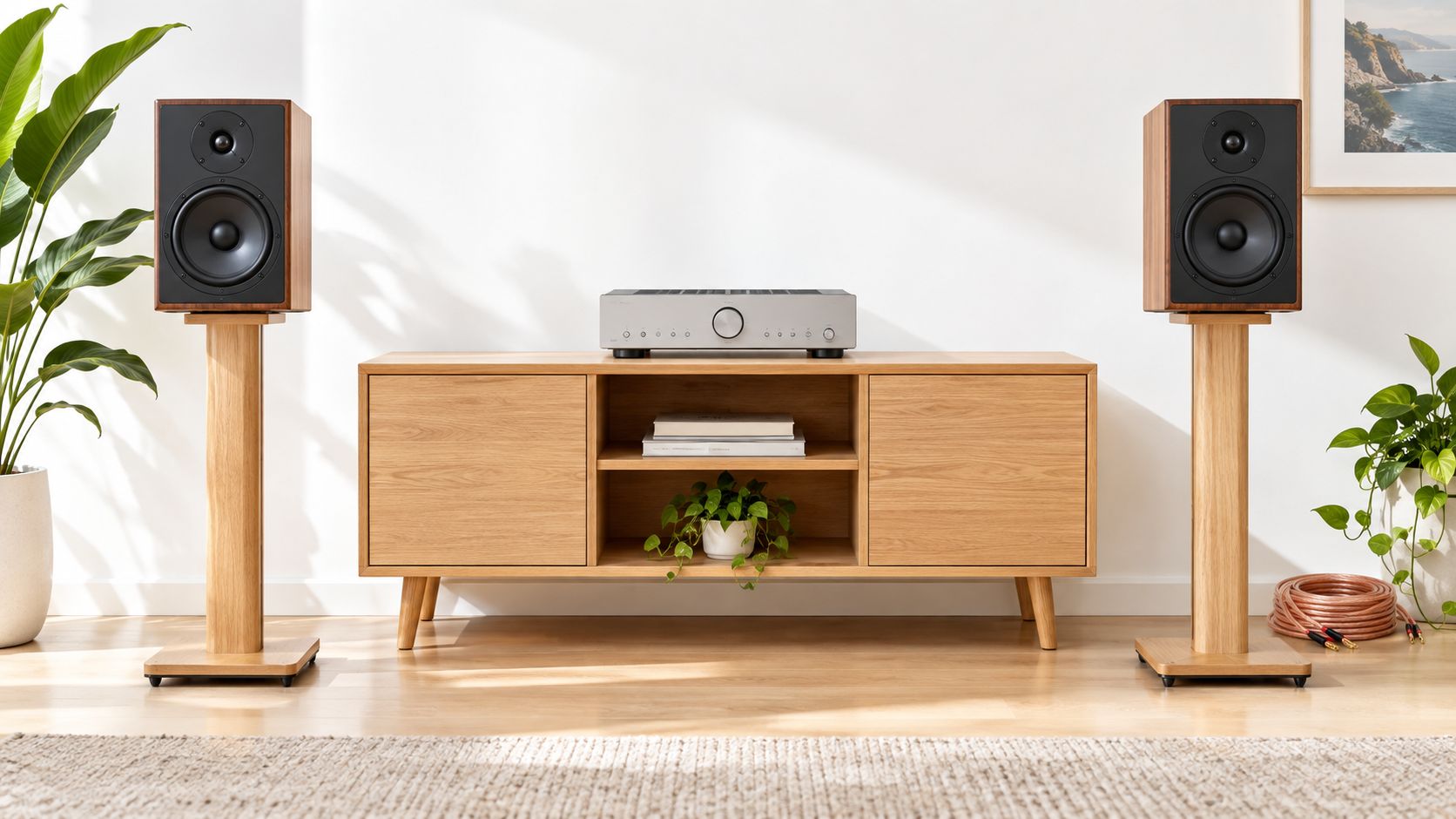
Under $500, the primary choice is system architecture, not a longer specification sheet. A passive setup pairs bookshelf speakers with an integrated amplifier and a streamer. A powered pair places amplification and often wireless connectivity inside the cabinet, reducing the number of downstream decisions.
The passive stack remains compelling because each box has a defined job. Speakers convert the signal, the amplifier supplies current, and the streamer handles convenience. The independent 2026 roundup cited earlier places passive speakers in the $150 to $500 range, alongside an integrated amplifier at about $350 to $400 and a streaming source. That stack can beat many all-in-one systems sold for twice as much because the signal path gives each component room to do its work. It also exposes the cost: amplification, cables, and stands still matter.
The market is pulling features downward
KnowledgeLib's 2026 audio market report values the global bookshelf-speaker market at $3.2 billion in 2025 and projects $5.1 billion by 2034, with a 5.8% compound annual growth rate. Those market figures and projections also place active speakers at 56.3% of 2025 revenue, about $1.80 billion, while passive models account for 43.7%. Asia Pacific holds 38.2% of global market share.
The same report puts active growth at a 6.4% CAGR, compared with 5.0% for passive models. That shift brings integrated amplification, wireless connectivity, and DSP-based optimization into cheaper systems. It also changes the budget equation. A powered pair may cost more upfront than passive speakers alone, yet less once amplification and control are included.
The wrong format still creates trouble. A passive pair needs an amplifier that can handle its load and room placement. A powered pair needs sensible positioning and a clear view of future upgrades. Real-room character and downstream system cost matter more than headline bass extension.
A specification is a clue, not a verdict
Most budget bookshelf speakers use a two-way layout, with a soft-dome tweeter and a woofer in a compact cabinet. A general guide describes the common format as roughly 25 to 35 cm tall, with 4 to 7 inch woofers, 8-ohm impedance, and sensitivity around 85 to 88 dB. That overview of common budget designs provides useful context, not a buying commandment.
Listen to the woofer-to-tweeter handoff. Bass should stop cleanly instead of lingering near the walls. Vocals should stay attached to the centre when the arrangement thickens. A speaker that needs perfect placement or a powerful amplifier can become the expensive choice after checkout.
The floor moved. The excuses didn't.
Powered or Passive and How to Choose Without Regret
Powered speakers make the strongest case where the system itself needs to stay small. On a desk, an amplifier box steals space and adds another source of hum, heat, and remote-control confusion. Beside a television, built-in amplification and a remote can matter more than the last layer of stereo depth.
Passive speakers win when you care about the system beyond today. You can change the amplifier without replacing the speakers. You can add a streamer later. You can choose a warmer or more forceful electrical partner when the room changes. The extra box isn't automatically waste. Sometimes it's the part that keeps the system alive.
The practical decision matrix
| Scenario | Smarter Pick | Why It Wins |
|---|---|---|
| Desk system with limited space | Powered | Fewer boxes, simpler volume control, and less cable clutter |
| Television and casual listening | Powered | Remote convenience and straightforward crossover use |
| Dedicated two-channel listening | Passive | Better upgrade path and more freedom in amplifier matching |
| Existing integrated amplifier | Passive | Your current electronics already cover the downstream cost |
| Small room with uncertain placement | Powered or compact passive | Choose based on usable footprint and bass control, not headline extension |
| Future system expansion | Passive | Amplifier, source, and subwoofer choices remain open |
The phrase downstream cost matters. A passive pair priced near the top of the category may still be the cheaper purchase if you already own a capable amplifier. A powered pair may become the expensive route if you later need more inputs, a different control system, or a separate cinema setup.
Desk sound has its own rules
Nearfield listening exposes hiss, cabinet resonance, and uneven treble more quickly than a sofa does. You sit close, so the speaker's tonal balance arrives before the room can blur it. A good powered pair can sound more coherent at arm's length because the manufacturer controls the amplifier and drivers as one package.
That doesn't make powered speakers automatically more accurate. It makes them more self-contained. The relevant comparison is not speaker against speaker. It's complete system against complete system.
For a deeper look at how room use changes the choice between consumer speakers and monitor-style designs, I keep a separate guide on studio monitors versus speakers.
Practical rule: If adding an amplifier feels like an obligation, buy powered. If changing the amplifier sounds like part of the fun, buy passive.
The Standout Passive Picks and How They Sound
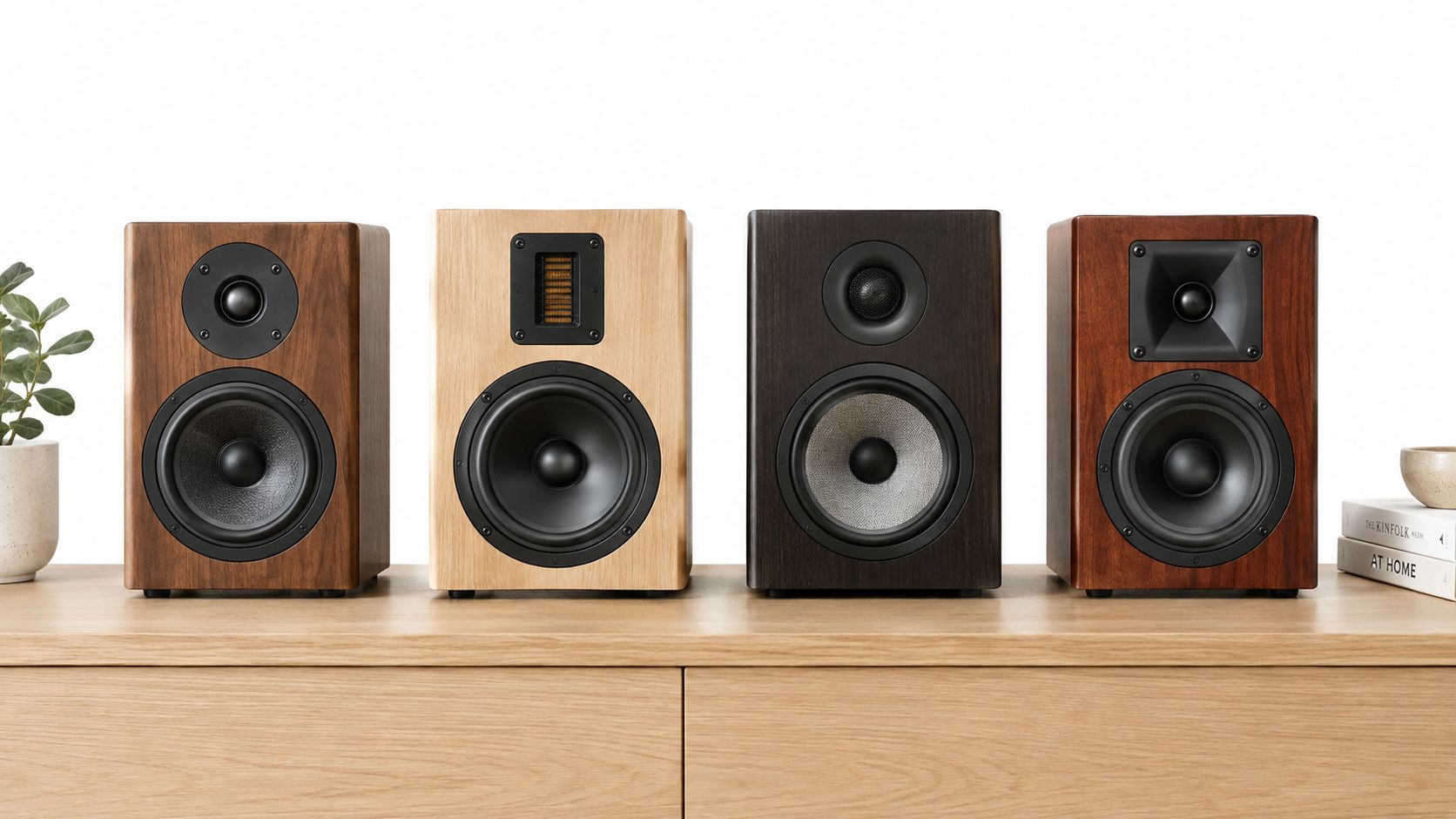
Passive speakers under $500 earn their place through room character, amplifier demand, and placement tolerance. Spec-sheet bass extension comes second. Some models move more air but require stronger current. Others stay compact, behave near walls, and cost less to build into a complete system. The right choice depends on the sound you want and the electronics you already own.
ELAC Debut 2.0 B6.2 for weight and reach
The ELAC Debut 2.0 B6.2 is the bass-first choice, and its output comes with a real amplifier requirement. Its 6.5-inch aramid-fiber woofer, 1-inch cloth-dome tweeter, 6-ohm nominal impedance, 87 dB sensitivity, and quoted 44 Hz to 35 kHz response support a substantial low-end presentation. Those specifications and the associated amplifier warning make the system cost clear. The speaker needs an amplifier that can supply current without losing control.
Its appeal is physical. Kick drums have a shoulder, bass lines carry thickness, and lower registers feel present rather than merely outlined. That weight makes it a strong choice for listeners who want to delay adding a subwoofer. The cost appears when the amplifier lacks authority. Bass loses grip, and the lower midrange can become crowded.
Best fit: Listeners who want fuller bass without immediately adding a subwoofer.
Skip it if: Your amplifier is weak or your room already carries too much bass.
Q Acoustics 3020c for small-room control
The Q Acoustics 3020c takes the compact, controlled route. Its 254 x 155 x 251 mm dimensions keep the cabinet manageable on a shelf or small stand, particularly where furniture and wall distance limit placement. Q Acoustics does not publish a sensitivity figure for the 3020c in the material considered here. The related 3030i family is commonly cited around 88 dB sensitivity, but that figure should not be treated as a specification for the 3020c.
The sound is tidy rather than thunderous. Vocals occupy a clean, readable space, and the cabinet does not make a modest room feel overloaded. It cannot deliver the ELAC's physical shove, yet it may produce more usable music in a cramped setup because its scale stays proportionate near walls and furniture.
The Q Acoustics load as a warning label
Another guide lists the Q Acoustics example at 88 dB sensitivity at 2.83 V/1 m, with 6-ohm nominal impedance, a 4-ohm minimum impedance, and a 46 Hz to 30 kHz frequency response with a +3/−6 dB tolerance. Read the cited load and response data. Treat those figures as a reminder about amplifier demand, not as proof that every specification applies directly to the 3020c.
At normal levels, the speaker sounds composed. Raise the volume and the compact cabinet reaches its limits sooner than a larger, heavier design. Its strength is proportion. It gives a small or medium room a believable stage without pretending to be a floorstander.
Other passive voices worth hearing
The passive field includes warm compact designs, lively cinema-oriented models, and revealing speakers that favor image precision over softness. No single voicing works for every record. Forward treble can make films exciting and poor recordings tiring. A relaxed balance suits long listening but may make dense mixes feel too polite.
Use these filters:
- Choose warmth if vocals and long listening sessions matter most.
- Choose scale if the room has breathing space and you listen at serious volume.
- Choose compact control if the speakers must sit near a wall, desk, or television.
- Choose high sensitivity if your amplifier has limited current reserves.
The best passive pick is the one whose compromises fit your furniture, room, and electronics. A cheaper speaker with an easy load can produce the better complete system. A heavier speaker only wins when the amplifier can feed it properly.
The video below adds a visual reference for cabinet proportions and driver arrangement, two practical clues when judging how a speaker will fit the room.
Buy the character you can live with.
Matching Amps Stands and Placement So You Do Not Starve the Signal
The amplifier match matters more than a flattering wattage label. Impedance and sensitivity show how demanding a speaker can become, especially when the music gets dense and the volume rises.
The ELAC's load characteristics, covered above, explain why the amplifier tier matters. Lower sensitivity needs more electrical effort, while a low minimum impedance puts greater pressure on current delivery. Choose the amplifier for composure, not headline power.
Match the electrical load first
Sensitivity gives you a useful starting filter. Speakers in the lower sensitivity tier need stronger amplification, models in the middle tier suit most receivers, and highly sensitive designs are easier to drive. Use that sensitivity guidance as a practical filter.
Listen for strain. If bass loses its shape, cymbals harden, or the stereo image narrows as volume rises, the amplifier is running out of control. A modest speaker with an easy load can make a better complete system than a larger model that forces an expensive amplifier upgrade.
Give the cabinet a stable platform
A bookshelf speaker does not belong on every shelf. Stands place the tweeter closer to ear height and reduce vibration from furniture. On a desk, isolation pads limit the surface's tendency to blur bass and thicken the lower midrange.
Start with both speakers the same distance from your listening position. Keep them away from corners. Add modest toe-in, then reduce it if the centre image feels too narrow or the treble turns pointed.
Stands are part of the system cost. Budget for them before choosing a passive pair. A powered pair may need less equipment, but it still needs stable support and sensible spacing.
Tune the room by ear
Compact speakers generally suit smaller rooms, while mid-size models need more breathing space. Larger rooms may require bigger woofers or a subwoofer. Treat those categories as starting points, not fixed rules. Furniture, listening distance, and wall proximity change the result.
If bass booms, move the speakers farther from the wall before changing electronics. If vocals sound thin, test a little less distance from open space and check whether the amplifier is struggling. Change one variable at a time.
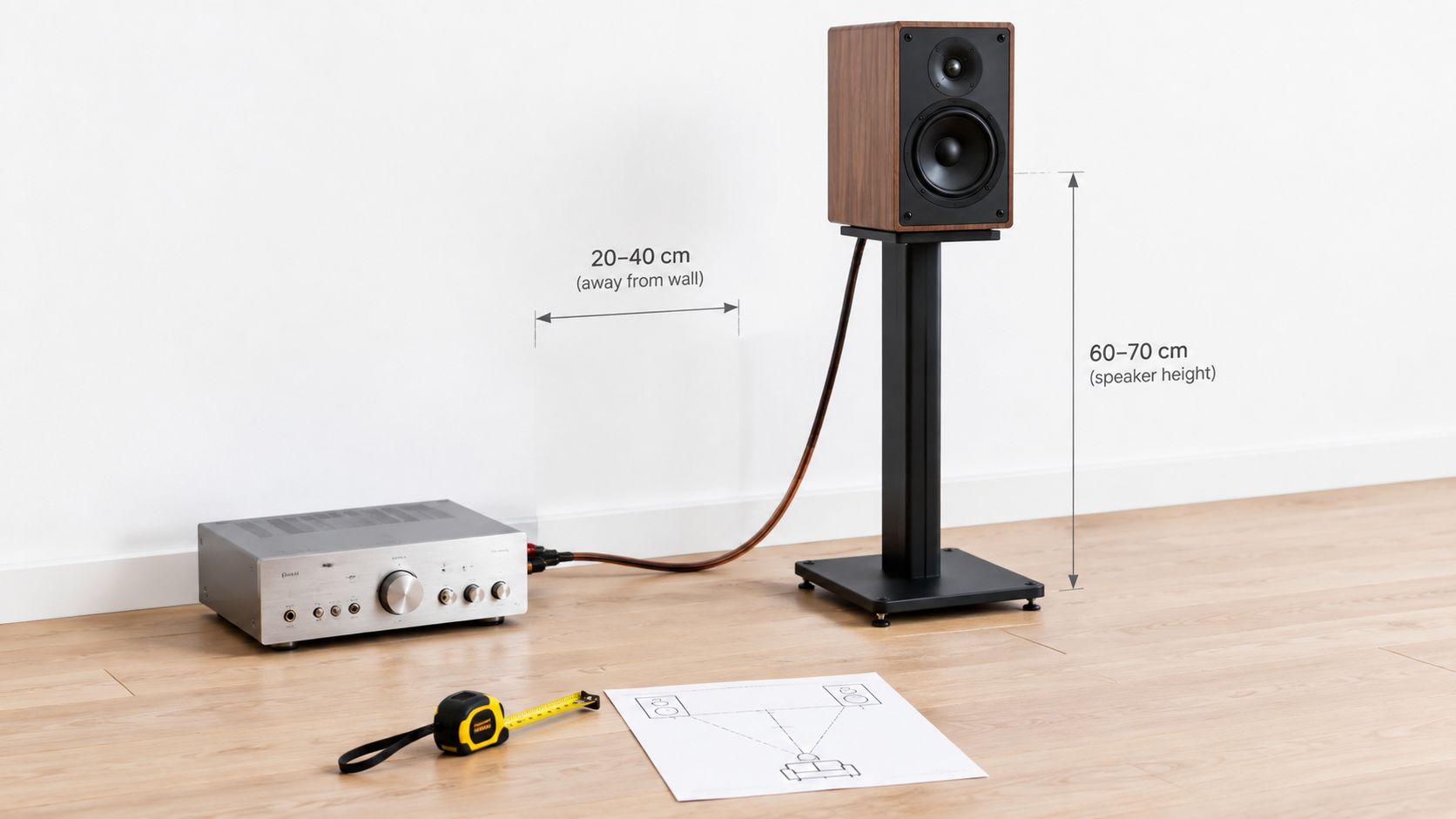
Placement is free. Bad placement isn't.
Three Real Rooms and the Right Speaker for Each
Room size sets the speaker's workload, but listening distance and furniture decide how that workload sounds. Rank the options by real-room character and total system cost, not by the lowest bass claim.
The small bedroom desk
A compact speaker is the right starting point. Nearfield listening exposes excess bass quickly, turning a warm balance into one-note thump. The Q Acoustics 3020c class keeps its cabinet manageable and puts control ahead of brute extension. Choose a powered pair if the desk already holds a computer, display, and interface. Fewer boxes matter here.
Buy signal: compact cabinet, clean midrange, simple volume control.
Avoid signal: large woofer or rear port pressed against the wall.
This room rewards placement tolerance more than maximum output. Keep the setup simple and protect desk space.
The living room
A mid-size passive pair with a capable integrated amplifier fits a shared living room better than an oversized cabinet. It needs enough weight to reach the sofa without flooding the room with bass. The Q Acoustics 3030i family is a sensible choice for broad usability, especially when the amplifier and speaker must work comfortably together.
Use stands and give the cabinets breathing room. The goal is an even balance across the seating area, not the biggest sound from one chair.
Buy signal: balanced scale, clean midrange, manageable amplifier demand.
Avoid signal: choosing only by the lowest bass figure.
Furniture and wall distance can decide whether a compact speaker sounds controlled or congested. Follow this guide to speaker placement in a small room before changing equipment.
The larger open plan
Open-plan rooms need authority and a system budget that accounts for amplifier reserves. The ELAC Debut 2.0 B6.2 can deliver satisfying low-end weight, but it wants current. Choose an amplifier with real reserves rather than relying on the sensitivity sheet alone. The load traits covered earlier matter most when you expect sustained output across a large space.
A subwoofer path is the sensible upgrade route. It adds low-frequency scale without forcing a bookshelf cabinet to behave like a floorstander.
Buy signal: larger cabinet, stronger amplifier, subwoofer path.
Avoid signal: compact speakers expected to energise an open plan at party levels.
The room gets the final vote.
What to Buy What to Skip and the Final Call
Buy the Q Acoustics 3020c or 3030i class when room tolerance and easy system matching matter most. They deliver controlled scale without bullying a modest space. Buy the ELAC Debut 2.0 B6.2 when bass weight leads the brief, but pair it with an amplifier that has real current delivery, as noted earlier.
Choose powered speakers for a desk or television when fewer boxes, a remote, and immediate usability matter. Buying guides now place powered designs alongside passive ones because desk, TV, and gaming systems increasingly share the same space. See the powered and passive buying lanes. Supermarket Sound covers practical system choices for those setups.
Skip the lowest bass number when the room cannot support it. Skip a demanding speaker when the amplifier lacks current reserves. Skip large cabinets in small rooms.
Before buying, check three costs and constraints:
- System cost: include amplification, streaming, stands, and isolation.
- Room fit: match cabinet scale to the space and wall distance.
- Listening character: choose weight, warmth, or precision for your music.
Pick the speaker that makes the whole system easier to live with. The cheapest pair can become the expensive choice once the amplifier, stands, and placement demands arrive.
Tell me your room size, amplifier, listening distance, and whether you need television or desk use. Then choose the route that fits. Do not shop by the bass number. Shop by the room.

