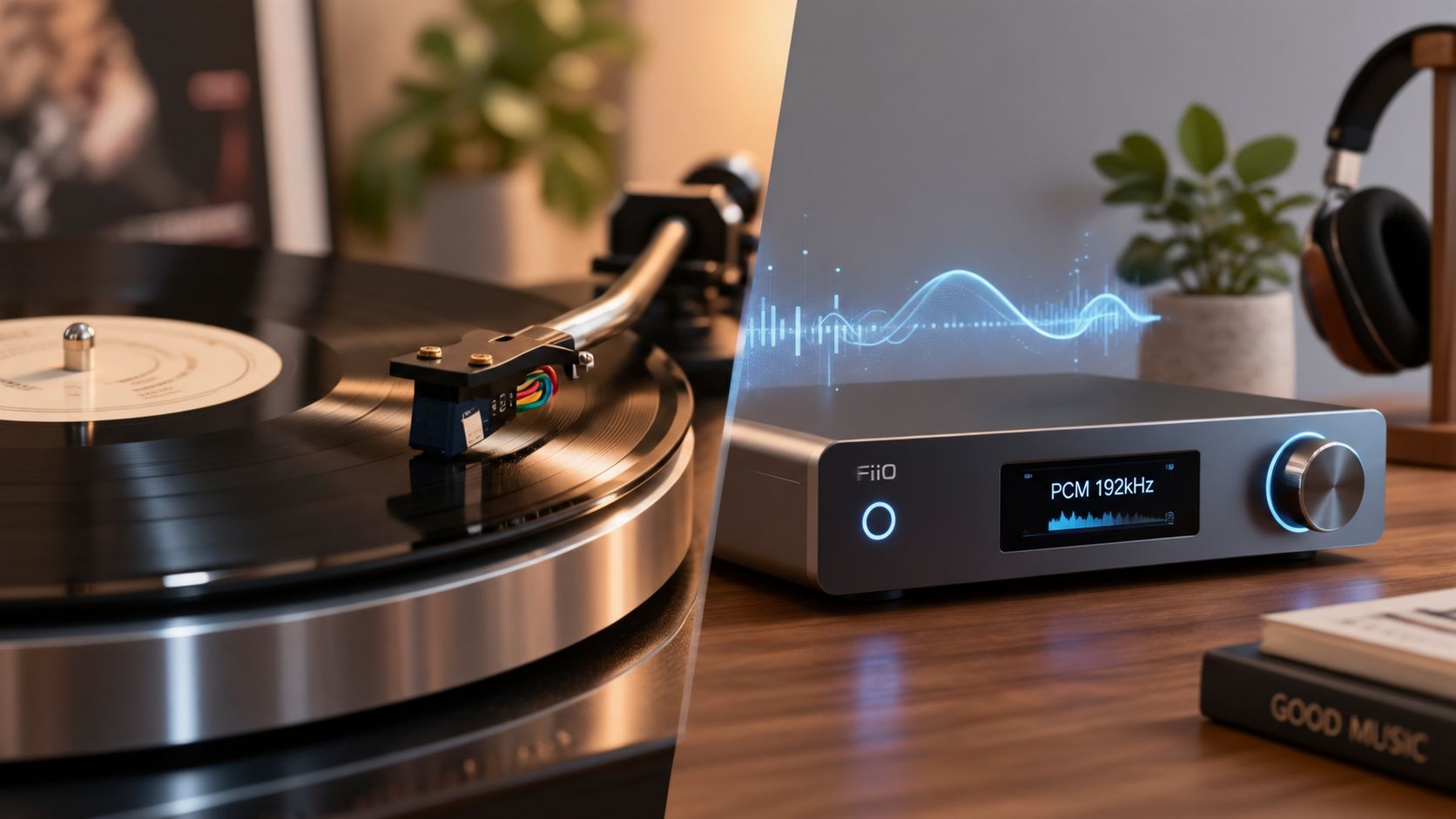
The popular advice about analog vs digital sound is usually wrong because it starts at the record or file and stops before the speaker. “Vinyl is warm” and “digital is clean” describe possible outcomes, not fixed identities. The audible result gets built downstream, through mastering, conversion, gain staging, amplification, room acoustics, and the playback device sitting nearest your ears.
I'm Marque Hersh, founder of Supermarket Sound, and I care about what survives an actual listening session. Digital usually gives you the quieter floor, greater editing control, and more predictable headroom. Analog can give you a physical ritual and a pleasing way of bending peaks. Neither format automatically wins. The chain decides what reaches you.
| Listening priority | Analog tends to offer | Digital tends to offer |
|---|---|---|
| Tonal character | Saturation, gradual overload, mechanical texture | Clean reproduction and predictable level behavior |
| Dynamic range | Limited by the medium and circuitry | High theoretical range, especially at 24-bit |
| Convenience | Physical ownership and deliberate playback | Instant access, recall, editing, and portability |
| Main risks | Noise, wear, alignment, inconsistent setup | Abrupt clipping, poor mastering, conversion, and device voicing |
| Where the difference often appears | Cartridge, phono stage, pressing, amplification, room | Mastering, DAC, filters, amplifier, headphones, room |
The useful question isn't which format has the better mythology. It's where the signal changes character.
Table of Contents
- Why Analog vs Digital Sound Still Divides Ears
- How Analog and Digital Chains Inherit Their Character
- Perceived Differences Listening to Vinyl and Lossless Files
- Measured Differences Under the Hood
- Real-World Playback Scenarios and Use Cases
- Cost and Maintenance Implications for Enthusiasts
- Choosing Between Analog and Digital for Your Setup
Why Analog vs Digital Sound Still Divides Ears
The format label rarely predicts what reaches your ears. A vinyl record may sound thin, harsh, or magnificent. A digital file may sound sterile, dense, or strikingly open. Those descriptions are outcomes, not fixed identities. The source matters, then mastering, conversion, gain staging, amplification, room acoustics, and the playback device reshape it downstream.
“Warmth” often gets assigned to vinyl when the stronger fingerprint comes from cartridge loading, the phono stage, amplifier, speaker, or mastering. A record cut from a compressed digital master does not represent a different artistic decision solely due to its carrier having grooves. A lossless file through a revealing system does not automatically sound “digital” in the cartoon sense. Balanced recording and playback choices can matter more than the storage medium.
Practical rule: Change one link at a time, match playback levels, and use the same musical passage. Otherwise, you are comparing complete systems rather than formats.
Digital audio also arrived as a physical recording chain, not merely as an abstract computer process. In 1977, Sony marketed the PCM-1, the world's first product enabling digital recording and playback. The system used a consumer setup with a Betamax VCR, as documented in Sony's history of the PCM-1. Digital therefore entered listening through hardware, signal conversion, and a defined route for sound.
The format debate becomes less useful as listening habits spread across radio, podcasts, streaming music, and satellite audio. Nielsen reports 3 hours and 50 minutes of daily audio consumption in the United States in 2025 in its 2025 audio listening trends report. A vinyl or digital experience may already pass through digital infrastructure somewhere in the recording, distribution, or playback chain.
The medium leaves a fingerprint. Downstream hardware and room conditions determine how clearly you hear it.
How Analog and Digital Chains Inherit Their Character
A turntable system begins with a physical groove. The stylus traces its shape, the cartridge turns that movement into a small electrical signal, and the phono stage applies the required equalization while adding gain. From there, the amplifier and speakers determine how much of the groove's texture, noise, and tonal balance survives in the room.
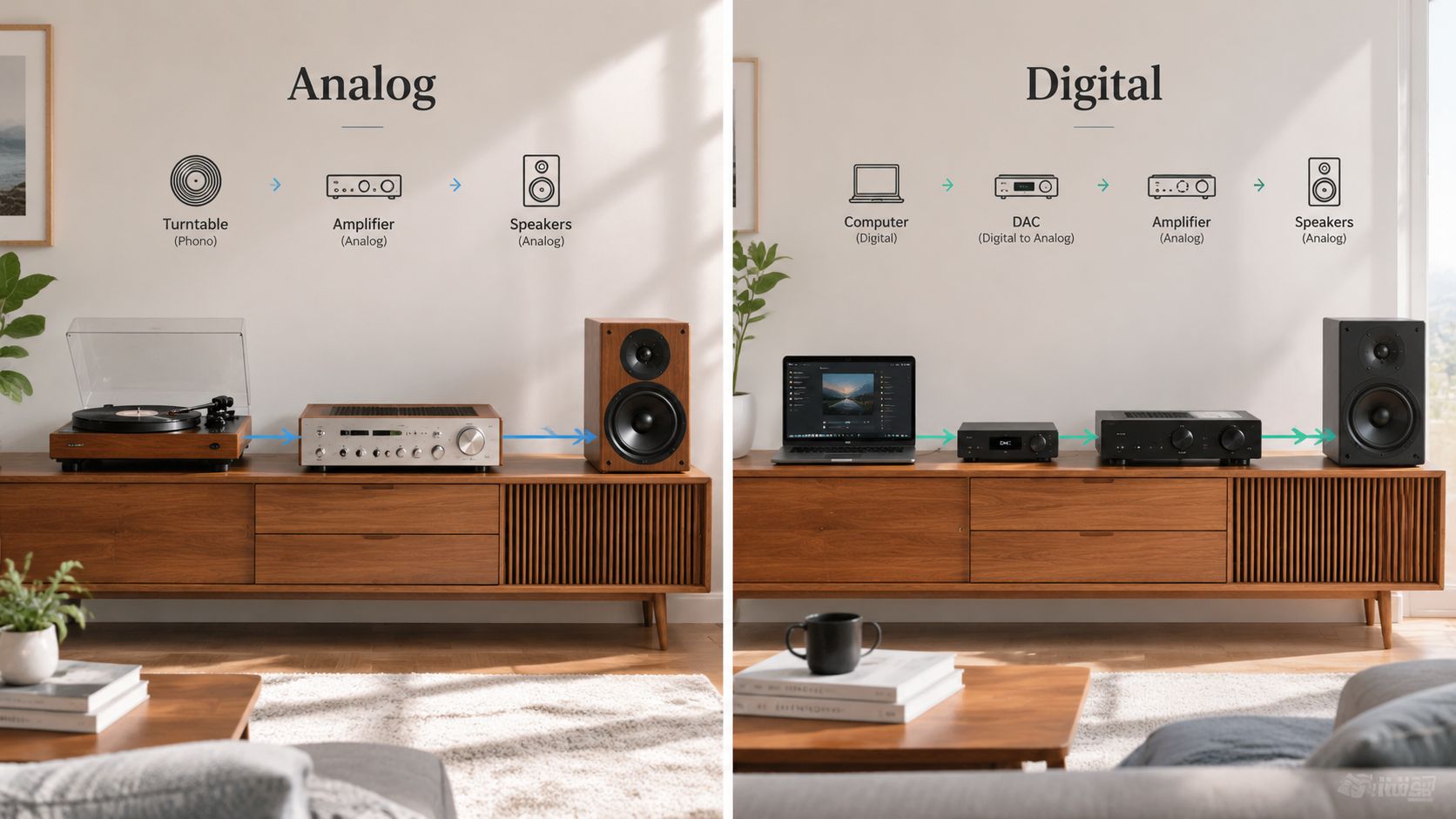
The digital path starts with stored samples, then moves through software, a digital-to-analog converter, amplification, and speakers or headphones. If the original recording began as an analog performance, an analog-to-digital converter entered the chain earlier. If you stream a recording made from tape, edited in a workstation, mastered digitally, and played through a DAC, “analog” may describe the microphone, the tape stage, or the aesthetic choice, but not the complete route to your ears.
The load-bearing links
The cartridge can shape tonal balance and tracking behavior. The phono stage can expose hiss, overload, or hum. The DAC can influence filtering and conversion behavior, though the rest of the system still determines whether those differences matter. A cheap or poorly matched link can starve the signal long before an expensive upgrade gets a chance to sound impressive.
Digital reconstruction depends on sampling theory. The Nyquist-Shannon theorem requires a system to sample at least twice the highest frequency present for perfect reconstruction. A 44.1 kHz sample rate therefore has a 22.05 kHz Nyquist frequency, while a 20 kHz sample rate can represent audio only up to 10 kHz without aliasing, as explained in this sampling theory reference.
That doesn't mean a higher number automatically creates better music. It means the filter, conversion stage, recording decisions, and playback context deserve more attention than a badge on a file.
A sensible turntable setup guide should start with the mechanical and electrical chain, not the romance. Supermarket Sound's turntable sound system guide follows that practical route.
The bridge matters more than the slogan.
The video below gives a visual companion to the two signal paths. Listen afterward through your own system, because diagrams can't tell you where your room starts misbehaving.
Perceived Differences Listening to Vinyl and Lossless Files
Vinyl often presents music with a sense of physical density. Bass can feel anchored, the midrange can carry a gentle bloom, and vocals may sit inside the mix rather than floating on top of it. That impression doesn't come from one universal “analog sound.” It can come from the mastering, the pressing, the cartridge, the phono stage, and the way the system handles low-level noise.
Lossless digital tends to make transient information easier to follow. A snare attack arrives with a clean edge, reverb tails remain easy to inspect, and quiet passages don't need to fight the medium's surface noise. On headphones, that clarity can feel like a window opening. On an already bright system, it can feel like somebody replaced the curtains with glass.
The fair comparison requires level matching and equivalent mastering. If the vinyl copy plays louder, it may sound more exciting before the listener notices the difference. If the digital version uses a different master, the test stops measuring the carrier and starts measuring production choices.
What happens near the limit
Analog and digital disagree most dramatically when a signal gets pushed. Analog systems generally add distortion progressively as the level approaches saturation. The result can soften peaks and add harmonic density, which many listeners describe as forgiving or warm. The Stanford lecture on digital audio systems explains the contrasting behavior of digital systems, where added distortion remains low until the signal reaches full scale and clips abruptly at 0 dBFS.
That difference is easy to hear in a mix with aggressive drums or a vocal recorded too hot. Analog may bend the peak into a thicker shape. Digital may preserve the peak cleanly until the ceiling, then turn one mistake into a brittle crack. Digital's headroom is cleaner right up to the limit. Analog's overload can be kinder after the limit arrives.
A pleasing distortion is still distortion. The question is whether the system adds it deliberately, consistently, and in the right place.
Vinyl also introduces friction. You handle the record, lower the stylus, accept the side length, and live with the condition of the object. That friction changes attention. Streaming removes the ceremony and makes discovery effortless, but effortless listening can become background listening.
The sound difference is real in some systems. The behavioral difference is real in every room.
Measured Differences Under the Hood
Measurements explain why digital often wins the technical argument, but they don't settle the musical one. A format can provide more theoretical range and still sound worse after a bad master, aggressive level matching, poor conversion, or an unsuitable speaker-room interaction.
Bit depth supplies the clearest example. Each additional bit adds roughly 6.02 dB of usable range, following the relationship SNR = 6.02 × N + 1.76 dB, as outlined in this bit-depth and dynamic-range explanation. Higher bit depth lowers quantization noise during recording and mixing. It doesn't make the finished music louder.
The practical comparison looks like this:
| Format | Dynamic Range (dB) | Noise Floor (dB) |
|---|---|---|
| 16-bit digital | About 96 | About -96 relative to full scale |
| 24-bit digital | About 144 | About -144 relative to full scale |
| Professional analog tape | About 70–80 SNR | About -70 to -80 relative to signal |
The digital figures are theoretical, while the analog figures describe signal-to-noise performance. The digital versus analog audio comparison places 16-bit audio at about 96 dB, 24-bit audio at about 144 dB, and professional analog tape around 70–80 dB SNR.
Where the numbers stop answering
Analog noise comes from the circuitry and medium. Tape hiss, groove noise, motor vibration, electrical hum, and stylus behavior all occupy the listening floor. Digital has a noise floor too, but 0 dBFS defines its upper ceiling, while quantization noise marks part of the lower usable range. A higher bit depth gives engineers more room to record and process quiet material without burying it in quantization artifacts, as described in this bit-depth reference.
Frequency response also needs context. Sampling rate sets the representable bandwidth, but filters handle the transition near the Nyquist limit. Analog playback has its own limits, shaped by the record cut, stylus, cartridge, tonearm, phono equalization, and speaker response. Neither path behaves like a perfect wire.
Distortion spectra tell a similar story. Analog saturation can introduce harmonics that sound musically connected to the source. Digital clipping creates a harsher failure mode. A clean digital chain can preserve low-level detail with remarkable discipline, while an analog chain can make a vocal feel larger by adding a texture the meters won't label as “better.”
Measurements are the floor. Taste builds the room.
For system-level control, a DAC with volume control can simplify the digital path, but it won't repair a poor master or a bright loudspeaker. The converter is one link, not a magic eraser.
Real-World Playback Scenarios and Use Cases
The audible difference between analog and digital usually appears downstream, not in the format label. Room acoustics, speaker placement, headphones, level matching, and the recording master can outweigh subtle differences between competent sources. A turntable in a quiet living room may make surface noise part of the experience, while digital playback through noise-cancelling headphones can present transient details with less mechanical background.

In a home hi-fi system, reflections, bass behavior, and listening position often shape the result more than the source format. Analog demands accurate tracking, cartridge alignment, and suitable phono gain. Digital demands a quiet, stable chain and honest level matching. Neither source can correct a speaker placed badly or a room with uncontrolled low frequencies.
Four listening realities
- Home listening: Vinyl fits deliberate sessions where ownership and handling add value. Digital fits mixed libraries, rapid comparisons, and listeners who want silence between notes.
- Portable listening: Digital suits portable devices, headphones, and changing environments. A physical analog source is difficult to carry, and the practical chain commonly ends in digital playback.
- Studio monitoring: Digital supports editing, recall, and precise arrangement. Analog processing can provide deliberate color, but levels must be watched before saturation obscures the recording.
- Desktop speakers: Speaker placement, desk vibration, room behavior, and the master usually matter more than the original carrier. Changing format will not fix a speaker aimed at a wall.
Daily listening is mixed by default. Radio, podcasts, streaming, and other habits often place digital stages somewhere in the chain before sound reaches the speakers, so the useful question is how the complete path is configured rather than which format wins in isolation. Nielsen addresses this broader pattern in its 2025 audio listening report.
A turntable also needs the right gain and equalization before it reaches an ordinary line input. Supermarket Sound's phono preamp guide explains that cartridge output cannot connect directly to every line-level input.
Context beats ideology.
Cost and Maintenance Implications for Enthusiasts
Analog asks you to maintain a mechanical instrument. The stylus contacts the record, the cartridge needs alignment, records need sensible cleaning, and the turntable must sit level and stable. Belts stretch, styli wear, and dust can turn a quiet passage into a small thunderstorm.
Digital removes most mechanical maintenance, then replaces it with system housekeeping. Files need organized storage and backups. Computers and playback devices need to remain compatible, while firmware or operating-system changes can disrupt a stable setup. Digital is easier to repeat, but it still needs care.
What ownership demands
Budget for the complete chain rather than one glamorous component. A turntable without an appropriate phono stage leaves the signal under-gained or incorrectly equalized. A capable DAC connected to noisy amplification or unsuitable speakers will not complete the upgrade.
For analog, plan for:
- Setup time: Cartridge alignment and tracking adjustments affect what reaches the speakers.
- Cleaning: Dust and residue increase noise and can complicate stylus contact.
- Replacement parts: Belts and styli eventually need attention.
- Storage: Records need protection from heat, pressure, and careless handling.
Digital requires a different routine:
- File management: Keep original files, edited versions, and playback copies clearly separated.
- Compatibility: Updates can affect drivers, playback software, or older interfaces.
- Conversion choices: A DAC upgrade makes sense when the current unit introduces audible problems, not because a new logo promises transformation.
- Listening tests: Compare at matched levels before deciding that a change helped.
Where enthusiasts waste money
The common mistake is buying the most visible object first. A costly turntable remains compromised if the cartridge sits incorrectly. An expensive digital front end cannot restore contrast removed by the mastering.
Ownership test: Choose the maintenance routine you will perform. A theoretically superior setup that stays misaligned or unused is not superior in your room.
Vinyl remains commercially serious rather than purely nostalgic. Global vinyl sales represented 4.3% of total global music sales in 2023 and 14.3% of total physical music sales worldwide that year, according to independent vinyl sales reporting. That market persistence reflects more than frequency response. People still pay for objects, artwork, versions, and ritual.
The audible payoff still depends downstream. A clean record cannot compensate for poor cartridge setup, unstable placement, or unsuitable speakers. A well-managed digital library cannot overcome harsh amplification or a weak master.
Maintenance is not a punishment. It is the admission price for a physical format.
Choosing Between Analog and Digital for Your Setup
Choose analog when the record itself belongs in the listening experience. Artwork, sequence, physical limits, and the ritual can make an album feel like an event rather than a utility. Vinyl can also introduce a distinctive saturation and peak response, but the result depends on cartridge setup, placement, records, and the rest of the playback chain. Surface noise, wear, and regular adjustment come with the format.
Choose digital when access, consistency, editing, and quiet playback matter more. A well-built digital system handles a broad library without mechanical fuss, while 24-bit production offers useful theoretical range during recording and mixing. A higher-resolution file cannot repair a poor master. Examine the recording and playback chain before paying for file labels.
Three sensible listener profiles
The vinyl collector should build the complete analog path rather than stop at the turntable. Cartridge alignment, phono gain, clean records, stable placement, and suitable amplification shape the result more than decorative nostalgia.
The digital purist should prioritize a dependable source, transparent conversion, competent amplification, and speakers or headphones that suit the room and personal taste. Make level matching easy. A louder signal can sound more impressive during a quick comparison, even when it is not better.
The hybrid listener can use digital as the daily source and add a turntable for records that reward physical playback. Each format then has a defined job instead of being forced to cover every use. That separation also makes differences easier to assess through the same downstream equipment.
Vinyl's continued market presence reflects ownership demand, not proof of superior fidelity. People still buy records for objects, artwork, versions, and ritual, as reflected in vinyl sales source.
Invest in 24-bit files when recording, mixing, or processing benefits from additional margin. For ordinary playback, inspect mastering, conversion, amplification, speakers, headphones, and the room first. Audible differences usually emerge downstream, where gain structure, transducers, placement, and room response determine what reaches your ears.
Your ears decide. Your system reports. Your habits cast the vote.
If you are choosing a source today, list how you listen. Then compare a properly set-up turntable with a level-matched digital chain through the same amplifier and speakers. Put money into the weakest link, not the loudest marketing claim. Supermarket Sound's practical guides cover turntable system planning, phono preamp decisions, and DAC volume control before you buy.

