Most turntable sound system advice starts with the cartridge. That's backwards. In a real room, a vibrating shelf, a badly placed speaker, or a bass-heavy wall can do more damage than the difference between two respectable cartridges.
I'm Marque Hersh, founder of Supermarket Sound, and I've spent enough time moving decks, stands, speakers, and furniture around listening rooms to stop pretending the spec sheet tells the whole story. A turntable is a mechanical source. The room is part of that mechanism. Downstream inherits upstream mistakes, and the first upstream mistake is often placement.
Table of Contents
- Why Your Room Matters More Than Your Cartridge
- How the LP Chain Got Built
- Cartridge and Tonearm as a Matched System
- The Phono Stage Decision
- Amplification and Speakers Downstream
- Placement and Isolation That Actually Move Sound
- Tweaks Worth the Effort and Tweaks That Aren't
- The Whole Chain From Plinth to Room
Why Your Room Matters More Than Your Cartridge
A cartridge reads a groove that's moving by fractions of a millimetre. It doesn't need much help to lose composure. A hollow shelf can feed footfall energy into the plinth, a nearby subwoofer can shake the cartridge suspension, and a hard room can turn an already forward recording into glass.
That's why I don't begin a turntable sound system upgrade with a cartridge swap. I begin by asking where the deck sits, what supports it, where the speakers fire, and whether the floor flexes under normal movement. Walls, floors, glass, furniture density, and speaker boundaries establish bass weight, midrange glare, and image focus before the stylus gets a chance to show off.
A room with too many hard surfaces can make cymbals splash and vocals push forward. A room with thick soft furnishings can swallow air and make the upper midrange feel sleepy. Neither problem gets solved by buying a more exotic stylus.
Mechanical support is part of the source
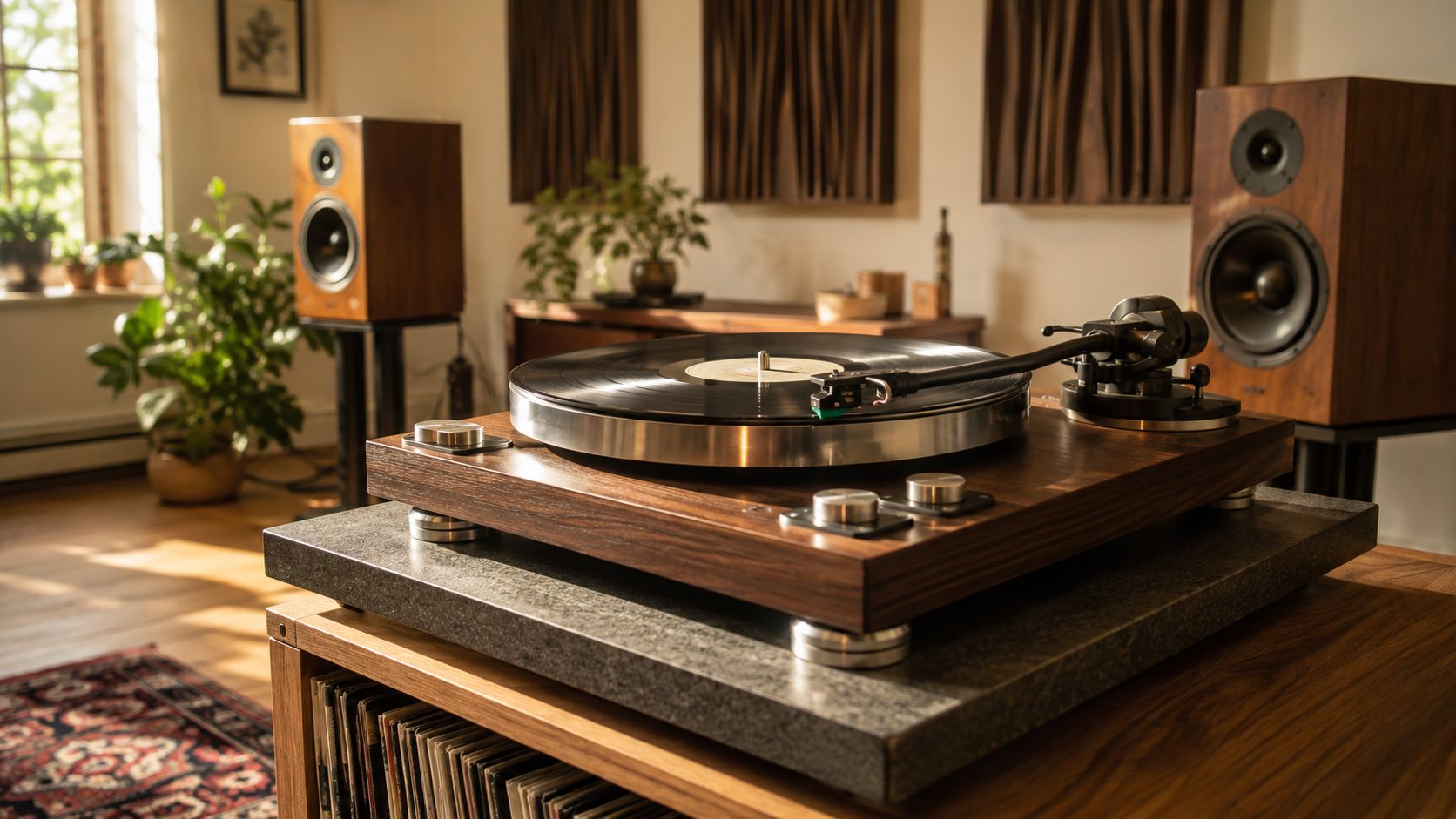
The turntable's platform needs to stay level, rigid, and as isolated from airborne and structural vibration as the room allows. Keep it away from speaker shelves and subwoofers. A level support surface matters because the tonearm and cartridge are working against gravity, groove modulation, and the record's physical imperfections at the same time.
That doesn't mean every deck needs an expensive rack. A sturdy piece of furniture in the right place can outperform a costly accessory placed beside a speaker. In an apartment, a wall-mounted shelf can help with a springy floor, but it can also transmit building movement if the wall itself carries footsteps or low-frequency energy.
For smaller rooms, I'd start with the practical guidance in this small-room acoustic treatment guide before spending on a new cartridge. Treating the room isn't glamorous. It works.
Practical rule: If moving the turntable or speakers changes the presentation more than changing the cartridge, the room was the upgrade.
The floor comes first.
How the LP Chain Got Built
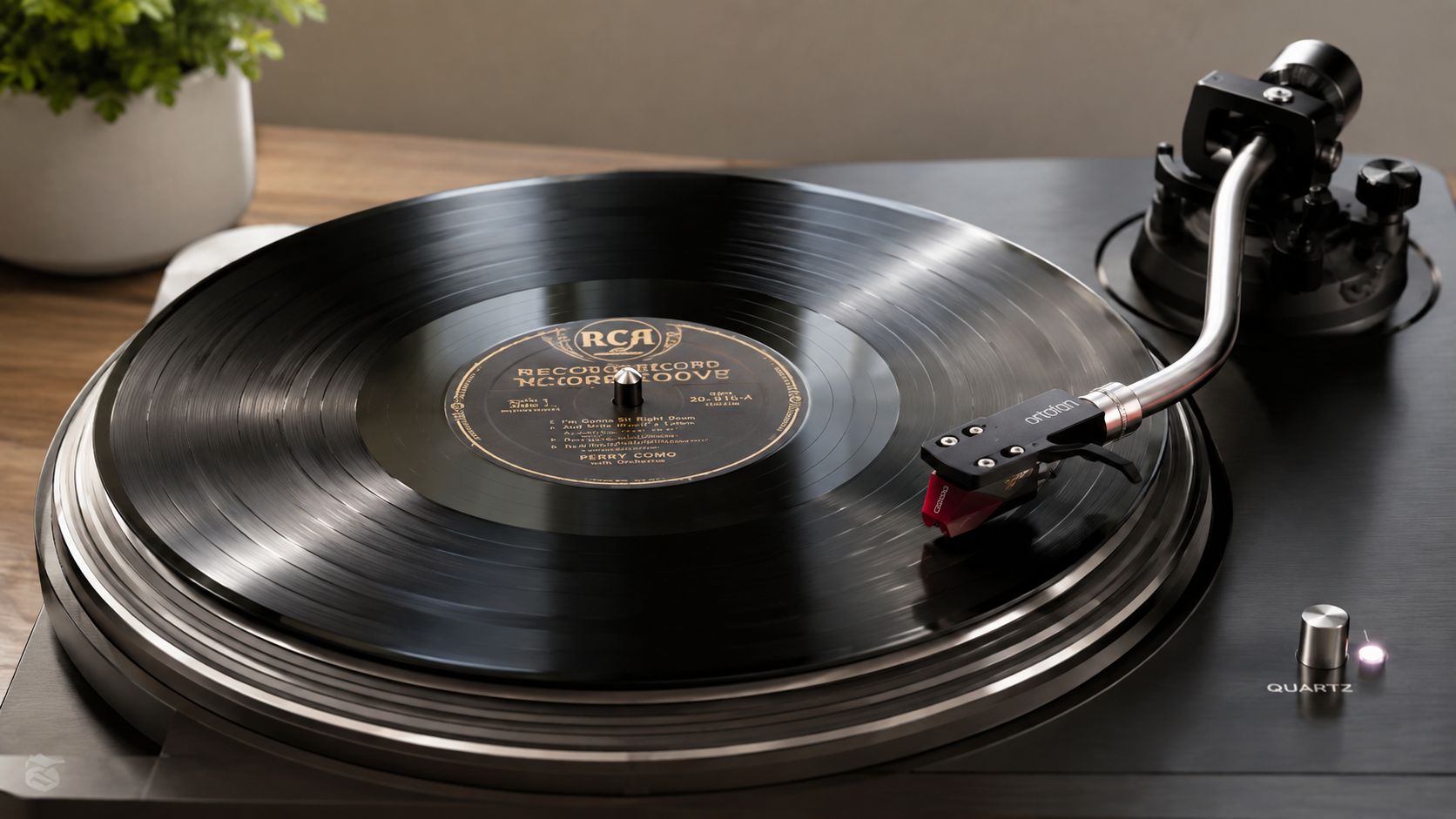
The modern turntable carries a long hardware history, not a nostalgia costume. Sound recording begins with the work associated with 1857, playback arrives with Edison's phonograph in 1877, and the format shifts into the vinyl age in 1948, when Columbia introduced the 33⅓ RPM LP. That LP paired longer playing time with improved fidelity and created the template for serious home listening. (Turntable timeline)
The chain then moved toward mechanical precision. In 1972, Technics released the SL-1200 direct-drive turntable, a design that became a reference point for both home hi-fi and DJ use. Direct drive made speed control a central design concern rather than a hidden motor problem, and it helped establish the expectation that a serious deck should hold pitch rather than merely spin a record.
Why old decisions still shape new systems
Modern decks still inherit the same arguments. Belt drive prioritizes motor isolation through a flexible connection. Direct drive prioritizes speed control and torque at the platter. Mass-loaded plinths aim to resist unwanted movement. Suspended designs try to separate the record-playing platform from external energy. Tonearm shapes and cartridge generators change, but the load-bearing questions remain mechanical.
Vinyl's revival gives those decisions commercial weight. U.S. vinyl LP sales reached more than 43.2 million units in 2023 and generated over $1.3 billion in revenue, according to RIAA-linked industry reporting summarized by turntable market statistics. The same source reports a separate 2023 figure of 40.5 million units, described as the highest annual total since 1986. The figures differ by reporting basis, but the direction is clear. This isn't a museum category.
The modern hybrid system combines old assumptions with new convenience. A belt-drive deck may feed powered speakers through a built-in phono stage. A direct-drive deck may feed a traditional integrated amplifier. A wireless chain can still begin with a moving magnet cartridge and end with digital transmission. The furniture changed. The physics didn't.
Cartridge and Tonearm as a Matched System
Buying a cartridge without checking the tonearm is like fitting tyres without looking at the car. The cartridge's compliance and the arm's effective mass form a low-frequency resonance, and that resonance needs to stay in a useful zone rather than wandering into warp, footfall, or room-borne trouble.
A practical target sits between roughly 7 and 12 Hz. A 12 g arm paired with a 15 µm/mN cartridge settles near 8 Hz, while a 25 g arm with a 10 µm/mN cartridge lands near 10 Hz. Those examples aren't shopping promises. They're a way to understand the direction of travel. More arm mass tends to suit lower-compliance cartridges, while a light arm generally behaves better with a more compliant design.
Read the pairing before buying anything
| Tonearm Effective Mass | Low Compliance (≤10 µm/mN) | Medium Compliance (12-18 µm/mN) | High Compliance (≥20 µm/mN) |
|---|---|---|---|
| Light | Can sound under-controlled | Usually workable | Often the natural match |
| Medium | Often suitable | Broadly flexible | Check resonance carefully |
| Heavy | Frequently appropriate | Can work with careful setup | Higher risk of low-frequency instability |
A high-compliance moving magnet on a heavy arm can drift toward the floor. A low-compliance moving coil on a very light arm can sound tense, thin, and bright because the stylus doesn't settle into the groove with the authority you expected.
Tracking force sits inside the same decision. Audio-Technica notes common cartridge recommendations around 1.5 to 2.5 grams in its turntable specification guide. Too little force encourages mistracking and skipping. Too much force increases wear on the record and stylus. Use a scale, set the manufacturer's recommendation, and stop treating the counterweight markings as sacred.
A Sony PS-Q7 lab report measured a compliant moving magnet cartridge with a 0.6 mm spherical stylus at about 2.17 g downforce. Its tracking limit reached roughly 70 µm, while distortion stayed near 1% only up to the penultimate +15 dB groove modulation. (Independent technical report) That's a useful reminder that tracking performance depends on the complete mechanical arrangement, not the cartridge label alone.
Set the pair first. Then set geometry. Then obsess over the protractor.
The Phono Stage Decision
A phono stage is a load-bearing part of the system, not a decorative upgrade. It raises the cartridge's tiny signal to line level and reverses the RIAA equalization applied when records are cut. Miss either job, and the result can be pinched, noisy, or unnaturally bright.
For a moving magnet cartridge, 47 kΩ is a common load. Capacitance also matters. Manufacturer specifications may list values such as 100 pF or 100–200 pF, as shown in this moving-magnet cartridge loading reference. The total comes from the phono stage, tonearm wiring, and interconnects. Excess capacitance can push the upper range forward with some cartridges. Match the electrical load to the cartridge design rather than applying a universal rule.
Moving coil cartridges need a different check. Their output and impedance may call for an active moving-coil stage or a step-up transformer, with the right choice determined by the cartridge and the gain available from the phono input. Choose the cartridge and phono stage as a pair. Buying an MC cartridge first and checking compatibility afterward is an expensive way to create a thin, noisy system.
Put exactly one phono stage in the path
Use this connection logic:
- Turntable with a phono output: Connect it to a phono input or one external phono stage, then feed a line-level input.
- Turntable with a switchable built-in preamp: Either use the built-in stage into a line input, or switch it off and use one external stage.
- Turntable with a line output: Treat it as already phono-preamped and avoid another phono input.
- Powered or wireless speakers: Check whether they accept phono-level or line-level input before connecting anything.
The normal order is cartridge, tonearm wiring, phono stage, then a line-level input on the amplifier or preamp. Double preamping can create excessive gain, congestion, and reduced headroom. Feeding a phono-only turntable into an ordinary line input does the opposite, leaving the signal too quiet and tonally compromised.
| Cartridge Type | Recommended Loading | Common Mistake |
|---|---|---|
| Moving magnet | Usually 47 kΩ, with capacitance matched to the cartridge specification | Adding excessive capacitance without checking the cartridge |
| Moving coil | Cartridge-specific impedance and suitable gain | Assuming an MM-only stage can handle every MC |
| Built-in phono output | Line input on the amplifier, preamp, or powered speaker | Sending a line output into a second phono stage |
If the labels still look confusing, use this phono preamp guide to identify the signal level each connection expects. Match the load to the cartridge specification, then stop second-guessing it.
Amplification and Speakers Downstream
By the time the signal leaves the phono stage, the room has already decided whether you'll hear texture or glare. Amplification matters, but it can't repair a deck that feeds vibration into the stylus or speakers that excite the same bass mode every time a kick drum arrives.
I've heard a modest front end sound balanced through a forgiving speaker in a difficult room, then turn brittle when someone substituted a more forward amplifier and moved the speakers hard against the wall. The electronics didn't create the original problem. They exposed and amplified the tonal direction already present.
Speakers are the room's main energy source
Speakers move far more air than a cartridge ever will. Their position determines boundary reinforcement, bass smoothness, vocal scale, and stereo focus. Bookshelf speakers need stable stands that place the drivers at a sensible listening height. Floorstanders need breathing room from nearby walls, corners, and furniture.
A speaker's sensitivity still matters in a real room. An 88 dB design asks more from an amplifier than a highly sensitive model, especially when you want clean peaks rather than a permanently compressed presentation. A 30-watt integrated amplifier may work beautifully in some compact systems, but it isn't automatically a sensible match for every 88 dB speaker, room, or listening distance.
Don't treat amplifier topology as a personality test. A lean, fast amplifier can bring welcome control to a thick-sounding room, but it can make a thin cartridge and reflective space sound unforgiving. A warmer amplifier can smooth an aggressive chain, but too much softness can turn bass into upholstery.
The amplifier is a filter for the conditions it receives. It isn't a magician.
Powered speakers simplify the chain, but they don't remove the need for correct signal level. A turntable with a phono output needs a phono stage somewhere. A turntable with a line output needs a line input. Bluetooth adds convenience and can suit a compact room, but a wired connection remains the cleaner choice when the system supports it.
For amplifier matching and connection planning, see the guide to choosing an amplifier for a turntable. Start with the speakers and room, then select amplification that keeps the whole system from shouting in one tonal direction.
The speakers finish the sentence.
Placement and Isolation That Actually Move Sound
The cheapest meaningful upgrade in a turntable sound system is often moving something. A shelf, a speaker, a chair, or the rack can change more than a premium cable because those objects alter the path of vibration and reflected sound.
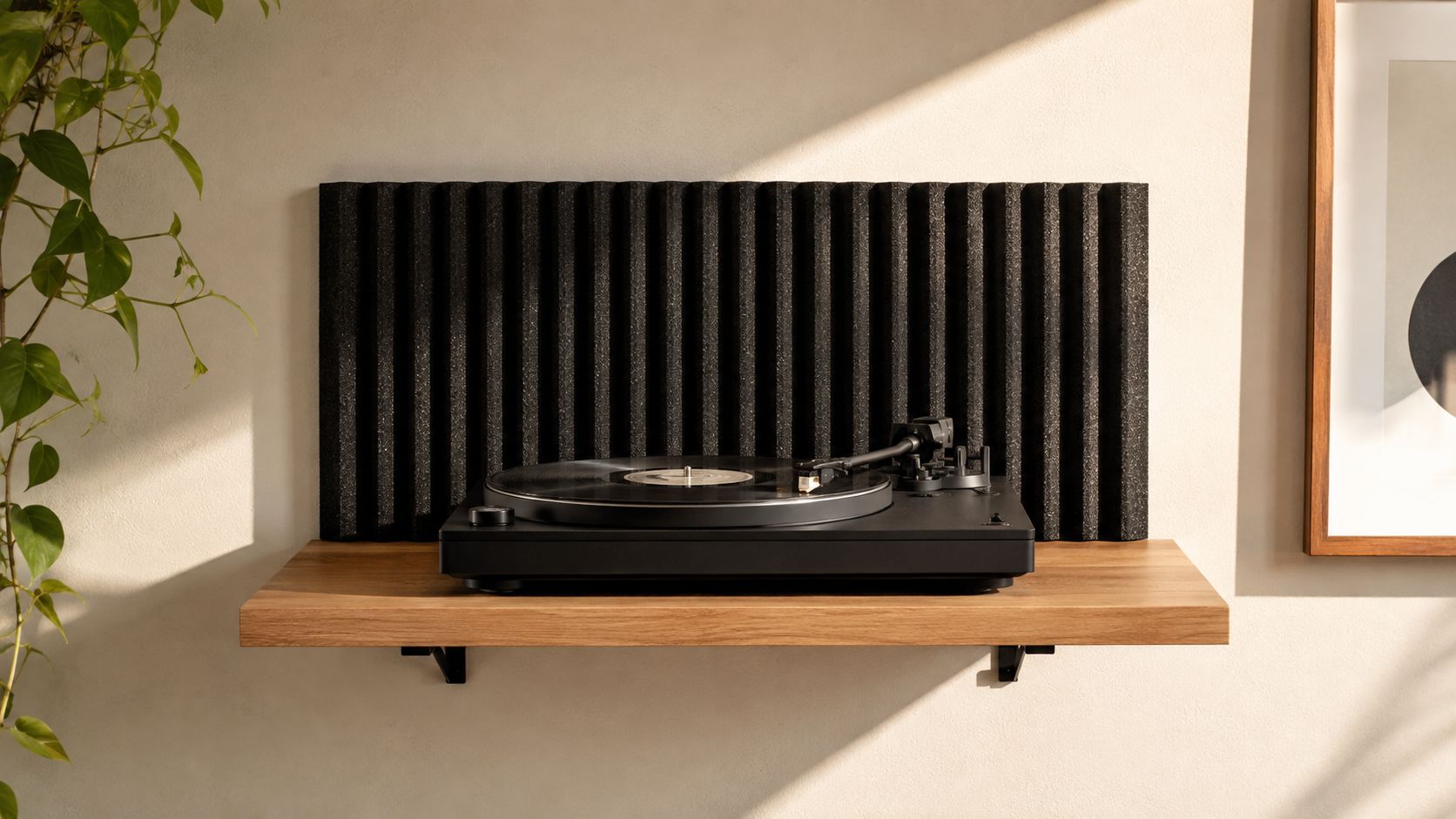
Start with the turntable. Keep it level, place it on a rigid support, and remove it from the same shelf as a speaker. A suspended wood floor can carry footfall and bass energy into the plinth. A heavy floor stand on a stable surface generally gives the deck a calmer mechanical platform, while a wall shelf can help when the floor flexes but may couple into a lively wall.
Spend the first hour on the speakers
Speaker placement deserves deliberate listening rather than a ritualized diagram. The rule of thirds can provide a starting point, but your room may demand something else. Pulling speakers away from the front wall often reduces bass thickening and opens the centre image. Toe-in changes the balance between direct and reflected energy, so adjust it while listening from the actual seat, not while standing behind the rack.
Rugs on hard floors can reduce flutter echo. Curtains, bookshelves, and furniture density change how quickly high-frequency energy reaches your ears. You don't need to turn the room into a studio. You need to stop the room from adding the same obvious defect to every record.
Try this order:
- Move the deck first: Remove it from speaker furniture and check its level.
- Set the listening triangle: Establish a stable seat and equal speaker distances before chasing toe-in.
- Adjust front-wall distance: Move both speakers together and listen for bass definition and vocal focus.
- Control the floor: Add a rug or rearrange furniture if the room rings after hand claps.
- Test isolation accessories last: Buy them only after you know which vibration problem you're solving.
Listen for piano notes, sustained vocals, kick-drum edges, and the space around percussion. If those elements sharpen after moving furniture, the cartridge didn't suddenly improve. The room stopped interfering.
Hear the difference between structural vibration and room reflection in this practical demonstration.
Isolation isn't decoration. It's signal protection.
Tweaks Worth the Effort and Tweaks That Aren't
I judge a tweak by audible payoff per hour, not by how serious it looks in a product photograph. Setup errors, mechanical grounding, and speaker interaction usually matter first. Accessories that add mass or visual drama often matter last.
| Tweak | Effort | Audible Payoff | Verdict |
|---|---|---|---|
| Cartridge alignment with a proper protractor | Moderate | Clearer tracking and more stable imaging | Do it carefully |
| Speaker toe-in matched to the listening seat | Low | Strong change in centre focus and treble balance | Try tonight |
| Wall-mounted or rigid isolation platform | Moderate | Useful when floor movement reaches the stylus | Solve the actual vibration |
| VTA adjustment using a suitable record | Moderate | Can refine tonal balance and image shape | Helpful after basic setup |
| Better isolation feet | Low to moderate | System-dependent | Test before buying |
| Dedicated phono stage | Moderate cost and setup | Can improve gain, loading, and noise control | Worth it when the built-in stage limits the cartridge |
| Upgraded speaker cables | Low setup effort, variable cost | Usually smaller than placement changes | Leave it late |
| Heavy stone mat or slab on a compliant shelf | Moderate | Can worsen coupling if the support flexes | Don't confuse mass with isolation |
| Exotic record clamp | Low | Useful only for specific record or spindle problems | Not a first move |
| Audiophile fuse | Low | No reliable priority over setup fundamentals | Ignore until everything else is right |
VTA deserves listening, not mythology. A small change can alter the perceived balance of bass, presence, and treble, but it cannot rescue a badly aligned cartridge or a crooked platter. Adjust anti-skate sensibly as well. It will not correct the wrong tracking force or an arm-cartridge resonance problem.
Phono-stage changes belong later in the process unless the current unit is adding audible noise or forcing poor gain staging. Gain matters when the signal is too weak for the amplifier's input, or when excessive gain leaves little room before overload. Loading still has a place, but chasing a value on paper is less useful than confirming that the cartridge, phono stage, amplifier, and speakers are working as one electrical chain.
A cable upgrade rarely outranks moving a speaker away from a corner. Likewise, a heavy mat or slab can make a flexible shelf worse by coupling the deck more firmly to its movement. Mass only helps when the support underneath remains stable.
Use VTA, clamps, and isolation feet to solve a symptom you can hear. Leave cosmetic upgrades and speculative electrical accessories until alignment, tracking force, support, and speaker placement are settled.
Spend the next hour before the next paycheck.
The Whole Chain From Plinth to Room
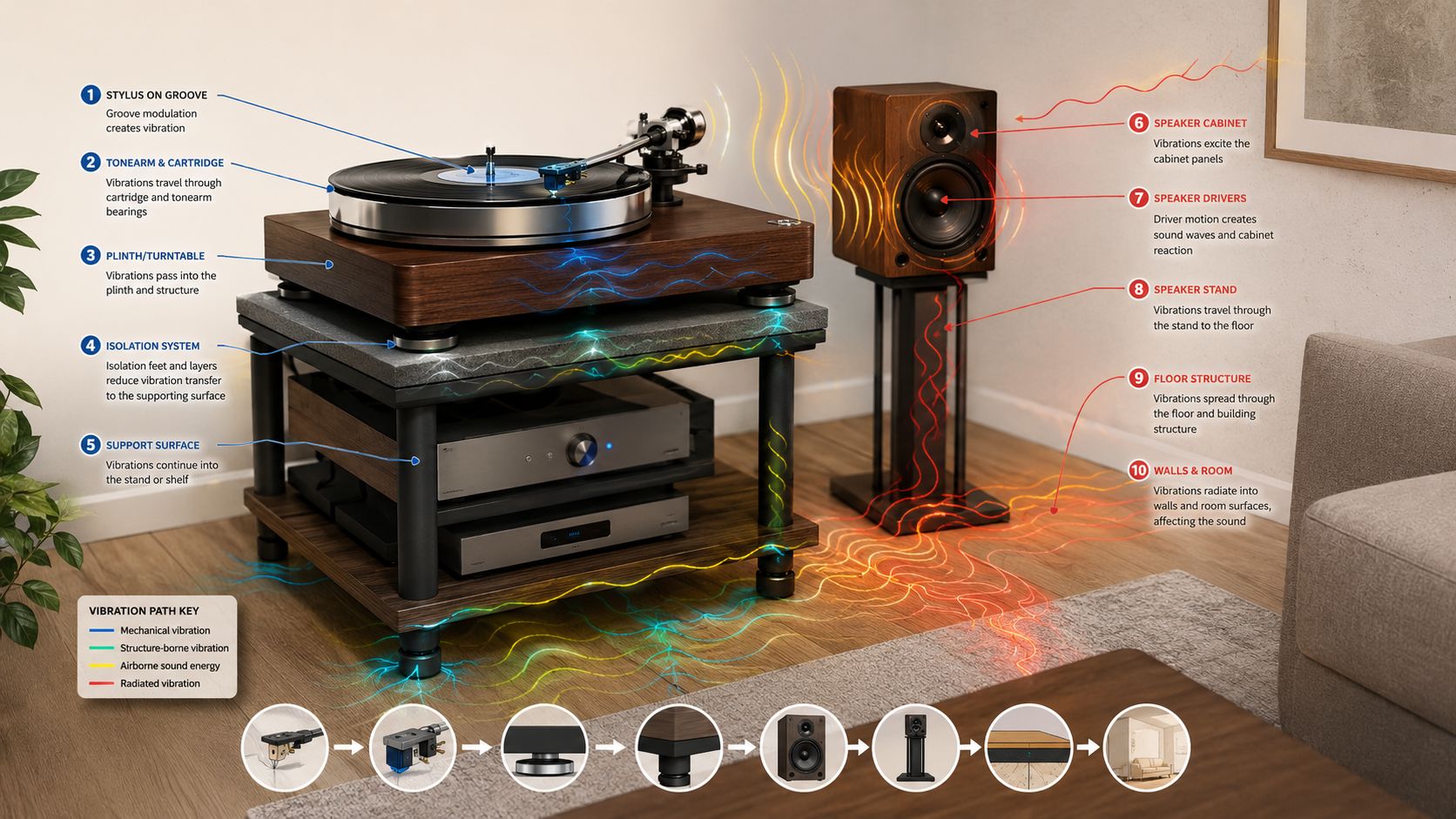
A turntable sound system doesn't end at the RCA sockets. The stylus meets the groove, the cartridge body transfers energy into the tonearm, the arm bearing governs movement, and the platter carries the record through rotation. From there, the plinth, shelf, floor, rack, speaker stand, wall, and ceiling all take part in what reaches your ears.
Each link can leak energy or reflect it. A loose tonearm bearing can soften focus. A poorly supported platter can destabilize pitch. A flexible shelf can turn footsteps into stylus movement. A speaker stand that rings can add a metallic edge. A rear wall can reinforce bass until every low note arrives wearing the same oversized coat.
Listen for the symptom before buying the cure
Speed stability is one of the basic mechanical fingerprints. Wow describes slower pitch drift, while flutter describes faster pitch variation. Published specifications often target 0.1% or better, and one direct-drive model lists 0.008% WRMS / 0.025% WRMS with ±0.035% peak under its stated IEC 98A weighting. Those figures matter, but the peak error matters to your ear when a piano note or vocal holds steady.
Rumble comes from low-frequency bearing and drive-system noise. A common specification range sits around -60 to -65 dB DIN B, while one direct-drive model lists -78 dB DIN B under IEC 98A weighting. In a working room, though, footfall, subwoofer output, and shelf movement can overwhelm the difference between impressive printed specifications.
If the system sounds dull, check whether the room is swallowing high frequencies. If it sounds hard, check what the room is adding. If bass has no shape, inspect the floor, the speaker boundaries, and the wall behind the speakers before blaming the cartridge.
The weakest mechanical link sets the ceiling.
Stop upgrading by category. Tonight, level the turntable, move it away from the speakers, establish a proper listening seat, and adjust toe-in while playing a familiar record. Then set tracking force with a scale and verify that exactly one phono stage sits in the signal path. If the system still fights you, visit Supermarket Sound for practical setup guides written around real rooms, real gear, and the parts of vinyl playback that reach your ears.

