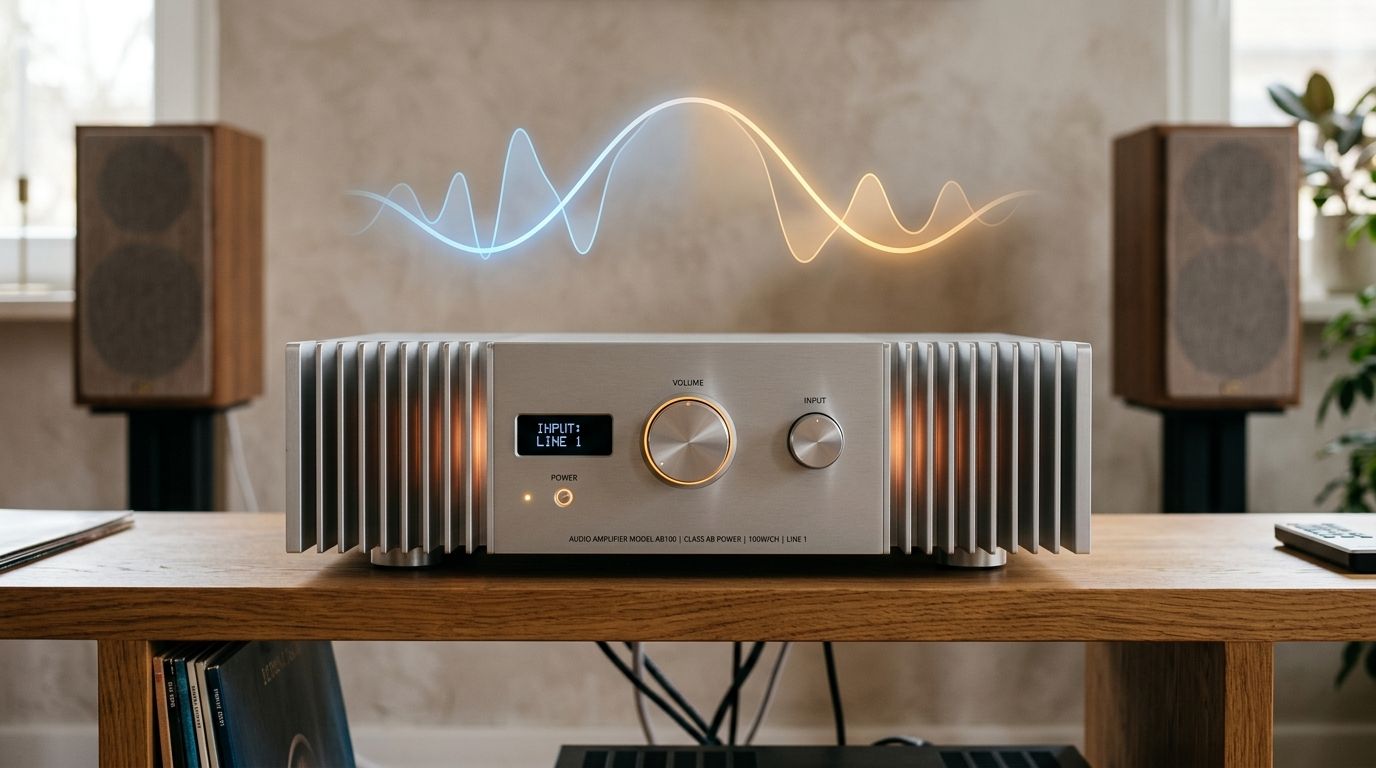
A Class AB integrated amplifier can draw more power while doing nothing than modern switching designs, yet its standby consumption may be almost laughably small. That contradiction tells you more about living with one than any watt-per-channel headline.
I'm Marque Hersh, founder of Supermarket Sound, and I've spent enough time around warm amplifier cases, stubborn speaker loads, and long records to stop calling Class AB a compromise. It's the load-bearing middle ground of serious hi-fi. You get cleaner low-level transitions than pure Class B, more practical heat than Class A, and a physical sense of grip that still makes difficult speakers behave.
That doesn't make every Class AB integrated amplifier a smart purchase. Bias, power-supply strength, thermal design, and speaker matching decide whether the sound feels composed or congested. The topology gives you a useful starting point. It doesn't give a badly designed amplifier a free pass.
Table of Contents
- Why Class AB Is Still the Sound Most Hi-Fi Defaults To
- How Class AB Biasing Cleans Up the Sound
- The Heat Tax and Where Efficiency Really Falls Apart
- What Class AB Sounds Like Next to Class A, Class D and Tubes
- The Idle Power Question Nobody Answers Straight
- Pairing Speakers the Watt Rating Never Tells You About
- How to Buy a Class AB Integrated Amp With Your Ears
Why Class AB Is Still the Sound Most Hi-Fi Defaults To
Class AB became the default sound of mainstream hi-fi because it solves the problems people hear without turning the listening room into a radiator. An integrated amplifier places the preamplifier and power amplifier in one chassis, so it handles source selection, volume control, and speaker drive together. The power stage matters most here. It sits downstream of every source decision, and everything else inherits its behavior.
Pure Class A has a gorgeous kind of ease. It can sound dense, textured, and unhurried, with instruments occupying solid, tactile spaces. It also burns power continuously because its output devices remain conducting throughout the waveform. Class AB backs away from that furnace while keeping both output devices slightly active around the handoff point.
That's why I don't hear Class AB as “halfway” between better and worse. I hear it as a practical design choice that preserves the important bit of Class A cleanliness, then adds usable output and manageable heat. The engineering details still matter, but the underlying trade is sane. You can read a more technical overview in this explanation of amplifier classes.
The integrated advantage
A separate preamp and power amp can offer flexibility, but an integrated design shortens the chain and reduces the number of boxes competing for space, ventilation, and budget. A good class ab integrated amplifier can put the money into the power supply, output devices, and thermal hardware instead of duplicating enclosures and connections.
That simplicity has a sonic benefit, too. A coherent integrated design often sounds less like a stack of personalities. The music arrives with a unified center, rather than a preamp imposing one texture and a power amp correcting it.
The trade that survives listening
Class AB doesn't erase the compromises of transistor amplification. It manages them. The circuit must maintain clean transitions, deliver current when the speaker demands it, and shed heat when the music isn't asking for much.
That balance is why the topology remains so common. It's livable. It's musical. It has earned its place.
How Class AB Biasing Cleans Up the Sound
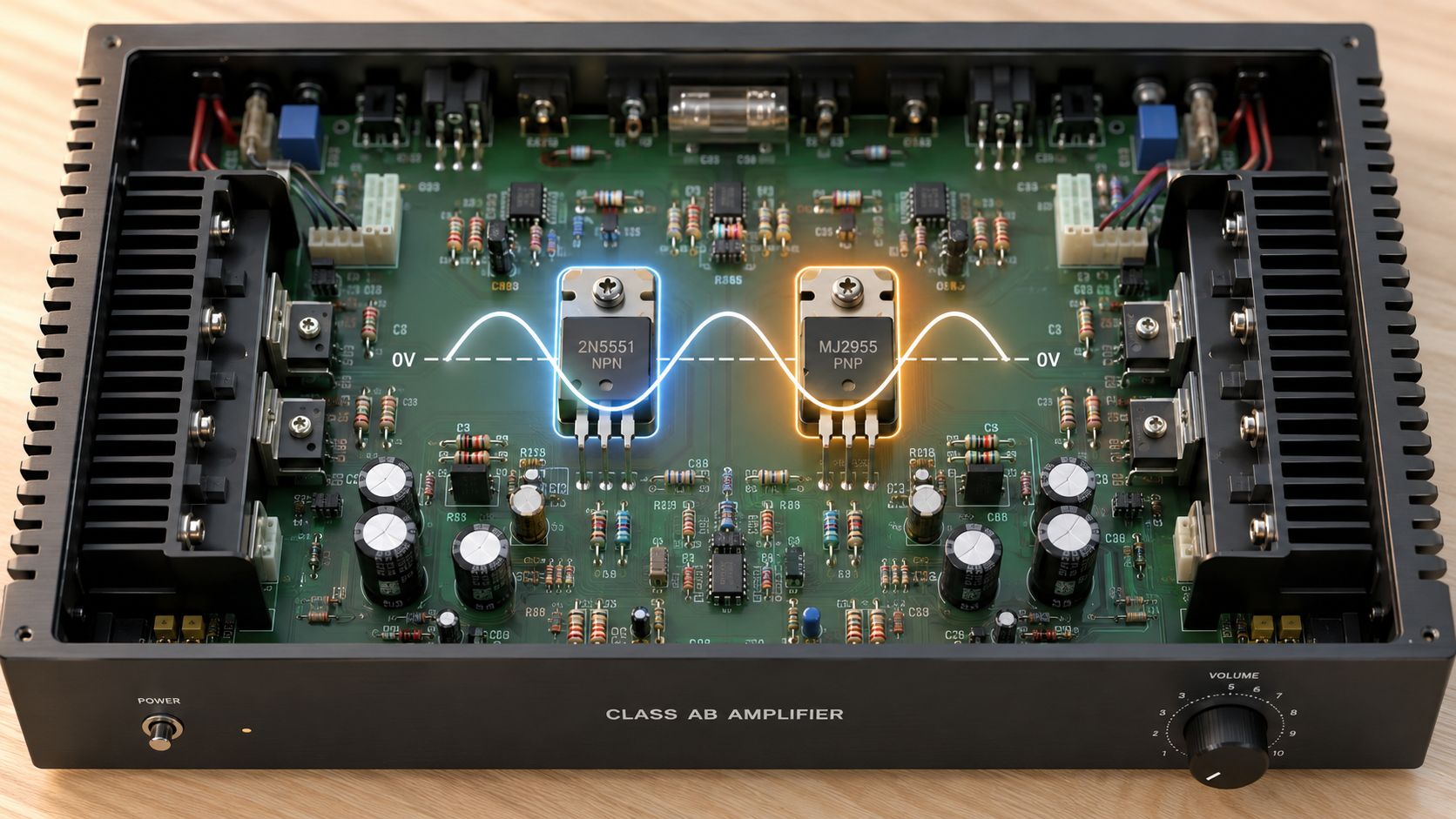
Class B divides the waveform between two output devices. One handles one half of the signal, the other handles the opposite half. Around the zero crossing, neither device conducts perfectly for an instant, leaving a dead band in the handoff. On a waveform, it appears as a notch. In a living room, especially at low listening levels, it can sound grainy, rough, or faintly mechanical.
Class AB closes that gap with a small quiescent current. Both output devices remain slightly conductive near zero, so one is already working as the other takes over. Class B drops the signal between two hands. Class AB keeps both hands on it briefly, then lets one carry the load.
The bias window
The output devices in Class AB conduct for more than 180 degrees but less than 360 degrees of the waveform. That places the design between Class B and Class A, but the label matters less than the overlap the circuit creates. This technical explanation of Class AB operation covers both the conduction range and how suitable bias reduces crossover distortion.
Set the bias too low, and the dead band returns. Quiet vocals can turn edgy, brushed cymbals lose their fine texture, and a piano note can sound ragged as it fades. Set it too high, and the output stage moves toward Class A behavior, drawing more idle power and producing more heat before the music gets loud.
A well-set bias point is something you hear rather than admire on a bench chart. The midrange stops sounding pinched at low volume, and the amplifier keeps soft transitions from becoming a rough electronic seam. The specification matters, but the listening result matters more.
Listening cue: Play a sparse recording quietly. If the midrange feels brittle exactly where notes cross from silence into sound, suspect the amplifier's transition behavior.
Bias networks also need thermal stability. Device behavior changes as temperature rises, so the circuit must track that movement instead of letting the operating point drift. Poor control can bring back crossover distortion or push the output stage into unnecessary heat. Either fault becomes part of the sound, and the latter also raises the amplifier's real power draw in the room.
The reward is smoother handoff and cleaner low-level detail. The cost is heat at idle, paid continuously by the heatsink.
The Heat Tax and Where Efficiency Really Falls Apart
Class AB's practical efficiency usually sits around 60% to 75%, depending on bias, output level, and speaker load, with a well-designed stage often landing near 70% in audio service, as outlined in this power-amplifier efficiency reference. The theoretical maximum for a sine wave can reach 78.5% when the circuit sits right at the edge of cutoff, but real operation falls below that because the bias current never disappears. The amplifier pays some thermal cost before the first drum hit.
The important detail gets lost in spec-sheet worship. Efficiency falls fastest at low and moderate output, where the output devices aren't close to saturation and the standing bias current dominates losses. That describes ordinary listening far better than a full-power test does.
Amplifier Classes Compared
| Class | Typical Efficiency | Heat | Sonic Character |
|---|---|---|---|
| Class A | Lower than Class AB | High, including at idle | Dense, fluid, effortless |
| Class AB | About 60% to 75% in practical audio service | Warm, with idle dissipation | Clean, weighty, controlled |
| Class B | Higher than Class AB in theory | Lower at idle | More vulnerable to crossover roughness |
The table is a guide, not a verdict. Circuit execution still outranks the class badge. A stable bias network and capable feedback loop can make an AB amplifier sound polished, while a lazy implementation can sound thick or strained.
Why warm isn't automatically a fault
That warm chassis isn't necessarily evidence of wasteful engineering. The amplifier has to keep the output devices slightly active so the waveform doesn't stumble at zero. The heat is the physical consequence of the cleanliness you're hearing.
A bias point set too low saves heat by reintroducing the problem. A bias point set too high pushes the amplifier toward Class A behavior, increasing dissipation for diminishing audible returns. Designers are balancing a transfer curve, not chasing a magic number.
Give the amplifier ventilation. Don't stack gear directly on top of it. Treat the heatsink as part of the circuit, because it is.
What Class AB Sounds Like Next to Class A, Class D and Tubes
Class A gives music a dense, tactile ease. Bass notes feel carved rather than outlined, and crowded recordings take on a saturated texture. The cost is constant heat and higher power draw, so choose it only if that behavior belongs in your listening room.
Class AB sounds less romantic, but often more convincing over long sessions. Voices retain body without turning every singer into a sepia photograph. Electric guitars have bite, upright bass keeps the wood around the note, and orchestral climaxes hold their shape instead of collapsing into a bright wall. That composure comes from the reduced crossover roughness you hear around low-level transitions, not from a flattering specification.
AB against modern switching designs
Class D has outgrown the old “digital glare” cliché. A well-executed switching amplifier can sound clean, spacious, and forceful, while its lower heat output makes placement easier in a cramped room. Class AB remains appealing when you want more flesh through the middle of the image and a slightly weightier attack.
The difference is audible preference, not a fixed rule. Some Class D designs sound more open than warm-running AB hardware. Some AB amplifiers sound tighter and more explicit than their reputation suggests. For a closer discussion, read this guide to Class D amplifier sound quality.
Class AB is not automatically soft. It often gives voices and strings more substance, while preserving rhythmic edges and control into demanding speaker loads. Listen for that balance rather than choosing from the class label alone.
Tubes bring another kind of compromise
Tube amplifiers add glow, harmonic texture, and an inviting sense of depth. They can make an ordinary recording feel physically present, but they require maintenance and careful speaker matching. Bass grip may vary, particularly with speakers whose impedance changes place a heavy demand on the output transformer.
A Class AB solid-state integrated amplifier usually gives you firmer control and less ritual. It will not imitate tubes, yet it can provide warmth without requiring valve replacement or the same level of system fuss.
My preferred AB sound sits between those extremes. It avoids the liquid blur of a romantic tube design and the polished distance some efficient amplifiers can produce. It offers tonal forgiveness, enough weight to keep music grounded, and enough attack to preserve rhythm.
That is a useful flavor, not a costume. Listen for the way the amplifier handles voices, crossover-level detail, and 4-ohm speakers at real room volume. Those impressions tell you more than a class badge or a headline watt rating.
The Idle Power Question Nobody Answers Straight
Calling Class AB an energy hog is too crude. A typical integrated amplifier can list 750W maximum consumption with under 1W in standby, while another may list 220W power consumption and 0.3W in standby. Those figures come from published Cambridge Audio CXA81 specifications, but they describe different conditions. Maximum draw reflects demanding operation, not quiet background listening.
Standby is the simple part. Modern designs can reduce it to a nearly negligible level. Idle operation is the figure buyers feel at home, because the amplifier keeps its bias network and output stage active even while the room stays quiet.
A wall meter gives the honest answer. Maximum consumption belongs on a specification sheet. Actual running draw belongs in your living room.
Living-room behavior matters more than the headline
A large Class AB integrated amplifier can become noticeably warm during silence. A smaller design may feel only mildly warm. Bias level, chassis size, heatsink area, power-supply design, and protection behavior all affect the result, so the class label cannot predict how hot a particular amplifier will run.
That warmth is part of the design trade-off. The output stage stays biased to reduce the ragged crossover behavior that Class AB is meant to avoid, and it keeps doing that work between tracks. You may hear the benefit as cleaner low-level texture, but you will also feel it in the chassis and see it on the power meter.
Apartment listeners should switch the amplifier off when the day is done, particularly with limited ventilation. Office systems deserve the same treatment. Standby is convenient, yet silence from the speakers does not mean zero draw.
Practical rule: If the amplifier stays warm with no music, it is using energy. Do not leave it running unattended out of superstition.
Some listeners prefer a warm-up period before serious listening. I understand the preference, but I do not treat it as a ritual requirement. Let the amplifier reach a stable condition if your ears prefer the result. Do not turn that preference into a claim that every Class AB design needs hours of idle time.
Your monthly cost depends on actual draw, operating hours, and your electricity rate. Measure consumption at the wall instead of turning a maximum specification into a fictional bill.
The heat is real. Standby panic is usually overstated.
Pairing Speakers the Watt Rating Never Tells You About
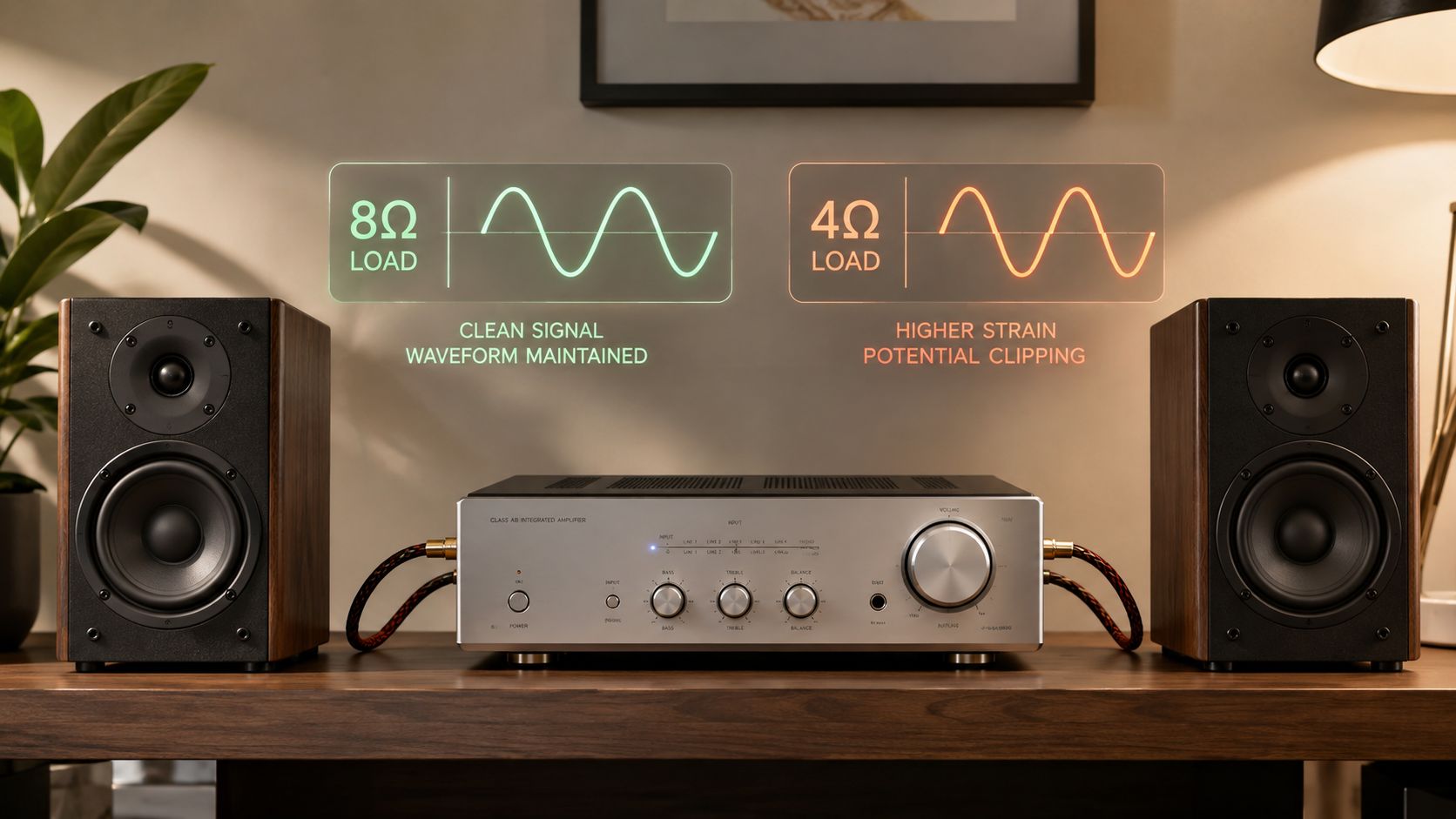
An eight-ohm rating describes a friendly test load. It does not show how an amplifier behaves when a real loudspeaker falls toward four ohms in the bass. A capable class ab integrated amplifier keeps its composure there because the power supply and output stage can deliver current without turning the music hard or compressed.
Look for output that rises substantially as the load halves. One measured amplifier delivered about 78W into 8 ohms and 137W into 4 ohms at clipping, according to this independent measurement-focused review. The figures do not double, but they show useful reserve when the speaker asks for more current.
Other measured examples reached 180W into 8 ohms and 260W into 4 ohms, while another produced 125Wpc into 8 ohms at 3% THD and 195Wpc into 4 ohms at 3% THD. These load figures reveal more about difficult speakers than one flattering eight-ohm number.
What the listener hears
With a demanding low-impedance speaker, a strong AB amplifier keeps bass lines separate when the arrangement gets busy. Kick drums retain a defined edge, bass guitar stays connected to the rhythm, and the soundstage remains stable as the volume rises.
A weaker design may sound excellent at moderate levels with an easy speaker. Connect a current-hungry floorstander, and compression appears first. Treble can harden, while bass loses its stopping power. The amplifier is not suddenly becoming bright. It is losing control.
High-sensitivity speakers usually need less output, yet they can expose background noise and tonal roughness. Low-sensitivity or impedance-challenging speakers place greater demands on current delivery. Match the amplifier to the speaker's actual behavior, not the number printed beside “watts per channel.”
For the electrical background, use this plain-language guide to impedance matching. The buying decision remains straightforward.
Check the four-ohm figure before you buy. It shows whether the amplifier has a power supply behind the music or only a flattering headline.
Four ohms makes the amplifier's real character obvious.
How to Buy a Class AB Integrated Amp With Your Ears
Start with the speaker, not the amplifier. Bring the model you own, or at least its impedance and sensitivity information, then find out whether the amplifier's output rises meaningfully into four ohms. A class ab integrated amplifier that barely changes its output may still suit an easy speaker, but it shouldn't be your first choice for a difficult load.
Use a short audition checklist
Listen first. Class AB's bias behavior lives closest to the zero crossing at low levels, and a good design should keep vocals natural rather than papery. Then raise the volume and listen for bass control, image stability, and treble that stays articulate instead of turning sharp.
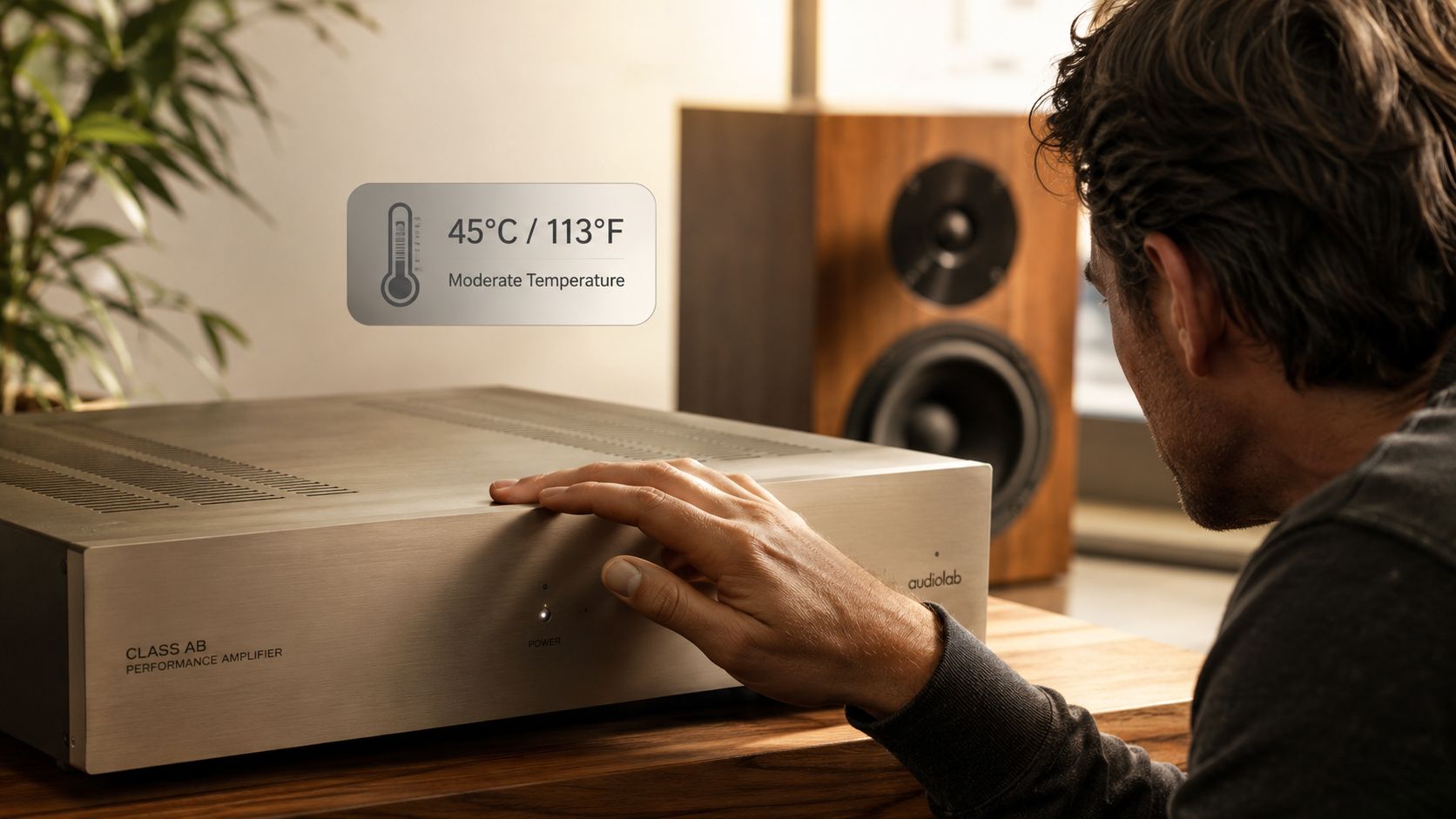
Touch the chassis after an hour of ordinary playback, with adequate ventilation. Warm is normal. Excessive heat, thermal shutdown, or a case that makes placement awkward is a design problem for your room, regardless of how impressive the specification sheet looks.
Don't spend the entire budget on features you won't use. A simpler integrated amplifier with a stronger power supply can serve music better than a crowded chassis built around conveniences you already own elsewhere. Streaming, digital conversion, and phono stages have value, but they shouldn't starve the output stage.
Listen for disappearance. The right amplifier stops announcing its topology once the record gets moving.
I'll be transparent about the SEO reality. A buyer guide needs language people search for, including “Class AB integrated amplifier,” because a site like Supermarket Sound has to be found before it can pay for the next listening session. Search intent can point you toward the right questions. It can't audition the amp in your room.
For a visual demonstration of operating behavior, this Class AB amplifier video can supplement listening, but it can't replace it.
Choose the amplifier that keeps your speakers relaxed, your midrange alive, and your room bearably cool.
The best Class AB amplifier is the one you stop thinking about ten minutes into the record.
If you're choosing an integrated amplifier now, check your speakers' four-ohm behavior, compare the manufacturer's standby and power-consumption figures, and audition the unit at both quiet and realistic listening levels. Then give your shortlist a full hour in your room before you buy. That's where Class AB earns its place.

