Most advice about the best speakers for living room use is backward. It starts with products, not physics.
That's why people end up with oversized towers gasping in corners, tiny lifestyle boxes trying to fill open-plan caverns, and soundbars being judged like stereo systems they were never built to be. The living room decides first. The speaker just survives the verdict.
The irony is that this isn't some fringe audiophile obsession. Living-room applications accounted for 54.62% of wireless home speaker market value in a 2025 projection, equal to USD 10,142.39 million, with that segment still growing at 5.3% CAGR according to this active speaker market report. The center of gravity is the couch, the TV, the shared room. Not the fantasy lab.
I know why search results keep serving product roundups. They rank. “Best speakers for living room” is an SEO phrase with gravity. Fine. But if your couch is pinned to the back wall and your left speaker is kissing a window, your shopping list is downstream from a bad setup. Bad geometry makes expensive gear sound cheap. Good geometry makes modest gear sound grown up.
Table of Contents
- The Room Decides Before the Speaker Does
- Four Speaker Types and What They Actually Do
- Reading Your Room Like an Acoustic Map
- Placement Geometry That Preserves the Image
- Wireless Convenience Versus Long-Term Stereo Value
- Pairing Amps and Streamers Without Starving the Signal
- Budget Tiers and Marque's Listening Notes
The Room Decides Before the Speaker Does
There is no best speaker in a vacuum. There is only the best fit for your room, your listening distance, your furniture, and your tolerance for visual clutter.
A large floorstander in a cramped, reflective room isn't “more speaker.” It's more trouble. A compact pair in a sensible layout isn't a compromise. It's often the adult decision.
Air Volume Beats Brand Loyalty
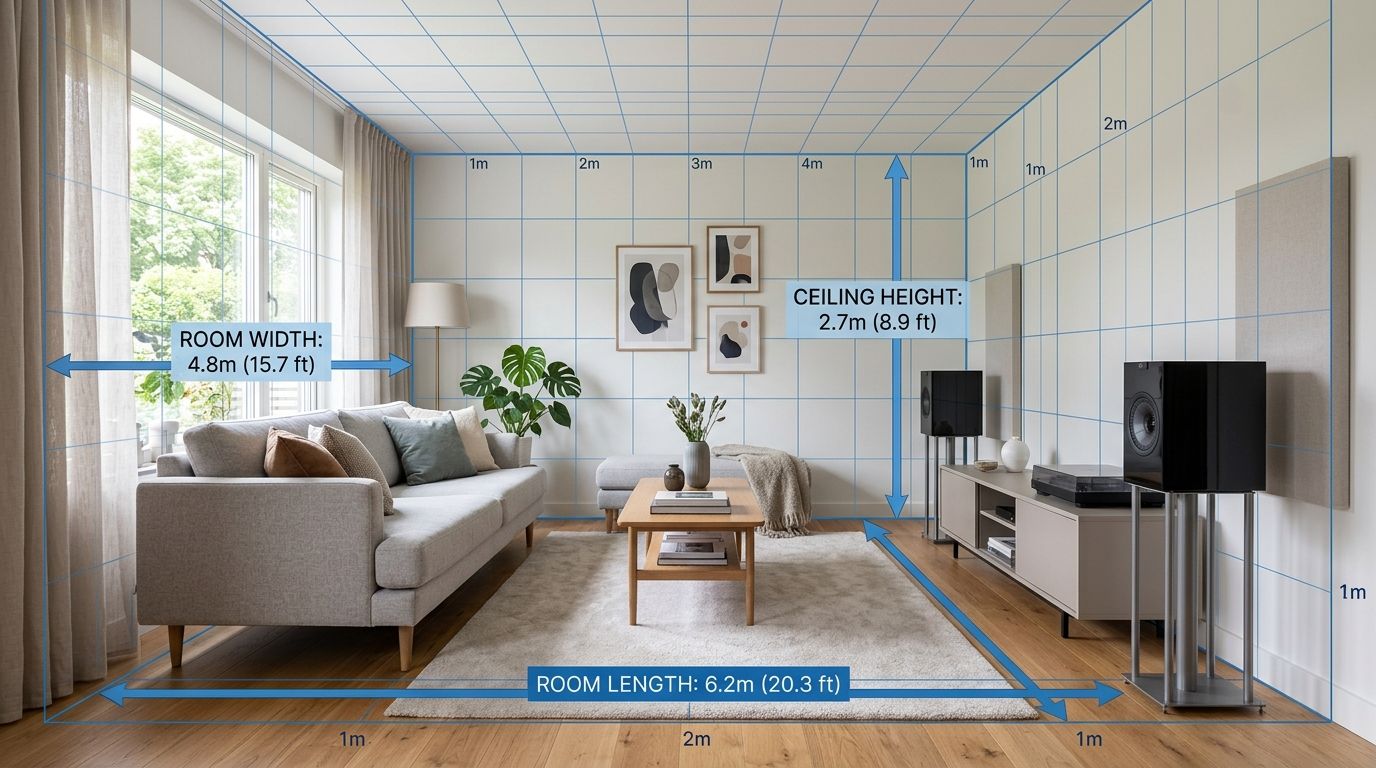
Before I care about cabinet finish, driver material, or whatever marketing team discovered the phrase “musicality” this week, I care about air volume. Length, width, and ceiling height tell you how much room the speaker has to energize. Open plans change the math because sound leaks into the next zone instead of loading the listening area.
Furniture matters too. Thick sofas soak up some energy. Bare floors and glass kick it back at you. A rug isn't decor in this context. It's acoustic damage control.
Practical rule: A speaker doesn't play into “a living room.” It plays into your surfaces, your boundaries, and your seat.
The Market Already Tells You What Matters
The broader category has had its swings, but the lesson is clear. Futuresource reported global home-audio shipments at 174 million units in 2023, down from 194 million in 2022, and later said the market fell another 7.7% in both volume and value in 2024, with wireless speakers still dominating at 138 million units despite a 7.5% decline, as outlined in its home-audio market update.
That matters because even after the contraction, wireless speakers are still the floor of the category, not a side trend. The living room is where people use this stuff. For TV dialogue. For stereo music. For movies. For guests who don't care about your cable management but will absolutely notice thin sound.
So start where the sound lands. In the room.
Four Speaker Types and What They Actually Do
Most buyers don't need more options. They need cleaner categories.
The four real living-room choices are floorstanders, bookshelf speakers, powered speakers, and soundbars. Not one of them is universally “best.” Each one solves a different problem and creates a different one.
Floorstanders Are Not Bigger Bookshelves
Floorstanders are not bookshelf speakers with ego. They're air-movers built to energize more space and hold their balance from farther away.
That makes them excellent in larger rooms where the listening seat isn't on top of the speakers and the cabinets can breathe. It also makes them clumsy in tighter rooms where boundary gain fattens the midbass and turns kick drums into upholstery.
Their failure mode is predictable. Buyers assume bigger cabinet equals better sound. Then they shove the speakers near walls because the room won't tolerate anything else. Now the room is doing half the voicing. Badly.
Bookshelves Are Not Compromised
Bookshelf speakers are not lesser floorstanders. They're often the cleaner answer in normal living rooms.
They image well, they disappear more easily, and they usually let you control bass with more precision, especially if you add low end later instead of accepting whatever the room exaggerates. In a lively room, a well-placed compact pair can sound more coherent than a larger speaker that never gets enough breathing room.
They fail when buyers treat the word “bookshelf” strictly and trap them inside furniture. A speaker crammed into a shelf is a hostage.
Powered Speakers Are Not Freedom
Powered or active speakers are not simplification without tradeoffs. They simplify amplification and source matching, which is real value. They also tie the speaker to its internal electronics, software path, and input set.
That can be perfect for someone who wants fewer boxes in a smaller room. It can also feel restrictive in the main living room once your needs change.
Soundbars Are Not Stereo Systems
Soundbars are not replacements for proper left-right stereo. They are dialogue tools and convenience machines.
That's not an insult. It's a category correction. If your priority is cleaner TV sound with minimal visual footprint, a soundbar makes sense. If your priority is believable imaging, tonal body, and the sense that a singer exists between two speakers instead of inside a television, a soundbar is still doing theater.
Recent coverage of home-focused speaker buying has leaned harder into active systems, decor-friendly designs, all-in-ones, and software support. It also flags HDMI compatibility and firmware roadmaps as decision points, which is exactly where living-room buying has shifted, as noted in this home-usage speaker buying guide. Inputs and updates now matter almost as much as tone.
Speaker Types at a Glance
| Speaker Type | Best For | Room Size Sweet Spot | Key Limitation |
|---|---|---|---|
| Floorstanders | Dedicated music listening and larger shared rooms | Medium to large rooms with real wall clearance | Bass buildup and visual bulk in tight spaces |
| Bookshelf Speakers | Balanced stereo in normal living rooms | Small to medium rooms | Need proper stands or placement to shine |
| Powered Speakers | Clean setup with fewer boxes | Small to medium rooms | Locked electronics and limited upgrade path |
| Soundbars | TV dialogue and convenience | Small to medium TV-first rooms | Weak stereo imaging compared with true left-right speakers |
Buy the category that fits the room. Not the fantasy.
Reading Your Room Like an Acoustic Map
A living room isn't neutral. It's an instrument you've already built out of drywall, glass, wood, fabric, and bad habits.
Start with dimensions. Then look at what the room is made of. Then listen to what it does back to you.
The Floor Is Not Innocent
The floor reflects energy. So does the ceiling. Glass throws mids and highs back into the room. Big soft seating absorbs some energy and changes the balance from seat to seat.
If you want a useful framework, think of the room in layers:
- Raw volume: Length, width, and ceiling height decide how much air the speaker has to pressurize.
- Boundary pressure: Walls and corners reinforce bass, often in the worst places.
- Surface behavior: Rugs, curtains, bookshelves, and upholstery either tame or scatter reflections.
- Leakage: Open doorways and connected spaces drain energy away from the listening position.
None of this requires software to notice. Your ears already know. They just need a method.
Do a Five-Minute Room Audit
Clap once in the room. If you hear a zingy slap or papery repeat, the room is too live. Walk the perimeter while music with steady bass is playing. You'll hear spots where low frequencies pile up and spots where they fall through the floor. That's your room telling you where not to sit and where not to park big speakers.
Then measure the main listening distance. If your seat is unusually close, giant speakers make less sense. If the room opens into adjacent space, compact models may need help downstairs.
One buyer-oriented angle that more guides are finally getting right is this: start by measuring the room, matching speaker size to the air volume, and checking what rugs, curtains, and furniture do to the sound. Some even recommend testing the room with curtains open versus closed and adding or removing soft furnishings to hear the difference, which lines up with this practical room-fit buying guidance. That advice is more useful than another lifeless product roundup.
If your room is small and lively, I'd also spend time with small room acoustic treatment ideas that fix the actual problem. Not glamorous. Effective.
Hard room, hard sound. Soft room, easier life.
Long Wall Wins More Often Than People Admit
Independent placement guidance consistently favors using the long wall and placing the listening seat and speakers around fractional points of the room length to reduce ugly bass peaks and nulls. In a 20-by-15-foot room, that can mean speakers roughly 3 to 4 feet off the side walls and about 4 feet from the front wall, according to this room acoustics guide. The point isn't memorizing the numbers. The point is that corners are acoustic sabotage.
Sketch the room. Mark the couch. Mark windows, rugs, shelves, and openings. You should know your room's personality before you know your shortlist.
That's the map.
Placement Geometry That Preserves the Image
If stereo imaging matters to you at all, symmetry is not optional. It's the whole trick.
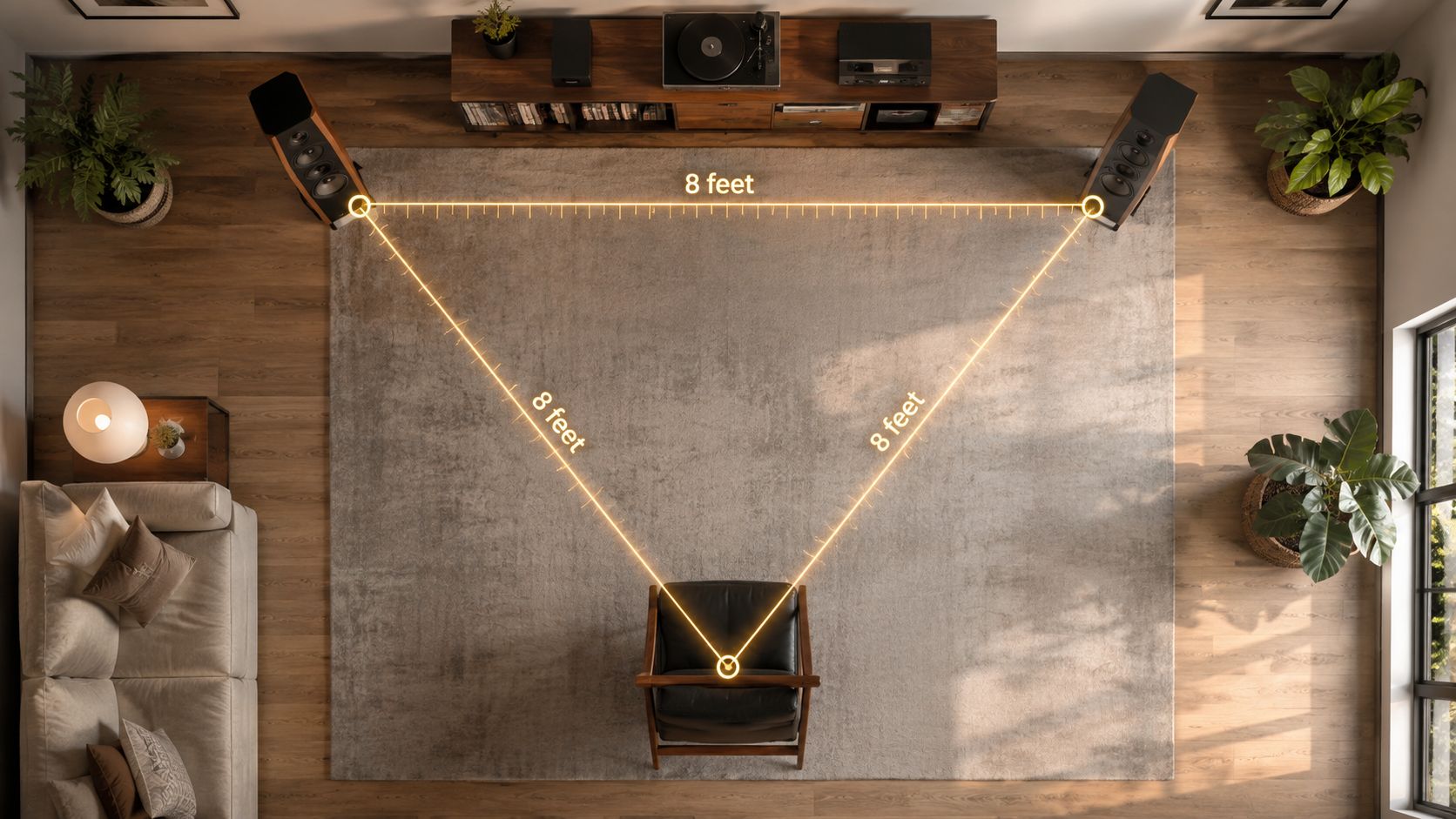
The strongest starting point is the equilateral triangle. If the speakers are 8 feet apart, your head should be 8 feet from each speaker. Not vaguely. Not spiritually. Precisely.
Build the Triangle First
Expert placement guidance recommends the distance between left and right speakers should match, or come slightly under, the distance from each speaker to the main listening seat. It also advises keeping speakers at least a couple of feet from the front wall and roughly the same distance from the side walls to reduce early reflections, as explained in this stereo speaker placement guide.
That's why a couch jammed against the back wall fights physics. Rear reflections arrive too early and too loudly. Depth collapses. The image flattens.
Use this as your starting sequence:
- Set speaker spacing first: Start with left and right speakers 7 to 9 feet apart in a normal living room.
- Match listening distance: If they're 8 feet apart, sit 8 feet from each speaker.
- Pull the seat forward: If the couch is on the back wall, move it out by about 3 feet if the room allows.
- Match side clearances: If the left speaker is 3 feet from its side wall, the right one should match.
That gets you out of random placement and into repeatable geometry.
Toe-In and Height Are Mechanical, Not Decorative
Start with light toe-in. About 15 degrees inward is a sensible first pass. More toe-in usually sharpens the center image and focus. Too much can narrow the stage and make the presentation feel spotlighted.
Tweeter height matters for the same reason. Placement guides commonly recommend tweeters at seated ear level, often around 36 to 42 inches, and center channels angled toward the listener when placed above or below a TV, as noted in this speaker placement overview. High frequencies are directional. If the tweeter beams over your head, the room inherits the treble.
Don't lay bookshelf speakers on their sides unless the design specifically supports it. Horizontal placement often messes with dispersion and image stability. You don't want the stage sliding every time you lean.
For a visual walkthrough, this placement demo is useful:
Surround Layout Is Format Geometry
For TV and movie systems, geometry changes with the format. Dolby's setup guidance places surround speakers to the sides or slightly behind the listener in a standard 5.1 layout, while Atmos adds height channels for overhead effects, according to Dolby's surround speaker setup guide.
That's the point most buyers miss. A living-room speaker purchase isn't just about the box. It's about whether the room can support the layout the format expects.
If you're working with tighter dimensions, small room speaker placement fixes matter more than another hardware upgrade.
Image first. Then gear.
Wireless Convenience Versus Long-Term Stereo Value
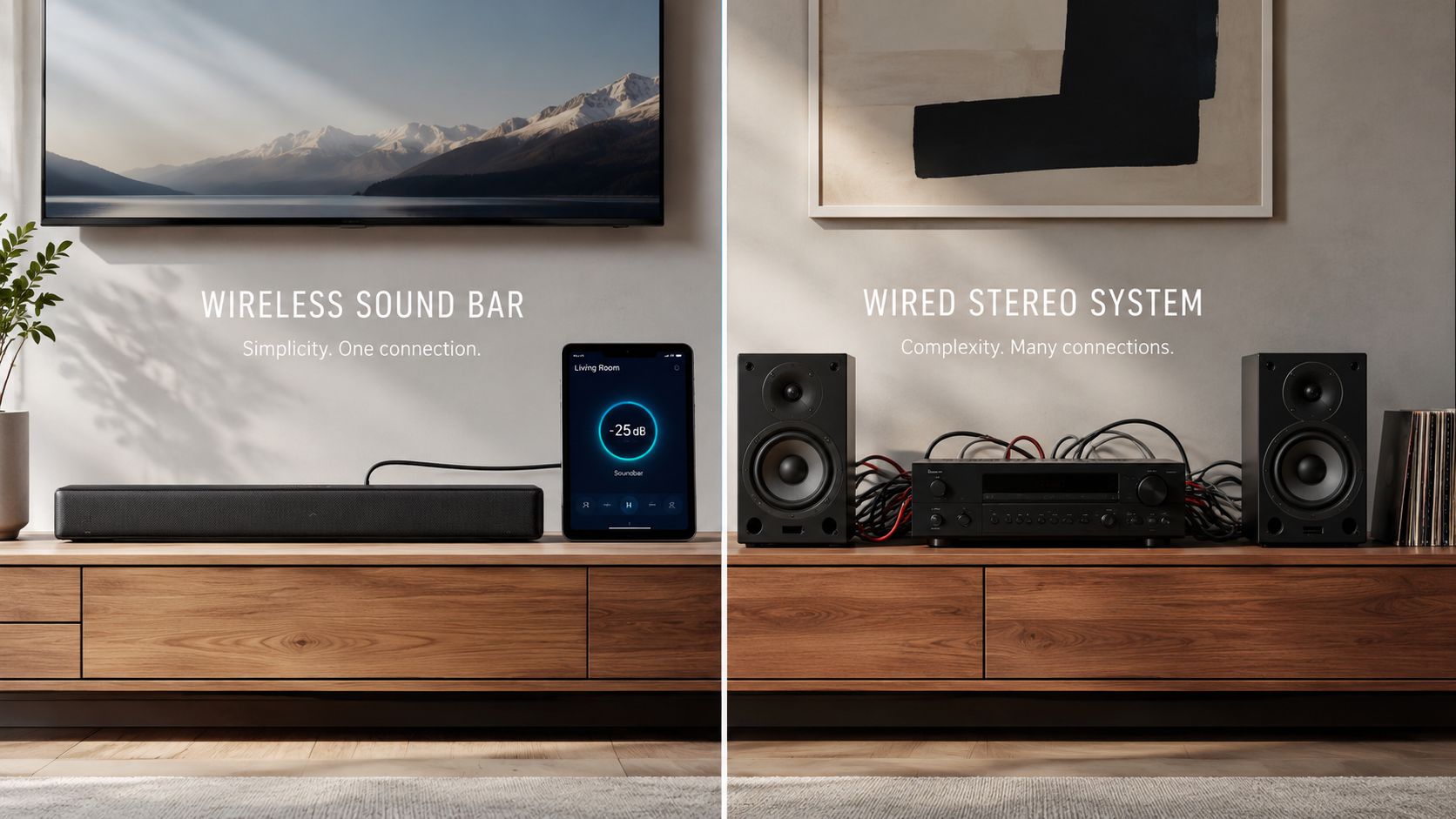
Wireless systems are seductive because they remove friction. One app. Fewer cables. Faster setup. Cleaner spouse approval math.
I get it. In a secondary room, that convenience can be the whole point. In the main living room, it's usually a compromise you should make consciously, not casually.
Convenience Is a Rental, Stereo Is an Asset
A passive stereo system ages well because its parts are separable. If your streamer becomes obsolete, replace the streamer. If your amplifier no longer suits the room, change the amplifier. The speakers stay in service if they still sound right.
A closed wireless system flips that logic. The electronics, software support, and speaker are fused into one object. If the platform ages badly, the whole thing ages badly.
That's why newer home-speaker buying advice has started emphasizing HDMI compatibility and firmware support alongside raw sound quality, as mentioned earlier in the linked home-use guide. That concern is real. A beautiful speaker with shaky long-term support can turn into expensive furniture.
Buy software if you like. Just admit you're also buying its expiration date.
Where Wireless Actually Makes Sense
I'd recommend wireless or active all-in-one setups in three situations:
- Small apartments: Fewer boxes, easier placement, less visual aggression.
- TV-first rooms: If dialogue and ease matter more than stereo image, convenience wins.
- Secondary spaces: Offices, dens, and bedrooms reward simplicity more than upgrade paths.
Where I push back is the primary living room. That room carries too many jobs. Music. TV. Film. Hosting. Late-night listening. You want something you can repair, reconfigure, and live with over time.
The Better Question to Ask
Don't ask whether wireless is “good now.” It is. Ask whether it stays good on your terms.
If your living room is your main listening room, longevity should count. Inputs should count. Serviceability should count. The prettier the lifestyle pitch gets, the more you should ask what happens in five years.
That's the trade. Nothing mysterious about it.
Pairing Amps and Streamers Without Starving the Signal
The signal chain is load-bearing. The streamer feeds the conversion stage, the conversion stage feeds the amplifier, and the amplifier drives the speakers. If one link is weak, everything downstream inherits the weakness.
Buyers sabotage otherwise smart speaker choices by blowing the budget on cabinets and leaving the amp wheezing.
Don't Buy a Big Speaker and a Tiny Amp
In my experience, the classic mistake is obvious the moment you sit down. Bass thins out. Treble gets brittle. Dynamics flatten. The speaker doesn't sound “revealing.” It sounds underfed.
As a working rule, more demanding speakers need more amplifier grip, especially at real living-room distances. If your room is medium to large and you listen from across the room, don't cheap out on current delivery just because the spec sheet looked survivable.
A weak amp doesn't save money. It wastes the speaker.
Keep the Chain Balanced
For entry-level systems, I'd rather see balanced spending than hero spending. A sensible integrated amp and a competent streamer will usually beat an expensive pair of speakers attached to an afterthought front end.
If you're matching compact speakers and need a primer, this guide to choosing an amp for bookshelf speakers covers the practical side of the pairing.
I'll also say this plainly. Compression and flaky wireless handoffs are audible on a resolving system. A good living-room rig exposes bad source quality fast. That's not snobbery. That's the system refusing to flatter weak inputs.
Signal Chain Pairing Guide
| Budget Tier | Speaker Sensitivity | Amp Power | Streamer Type | Example Pairing |
|---|---|---|---|---|
| Entry | Easier-to-drive compact speakers | Modest integrated amp with honest current delivery | Basic network streamer or built-in streaming platform | Compact passive speakers with an integrated amp and simple streamer |
| Mid | Average-sensitivity standmounts or smaller towers | Stronger integrated amp with more headroom | Dedicated network streamer over stable home network | Medium-room stereo setup with separate streaming front end |
| Upper Mid | Less efficient speakers in larger living rooms | High-current integrated amp or separates | Dedicated bridge feeding a better conversion stage | Full-range system with upgradeable front end |
Spend across the chain. Not just at the end of it.
Budget Tiers and Marque's Listening Notes
I'm not above giving picks. I just refuse to pretend the picks exist outside the room.
So here's the cleaner version of a “best speakers for living room” shortlist. These are system shapes I trust because they behave like adults in an actual shared room, not because a bench test made them look heroic.
Entry Tier Needs Restraint, Not Tiny Ambition
At the lower tier, I want compact passive speakers with an integrated amp and basic streaming. That combo usually gives you the best blend of placement flexibility, upgrade path, and honest stereo.
In a typical 15 by 20 living room, that setup can sound surprisingly complete if the couch isn't glued to the wall and the speakers get some breathing room. To my ears, the good versions sound nimble, centered, and tonally sane. The limitation is scale. They won't fake cathedral-sized impact, and they shouldn't try.
Mid Tier Is the Sweet Spot for Most People
Normal living rooms get fun. A stronger integrated amp, proper stands or well-placed compact floorstanders, and a dedicated streamer usually deliver the best ratio of money to satisfaction.
This tier tends to sound fuller through the midband and less strained when the room opens up or guests are over. Vocals gain body. Drums gain weight. The room stops feeling like it's asking the system for favors. The honest limitation is that poor placement still ruins everything. Mid-tier gear is better at revealing your mistakes.
Aspirational Tier Only Works if the Room Earns It
At the top end, I'd only move into larger speakers or more ambitious electronics if the room can support them. If not, you're buying more cabinet, more bass interaction, and more regret.
When the room is right, the jump is obvious. The soundstage gets deeper. Image edges stop sounding sketched and start sounding carved. Bass has shape instead of just force. The downside is mercilessness. Bad recordings stay bad, and lazy placement gets exposed immediately.
Living Room Speaker Picks by Budget Tier
| Budget Tier | Speaker Model | Paired Amp/Streamer | Marque's Listening Notes |
|---|---|---|---|
| Entry | Compact bookshelf speaker pair | Integrated amp with built-in or basic network streaming | In a 15 by 20 room, this sounds balanced and agile when pulled clear of walls. Great vocal focus. Limited low-end authority in open layouts. |
| Mid | Larger standmount or slim floorstanding pair | Stronger integrated amp plus dedicated streamer | The sweet spot. Better weight, better image stability, and enough scale for TV and music. Still hates asymmetrical placement. |
| Aspirational | Full-range stereo pair matched to room size | High-current integrated amp or separates with dedicated streamer | Deep stage, real physical presence, and bass with shape. Brutal on bad rooms and wasted if shoved into corners. |
If you want one sentence instead of another shopping list, here it is.
The best speaker for your living room is the one your room doesn't fight.

