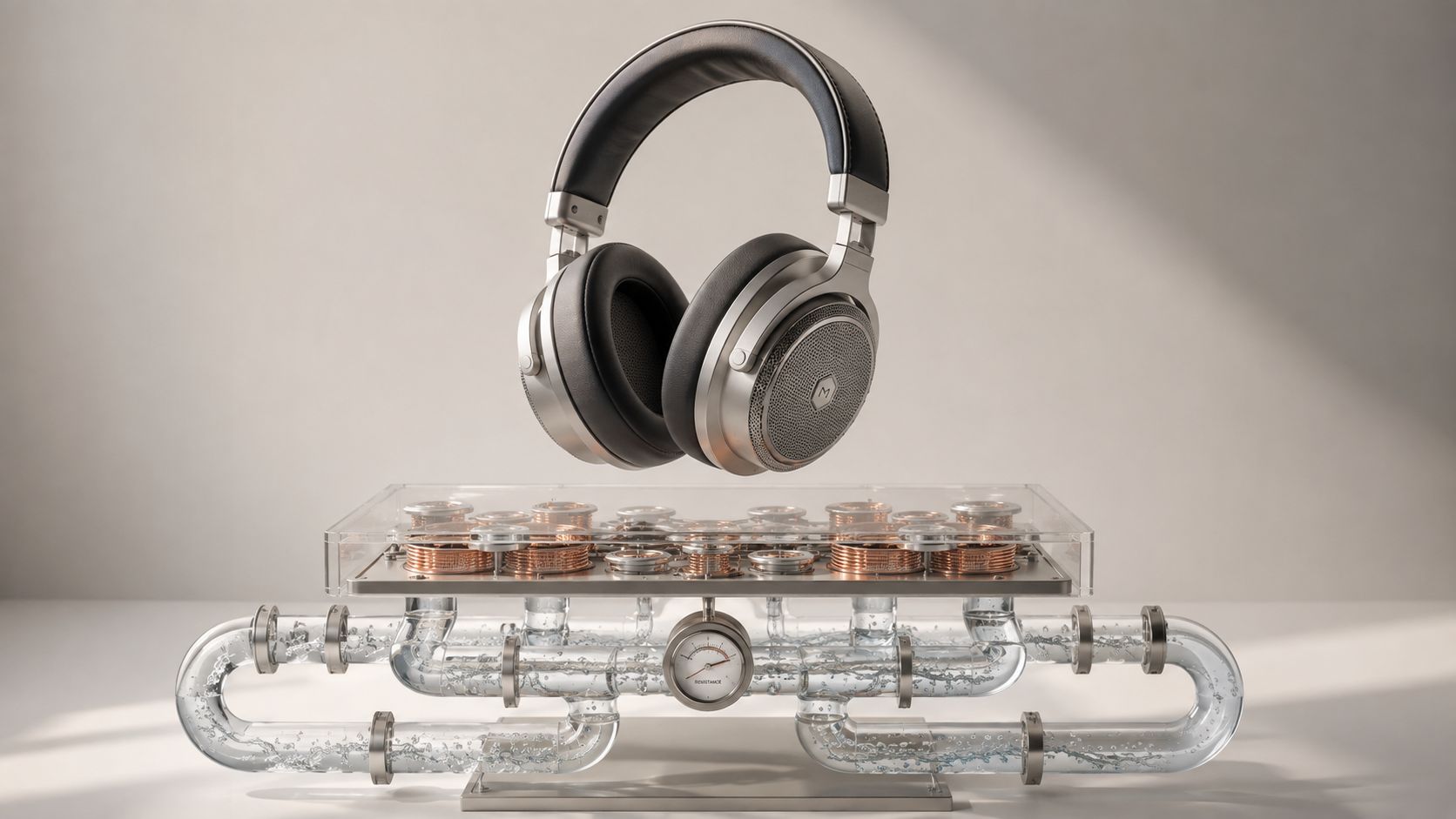
16 to 32 ohms is the portable-friendly lane, 80 to 250 ohms is where studio headphones usually live, and 600 ohms is where some reference pairs go when they're built for stronger amplification. The number on the box isn't a quality score, it's the AC load a headphone presents to an amplifier, and that load is shaped by the voice coil's windings.
That's the part many users miss. What is impedance in headphones? It's not a magic sound badge, and it isn't even a flat property, it's a nominal rating that only tells the truth when you put it next to a source, a sensitivity figure, and an output stage that can drive it.
Table of Contents
- Why the Ohms Number on the Box Is Misleading You
- The Voice Coil Is Where the Ohms Come From
- Why a 100 Ohm Headphone Can Out-Loud a 32 Ohm One
- The Impedance Curve and Why Your Frequency Response Moves
- The Eighth-Impedance Rule for Source Matching
- Myths Worth Killing Before You Buy Another Pair
- Three Specs to Check Before You Plug Anything In
Why the Ohms Number on the Box Is Misleading You
The problem usually starts upstream. A phone, laptop, dongle DAC, interface, or amp does more than “play audio,” it supplies a certain amount of voltage and current, and the headphone on the other end has to live with whatever headroom, or lack of it, that source can deliver.
Impedance is one part of a three-way match
I've seen plenty of buyers treat the ohms number like the whole story. They grab the big number, assume they know what they're buying, then wonder why one 32-ohm set sounds flat while another wakes up fast from the same device.
That confusion makes sense because loudness and control do not come from impedance alone. They come from the interaction of impedance, sensitivity, and source output impedance. Impedance describes the electrical load. Sensitivity describes how efficiently the driver turns power into loudness. Output impedance describes how much the source interferes with the headphone instead of staying out of the way.
Practical rule: impedance is a compatibility clue, not a sound-quality rating.
The better question is, “What source was this built to be fed by?” A low-impedance headphone is usually meant for weaker outputs. A higher-impedance model is often built to behave better in a chain that can supply more voltage without getting sloppy.
The oldest mistake in this hobby is treating low ohms as an automatic shortcut to easy listening, or high ohms as a guarantee of better sound. That shortcut is how people buy the wrong headphone for the gear they already own. It is also why the portable default shifted toward 32 ohms, since phones and laptops became the main listening devices for a lot of people. The number on the box was answering a source question, not handing out a verdict on quality.
Read the box like a compatibility note
Here is the clean mental model. The ohms number tells you how hard the headphone asks the amplifier to work. It does not tell you, by itself, whether the pairing will be loud enough, clean enough, or tonally stable enough.
That is why the spec sheet needs a second pass, not a quick glance. Sensitivity tells you how much volume you get for the power you feed it, and the source matters just as much because its output impedance can change how the headphone behaves. If the driver type is also unclear, this breakdown of dynamic driver and balanced armature behavior helps show why the same ohms number can hide very different results.
A headphone spec is not a trophy. It is a clue about pairing, and the pair is what you hear.
The Voice Coil Is Where the Ohms Come From
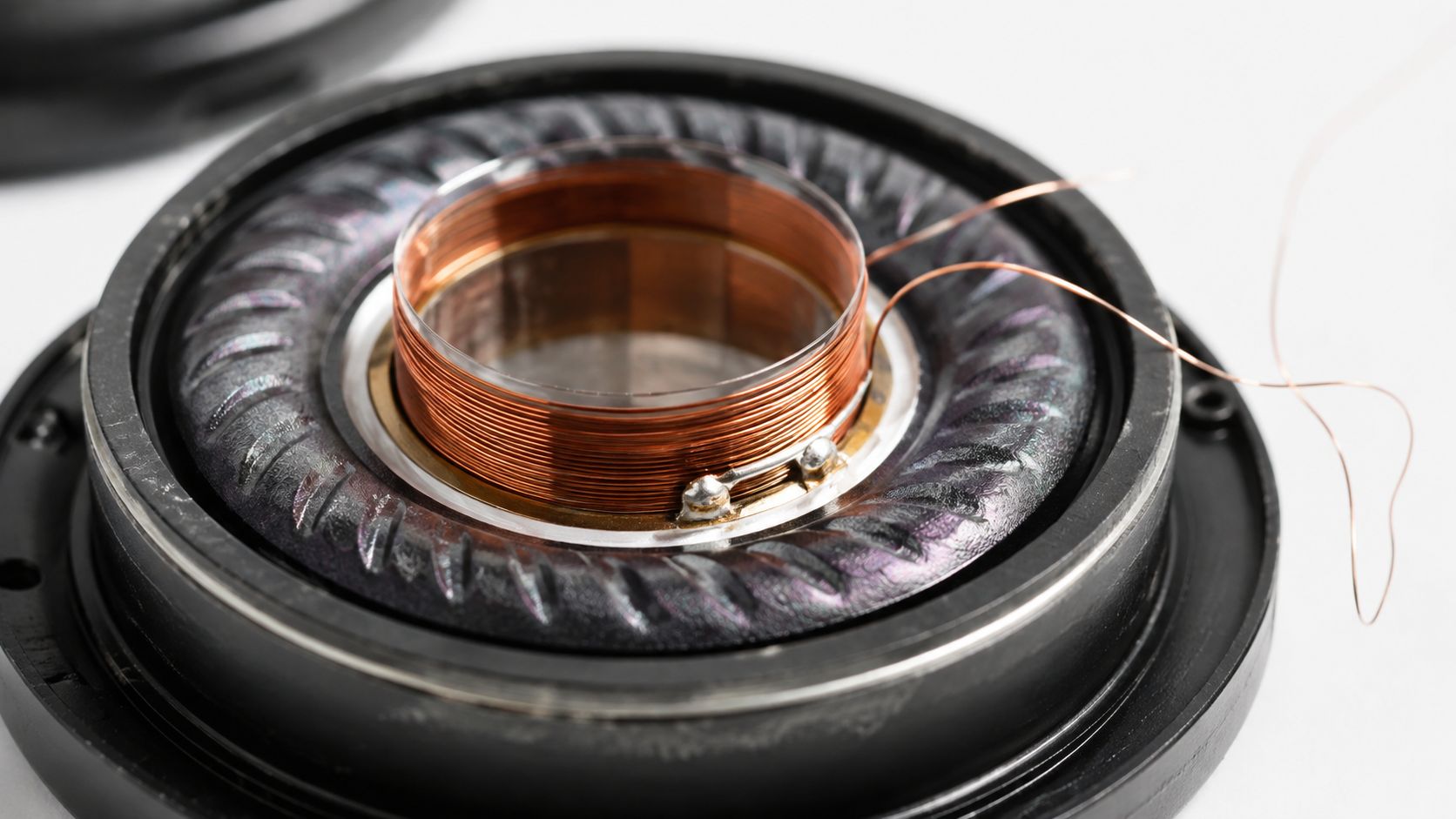
The ohms number starts in the driver, not in the marketing copy. Inside the headphone, the voice coil is the winding that moves the diaphragm, and that winding is where impedance largely comes from. Fewer turns usually mean lower impedance. More turns usually mean higher impedance. That is the physical reason the spec exists at all.
More wire means more load
The coil is not just a simple loop of copper. Its wire length, thickness, and number of turns all shape the electrical load the source sees. That is why impedance is a structural fact, not a decorative label.
A plain way to read it is this, more wire usually means more impedance, and more impedance usually asks for more voltage. That still leaves out sensitivity, which is why the number on its own never finishes the story. A headphone can be efficient enough to sound lively from a modest source, or it can be picky even at a lower nominal ohm rating. The driver design matters too, and how dynamic drivers and balanced armatures behave differently helps show why the same headline number can hide very different results.
As shown in the impedance band breakdown above, the low range suits phones and laptops, while the high end wants a stronger amplifier. That shorthand is useful because it matches how headphones are built and used. A coil designed for easy portable use does not ask the same thing from a source as a coil built for a more powerful chain.
What the spec is really saying: this driver was designed around a certain kind of source, not around a promise that it will behave the same everywhere.
If you are trying to guess where a pair belongs, the ohms number gives you a starting clue. Low impedance usually points toward convenience and portability. Higher impedance usually assumes a stronger output stage and tends to make more sense near a desk than in a pocket. A practical buying guide to impedance bands
Why a 100 Ohm Headphone Can Out-Loud a 32 Ohm One
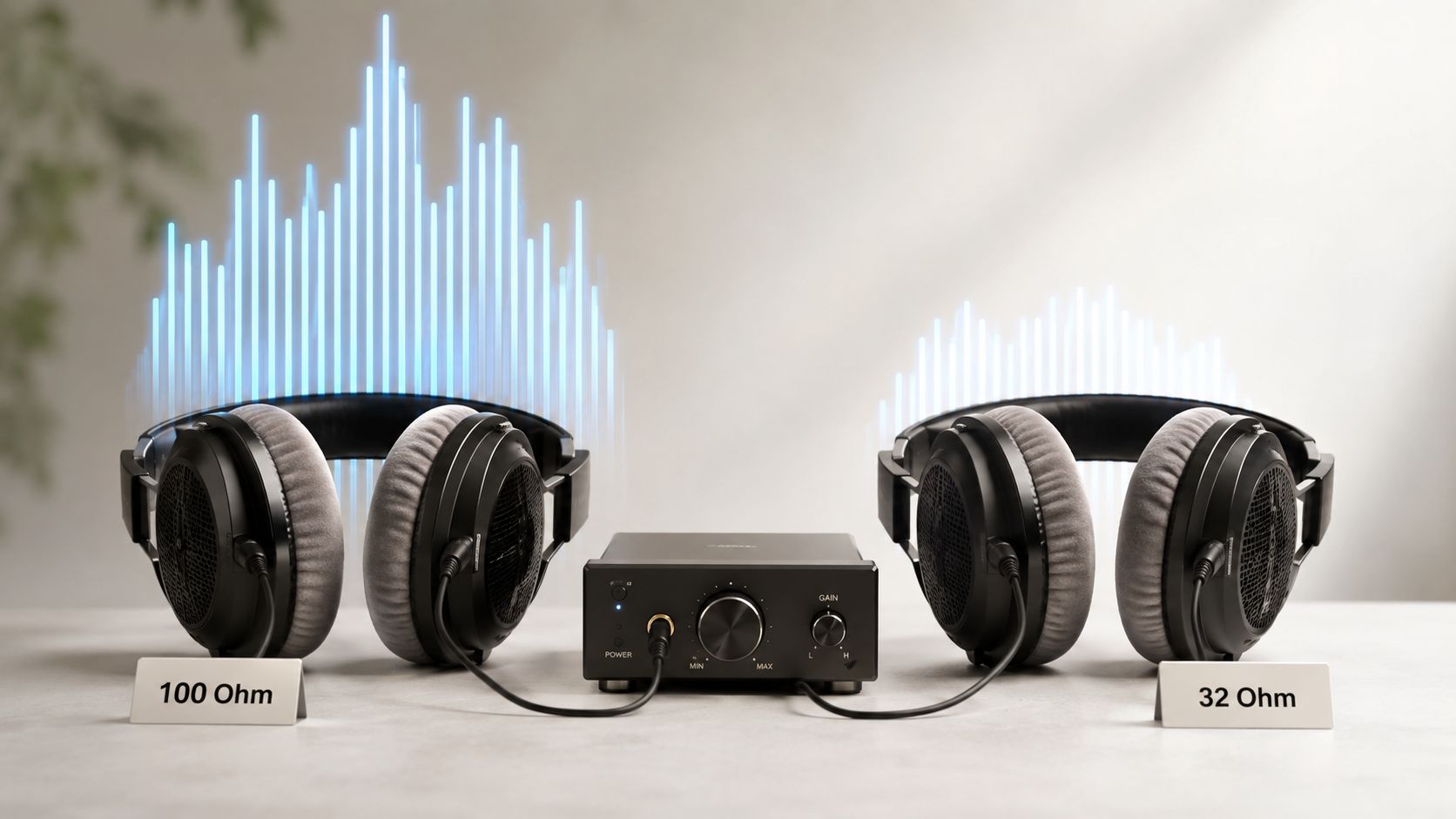
The “lower ohms equals louder” rule falls apart as soon as you compare real headphones. A 100-ohm headphone can play louder than a 32-ohm one if its sensitivity is higher, because loudness depends on how efficiently the driver turns input into SPL, not on impedance alone. Galaxus points out that the ohm value by itself cannot predict loudness, and that is the part buyers need to hear before they start treating the smaller number like a prize. Sensitivity is the real loudness clue
Current, voltage, and why the same phone behaves differently
Here is the clean version. Low-impedance headphones draw more current for a given signal. High-impedance headphones need more voltage. Neither one is automatically louder.
That is why the same phone can wake one headphone easily and leave another sounding flat and underfed. The source has a limited output stage, and the headphone asks for a particular mix of voltage and current. If the source cannot provide that mix, the sound gets smaller and less confident.
As the impedance band table above shows, 16 to 32 ohms suits phones, while 250 ohms and up wants a dedicated amp. That shorthand is useful because it matches how headphones are built and used. A coil meant for portable use does not ask the same thing from a source as a coil built for a more powerful chain.
A 100-ohm pair with strong sensitivity can absolutely out-loud a 32-ohm pair with weaker sensitivity. That is not a strange edge case. It is normal behavior wearing a fake mustache.
Do not shop by the lowest number. Shop by the right pairing.
The useful question is never “Which impedance is best?” It is “Which headphone's electrical appetite matches the gear I already use?” That one question saves more returns than any forum thread ever will.
Sensitivity is the missing half of the story
Most beginner explainers stop too early. They settle on “low impedance is easier to drive,” which is only part of the picture and can mislead you. Sensitivity is the other half, and it is the part that tells you how much loudness you get for the power coming in.
If two headphones differ in impedance but one is far more efficient, the efficient one can feel easier on a phone even if the ohm number looks worse on paper. That is why the box alone is a poor oracle. The box is a clue. The spec sheet is the map. Your ears do the final grading.
The Impedance Curve and Why Your Frequency Response Moves
The printed ohms number is a convenience, not the full picture. Real headphone impedance changes with frequency, so the load isn't perfectly flat across the audio band. A technical reference describes impedance as a varying resistance, and that's the phrase worth carrying around in your head. Impedance as a varying resistance
The curve matters more when the source is sloppier
When a source has high output impedance, it interacts with the headphone's impedance curve. That interaction can change more than volume. It can shift tonal balance. Bass can thicken. Treble can soften. The whole response can tilt in a way that sounds less like a clean chain and more like a bad compromise.
That's why people plug one headphone into a vintage receiver or a quirky dongle and swear it changed personalities. It did. Not because the headphone became a different model, but because the source and the load started negotiating over the frequency response.
A standard explainer makes the same core point, the labeled ohms number is usually measured at a standard frequency such as 1 kHz, while the full impedance curve can rise or fall elsewhere across the band. Why the nominal number is only a snapshot
Low-output sources keep the curve from coloring the sound
Solid-state sources with near-zero output impedance tend to behave better here because they don't let the headphone's curve tug the response around as much. That's the boring answer, and boring answers are usually the right ones in audio.
If the source has a weak grip, the headphone's curve starts writing part of the EQ.
That's the hidden reason some headphones sound fine from one device and strangely bloated, thin, or dull from another. The label on the box didn't change. The electrical handshake did.
The best mental image is a seesaw. If the source is heavy and stable, the headphone behaves more predictably. If the source is wobbly or high in output impedance, the balance shifts and the downstream sound inherits the wobble.
The Eighth-Impedance Rule for Source Matching
The clean engineering rule of thumb says the amplifier's output impedance should be no more than one-eighth of the headphone's nominal impedance. That ratio gives the source enough control to avoid audible misbehavior. One independent guide lays it out bluntly, 300-ohm headphones should see no more than 37.5 ohms of source impedance, and 16-ohm headphones should see about 2 ohms or less. The one-eighth matching rule with worked examples
Use the ratio, not vibes
Once you know the rule, the math is simple.
- 16 ohms, source should stay at 2 ohms or less
- 80 ohms, source should stay at 10 ohms or less
- 300 ohms, source should stay under 37.5 ohms
That's the compatibility test. Not “Does this sound expensive?” Not “Does this spec look serious?” Just, does the source stay low enough in output impedance to avoid distorting the headphone's behavior?
Most modern phones and dongle DACs sit near zero output impedance, which is why they usually play nicer than old receivers or oddball adapters. The failure cases are the sources with higher output impedance, because they can alter both level and tone instead of just passing the signal through. Why output impedance control matters
The quick pairing habit I use
I check the headphone's nominal impedance first, then I look for the source's output impedance. If the source spec is missing, I get cautious. If the source spec is obviously too high, I move on.
That's the part people skip because they'd rather buy by label than by pairing. Then they end up blaming the headphone for what the source did upstream. The gear wasn't broken. The match was.
A lot of confusion disappears the moment you treat output impedance like a floor, not a footnote. If the source can't stay well below the headphone's nominal rating, the downstream sound can get crooked fast.
Myths Worth Killing Before You Buy Another Pair
As covered earlier, low ohms does not automatically mean easy to drive. There is a second myth worth killing, though. High impedance does not always sound more detailed, more refined, or more “pro.” The ohms number is a clue, not a verdict, and it only makes sense alongside sensitivity and the source feeding the headphone.
A headphone with higher impedance may ask for more voltage to reach the same loudness, but that alone does not tell you how it will sound. A headphone with lower impedance may still be a stubborn load if its sensitivity is poor or the source is a bad match. The spec sheet keeps people honest only when they read the whole thing.
Three myths that keep wasting people's money
The first myth is that anything above a certain ohm number automatically needs a dedicated amplifier. That sounds tidy, which is why it survives, but it misses the test. Some higher-impedance headphones work well from a strong laptop or interface output, while some low-impedance in-ears still need help because sensitivity and source output matter too.
The second myth is that higher impedance always delivers better detail. It does not. Detail comes from driver design, tuning, and a proper match between the headphone and the source, not from a bigger ohms number sitting on the box like a badge.
The third myth is that low impedance equals consumer trash. That one falls apart as soon as you look at why portable gear became so dominant. The 16 to 32 ohm range fits phones, tablets, and laptops because those sources became the default for everyday listening. That is practical design, not a downgrade. Why portable gear pushed 32 ohms into the mainstream
The smarter way to read the spec
I would take a well-matched 32-ohm pair over a badly matched 600-ohm pair every time. The first one is more likely to behave the way its designer intended. The second one can sound starved, flat, or oddly uneven if the source cannot supply enough voltage or keep its output impedance under control.
A good headphone is not a moral object. It is a load, and the source has to meet it cleanly. If the source is weak, the headphone does not magically become “better” because the ohms number looks serious on paper.
That is why I check the source stage with the same care I give the headphone itself. For a useful starting point, this guide to choosing a DAC for headphones helps frame the rest of the chain without pretending the ohms number tells the whole story.
And yes, the internet loves the clean binary because it is easy to repeat. Easy does not make it useful.
Three Specs to Check Before You Plug Anything In
Before you connect anything, check three things. The headphone's nominal impedance. The headphone's sensitivity rating. The source's output impedance. If one of those is missing, you're guessing, and guessing is how people end up calling a bad pairing a bad product.
Make the pairing decision before the purchase
I use the same logic whether I'm looking at a cheap in-ear, a laptop setup, or a reference pair that wants a serious amp. If the headphone is low impedance but insensitive, it still may need more help than you expect. If the headphone is high impedance but efficient and the source is strong, it may work better than the forum scolds predicted.
That's the whole game. Not chasing the smallest number. Not worshipping the biggest one either. Just matching the load to the source.
For anyone building a desk chain, I'd also sanity-check the DAC and amp stage together, because the source is only as good as the weakest piece in the chain. A practical guide to picking a DAC for headphones
Final test: if you can't explain the pairing in terms of impedance, sensitivity, and output impedance, you don't understand the setup yet.
Once you do understand it, the spec sheet stops looking mysterious. It starts looking like a map.
That's the answer to what is impedance in headphones. It's a compatibility question, not a quality grade. Use the right chain, and the numbers stop arguing with you.
If you want a cleaner way to read headphone specs without the usual forum fog, keep going through Supermarket Sound and use the site as a desk-side reference while you shop.

