Most advice about the best DAC for headphones is stuck in a world that no longer exists. People still shop DACs like the chip is the magic part, then act shocked when the expensive one sounds suspiciously like the sensible one.
Here's the blunt version. The DAC chip is mostly a solved problem. The primary decision is not chip worship. It's the analog output stage, the feature set, and whether the unit suits your headphones and how you listen. If you're pairing a cold, sharp desktop box with already-bright headphones, you didn't build a high-fidelity system. You built a fatigue machine.
A lot of search traffic wants a neat ranking. I get it. SEO likes a winner. My ears don't. There isn't one universally best DAC for headphones, and pretending otherwise is how people waste money on polished aluminum and meaningless spec chest-thumping.
Table of Contents
- Your Search for the Best DAC Is Probably Broken
- The Real Job of a DAC in 2026
- The Shortlist A DAC for Every Desk and Pocket
- Desktop Contenders From Workhorse to Luxury
- Portable Players Dongles and Dedicated Units
- Synergy Is Not Snake Oil It Is the Entire Game
- The Only Time You Should Not Buy a DAC
Your Search for the Best DAC Is Probably Broken
The biggest lie in this category is that a DAC is the secret key that brings out the full potential of your headphones. That story sells boxes. It doesn't help listeners.
The myth is common enough that 78% of headphone buyers over $300 assume a $200 DAC is mandatory for maximizing sound potential, yet independent blind tests showed no measurable or perceptible difference between high-end DACs and basic USB interfaces when using modern 3.5mm and 4.4mm IEMs or headphones with built-in amp stages, according to the DAC myth gap research. That should reset the conversation immediately.
If your headphones are easy to drive, your source is already clean, and your use is straightforward, you may not need a DAC at all. Not a fancy one, anyway. What you may need is better amplification, quieter power, a better volume control, more useful inputs, or a device that doesn't make daily listening annoying.
Practical rule: Stop asking which DAC chip wins. Ask what your headphones need downstream.
This is why most “best DAC for headphones” lists miss the point. They rank parts, not systems. They obsess over conversion while ignoring the load-bearing stuff that shapes the experience: output stage voicing, gain behavior, headphone compatibility, physical controls, and whether the thing fits your desk or your pocket.
Three questions matter more than the chip badge:
- What are you driving: Efficient IEMs need silence and control. Demanding over-ears need grip and headroom.
- How do you listen: Desk, couch, commute, phone, laptop, streamer. Different jobs, different boxes.
- What kind of sound do you want: Dry and surgical, warm and dense, spacious and relaxed. Those differences usually come after the chip.
The best DAC for headphones is not the one with the loudest spec sheet. It's the one that doesn't starve the signal, doesn't fight your headphones, and doesn't waste your money.
That's the whole game.
The Real Job of a DAC in 2026
Digital conversion used to be a meaningful dividing line. It isn't anymore. Now the chip is the floor, not the house.
The Chip Lays the Floor
Modern DAC quality has plateaued hard. Virtually all modern DACs using high-end chips now achieve more than 120 dB dynamic range and less than 0.001% THD+N, and in Audio Engineering Society blind tests from 2023, 94% of participants could not distinguish between a $50 USB DAC and a $1,200 audiophile model when both used identical output amplifiers, as covered in the AES blind test summary.
That's not a tiny footnote. That's the category getting turned inside out.
If you want the plain-English version of the basics, read my guide on DACs explained simply. Then come back and stop shopping like it's 2012.
The Analog Stage Builds the House
The chip turns digits into voltage. Fine. Useful. Necessary. But it's not where most of the audible personality lives anymore.
The analog stage is where a unit earns its keep. That means the output buffer, power delivery, filtering choices, and how the unit handles the signal after conversion. One box gives you density in the mids, believable image edges, bass with shape, and treble that hangs in space without turning brittle. Another gives you a bleached, papery sound that measures clean and feels dead.
That's why two DACs with similarly excellent conversion can still feel different in use. Not because one has mystical fairy dust. Because downstream inherits every design choice that follows the chip.
A good DAC doesn't add magic. It avoids damage, preserves texture, and hands the amp a signal with weight and stability.
This is also why combo units can make more sense than separate DACs for a lot of people. If the analog stage and amp section are designed together well, you get coherence, less clutter, and fewer chances to build a mismatched system out of internet folklore.
So the job of a DAC in 2026 is simple. Lay a clean floor. Feed a strong analog stage. Stay out of the music's way.
Everything else is marketing fog.
The Shortlist A DAC for Every Desk and Pocket
Some readers want the long sermon. Some want the shortlist before lunch. Fair enough.
Here's mine. Not a museum of every box on the market. Just the picks that make sense if you're buying with ears instead of with forum anxiety. If you want a budget-first path, I've got a separate guide to the best budget DAC and amp.
Marque's DAC Shortlist 2026
| Model | Category | Best For | The Sound In a Nutshell |
|---|---|---|---|
| RME ADI-2 Pro FS R BE | Desktop reference | Analytical listeners, high-impedance headphones, serious desk setups | Clean, controlled, spacious, with a grip that keeps complex mixes sorted |
| Topping DX7 Pro | Desktop precision value | Detail chasers who want a crisp, modern presentation | Fast, explicit, low-grain, slightly cool if paired badly |
| Schiit-style discrete desktop unit | Desktop character pick | Listeners who want body and less glare | Fuller through the mids, more texture than sparkle, easier to live with long-term |
| USB-C dongle DAC | Pocket everyday carry | IEM users, commuters, laptop listeners | Immediate, tidy, punchy enough, usually all you need on the move |
| Battery-powered portable DAC/amp | Portable authority | Harder-to-drive headphones away from the desk | Bigger image, firmer bass, more ease at volume, less pocket-friendly |
A few direct calls.
If you want the most broadly sensible desktop answer, get something with a strong analog stage and a usable interface. If you want portable, start with a dongle unless your headphones clearly demand more power. If you already have easy-to-drive headphones and clean output from your device, don't buy a DAC just to feel involved.
Buy for use case first. Sound second. Spec sheet third.
That order saves people from a lot of bad purchases.
The rest of the story is about where these categories win, where they annoy, and which headphones they flatter.
Desktop Contenders From Workhorse to Luxury
Desktop DACs are where audiophiles love to lose the plot. This is the land of giant displays, dense menus, aluminum slabs, and debates that sound like wine tasting by way of electrical engineering. Some of it matters. A lot of it doesn't.
The Honest Desktop Pick
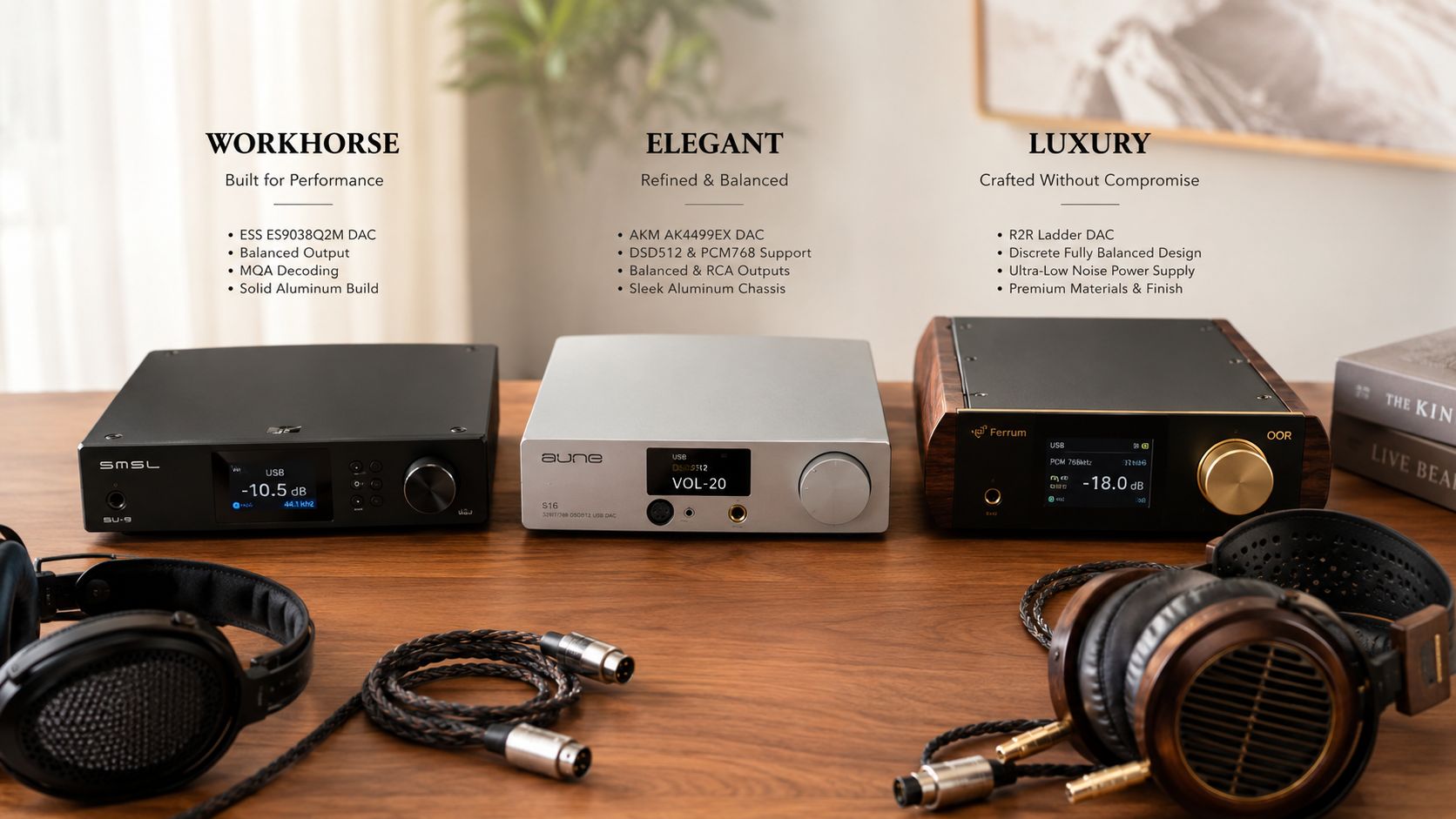
The workhorse desktop DAC is the one that disappears into your routine. Good knob. Clear display. Useful outputs. Stable connection. No drama.
That matters more than enthusiasts admit. If the unit is annoying to operate, you'll use it less. If its output stage sounds thin and mechanical, your fancy headphones will tell on it immediately. Good desktop gear should sound settled. Notes should have leading edges, yes, but also body behind them. Kick drums shouldn't be just impact. They need mass.
A more characterful desktop unit can beat a supposedly purer one. Not because it's less accurate, but because it doesn't bleach the harmonic structure out of instruments. Vocals sound more human. Guitars have wood and wire, not just string noise.
The Precision Pick
The RME ADI-2 Pro FS R BE is a good example of what elite execution looks like. It delivers THD+N of -119 dB at 1 kHz and channel separation above 120 dB, according to the RME ADI-2 Pro FS R BE measurements. That's not interesting because big numbers are sexy. It's interesting because this level of cleanliness means the device keeps complex material organized without turning the sound sterile.
With high-impedance headphones, especially something spacious and revealing, a unit like this can sound impressively unflustered. Orchestral layers stay untangled. Reverb tails remain intact. The center image doesn't smear when the arrangement gets busy. To my ears, the best thing about this style of DAC is composure. It doesn't shout detail at you. It unfailingly retains it.
That said, precision can become a trap. Pair a highly explicit DAC with already hot treble and you can cross from “revealing” into “I am now listening to cymbals file for divorce.” The gear isn't wrong. The pairing is.
Here's a listening break worth your time.
The One That Makes Sense for Most People
Most listeners don't need luxury desktop gear. They need a DAC that gives them stable performance, enough output flexibility, and a sound that won't punish long sessions. That usually means a unit with a competent analog stage and sane ergonomics, not the most glamorous converter chip.
A good mid-tier desktop option tends to shine with modern genres because it keeps transients tight and bass lines distinct. Electronic tracks need slam without bloat. Dense rock needs separation without turning into a bright wall. A decent desktop DAC/amp combo often nails this better than a more expensive but mismatched stack.
A few desk-side buying rules:
- Choose control over hype: A tactile volume knob and readable display matter every single day.
- Match temperament to headphone: Warm or neutral-leaning boxes often pair better with sharper headphones.
- Don't overbuy the chip: The analog section and amp behavior will shape the experience more.
Desktop DACs are not where magic happens. They're where mistakes become permanent.
Choose accordingly.
Portable Players Dongles and Dedicated Units
Portable DAC shopping splits into two camps. The sensible camp buys a dongle and goes outside. The obsessive camp straps a brick to a phone and calls it freedom. I respect both, but only one of them fits in jeans.
Dongles Win on Convenience
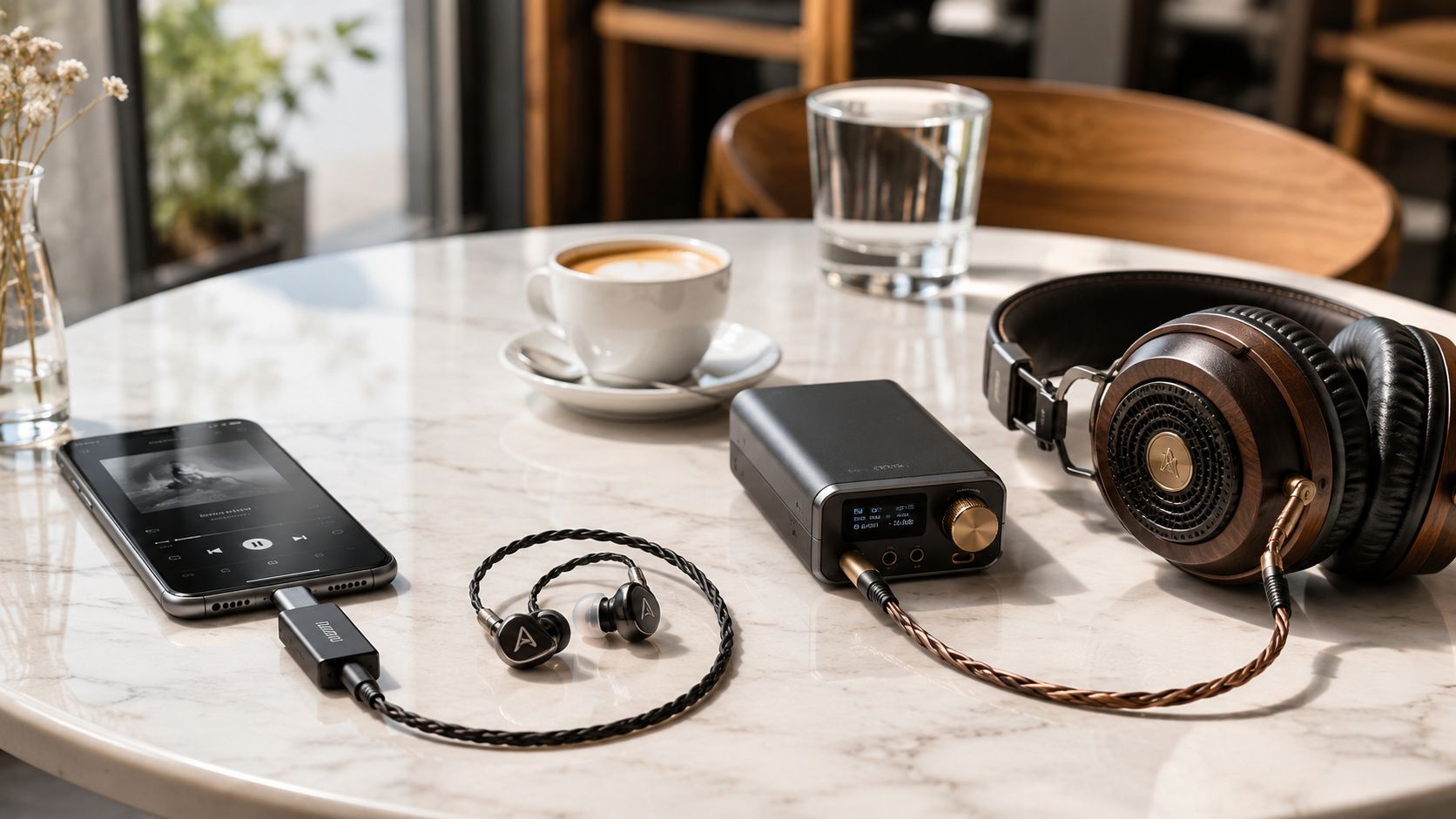
For IEMs and efficient headphones, a good USB-C dongle is usually the right answer. Small, quiet, easy, cheap compared to desktop gear, and far better than the snobs used to admit. Most of the time, that's enough.
The market has moved that way for a reason. The global DAC market grew to $2.4 billion in 2024, with headphone DACs representing 38% of that segment, and by 2025, 67% of new mid-tier headphone DACs in the $150 to $400 range support MQA and DSD512 decoding, according to consumer DAC market trends. The practical reading is simple. Portable listening is mainstream, feature-heavy, and no longer sonically embarrassing.
That doesn't mean every format badge matters. It means portable gear has matured. A lot.
If your portable headphones are easy to drive, a dongle isn't the compromise. It's the correct tool.
What does a good dongle sound like? Quick off the line. Clean enough not to hiss with sensitive earphones. Punchy without trying to impersonate desktop authority. It should vanish, not become a second hobby.
Battery Units Win on Control
Dedicated portable DAC/amp units still have a place. They matter when your headphones need more power, when you want better physical controls, or when you don't want your phone doing all the electrical heavy lifting.
The sonic advantage usually shows up as ease. Bass feels more planted. Loud passages stop sounding strained. The image gets less cramped. There's a sense that the headphones are being held properly, not just pushed. With bigger over-ears, that matters.
But there are trade-offs, and they're not subtle:
- Pocketability suffers: A dedicated portable unit turns “grab and go” into “assemble and go.”
- Charging becomes a relationship: One more battery. One more cable. One more thing to forget.
- Use case narrows: Brilliant for travel or a café session. Ridiculous for a quick walk.
This category only makes sense if the sonic and ergonomic gains meet a real need. For many people, they won't. For some, especially listeners using harder-to-drive headphones away from a desk, they absolutely will.
Portable audio is not about maximum hardware. It's about choosing the least annoying path to good sound.
That usually wins.
Synergy Is Not Snake Oil It Is the Entire Game
A DAC doesn't play music alone. It feeds a chain. Then the headphones tell the truth.
That's why “best DAC for headphones” is a bad question until you attach a specific headphone to it. A precise, low-grain DAC can sound glorious with one pair and exhausting with another. A fuller, slightly smoother output stage can rescue a headphone from its own worst habits.
Bright Plus Bright Is a Bad Time
This is the easiest mistake to make. People hear “detail” and buy a very explicit DAC, then pair it with headphones that already lean hard into upper-mid and treble energy. The result is not transparency. It's glare.
On paper, something like the Topping DX7 Pro is exceptional. Benchmark testing showed jitter under USB input at less than 10 picoseconds and a dynamic range of 123 dB A-weighted, as noted in the DX7 Pro benchmark review. That matters because clean timing and strong dynamic range help preserve transient edges and low-level detail. With the right headphones, you hear sharper image outlines, cleaner attack, and more air around dense passages.
With the wrong headphones, you hear your own buying mistake.
If you're still sorting out what amps and sources do in a chain, my beginner's guide to headphone amps will save you some grief.
What Good Matching Sounds Like
Good synergy sounds relaxed without sounding dulled. That's the target.
A warmer DAC or DAC/amp can work beautifully with analytical studio-leaning headphones because it restores a little flesh to the midrange and takes the edge off sibilants. On the other side, a cleaner and more explicit DAC can wake up darker headphones that otherwise feel sleepy or too thick through the mids.
I use a simple matching instinct:
- Treble-forward headphones: Pair with smoother, denser sources.
- Dark or soft headphones: Pair with cleaner, faster sources.
- Planar headphones: Give them grip and control first, romance second.
Build a system that corrects excess. Don't stack the same personality twice.
That isn't snake oil. It's system building. And it's the difference between a rig that impresses for ten minutes and one that keeps you listening for three albums.
The Only Time You Should Not Buy a DAC
If your current source is quiet, your headphones are easy to drive, and you're not missing features, don't buy a DAC. Buy music. Or pads. Or nothing.
This is even more true now that many listeners are using integrated solutions that are already competent. Some headphones handle conversion internally. Some amps with built-in DAC sections are plenty good enough. Some modern USB-C listening setups make the whole external box conversation feel like a hobbyist side quest.
There's another blunt truth. A lot of mainstream users are drifting toward digital headphone paths that make standalone DAC talk less relevant than forums want to admit. If your daily headphones already solve the conversion step internally and sound good doing it, adding another DAC isn't clever. It's redundant.
The worst reason to buy a DAC is guilt. The second worst is fear that your headphones are being “held back” by a perfectly decent source.
Buy a DAC when you need better analog output, cleaner control, more useful connectivity, or a sound that better suits your headphones. Don't buy one because the internet told you a chip swap is a personality.
That fantasy is over.
Author: Marque Hersh
Publisher: Supermarket Sound
Author profile: Marque Hersh on Steam

