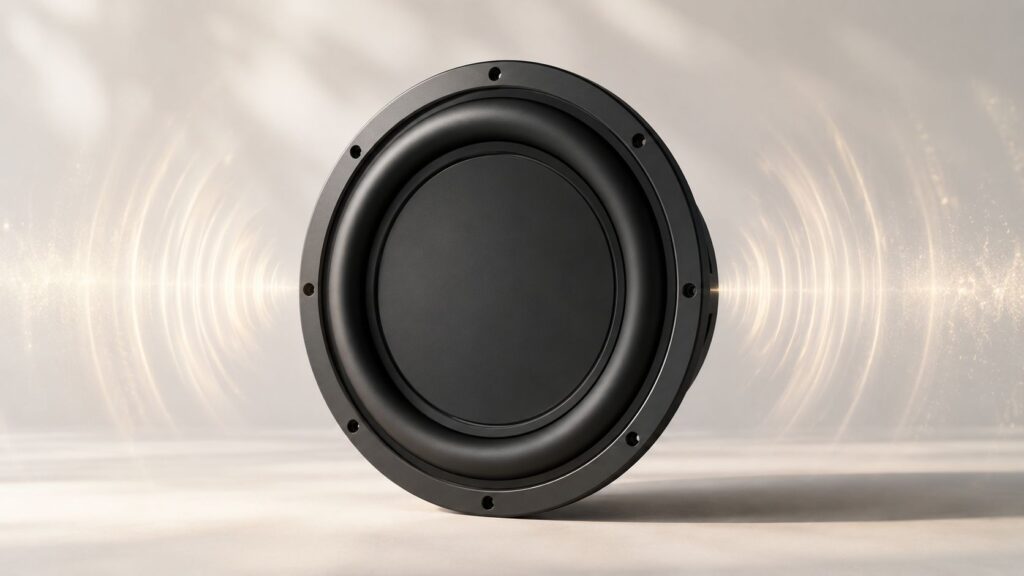
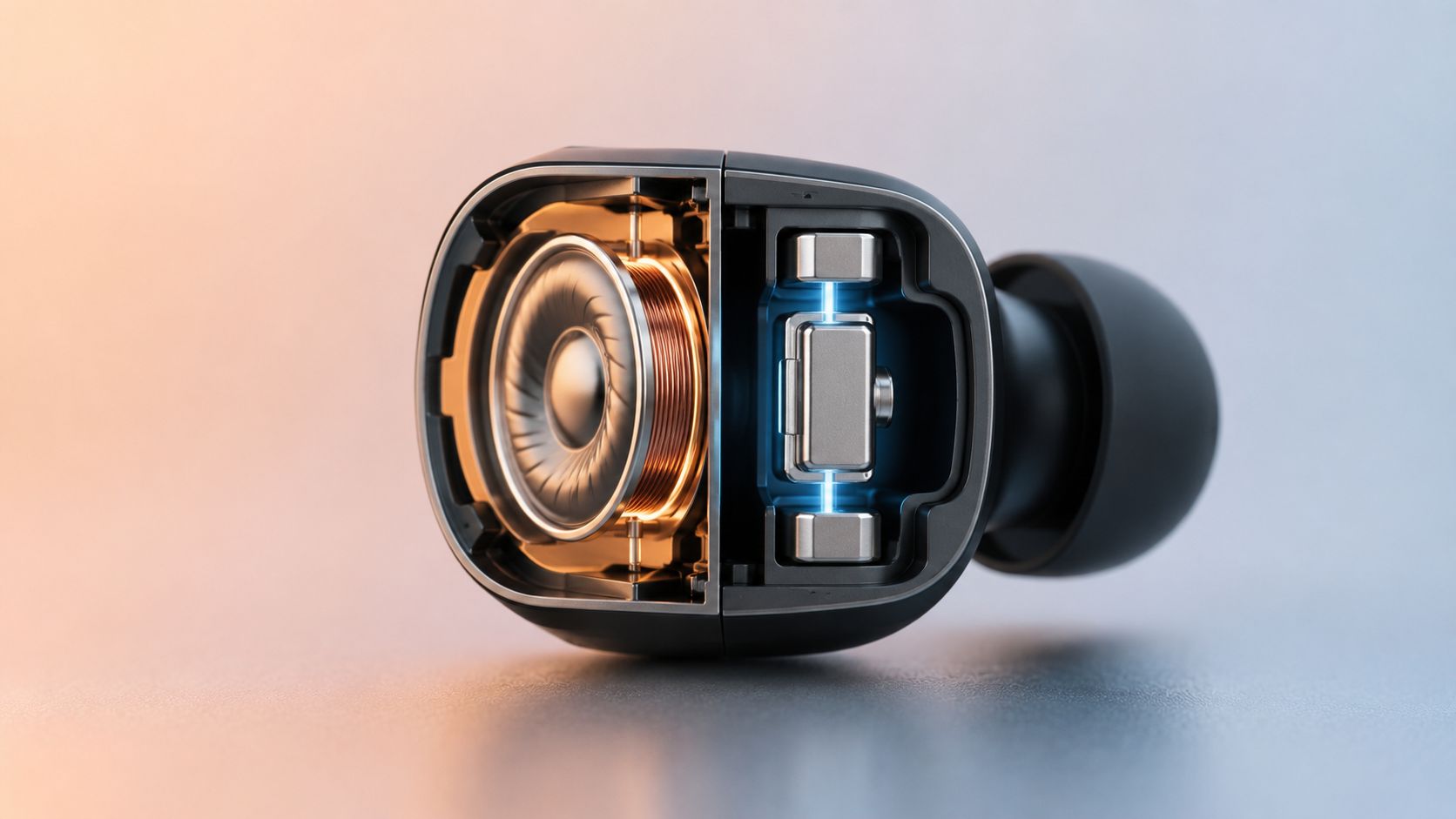
Forget the lazy line that says balanced armature means detail and dynamic driver means bass. That slogan survives because it's easy, not because it tells you what's happening inside the shell. The split is harsher and more useful, one design spends its physics budget on excursion and air, the other spends it on control and efficiency.
That's the lens I trust after years of pulling IEMs apart and listening through the usual excuses. A good dynamic driver gives you body, reach, and a more coherent floor. A good balanced armature gives you compact efficiency, isolation, and the kind of precision that makes bad recordings feel naked. Pick the wrong one for the job, and downstream inherits the mistake.
Table of Contents
- The Lazy Version of This Comparison Is Wrong
- How a Dynamic Driver Actually Moves Air
- How a Balanced Armature Stays Tight
- Timbre, Transients, Efficiency, and the Numbers That Matter
- Hybrids, Multi-BA Arrays, and When a Single DD Wins
- Measurements Lie, Ears Argue and Source Plus Seal Decide Everything
- What to Buy, by Listener and Use-Case
- The Two Questions That Actually Pick the Driver
The Lazy Version of This Comparison Is Wrong
The internet loves the shortcut. It says DD for bass, BA for detail, and then everyone pretends the job is done. That framing misses the part that matters, which is where each design spends its budget. A dynamic driver spends on diaphragm travel and moving air. A balanced armature spends on control, density, and efficiency.
That difference is not cosmetic. Knowles says its RAB balanced armature is about one-third the size of a 6 mm dynamic speaker by volume, and in side-by-side efficiency testing it used about one-sixth the power over a 2 kHz to 300 Hz sweep Knowles. That's the sort of gap you can feel in product design before you ever put the thing in your ear. Smaller shell. Easier load on the source. Less wasted motion.
A better way to think about this is simple. DDs buy you air and continuity. BAs buy you compact precision. That distinction explains why stage monitors, isolation-focused IEMs, and multi-driver layouts gravitate toward BA designs, while full-bodied everyday listening still leans on dynamic drivers. Balanced armature drivers also became a major force in professional in-ear monitoring in the 1990s, which is why they still dominate talk about isolation, detail, and compact multi-driver layouts SoundStageSolo.
Practical rule: if a comparison starts and ends with “detail versus bass,” it's probably marketing copy wearing a fake mustache.
The useful question isn't which driver is “better.” It's which one spends its physics where you need the money gone. That's the whole game.
How a Dynamic Driver Actually Moves Air
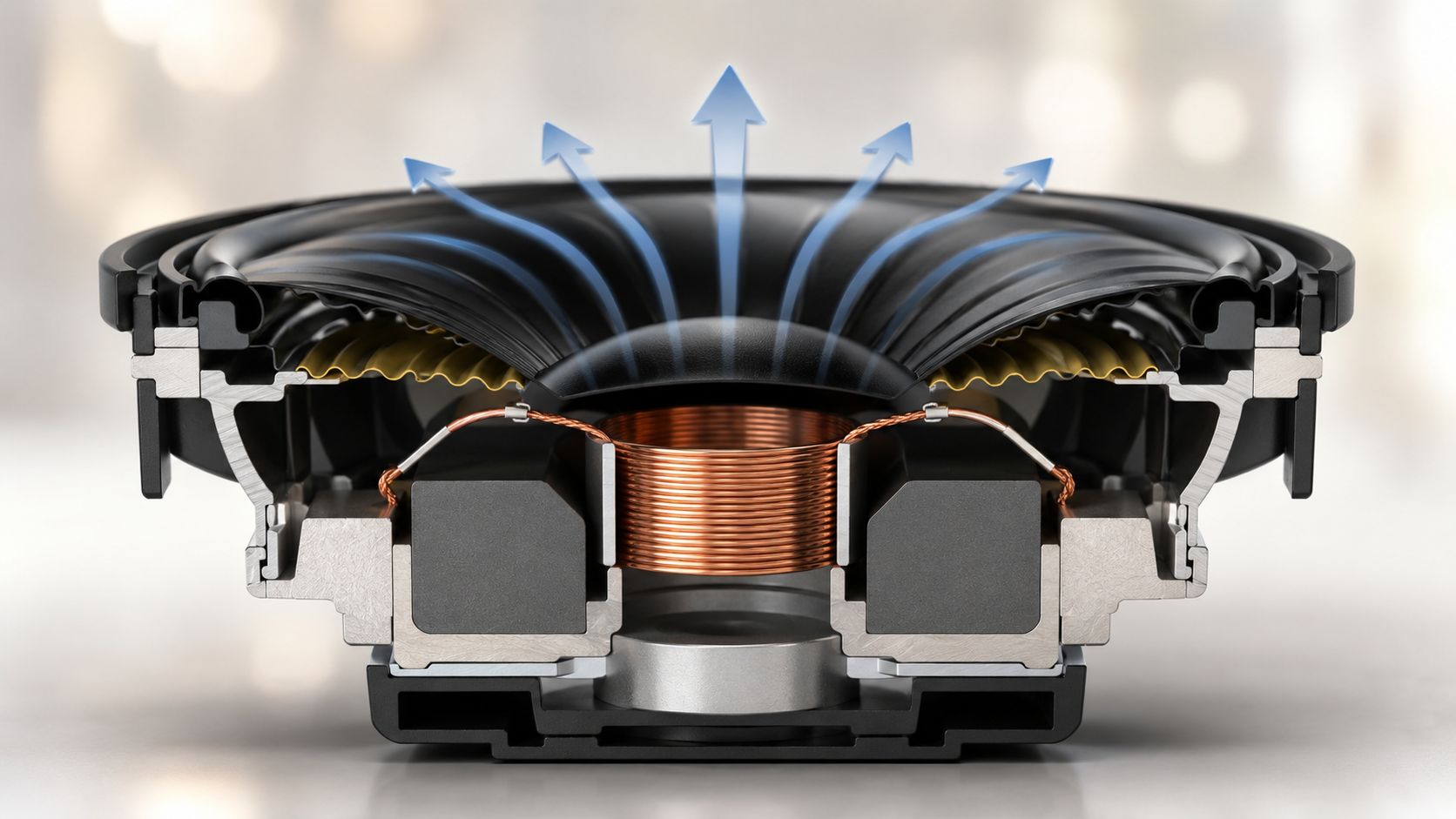
A dynamic driver is the one people can picture once you stop being vague about it. A voice coil sits in a magnetic gap, the diaphragm hangs off that assembly, current flows, the coil moves, and the diaphragm pushes air. That's the basic moving-coil recipe. It's the same mechanical idea behind the bulk of headphone drivers, just shrunk for an IEM shell SoundGuys.
Why That Movement Sounds Like Body
What matters is not just that the diaphragm moves. It's how much it moves and what that motion does to the bottom of the band. A dynamic driver can shift more air, which is why it usually owns the sense of bass reach, slam, and weight. It also tends to give the midrange a more unified feel, because one diaphragm is carrying a larger slice of the spectrum instead of handing pieces off to several tiny radiators.
That's why a good single dynamic often sounds more natural in a chair, even when it looks less exotic on paper. The presentation has a floor under it. Kick drums feel like they bloom out of the same body as the lower mids instead of snapping into place from separate parts. On a decent recording, that coherence is the point.
The Tradeoff Is Mass, Not Magic
The same moving mass that gives a dynamic driver its punch also slows it down a bit compared with a tiny BA motor. That doesn't make it sloppy. It makes it bigger in motion. When people describe dynamic drivers as warmer or more relaxed, they're usually hearing that bigger mechanical gesture, not some mystical “audiophile” trait.
Balanced armature drivers became a major force in professional in-ear monitoring in the 1990s, and that history matters because dynamic drivers never owned that space in the same way SoundStageSolo. Onstage, people wanted isolation and compactness. In casual listening, the dynamic driver's bigger air-moving behavior still wins a lot of arguments. Different jobs. Different floors.
How a Balanced Armature Stays Tight
A balanced armature driver looks like a small piece of watchmaking that ended up in audio. A coil wraps around an armature suspended between two magnets, and it's called balanced because there is no net force on the armature when it sits centered in the magnetic field MajorHiFi. The motion is tiny, controlled, and almost stubbornly restrained.
That restraint is the point. A BA driver spends its physics budget on control, not excursion, so it can keep the diaphragm's movement extremely short and tightly managed. If you want a simple setup primer before you start choosing driver types, Supermarket Sound's beginner IEM guide is the right starting point.
Tiny Motion, Huge Consequences
That small moving system is the reason BA designs are so efficient. Knowles says its BA platform takes far less power than a comparable small dynamic driver in its test setup, and that is not trivia, it is the load-bearing fact behind how these things behave Knowles. Less power means easier portability, easier battery life, and less strain on weak outputs. If a source is already noisy or underfed, a BA will expose that fast.
The other thing you notice is isolation. BA designs are often sealed or semi-sealed, and they do not need to vent air the way many dynamic drivers do. That makes them excellent for cutting out the room and keeping a mix clean. It also explains why the same shell can hold multiple BA drivers without turning into a basketball of air pressure.
Clean source, consistent seal. That's the whole game.
Why the Tuning Window Is Narrow
The catch is that BA output lives and dies on acoustic loading and damping. Small changes in nozzle geometry, venting, or ear-tip seal can swing the response harder than many people expect Facebook group post. That is why one person hears a clean, exact IEM and another hears thinness or glare from the same model. The driver is not changing. The acoustic conditions are.
That narrow tuning window is also why BA sets can sound ruthlessly fast without feeling physically large. They spend less energy on motion and more on precision. That is great for detail, speech, and monitoring. It is not free, and it is not forgiving.
Timbre, Transients, Efficiency, and the Numbers That Matter
別再糾纏形容詞,直接看它把物理預算花在哪裡。Timbre、transients、efficiency,還有size,才是動圈和balanced armature差異真正冒出來的地方。你耳朵先感受到的,通常不是規格表,而是這些取捨。
Timbre Is Where Dynamic Drivers Keep Winning
一顆調得好的 dynamic driver,通常在lower mids和bass之間聽起來更連貫。低頻不只是輪廓,還帶著身體感。BA 設計在中頻和高頻可以非常漂亮,可是一旦調音變複雜,聲音常會顯得更切碎、更分段,像是組出來的,而不是一整塊長出來的。這不代表它不好,只是質地不同。
原因很直接。dynamic driver 的振膜更大,能推動更多空氣,所以低頻會有更實在的重量。BA driver 把預算花在控制上,所以聲音邊緣常常更乾淨,卻少了底下那種自然膨起的感覺。這就是交換。你在鼓、男聲,還有任何卡在衝擊和溫暖交界的聲音上,都會立刻聽到差別。
The Numbers Back the Feeling
SoundStageSolo 在真無線比較裡提到,6 mm dynamic model 的電池續航是 6 hours,而單一 balanced armature model 是 7 hours,其他整理也把典型 dynamic-driver sensitivity 放在大約 110 to 114 dB/mW,balanced armature 則常見高出約 6 dB SoundStageSolo。6 dB 的差距,代表在相同輸入功率下,聲壓輸出大約會變成兩倍,這不是小修小補。它會直接改變前端要扛多少負擔。
外觀小,和吃電少,是兩回事。Knowles 的比較也指出,BA 在體積上可以明顯更省空間,而且在功率需求上比對照的 dynamic 設計更省力,這就是它能塞進更小腔體、也更容易做多單體配置的原因 Knowles。
下面這張表把重點攤開。
| Criterion | Dynamic Driver | Balanced Armature |
|---|---|---|
| Timbre | Fuller, more cohesive, more physical in the bass and lower mids | More textured, more analytical, especially in mids and treble |
| Transients | Slower on paper, but often more natural and weighty | Faster, tighter, more surgical |
| Efficiency | Usually lower | Usually higher, often about 6 dB higher sensitivity under similar conditions SoundStageSolo |
| Size | Larger moving system, needs more space | Smaller on a volume basis, roughly one-third the size of a 6 mm dynamic speaker in Knowles' comparison Knowles |
| Power use | More demanding when pushed | About one-sixth the power in Knowles' side-by-side test over 2 kHz to 300 Hz Knowles |
| Fit sensitivity | More forgiving | More sensitive to seal and acoustic loading |
這張表不是裝飾。重點很簡單。DD buys the floor. BA buys the edge.
Hybrids, Multi-BA Arrays, and When a Single DD Wins
The modern market isn't clean anymore, and pretending otherwise is lazy. Recent consumer audio explainers still frame DD and BA as the dominant technologies, but they also fold in hybrid and dual-dynamic designs, which tells you the simple binary has already broken down QCY 2026 guide. That's not a problem. It just means the question got more honest.
Hybrids Make Sense When the Hand-Off Is Clean
A hybrid can be excellent when the driver jobs are divided with some dignity. Let the dynamic driver handle bass. Let the BA handle mids and treble. If the crossover is honest and the shell doesn't fight the integration, you get the punch of one motor and the precision of the other. That's the dream.
The problem is that a crossover can also smear the handoff, and then you get sound that's busy without being coherent. Multi-BA arrays are famous for sounding detailed while still feeling disconnected if the integration is sloppy. You hear separate zones instead of one voice. That's not high resolution. That's a seam.
A Single Good Dynamic Still Has a Case
A well-tuned single dynamic often beats a stacked BA array on tonal continuity and bass realism. It doesn't have to jump through crossover hoops. It doesn't split the low end into pieces. It just moves air and keeps the same character across the band. If you care about natural tone more than microscope detail, that matters more than driver count ever will.
That doesn't make hybrids bad. It makes complexity guilty until proven innocent.
More drivers don't rescue bad tuning. They can hide it for a while, then you notice the seams.
Supermarket Sound's headphone buying guide is useful here because it keeps the decision anchored in use, not mystique. Buy the simplest design that solves your problem. Fancy is not a virtue by itself.
Measurements Lie, Ears Argue and Source Plus Seal Decide Everything
Charts flatter both camps, and they still leave out the part your ear lives with. A frequency response curve can make a BA look neat and a dynamic driver look messy, while a bad fit can make either one sound wrong. The seal matters before the graph does.
Why BA Sets Can Flip So Hard
Balanced armatures live and die by acoustic loading and damping, so their tuning window is narrow. Small changes in nozzle geometry, venting, or ear-tip seal can move the response far more than many dynamic driver designs. That is why the same BA IEM can sound sharp in one ear and thin in another. The driver did not change. The fit did.
Dynamic drivers usually forgive that mess more easily. They hold together better when conditions are imperfect, even if they do not always sound as locked in when everything is dialed. A mediocre fit can flatten a BA much harder than a dynamic, because the source and the seal are part of the circuit whether people want to admit it or not.
What to Fix Before You Blame the Driver
If the sound is wrong, start with the dull stuff.
- Use a clean source: A BA shows weak outputs fast, so low-noise voltage headroom matters more than people want to admit. If you want the source side explained clearly, the basic tradeoff between output gear is laid out in this DAC vs audio interface guide.
- Stabilize the seal: If the fit changes every time you insert them, the tuning changes too.
- Swap tips before swapping opinions: Tip material and insertion depth can shift the response enough to make a verdict useless.
- Match the use case: A stage monitor and a couch IEM are not supposed to behave the same way.
A BA feels like a smart buy when the source is clean and the fit is locked. It feels like a blur when either one is sloppy. Same driver. Different result.
What to Buy, by Listener and Use-Case
If you live on stage, buy for isolation and separation first. A multi-BA design or a well-made hybrid makes sense when you need clean mids, strong isolation, and the ability to hear yourself without fighting the room. That's exactly where the compact, efficient nature of BA hardware earns its rent.
If you commute or care about battery more than bragging rights, look hard at BA-friendly tuning or a simple single dynamic that doesn't waste power. The source matters here, because a hungry design will punish a weak output and chew battery for no good reason. Efficiency isn't glamour. It's sanity.
If you listen at home and want body, scale, and a presentation that feels less carved up, buy a good single dynamic first. If you want some extra separation without losing the floor, a coherent hybrid can work. I'd still choose a single dynamic before I'd choose a messy multi-BA array for casual listening.
If you run a low-noise source and you like hearing into recordings, then the full BA tier becomes worth your time. The efficiency advantage finally gets room to breathe, and the detail comes through without the driver sounding starved.
The broad buying rule is simple. Choose the design that fits your listening job, not your forum identity. That's where the money goes furthest.
The Two Questions That Actually Pick the Driver
Ask two things and stop there. Does your source have enough low-noise voltage headroom? Can you keep a stable seal every time you put them in? If both answers are yes, BA designs can deliver what they're built for. If either answer is shaky, a dynamic driver or a hybrid will forgive you more.
That's the honest split. Clean source. Stable seal. Everything else is just the costume on top.
If you want the next step, start with a clean fit check, then compare one well-tuned dynamic, one BA, and one honest hybrid on the same source. That's the fastest way to hear where your own ears land. Then come back to Supermarket Sound, and I'll keep cutting through the marketing for you.

