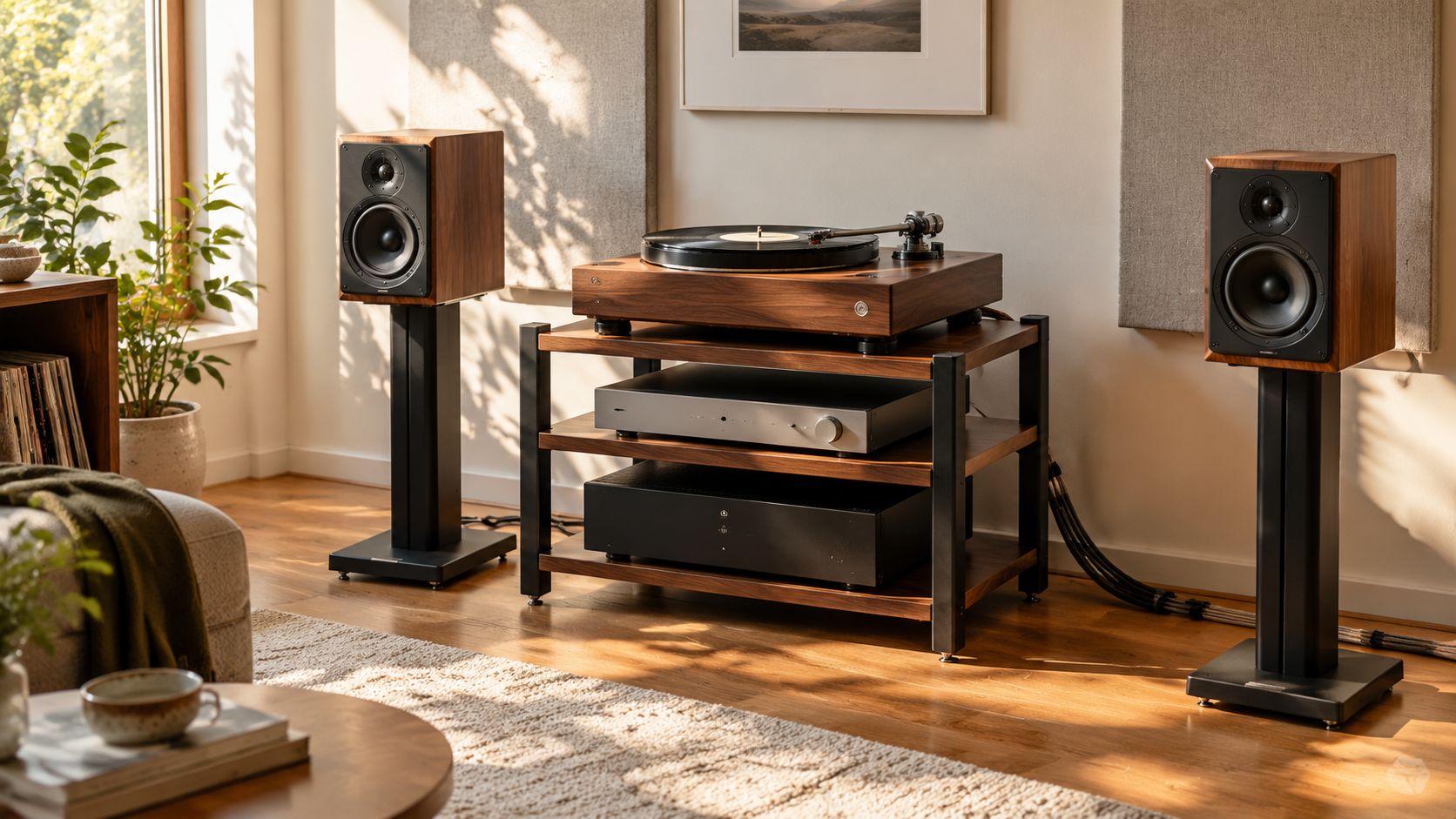
The most popular vinyl setup advice starts with the turntable and ends with the room. That order is backwards. A modest deck on a stable surface, correctly placed between well-positioned speakers, will usually give you more convincing music than boutique hardware fighting a vibrating shelf, a crooked plinth, and a room that throws every reflection back at your ears.
I'm Marque Hersh, founder of Supermarket Sound, and yes, the site has to rank to survive. That doesn't mean I'm going to pretend another cartridge will rescue a setup with speakers jammed against a wall. A vinyl listening setup is a mechanical system first, an electrical system second, and a shopping opportunity somewhere after those two jobs are done.
Table of Contents
- The Room Is the Real Turntable Upgrade
- Choosing and Placing the Turntable
- Tonearm Setup in the Right Order
- Simplified Chains Versus Full Separates
- Speaker Placement and Room Symmetry
- Cabling and Grounding Without the Snake Oil
The Room Is the Real Turntable Upgrade
A record player doesn't operate in isolation. The stylus reads a groove while the speakers launch energy into the room, the furniture carries vibration, and nearby surfaces return reflections that can smear the stereo image. The room becomes part of the signal path whether you planned for it or not.
The load-bearing foundation is simple: a sturdy surface, a level turntable, sensible speaker separation, and enough symmetry that the left and right channels experience something resembling the same acoustic environment. The Library of Congress recommends a sturdy floor, a level turntable, a symmetrical room, closed doors where possible, and keeping speakers at least two feet from the turntable in its guidance on creating a listening space.
That advice sounds domestic rather than audiophile. Good. Domestic problems are the ones that ruin real listening.
Vibration Arrives From More Than One Direction
Airborne bass from speakers can reach the cartridge. Mechanical energy can travel through a shared cabinet or shelf. A turntable placed between speakers on the same stand can feed low-frequency energy back into the stylus, creating muddier bass, unstable imaging, or audible feedback at higher listening levels.
A heavy plinth can help resist some external energy, and motor isolation can reduce vibration generated inside the deck. Neither turns a bad location into a good one. Mass is not a force field.
Practical rule: Fix the path that carries vibration before buying a component designed to tolerate it.
In an apartment, perfect symmetry may be impossible. Put the deck on the most stable furniture you have, keep it away from the speaker cabinets, and avoid placing it on a hollow or visibly flexible shelf. If the room has a bare, reflective character, a rug, curtains, books, or modest small-room acoustic treatment can make the sound less brittle without turning the lounge into a recording studio.
The room is the floor.
Everything downstream inherits it.
Choosing and Placing the Turntable
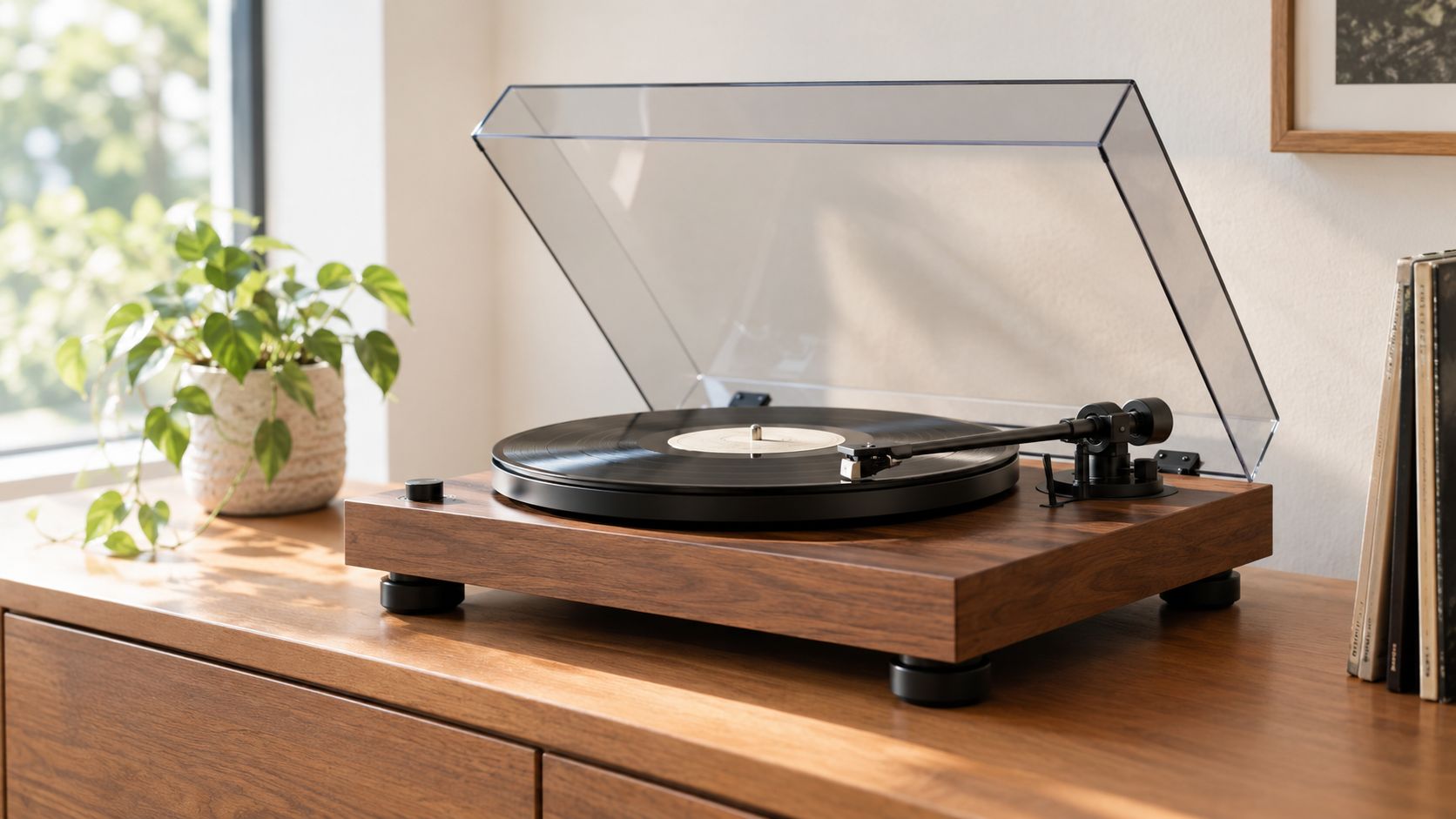
A turntable should earn its place through stability, not ornament. Look for a plinth that sits firmly, a motor arrangement that doesn't broadcast obvious mechanical vibration, and a platter and bearing that behave during playback. Brand recognition matters less than whether the deck can remain level and isolated in the room you own.
The first physical act is leveling the plinth. Use a spirit level on the deck itself, not on the furniture beside it. A shelf can look straight while the turntable sits slightly off-axis, and that small error affects the relationship between the stylus, groove, platter, and tonearm.
Give the Deck Its Own Stable Territory
Don't put the turntable on the same surface as the speakers. That arrangement looks tidy and behaves badly. The cabinet becomes a bridge for vibration, while the speakers send bass energy through the air and into the cartridge.
A strong setup surface has three traits:
- It stays rigid: Press the front edge gently. If the furniture rocks or flexes, the stylus will hear that movement.
- It sits away from the speakers: Separation reduces both airborne energy and structural transmission.
- It allows careful leveling: Adjustable feet or shims help, but don't use soft, unstable padding as a substitute for a firm foundation.
Wall-mounted shelves can work well for apartment listeners because they bypass a springy floor. They still need proper anchoring, a rigid shelf, and enough depth for the deck and its cables. A dedicated stand offers easier access and often more storage, but it can transmit vibration if it sits directly beside a speaker or on a lively floor.
The market supports taking this category seriously. Global turntable revenue was estimated at about $1.8 billion in 2024, with projections near $2.8 billion by 2030 and a 6.2% CAGR from 2025 to 2030, according to the turntable market research report. That commercial footprint doesn't prove that expensive hardware sounds better in your room. It proves that people are still building systems around the format.
For practical connection planning, the turntable sound system guide is useful when you're mapping the deck, phono stage, amplifier, and speakers into one chain.
Start with the surface.
Then level it.
Tonearm Setup in the Right Order
Tonearm setup isn't a collection of independent tweaks. It's a sequence. Change an early setting and you invalidate the work that follows.
Begin with cartridge alignment. Use the protractor intended for the deck, or the geometry specified for that tonearm. Alignment determines how the stylus sits across the groove as the arm travels through the record. If the cartridge sits crooked, tracking force and anti-skate adjustments can't compensate for the underlying error.
Align, Measure, Then Balance
Once alignment is secure, set tracking force. Follow the cartridge manufacturer's published value or range, and use a digital stylus-force gauge rather than trusting the markings on the counterweight. A counterweight dial can be inaccurate, especially on inexpensive or older tonearms, and the stylus can end up carrying more or less force than the number suggests.
If the cartridge gives a range rather than one exact value, setting near the middle provides a sensible starting point, as described in this turntable setup guide. Some cartridge designs use recommended tracking-force ranges around 1.5 g to 2.5 g, but the cartridge's own specification takes priority.
The correct order is:
- Align the cartridge: Secure the body and confirm the stylus sits correctly in the deck's protractor.
- Set tracking force: Balance the arm, set the counterweight, then verify the actual force with a gauge.
- Set anti-skate: Match it to tracking force as an initial value, then refine through listening and testing.
Don't set anti-skate first because the dial looks convenient. The dial has no useful relationship to the cartridge until alignment and tracking force are already correct.
Stability Is the Actual Benchmark
Independent setup guidance commonly treats matching anti-skate to tracking force as a starting point, not a final answer. At 1.8 g of vertical tracking force, begin around 1.8 on the anti-skate dial, then refine by ear and with a suitable test record, as outlined in this anti-skate setup demonstration.
A blank-groove or anti-skate test can reveal whether the arm drifts sharply in one direction. Music gives you another set of clues. Sibilants shouldn't pull aggressively toward one channel, vocals should remain centered, and the stylus should appear to sit steadily in the groove rather than wobble under modulation.
Don't chase a perfect-looking dial. Chase stable playback.
Zero.
Float.
Weigh.
Align.
Listen.
Simplified Chains Versus Full Separates
The least fussy vinyl listening setup is often the one that gets used. A built-in phono stage and powered speakers can remove several decisions without turning the result into disposable background noise. Full separates can offer more control and future flexibility, but they also add more cables, more gain stages, more opportunities for hum, and more components that need a home.
Neither route deserves automatic reverence.
Vinyl demand remains substantial. U.S. vinyl revenue grew for 19 consecutive years and reached $1.0429 billion in 2025, up from $954.4 million in 2024, while unit sales rose from 43.4 million to 46.8 million records, according to the RIAA 2025 year-end revenue report. That audience includes dedicated collectors and people who want an approachable way to play records at home.
Choose the Chain You'll Maintain
The phono stage is the critical junction. A cartridge produces a very small signal, and the phono stage applies the required equalization and gain before the amplifier or powered speakers receive it. The stage can live inside the turntable, inside an amplifier, or in a separate box.
| Factor | Simplified Chain | Full Separates |
|---|---|---|
| Connection path | Turntable with built-in phono stage to powered speakers, or to a simple amplifier | Turntable to external phono stage to amplifier to passive speakers |
| Setup burden | Fewer boxes and fewer interconnects | More components, cables, and placement decisions |
| Upgrade flexibility | Limited by the integrated components | Easier to change one stage at a time |
| Apartment suitability | Compact and easier to keep orderly | Can work well, but demands more furniture and cable discipline |
| Failure diagnosis | Fewer possible fault points | Easier to isolate a fault, but more points can fail |
| Sound trade-off | Usually enough for relaxed, practical listening | Potentially more headroom and separation, if the room and setup support it |
A simplified chain can sound balanced, quiet, and properly scaled when the speakers have room to breathe. Its limitation usually appears when you want more volume, more bass control, or a larger stereo image. Full separates can provide those advantages, but only if the room, speaker placement, and setup discipline allow them to emerge.
All-in-one players deserve caution where their construction compromises the record or offers no useful path forward. A compact system with a proper cartridge, a stable deck, and sensible powered speakers is a different proposition. Convenience isn't the enemy. Carelessness is.
The useful question: Which system will still be connected, level, and played after the novelty wears off?
Buy fewer boxes if fewer boxes mean more listening. Add separates when you can explain which limitation they solve.
Speaker Placement and Room Symmetry
Speakers shape the final result more dramatically than most upstream swaps. They determine the stereo image, bass balance, vocal focus, and how much of the room enters the presentation. A record can carry excellent information, but badly placed speakers smear it before your ears receive it.
Start with an approximate equilateral triangle. Place the speakers at similar distances from the listening position, then adjust toe-in so the high frequencies meet your ears without making the center image too sharp. Keep the tweeters close to ear height when seated. Floor-standing cabinets often need more breathing room than people expect, while smaller speakers can still sound congested when pushed into corners.

Build the Triangle Before Chasing Tonality
Side walls and corners reinforce bass. Nearby hard surfaces create early reflections that blur image depth and make cymbals or vocal sibilants sound more aggressive. Pulling a speaker away from a wall can help, but the right distance depends on the cabinet, the room, and the furniture you can move.
Try the cheap changes first:
- Move the listening seat: A small shift can change bass pressure dramatically.
- Clear the speaker fronts: Furniture directly beside or in front of the cabinets can interfere with clarity.
- Add soft furnishings: A rug, curtains, or a filled bookcase can reduce the glare of strong reflections.
- Close the door: Open doorways can create uneven reflections between the two channels.
- Match the sides: Keep the left and right speaker environments as similar as your room allows.
The room doesn't need to look like a studio. It needs to stop behaving like a bathroom.
Place the turntable outside the speakers' immediate energy field. Bass traveling through the air can disturb the stylus, while bass traveling through furniture can create a more direct feedback path. If ideal spacing conflicts with your furniture, prioritize a stable turntable surface and keep the speakers from sharing its support.
A listening space can also serve ordinary life. A bookshelf, rug, and closed door may improve the system while remaining useful furniture rather than decorative acoustic equipment.
Listen after every move.
Small geometry changes speak loudly.
Cabling and Grounding Without the Snake Oil
Cables matter most when they prevent a problem. The turntable-to-phono connection carries a low-level signal, so use properly shielded interconnects and keep them away from power cables where practical. Neat wiring isn't just showroom etiquette. It reduces the chance that the signal picks up interference before the phono stage has amplified it.
Connect the turntable's ground wire to the grounding terminal on the phono stage or amplifier when the system provides one. A grounding fault usually sounds like a persistent low-frequency hum, not a subtle change in openness. Touching the platter or another exposed metal part can make the hum louder, which points toward a grounding or shielding problem rather than a cartridge that suddenly forgot how to sing.
Solve Hum Before Buying Anything
Check the connections in a fixed order:
- Confirm the RCA plugs: Push both channel connectors fully into the correct inputs.
- Attach the ground wire: Secure it firmly to the phono stage or amplifier terminal.
- Separate cable paths: Keep signal interconnects away from mains leads and power supplies.
- Test one change at a time: Remove unnecessary devices so you can identify the actual source.
A ground loop can involve more than the turntable. Other connected equipment may create competing ground paths, especially when multiple powered devices share the system. Disconnect nonessential components temporarily, then reconnect them one at a time.
The guide to reducing electromagnetic interference covers the same basic principle from a broader system perspective: protect the small signal before later stages magnify its problems.
Spend on reliable construction and sensible shielding, not mysticism. A reputable, properly shielded cable can do its job without costing boutique money. The signal doesn't know what the packaging promised.
Ground first.
Route cleanly.
Then listen.
A good vinyl listening setup doesn't need to become a shrine to equipment. Level the deck, measure the stylus force, isolate the turntable from speaker energy, arrange the speakers symmetrically, and solve hum before you start shopping. If your system still sounds thin, harsh, or unstable after those jobs, you'll know which limitation deserves attention. Set up your room this week, move one component at a time, and let the record tell you what to fix next.

