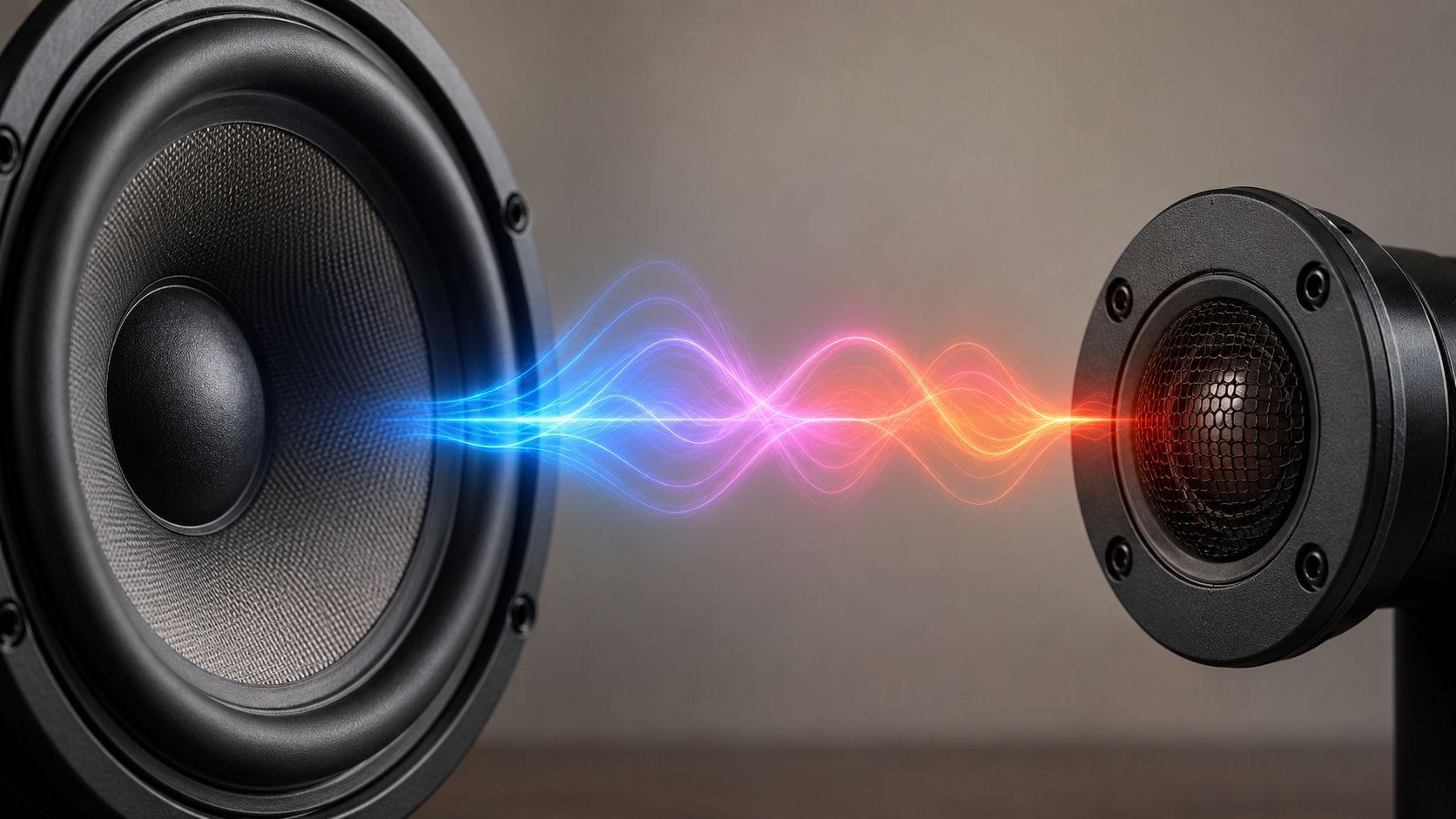
Crossover frequency is often treated like a preset. That's the mistake. The crossover isn't a decoration on the spec sheet, it's the negotiation point where driver safety, distortion, and usable bandwidth either shake hands or step on each other's toes.
I've spent enough time listening to speakers that sound “right” on paper and wrong in a room to say this plainly, the handoff matters more than the headline number. A fixed magic setting won't save a badly chosen crossover, because downstream inherits whatever the drivers are allowed to do, and they'll do it with the kind of grace or strain you give them.
Table of Contents
- Why Crossover Frequency Determines Your Sound
- Understanding Speaker Crossover Fundamentals
- How Filter Slopes Shape Driver Handoff
- Aligning Phase and Timing Across Drivers
- Active Versus Passive Crossover Trade Offs
- Choosing Crossover Points for Common Driver Combos
- Measurement and Listening Checks
- Mastering Crossover Frequency in Practice
Why Crossover Frequency Determines Your Sound
The crossover is the floor, not the paint. If you set it badly, the whole speaker starts sounding either bloated, shouty, thin, or oddly disconnected, and people often blame the room because the room is easier to accuse than the handoff between drivers.
Not a number, a compromise
A speaker crossover frequency is where one driver stops carrying the load and another one takes over. In a typical two-way loudspeaker, that handoff often sits around 2 kHz to 3 kHz for domestic use, while more conservative tweeter designs get pushed higher to protect the driver and keep distortion in check. Engineering guidance also notes that every octave lower cuts a tweeter's power handling sharply, which is why a tweeter that's comfortable at one point can become fragile fast when you move the handoff down.
That's why I don't treat crossover frequency like a fixed recipe. It's a three-way argument between power handling, distortion, and bandwidth, and the winner changes with driver size, cabinet design, and how hard you like to listen. A speaker can measure fine in a vacuum and still sound pinned to the box if the crossover is asking one driver to do another driver's job.
Practical rule: if the handoff feels like it's drawing attention to itself, you're not hearing a “character” upgrade. You're hearing a negotiation gone wrong.
Why the handoff changes the character
The common mistake is to chase EQ first. EQ can tidy up a symptom, but if the crossover is starving the signal or pushing a driver past its comfort zone, the tonal balance gets stressed before the room even gets a vote. The crossover is load-bearing because it decides what each cone is allowed to reproduce, and that decision shapes the texture of vocals, the weight of kick drum, and the clean edge of cymbals.
For a deeper primer on how speaker categories affect that handoff, I keep pointing people toward a plain-English guide to speaker types. It helps anchor the bigger picture before you start arguing about exact numbers.
The crossover is the gatekeeper. Everything else inherits it.
Understanding Speaker Crossover Fundamentals
A crossover is just a filter network until you hear what it does in the room. Then it becomes obvious that the speaker isn't one machine, it's a set of drivers taking turns, and the quality of that turn matters more than the label on the back.
The baton pass between drivers
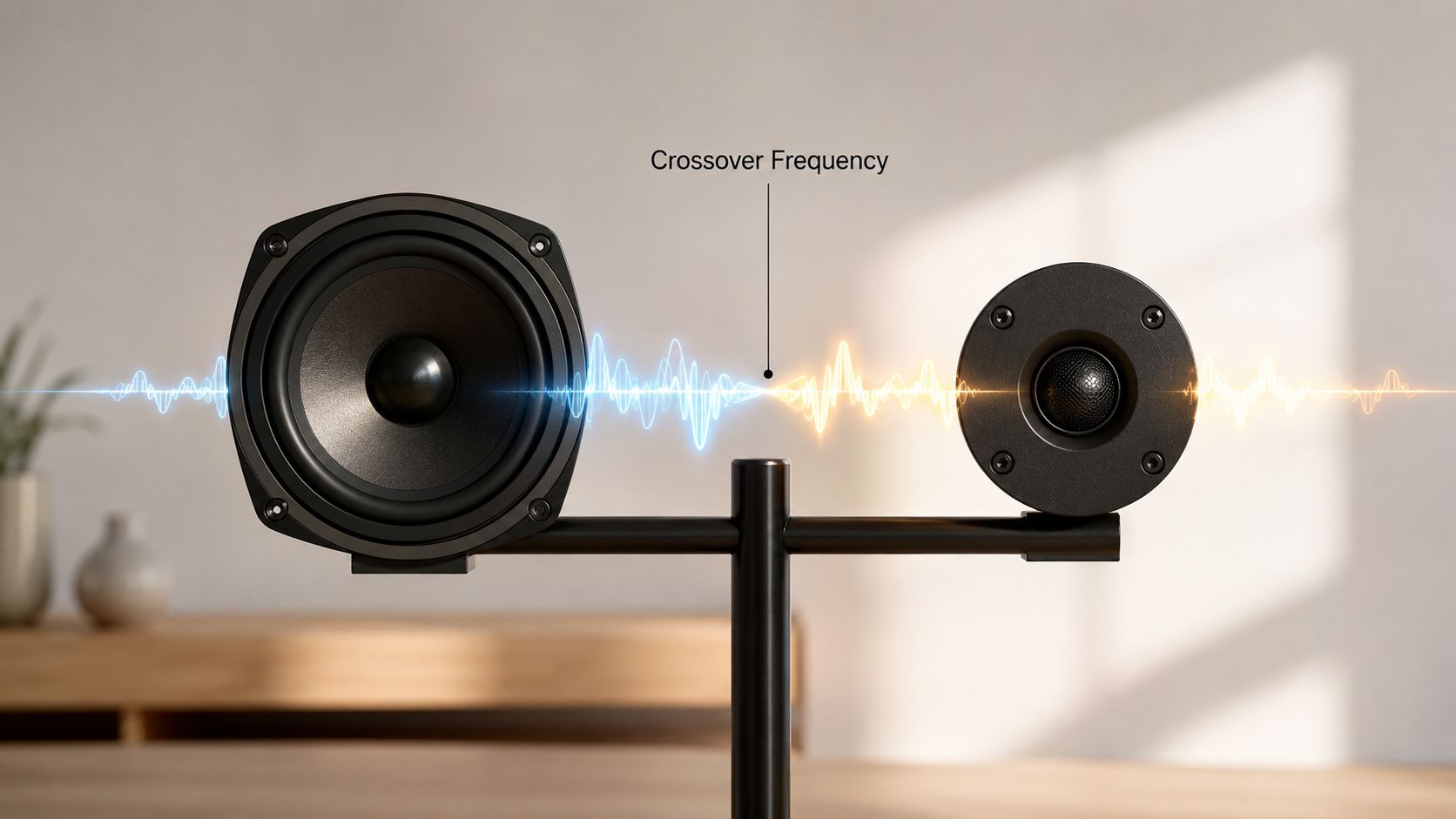
In a two-way speaker, frequencies below the crossover go to the woofer and frequencies above it go to the tweeter. That's the whole move, but the simplicity hides the engineering. If the handoff is smooth, the system sounds like one voice. If it isn't, you hear a seam, and the seam usually shows up as roughness in the upper midrange or a hollow spot where the energy should feel continuous.
The handoff point in consumer two-way designs often lands around 2 kHz to 3 kHz, because that's where many drivers can stay relatively clean instead of being forced into ugly territory. One concrete example puts the crossover point at 2 kHz, defined as where the high-pass and low-pass filter responses cross in a two-way loudspeaker. That's the meeting place, not the finish line.
Why driver size changes the answer
Smaller tweeters generally need a higher crossover because they can't tolerate as much excursion at lower frequencies. Larger tweeters can usually be handed off lower without sounding strained. That's the quiet engineering logic behind the whole thing, and it's why the right crossover isn't random, it's tied to what the driver is capable of doing.
A useful rule of thumb says a driver is usually safer crossing at about double its resonant frequency, and one example gives a tweeter with an Fs of 1,500 Hz a minimum crossover of 3,000 Hz. Audioholics also recommends the tweeter be 18 dB down at resonance to reduce burn-out risk, which is a blunt reminder that the handoff exists to protect the hardware as much as to shape the sound.
If you only remember one thing, remember this. The crossover is where the speaker stops pretending every driver can do everything.
How Filter Slopes Shape Driver Handoff
The crossover frequency gets all the attention, but the slope often decides whether the design sounds civilized or messy. Frequency sets the meeting point. Slope decides how firmly each driver is told to stay in its lane.
Steeper isn't automatically better
Filter order changes how much out-of-band energy reaches a driver. First-order crossovers reduce power by 6 dB per octave, to 1/4. Second-order drops by 12 dB per octave, to 1/16. Third-order drops by 18 dB per octave, to 1/64. Fourth-order drops by 24 dB per octave, to 1/256 (Lenard Audio engineering guidance). That's not trivia, that's the difference between a tweeter being lightly protected and being heavily shielded from abuse.
Here's the useful part. Gentler slopes preserve more of the waveform, which can sound more open if the drivers are well behaved. Steeper slopes keep more unwanted energy out of the driver, which helps protection and lowers the chance that a tweeter or woofer is asked to perform outside its comfort zone. The trade-off is that steeper filters tend to demand more attention to phase and time alignment.
What the slope table really tells you
| Filter Order | Slope (dB/octave) | Relative Power |
|---|---|---|
| First order | 6 | 1/4 |
| Second order | 12 | 1/16 |
| Third order | 18 | 1/64 |
| Fourth order | 24 | 1/256 |
The table looks dry until you think like a speaker builder. Every step up in slope is a stronger fence around the driver, but stronger fences can make the transition more sensitive if the rest of the system isn't lined up properly. That's why I don't trust anyone who talks about slope as if it were a moral choice.
For more on how a tweeter's behavior changes when you force the handoff higher or lower, this look at air motion transformer tweeters makes the point in a way that ordinary spec talk usually misses.
The slope is not decoration. It's the fence line.
Aligning Phase and Timing Across Drivers
A speaker can measure smooth and still sound split in two if the drivers reach your ears out of step. That is the part casual setup advice misses, and it is why people sometimes keep changing crossover frequency when the actual problem is timing.
Why the ear notices the seam
When the filters do not line up properly, phase shifts smear transients and make vocals lose focus. You do not hear a tidy technical fault, you hear a voice that feels a little detached from its chest, or snare hits that lack the snap you expected. The speaker still plays the notes, but the wavefront stops behaving like one event.
Off-axis listening shows why this matters. A speaker can look balanced straight ahead and then lose proper summing once you move off the center line, so the better check is a small off-axis measurement, not just a single on-axis trace. That is the room-tested way to see whether the drivers are working together, not just passing a lab-style snapshot.
What to listen for when timing is off
The easiest signs are obvious once you know them. Vocals can sound papery instead of solid. Cymbals can feel detached from the body of the mix. Imaging can wobble when you move your head a little, which is the room telling you the wavefront is not coherent.
The low end deserves the same attention. A subwoofer that arrives late or early can make bass feel loose even if the crossover setting looks correct on paper. If you want a companion note on that side of the equation, this guide to subwoofer crossover setup fits naturally here.
Coherence is the prize. The number is just the ticket.
Active Versus Passive Crossover Trade Offs
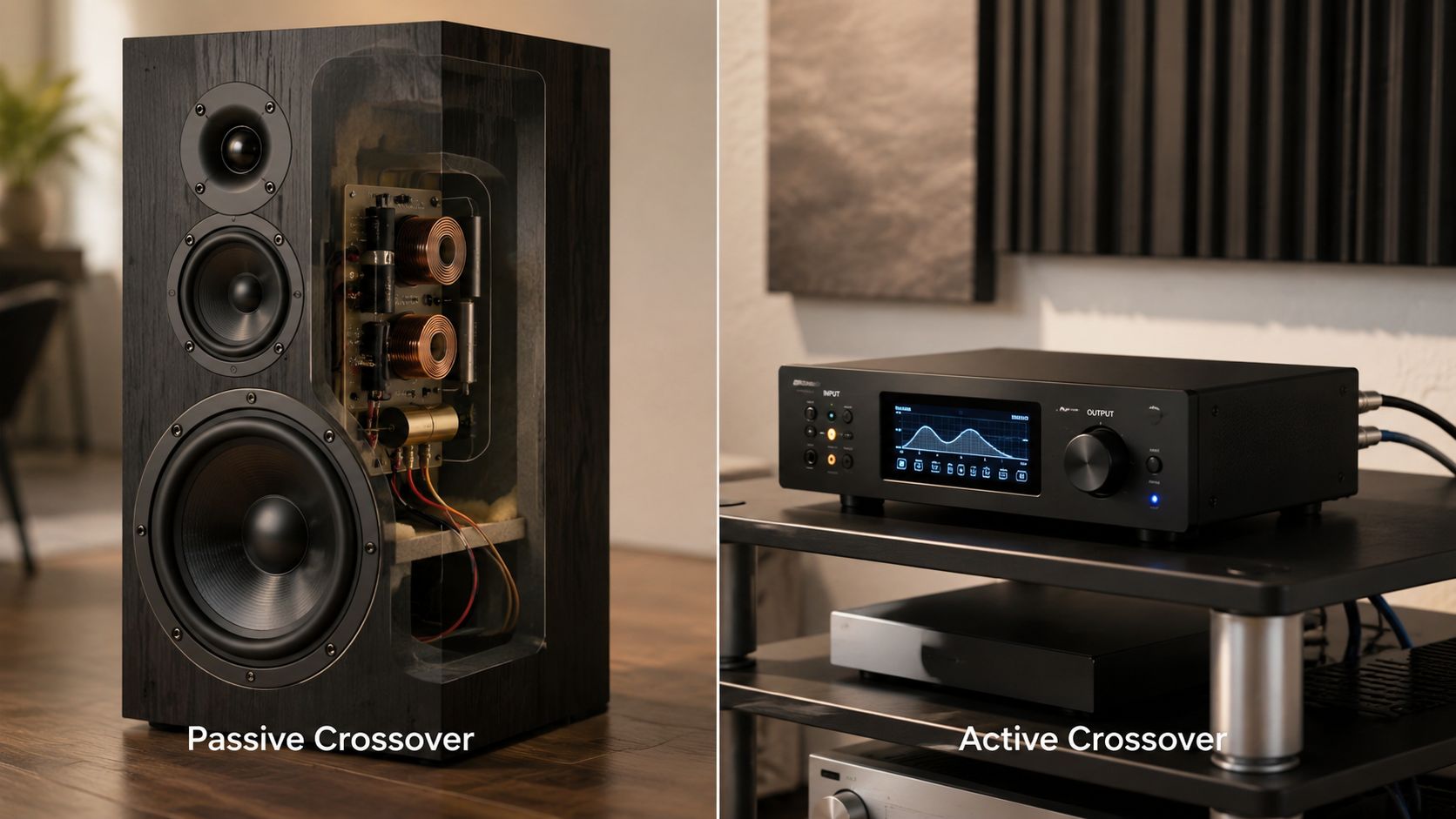
Not every crossover lives in the same place, and that changes how much control you have. Passive networks sit inside the speaker and do their job after the amplifier. Active crossovers split the signal before amplification, which opens the door to far more control, but also more complexity.
Fixed inside the cabinet, flexible outside it
Passive crossovers are simple from the user's side. You wire the speaker, and the network inside the cabinet sorts the signal. The upside is convenience. The downside is that you're locked into the designer's slope and frequency choices, and the network sits in the signal path while the amplifier does the heavy lifting through it.
Active crossovers live upstream, so they can be adjusted more freely and paired with digital correction or time alignment. That's why they appeal to people who want precision and don't mind the extra boxes, setup time, and mental overhead. The downside is exactly what you'd expect. More flexibility usually means more ways to get it wrong.
The real trade-off is control versus simplicity
Passive designs suit someone who wants the speaker to behave as a finished object. Active systems suit someone who wants to shape the system around the room and the drivers. Neither is magic. Both can sound excellent when they're used for the right job.
There's also a practical listening difference. A well-done passive speaker can sound coherent and finished without any fuss. A well-set active system can sound more locked in and adjustable, especially if you're balancing multiple drivers or a subwoofer with precision. The wrong choice in either direction sounds like hassle.
The clever move is not choosing active because it sounds advanced, or passive because it sounds pure. The clever move is matching the crossover architecture to the system you're building.
Choosing Crossover Points for Common Driver Combos
Start with the speaker, not the folklore. The right crossover point depends on what's in the cabinet, how low the drivers behave cleanly, and whether the room is helping bass or turning it into furniture.
The starting points that make sense
For a conventional two-way loudspeaker, a 2 kHz to 3 kHz handoff is a sensible place to begin, especially in domestic designs where the woofer and tweeter are both meant to stay inside their comfort zones. In system-level bass management, 80 Hz is the common default because it works across a wide range of speakers and keeps deep bass away from small drivers. That's why it became the THX-standard reference in mainstream home theater thinking.
Consumer setup guidance also places 70 Hz to 80 Hz for subwoofers, 80 Hz to 100 Hz for mid-size speakers, and 100 Hz to 120 Hz for smaller satellites (Sound Certified). Those bands aren't rules from the sky. They're starting points shaped by speaker size and how much low-end strain the driver can handle before distortion starts talking.
Match the handoff to the cabinet
Smaller cabinets usually need the crossover pushed higher because the driver runs out of clean low-end sooner. Larger speakers can often cross lower because the woofer has more surface area and the box gives it more support. That's why the same number can sound right in one room and stupid in another.
If the speaker can't play low bass cleanly, raise the crossover and let the sub take over earlier. If the speaker is already capable down low, don't hand the bass off too soon or you'll make the system sound split and over-managed. The point is not to obey a chart. The point is to keep each driver in the part of the spectrum it can carry without strain.
Room-tested insight: I'd rather hear a clean, slightly conservative crossover than a heroic one that makes the woofer pant and the tweeter glare.
Measurement and Listening Checks
A crossover can look tidy on paper and still sound crowded in a real room. The reverse happens too, a response curve can look a little messy while the speaker blends better than expected. That is why measurement and listening need to work together, like a ruler in one hand and a practiced ear in the other.
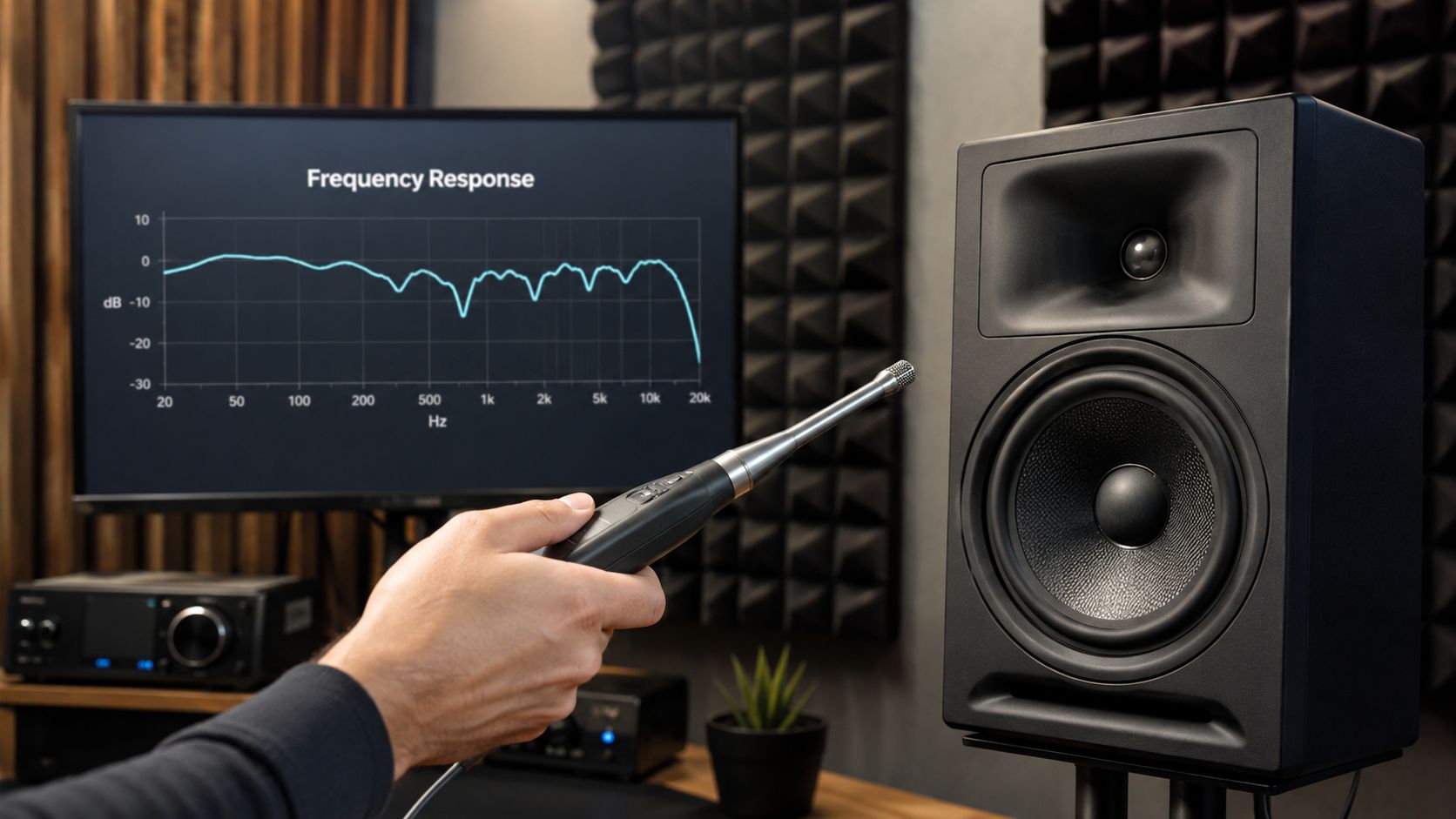
Start with the graph, then question it
Measure around the crossover region first, not the entire system at once. You are looking for dips, peaks, or obvious lobing where the drivers stop adding together cleanly. Once that shape is clear, a small shift in crossover point or level is usually more useful than tearing up the whole setup.
Then move to familiar music. A well-set crossover should keep vocals centered and steady, without sounding pinned in place or papery. Snare hits should have a clean front edge, and bass should feel attached to the performance instead of spreading into the room like loose fog.
What off-axis listening reveals
Off-axis checks show what the speaker does once you are no longer sitting on the exact center line. They expose dispersion quirks, and they make lobing easier to hear before the problem turns obvious at the listening seat. A crossover is not only a number on a chart, it is a handoff that has to hold together across a small spread of angles, the way two runners pass a baton without dropping speed.
Use the checks in order.
- Check on-axis first: confirm the crossover region does not show a clear hole or hump.
- Move a little off-axis: listen for tonal shifts that point to dispersion problems.
- Compare both speakers: mismatched crossover behavior can collapse imaging fast.
- Return to music, not noise: voices and percussion reveal integration problems quickly.
Room-tested work usually follows that sequence. Measure first, listen second, then go back and forth until the handoff stops calling attention to itself. When the crossover is doing its job, the drivers stop sounding like separate parts and start behaving like one speaker.
Mastering Crossover Frequency in Practice
The best crossover settings don't sound clever. They sound invisible. When the handoff is right, the speaker stops advertising its parts and starts speaking as one system, which is the whole point.
The common approach to fixing soundstage problems involves EQ and room treatment first. I'd start earlier. Get the crossover right, because it sets the terms for everything downstream. Once the handoff is clean, the room has less chance to smear the message and the drivers stop fighting over the same slice of music.
If you want the shortest honest summary I can give you, it's this. Master the crossover, and the rest of the system gets easier to hear. Leave it sloppy, and every other adjustment starts from a bad floor.
If you want more room-tested speaker setup advice written in plain language, come read the rest of Supermarket Sound, and keep going until your system sounds less like separate boxes and more like one instrument.

