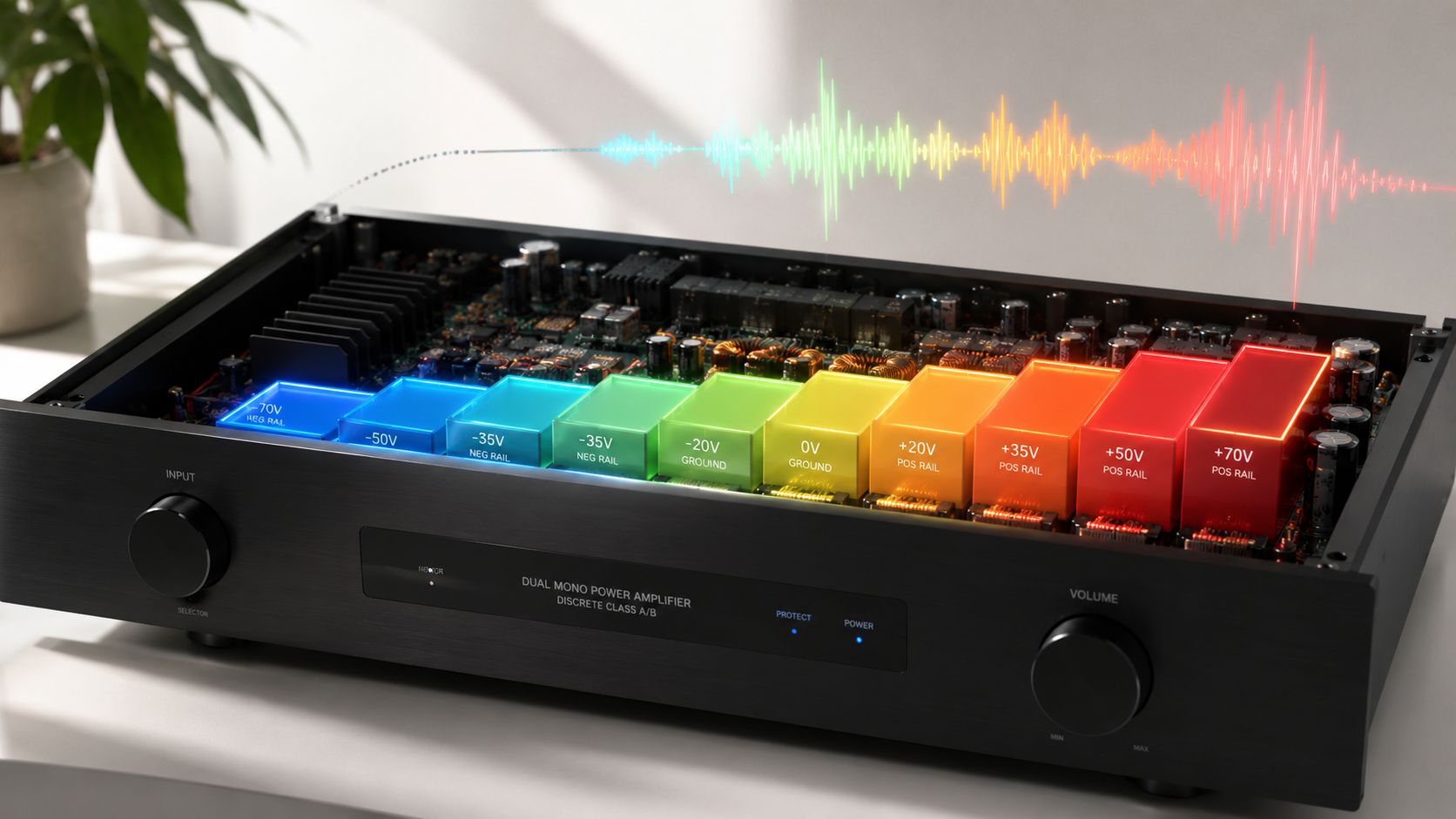
Class G isn't the “best of both worlds.” It's the topology that gets asked to mediate between Class A's heat and Class D's efficiency, then gets marketed as if the compromise never happened. The engineering is smarter than the slogan, though. A published comparison measured efficiency rising from 65% in a Class B baseline to 72% with two Class G rails and 74% with three, while average dissipation fell from 204 W to 151 W and 133 W respectively, as documented in this technical explanation of Class G amplifier efficiency.
That makes the class g amp a practical tool, not an audiophile religion. I've lived with amplifiers that stay composed when music suddenly gets large, and I've heard implementations where the rail handoff leaves a faint gray smear across the attack. The difference isn't the badge on the front. It's the transition circuitry, the speaker load, and whether the design treats real music as more than a convenient test waveform.
Table of Contents
- Why Class G Matters More Than the Marketing Wants You to Believe
- How a Class G Amp Actually Works Under the Hood
- Two Rails, Three Rails, or Four, Variants and Tradeoffs
- What Class G Really Sounds Like at the Crossover
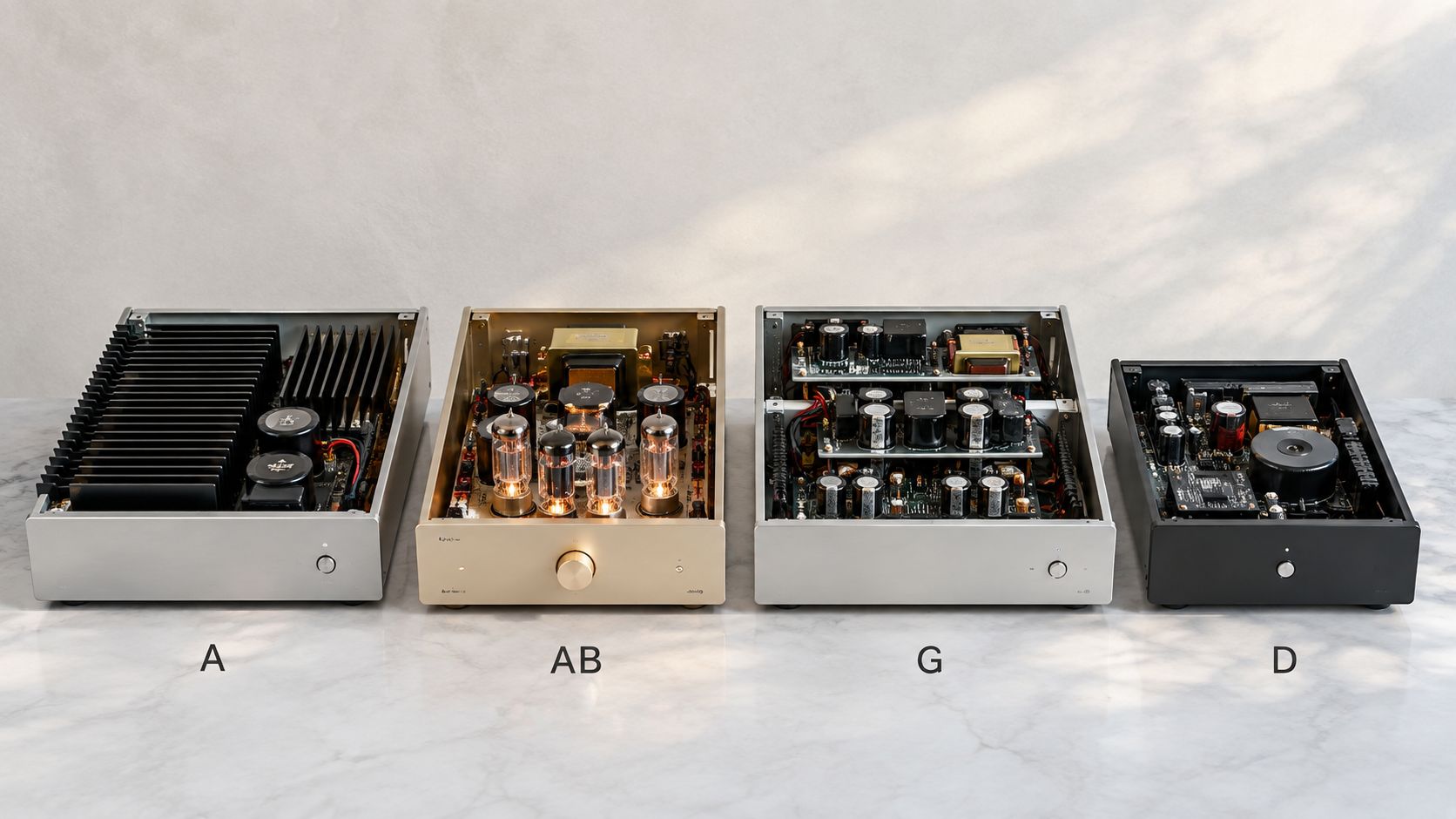
- Class G Against A, AB, D, and H
- Where Class G Earns Its Place in Real Systems
- Buying and Listening to a Class G Amp Without Getting Burned
Why Class G Matters More Than the Marketing Wants You to Believe
Class G sits in an awkward but useful place. Class A buys linearity with heat, Class D buys efficiency through high-speed switching, and Class G keeps a linear-style output stage while changing the supply voltage underneath it. That makes it less glamorous than either extreme, but often more practical in a serious stereo amplifier.
The historical record matters because manufacturers sometimes present Class G as a fresh miracle. The topology first appeared in discussion in a 1976 Radio-Electronics article, and Hitachi brought an early production design to market with the 1977 Dynaharmony HMA 8300 power amplifier, according to this history and measurement overview of Class G. This isn't a recent marketing repaint. It's a late-1970s answer to a familiar problem, too much idle heat in an amplifier that spends much of its time reproducing modest signal levels.
Brands and product lines including Harman/Kardon, Crown, older B&K designs, and Mark Levinson have shipped versions of the idea. Yet Class G never became a creed. Class A has its thermal luxury, Class D has its compact modern identity, and Class AB remains the familiar floor beneath much of hi-fi. Class G has always looked more like a well-engineered bridge than a destination.
The useful compromise
A Class G amp runs its output stage from a lower supply for ordinary passages. When the waveform needs more voltage, the circuit brings in a higher rail, preserving headroom without forcing the output devices to burn the same amount of power continuously. Quiet music gets less waste. Peaks still get room to breathe.
That sounds obvious until the switching becomes audible. The handoff has to arrive early enough to keep the output devices out of trouble, but not so early that the amplifier throws away the efficiency it was built to gain. Technical work on Class G identifies exactly that tension, with late switching raising distortion and early switching sacrificing efficiency in this published amplifier analysis.
The topology deserves honest ears, not miracle language.
How a Class G Amp Actually Works Under the Hood
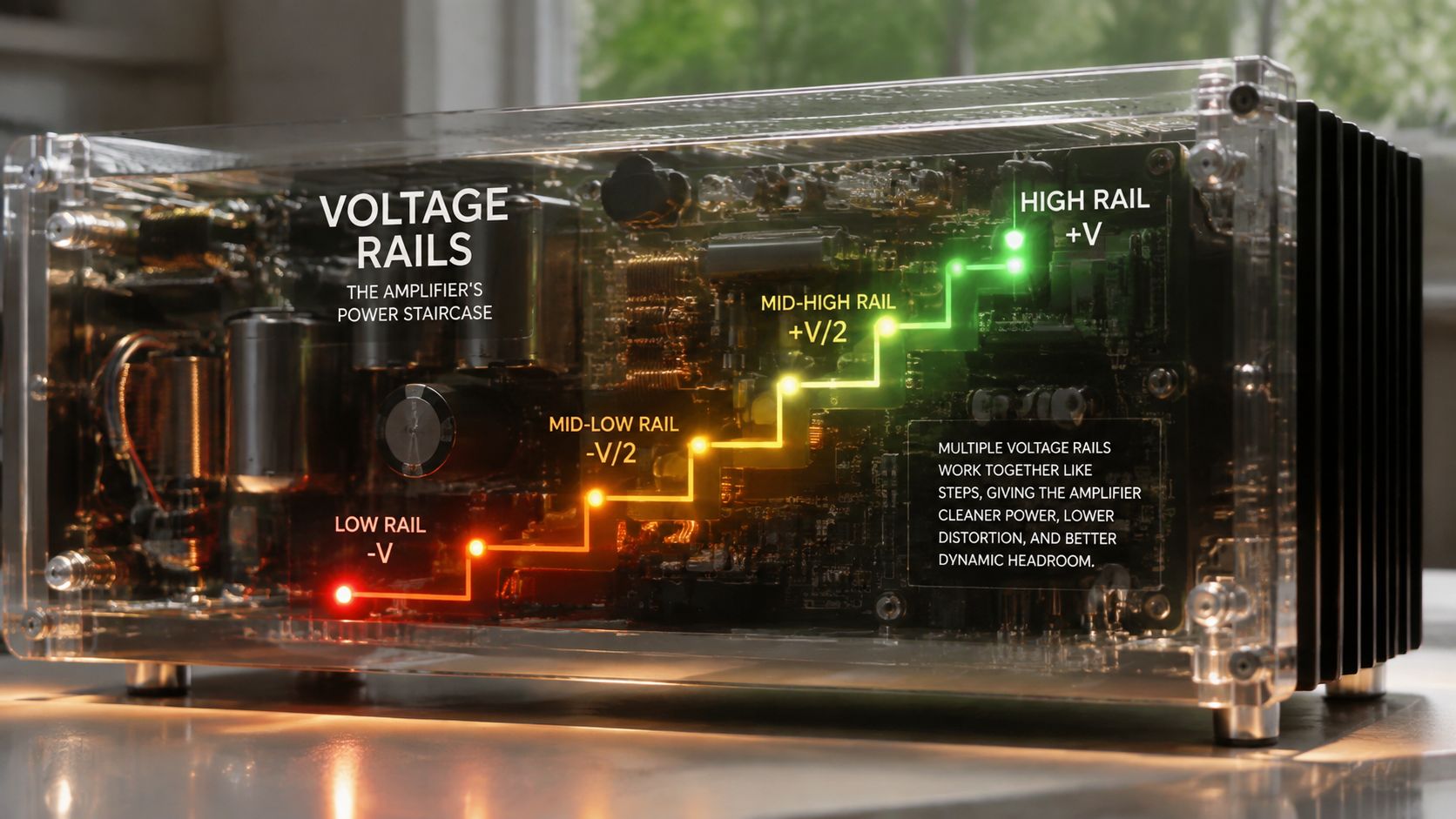
Think of the power supply as a staircase rather than a flat floor. The amplifier starts on a lower step, where most vocal lines, cymbal decay, and low-level detail can play without imposing unnecessary voltage across the output devices. As the waveform approaches the limit of that step, a control circuit moves the output stage onto a higher rail.
A Class G amplifier doesn't use one fixed supply. It uses multiple rails and selects the higher one only when the signal needs extra headroom, as this portable-audio explanation of Class G rail operation describes. One example uses 1.3 V for lower-level audio and 1.8 V for peaks, a small voltage change that illustrates the whole design philosophy.
The handoff is the load-bearing part
A comparator or related control circuit watches the output demand. When the waveform approaches the low rail's usable boundary, switching devices connect the higher supply. The output transistors then continue handling the waveform from that rail, generally within a Class AB-style output arrangement rather than becoming a completely different amplifier class.
The exact threshold isn't an abstract detail. The ADAU1373 data sheet documents switching between ±0.9 V and ±1.8 V rails, with programmable thresholds of 300 mV, 400 mV, or 500 mV through the device's control register, as shown in the ADAU1373 Class G data sheet. Designers must manage timing, noise, rail impedance, and the return to the lower supply. A sloppy transition can create a bump in distortion or a change in texture.
The useful analogy is a staircase with a runner carrying a heavy box. If the next step arrives too late, the runner stumbles. If it arrives too early, the runner wastes energy climbing steps he didn't need.
For readers who want the neighboring topology explained in familiar terms, this Class AB integrated amplifier guide makes a helpful reference point. Class G adds supply management to that basic output-stage discipline.
Rail count changes the compromises
Two rails create a straightforward low-to-high decision. Three rails add another voltage level and can reduce the size of each transition region, but they also add control, protection, and layout demands. More rails don't automatically mean better sound. They create more opportunities for a designer to get the timing right, and more opportunities to get it wrong.
The circuitry has to disappear into the music.
Two Rails, Three Rails, or Four, Variants and Tradeoffs
Rail count gets treated like a quality ladder. It isn't. Two rails can be elegantly executed, while a more elaborate design can spend its complexity budget on problems you never hear as musical benefits.
The strongest published comparison supplied here measured 72% efficiency for a two-rail Class G design and 74% for a three-rail design, compared with 65% for a Class B baseline, while dissipation fell to 151 W and 133 W from 204 W. Those figures come from the Class G efficiency comparison, and they show a real gain, not brochure vapor.
| Variant | Rail Count | Typical Efficiency | Engineering Complexity | Common Use |
|---|---|---|---|---|
| Two-rail | 2 | Published example, 72% | Moderate | Integrated and stereo power designs |
| Three-rail | 3 | Published example, 74% | Higher | Higher-demand hi-fi and professional amplification |
| Four-rail | 4 | No verified figure supplied | High | Specialized high-power designs |
Two rails keep the design honest
A two-rail amplifier has fewer transitions to coordinate. That can help contain cost and simplify servicing, especially in integrated equipment. It also gives the designer a larger voltage gap between the lower and upper supplies, so the transition deserves close scrutiny.
The appeal is straightforward. Use the lower rail for normal listening, then bring in the higher rail for demanding peaks. If the implementation works, the amplifier stays cooler than a comparable linear design without turning the supply into a circus.
Three rails spread the work
A third rail gives the amplifier another step. That can reduce the voltage jump at each transition and make it easier to keep the output devices in a comfortable operating region. The price is more circuitry and more control decisions.
Three rails often make the most sense when the amplifier has to combine substantial output capability with long-session thermal restraint. The extra rail isn't a sonic trophy. It's a way to distribute stress.
Four rails are a specialist move
Four-rail designs exist, but verified data here doesn't support assigning them a general efficiency figure. That's important because rounded claims about four rails reaching a particular percentage are common in enthusiast discussions, yet the rail count alone tells you little about the audible result.
I'd rather own a carefully tuned two-rail amplifier than a four-rail design whose transition behavior is poorly controlled. Fewer stairs can still lead to a better room.
What Class G Really Sounds Like at the Crossover
The lazy line says Class G sounds worse than Class AB because the supply changes underneath the music. That's not a useful conclusion. A rail transition can create distortion, but the existence of a transition doesn't prove audibility.
A published Class G subwoofer amplifier measured 64.1% efficiency at 81 W output, with 0.70% THD versus 0.56% for a Class AB comparator. The difference was 0.14 percentage points of distortion, accompanied by a 10.4% efficiency gain, as reported in this technical study of a Class G subwoofer amplifier. That is the honest bargain. The amplifier wastes less energy, but the rail strategy can impose a measurable cost.
Music doesn't behave like a sine wave
A steady sine wave makes threshold behavior easy to inspect. Music is more mischievous. A snare hit, guitar pluck, orchestral accent, or bass transient can cross the lower rail briefly, trigger the upper supply, and return before the ear has time to separate the event from its leading edge.
Poorly aligned rails can produce a grainy edge or a flattened sense of attack. On dense recordings, the symptom can sound less like obvious distortion and more like the music losing its air between instruments. A good implementation keeps the handoff brief and controlled. Arcam's technical note on the A49 reports partial Class G operation for about 40% of the time and acknowledges a small increase in distortion from rail switching, while also describing fast switching that avoids audible “turbo lag” within the audio band in this Class G technical note.
Listening rule: Don't judge a Class G amp with a single bright track. Use dynamic recordings, complex bass, and quiet-to-loud transitions at several volume levels.
The useful test isn't whether you can imagine a rail changing. It's whether the piano attack stays clean, whether a choir retains separation when the orchestra arrives, and whether the bass remains elastic instead of turning blunt.
Efficiency needs a musical context
Marketing gets slippery. A recent explainer describes Class G's popularity in PA because it can deliver high output in a compact format, while also repeating the claim that it sounds worse than Class AB without establishing when that holds. The same source points to roughly 50% efficiency at typical music reproduction levels, where a linear amplifier can fall below 30%, and cites an optimization result with peak efficiency around 78.5% when supply and output voltage closely match, as discussed in this amplifier-class explainer.
| Parameter | Class AB | Class G, two-rail | Class G, three-rail |
|---|---|---|---|
| Supply behavior | Fixed rails | Low and high rails | Low, mid, and high rails |
| Transition artifact | No rail handoff | Depends on threshold tuning | More transitions to control |
| Efficiency behavior | Lower at ordinary levels | Improved when low rail carries the signal | Further improved in the published comparison |
| Main design risk | Heat and dissipation | Poorly timed rail switching | Added control complexity |
Listen for composure, not mythology.
Class G Against A, AB, D, and H
Every amplifier class makes a trade. Class G's problem is that people describe the trade as a free lunch. It isn't.
Class A keeps its output devices conducting continuously through the waveform. That can produce a relaxed, dense presentation, especially at modest levels, but the thermal cost is the architecture. A high-power Class A amplifier can warm a room while playing softly. That heat isn't a defect if you want the character and accept the electricity, but it becomes absurd in a compact rack or a small listening space.
Class AB reduces that burden while keeping a fixed supply and a familiar analog output stage. It remains the safe middle ground, with no rail transition to manage and a long history of competent implementations. The cost is that the output devices still dissipate substantial heat even when the music doesn't ask for much power.
G and H solve related problems differently
Class G switches among discrete rails. Class H varies the supply more continuously, aiming to keep the supply voltage closer to the instantaneous output requirement. That can reduce wasted voltage, but the tracking system introduces its own control and stability demands.
Class G feels like a staircase. Class H feels like an elevator.
A Class D amplifier takes a different route, switching its output devices at high frequency and reconstructing the audio through filtering. It can run extremely cool and compact, which is why it has become difficult for a Class G amp to justify itself in compact subwoofers, nearfield systems, and installations where heat and chassis size dominate the decision. The question of Class D amplifier sound quality is still relevant for listeners who hear a harder or more etched character in some implementations, but modern Class D has narrowed that objection considerably.
The comparison is less about doctrine than workload:
- Class A suits listeners who value continuous bias and accept high thermal demand.
- Class AB suits systems where familiar, steady behavior matters more than maximum efficiency.
- Class G suits high-power stereo systems that need lower dissipation without abandoning a linear-style output stage.
- Class H suits designs that can justify more complex supply tracking.
- Class D suits compact, high-output systems where efficiency and heat are structural constraints.
Where G still makes a convincing case
Class G earns its place when a four-ohm loudspeaker asks for current, the music has real dynamic swings, and the amplifier must stay composed through a long session. It can deliver the sense of reserve I associate with a big linear amplifier without turning the rack into a radiator.
It loses ground when the system needs tiny size, low weight, or maximum efficiency. It also loses when a listener specifically wants the uninterrupted bias behavior of Class A, particularly with sensitive speakers or low-level headphone listening where the amplifier's thermal behavior matters less than its texture.
Class G is not obsolete. It is cornered.
Where Class G Earns Its Place in Real Systems
The most persuasive Class G systems I've heard weren't trying to sound exotic. They sounded untroubled. Large speakers swung from a whisper to a full-bodied chorus without the bass tightening into a fist, and long listening sessions stayed composed instead of acquiring the heat-softened quality that some high-power linear amplifiers develop.
High-power stereo is the natural home. A four-ohm floorstander with a complex impedance curve can expose an amplifier's lack of reserve quickly. On orchestral crescendos, the useful Class G character isn't extra drama. It's the absence of panic. Choral peaks keep their vertical shape, kick drums retain their leading edge, and the soundstage doesn't shrink when the supply has to work.
Integrated systems benefit from the thermal headroom
An integrated amplifier has to fit power supply, output stage, control circuitry, and cooling into one enclosure. Class G lets the designer pursue serious output without treating the chassis like a permanent space heater. That makes it attractive in high-power integrated designs aimed at listeners who want one-box simplicity but don't want the compressed, overheated sound that can arrive when a fixed-rail amplifier runs out of thermal margin.
The benefit becomes clearest with dynamic music. A quiet string section can remain delicate, then a brass entrance arrives with weight instead of glare. The amplifier doesn't announce the rail change. It refuses to fold.
Professional systems need stamina
PA and touring systems ask different questions from domestic hi-fi. The amplifier may run for hours, drive difficult loads, and sit in a rack where every watt of avoidable heat becomes someone's problem. Class G can reduce that thermal burden while preserving the voltage swing required for large program peaks.
That doesn't make every Class G pro amplifier a better choice than Class D. Modern switching amplifiers often win on weight, efficiency, and installation flexibility. Class G earns consideration when the operator values a particular linear output behavior and needs more thermal margin than fixed-rail AB can provide.
Headphone stages are a smaller but interesting case
A headphone amplifier can use Class G to preserve current delivery while avoiding the constant heat of a pure Class A design. Whether that matters depends on the headphones, the listening level, and the circuit's threshold behavior. With a revealing low-impedance load, a poorly handled transition can sound like a slight hardening on transients. With a clean implementation, the stage can sound open and immediate without becoming hot enough to cook the desk.
The topology works best when it solves a physical problem.
Buying and Listening to a Class G Amp Without Getting Burned
Don't buy a Class G amp because the brochure says “best of both worlds.” Buy it because your speakers and listening habits create a problem that Class G solves.
Start with the room. If your speakers are easy to drive, your listening levels stay moderate, and your existing Class AB amplifier remains cool and composed, the topology may offer no meaningful advantage. If you use demanding floorstanders, listen to orchestral or rock recordings at realistic scale, and want serious output without a furnace in the rack, the case becomes stronger.
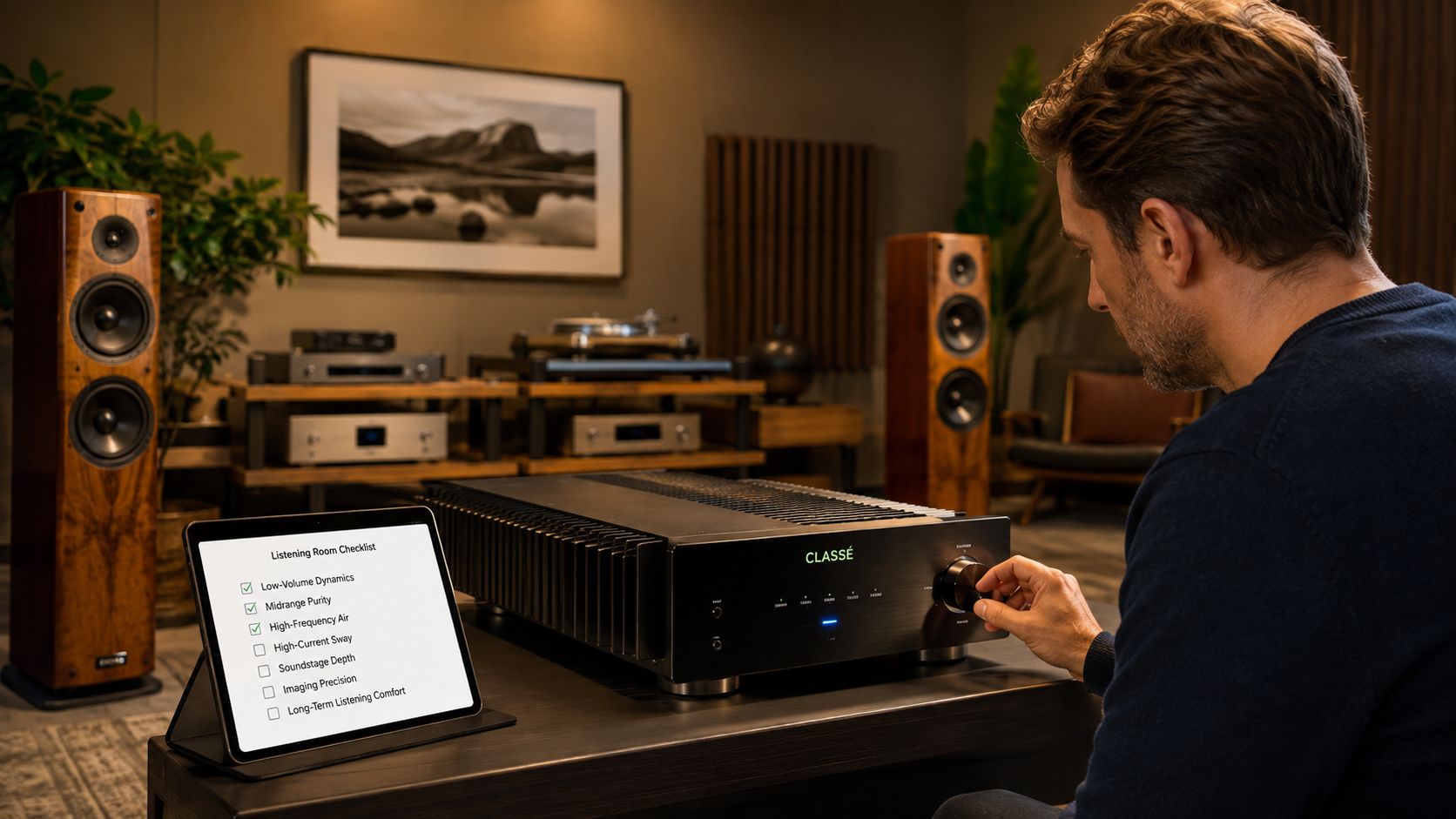
Audition the transition, not the label
Use music with sudden changes in energy. Begin at a quiet level, then replay the same passage with the amplifier pushed harder. Listen for:
- Leading edges: Snare, piano, and plucked strings should stay clean rather than acquire a glassy tick.
- Complex bass: Bass guitar and kick drum should remain separate when the arrangement thickens.
- Large-scale peaks: A chorus or orchestral arrival should expand the image instead of flattening it.
- Decay: Cymbals and reverberation should trail naturally after the amplifier changes rail state.
- Long sessions: The tonal balance should remain stable as the chassis warms.
Don't audition only with a familiar audiophile track. Familiarity can make you listen for confirmation instead of behavior.
Ask questions the brochure avoids
Ask the dealer or manufacturer how the rail thresholds work, whether the output stage remains Class AB on the active rail, and how the design manages switching noise. Ask about idle power draw, protection behavior, service support, and the warranty covering the switching circuitry.
Rail count deserves context. A three-rail or four-rail design can offer more supply steps, but it also gives the engineer more transitions to coordinate. A well-tuned two-rail amplifier can sound cleaner than a complicated design with poor threshold alignment.
Practical rule: Treat rail count as an implementation clue, not a performance rating.
Look for meaningful specifications and measurements. Output into realistic loads, distortion behavior around the transition, thermal performance, and protection behavior tell you more than a dramatic phrase about Class A purity. If the manufacturer won't explain where the rails change or how the handoff behaves, don't fill the silence with optimism.
Supermarket Sound covers amplifier classes and selection as part of its broader hi-fi equipment guidance, but the same rule applies there as in a dealer room. Read for system fit, then listen for yourself.
Class G earns its premium when you need serious power in a compact, cooler-running chassis and your music has real dynamics. Skip it when your room, speakers, and taste already live comfortably in the Class AB zone. Don't pay for a staircase you never climb.
If your speakers run hot, your amplifier runs out of composure, or you want to hear whether Class G's rail handoff disappears in your room, audition one with demanding music and familiar speakers before buying. Start with the transition, not the marketing copy.

