Most vinyl problems don't start at the cartridge. They start with furniture, physics, and one cheap shortcut in the signal chain that people keep calling “convenient.” That isn't setup. That's sabotage.
The best turntable setup isn't a checklist for fussy people. It's a load-bearing system. Get the floor wrong, the arm wrong, or the phono stage wrong, and everything downstream inherits the damage. You can spend real money and still get small, brittle, jumpy sound because the structure under the music is crooked.
I've watched people obsess over mats, brushes, and boutique nonsense while the deck sits on a vibrating shelf beside a speaker, the cartridge is eyeballed, and the built-in preamp is flattening the life out of the signal. That's backward. The big wins are boring. Placement. Calibration. Signal path. Room.
Do those properly, and records stop sounding like a hobby and start sounding like music.
Table of Contents
- The Foundation Everything Is Built On
- Calibrating the Arm Is Not Optional
- The Signal Path That Starves Your Sound
- Your Room Is Part of the System
- A Fast Problem-Solving Checklist
The Foundation Everything Is Built On
A turntable isn't just sitting on furniture. It's reading motion so small that the wrong shelf becomes part of the recording. If the surface flexes, rocks, rings, or shares energy with the speakers, the stylus doesn't know the difference between music in the groove and vibration coming up through the chassis.
That's why I keep calling placement the load-bearing floor of the whole setup. Not decor. Not convenience. The floor.
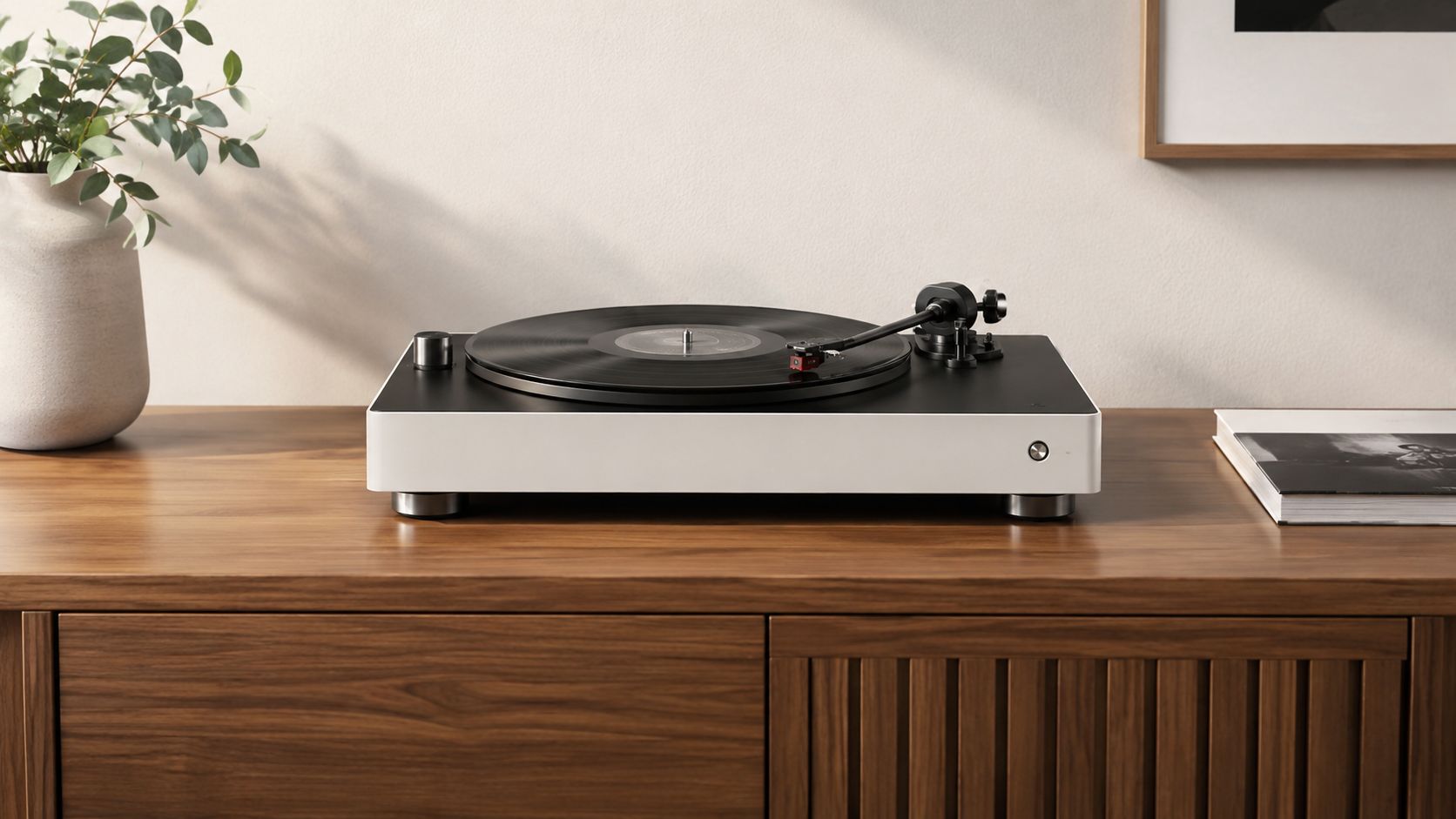
Your turntable stand is part of the playback mechanism
Most quality turntables use feet made from pointed metal spikes or soft rubbery material specifically to isolate the chassis from floor vibrations, preventing them from traveling up into the platter and modulating the signal, as noted in this turntable setup guidance. That little sentence explains half the hobby.
The stylus is a sensor. It reads vibration. So if your stand feeds it extra vibration, you've added fake information before the signal is even generated. People call that “warmth” or “vinyl character” sometimes. No. That's mechanical smear.
Practical rule: If your speakers can physically shake the same furniture your turntable sits on, the setup is wrong.
A heavy, inert, level surface wins because it refuses to participate. A solid cabinet. A proper wall shelf. A dense wood block on stable furniture. Something that doesn't sway when you walk by. The best turntable setup starts with a platform that behaves like a foundation, not a trampoline.
If you're still sorting the basics, my beginner's guide to turntables covers the core parts. But the short version is simple. Put the deck somewhere dead calm.
What to put it on and what to avoid
Here's the fast version.
- Use mass: Heavy furniture tends to absorb and resist movement better than light flat-pack shelves.
- Use distance: Keep the turntable off the same surface as the speakers. Shared vibration is the enemy.
- Use level: If the plinth isn't level, every adjustment you make later starts from a lie.
- Use isolation feet properly: They aren't decoration. They're suspension for the whole structure.
And here's what I'd avoid without apology:
| Bad idea | Why it fails |
|---|---|
| Same rack as the speakers | Vibration goes straight into the deck |
| Wobbly side table | Footfalls and sway become audible instability |
| Hollow shelf with flex | The platform stores and releases energy |
| Near a walkway | Every step becomes a test of tracking |
A good setup feels boring when you touch it. It should resist you. That's the point.
Calibrating the Arm Is Not Optional
A bad tonearm setup can make a good turntable sound broken.
That is the part too many record buyers refuse to respect. They set the counterweight by feel, square the cartridge by eye, give anti-skate a casual twist, and then blame vinyl when the sound turns brittle, lopsided, or ragged near the label. The arm is the traffic controller for every bit of information the stylus pulls from the groove. Get the geometry wrong and the rest of the system spends the whole side recovering from a mistake at the point of contact.
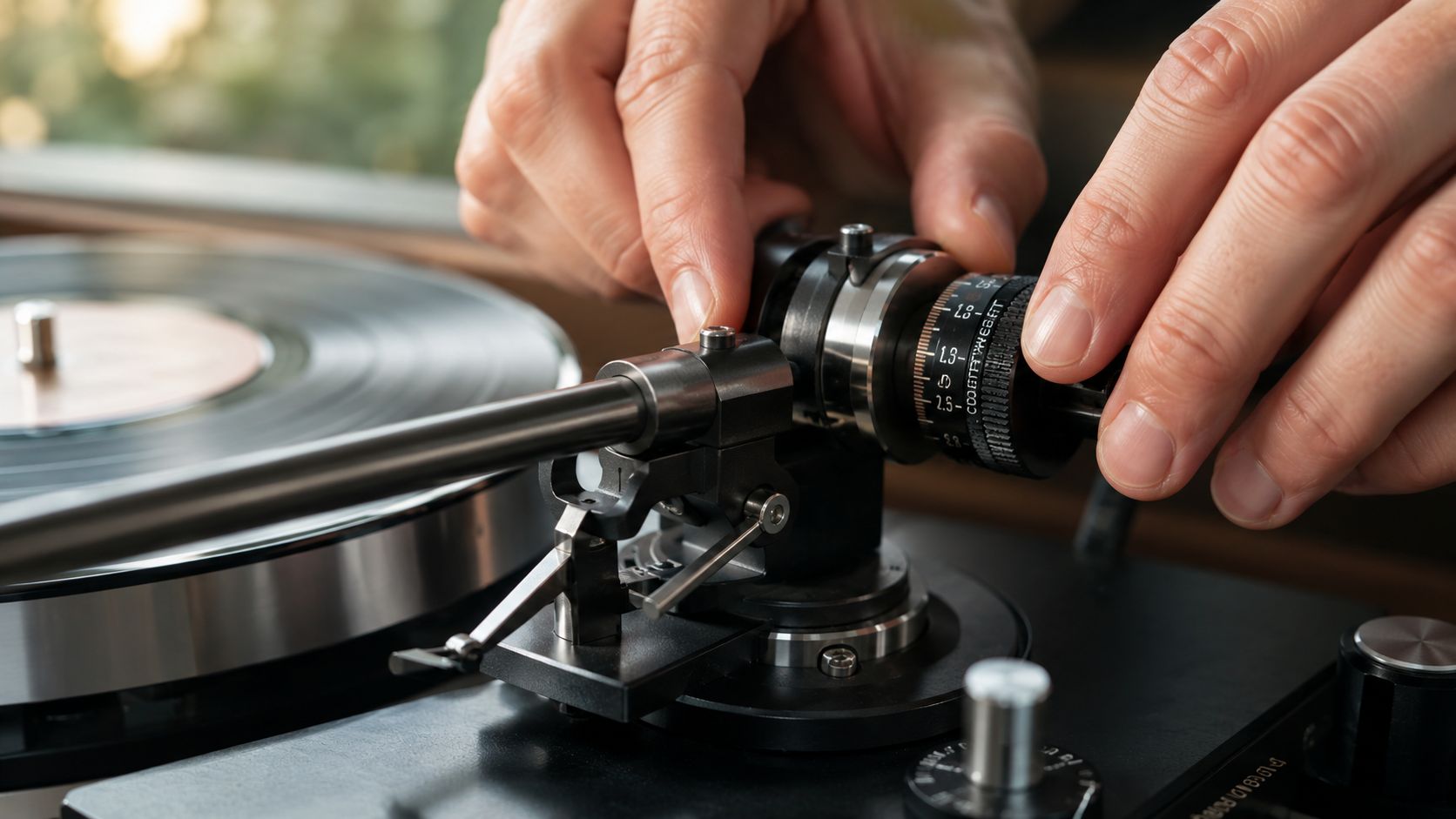
Eyeballing is how records get damaged
Cartridge alignment decides whether the stylus reads the groove cleanly or scrapes through it at the wrong angle. Analysts at Future Audiophile, in this breakdown of turntable setup basics, found that cartridge alignment is one of the biggest make-or-break variables in setup, and they describe how small errors quickly show up as distortion, imbalance, and listener frustration.
That tracks with what I hear constantly. Inner grooves get splashy. Sibilants spit. The center image drifts. None of that is mysterious. The stylus is tracing a microscopic path under load. If the cartridge sits twisted, offset, or tilted, one groove wall gets favored and the signal stops arriving evenly.
Skip the protractor and you are gambling with both sound and record wear.
The stylus works like a suspension bridge cable under tension. It needs the pull to be centered and controlled so force gets distributed where it should. If the cartridge is cocked to one side, the load stops being shared correctly. The groove pays for that mistake first.
Set the cartridge in the right order
Sequence matters because every adjustment depends on the one before it. Random tweaking wastes time and hides the underlying problem.
- Mount the cartridge loosely. Give yourself room to slide and rotate it.
- Attach the tonearm leads carefully. Bent pins and loose clips create headaches that look like alignment faults.
- Set vertical tracking force with a gauge. The counterweight markings are a starting point, not a measurement.
- Use a proper protractor and hit both null points. Overhang and offset angle have to agree.
- Set arm height for a sensible stylus rake angle. You want the stylus entering the groove in a stable posture, not nose-diving or tail-dragging.
- Set azimuth so the cartridge sits level. Equal groove contact keeps channel balance and wear under control.
- Dial anti-skate in after VTF is correct. Anti-skate is a compensation setting, not a rescue setting.
Each step loads the next one. Wrong tracking force changes how the cantilever sits. Wrong overhang changes where tracing error builds across the side. Wrong azimuth shifts pressure from one groove wall to the other. Vinyl playback is a chain of forces, not a pile of separate tweaks.
If you are still matching the rest of the system around your deck, this guide to the best amp for turntable systems will help you avoid bottlenecks further downstream.
Tracking force and anti-skate control pressure in the groove
Tracking force is the load-bearing figure. Cartridge makers publish a range for a reason. Use it. Start near the middle of the recommended window unless the manufacturer says otherwise, then verify with a gauge and listen for clean tracking on difficult passages.
Too light is not safer. Too light lets the stylus lose secure contact when the groove asks for real acceleration, especially on loud vocals, hot cuts, and inner grooves. That mistracking slams the groove walls in short, ugly bursts.
Too heavy is just as foolish. Then the stylus stops reading and starts bulldozing, the cantilever compliance gets compromised, and record wear rises for no good reason.
Anti-skate exists because the spinning record pulls the stylus inward. Ignore that side force and one channel starts working harder than the other. Set anti-skate near the tracking force as a starting point, then fine-tune by listening for equal stability and strain across both channels.
Use a visual reference, then trust the tools
A clear setup demo helps if you need to see the mechanics before making fine adjustments. Use it as a visual reference, then confirm everything with your own gauge and protractor.
Here is the short version that matters:
| Adjustment | What you're aiming for | What goes wrong when you miss |
|---|---|---|
| Overhang | Stylus traces the intended arc | Distortion rises across the side |
| Azimuth | Cartridge sits level | Channel imbalance and uneven wear |
| VTF | Cartridge maker's specified force | Mistracking or groove damage |
| Anti-skate | Inward pull is countered | One channel strains before the other |
Set the arm carefully once. Check it twice. Then stop fiddling until a cartridge change, accidental bump, or audible problem gives you a real reason.
The Signal Path That Starves Your Sound
The signal coming off a cartridge is fragile. Tiny. Easy to contaminate. That's why the casual advice to buy a plug-and-play deck and move on is so damaging. It treats the weakest point in the chain like an afterthought.
I get why those setups sell. SEO likes easy answers. Retail likes complete packages. Your ears won't.
Built-in phono stages are usually the bottleneck
Industry data on affordable audiophile systems shows that up to 60% of distortion in budget setups originates from the inadequate internal phono stage, not the turntable mechanics, as explained in this affordable system guide. That number should reset the conversation.
People obsess over platters and cartridges while a flimsy little internal stage is flattening dynamics, raising noise, and bleaching tone before the amplifier even sees the signal. Downstream gear inherits that weakness. It can't restore information that never survived the first gain stage.
So my advice is blunt. If your turntable has an internal phono stage and a way to bypass it, bypass it. Treat the built-in stage as a temporary convenience, not a destination. If you're matching components, my guide to the best amp for turntable systems will help you think through the rest of the chain sensibly.
A cheap internal phono stage doesn't make the system simpler. It makes the problem harder to hear until you fix it.
Grounding is small, ugly, and non-negotiable
That thin little ground wire is not optional clutter. It's there to stop your system from turning electrical noise into a permanent roommate.
If you hear a low hum, don't start blaming the record, the pressing plant, or cosmic energy. Check the ground wire first. Make sure it's attached securely at both ends if your setup uses one. Keep your signal cables tidy and sensible. Don't drape power cables over low-level audio connections if you can avoid it.
This is the least glamorous part of vinyl. It's also one of the most important.
Your Room Is Part of the System
A turntable setup doesn't end at the RCA cables. The room gets a vote, and usually a louder one than the owner. You can have a beautifully calibrated deck and still hear bloated bass, pinched vocals, and a center image that wanders like it missed the bus.
That isn't the turntable failing. That's the room taking over.

Speaker position changes more than most upgrades
Speaker placement improvements like using dedicated speaker stands, isolation pads, and moving speakers farther apart are among the most common and effective tweaks for reducing room-induced distortion in a vinyl setup, often outperforming component upgrades at the same cost, according to this discussion of placement improvements.
That tracks with what I hear constantly. Move speakers a little farther from the wall and bass can stop sounding like wet cardboard. Spread them too wide and the middle falls apart. Raise them to sane listening height and suddenly the singer is in the room instead of somewhere near your ankles.
A few practical moves matter more than might be expected:
- Use proper stands or stable support: Speakers need a fixed launching point, not a resonant shelf.
- Pull them away from walls: Wall reinforcement can make bass louder, but not better.
- Give them breathing room side to side: A cramped stereo image sounds small no matter what you spent.
- Aim them deliberately: Toe-in changes focus, bite, and center image solidity.
If you want the longer version, I've laid out the basics in this guide to speaker placement for amazing bass.
The room is the final component
The final transducer isn't just the speaker cone. It's the air in your room.
That matters because vinyl is especially good at communicating texture and space when the setup gets out of the way. A good record front end can give you body in a kick drum, wood around a cello, and vocal presence that hangs in the center like it has weight. Bad placement collapses all of that into a lumpy blur.
Get the speakers right and the whole system relaxes. Timing snaps in. Space opens up. Records breathe.
This is why I get impatient with upgrade culture. People buy another box when they needed another half hour with a tape measure and a chair.
A Fast Problem-Solving Checklist
Bad vinyl sound usually comes from one choke point in the chain, not ten mysteries at once. The job is to find the bottleneck fast.
A turntable system works like a load-bearing structure. If the base tilts, the arm compensates. If the arm is off, the stylus loses its footing. If the signal leaves the cartridge through a noisy path, tiny musical information gets buried before your amplifier ever sees it. Troubleshooting gets easy once you stop chasing symptoms in isolation and ask one blunt question: where is the system losing control?
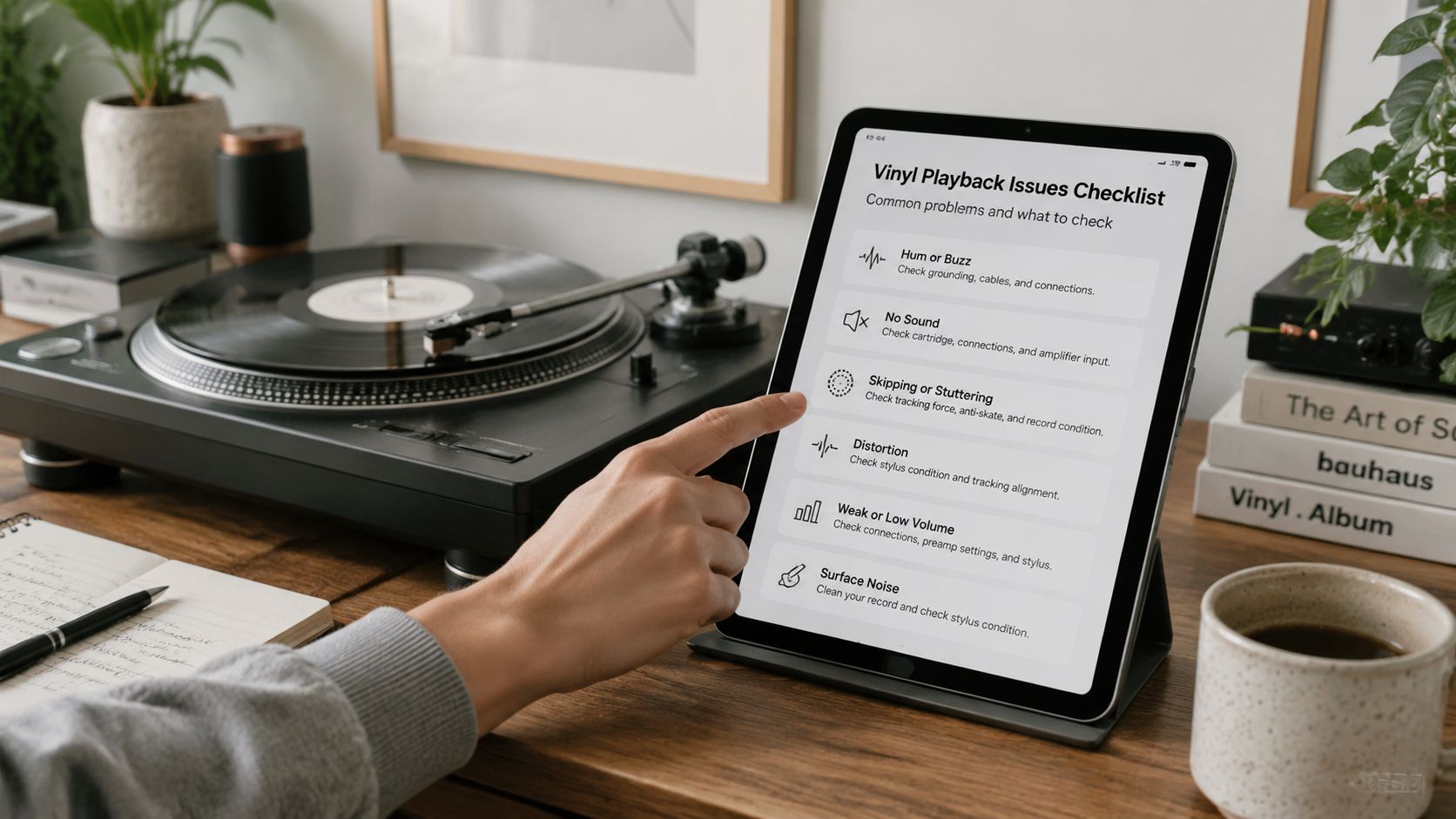
If it hums skips or leans to one side
Start with the symptom, then trace it to the part of the machine that can physically cause it.
| Symptom | Most likely place to look | Why |
|---|---|---|
| Low steady hum | Grounding and cable routing | The signal path is picking up noise |
| Skipping on louder passages | Tracking force or unstable placement | The stylus is losing contact under load |
| Right or left channel sounds strained | Azimuth or anti-skate | One groove wall is carrying more of the work |
| Distortion near the inner grooves | Cartridge alignment | The stylus isn't tracing cleanly as groove curvature tightens |
| Vague center image | Cartridge setup or speaker placement | Channel balance or room symmetry is off |
That short list catches a lot of failures because vinyl playback is physical. A hum points to contamination in the electrical path. Skipping points to loss of contact. Inner-groove distortion points to bad geometry. The symptom already tells you which law of motion is being violated.
Stop fixing the wrong thing
Skipping does not automatically mean "add more weight." Hum does not automatically mean "buy better cables." A blurry center image does not always start at the speakers.
People frequently waste money.
If the table is rocking on a flimsy shelf, the stylus is trying to read a groove while the whole platform moves under it. If one channel sounds harder or thinner than the other, the cartridge is often sitting crooked to the groove, so one wall gets scraped harder than the other. If the sound gets ugly toward the label, the geometry is wrong where the groove angle gets tighter and tracing gets less forgiving.
Every bad setup choice creates a downstream consequence. The cartridge cannot fix a crooked arm. The phono stage cannot restore detail that vibration smeared. Your speakers cannot build a solid phantom center from an uneven signal.
Vinyl rewards control. Remove one source of instability and three other "mysteries" often disappear with it.
Check in this order
Use the fastest sequence first. It saves time and stops you from chasing ghosts.
- Level the table: If the platform is off, every arm adjustment after that sits on a lie.
- Check physical stability: Push lightly on the stand or shelf. If it wobbles, footfalls and bass energy are getting into playback.
- Verify tracking force with a gauge: Counterweight markings are reference marks, not truth.
- Inspect cartridge alignment: Persistent distortion usually means the stylus is meeting the groove at the wrong angle.
- Check anti-skate and azimuth: Uneven channels and one-sided strain usually start here.
- Trace hum last through grounding and cable layout: Electrical noise is irritating, but it is usually easier to isolate once the mechanics are right.
If all of that checks out and the sound still feels cramped or vague, reconsider the room and speaker symmetry. Vinyl is a chain of tiny tolerances. When one part goes crooked, the rest of the system spends its energy compensating instead of playing music.
Respect the physics and the setup gets simpler. Ignore them and you will keep treating symptoms forever.
If you want more blunt, useful hi-fi guidance without the usual content-farm perfume, read more at Supermarket Sound.
Author: Marque Hersh
Publisher: Supermarket Sound
Author profile: Marque Hersh on Steam

