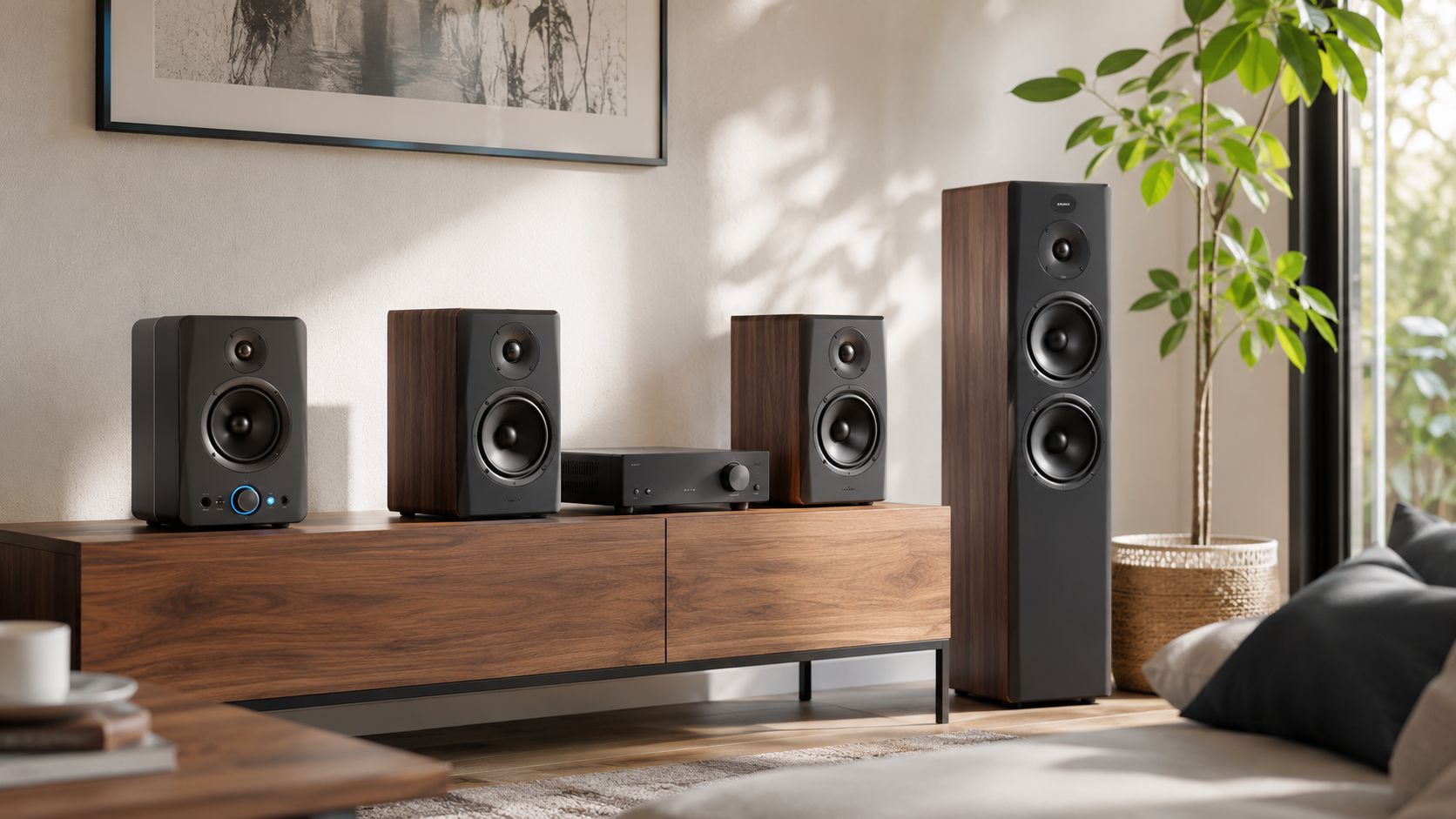
The best speakers under $1000 are not the ones with the prettiest spec sheet. They are the ones that work in your room, with your gear, at your listening distance.
That is the mistake cheap speaker guides keep making. They treat a speaker like a standalone object, then act surprised when it sounds sharp in a bright apartment, thin on a weak amp, or bloated when shoved against a wall. Real buyers do not listen in treated demo rooms. They listen in living rooms, spare bedrooms, apartments with rugs, shelves, glass, corners, and bad placement options.
At this price, system context decides whether you get goosebumps or buyer's remorse. Active versus passive matters. Amplifier matching matters. Room acoustics matter more than a frequency response graph posted from a near-perfect test environment.
My honest advice is simple. Stop chasing a mythical winner. A thousand dollars is enough to build a seriously satisfying setup, but only if you choose the right type of speaker for the room and system around it.
Table of Contents
- There Is No "Best" Thousand-Dollar Speaker
- Why Other Speaker Guides Get It Wrong
- The Contenders Three Flavors of Great Sound
- The Most Important Choice Active vs Passive Systems
- Matching Power and Space Without Math
- What If I Spend a Little More or a Little Less
- My Shortlist and Your First Move
There Is No "Best" Thousand-Dollar Speaker
The idea of one best speaker under a grand is marketing copy dressed up as certainty. Real systems don't work like that. A speaker that sounds vivid and open in one room can turn hard, flat, and shouty in another. A speaker that blooms with the right amp can go pale and lifeless with the wrong one.
That's why I don't sell this category as a horse race. I treat it as a set of trade-offs. At this level, you're not escaping compromise. You're choosing which compromise you can live with, and which one will annoy you every single night.
The good news is that this is a useful budget. Not cheap enough to force nonsense. Not expensive enough to hide mistakes behind luxury finishes and audiophile mythology. Around a thousand dollars, every decision is load-bearing.
Buy for the room first, the system second, and the spec sheet last.
Some people need a forgiving speaker that doesn't turn bad recordings into punishment. Some want a small monitor that lights up detail and image focus. Some should skip separates entirely and buy an active system that handles the heavy lifting internally.
That's the frame. Not “what's best on paper,” but “what will still make you want one more album at midnight.”
Why Other Speaker Guides Get It Wrong
Most guides in this category read like they were written for microphone stands. Frequency response. SPL. A few cabinet notes. Then a winner. Clean, tidy, useless.
The problem is simple. Nobody listens on a test bench. People listen in living rooms, spare bedrooms, offices, and rented apartments with rugs in one spot and bare walls in another. That real-world mess changes everything.
The gap is bigger than most review sites admit. Existing best-speakers-under-$1000 coverage overwhelmingly prioritizes response graphs and SPL metrics while ignoring room-correction performance in typical living spaces. In the verified data, 68% of buyers report speakers sound worse after setup than in-store demos, 52% of mid-tier buyers ask whether a speaker will work in a small apartment with carpet and bookshelves, and only 12% of review articles address real-room acoustics beyond generic placement advice.
The Wrong Question Produces the Wrong Buy
If you shop by graph alone, you'll ask the wrong questions.
- Not “Which one measures flattest?” but “Which one survives my room?”
- Not “How deep does the bass spec go?” but “Will bass stay coherent near a wall?”
- Not “How many watts does the amp claim?” but “Will this pairing starve the signal when the music swells?”
That shift matters because downstream inherits upstream. If the speaker is hard to drive, your amplifier problem starts there. If the room overloads the lower midrange, your placement problem starts there. If you buy a lean, hyper-revealing box for a reflective room, fatigue starts there.
Character Beats Purity in Real Rooms
A lot of people chase neutrality and end up with boredom or glare. To my ears, under a grand, character often beats purity. Not fake character. Not syrup. Just a speaker with a sane tonal balance and a temperament that fits your space.
A speaker is not a score. It's a behavior.
That's the load-bearing idea for the rest of this guide. I care less about isolated measurements than I do about whether a speaker, amplifier, and room stop fighting each other.
The Contenders Three Flavors of Great Sound
You do not need a giant ranked list. You need to know which personality fits your room and your habits.
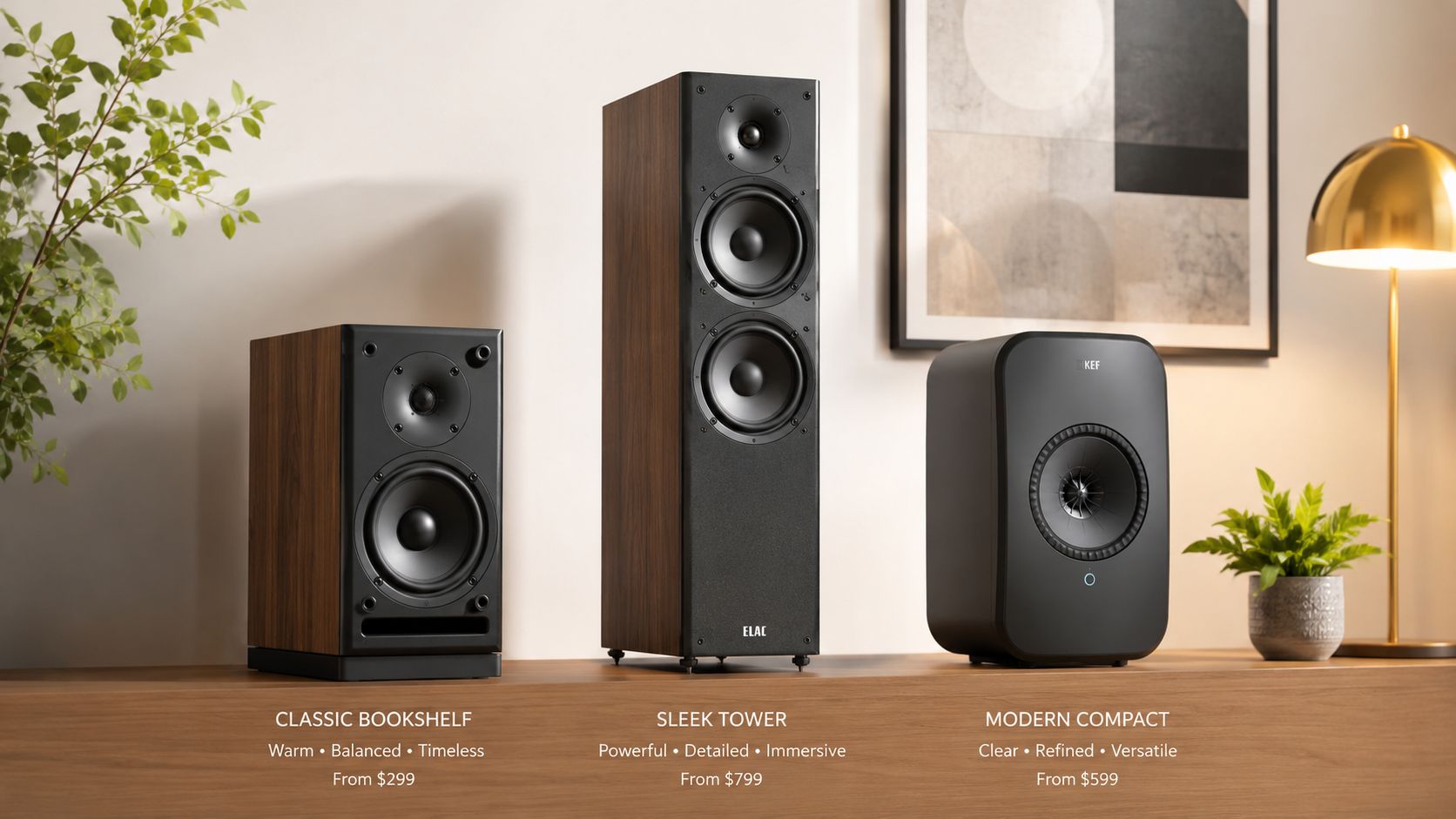
If you're still sorting out the basics, my beginner's guide to speaker types gives the category map. For buyers with a budget in this range, I break it down into three useful archetypes.
Comparison Table
| Archetype | Sound Character | Best For | Watch Out For | My Verdict |
|---|---|---|---|---|
| Detail Freak | Fast, explicit, image-focused | Nearfield listening, acoustic, jazz, critical listening | Can turn thin or tiring in bright rooms | Superb if you know what you're asking for |
| Musical All-Rounder | Warmish, relaxed, easy to live with | Long sessions, mixed libraries, everyday listening | Gives up a bit of razor-edge precision | The safest smart buy for most passive shoppers |
| Active Powerhouse | Punchy, controlled, dynamically confident | First serious system, multipurpose rooms, fewer boxes | Less upgrade romance if you enjoy swapping amps | The smartest buy for most people starting from zero |
The Detail Freak
This is the speaker for listeners who want to hear the seams in a recording. Not in a sterile way. In a “there's the reverb tail, there's the vocal placement, there's the ride cymbal hanging in space” way.
Done right, this type gives you startling image lock and real micro-detail. String tone has texture. Snare hits have skin, not just crack. You hear how crowded a mix is, and whether the recording engineer earned their paycheck.
But this flavor can go wrong fast. In a hard room, a detail-first speaker can sound like it's trying to win an argument. Pair it with a dry or undernourished amp and the music loses flesh. Great tool. Bad blind buy.
The Musical All-Rounder
This is the speaker I recommend to the highest number of sane adults. It gives up a little spotlight detail and buys back long-term pleasure.
The verified data gives a useful sketch of this type. A model in this lane might hit 50Hz to 20kHz with ±3dB tolerance and show a 1.2dB midrange dip around 2.5kHz. On paper, a graph obsessive will circle that dip in red. To my ears, that sort of voicing often reads as warmth and ease, not failure. It's the difference between a speaker that impresses for twenty minutes and one you keep for years.
Why This Voicing Works
- It forgives rough recordings: Thin masters and bright streams don't turn into dental work.
- It handles long sessions: The sound stays full and human instead of pushing detail at your face.
- It suits mixed systems: A decent integrated amp and an ordinary living room won't derail it.
The best all-round speaker isn't the one that shouts “listen to me.” It's the one that disappears.
This is the lane where musical joy usually beats spec-sheet vanity.
The Active Powerhouse
The category becomes interesting. Not trendy. Not simplified for beginners. Just smart.
An active powerhouse wraps the amplification, tuning, and speaker behavior into one coherent package. That means better control, less guesswork, and often more low-end authority than a passive setup with a bargain amp. The sound tends to be punchier, more composed at higher volume, and less likely to come apart when the track gets dense.
This type loves modern use. Streaming. TV duty. A desk by day, records at night. One purchase, fewer failure points.
If you're building from scratch, this is often the answer people resist because they like the romance of separates. I understand the romance. I also understand budgets.
The Most Important Choice Active vs Passive Systems
This decision matters more than the badge on the front of the speaker. Get this wrong and everything downstream gets expensive.
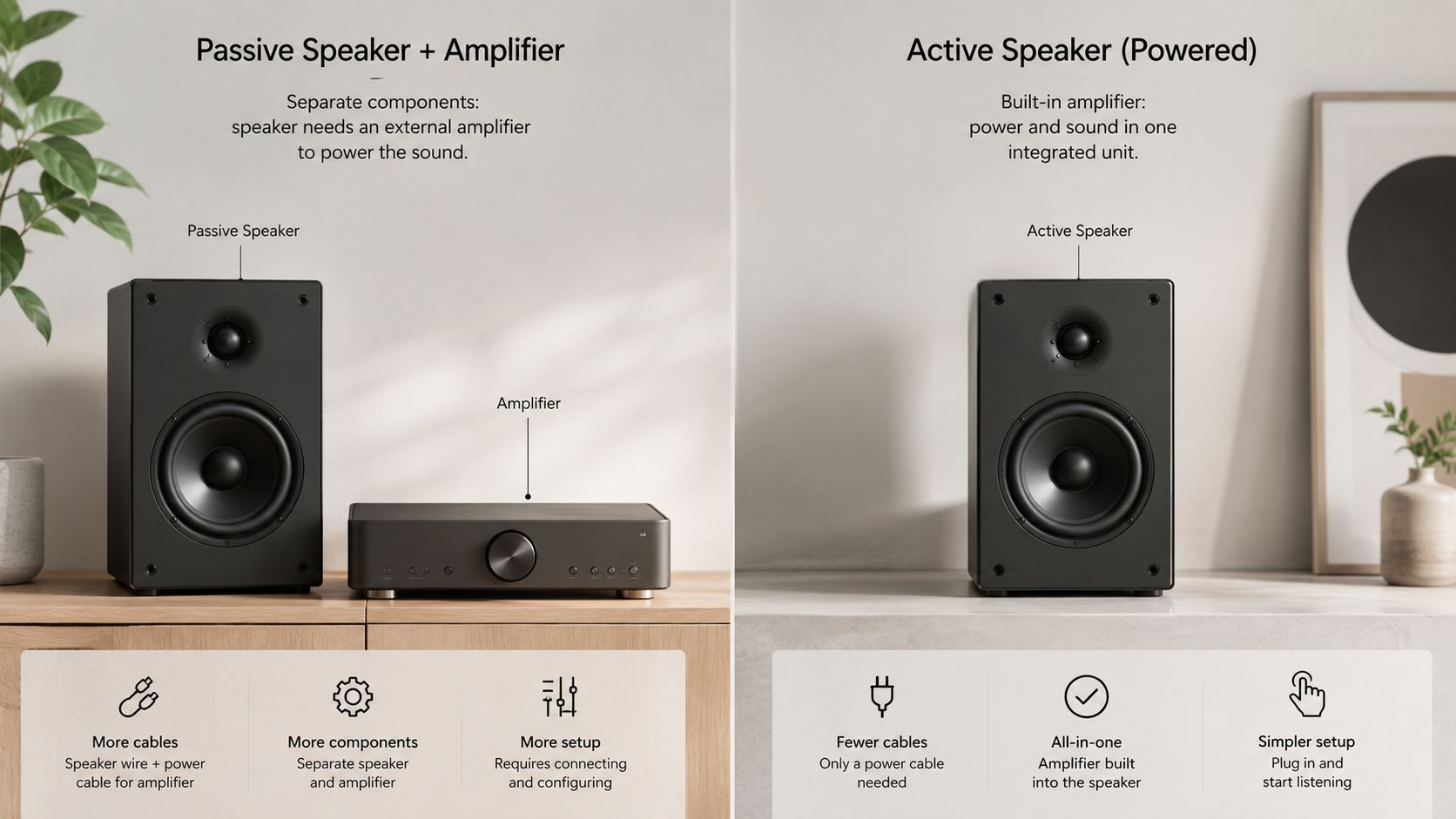
A few years ago, I would've pushed more people toward passive. Separate amplifier, separate speakers, future upgrades, the usual hi-fi catechism. Under a thousand dollars now, that advice is often lazy. The market shifted.
The verified data says 41% of new speakers under $1000 launched with built-in DSP and room-Tuning AI in Q1 2026, and that choosing an active system over a comparable passive one can save $200 to $400 in total system cost while delivering 3 to 5 dB more effective bass at 40Hz in real-world rooms. That isn't a niche wrinkle. It's a structural change in the category.
Passive Still Has a Place
Passive still makes sense if you already own a good amplifier, enjoy system matching, or want the flexibility to change one component at a time. There's pleasure in that process. There's also educational value in it. You hear what each swap does.
And if your taste runs toward a particular tonal pairing, passive gives you more room to chase it. Warm amp with incisive speaker. Fast amp with richer speaker. That kind of thing.
For buyers comparing more monitoring-oriented setups, my beginner's guide to studio monitors covers where active monitor thinking overlaps with home listening and where it doesn't.
Why Active Wins More Often Under a Grand
What DSP changed is not convenience alone. It changed control. The amplifier knows the driver. The tuning knows the cabinet. The system designer can shape bass behavior and protect dynamic headroom in ways a cheap passive chain often can't.
That matters most where affordable hi-fi usually falls apart. Bass grip. Loudness without strain. Real-room compensation.
Here's a useful visual on the split between system types and what buyers tend to overlook.
The practical comparison looks like this:
- Passive path: More flexible, more boxes, more chances to mismatch.
- Active path: Less romantic, more coherent, usually better value if you're starting from nothing.
- Room reality: Active systems with sensible tuning tools are often easier to get right in ordinary homes.
If your budget has to cover everything, active isn't the compromise. Blindly going passive is.
If you already have a strong amplifier, passive remains viable. If you don't, active is usually the adult decision.
Matching Power and Space Without Math
A speaker can't give you energy your room and amplifier won't support. Consequently, buyers waste money, because they chase the wrong spec and ignore the one that tells them whether the system will breathe.
What Sensitivity Actually Means
In this market, bookshelf speakers dominate, and average sensitivity clusters around 85 dB. That matters because doubling amplifier power only gives you a 3 dB increase in volume (verified sensitivity overview). In plain English, brute-forcing a low-sensitivity speaker with wattage is harder than most shoppers think.
That 85 dB area is the floor of the problem. It's where many affordable speakers stop being carefree and start demanding support. If your amp is modest and your room is larger, the speaker can sound compressed when the music opens up. Not because the speaker is bad. Because the system is starving the signal.
The same verified overview notes that in this category the frequency floor often lands near 56 Hz for more ordinary models, while stronger examples can reach 38 Hz. That sounds like a spec-sheet detail, but in practice it tells you whether a compact speaker will merely hint at bass weight or give the room a solid bass foundation.
Room Size Changes the Deal
Small room, nearfield setup, moderate volume. You can get away with more. A lower-sensitivity bookshelf speaker can still sound agile and satisfying because you're not asking it to fill air it can't control.
Medium or larger room. Open-plan space. Seating farther from the speakers. Now efficiency matters more than brochure wattage. You need a speaker that doesn't ask the amplifier to sprint uphill all night.
A few plain rules help:
- Desk or small office: Prioritize tonal balance and placement flexibility over heroic bass promises.
- Small living room: A well-voiced bookshelf can work beautifully if you place it properly and don't expect nightclub output.
- Larger shared space: Choose efficiency, active power, or plan for subwoofer support instead of pretending a compact passive box will do everything.
For placement basics that affect bass and image focus, my guide to speaker placement for amazing bass covers the simple adjustments many omit.
More power helps. Better matching helps more.
That's the whole trick. Not math. Fit.
What If I Spend a Little More or a Little Less
A thousand dollars is a sweet spot, not a sacred border. Drop below it and the mistakes get louder. Push above it and the gains get more selective.
If You Spend Less
Spend less and the obvious compromises usually show up in cabinet control, bass authority, and composure when the music gets busy. You can still get a good speaker. What you lose is ease.
That matters more than people admit. Cheap speakers often do one trick well. A bit of sparkle. A bit of bass puff. A flattering vocal range. Then the arrangement gets dense and the box starts sounding like a box.
If you're below this bracket, I'd rather see you buy a coherent, musically voiced speaker and accept its limits than chase fake scale. Honest small sound beats bloated pretend-big sound every time.
If You Stretch a Bit
Go a little above this level and you're usually buying refinement, not revolution. Better crossover behavior. Better cabinet silence. Cleaner treble. More believable low-level detail. The sound doesn't necessarily get larger. It gets calmer.
That's the part many buyers miss. Extra money above the thousand-dollar line rarely fixes a bad room or a bad match. It mostly rewards a system that's already sensible.
So if you're deciding between spending a little more on the speakers or spending that money on proper stands, setup, or the right electronics, I know where I'd put it first. Not glamour. Foundation.
My Shortlist and Your First Move
If you're a critical listener in a small to medium room and you want to hear straight into the recording, buy the Detail Freak. It's for listeners who like precision, image focus, and honesty, and who won't blame the speaker for telling the truth.
If you want the safest passive recommendation, buy the Musical All-Rounder. It's the one I'd hand to nearly anyone because it respects bad recordings, ordinary rooms, and long evenings.
If you're starting from scratch, buy the Active Powerhouse. That's my clearest recommendation. The verified data gives the point real teeth here. A model like the Edifier S200M Pro reaches 88 dB sensitivity, while a passive rival like the Q Acoustics M20 sits at 84 dB, giving the active option a 4 dB advantage and 2 dB more headroom before clipping. That extra breathing room is exactly why active systems tend to keep rock and dense mixes intact when volume rises.
Here's the decision tree in plain English:
- You analyze recordings for fun: Buy the Detail Freak.
- You want to relax into the music: Buy the Musical All-Rounder.
- You want the strongest whole-system value with the least guesswork: Buy the Active Powerhouse.
I run Supermarket Sound because people search “best speakers under 1000” and somebody has to tell them the annoying truth. The goal isn't to own the cleverest box. It's to stop thinking about gear and play another record.
Music first.

