
Most budget DAC advice is just noise about noise. The best budget DAC and amp isn't the box with the longest feature list or the prettiest badge. It's the one that does the least harm to the signal before your headphones ever get a chance to speak.
That's the whole game. Not adding magic, but preserving structure. The audible floor matters more than the spec-sheet fireworks, because everything downstream inherits it. If the floor is dirty, the music arrives already bruised.
| Use Case | Form Factor | What It Gets Right | What Usually Goes Wrong | My Bias |
|---|---|---|---|---|
| Phone plus IEMs | USB dongle | Small, simple, honest | Battery drain, hiss, bad pairing with splitters | Best if you actually listen on the move |
| Pocketable rig | Portable combo | More control and output | Bulk, cables, compromised convenience | Only worth it if a dongle leaves you wanting |
| Desk setup | Integrated desktop unit | Stable power, cleaner background, real usability | Feature creep and mediocre noise performance | Best for most people |
| Tinkerer's path | Budget separates | Flexibility and upgrade options | More variables, more chances to get the chain wrong | Usually overkill at the budget end |
I run an audio site, so yes, I know people search for "best budget dac and amp" expecting a neat winner and a shopping dopamine hit. Fair enough. But the honest answer is less glamorous. Buy the quietest foundation you can, in the shape that matches your actual listening life. Everything else is decoration.
Your Search for the Best Budget DAC Is Probably Wrong
Most buyers start by hunting for more. More formats, more power modes, more outputs, more little logos printed on the front panel like they won a trade show. That's backwards.
At the budget end, the smartest buy isn't the unit that promises to add the most. It's the one that subtracts the least. Noise, strain, grit, hash, that faint electronic fog that smears a vocal and flattens the space between instruments. That's what you're paying to avoid.
Stop Shopping for Ceiling and Start Shopping for Floor
A DAC and amp combo is load-bearing gear. It isn't the stained glass. It's the concrete slab under the house. If that slab flexes, the rest of the structure cracks in ways you'll hear as glare, blur, weak dynamics, or hiss with sensitive earphones.
That is why I care so much about the audible floor. The quiet beneath the music. The blackness behind a plucked string. The empty space around a snare hit. If the source pollutes that space, your headphones can't clean it up later. They just reveal the mess more clearly.
Most budget upgrades fail because they chase "detail" while ignoring the dirt underneath it.
This also explains why so many budget shootouts feel useless. They compare marketing language, not listening reality. A box can brag about formats you'll never use and still starve the signal where it counts.
What You Can Actually Hear
To my ears, the biggest budget mistake isn't a lack of resolution. It's instability. A noisy source makes quiet passages feel shallow. A weak amp stage makes transients sound pinched. A messy connection path turns separation into soup.
So the right question isn't "Which one has the most features for the money?" It's "Which one gives my headphones the cleanest floor to stand on?"
That's the only question that survives contact with actual listening.
The Four Forms a Budget DAC and Amp Can Take
The form factor isn't a side note. It decides the compromise before the first note plays.
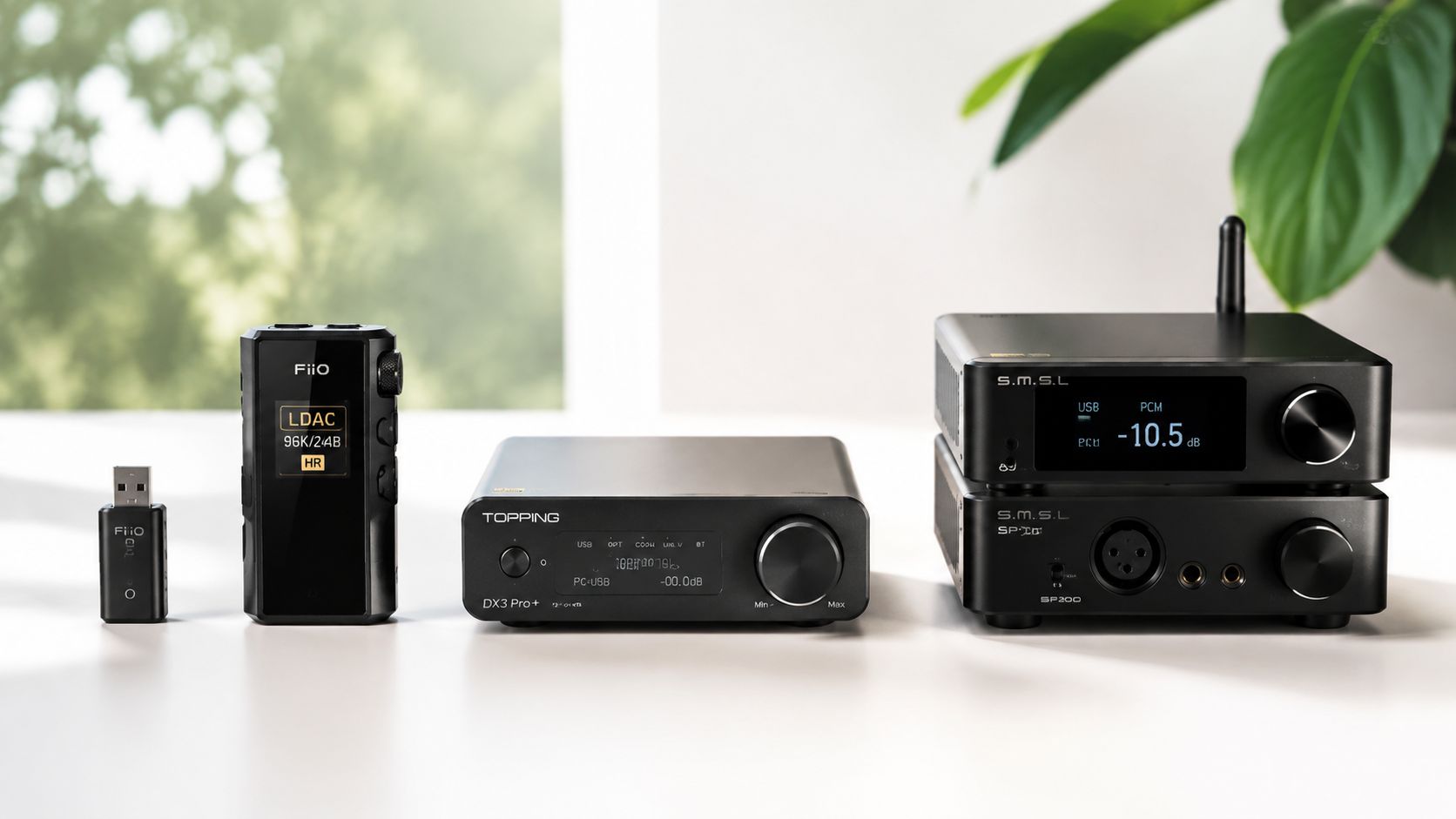
The Dongle Is Ruthless Minimalism
A dongle DAC is the most honest category. Tiny body, tiny margin for error, usually a direct line from phone to earphones. When it works, it feels invisible. That's the point.
The compromise is obvious. Limited power, limited controls, and a constant risk that your mobile setup turns into a cable octopus. If your earphones are easy to drive and you care about portability more than romance, a good dongle is enough. Not glamorous. Enough.
The Portable Combo Buys Control With Bulk
This is the in-between creature. Bigger than a dongle, smaller than a desktop rig, usually better at driving stubborn headphones and offering a bit more physical control.
But you're paying in friction. More battery anxiety. More cable management. More reasons not to bother on your commute. Portable combos make sense for people who know a basic dongle leaves their headphones sounding thin or cramped. Everyone else usually wants simpler.
Practical rule: If a portable rig is annoying to carry, you'll stop using it. Sound quality you leave at home is imaginary.
The Integrated Desktop Unit Is the Adult Choice
For those building a desk setup, an integrated desktop DAC/amp is often the sweet spot. One box. One power plan. Fewer variables. Usually better ergonomics, cleaner connectivity, and more headroom where it matters.
You give up modular upgrade fantasies, but you gain sanity. At this price level, sanity sounds good.
Budget Separates Are a Hobby Inside the Hobby
A separate DAC feeding a separate amp looks serious. Sometimes it is. Sometimes it's just two cheap boxes doing a passable impression of one competent box.
The upside is specialization. The downside is that every extra link in the chain is another place to get the system wrong. More cabling, more matching, more opportunities for noise to creep in and for the downstream gear to inherit it.
Here's the blunt version:
- Use a dongle if your world is phone plus IEMs.
- Use a portable combo if you need more output and will carry it.
- Use an integrated desktop unit if you sit at a desk and want the cleanest path with the least drama.
- Use separates only if you enjoy the process as much as the result.
Shape first. Specs later.
What Actually Matters When You Spend Under $300
The budget market loves to sell mythology. Chip names become personality tests. Sampling rates become chest-beating. None of that helps if the implementation is lazy.
Under this price ceiling, I care less about the badge on the silicon and more about whether the whole unit is electrically and ergonomically coherent. That's the difference between hearing music on a stable platform and hearing a component fight itself.
Chip Worship Is a Dead End
There is one place where chip choice is a concrete, mechanical distinction rather than forum religion. Budget DAC analysis as of January 2026 identifies the Hiby FC1 and the TRN Black Pearl as specific competitive models where chip selection, specifically lower-end versus higher-end variants, directly impacts audio performance.
Good. That's useful because it's specific.
But even there, the lesson isn't "always buy the fancier chip." The lesson is that implementation decides whether the hardware gets out of the way. If you need a cleaner mental model for that, I already broke it down in plain English in my guide to DACs explained simply.
Three Things You Can Hear Fast
Forget the brochure and listen for these:
- Background cleanliness. On quiet intros and reverb tails, does the space feel open or dusty?
- Driver control. On bass hits and dynamic swings, does the headphone sound planted or like it's jogging in dress shoes?
- Connection integrity. Does the whole chain stay clean when you swap cables, outputs, and devices, or does the sound get brittle and weird?
Those aren't engineering abstractions. They're audible consequences.
The Real Budget Enemies
Noise floor is the obvious villain, but weak power and messy connectivity are accomplices. A budget unit with a respectable conversion stage can still sound small if the amp section strains. Another can sound technically clean until a bad output path turns the music papery and thin.
A cheap DAC doesn't usually fail with fireworks. It fails by sanding off texture and shrinking the room.
The best budget DAC and amp doesn't need to impress you in a product listing. It needs to disappear in use. You hit play, and the source stops calling attention to itself. The voice sits in space. Cymbals decay naturally. Bass carries weight instead of blur. That's the standard.
Not chip theater. Not format cosplay. A clean floor.
The Dongle DACs That Do Not Starve Your IEMs
Those seeking budget DACs aren't typically building a shrine on a desk. They're plugging a phone into IEMs and trying to avoid garbage sound, cable nonsense, and battery misery. The portable side of this hobby gets treated like an afterthought, which is absurd.
Audio46 notes that 68% of IEM users in major markets rely on phones as their primary source, yet only 12% of budget DAC/amp guides cover dongle-to-dongle gain matching or battery drain specifics. That's exactly the blind spot. Real-world portable listening is where bad matching ruins an otherwise decent signal.
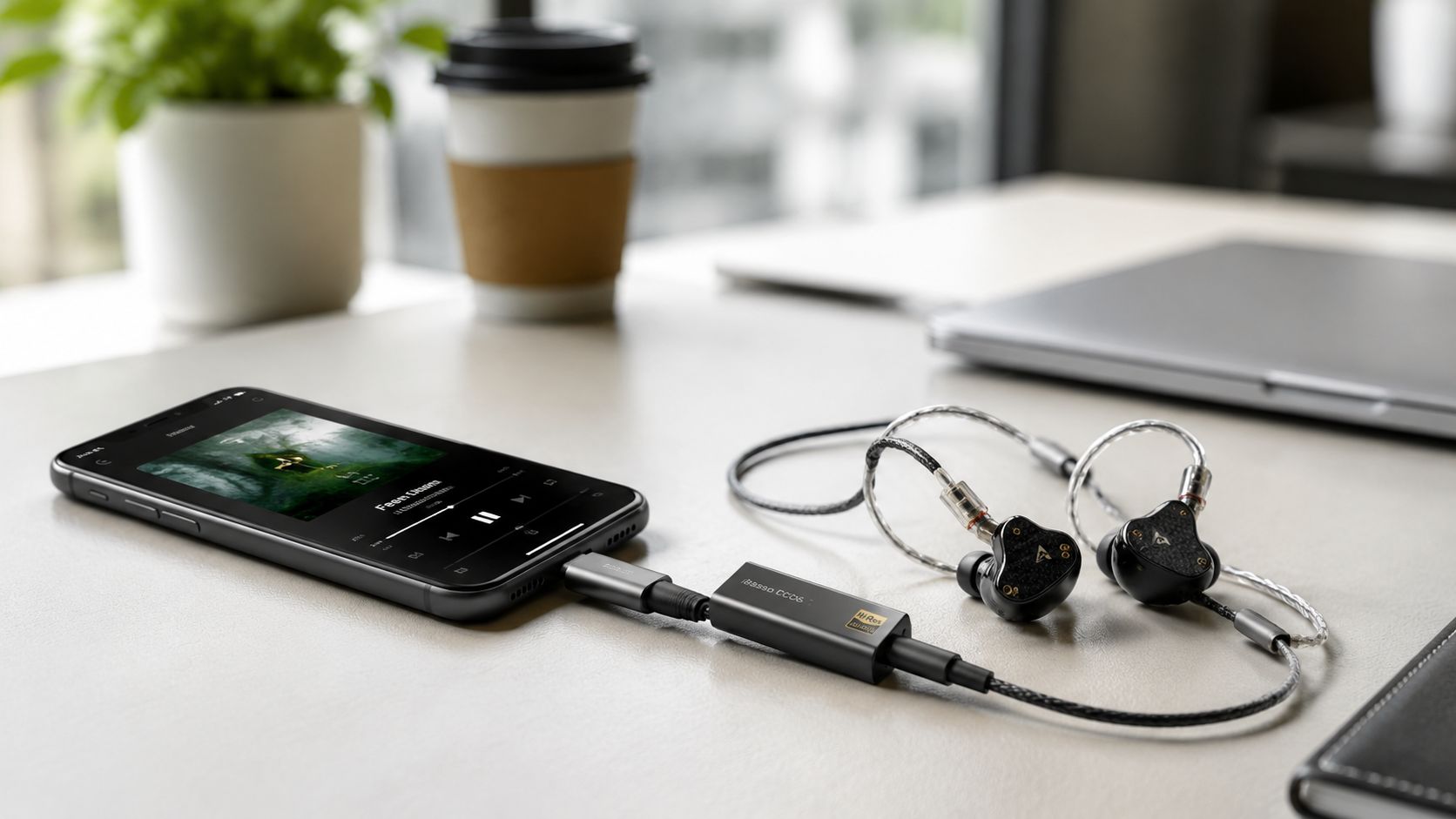
The Portable Trap Is Not Sound Quality Alone
A dongle can sound clean in isolation and still fail in a real pocket rig. Add a cheap splitter. Add a weirdly sensitive IEM. Add a phone that already has power quirks. Suddenly the signal gets starved downstream and you blame the earphones.
That is why I don't judge dongles as little lab specimens. I judge them as behavior inside a chain.
For readers still getting their footing with earphones, my beginner's guide to IEMs will save you from pairing mistakes that no accessory can fix later.
The Dongle I Trust Most
The AudioQuest DragonFly Red has been cited in unbiased 2026 reviews as the best budget DAC on the market, with its specific price point and USB-powered design establishing the standard for entry-level digital-to-analog conversion, according to this roundup at Midination. That doesn't mean it's magic. It means it set the template for what a serious entry-level portable DAC should feel like.
To my ears, gear in this lane works when it gives IEMs a stable center of gravity. No cheap sheen in the upper mids. No fake edge mistaken for detail. No hiss crawling into the space between notes. The good ones make the phone disappear and let the earphones keep their own personality.
Where Cheap Portable Rigs Go Sideways
This part gets ignored because it's less fun than arguing about chips. But it's the practical bit that matters.
- Sensitive IEMs expose hiss fast. If the floor isn't clean, you'll hear it before the chorus.
- Splitters and adapters can sabotage a decent dongle. The chain matters as much as the part.
- Battery behavior changes the ownership experience. A "great" dongle that turns your phone into a hand warmer isn't great.
- Output matching matters. A dongle can be clean and still not be the right partner for your earphones.
The portable budget recommendation, then, isn't "buy the fanciest dongle you can afford." It's simpler. Buy the one that behaves. Stable connection. Clean background. Enough gain for your IEMs without drama.
That matters more on a train than any slogan printed on the packaging.
Desktop Champs A Topping and Aune Brawl
Desktop is where budget audio stops pretending and starts doing real work. A good little box on a desk has one job. Keep the audible floor low, keep the signal intact, and stop your headphones from fighting the source before the music even starts.
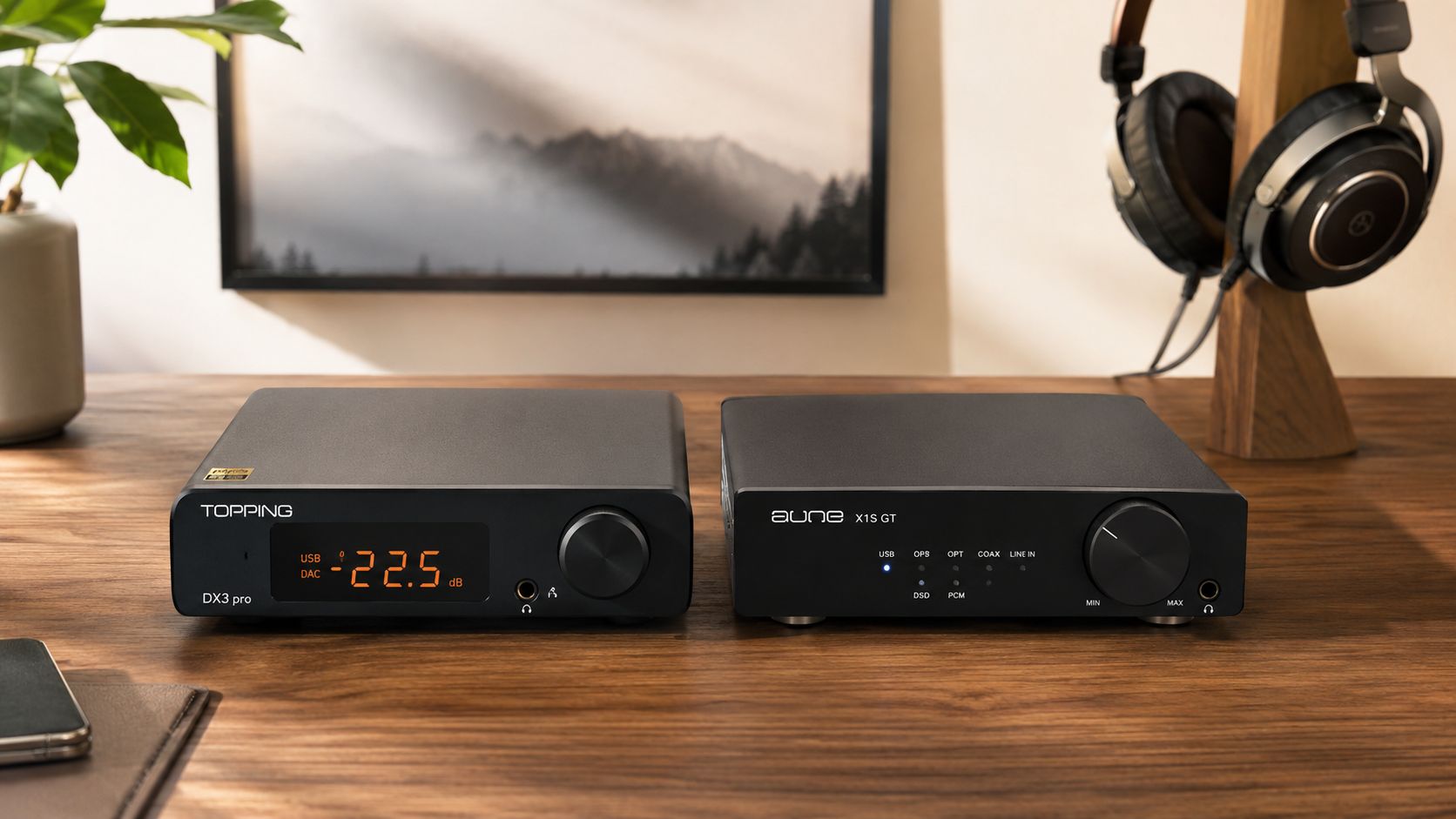
At this price, desktop DAC/amps usually split into two camps.
One chases a tight, controlled presentation. The sound feels squared off and well-supported, like the music was set on a drafting table instead of tossed onto a couch. The other camp goes after a quieter foundation. Less grit between notes. Less haze around edges. More of that "nothing is happening until the singer opens their mouth" silence that cheap gear so often smears.
I care more about the second one.
Budget buyers get dragged into a spec-sheet shouting match, then end up ignoring the problem they can hear. Noise. Grain. Poor headphone matching. A desktop unit wins by doing less harm, not by printing the most chest-thumping numbers on the product page.
The Clean, Controlled Desktop Type
Some desktop combos sound disciplined in a useful way. Bass lines stay upright. Transients hit with clear outlines. Dense mixes keep their lanes instead of bunching up in the middle. If your headphones already have warmth, softness, or a little bloom, this kind of tuning can act like a frame around the picture.
That matters more than beginners realize. The amp stage sets the grip and posture of the whole presentation, which is why a lot of "DAC talk" misses the point. If you want the plain-English version, read my beginner's guide to headphone amplifiers.
This desktop type works best for listeners who hate blur. You put on a busy rock mix or layered electronic track and the structure holds.
The Quiet-Floor Desktop Type
Then there's the desktop unit I usually prefer under $300. The one that gets out of the way.
This style treats silence like part of the recording. Quiet passages have room to breathe. Reverb tails do not get buried under low-level hash. Vocals detach from the backing track more easily because the space around them stays cleaner. With sensitive headphones and IEMs, that lower audible floor matters more than another round of brochure trivia.
You hear it first as calm.
Then as separation. Then as less listening fatigue, because your brain is no longer sorting music from junk riding underneath it.
Here's a closer look at desktop DAC/amp thinking in motion.
Buy for the Problem You Need to Solve
If your headphones sound loose, too soft, or a little sleepy from weaker sources, buy the cleaner, firmer desktop type. It gives the music shape and stops the presentation from slouching.
If your main complaint is hiss, glare, low-level grime, or that vague sense that quiet songs never feel completely quiet, buy the quiet-floor type first. That is usually the smarter budget move. The cleanest foundation fixes more real listening problems than a slightly flashier feature set.
A simple split helps:
| If You Value This | Buy This |
|---|---|
| Tighter control, clearer edges, stronger sense of grip | A clean, controlled desktop DAC/amp |
| Lower audible noise, blacker background, more space around notes | A quiet-floor desktop DAC/amp |
Neither should act like a flavor machine. Good budget desktop gear is load-bearing. It holds the house up and keeps its own fingerprints off the walls.
Your Final No-Regrets Buying Checklist
Stop shopping by fantasy. Buy for the noise, power limits, and daily annoyances you have.
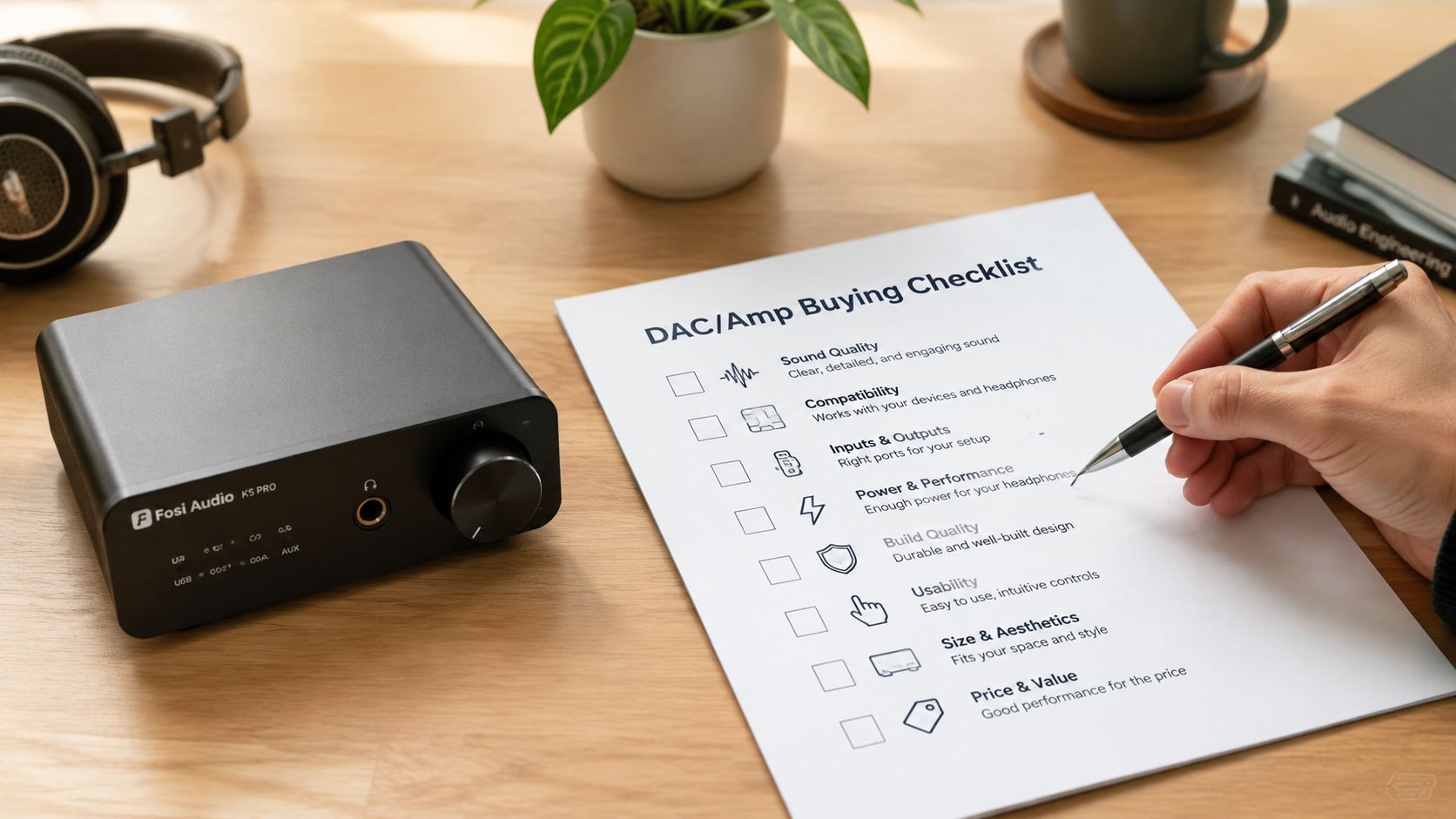
A budget DAC and amp earns its place by doing the least harm. That is the whole job. Under $300, the winners are usually the ones that keep the floor quiet, stay stable with sensitive earphones, and stop your headphones from sounding underfed or smeared. Fancy features are drywall. The audible floor is the foundation.
Ask These Questions and Make the Call
- Are you listening from a phone with IEMs most of the time? Buy the dongle type that stays quiet and behaves itself with sensitive gear.
- Does your setup live on a desk? Buy a desktop unit. Pocket gear on a desk usually turns into cable clutter and compromise.
- Do quiet tracks expose hiss, hash, or a gray background? Pick the quiet-floor archetype first. That fix carries farther than extra features.
- Do your headphones sound flat, loose, or weak from small sources? Get the desktop archetype with firmer drive and better control.
- Do you hate stacking boxes and troubleshooting gain, cables, and power? Skip separates and buy one good all-in-one.
Here is the shortcut I would use.
If you want the safest desktop choice, start with the quiet-floor desktop archetype from the previous section. It solves the problem I hear most often in cheap chains. Low-level grime, edge, and that faint electronic mist behind the music. Clean that up first, and everything else gets easier to judge.
If your headphones clearly need more grip, move to the cleaner, stronger desktop archetype. The goal is not bigger numbers for the sake of bragging. The goal is to stop the sound from slouching.
If your real setup is phone plus IEMs, stop forcing a desk answer onto a portable problem. Buy the dongle archetype that keeps the signal clean and does not turn your pocket rig into a science project.
Buy for the mess on your desk and in your pocket. That is the system you will actually hear.
My rule is simple. Chase the cleanest foundation first, then enough power, then convenience. In budget audio, that order saves money and regret.
The best budget DAC and amp is rarely the one with the loudest spec sheet. It is the one that disappears, leaves the fewest fingerprints on the signal, and lets your headphones build the house on solid ground.
Author: Marque Hersh
Publisher: Supermarket Sound
Author profile / sameAs: Marque Hersh on Steam

