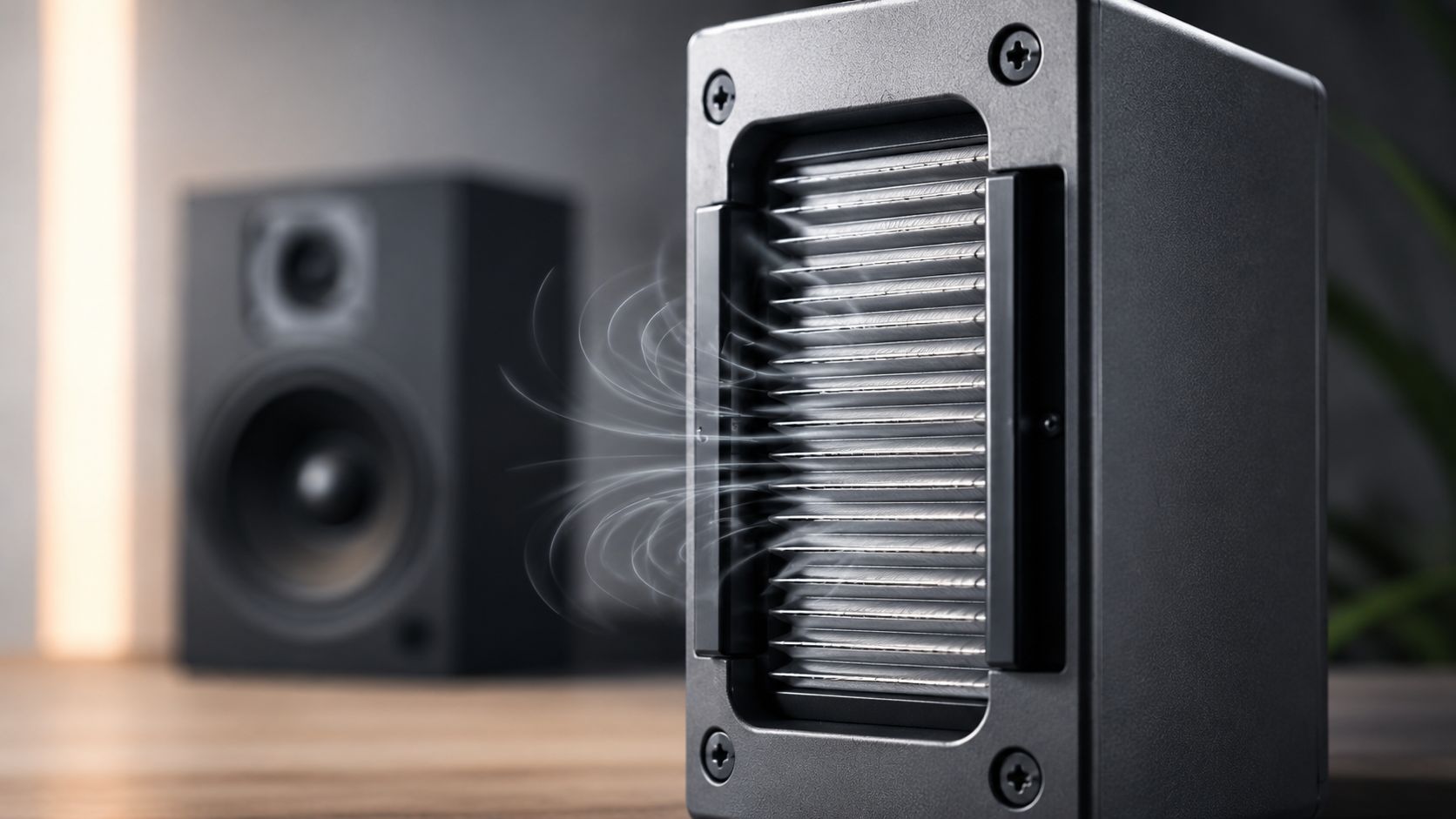
The bad advice about an air motion transformer tweeter is that it only sounds right when the room is already cooperating. That's backwards. The diaphragm gets the headlines, but the loading, crossover point, and placement decide whether you hear speed and air, or a narrow, bright beam that makes vocals sound like they're being lit from underneath.
I've lived with AMT-loaded speakers long enough to stop romanticizing the folded diaphragm. The mechanism matters, sure. But the question is uglier and more useful, does this driver behave like a precision instrument in your room, or does it punish sloppy setup and then get blamed for it?
Table of Contents
- Why Air Motion Transformer Tweeters Divide Listeners
- How the Folded Diaphragm Actually Moves Air
- Speed, Headroom, and the Price You Pay for Both
- AMT Versus Dome, Ribbon, and Planar Tweeters
- Placement, Crossover, and Amplification That Work
- What AMT Tweeters Sound Like in a Real Room
- The Honest Trade-Offs and the Questions Buyers Ask
Why Air Motion Transformer Tweeters Divide Listeners
The split opinion around an air motion transformer tweeter usually isn't about the concept. It's about how the driver is loaded, crossed over, and aimed. AMTs won attention because they solve the old treble problem of needing speed, low mass, and enough headroom to stay clean, and the modern versions are generally used as tweeters or upper-mid/high-frequency drivers rather than full-range units. Their behavior around the crossover matters more than the brochure language suggests, especially once the speaker is in a real room, where off-axis response and driver integration decide whether the treble feels effortless or lit up. For a clear overview of that relationship, see AMT overview and crossover behavior.
That's the part many gloss over. They hear the familiar line about a folded diaphragm, faster treble, and lower distortion, then assume the speaker will behave itself in any setup. In practice, an AMT's reputation depends on the full system, because the same geometry that gives it that quick, highly resolved top end can also make it more directional and more sensitive to crossover choices than a forgiving soft dome.
The reputation follows the room
A clean implementation can sound startlingly open, with cymbals that stop sounding like white noise and start sounding like metal. A poor one can turn sharp fast, especially if the designer lets the response rise where the ear is already sensitive or if the room throws that energy straight back at you. The driver is not broken. The system is.
Practical rule: if an AMT sounds “too much,” start with setup, not the idea behind the design.
That is why buyers argue about these things. One listener hears detail and ease. Another hears glare and a top end that never settles down. Both can be right.
How the Folded Diaphragm Actually Moves Air
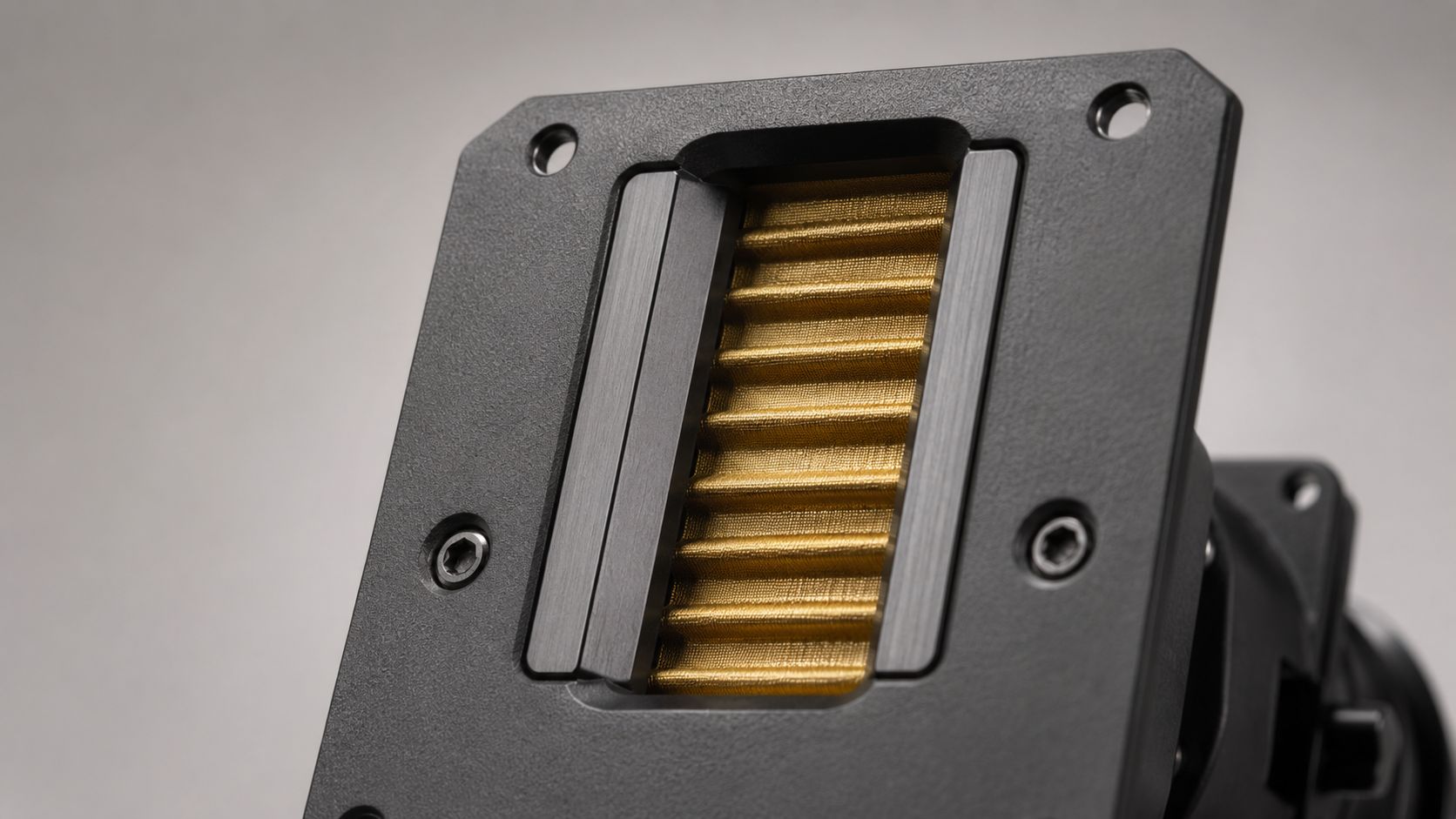
Think of the diaphragm less like a little drumhead and more like a concertina breathing through narrow slits. A dome pushes air forward. An AMT folds a pleated diaphragm so the air moves laterally through the pleats, which gives it a very large effective radiating area relative to its physical size. That low-mass, high-surface-area trick is the whole point, because less moving mass usually means faster transient behavior and less stored energy in the treble when the motor stays linear engineering discussion of AMT behavior.
A standard tweeter is generally expected to live roughly in the 2,000 Hz to 20,000 Hz band, with 20 kHz often treated as the upper edge of human hearing standard tweeter range. AMTs fit that brief comfortably, but they're not limited to it in the same neat way a conventional tweeter is. Some implementations reach lower than the usual tweeter box, and ESS's original Heil Air Motion Transformer tweeter has been described as reaching down to 800 Hz with a 96 dB sensitivity rating ESS Heil AMT description.
Why the geometry matters
The catch is that the narrow slots and pleat structure don't just move air efficiently, they also shape how the sound leaves the driver. If the crossover and waveguide aren't tuned carefully, the result can be directional behavior and a response that rises where you don't want it. That's the trade. More surface area and less excursion can buy cleaner treble. The same geometry can also make the speaker less forgiving if you treat it like a dumb little tweeter and bolt it into any cabinet.
The mechanism is elegant. The implementation is everything.
That's why the folded-diaphragm diagram is only the first sentence. The listening room writes the rest.
Speed, Headroom, and the Price You Pay for Both
The upside of an AMT is easy to hear when the speaker is right. The low moving mass helps preserve microdetail and attack, so brushes on a snare, the shimmer on a ride cymbal, or the edge on plucked strings can arrive with a sense of quickness that feels more immediate than many conventional tweeters. The same geometry also gives designers a very large effective radiating area, which can translate into high acoustic output with low diaphragm excursion.
What that buys, and what it costs
That extra headroom matters because a driver that doesn't have to swing far stays cleaner longer. In the upper octaves, AMTs can feel relaxed at levels where some domes start sounding busy or slightly compressed. The practical buying guidance on AMTs ties that appeal to low distortion in the 2 to 20 kHz range and reduced listening fatigue during long sessions, which is exactly where many listeners notice the difference first buying guidance on AMT use.
But every one of those strengths has a failure mode. Narrow slots can make the presentation more directional. A crossover that's too low, or a waveguide that doesn't suit the driver, can create a top end that starts to feel aggressive instead of airy. Good AMTs don't hide bad setup. They expose it.
For readers chasing the amplifier side of the chain, I'd also keep the electrical end honest. Treble sensitivity doesn't magically erase downstream problems, and a speaker system is still only as calm as the parts feeding it. I've written before about how amplifier character can influence the whole presentation in ways people oversimplify, and the same logic applies here, the speaker inherits what the amp gives it, then the room inherits that too, see my notes on class D amplifier sound quality.
The failure mode is usually obvious
If the AMT is crossed too low, the sound can harden. If the room is lively, the top end can seem brighter than the spec sheet would suggest. If toe-in is wrong, you may lose the sense of openness and end up with a thin center image. Same driver. Different result.
That's why people who love AMTs talk about “speed,” and people who don't talk about “edge.” Both are describing the same precision.
AMT Versus Dome, Ribbon, and Planar Tweeters
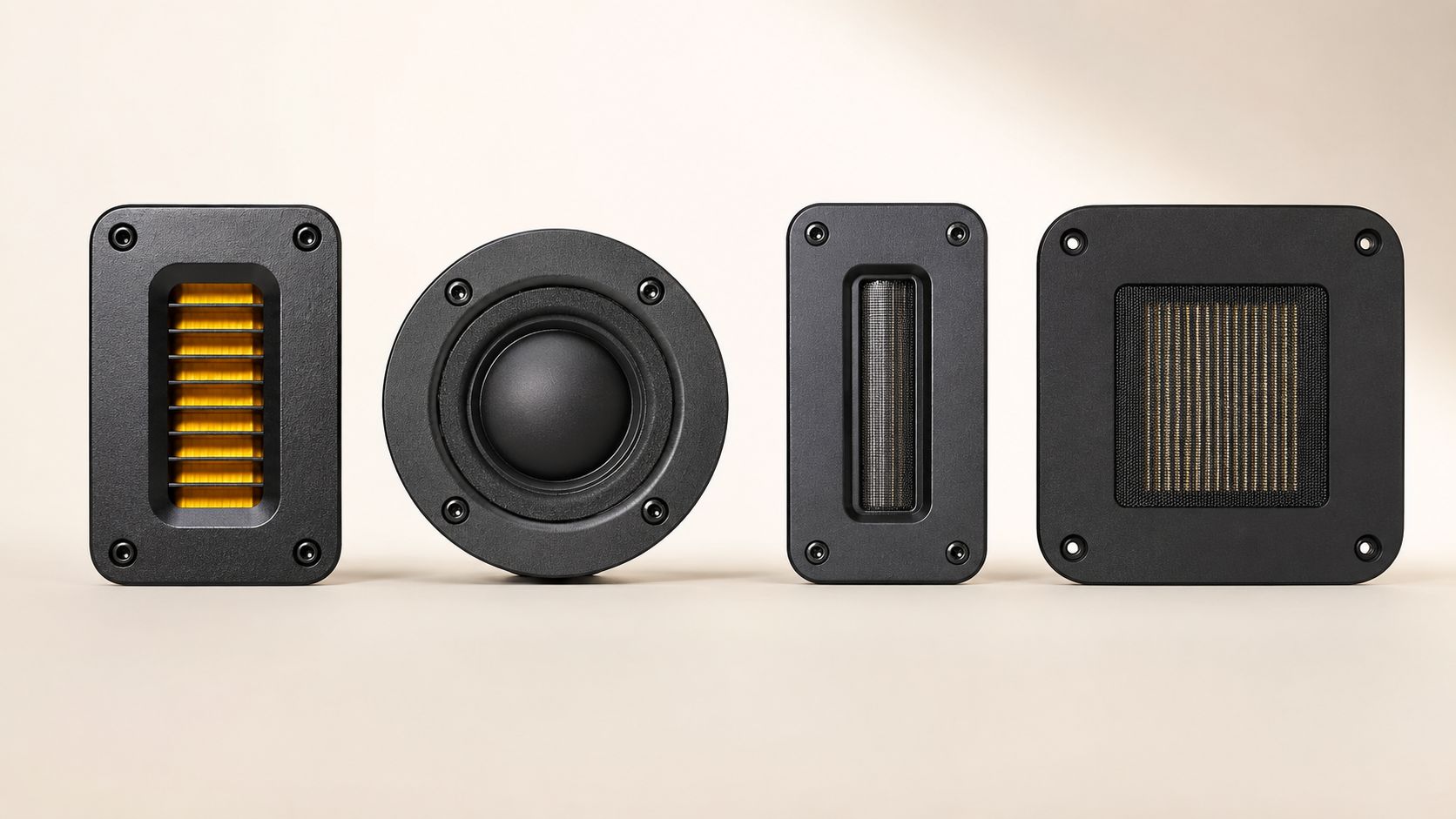
The comparison is not which tweeter wins on paper. It is which one still makes sense once it is in your room. AMTs usually land between the easygoing behavior of a conventional dome and the more exacting nature of other high-frequency designs, which is a big reason they have moved from specialist monitors into more common bookshelf and floorstanding speakers. Better driver consistency, cleaner crossover integration, and stronger cost-per-performance have all helped that shift, along with broader acceptance from listeners who were tired of treble that sounded sharp before it sounded detailed. See also this speaker types guide for a wider view of how tweeter families fit into speaker design.
What you actually feel at the seat
A soft dome usually gives you easier room behavior and wider forgiveness, though it often gives up some of the etched leading-edge attack that makes certain recordings feel so immediate. A ribbon can sound extremely quick, but it tends to ask more from placement and from a room that is already well behaved. A planar design can produce a large, coherent top end, but it still depends on the right geometry and a listening position that suits its radiation pattern.
An AMT sits in the middle more often than people want to admit. It can deliver texture, speed, and clean separation without sounding as obviously brittle as a bad metal dome, yet it can still turn demanding if the cabinet, crossover, and room are working against it. The same driver can sound relaxed in one setup and insistent in another, and that is usually the difference between a speaker that disappears and one that keeps reminding you it is there.
For readers comparing the practical behavior of different tweeter families, the useful question is not how impressive the first five minutes sound. It is whether the speaker stays composed after the novelty fades and the room starts adding its own voice.
Listening rule: choose the tweeter that fits your room, not the one that sounds most impressive on first contact.
If your room is reflective and your listening sessions run long, a gentler high-frequency balance may be the smarter choice. If you want that lively, etched sense of leading edges and you can control placement, AMT territory starts to make sense.
Placement, Crossover, and Amplification That Work
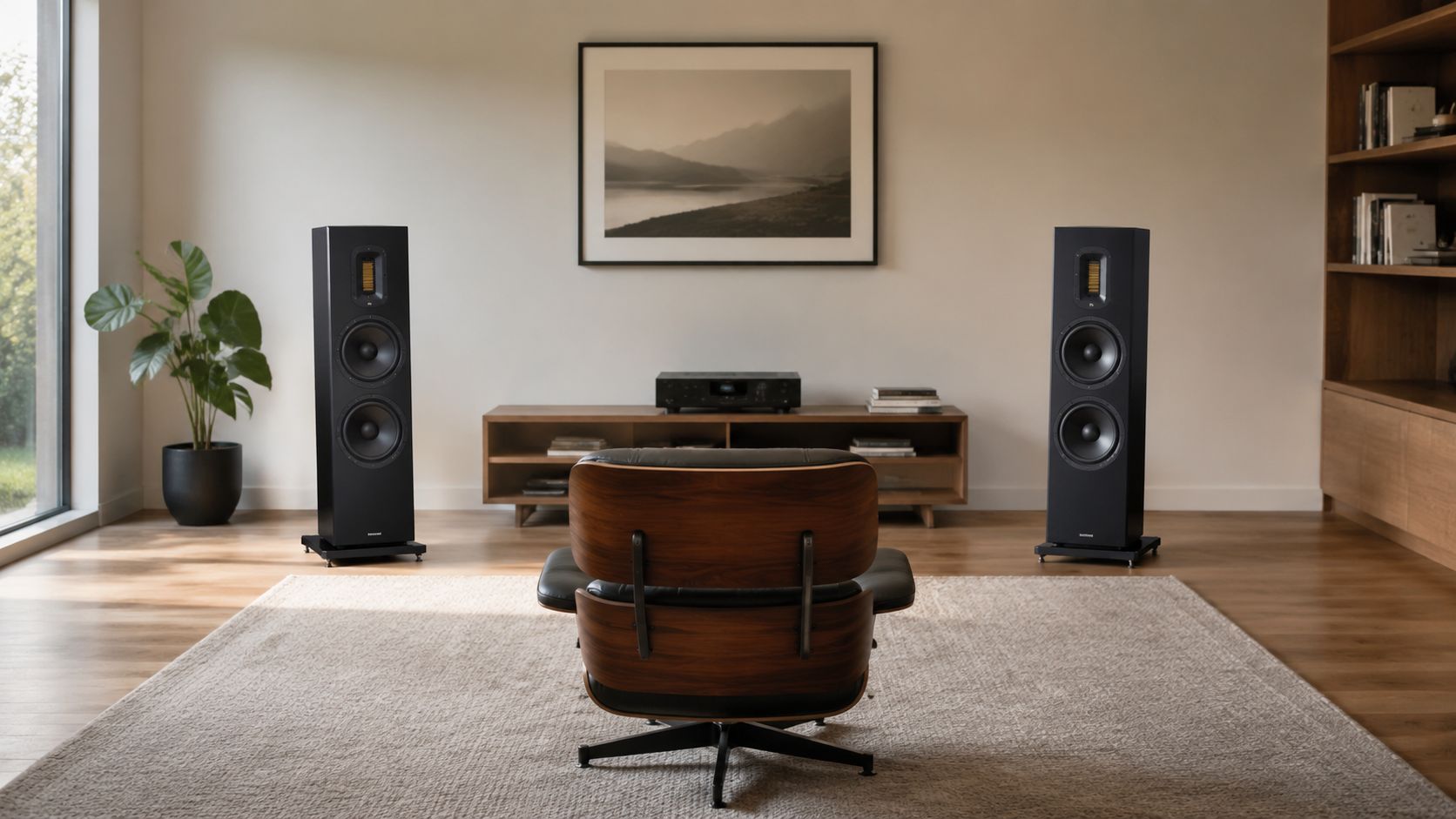
I start with toe-in because AMTs punish lazy aiming faster than many tweeters do. Their off-axis behavior is part of the sound, and the listening seat, cabinet angle, and amount of reflected energy in the room all shape the result. If the top end feels hot, do not assume the AMT is the problem first. Move the speakers, change the angle, and listen again.
Keep the crossover out of trouble
The practical baseline is simple. AMTs are usually used as tweeters or upper-mid and high-frequency drivers, with a crossover around 2.4 to 2.5 kHz and usable output that extends well past 20 kHz, depending on the implementation. That crossover region matters because once the driver is asked to work too low, excursion rises and distortion climbs faster than the format's marketing language suggests.
The crossover choice also affects how forgiving the speaker feels in a real room. A gentler handoff can keep the AMT in the range where it stays composed, while a poorly judged crossover can make the top end sound strained long before the speaker reaches useful volume. That is why typical AMT crossover use tends to keep the driver where it behaves more like a specialist than a full-range loudspeaker element.
A normal room becomes the test bench. Boundary reflections can load the top end in a way that makes the speaker feel more forward than intended. Put the cabinets where the AMT is not firing directly into a reflective side wall at a shallow angle, and give yourself enough distance to hear the direct sound before the room bounces it back.
For setup basics that fit this, my speaker placement guide covers the room-loading logic that matters here. You do not need measurement gear to hear the difference between clean direct sound and a room that is overfeeding the top octave.
Do not confuse sensitivity with easy drive
AMTs often have strong sensitivity in the upper band, but that does not mean every AMT-loaded speaker is easy to drive in real use. Sensitivity is only one piece of the puzzle. The crossover network, the impedance behavior of the full speaker, and the way the tweeter is loaded all decide how relaxed the system feels.
A practical setup checklist looks like this:
- Start with moderate toe-in: aim for direct treble energy at the listening seat, then back off if the center image turns too bright.
- Respect the crossover region: designs that keep the AMT above its awkward excursion zone tend to sound calmer.
- Control first reflections: hard side walls can make a precise tweeter sound too crisp.
- Match the amp to the full speaker, not the tweeter alone: the whole load matters, not just a sensitivity number on a sheet.
If the top end feels sharp before lunch and smoother at night, the room is probably doing more than the driver.
The speaker angle, the crossover point, and the amplifier all interact. Get those three working together, and the AMT stops calling attention to itself. It starts making you notice the recording instead.
What AMT Tweeters Sound Like in a Real Room
Put an AMT in a nearfield desk setup, and it can sound almost unfairly articulate. Cymbals separate into attack and decay instead of turning into a wash, acoustic guitar picks up more string texture, and vocal consonants can land with real snap if the speaker is aimed well. That precision is the appeal. It also means the wrong angle can turn that same clarity into glare fast.
The room decides the mood
In a treated mid-size room, the good qualities are easier to trust. The treble hangs in space with more confidence, and the speaker can disappear in a way that makes the top end feel like it is floating instead of beaming. An AMT's speed and air make sense there, because the room is not piling early reflections on top of the direct sound.
A reflective living room is where the format earns its reputation for being picky. Glass, bare walls, and hard furniture can make that upper-band energy stick to the speaker and the nearest surfaces. Then people say AMTs are fatiguing. Sometimes they are. More often, the room is fatiguing, and the AMT refuses to hide it.
The original ESS Heil description helps explain why this design still gets attention. ESS described its original version as reaching down to 800 Hz with 96 dB sensitivity, which shows this was never just a tiny sparkle-only tweeter sitting on top of a box original ESS Heil AMT description. It is a wider-band driver concept than casual tweeter talk usually allows for.
What fatigue feels like
When an AMT is set up well, long sessions feel easy because the treble stays articulate without turning cottony or etched. When it is not, fatigue shows up as persistent brightness, not just sheer volume, but too much information crowded into the same narrow band of space. That is the clue. A good AMT makes detail feel organized. A bad one makes detail feel pasted on.
Off-axis behavior matters as much as the driver itself. If the speaker stays too hot once you move off center, the room will tell you before the spec sheet does. Toe-in changes the balance quickly, and the right angle is often the difference between clean detail and a top end that sounds pinned to the cabinet. I have lived with AMT-loaded speakers that sounded thrilling dead on and far less convincing a few degrees off, which is why setup matters so much here.
I would rather hear an AMT in a room that forces careful placement than a gentler tweeter that sounds acceptable everywhere and remarkable nowhere.
The Honest Trade-Offs and the Questions Buyers Ask
An air motion transformer tweeter is not a miracle. It is a precision device with a relatively narrow operating window, and when the speaker around it is built well, it gives you speed, separation, and a top end that feels unusually alive. When the rest of the design is off, it exposes that fast.
The old ESS Heil description from ESS Audio still matters because it points to the original idea behind the format, a tweeter meant to move air differently from a conventional dome and to do more than just add sparkle. That history explains why the best AMTs sound open and quick, and why their behavior in a real room matters just as much as the diaphragm itself.
The buyer questions I'd answer first
Do AMTs need special amplification?
Not in the boutique sense. They need an amplifier that is comfortable with the full speaker load and a crossover design that is doing its job instead of forcing the tweeter to carry problems elsewhere. The whole system matters more than the badge on the driver.
Are they bad for small rooms?
Small rooms can work well if reflections are under control and the speaker is aimed properly. A small untreated room is the problem, not the format itself, because the off-axis response and early reflections will shape what you hear before the driver's speed ever gets a chance to matter.
Do they fatigue the ears?
They can, and the cause is usually placement, crossover choices, or a room that is already bright. A good AMT should sound revealing and clean, while a poorly matched one can turn that same clarity into something sharp and tiring. Toe-in often decides which side of that line you land on.
Is the price premium worth it?
Only if you care about what AMTs do best and your room lets them do it. If you want a speaker that flatters everything and stays forgiving no matter where you sit, a gentler top end may be the better buy. If you want the speaker to show you everything in the recording, including the setup mistakes, the AMT route makes more sense.
If you want more articles like this, keep Supermarket Sound bookmarked and follow the trail from here. I'll keep writing the honest version, the one that cares about what the driver does in your room, not just what it looks like on paper.

