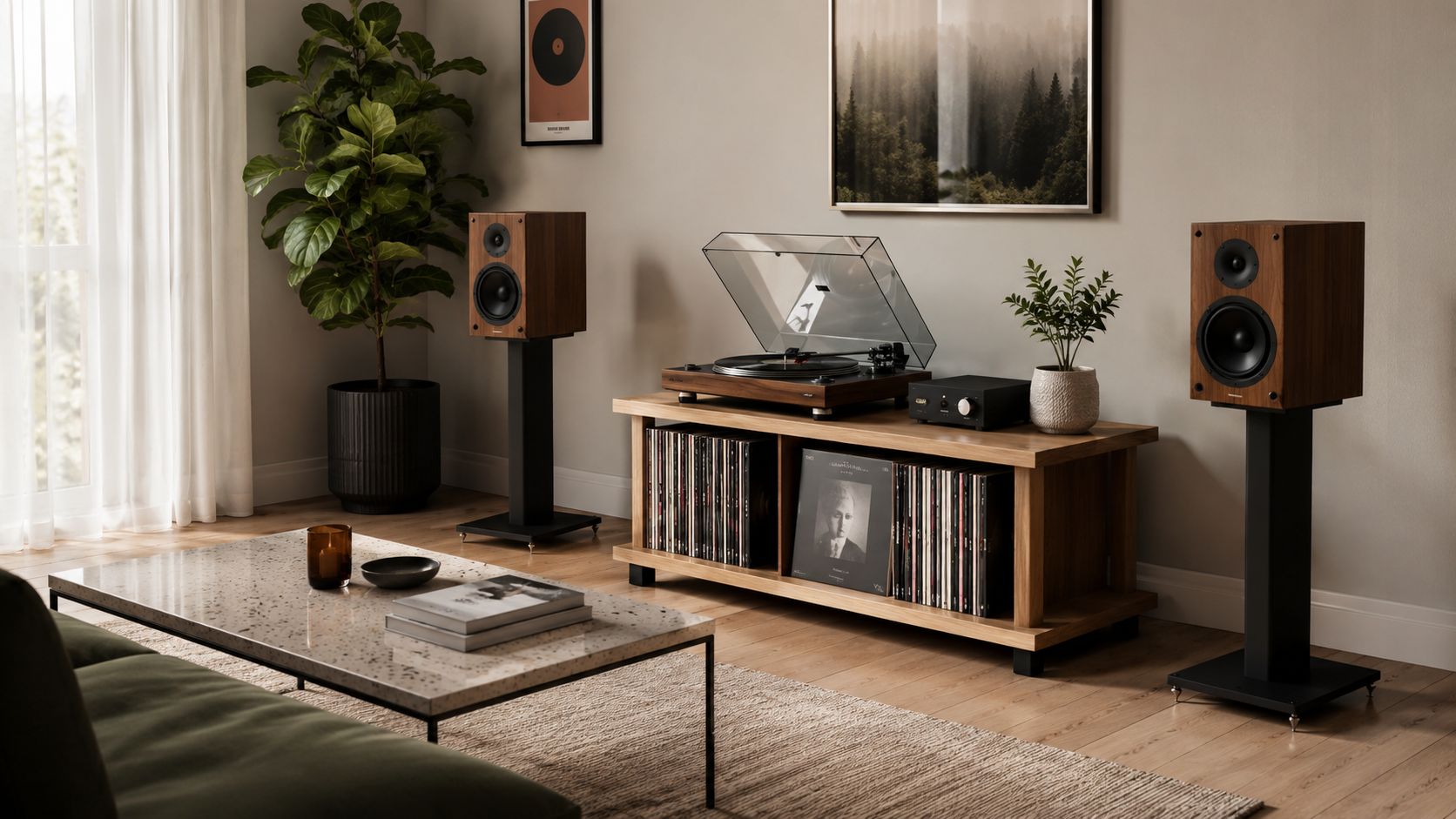
Most record player setup living room advice is written for a room that doesn't exist. It pretends your sofa, your coffee table, your partner, and your floor are all optional. They're not. A setup that works in a real living room has to respect the room you live in, not the fantasy room in a brochure.
The trick is simple and annoying. The best setup isn't the one that obeys every audiophile rule like a schoolboy, it's the one that keeps the load-bearing rules intact and bends the rest without wrecking the sound. That's how you get music that breathes in the room instead of turning the room into a shrine to bad compromises.
Table of Contents
- Your Living Room Is Not a Recording Studio Good
- The Load-Bearing Geometry of Sound
- The Electrical Path and The Hum You Can Avoid
- Taming Vibrations and Other Physical Gremlins
- Cable Management and Other Aesthetic Victories
- The Art of The Compromise and The Final Tweak
Your Living Room Is Not a Recording Studio Good
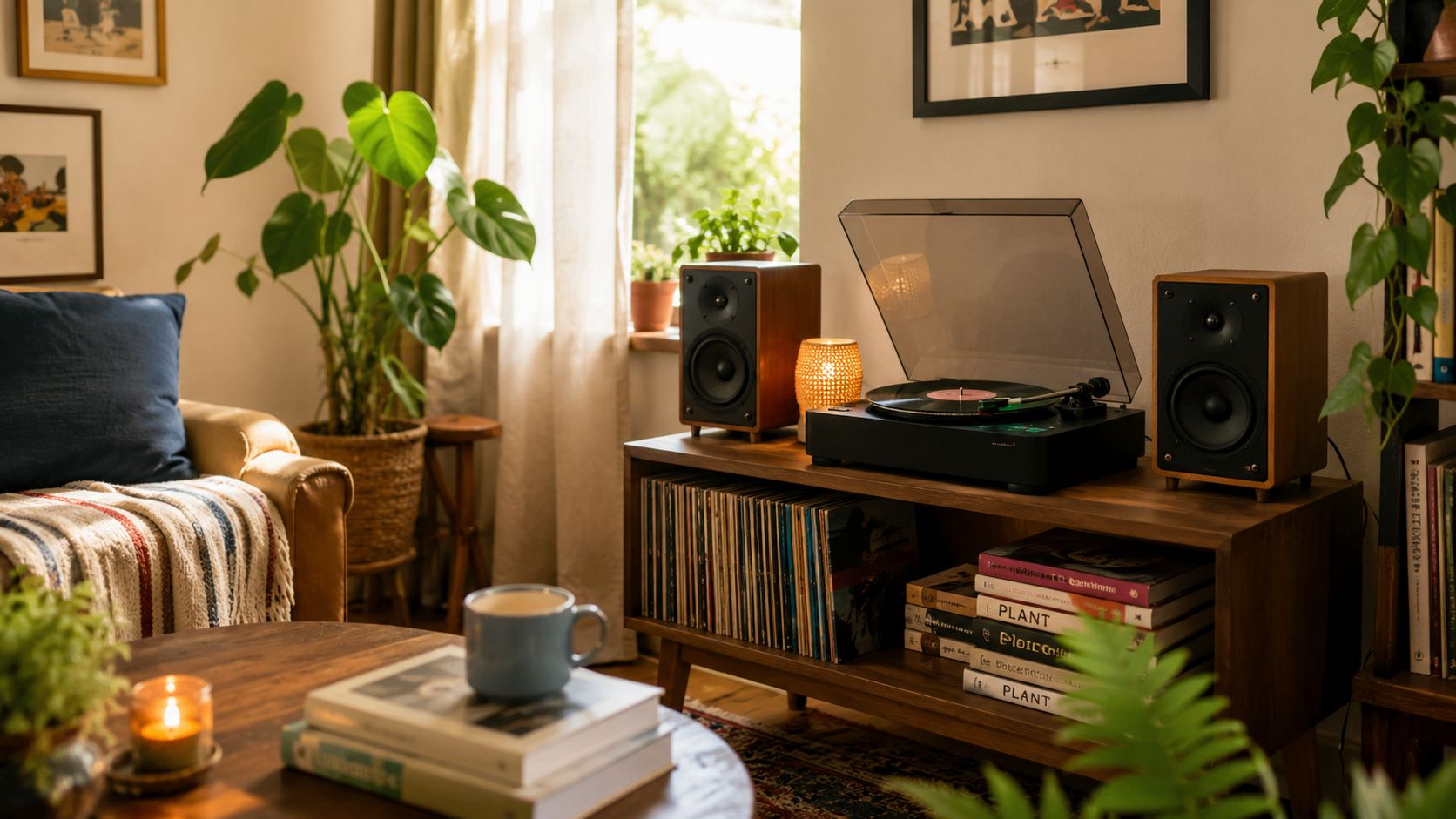
A living room setup lives or dies on compromise. Not the mushy kind, the useful kind. You don't need a sterile listening bunker. You need a turntable, speakers, and records to look intentional while still sounding like someone cared.
The market tells the story plainly. The global turntable market was valued at about USD 287 million in 2023 and is projected to reach roughly USD 463 million by 2030, which implies a CAGR of around 7.1% according to Deep Cut's interior design piece on record players. That growth says the same thing I hear from customers every week, the question has shifted from “where do I hide this?” to “how do I make it part of the room without wrecking the room?”
Treat the turntable like furniture, not temporary clutter
That shift matters because a good record player setup living room layout is visual and acoustic at the same time. Front-facing record storage, a stable stand, and a clean cable path make the whole thing feel deliberate. A deck shoved onto a wobbly shelf with wires hanging like a bad haircut tells the room it's a weekend project.
Practical rule: if the setup looks temporary, people treat it like temporary gear. Then it gets bumped, moved, dusted badly, and listened to less.
I'm blunt about this because the room changes how often you use the system. If it looks like part of the home, you'll play records. If it looks like it's in witness protection, you won't. That's the essential design task.
The old hi-fi fantasy was isolation. The modern living room asks for integration. That's the game.
Start with the wider home-audio layout principles
The Load-Bearing Geometry of Sound
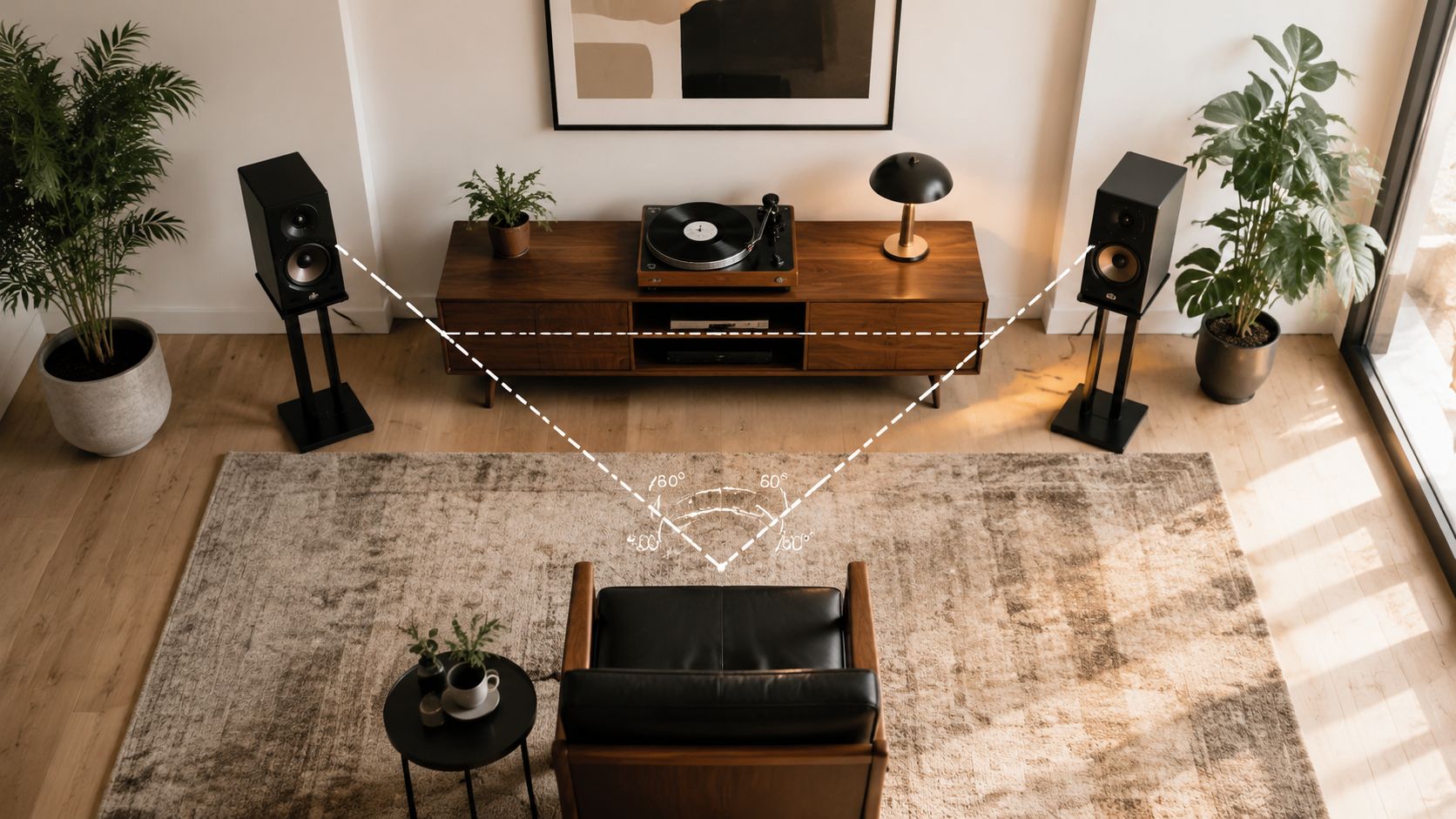
The speaker layout is the part you don't freestyle. Get this wrong and everything downstream inherits the damage. Get it right and the room stops fighting you.
The basic shape is an equilateral triangle. Put the speakers and your listening seat in that triangle, keep the tweeters at ear height, and pull the speakers at least 30 cm from the rear wall so bass doesn't bloom and smear the stereo image, as outlined in Audioengine's vinyl listening space guide. That's not cosmetic advice. That's the geometry that lets the left and right channels arrive with enough balance to make a centered voice sound like a person, not a rumor.
Why the triangle is the floor under the whole system
I've seen people obsess over cartridges while their speakers sit wherever the console happened to fit. That's backwards. If the speakers are too close to the wall, the low end thickens up and the center image gets blurry. If one speaker is closer to the listener than the other, the phantom vocal starts drifting off like it's late for a train.
Keep the speakers where they can breathe. The room always tells you when they're cramped.
Tweeter height matters because the high frequencies carry the edges of the image. If the tweeter shoots over your shoulder or into your knees, the stage loses focus. You don't need laser precision. You do need the drivers aimed at the part of your head that listens.
Set the foundation before you chase the pretty stuff
Level the plinth, level the platter, then place the speakers. That order matters. I know it's tempting to admire the furniture first, but sound doesn't care about your mood board. Sound cares about symmetry, wall distance, and whether the seat can hear both channels evenly.
This is the part people call boring because it works. Boring is fine. Boring is load-bearing.
See the speaker placement basics that keep bass from swallowing the room
The Electrical Path and The Hum You Can Avoid
A turntable signal is tiny. Tiny signals are fragile little things, and they don't forgive lazy wiring. If you want quiet playback, the electrical chain has to be treated with the same respect as the placement.
The deck needs to go into a PHONO input or an external phono preamp, and the ground wire needs to be attached if the turntable has one. That's because the cartridge signal needs RIAA equalization and gain, and skipping that step usually gives you hum or very low output, as explained in Record Player Guide's setup guide. If you plug into the wrong input, you're not getting “a different sound.” You're starving the signal.
The phono preamp is a translator, not a luxury
Think of the preamp as the person in the room who speaks both languages. The cartridge sends out a weak signal with the wrong tonal balance for direct use. The phono stage boosts it and puts the frequency curve back where it belongs. Without that translation, the music comes out thin, quiet, or buzzing like an angry fluorescent light.
Proper tracking force usually sits between 1.5–2.5 g, depending on the cartridge, and the counterweight should be balanced before you set it, with anti-skate matched after that, according to the same setup guidance. I'd rather see a beginner follow that order carefully than invent “feel” and chew up a stylus.
Do the small mechanical steps in the right order
First, secure the tonearm. Then balance it so it floats level. Zero the dial. Set tracking force. Match anti-skate. That sequence keeps the stylus riding the groove with enough pressure to track cleanly, not enough to wear the record like sandpaper.
Choose an amplifier path that matches the rest of the chain
If the setup hums, check grounding before you blame the record. Half the “mystery noise” I hear on bad systems is just a missing wire doing exactly what a missing wire does.
The electrical side isn't glamorous, but it's ruthless. Get it right and the background goes black. Get it wrong and every track sounds like it's coming through a bad fence.
Taming Vibrations and Other Physical Gremlins
A turntable is basically a vibration detector with ego problems. It hears the music, sure, but it also hears the floor, the cabinet, the subtlest wobble in the stand, and the cheap shelf you thought was “good enough.” That's why a stable surface isn't optional.
Best Buy Canada's setup guidance is blunt about this, a turntable should sit on a sturdy, non-wobbly surface, and a tilted deck can hurt sound quality and even scratch records, with a spirit level used to verify the plinth before playback, as noted in their beginner setup guide. I agree with that completely. A bad surface isn't a cosmetic problem, it's an acoustic problem and a mechanical one.
Why wobble turns into bad sound
The signal starts in the groove, but vibration joins the party before the stylus can do its job. If the furniture moves, the cartridge reads movement that isn't on the record. That extra motion turns into muddied bass, weaker imaging, and the kind of skipping that makes people glare at the system like it insulted them.
A heavy, level stand is the baseline. Isolation feet or a proper platform help when the furniture itself is decent but not dead quiet. A dedicated rack is better when you've got the room and the budget, because mass and stability are doing real work there, not playing dress-up.
Don't park the deck where the room is busiest
I've watched people place a turntable beside a walkway and then act surprised when the stylus hates it. Feet, doors, subwoofers, and even a heavy stomp across a suspended floor can all feed the table. The solution is simple, keep the player away from traffic and give it a surface that doesn't shimmy when someone crosses the room.
A turntable doesn't need drama. It needs stillness.
That's the whole physical game. Make a quiet island, and the groove has a chance to speak cleanly.
Cable Management and Other Aesthetic Victories
A beautiful setup that looks like a rat's nest behind it is only half-built. The front might say “curated,” but the back says “I gave up.” In a living room, that matters because people see the cables every time they walk past the system.
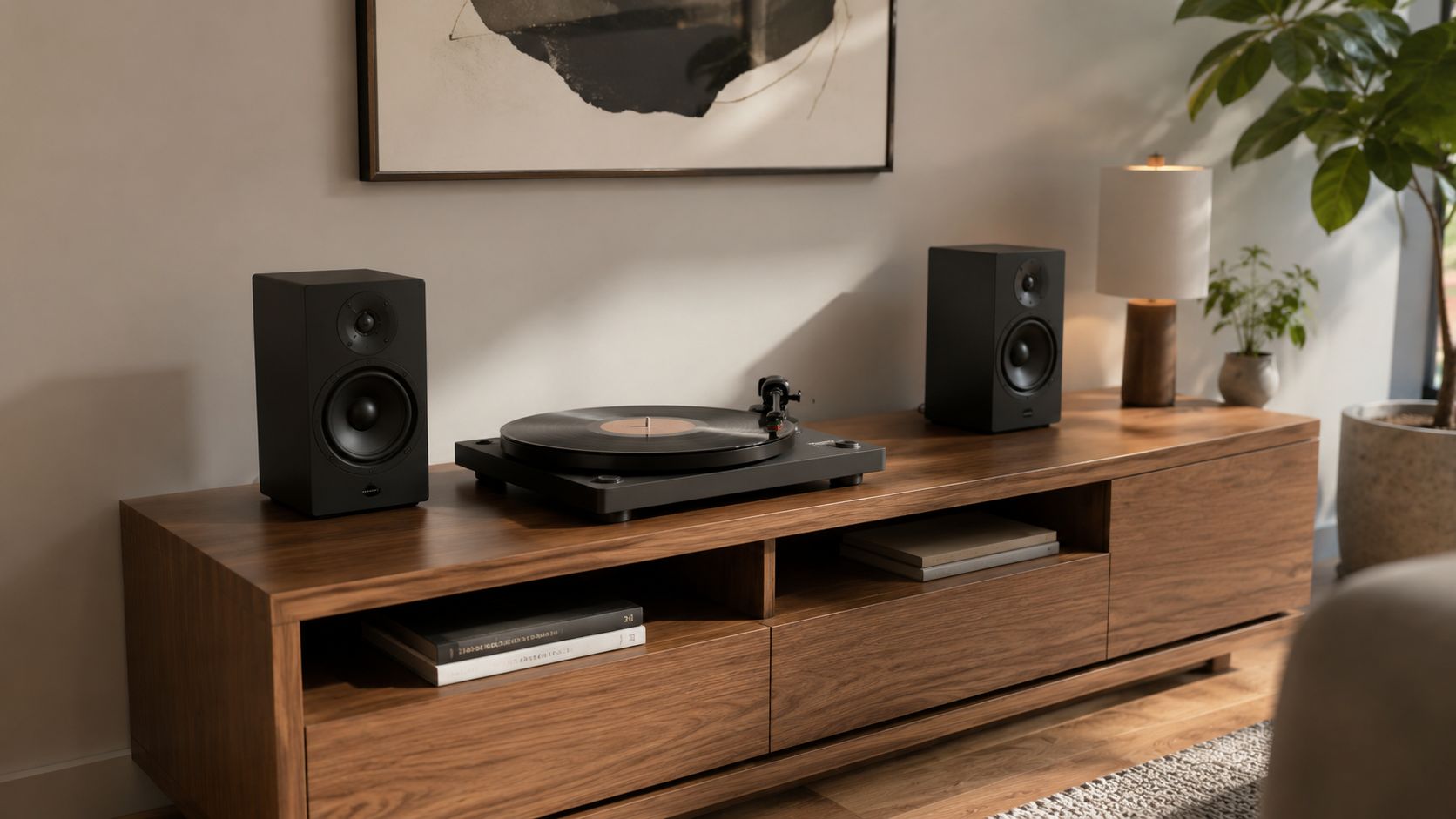
Cable cleanup is not a vanity move. It keeps the setup readable, and readable setups get used. Braided sleeves, adhesive clips, and a short, direct route from turntable to amp or powered speakers are the difference between a system that looks settled and one that looks like it's waiting for a refund.
Make the wires disappear without hiding the truth
Don't snake cables across open surfaces if you can avoid it. Run them along the back edge of the furniture, keep power and signal lines from tangling into one ugly knot, and leave enough slack that nobody yanks the deck forward when they dust around it. That's not perfection. That's basic respect for the equipment.
Record storage deserves the same attitude. Front-facing storage turns the collection into part of the room instead of a closet in disguise. Modular shelving works because it scales with the collection and doesn't force you to stack jackets like firewood.
The tension here is display versus resonance, and Turntable Kitchen's home vinyl guide gets the point right. Visible storage can look great, but large hard surfaces like glass can create acoustic problems such as slap echo. So yes, make the room attractive, but don't build a reflection chamber around the system.
Put the records where the room can actually see them
A front-facing “now playing” stand does more than look clever. It makes the listening ritual visible, which is half the charm of vinyl in a shared room. Your collection becomes part of the décor, not a private stash hiding in plain sight.
That video doesn't matter because it's flashy. It matters because the best setups are visible in motion. The gear has to look calm while still being ready to play.
The point is simple. If the room says “permanent,” the system feels right.
The Art of The Compromise and The Final Tweak
No living room is perfect, and that's fine. The last stretch is about choosing the compromises that keep the music alive without making the room hostile to life. That's where rugs, curtains, and common sense earn their keep.
A thick rug softens floor reflections. Heavy curtains calm bright windows. Soft furnishings do some of the work that ugly acoustic foam panels would otherwise do, only they don't make the room look like a rehearsal space somebody abandoned in a hurry.
Solve for the room you actually have
If a speaker wants to sit exactly where a doorway lives, you've got a decision to make. Move the speaker and accept a slightly weaker image, or leave it in the ideal spot and turn the room into a traffic obstacle. I'm not interested in fake purity here. I'm interested in the setup you'll keep using six months from now.
In this context, human factors are paramount. A shared living room is part acoustics, part interior design, and part relationship counseling. If you need people to respect the system, the system has to respect the room.
The best setup is the one you don't resent after dinner.
That line saves more systems than expensive upgrades do.
Stop chasing perfect and start chasing repeatable
Once the geometry is right, the wiring is quiet, and the deck is stable, the final tweak is personal. Move the chair a little. Toe the speakers in a touch. Add fabric where the room feels sharp. Listen again. Your ears will tell you when the center image stops wandering and the bass stops puffing itself up.
That's the standard. Not theory, not showroom fantasy, and not some monkish room that nobody lives in. The best record player setup living room is the one that sounds good, looks right, and survives actual human use.
If you want the next step after this, use it to build a system that fits your room instead of fighting it. Start with the home-audio fundamentals at Supermarket Sound, then tune the rest around the way you really live.

