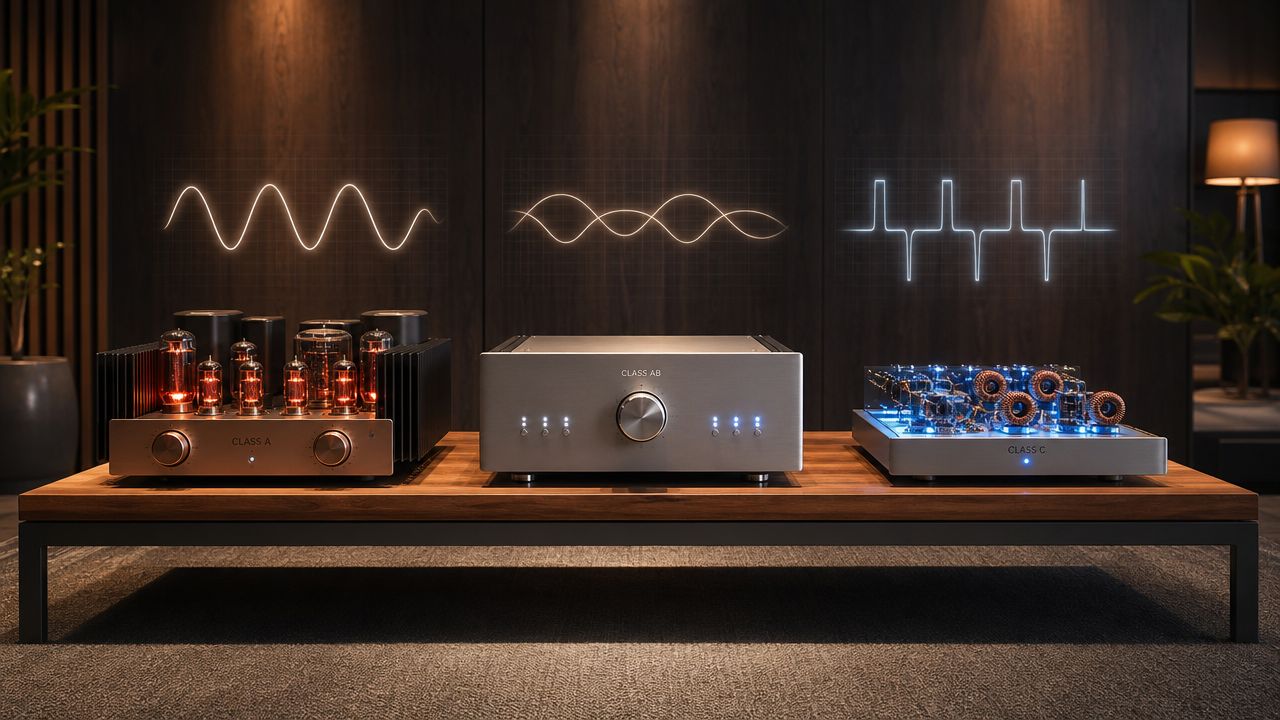
People love to talk about amplifier classes like they're Pokémon evolutions. They aren't. Classe A B C is not a ladder from primitive to enlightened. It's a pile of engineering compromises, and half the bad advice online comes from pretending otherwise.
My take is simple. The best amplifier class on paper often isn't the best one in your room, with your speakers, at your listening levels. And one part of this alphabet soup needs to be kicked out of the room entirely. Class C has nothing to do with music playback. If you're still sorting out the basics, start with a plain-English beginner's guide to amplifiers. Then come back ready to ignore the spec-sheet theology.
Table of Contents
- The Amplifier Class War Is a Lie
- Class AB The Compromise That Won The War
- The Red Herring Why Class C Is Not For Audio
- How Amps Sound In a Room Not On a Bench
- A Buying Heuristic For People Who Listen to Music
The Amplifier Class War Is a Lie
The old argument goes like this. Class A is pure. Class B is crude. Class AB is compromise. Therefore the closer you get to Class A, the better your sound. Nice story. Terrible buying advice.
Amplifier classes aren't moral categories. They're decisions about where the designer wants to spend the pain. Heat, efficiency, distortion behavior, output capability, chassis size, power supply demands, electricity cost, speaker control. Nothing comes free. Downstream, your room inherits every one of those decisions.
The right amp class isn't the one with the prettiest theory. It's the one whose compromises stay below the floor of what you can actually hear.
That's why the whole classe A B C debate gets silly fast. People compare a topology in the abstract instead of comparing complete amplifiers in a room. A good design can make one class sing and another sulk. A bad design can ruin any of them.
Here's the part the marketing department hates. “Higher purity” doesn't automatically mean “better listening.” Sometimes the thing that measures more elegantly also runs hotter, strains harder, and leaves you with a box that's impressive in a forum signature and less convincing in an actual living room.
Class A The Purist's Space Heater
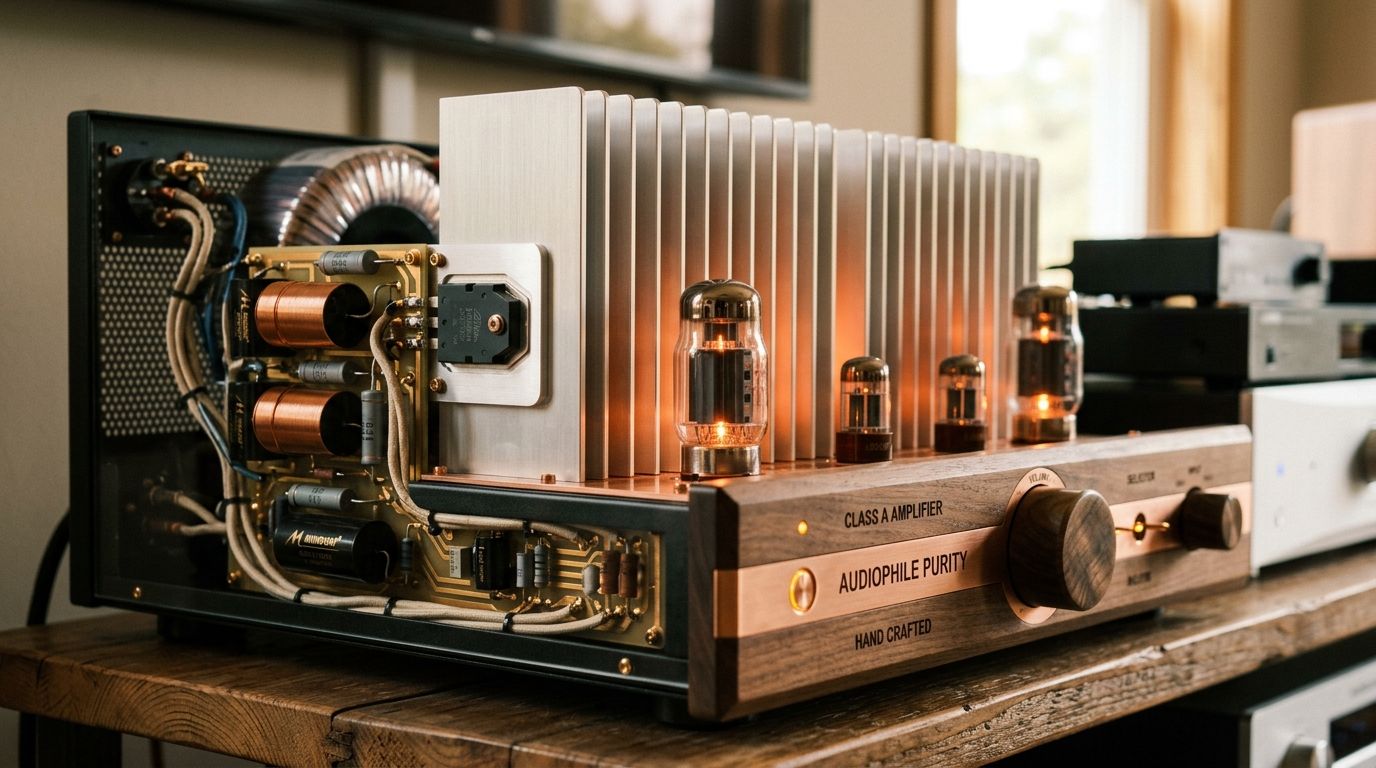
Class A is the fantasy version of amplification. The output device stays on all the time, conducts through the entire signal cycle, and never has to do that ugly handoff that creates crossover nastiness in lesser schemes. In technical terms, Class A conducts through θ = 360°, which is why it delivers maximum fidelity and the lowest distortion, but also the worst efficiency, typically below 30%, according to this Class A conduction and efficiency breakdown.
Why Class A seduces people
To my ears, good Class A doesn't sound “detailed” in the brittle audiophile-brochure sense. It sounds continuous. Voices have a kind of poured-cream texture. Strings stop sounding like separated strands of information and start sounding like one event in space.
That coherence matters more than people admit. It isn't about hearing a new triangle hit in the back corner. It's about the whole presentation losing a little mechanical edge. Notes arrive with less grain. The midrange can feel load-bearing in the best way. It carries the emotional weight of the music.
If your system leans toward vocal, acoustic, jazz, chamber music, or anything where tone and body matter more than brute slam, Class A can be intoxicating. That's why people stay loyal to it long after they've read all the practical objections.
Practical rule: If you're chasing texture, not fireworks, Class A is one of the few technologies that can make you forget the circuitry for a while.
A lot of vinyl listeners end up here for exactly that reason. If that's your lane, it helps to think about the whole chain, not just the amp. I'd pair this with the thinking in this guide to the best amp for turntable systems.
What the romance costs
Now the part people soft-pedal. Class A pulls constant current and throws off serious heat. The amp isn't only amplifying music. It's heating the room whether music is playing or not. That means big power supplies, substantial thermal management, and a chassis that often feels like it was designed by someone who hates furniture.
Here's the trade in plain English:
- Lower distortion behavior: The output device never cuts off, so crossover distortion doesn't enter the conversation.
- Higher heat burden: A lot of what you pull from the wall becomes heat instead of music.
- More demanding ownership: Placement matters. Ventilation matters. Summer matters.
The result isn't “bad.” It's expensive, hot, and fussy. Those are different things.
I love a great Class A amplifier. I just don't worship it. Not everyone needs their stereo to double as a winter appliance.
Class AB The Compromise That Won The War
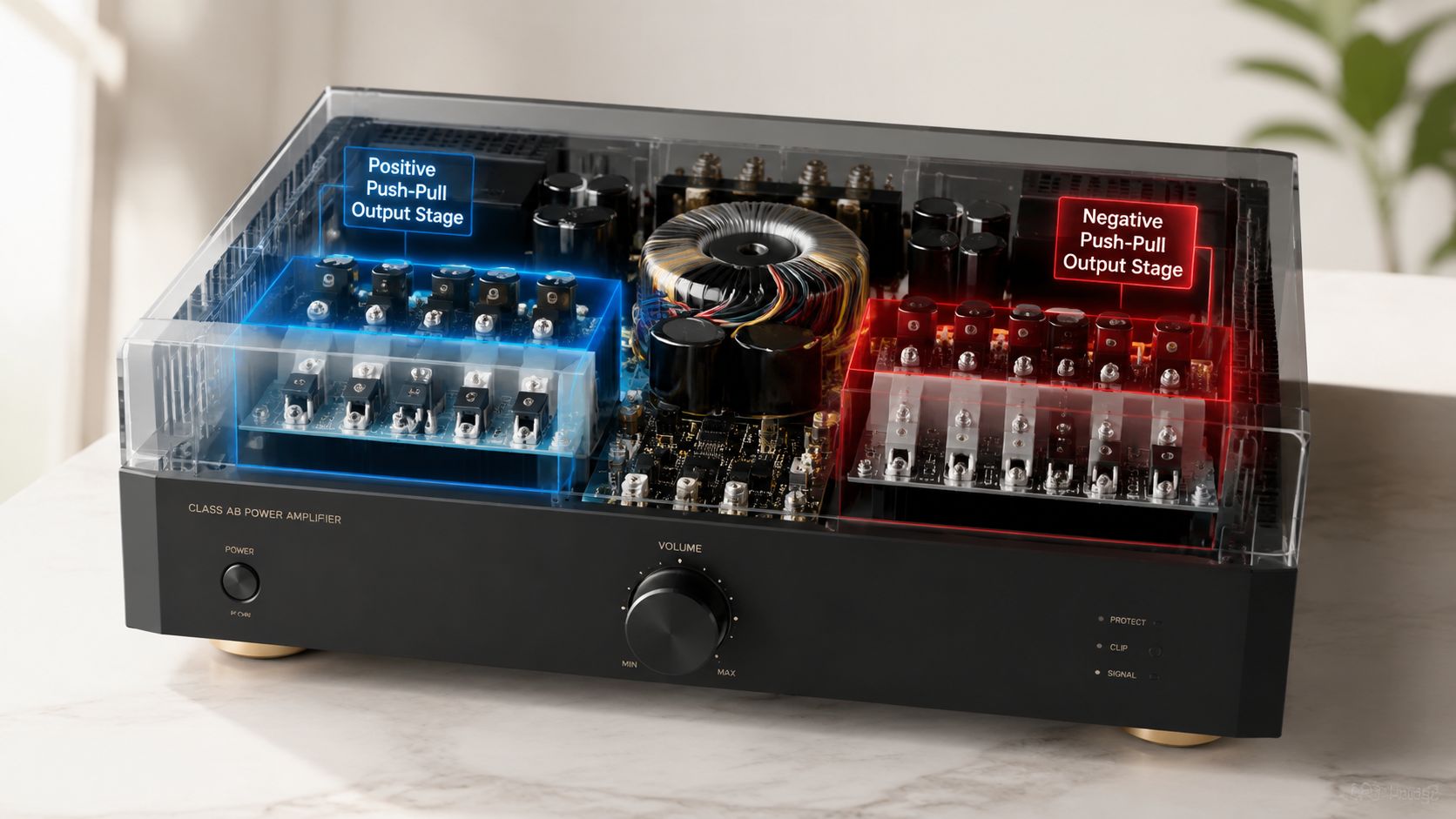
Class AB is what happens when an engineer keeps their ego under control. It doesn't pretend purity is free. It just asks a smarter question. How much of the good stuff can we keep without cooking the room and wasting power for sport?
That question built most of modern home audio.
Class B created the problem
To understand AB, you have to understand the flaw it fixes. Class B uses a push-pull configuration where each device conducts for 180° of the waveform, and that handoff creates crossover distortion, as outlined in this overview of Class B and Class AB operation.
That zero-crossing handoff is the problem. One side stops. The other starts. If that transition isn't smooth, the signal gets nicked right where your ear is good at noticing it. Not always as some giant obvious rasp. Often as dryness, edge, or a faint sense that the music is assembled rather than flowing.
Here's the ugly truth. A clever spec sheet can hide a lot of that. Your ears usually won't.
Class AB fixed it without losing the plot
Class AB keeps the push-pull architecture but biases both devices so they conduct slightly beyond that strict halfway point. That overlap smooths the handoff. Not perfectly in all cases, but enough that the ugliness drops and the efficiency stays practical.
That's why Class AB became the workhorse. It gives you clean power, reasonable heat, and real-world drive. Not saintly. Useful.
Class AB is not the “middle child” of amplifier classes. It's the adult in the room.
In listening terms, well-done AB often sounds more grounded than romantic. Bass has firmer edges. Drums hit with more conviction. Big dynamic swings don't feel like they're asking permission first. If Class A can charm you with flow, Class AB tends to win with stability.
And yes, some of that “boring” practicality is exactly what makes it good.
Here's a visual explainer worth your time if you want the circuit behavior in motion.
The reason AB stayed dominant isn't mystery. It solved a real audible problem without becoming ridiculous to own. That's good engineering. Not glamorous. Better.
The Red Herring Why Class C Is Not For Audio
Let's clear out the nonsense. If you're searching for classe A B C because you assume all three belong in hi-fi, one of them doesn't. Class C is not an audio amplifier class in any practical consumer-music sense.
According to this Dynaudio explainer on amplifier classes, Class C amplifiers are strictly RF devices, with around 80% efficiency and more than 50% distortion, which makes them useless for music playback. That's not a subtle preference call. That's a category error.
Why people keep searching for it
The confusion is easy to explain. People see A, B, AB, then assume C must be the next option on the menu. Or they mix it up with Class D, which is absolutely relevant to audio. Search engines don't care if the user is mixing up radio transmission and home listening. They just see letters and traffic.
That's how bad folklore gets legs.
A Class C circuit conducts for less than half the signal cycle. In RF work, a tuned circuit cleans up the mess and makes that behavior useful. In music playback, that same behavior mangles the waveform. You don't get charm. You get wreckage.
The only answer you need
If somebody asks whether Class C is better than Class A for sound quality, the answer is no.
If somebody asks whether a Class C hi-fi amp is a hidden gem, the answer is also no.
Use this as the filter:
- For music playback: Think Class A, Class AB, and modern Class D.
- For RF transmission: Class C exists for that world, not your stereo rack.
- For search confusion: The letter C shows up because people mistype and misread, not because it belongs beside the others in a listening-room shootout.
That's the whole story. Short for a reason.
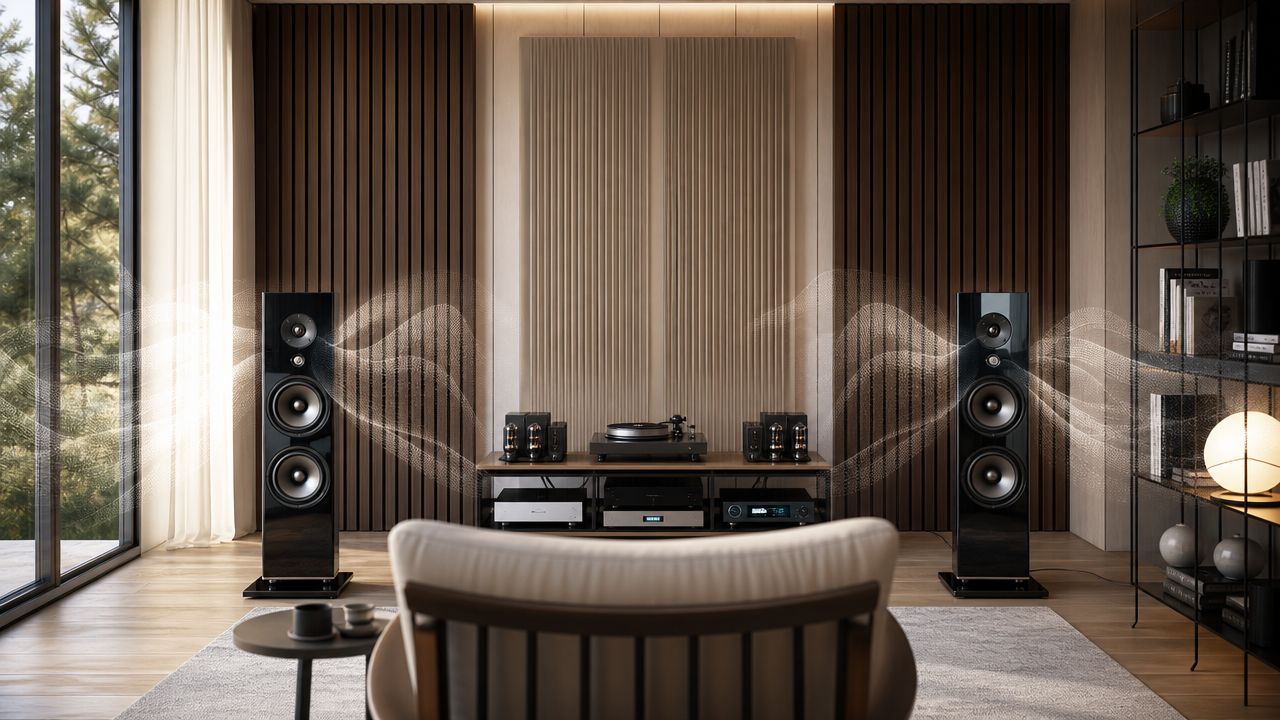
How Amps Sound In a Room Not On a Bench
Spec sheets tell you what an amplifier does under controlled conditions. Your room tells you whether the thing can carry a song without falling apart. Those aren't the same test.
Class A sounds like flow
In a real room, good Class A often gives you the illusion that notes are less assembled and more born. The midband has flesh on it. Singers step forward with body, not just outline. Cymbals don't merely shimmer. They bloom and decay in a way that feels less interrupted.
That quality can be addictive. You stop listening for “detail retrieval” and start listening to phrasing, breath, bow pressure, the little human hesitations that make a performance feel inhabited.
But there's a catch. If the amp runs out of comfort with a difficult speaker load or sustained volume, the bass can soften and the whole picture can lose grip. Not always. But often enough that blind devotion to topology gets expensive.
Class AB sounds like grip
A strong Class AB design usually sounds more planted. Kick drums have firmer start-stop behavior. Bass lines carry more shape and tension. Big orchestral rises don't feel like the amp is sweating under the floorboards.
That matters in normal homes. The average listener isn't enjoying sound in a perfectly treated shrine with easy speakers and saintly climate control. They're in rooms with reflective surfaces, awkward placements, and speakers that ask for current with zero manners. In that situation, AB's practicality often translates to better sound, not lesser virtue.
A bench can tell you distortion behavior. It can't tell you whether the chorus opens up or whether the amp clamps down when the room gets lively.
Online arguments frequently falter. They compare ideals. You hear implementations.
Class D changed the practical argument
Modern Class D deserves its own lane because it broke the old script. It is not “fake hi-fi” and it is not automatically sterile. Class D amplifiers use pulse-width modulation at switching frequencies of 250 to 550 kHz, with efficiency of 85 to 95%, and can drive 4Ω loads with less than 0.05% THD, according to this Class D overview with switching-frequency and efficiency details.
That matters because high efficiency isn't a side benefit. It changes the ownership experience. Smaller chassis. Less heat. More placement flexibility. More usable power without the amp acting like it needs a union break.
To my ears, the best current Class D sound is clean, quiet, and controlled. The background goes black. Bass firms up. Images snap into place. What you may give up, depending on the design, is a little of that soft-lit midrange liquidity people adore in Class A. What you gain is composure.
Here's the plain version:
| Class | What tends to stand out in a room | What can go wrong |
|---|---|---|
| Class A | Texture, continuity, midrange body | Heat, softening under stress |
| Class AB | Drive, punch, all-round balance | Less romance if the voicing is dry |
| Class D | Control, silence, efficiency, compact power | Can sound matter-of-fact if poorly voiced |
None of those are universal truths. They are patterns. Useful ones.
A Buying Heuristic For People Who Listen to Music
Forget the alphabet obsession. Buy for your speakers, your room, your habits, and your tolerance for heat and nonsense.
The ownership part matters more than many audiophiles want to admit. Running a Class A amplifier for 4 hours daily can cost $200 to $400 per year in electricity, while a modern Class D equivalent can come in at less than $50, based on this energy-cost comparison for amplifier classes. That difference isn't romantic. It lands on your bill.
Buy for speaker load and listening habits
If you have easy speakers, listen at sensible levels, and care most about tonal density, vocal intimacy, and that “everything melts together” quality, Class A can be glorious. It's a specialist choice. A lovely one. But still a specialist choice.
If your music diet includes rock, electronic, large orchestral work, or anything with jump and impact, a good Class AB is usually the smarter floor. It gives you headroom, bass grip, and fewer ownership penalties. Not spiritually superior. Just better aligned with reality.
And if you want compact size, cooler operation, and strong speaker control without paying the traditional heat tax, modern Class D makes a lot of sense. Pairing it with sensible front-end gear matters, and so does voicing, but the old sneering at the category is stale.
The fast decision rule
Use this quick filter:
- Choose Class A if your room is modest, your speakers are friendly, and you want texture more than brute force.
- Choose Class AB if you want the safest all-round answer for mixed music and normal domestic life.
- Choose Class D if you want power, efficiency, cooler operation, and a smaller box that still acts like a grown-up amp.
- Ignore Class C if your goal is music playback. It's the wrong tool entirely.
Don't buy a letter. Buy the amp that keeps your speakers under control and your attention on the music.
I'd also be honest about budget. Chasing topology while neglecting the rest of the chain is classic audiophile self-sabotage. A balanced system usually beats a doctrinaire one. If you're assembling a sensible front end without blowing the rent, this guide to the best budget DAC and amp combinations is the kind of practical thinking that saves people from dumb purchases.
My recommendation is blunt. For most listeners, Class AB or modern Class D is the right answer. Class A is for people who know exactly why they want it and accept the heat, size, and cost. Class C isn't part of the conversation.
That's the hierarchy I trust because it survives contact with an actual room.
Author: Marque Hersh
Publisher: Supermarket Sound
Author profile: Marque Hersh on Steam

