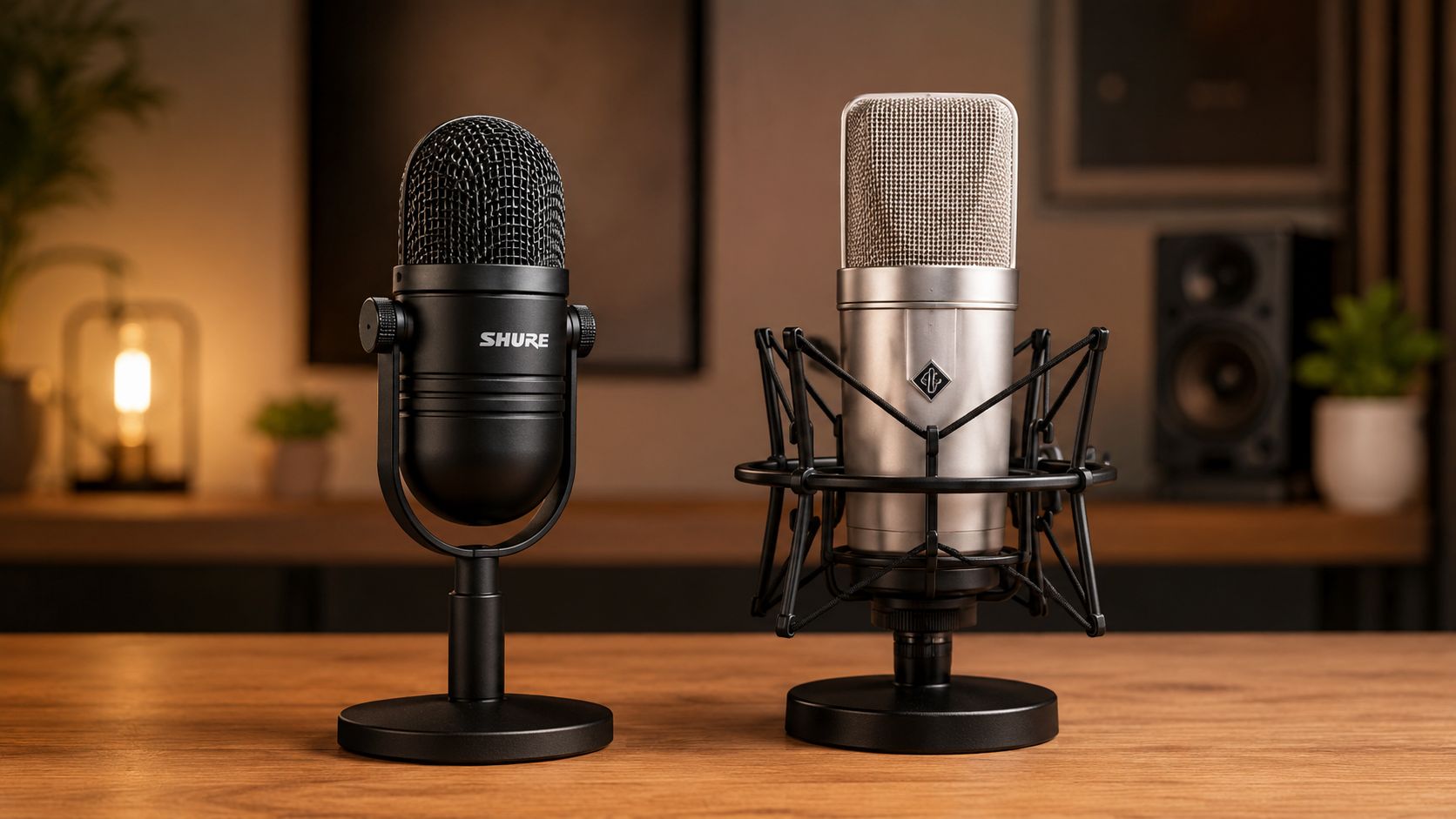
Most condenser mic advice is stale by a full hardware generation. The old rule said untreated room equals dynamic, treated room equals condenser. That used to be sensible. It isn't the whole truth now.
Modern noise reduction changed the load-bearing assumption. If software can strip a big chunk of ambient trash out of the signal in real time, then condenser mic vs dynamic stops being a room-only argument and becomes what it should've been all along. A question of texture, intent, and how much truth you want the microphone to tell.
I've heard enough of both to say this plainly. Dynamic mics don't win because they're “pro.” Condensers don't win because they're “detailed.” One gives you a voice with built-in guardrails. The other gives you a larger window into the source. Pick the one that matches the sound you want downstream, because your whole chain inherits that first decision.
| Attribute | Dynamic Microphone | Condenser Microphone |
|---|---|---|
| Core character | Focused, dense, forgiving | Open, fast, revealing |
| What it rewards | Close technique, loud sources, messy rooms | Controlled performance, nuance, detail |
| Voice vibe | Broadcast weight, tighter center image | Studio intimacy, more air and edge |
| Room tolerance | Better at ignoring junk around you | More honest about the room |
| Durability | Built for abuse | Better treated with care |
| Power needs | Usually simple to run | Needs phantom power in typical XLR setups |
| Best use mindset | Control the frame | Capture the whole scene |
Table of Contents
- How They Work Is How They Sound
- Why Background Noise Is a Solved Problem
- What Your Voice Sounds Like Up Close
- Choosing the Right Tool for Guitars and Drums
- The Practical Tradeoffs Nobody Talks About
- Your Decision Flowchart Not a Conclusion
How They Work Is How They Sound
The argument starts in the hardware, but it ends in your ears. A dynamic mic is not “worse detail.” It's a heavier mechanism doing heavier work. A condenser is not “better quality.” It's a lighter mechanism that reacts to smaller events. Those design choices are audible immediately.
A condenser has a sensitivity advantage of about 15 to 25 dB over a dynamic, and that's tied to an ultra-light diaphragm that's often under 10 µm, while a dynamic's moving-coil setup typically carries a diaphragm mass over 50 µm. That's why condensers grab quiet transients, breath, and string texture more easily, while dynamics ask for more sound pressure before they really wake up, as outlined in this condenser and dynamic sensitivity breakdown.
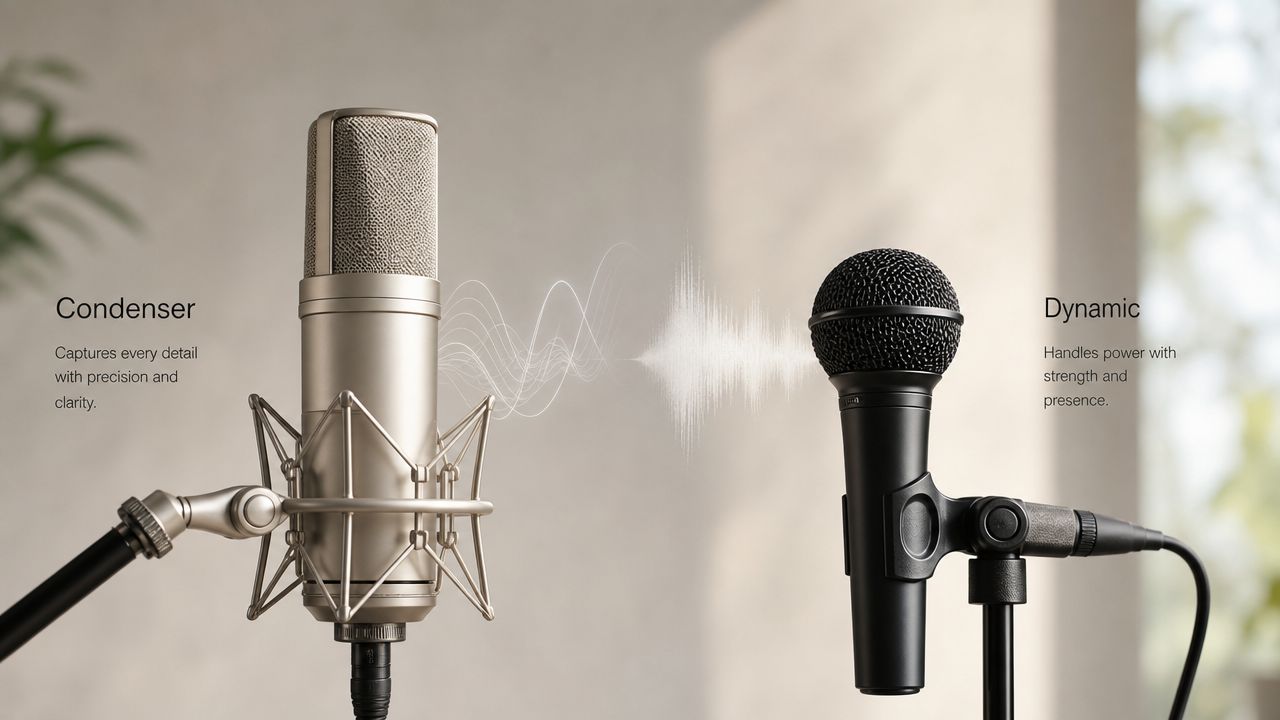
The Dynamic Mic Is a Brick Wall With a Door Cut Into It
To my ears, a good dynamic sounds like a frame around the source. It doesn't just capture sound. It organizes it. The heavier moving system rounds the attack a bit, keeps the center of the note solid, and takes some of the sharpest edges off ugly rooms and harsh voices.
That's why dynamic mics often feel thicker and more composed, especially close up. They don't fling every tiny reflection and mouth noise at your preamp. They give you the load-bearing parts of the performance first.
Practical rule: If the source already has too much bite, a dynamic often fixes the problem before EQ has to.
The Condenser Mic Is a Window That Refuses to Lie
A condenser reacts faster and tells on everything. You hear the front edge of consonants, the skin on a fingertip sliding over a string, the breath before a line. Used well, that sounds expensive. Used badly, it sounds like the mic is reading your room's police report back to you.
That's the true condenser mic vs dynamic divide now. Not pro versus amateur. Not studio versus bedroom. Clamp versus reveal.
Use a dynamic when you want the mic to shape the sound on the way in. Use a condenser when you want the source, the space, and the performance laid out with fewer excuses.
That's the floor.
Why Background Noise Is a Solved Problem
The old warning about condensers in untreated rooms came from a real problem. Condensers hear more. That used to mean your room joined the session whether you invited it or not. Fan noise, keyboard ticks, window slap, all of it.
What changed is simple. Software became good enough to act like digital treatment for a lot of everyday recording. Not perfect. Good enough.
A cited trend summary points to a 63% shift toward quiet-room condenser setups, while 90% of existing content still repeats the old “treated studios only” rule. The same source notes that modern DSP can cut ambient noise by 40 to 50% in real time, which is exactly why condensers have become far more usable in regular rooms than most guides admit, according to this discussion of quiet-room condenser setups and modern DSP.
The Old Rule Was Built for Raw Signals
If you record a condenser dry in a noisy room, yes, it will often hear too much. That part never stopped being true. The mistake is freezing the conversation there, like software doesn't exist, interfaces didn't improve, and everyday creators are still working like it's a decade ago.
People now track with noise suppression, gating, cleanup tools, and better monitoring habits. That doesn't turn a bad room into a world-class booth. It does move the decision line.
- If your room is chaotic: a dynamic still makes life easier.
- If your room is merely ordinary: a condenser is no longer automatically a bad idea.
- If your goal is detail: DSP gives you a path to keep that detail without wearing the whole room on your back.
That matters because too many people buy a dynamic for safety, then spend months trying to EQ back the openness they desired.
Background rejection used to be architecture. Now part of it is software.
Noise Control Is Now Part of Mic Choice
The condenser mic vs dynamic debate grows more authentic. You're not only choosing a capsule. You're choosing a workflow. Some people want to solve problems physically with placement and pickup behavior. Others would rather capture more information and let software strip out the junk.
Both are valid. One is not morally superior.
If you're fighting hiss, buzz, or weird background crud, fix the signal chain before blaming the capsule. I'd start with the basics in this guide on how to fix audio static. A lot of “my condenser is too noisy” complaints are really gain staging, cable noise, fan noise, or bad monitoring decisions wearing a fake moustache.
What This Means in Practice
I'll put it bluntly. “Condensers are only for treated studios” is dead advice for a lot of people. Not all people. A lot of people.
Choose a dynamic if your environment is loud, shared, or unpredictable and you need the mic to do defensive work. Choose a condenser if your room is reasonably manageable and your real priority is articulation, air, and transient detail. Modern DSP means you can now make that decision based on the sound you want, not just the room you tolerate.
That's the update most guides missed.
What Your Voice Sounds Like Up Close
Voice is where people feel this choice immediately. Not on a chart. In the headphones.
A dynamic up close gives you a voice with walls around it. The center image gets dense. The low mids lean in. The top end usually stays civil, which is a polite way of saying it doesn't magnify every sharp consonant and lip noise into a crime scene.

Since 1950, when the Shure 55S “Elvis” mic became the first mass-produced dynamic broadcast mic, radio stations have leaned on dynamics for a 1 to 3 dB presence boost in speech frequencies. Condensers became more common in studios after 1970 with the Neumann U87. That history matters because it explains why one family sounds like authority and the other sounds like intimacy, as noted in this podcasting microphone history overview.
The Dynamic Voice Is Pre-Mixed for Authority
A dynamic mic often sounds like someone already made a few smart mixing decisions for you. The voice sits forward without spraying detail all over the edges. You hear chest, shape, and a tidy center. It's not hi-fi in the glossy sense. It's edited by design.
That's why a lot of spoken-word people love them. You get a tighter lane in the mix, and your room doesn't keep trying to audition for co-host status.
For anyone building a voice setup, your monitoring matters as much as the microphone. If you're judging tone on weak playback, you'll chase the wrong fix. Get your ears calibrated with a proper beginner's guide to studio monitors.
The Condenser Voice Is Closer Than You Think
A condenser on voice feels different. The air around the words is more obvious. The front edge of syllables gets cleaner. You hear the person, not just the speech. Sometimes that sounds intimate and expensive. Sometimes it sounds brutally honest.
If the voice is naturally textured, soft, or expressive, a condenser can feel like the singer or speaker stepped half a foot closer to your face. Great for nuance. Terrible for sloppy technique.
Here's a listening reference worth using before you choose.
My bias: For podcasts, commentary, and anything that needs authority, I still reach for a dynamic first. For sung vocals, narration with emotional detail, or voice work that should feel high-resolution, I want a condenser if the chain can support it.
This isn't quality versus quality. It's persona versus persona. Broadcast focus or studio closeness. Pick your mask.
Choosing the Right Tool for Guitars and Drums
Instruments expose lazy mic advice fast. One mic type is not “for music” and the other isn't “for speech.” That's content mill nonsense. Instruments want the mic that fits the force, shape, and purpose of the source.
A dynamic can take punishment. A condenser can map nuance. Most useful setups mix both ideas instead of joining a tribe.
For Loud Amps Use the Hammer
On a cranked guitar amp, a dynamic makes immediate sense because the source is forceful and narrow in purpose. You usually want punch, midrange shape, and a sound that drops into a mix without asking for therapy.
Dynamic microphones are built with a coil-and-magnet structure that makes them rugged enough to handle sound pressure levels exceeding 150 dB SPL without distortion, which is why they remain such a natural fit for aggressive close-miking, according to this overview of dynamic mic SPL handling and design.
That toughness isn't just a durability flex. It changes how you work. You can get close, push the source, and trust the mic not to fold. The result is usually compact, punchy, and easy to place inside dense arrangements.
For Acoustic Detail Use the Lens
Acoustic guitar asks the opposite question. Not “can the mic survive this?” but “can the mic hear the fine grain?” The scrape of the pick, the shimmer on top, the body resonance underneath. For such subtleties, condensers earn their keep.
To my ears, a condenser on acoustic gives you more wood, more string edge, more room around the instrument. A dynamic can sound good here too, especially if the instrument is bright and the player is aggressive, but it tends to present the guitar as a shape. A condenser presents it as a surface with texture.
- Close solo acoustic: reach for a condenser if you want sparkle, finger noise, and room cues.
- Dense mix acoustic: a dynamic can work if you only need strum pattern and midrange pulse.
- Harsh instrument: a dynamic often saves you from sanding treble for an hour later.
Drums Usually Want Both
Drums are the best proof that condenser mic vs dynamic is often the wrong framing. On a real kit, one type handles impact, the other handles picture.
Use dynamics where you want punch and containment. Snare, toms, loud close positions. Use condensers where you want image, cymbal spread, and the sense that the kit exists in space.
A drum recording built only on close dynamic mics can sound like a box of parts. Overheads from condensers tell you it's a drum set.
That hybrid logic is the grown-up answer. Match the transducer to the job. Stop asking one mic family to do all the labor.
The Practical Tradeoffs Nobody Talks About
A lot of buyers obsess over tone and forget the boring parts that decide whether a mic fits their life. The sexy answer is “pick the one that sounds right.” The useful answer is “pick the one you'll use correctly for six months.”
The Boring Stuff Decides More Than People Admit
A condenser usually asks more from the chain. In a typical XLR setup, it needs phantom power. If your interface setup is shaky, the mic's strengths won't survive contact with reality. Before getting fancy, sort the front end with a reliable audio interface buying guide for recording.
A dynamic is simpler and more physically forgiving. That matters if your mic lives on a desk, gets moved around, or travels. Dynamics are the hammer in the toolbox. Not glamorous. Load-bearing.
Here's the quick gut check:
- Messy setup habits: dynamic.
- Stable desk setup with decent gain structure: either works.
- You want to throw it in a bag and not worry: dynamic.
- You're careful and want more nuance out of the source: condenser.
Handling Noise Is Not a Side Note
People talk about room noise and forget hand noise. Stand bumps. Desk taps. Tiny mechanical insults. Those sounds get into recordings more often than buyers expect.
Because of their low-mass diaphragms, condenser mics are lower in handling and mechanical noise than dynamic microphones with heavier moving coils, as explained in this comparison of dynamic and condenser microphone behavior.
That surprises people, because they assume the rugged mic is automatically cleaner in use. Not always. Rugged and mechanically quiet are not the same thing.
If you touch the stand a lot, type while recording, or live on a shaky desk, the mount matters almost as much as the mic.
The practical tradeoff is simple. Dynamics usually survive your habits better. Condensers often punish your setup less if it's physically stable and electrically clean. Different kinds of tolerance. Different kinds of failure.
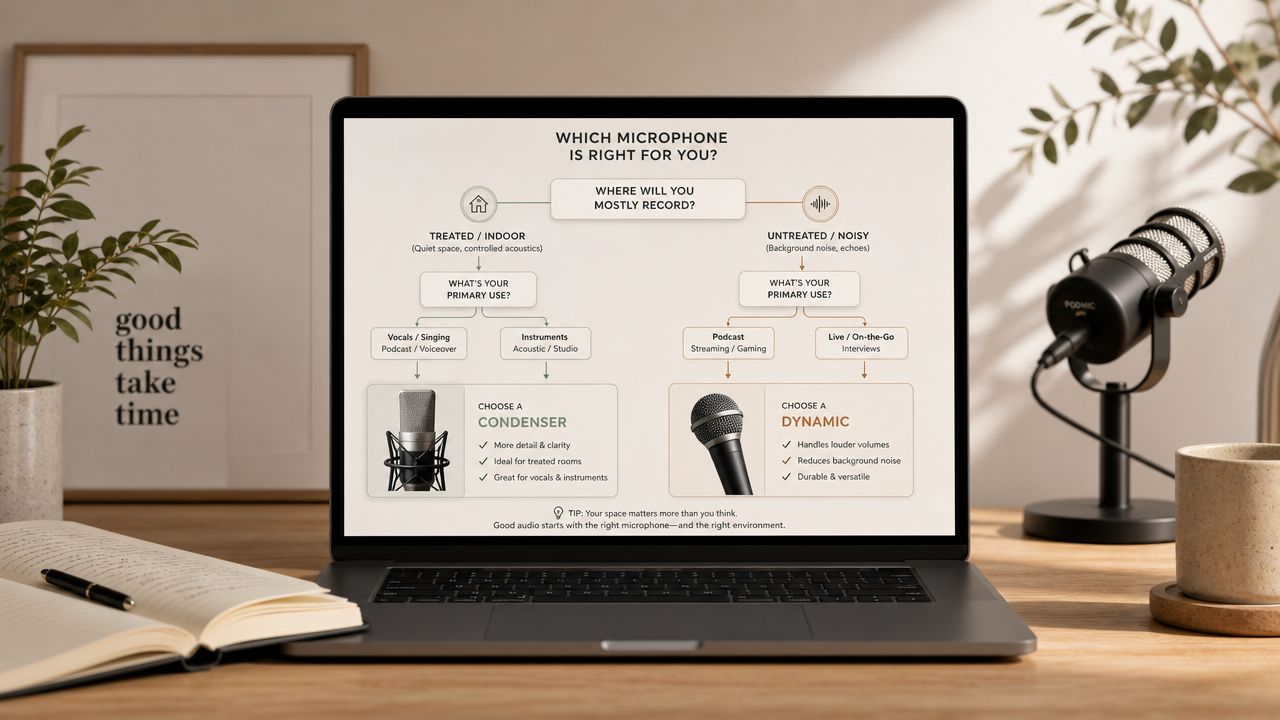
Your Decision Flowchart Not a Conclusion
You don't need another fake-balanced wrap-up. You need a decision. So here it is.
Start with the source, not the marketing. If you're recording something brutally loud, or something that benefits from focus more than finesse, start in dynamic territory. If you're recording something subtle, breathy, articulate, or harmonically rich, start in condenser territory.
Condenser Vs. Dynamic at a Glance
| Attribute | Dynamic Microphone | Condenser Microphone |
|---|---|---|
| Best first question | Do I need control? | Do I need detail? |
| Sonic shape | Dense, rounded, contained | Open, fast, revealing |
| Best for | Loud sources, spoken word, rough rooms | Vocals, acoustic instruments, nuance |
| Typical pain point | Can need more gain and sound less airy | Hears more of the room and chain |
| Personality | Broadcast | Studio |
| Ownership vibe | Tough and forgiving | Demands care and setup discipline |
Ask yourself these questions in order.
- Is the source extremely loud or physically punishing? Start with a dynamic.
- Is your main goal isolating a single voice in a less-than-ideal room? Dynamic.
- Do you want breath, string texture, transient snap, and more spatial information? Condenser.
- Is your room manageable and your cleanup workflow decent? Condenser is back on the table.
- Do you have an interface that can properly support the mic chain you're planning? If not, simplify first.
- Do you want the mic to flatter you, or expose you? That answer usually settles it.
Here's my blunt recommendation.
For podcasts, streaming, voice chat, rough rooms, mobile setups, and anyone who wants a controlled sound fast, buy a dynamic. For sung vocals, acoustic instruments, careful narration, and anyone chasing openness and detail, buy a condenser. If your room is merely normal and your cleanup tools are competent, stop treating condensers like forbidden fruit.
That myth had a good run. It's over.
Author: Marque Hersh
Publisher: Supermarket Sound
Profile: Marque Hersh on Steam

