
Most bad subwoofer setups aren't broken. They're crossed over badly.
The popular advice says set the crossover to 80 Hz, run room correction, and move on with your life. That's fine if your standards are low and your ears are off duty. A correct crossover setting gets you acceptable bass. A perfect one makes the subwoofer vanish, makes voices feel anchored, and makes your main speakers sound like they suddenly found another octave of authority.
What is a subwoofer crossover, really? Not a magic number. Not a polite suggestion. It's the load-bearing handoff between your speakers and your sub, and if that handoff is sloppy, downstream inherits the mess. You hear it as boom, thinness, chestless kick drums, or bass that seems to crawl out of a box in the corner instead of rising from the front soundstage.
I've heard expensive systems do this constantly. Fancy towers. Dual subs. Serious money. Then you look in the setup menu and there it is. A lazy default pretending to be calibration.
Your AV Receiver Is Lying About 80Hz
Your receiver loves 80 Hz because 80 Hz is easy. Easy for setup menus. Easy for support scripts. Easy for people who want one answer to a room-sized problem.
That doesn't make it wrong. It makes it incomplete.
For a lot of systems, 80 Hz is a solid starting point. It often works well enough that people stop there and call the job done. But the crossover isn't a set-and-forget preference like changing your wallpaper. It's a relationship between your main speakers, your subwoofer, and the room itself. If one of those three is out of step, the handoff sounds fake.
The proof is hiding in plain sight. Data from AVS Forum discussions in 2025 shows that 68% of users with two or more subwoofers still use the default 80 Hz crossover, often missing smoother room integration with a more optimized setting, according to this AVS Forum discussion summary. Two subs and still using the factory answer. That's not optimization. That's surrender.
Correct Is Not Perfect
A correct crossover gets bass into the room.
A perfect crossover makes the front speakers sound bigger, denser, calmer. The whole system stops feeling like separate boxes doing separate jobs. Bass lines gain shape instead of just mass. Movie effects hit with weight, but they don't smear into dialogue or crowd the center channel.
Practical rule: If you can point to the subwoofer with your ears, the crossover is doing a bad job.
If you're still new to bass management, my beginner's guide to subwoofers covers the basic hardware side. But system success or failure is determined by the handoff, rather than the spec sheet.
That handoff is everything.
The Crossover Is a Traffic Cop Not a Brick Wall
A subwoofer crossover is not a wall that sound crashes into. It's a traffic cop directing frequencies to the driver that can carry them.
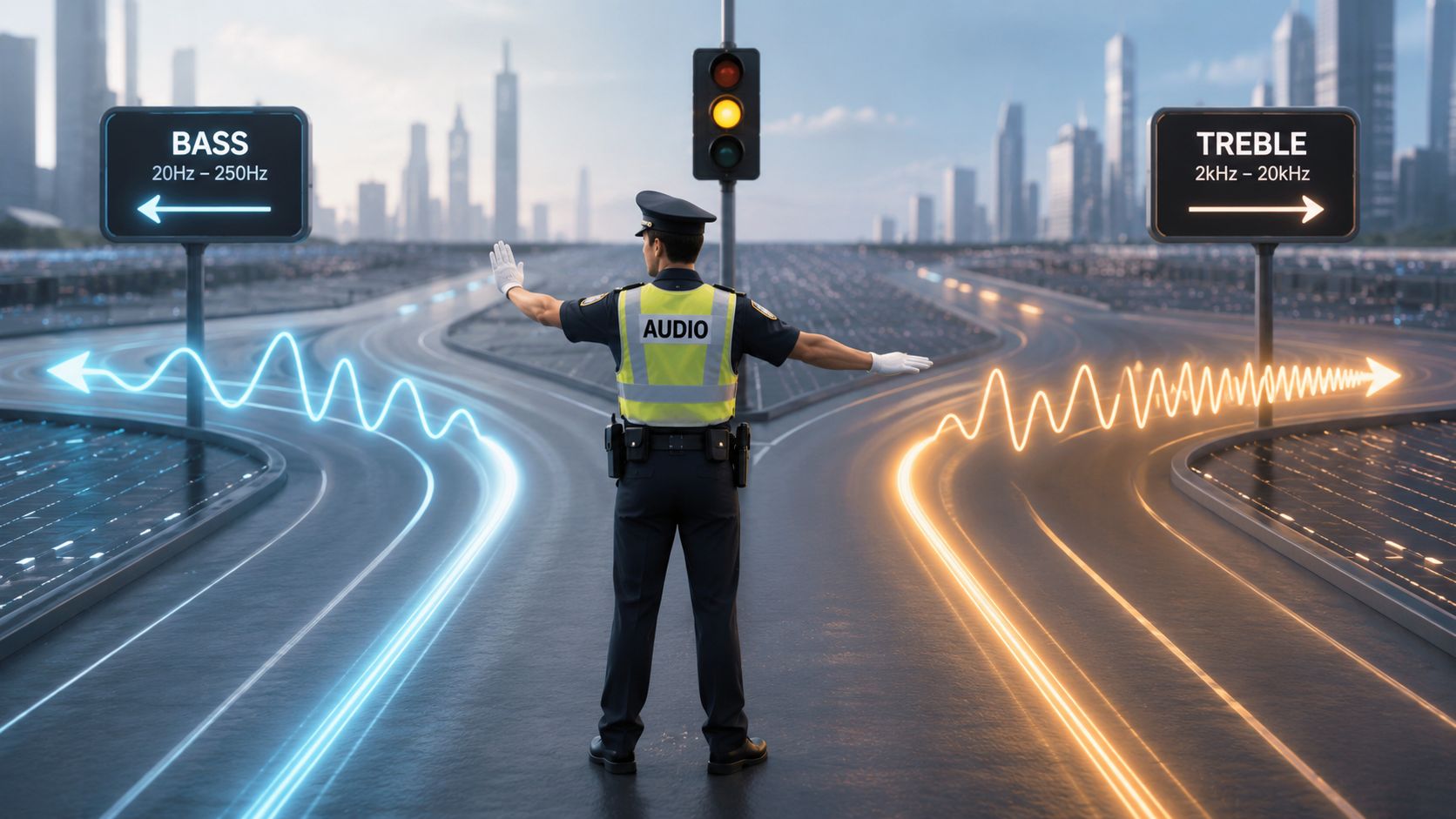
Below the chosen point, bass gets routed to the subwoofer through a low-pass filter. Above that point, the main speakers handle the rest through a high-pass filter. Those filters meet at the crossover point. That's the handoff. Not a hard stop. A controlled exchange.
The Famous Number Has a Real Reason
The 80 Hz standard didn't appear because audio people enjoy round numbers. The 80 Hz standard was established because it lies two standard deviations below the human threshold for localizing bass, which is why it became the unofficial and THX benchmark for effective integration, as outlined in Wikipedia's subwoofer overview.
That matters because if the sub plays too high, your ears start locating it. Once that happens, the illusion collapses. Instead of a cohesive front stage, you get a detached low-end box humming from the sidewall like a refrigerator with opinions.
For readers sorting out the basic difference between speaker designs, my beginner's guide to speaker types helps frame why some speakers need more help down low than others.
Two Filters, One Shared Job
The crossover point is where the subwoofer's low-pass filter and the main speakers' high-pass filter intersect. Done properly, they sum smoothly. Done badly, they either pile on top of each other or leave a hole in the floor.
It's like carrying a couch up stairs with two people. If both grab the same end, it gets clumsy fast. If neither grabs at the right moment, it drops. A crossover works the same way. The sub and mains need a clean exchange of load.
A short visual helps here.
The important part is this. What is a subwoofer crossover? It's the control point that decides who handles the bottom end, and how gracefully the system moves that weight around the room.
That's the main job.
Frequency Slope and Phase Are Your Only Tools
People obsess over the crossover frequency because it's the number they can see. Fair enough. But frequency alone won't save a bad integration.
You've really got three tools. Frequency, slope, and phase. If one is wrong, the other two spend their time cleaning up after it.
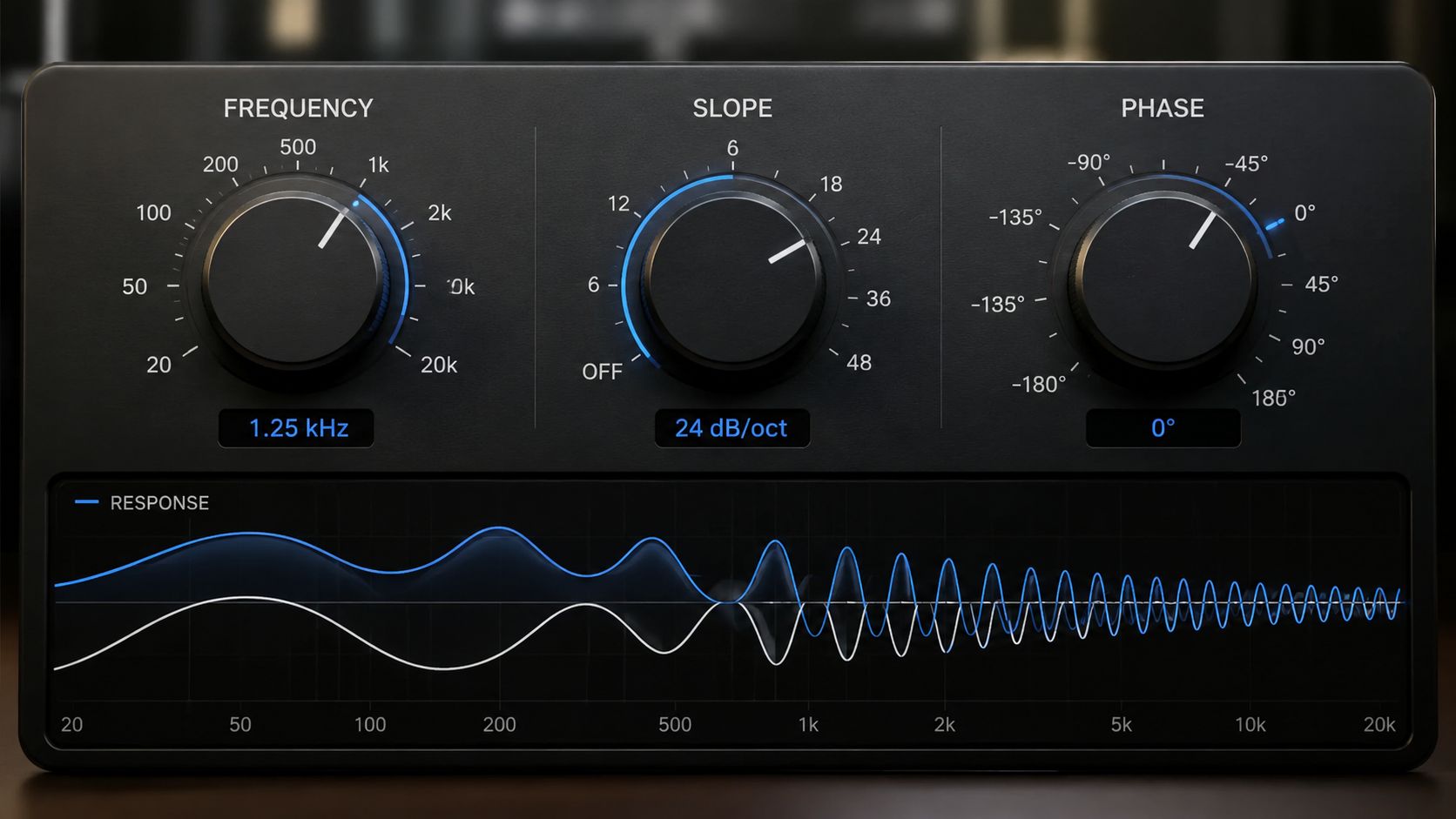
Frequency Decides Where the Handoff Starts
Frequency is the dividing line. It tells the system where the mains begin to taper off and where the subwoofer takes over.
Set it too low and you starve the signal. Your mains run out of breath before the sub fully steps in. Set it too high and the sub starts speaking in a register it shouldn't touch. You get bass that feels inflated and obvious, the sonic equivalent of over-salting dinner.
Slope Decides How Sharp the Split Feels
Slope controls how aggressively the filter rolls frequencies off past the crossover point. A gentler slope allows more overlap. A steeper slope cuts harder and keeps each driver in its lane.
A 24 dB/octave slope is widely considered the benchmark for professional separation, sharply limiting higher frequencies from reaching the sub and helping prevent midrange bleed, as noted in this crossover settings explainer.
That's why a sloppy slope can make a subwoofer sound vocal, papery, or weirdly present. The sub isn't supposed to dabble in upper bass and low mids like it's auditioning for full-range duty. It's supposed to carry the floor.
The subwoofer should add weight, not commentary.
Phase Decides Whether the Bass Adds or Cancels
Phase is the timing piece. It's the most ignored control and often the one causing the actual problem.
If the sub and mains reach your seat out of sync, certain bass frequencies can partially cancel. That's when a system measures or sounds like it has a hole right around the handoff. One note disappears. Another blooms. The line sounds uneven, like the bassist is taking accidental steps in and out of the room.
Here's the practical breakdown:
- Frequency picks the neighborhood.
- Slope decides how wide the handoff zone feels.
- Phase makes sure both arrivals push in the same direction at the same time.
If your sub sounds wrong, don't keep twisting the volume knob like it owes you money. Check the handoff tools first.
That's the whole game.
Finding Your Starting Point Beyond the Default
You need a starting point that matches the speaker, not a number worshipped out of habit.
Some speakers can hold the lower end without strain. Others fold early and need help sooner. That's why asking for one universal answer is like asking for one shoe size that works for every runner. It's lazy, and your ears pay for it.
Data shows that compact satellite speakers often need crossovers in the 150 to 200 Hz range, large bookshelf speakers can drop to 60 to 80 Hz, and tower speakers with 8-inch to 10-inch woofers may go as low as 40 Hz, according to this crossover frequency guide. Speaker-dependent. Exactly as it should be.
Start Here, Then Listen
Here's the cleanest way I know to choose a starting point.
| Speaker Type | Typical Low-End Extension | Recommended Crossover Start Point |
|---|---|---|
| Compact satellite or on-wall speaker | Limited low bass output | 150 to 200 Hz |
| Large bookshelf speaker | Moderate low-end reach | 60 to 80 Hz |
| Tower speaker with 8-inch to 10-inch woofers | Strong bass capability | 40 Hz |
That table is not a finish line. It's a map.
If your main speakers audibly strain when bass gets dense, raise the crossover. If they sound comfortable and full on their own, start lower. You're trying to make the sub pick up the load right where the mains begin to taper off, not fifty feet after the collapse.
Where to Set It So the System Doesn't Fight Itself
Most modern home theater systems handle crossover in the AV receiver's bass management menu. That's where the good control lives. The receiver applies active electronics or DSP to route the signal with more precision than the simple crossover dial on many subwoofers.
If you're using an AV receiver, set the subwoofer's own crossover control to its highest setting or the LFE position if it has one. Let the receiver run the handoff. Two bosses doing the same job usually ends with one bad result.
Use this quick sanity check:
- Tiny speakers on walls or shelves: start high, because they can't fake low bass for long.
- Big bookshelves: start in the middle and listen for a smooth floor.
- Real towers: don't assume lower is always better, but give them room to do what you paid for.
The right starting point saves hours.
The perfect one still takes ears.
Why Your Sub Still Sounds Disconnected or Boomy
A bad crossover doesn't always sound obviously bad. Sometimes it sounds impressive for five minutes. Then you realize every kick drum is the same shape, every explosion hangs around too long, and bass guitar has turned into a fog machine.
That's usually one of two problems. A gap or an overlap.

A Gap Makes the System Feel Thin
A gap happens when the crossover is set too low for the main speakers. They've already started giving up, but the sub hasn't stepped in firmly enough. The lower midbass loses meat. Drums lose chest. Movie soundtracks lose foundation.
People often call this “tight” bass because there isn't much of it. That's not tight. That's missing.
Overlap Makes the Room Shout One Note
Overlap is the opposite. The mains and sub both reproduce too much of the same range, so the room piles energy into the handoff zone. The result is a hump. You hear it as boom, thickness, or bass that lingers like a bad houseguest.
That complaint is common. Analysis of audiophile discussions on Reddit reveals frequent reports of a “bass bump at the crossover,” while many tutorials leave out phase and volume sweep techniques that help smooth that overlap, as discussed in this Reddit crossover thread.
If placement is making the problem worse, my guide to speaker placement for amazing bass will save you from trying to EQ a room problem with a crossover knob.
If one bass note jumps out like it's trying to get top billing, you don't have “power.” You have overlap.
Phase Is Often the Actual Fix
A lot of people hear boom or thinness and keep changing only the crossover frequency. Sometimes that works. Often it doesn't, because the primary culprit is phase.
Try this from your main seat:
- Pick a familiar track: use something with a steady bass line that climbs and descends.
- Flip the phase control: switch between 0 and 180 if that's what your sub offers.
- Listen for the stronger handoff: one setting will sound fuller and more even at the seat.
- Recheck volume after that: phase changes can alter perceived level.
The right phase setting doesn't always sound louder everywhere. It sounds more continuous where you sit. The bass stops tearing at the seam.
That seam is what you're fixing.
The Listening Test That Beats Any Measurement Tool
I like measurement tools. I also like not pretending they can hear for me.
The best listening test for a subwoofer crossover is brutally simple, and it tells you the difference between a system that's merely correct and one that's locked in. You're not chasing the biggest bass. You're chasing the point where the sub adds foundation without declaring itself.
Use Music That Exposes the Handoff
Skip the obvious demo tracks with endless low-end effects. They flatter bad tuning.
Use something with a clear, melodic bass line. Acoustic bass works well. So does a dry electric bass line that moves note to note without a pile of effects on top. You want pitch information, not just impact, because pitch exposes crossover mistakes fast. If one note swells and the next falls through the floor, the handoff is wrong.
Start with a track you know so well that one wrong bass note annoys you immediately.
Set your main speakers to Small in the receiver. Pick the starting crossover that matches your speakers. Turn the subwoofer level down low enough that it nearly disappears.
Bring the Sub In Until It Stops Sounding Like a Separate Box
Play the track. Listen first to the mains on their own character. Then bring the sub level up slowly until the bottom fills in.
Not until the room shakes. Not until your couch starts acting like a massage chair. Just until the system sounds complete.
Now replay the same passage and ask better questions than “is there more bass?”
- Does the bass line stay even as notes rise and fall?
- Does one note puff up while another goes hollow?
- Does the image stay pinned to the front, or does the corner of the room start glowing audibly?
- Does kick drum feel attached to the speakers, or detached from them?
If the bass gets lumpy, lower the crossover a bit and listen again. If the lower range feels disconnected from the mains, raise it a bit and repeat. Small moves matter because the handoff zone is where systems usually embarrass themselves.
Perfect Is the Point Where You Stop Noticing the Sub
This is why I don't worship the default 80 Hz advice. It gets you to the neighborhood. Your ears find the house.
A correct setting gives you bass extension. A perfect setting changes the scale of the entire system. Your speakers sound taller. The room sounds calmer. Bass lines stop blurring into room tone and start sounding like fingers, skins, cabinets, air.
That's not mystical. It's just careful listening.
Do the boring repetitions. They work.
The Goal Is for the Subwoofer to Disappear
People buy a subwoofer and then tune it like it's the star of the show. That's backwards.
The ideal subwoofer crossover doesn't make the sub more obvious. It makes the whole system more believable. Your bookshelf speakers stop sounding like they're balancing on stilts. The soundstage gains floor and depth. Film effects carry physical weight without turning into party tricks. Bass becomes texture, pressure, and architecture.
Invisible Bass Is the Good Stuff
If the subwoofer is calling attention to itself, you're still hearing the mechanism. The perfect setup hides the mechanism.
That's the audible difference between correct and perfect. Correct means the sub is on and contributing. Perfect means you stop thinking about it entirely. You just hear a bigger, more grounded system. The box disappears. The room fills in. Music gains mass without losing shape.
The best subwoofer setup is the one that makes you forget there's a subwoofer in the room.
So what is a subwoofer crossover? It's the control that decides whether your low end feels stitched together or taped on. Don't chase the preset. Don't trust the default because it came from a menu with clean graphics. Trust the handoff your ears can hear.
That's the one that lasts.
Author: Marque Hersh
Publisher: Supermarket Sound
Author profile: Marque Hersh on Steam
If you want more blunt, ears-first hi-fi advice, visit Supermarket Sound.

