Most “best amp for turntable” advice is backwards. Your amp usually isn't the problem. Your signal is.
People keep shopping for bigger boxes, more watts, shinier knobs. Meanwhile the actual failure happens at the very front of the chain, where a turntable sends out a tiny phono signal and the rest of the system expects line level. Get that wrong and even lovely gear sounds weak, thin, or noisy. Get it right and modest gear suddenly stops embarrassing itself.
I'm tired of watching people blame the power amp for a gain problem. This isn't about brute force. It's about translation. The best amp for turntable use is not the one with the most chest hair. It's the one that handles phono properly, or gets out of the way and lets a proper phono stage do it.
That's the whole game.
Your Amp Is Probably Fine Your Signal Is Just Wrong
A quiet, brittle, static-ridden turntable setup does not automatically mean you bought a bad amplifier. More often, it means you fed a line-level input a phono-level whisper and expected a miracle.
That whisper is the load-bearing fact. A turntable cartridge spits out a tiny signal. If the system doesn't boost and shape it correctly before the main amplification stage, the floor collapses. Downstream inherits the weakness. You don't get “a little less volume.” You get a starved signal that never becomes proper music.
Practical rule: If your records sound much quieter than every other source, the first suspect is gain, not speaker power.
People love to treat “best amp for turntable” like a shopping keyword. Fine. I know how the internet works. But the honest answer starts with the same boring, essential truth every time. You need the right gain stage before anything else matters.
That's why I'd advise most readers to pause amplifier browsing for five minutes and first learn what a phono stage does. For a deeper understanding, start with this guide to the best phono preamp for turntable setups. This is often where the main solution resides.
Here's the blunt version:
- If your amp has a PHONO input: use it.
- If your turntable has a PHONO/LINE switch: make sure it matches the input you're using.
- If neither exists: you need an external phono preamp.
Not more wattage. Not a panic purchase. Not forum mythology.
Correct gain.
The Signal Chain The Whisper and The Shout
A turntable doesn't speak the same language as your streamer, CD player, or phone. That's the mistake that keeps killing beginner setups.
Phono Is Tiny and Fragile
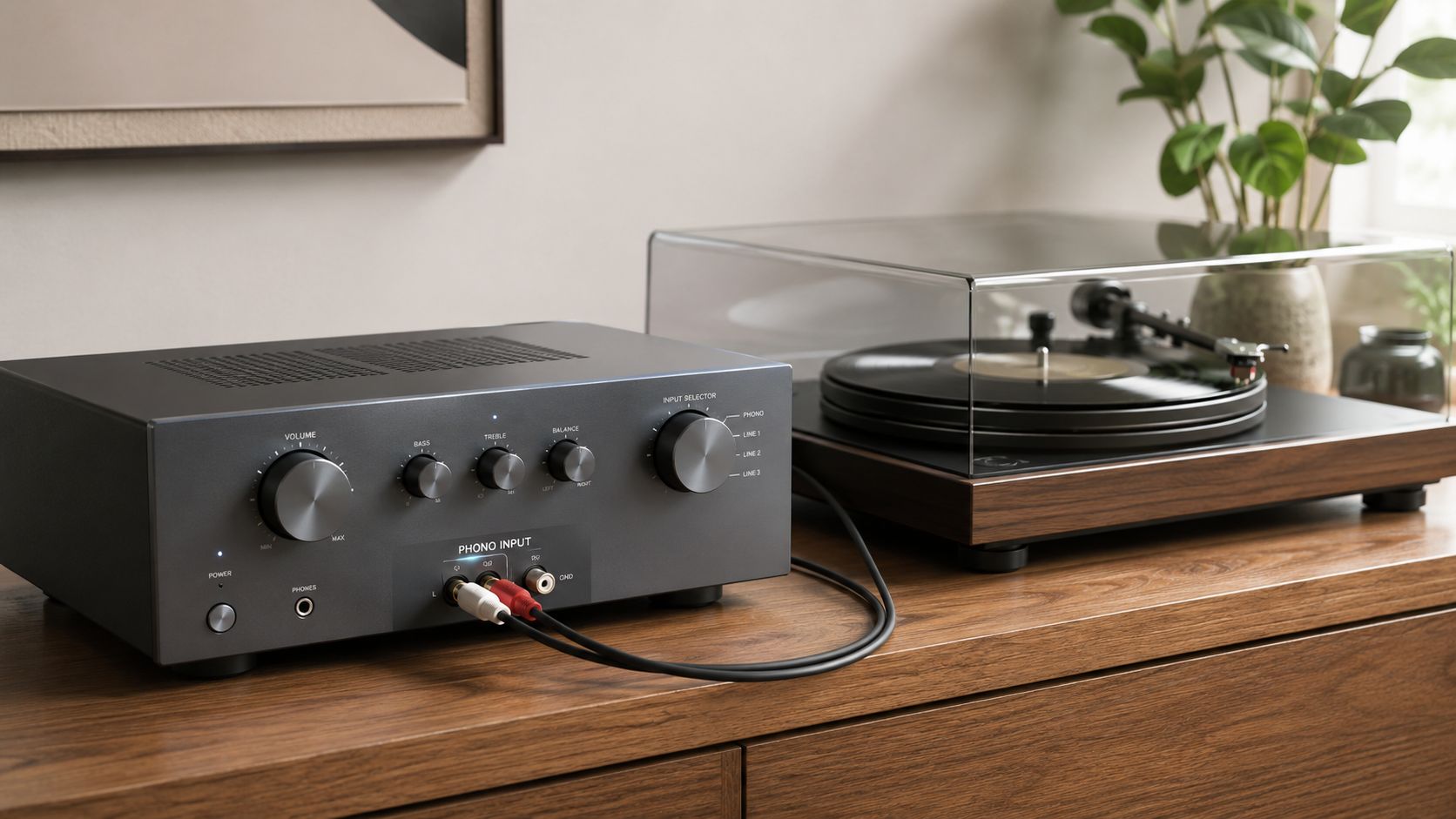
A PHONO level signal is typically around 2.5 to 5 millivolts RMS at 1 kHz, and it needs a dedicated phono preamp with 40 dB of gain to reach LINE level at approximately 0.775 volts before the rest of the system can work properly, as explained by Supermarket Sound's phono signal reference. Systems missing that gain stage produce low volume and static. That's not taste. That's a wiring error dressed up as disappointment.
This is why I use the whisper and shout analogy with people. A cartridge whispers. Every normal line input expects a shout. Plugging one into the other without help is like asking a bartender to hear your drink order from across a nightclub.
And the phono stage does two jobs, not one.
Gain Is Only Half the Story
The first job is gain. It takes that whisper and boosts it enough for the amplifier to work with it.
The second job is RIAA equalization. The foundational standard goes back to 1949, when the RIAA curve was standardized so records could be cut and played back correctly. That equalization is part of vinyl itself. It isn't optional decoration. It's the floor. Without it, the tonal balance is wrong before your speakers even get involved.
If you're still sorting out the basics of a vinyl system, this beginner's guide to turntables lays out the signal path cleanly.
The best amp for turntable playback is not the one with the fanciest faceplate, but the one that bridges the gap between phono and line without poisoning the signal.
A lot of setup mistakes become obvious once you know what to look for:
- Look for a PHONO input on the amp or receiver.
- Check the turntable for a PHONO/LINE switch if it has a built-in preamp.
- Use the right path. Turntable to phono stage first, then into a standard line input if the amp lacks phono.
The visual version helps. Then your ears do the rest.
Once you hear a turntable with the gain structure sorted, the whole presentation changes. Bass stops sounding apologetic. Voices get body. Cymbals stop turning into hash. The system stops sounding like it's asking permission to exist.
That's the key.
Path One The All-in-One Integrated Amp
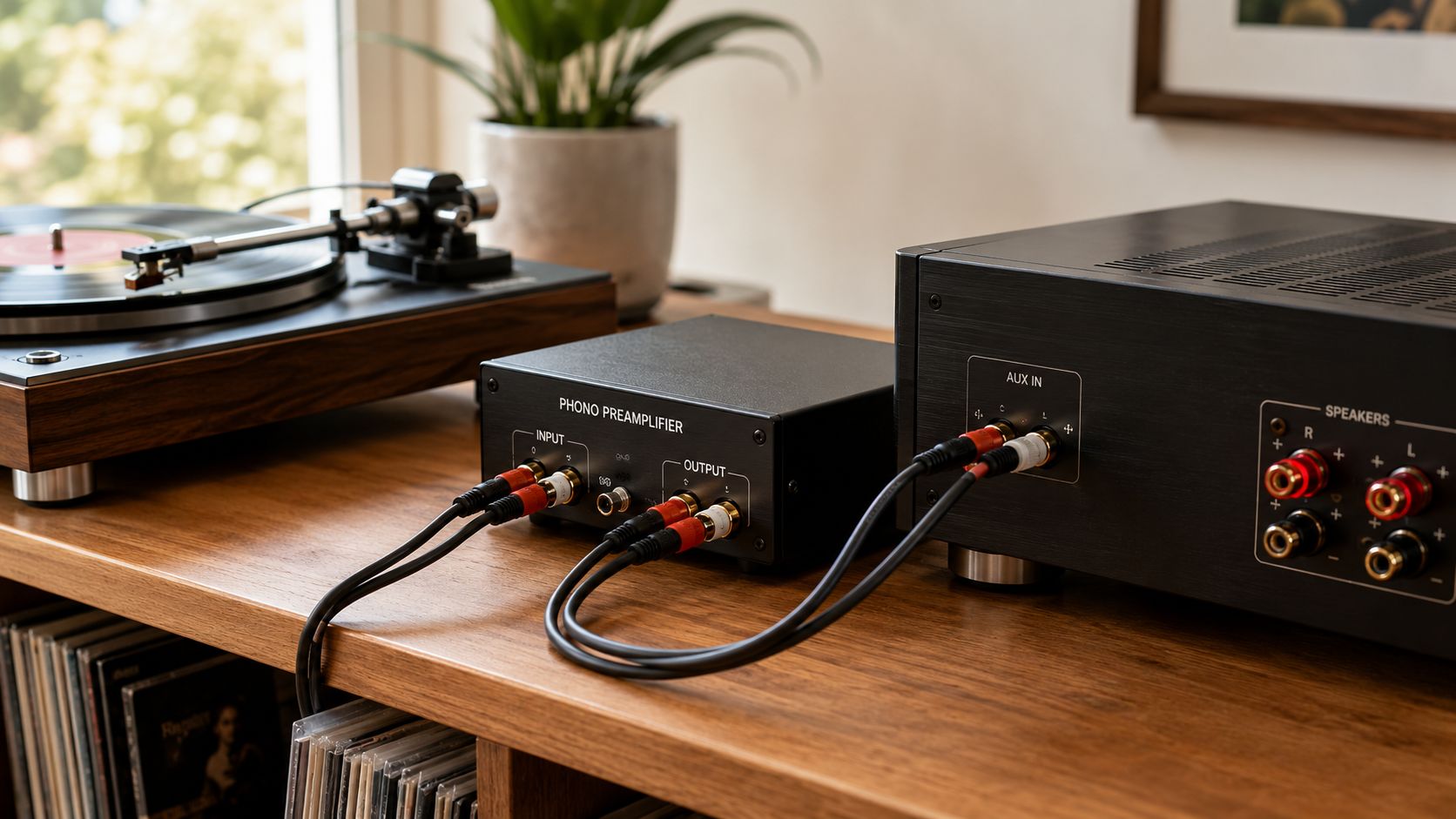
The easiest answer remains the cleanest: Buy an integrated amp with a proper PHONO input and stop making your life harder than it needs to be.
That path works because it removes the most common user error. You plug the turntable into the dedicated input, connect the ground wire, attach your speakers, and you're in business. Fewer boxes. Fewer wrong turns. Less internet folklore.
Why Integrated Usually Wins for Normal Humans
The dirty secret is that a lot of “best amp for turntable” searches are really cries for help from people who wired a turntable into AUX and got whisper-level sound. That's not me being snide. It's common enough to matter. According to this explanation of why a turntable may need an amplifier or preamp, 80% of new turntable buyers misidentify their output level, plugging MM cartridges into line inputs and getting 90% volume loss. The same source notes that the fix is often a $30-40 external preamp rather than a whole new amplifier.
That's why integrated amps with phono built in make so much sense. They remove ambiguity. You don't have to decode the chain every time you move a cable.
The good version of this setup sounds relaxed and coherent. Not flashy. Not hyped. Just properly proportioned. You get a stable center image, decent weight through the midbass, and none of that papery, underfed sound that comes from starving the front end.
The Catch Nobody Mentions
Built-in phono stages are convenient, but you're married to whatever the manufacturer put in there. Sometimes that's fine. Sometimes it's clearly there to tick a marketing box.
So the tradeoff looks like this:
- Choose integrated if you want simplicity, a tidier shelf, and fewer setup mistakes.
- Choose integrated if you're running a straightforward moving magnet cartridge and just want records to sound right.
- Skip integrated-only thinking if you know you're the type who upgrades one piece at a time and won't leave well enough alone.
Buy the all-in-one path if you want less friction. Skip it if you already know the phono stage is where your tinkering instincts live.
There's no shame in wanting plug-and-play. In fact, for many rooms and many listeners, it's the smartest route. But understand what you're buying. Not just an amp. A fixed phono stage too.
That matters.
Path Two The World of Separate Preamps
This is the route I prefer once someone moves past the basics. Not because separates are automatically more “audiophile,” which is the sort of word that makes me reach for a mute button. Because they're more honest.
An external phono preamp does one job. It takes the cartridge signal, applies the needed gain and equalization, and hands a proper line-level signal to the amplifier. That means your amp can be chosen for how it sounds driving speakers, not for whether its built-in phono section happens to be decent.
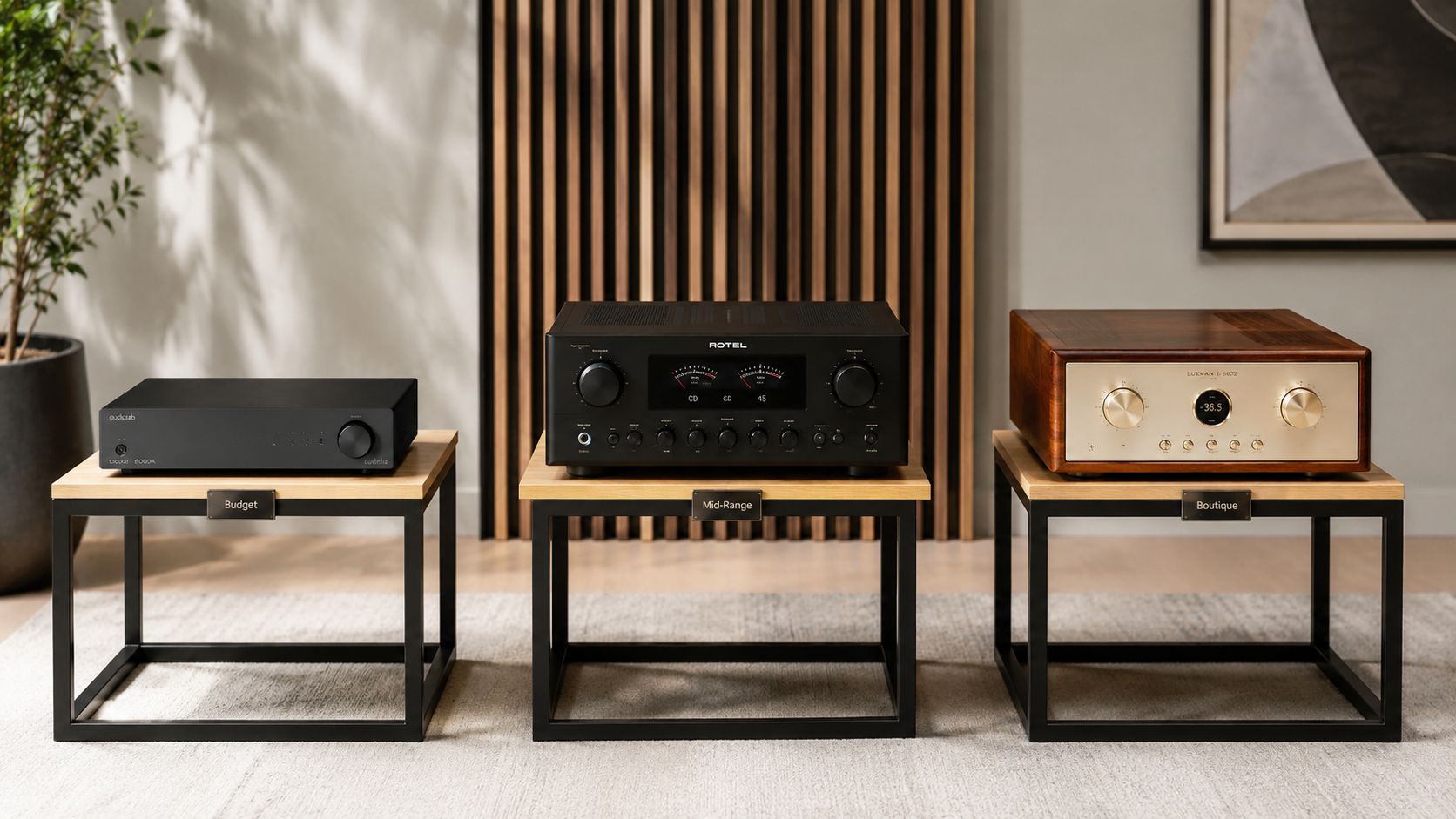
Why Separate Boxes Often Sound Better
A dedicated phono stage can bring real gains in texture and composure. To my ears, the change usually shows up first in low-level detail. Reverb tails hang around longer. Acoustic bass stops being a vague thump and starts sounding like wood and string. Surface noise feels less smeared into the music.
It also gives you freedom. If you love your current amplifier, keep it. If you want to try a vintage integrated with a sweet power section but no phono input, fine. If your speakers need one kind of amp and your cartridge needs another kind of front end, separates let each part do its actual job.
The MC Trap Most Guides Gloss Over
Here's where the usual shopping lists really fail people. They talk about amps as if every cartridge is the same. They aren't.
According to this breakdown of whether a turntable needs an amp, only 12% of “best amp” guides address moving-coil cartridge needs, even though MC cartridges require 100x more gain. Plug an MC cart into a standard MM-only phono input and you get an almost inaudible signal. The system hasn't become subtle. You've starved it.
That's the intermediate-user mistake I see most. Someone upgrades the cartridge, keeps the same amp, and then wonders why everything sounds anemic and distant.
Use this simple decision frame:
- MM cartridge: a built-in phono stage may be enough.
- MC cartridge: verify support immediately, or plan on a dedicated MC-capable phono stage.
- Unsure what cartridge you have: find out before buying anything else.
If your cartridge and phono stage don't match, the rest of your system is just amplifying the wrong answer.
Separate preamps are not mandatory. They are, however, the cleanest path once you start caring about cartridge matching, future upgrades, and not painting yourself into a corner.
That's why I like them.
Amps That Get It Right From Budget to Boutique
Enough theory. Here are the kinds of amps I'd point people toward if they want the best amp for turntable listening and don't want to spend the next month untangling bad advice.
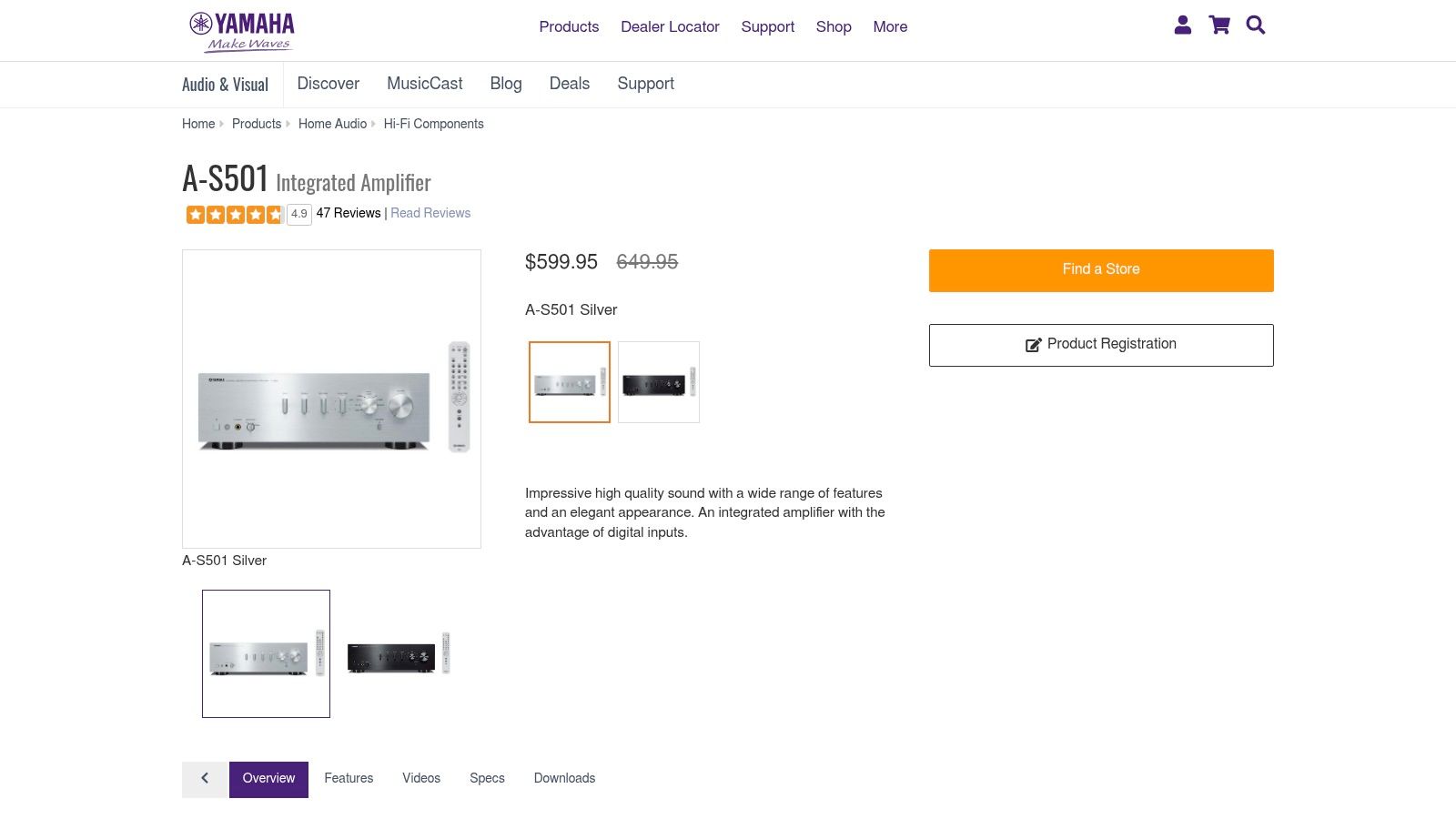
The Sensible Answer Is Usually the Right One
The Yamaha A-S301 and A-S501 are easy recommendations because they understand the assignment. Integrated amps with phono stages like these are defined by MM input sensitivity of 2.5 to 3.0 mV and 47kΩ impedance, according to What Hi-Fi's stereo amplifier roundup. That matters because it lines up with the kind of moving magnet cartridge many people own.
To my ears, the A-S series sounds clean, grounded, and unsentimental in the best way. There's decent grip in the bass, the midrange doesn't editorialize too much, and the top end stays composed rather than glassy. It doesn't romanticize bad recordings. It just lets the record through.
The A-S801 is the more flexible move in that family because it offers a dedicated MM/MC switch, which means it can adapt to both cartridge types without forcing an external preamp into the chain. That's not sexy. It is useful. Very useful.
If you're curious about more old-school and tube-leaning amp flavors, I've written about that broader world in this guide to PrimaLuna, NAD, and McIntosh amps.
If You Want More Character
Cambridge Audio has long made the kind of integrated amps people keep for years because they make records feel alive without turning everything into caramel. The AXA35 has been identified as a winner in a UK comparison for offering a built-in phono input, a headphone output, and strong overall sound. That tracks with the basic appeal of the brand to my ears. There's usually a bit more rhythmic push, a little more bounce through the mids, and a more conversational presentation.
The newer A8 sits in a more serious lane. Benchmark data from that same What Hi-Fi roundup notes 80W into 8Ω, less than 0.05% THD, and 20Hz to 20kHz bandwidth of ±0.1dB for the Cambridge Audio A8. Numbers alone don't tell you what music feels like, but they do explain why the amp sounds composed when arrangements get dense. It keeps transients tidy and doesn't flatten the life out of attacks.
Don't buy on wattage alone. Buy on whether the phono stage matches your cartridge and whether the amp keeps texture intact once the signal is healthy.
Budget Doesn't Mean Bad
If you're going the separates route and want to keep spending sane, mini amps can make a lot of sense. The Fosi Audio BT20A Pro is a good example of why I don't dismiss small class-D boxes out of habit. Testing covered by Wirecutter's mini stereo amplifier review found it produced 44 RMS watts into 8 ohms and 77.3 watts into 4 ohms.
No, that doesn't make it the last amp you'll ever own. It does make it a practical partner for an external phono stage in a budget vinyl rig. Spend less on the power box, spend carefully on the phono stage, and you often end up with a more balanced system than people who blow the budget on one shiny integrated and ignore the front end.
That's the part SEO roundups hate, because “buy this little preamp first” is less glamorous than “top 10 amps.” It's also more useful.
How to Kill the Hum Before It Starts
Hum is not a personality trait of vinyl. It's usually a setup mistake.
The first thing I check is the ground wire. Not the RCA pair. The thin separate wire that usually trails alongside it. That wire needs to go from the turntable chassis to the amp or phono preamp ground terminal. Tight connection. No laziness.
The Ground Wire Is Not Optional
A securely grounded wire between the turntable chassis and the amp ground terminal is essential for preventing hum because it cancels 50 to 60Hz room noise that would otherwise become audible, as explained in McIntosh's guide to finding the best tube amp for your turntable.
That little connection is the floor for quiet playback. Ignore it and the downstream system inherits noise before the music even gets moving.
Use this checklist:
- Find the GND post on the amp or phono stage.
- Attach the turntable ground wire securely to that post.
- Keep power supplies away from the turntable and phono cables if hum remains.
- Recheck input choice so you're not troubleshooting the wrong problem.
Connect the ground wire first. Then diagnose everything else.
When the grounding is right, the background gets darker and the music stops wearing a fluorescent vest. You hear the space around instruments instead of electrical grumble sitting underneath them.
That's not a tweak. That's basic competence.
Frequently Asked Questions
Most turntable problems look mysterious right up until you know the one missing piece. Then they become boring. Good. Audio should be boring at the setup stage and interesting at the listening stage.
Fast Answers for the Same Three Problems
| Question | Answer |
|---|---|
| Why is my turntable so quiet compared with Bluetooth or streaming? | Because the turntable is probably sending a phono-level signal into a line-level input. Use a PHONO input, enable the turntable's built-in preamp if it has one, or add an external phono stage. |
| Do I need a receiver, integrated amp, or just a preamp? | You need whatever gets the signal chain right. If you already have amplification, a phono preamp may be the missing piece. If you need a full system hub, an integrated amp with a phono input is the simplest answer. |
| Can I plug any cartridge into any phono input? | No. Moving magnet and moving coil cartridges have different gain needs. If the cartridge type and phono stage don't match, the signal will be compromised before it reaches the main amp. |
One More Thing People Keep Missing
If your setup sounds thin, low, and vaguely broken, don't start by blaming the speakers. If it hums, don't start by buying cables. If the system wakes up on digital inputs but collapses on vinyl, the front end is where the crime happened.
That's why the best amp for turntable use is usually the one that solves the least glamorous problem first. Correct input. Correct gain. Correct grounding. Then you can fuss about flavor.
And yes, flavor matters. Tube amps can sound voluptuous and harmonically generous. Some integrated solid-state amps sound leaner and faster. Some external phono stages make records feel denser, blacker, more tactile. But all of that comes after the signal chain makes sense.
Get the floor right.
Then listen.
Author: Marque Hersh
Publisher: Supermarket Sound
Author profile: Marque Hersh on Steam
Prepared with Outrank

